

Best Restaurant Uniforms for NZ Hospitality Teams
A restaurant uniform earns its place several hours into service, not when the team first arrives. By late trade, a chef may be working around heat and spills, a server may have crossed the dining room repeatedly, and an apron may be carrying more strain than its neat appearance suggested at opening. The best restaurant uniforms for New Zealand hospitality teams balance comfort, movement, hygiene, durability and consistent presentation across the whole shift.
That matters in a large and tightly regulated sector. New Zealand's hospitality industry includes more than 25,000 businesses, generates $21.4 billion in annual revenue, and employs more than 193,000 people, according to NZQA's hospitality review material. Uniforms therefore need to work as operational clothing, not just branding. They must remain practical through heat, wet work, repeated washing, food handling and long periods on hard floors.
What a Restaurant Uniform Has to Survive After Hour One
At the start of a busy Friday service, almost any uniform looks organised. The real test comes later. Under pass lights, a chef jacket may feel restrictive or trap heat. After repeated trips between tables, service stations and the bar, a front-of-house shirt can crease and cling. An apron strap that felt fine during fitting may press into one shoulder after hours carrying plates, trays or tools.
A polished appearance at opening does not prove that a uniform works. The strongest choice is the garment that remains presentable and comfortable after the shift has become physically demanding.
The three pressures that shape a practical choice
New Zealand hospitality clothing must handle several demands together:
- Heat and moisture: Kitchens involve hot equipment, steam, boiling liquids and sustained activity. Breathable fabric can reduce discomfort, but an overly light garment may provide less coverage or lose its shape sooner.
- Repeated laundering: Food-handling garments need frequent cleaning. Fabric affects shrinkage, colour retention, wrinkle control and how long branding remains clear.
- Movement and flooring: Staff bend, reach, turn and walk for long periods. A restrictive cut, loose fabric or unsuitable footwear can interfere with work and create a safety concern.
WorkSafe's hospitality material records frequent handwashing and wet-work exposure among hospitality workers, including an average of 26 handwashes per day, wet-work exposure reported by 51% of surveyed workers, and an average exposure duration of 2.3 hours per day. The same NZQA summary containing this WorkSafe context records that 82% said protective clothing was provided, while 75% reported using it. Provision alone does not settle the issue. Staff need garments they can wear, adjust and maintain comfortably during real service conditions.
Practical rule: If a garment only works when the wearer is standing still, it isn't a successful hospitality uniform.
Footwear needs the same attention as clothing. Closed, slip-resistant shoes support safer movement where floors may be affected by water, oil or detergent. Swift Running's standing shoe guide offers useful general context on prolonged standing, although restaurant footwear must still suit kitchen conditions and workplace requirements.
Purchase decisions should reflect the whole shift and the whole ownership period. A low garment price can become poor value if the item loses shape, becomes uncomfortable or needs frequent replacement. The principle behind buying cheap versus buying once applies to uniforms as well. Compare laundering, wear life and replacement needs, not price tags alone.
Matching the Garment to the Role
A generic uniform pack rarely serves every station well. Kitchen staff, bartenders, servers and hosts move differently, face different levels of heat and need different amounts of coverage. A venue can keep one visual identity while selecting garments according to the work each person performs.
Specify each station deliberately
Chef jackets should allow reaching and bending without pulling across the shoulders. A double-breasted design can provide a practical layer of coverage and may allow the front to be reversed when one side becomes marked. The common failure is choosing a heavy or narrow jacket that looks formal but becomes restrictive around the pass.
Chef trousers need a comfortable rise, movement through the seat and a waistband that stays secure without digging in. Dark colours can be more forgiving in busy kitchen areas, but excessive external pockets may catch on corners, handles or equipment.
Aprons should match the task. Bib aprons offer greater front coverage for kitchen and beverage work. Waist aprons are often easier for front-of-house staff to put on and remove quickly. Cross-back straps can distribute weight more comfortably than a neck strap, while waist ties suit teams that need fast adjustment. Pockets should be useful without becoming overloaded.
Shirts and tops should suit the dining-room temperature and the degree of movement. A shirt that fits neatly across the chest but restricts shoulder movement will create problems during service. A cut with room for natural movement is more valuable than a sharply tapered silhouette.
Headwear depends on the task and food-safety process. Caps, skull caps, hair nets and beard coverings may all have a place where hair control is required. The garment should stay secure without creating heat or pressure points.
Footwear should be closed-toe and slip-resistant, with a design suitable for kitchen or hospitality flooring. Simply Hospitality's guidance on non-slip shoes provides relevant background when setting a workplace footwear rule.
| Role | Core Garment | Key Specification | Common Failure On Shift |
|---|---|---|---|
| Chef | Chef jacket and kitchen trousers | Shoulder movement, coverage and comfortable fit | Heat retention or restricted reaching |
| Cook | Breathable jacket or work top and dark trousers | Easy movement and practical laundering | Trousers catching on equipment |
| Bartender | Bib or waist apron and practical shirt | Useful pockets and secure straps | Strap pressure or overloaded pockets |
| Server | Shirt or blouse with waist apron | Neat fit with room to walk and reach | Creasing and restrictive sleeves |
| Host | Polished shirt or top | Presentation with comfortable movement | Appearance prioritised over wearability |
| Food handler | Clean protective clothing and suitable headwear | Hygiene control and easy changing | Garments worn outside the workplace |
| All roles | Closed, slip-resistant footwear | Grip suited to wet or contaminated surfaces | Smooth soles on kitchen flooring |
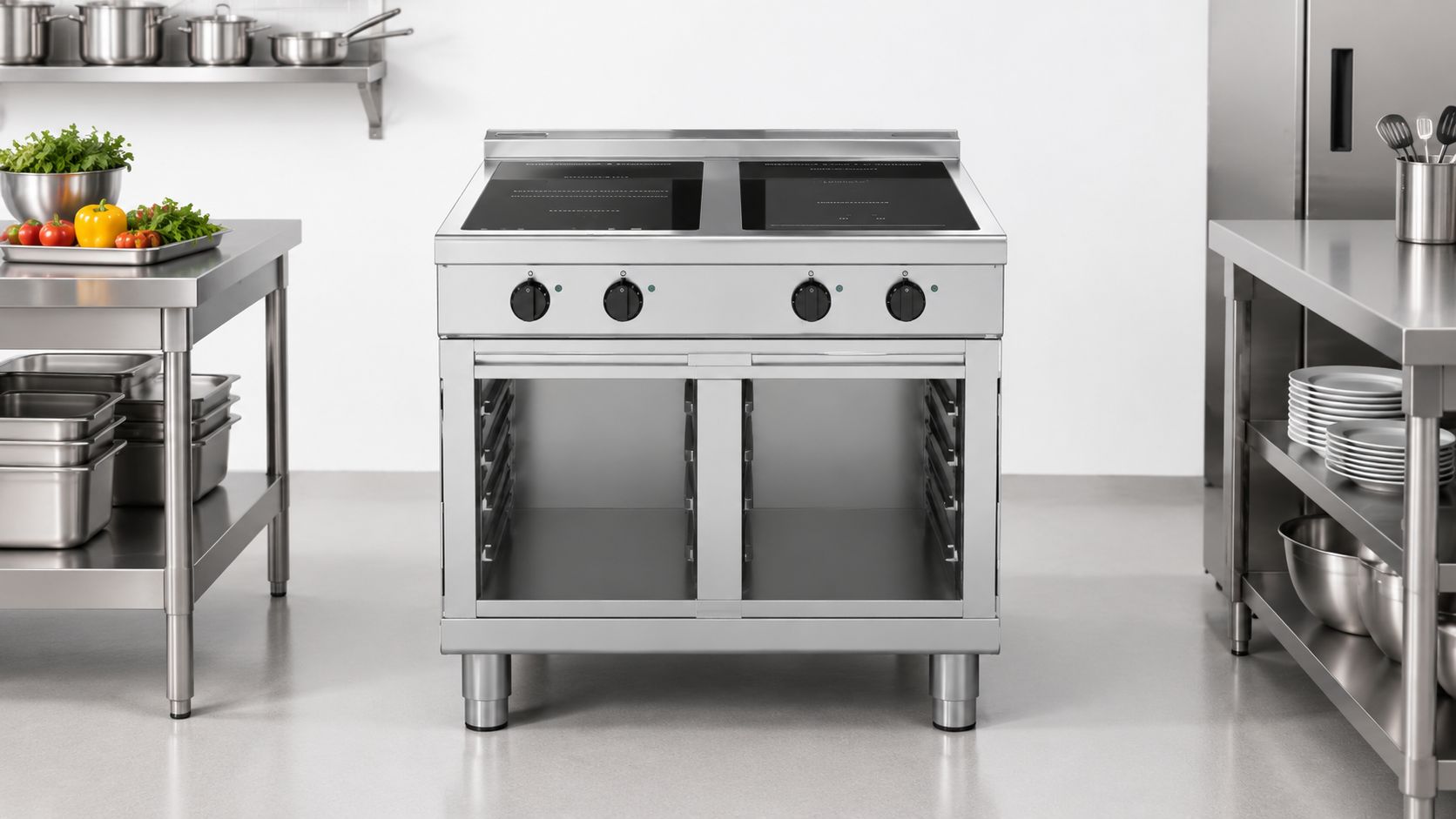
Some venues also work around specific cooking equipment. The Waldorf 800 Series INL8400R5F-CB, 900mm Electric Induction Cooktop Low Back Version with Cabinet Base is configured as a four-zone induction cooktop with a cabinet base, a 6mm ceramic glass cooking surface, automatic pan detection and reduced radiant heat. Equipment decisions can influence the working environment, but clothing still needs to be specified by task rather than selected as an afterthought.
For more detail on role-specific kitchen clothing, chef uniforms in New Zealand offers a useful companion reference.
Fabric, Weight and Breathability Across a Full Shift
Fabric selection should start with the work zone, not a catalogue photograph. 100% cotton is useful where heat comfort and absorbency matter. Poly-cotton blends generally offer better shrink resistance, wrinkle control and colour retention for high-turnover hospitality use. Neither option is automatically right for every garment.
A cotton chef jacket may feel comfortable in a hot kitchen, but it can absorb moisture and require careful laundering. A poly-cotton garment may hold its shape more reliably and dry more readily, but the wearer may prefer the hand feel and breathability of cotton. The right choice depends on station conditions, laundering arrangements and how much coverage the garment needs.
Weight is a working decision
Fabric weight affects how a garment behaves as the shift develops. A very light fabric can feel comfortable early in the day but may cling, crease or offer less structure later. A heavier twill can hold its shape and provide coverage, although it may feel warmer around hot equipment.
Weave matters too. Twill often provides a more substantial surface and can suit trousers, aprons and hard-working outer garments. Plain weaves can feel lighter and may suit shirts where airflow matters. Finishes that support moisture management can be useful in front-of-house areas, but any finish should be assessed against the laundering instructions and expected service life.
A uniform should be tested after washing, not judged only from the hanger.
New Zealand hospitality guidance supports a fabric-by-task approach, including cotton for heat comfort and absorbency, and poly-cotton blends for shrink resistance, wrinkle control and colour retention. The same guidance recommends testing stain release and shrinkage after repeated washing, then standardising laundering by fabric type rather than forcing every garment through one process. New Zealand chef uniform guidance also notes the importance of controlled professional laundering for food-handling garments.
Test the whole laundering loop
Operators should check:
- Shrinkage: Confirm the garment remains wearable after the intended wash process.
- Colour stability: Check whether dark garments fade or light garments retain a clean appearance.
- Seams and fastenings: Inspect stress points after laundering and drying.
- Branding: Make sure embroidery, transfers or prints remain suitable for the selected wash cycle.
- Drying time: Establish how many garments must be in rotation when pieces cannot return to service immediately.
Sustainability also belongs in this assessment. Auckland Transport's uniform repurposing case study discusses recycled polyester, CVC and BCI cotton in circular uniform sourcing, while Deane Apparel states that it is working towards all materials being traceable, recycled or organic by 2028, as described in Hospitality's discussion of sustainable chef uniforms. Operators should consider replacement waste, laundering demand and end-of-life options, not just the fibre label. Broader background on the benefits of bamboo fabric clothing can help with sustainability conversations, although hospitality garments still need to be assessed for commercial laundering and task suitability.
For additional detail on construction and use, chef jackets in New Zealand can support a more focused specification.
Front of House Versus Kitchen Without Breaking the Look
Kitchen and front-of-house teams don't need identical uniforms. They need a shared visual system that respects different work conditions. A dining-room shirt may be appropriate for a server but impractical for a cook working around heat, splashes and repeated bending.
Front-of-house clothing normally places greater emphasis on polished presentation, clean lines and brand expression. Kitchen clothing puts movement, coverage, heat management and hygiene first. Aprons, colour accents, buttons, trim and name badges can connect the two without forcing one garment standard across every role.
| Element | Front of House | Kitchen |
|---|---|---|
| Main top | Shirt, blouse, polo or polished service top | Chef jacket or practical kitchen work top |
| Lower garment | Comfortable dark trousers or approved service wear | Movement-friendly kitchen trousers |
| Apron | Waist apron or lighter bib apron | Bib apron with greater front coverage |
| Colour | May carry the venue palette more visibly | Often neutral, white, charcoal or a coordinated dark tone |
| Branding | Subtle chest, sleeve or apron placement | Controlled placement that tolerates frequent washing |
| Headwear | Optional where role and policy allow | Cap, skull cap, hair net or beard covering where appropriate |
| Footwear | Closed, slip-resistant service shoes | Closed, slip-resistant kitchen-rated footwear |
| Priority | Guest-facing presentation and movement | Heat, protection, movement and hygiene |
Three ways to connect the teams
A shared apron can create immediate cohesion even when shirts differ. This works particularly well when the apron colour is stable, the fabric suits both roles and the branding remains legible after washing.
A consistent button, trim or piping colour provides a quieter connection. It can carry the venue palette through chef jackets, shirts and outer layers without making the kitchen look like a copy of the dining room.
Matching name badges or restrained embroidery can also help guests identify staff. Logo placement should consider the garment surface. A mark that reads clearly on a dark apron may need different thread or placement on a white chef jacket.
Colour requires practical judgement. White can communicate cleanliness and make marks visible quickly, which supports prompt garment changes, but it can also demand disciplined laundering and replacement. Charcoal or darker tones may conceal some service marks, but they still need to be changed when soiled. Food-handling rules remain the baseline. The New Zealand food hygiene standard requires clean, suitable clothing and, where appropriate, a light-coloured apron, while also addressing protective clothing provision and laundering.
Consistency should never mean discomfort. A venue gains more from a team that looks coordinated and can work naturally than from a rigid programme that ignores station realities.
Fit, Sizing, Branding and Whole-of-Life Value
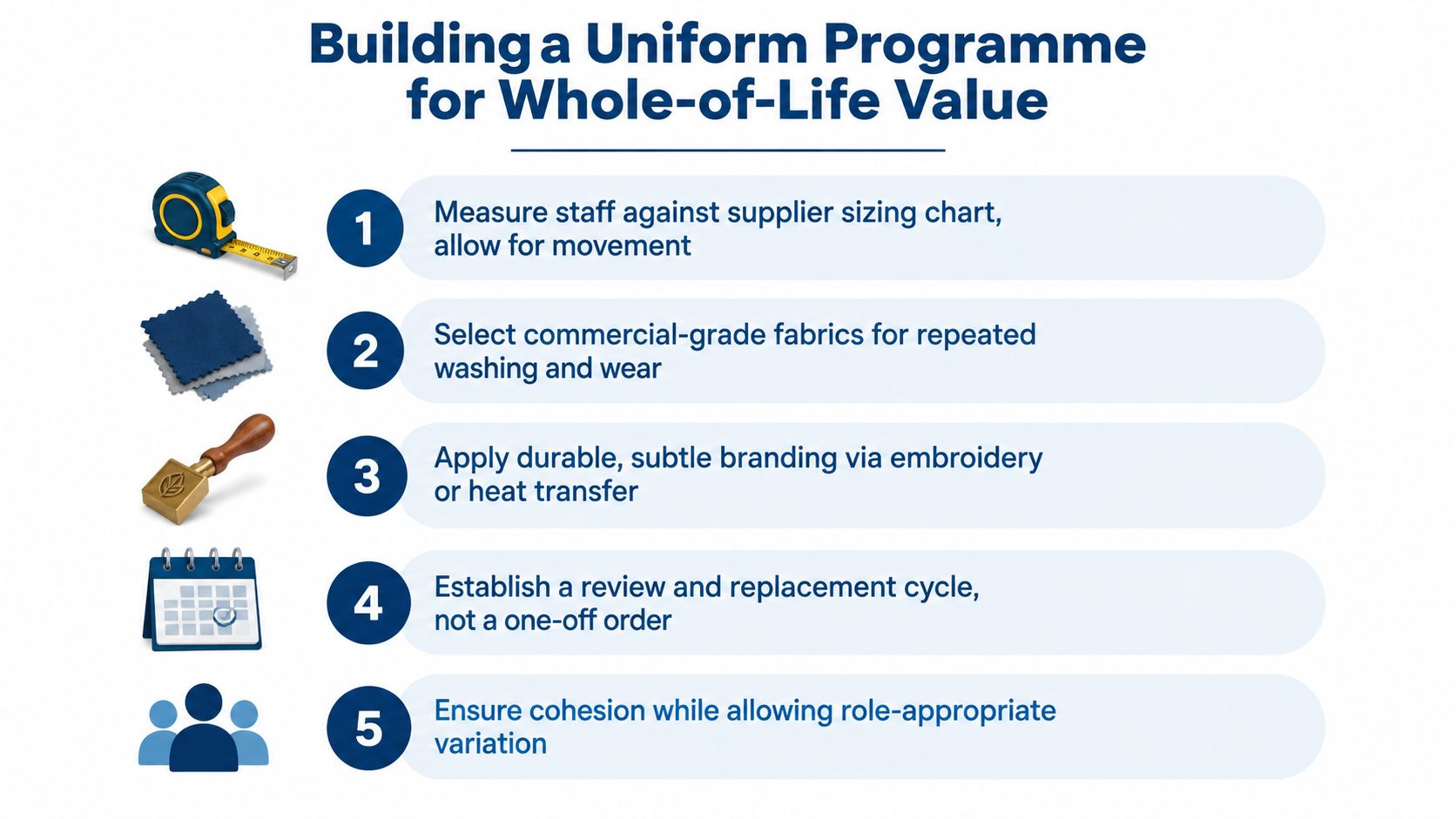
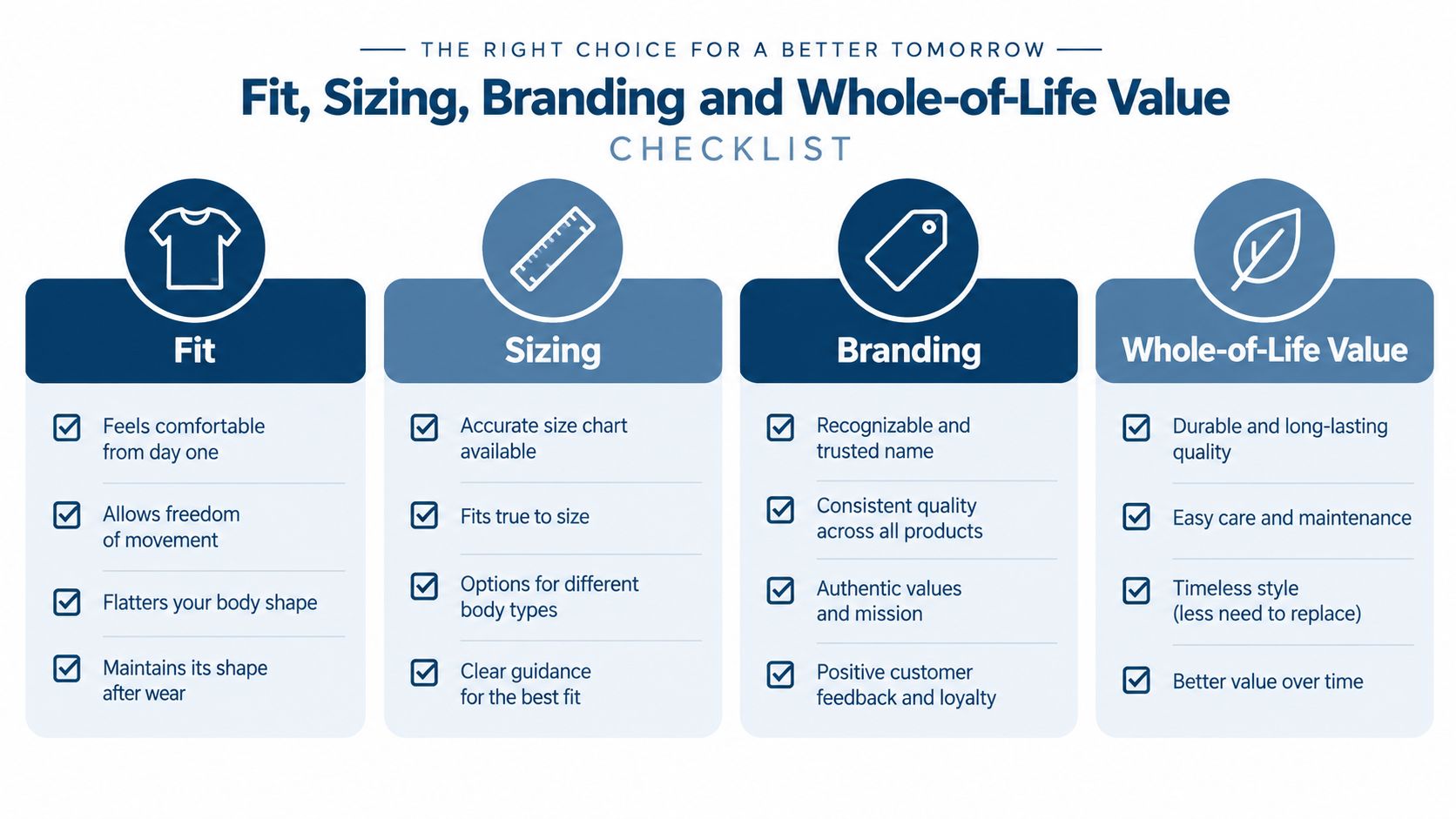
Sizing is one of the easiest parts of a uniform programme to underestimate. Staff have different body shapes, proportions and preferences, and a single cut won't suit everyone. Operators should use the sizing chart for the specific range, allow room for movement and order samples where practical before committing to a larger order.
Hospitality doesn't provide on-site uniform measuring or tailoring. The practical alternative is to compare staff measurements with the supplier's chart, review garment dimensions and test samples where possible. This approach reduces the risk of ordering a large quantity in a cut that restricts movement or creates excess fabric around equipment.
Build the programme around the wearer
A sound fitting process should check more than chest or waist measurements:
- Shoulder movement: The wearer should be able to reach forward, lift the arms and turn without pulling across seams.
- Working length: Jackets and shirts should stay secure during bending without creating a trip or snag risk.
- Waist comfort: Trousers and aprons should remain stable without pressure during prolonged standing.
- Role suitability: A bartender, cook and host may need different cuts even within the same colour system.
- Sizing flexibility: Unisex and gender-specific options can both be useful, depending on the range and team.
Branding should remain visible but controlled. Left-chest embroidery can suit shirts and jackets, while an apron mark may provide a stronger shared element across roles. Thread colour should work against the fabric, and logo size should be readable without dominating smaller garments. A restrained mark usually gives operators more flexibility when staff move between roles or when garments are replaced.
Stock is part of the uniform decision
Uniforms should be treated as a managed work system rather than a one-off order. Operators need enough clean garments for the laundering cycle, unexpected soiling, staff changes and different work areas. Exact quantities depend on shift patterns, washing arrangements and the level of exposure, so a venue should calculate its own rotation rather than copy a generic allowance.
Replacement stock also protects consistency. Keeping approved garments and sizes available means a worn apron or shirt can be replaced without introducing a mismatched alternative. A simple register can track garment type, size, colour, branding method and reorder source.
Whole-of-life value is more useful than purchase price alone:
Garment cost ÷ realistic number of wears = a practical cost-per-wear comparison.
That calculation still requires judgement. The realistic wear count depends on fabric, laundering, fit, station intensity and whether staff choose to wear the garment comfortably. A cheaper garment that loses shape or becomes unpleasant halfway through service may have a shorter useful life than a better commercial option. Premium clothing isn't automatically necessary, but intensive work should receive a level of construction that matches the workload.
The cheapest uniform is rarely the one with the lowest ownership cost if staff avoid it, it fails in laundering or it needs replacing before the programme is established.
Sourcing, Care Cycles and Getting the Right Advice
The purchasing conversation should cover more than colour and logo placement. Before ordering, an operator should ask how the range is sized, whether samples are available, how blank and branded orders are handled, and whether approved garments can be replenished later. A uniform that cannot be matched after staff changes creates unnecessary inconsistency.
Supplier questions should include:
- Sizing support: Is there a clear chart for each garment, and can staff compare measurements before ordering?
- Samples: Can the venue assess fit, movement and laundering before placing a larger order?
- Replenishment: Can the same approved style, colour and branding be reordered later?
- Care labels: Is the garment suitable for the intended commercial laundering process?
- Branding method: Will embroidery, print or transfer tolerate the required wash cycle?
- Role coverage: Are there suitable options for chefs, servers, bartenders, hosts and food handlers?
- Stock planning: Can the operator maintain replacement pieces without changing the visual system?
Make laundering part of the design
New Zealand hospitality guidance recommends clean uniforms changed every shift, put on at work and removed before travelling home where contamination control requires it. Dedicated work-only garments should be stored separately from personal clothing, with a same-day laundering loop where the operation requires one. Restaurant Association guidance on uniforms explains this operational approach and the importance of employer-supported changing and laundering arrangements where uniforms are required on site.
Food-hygiene requirements also make laundering frequency a management responsibility. The relevant New Zealand standard describes clean clothing, suitable protective garments and provision of at least one protective clothing set per worker each week for registered premises, with laundering as often as needed to keep garments satisfactorily clean. The practical schedule should reflect the actual exposure of each role.
Operators should follow the garment care label and separate fabrics where their laundering requirements differ. Cotton, poly-cotton, dark colours, embroidery and printed elements may not all tolerate the same process. General garment-care guidance from More Sewing can help staff understand everyday handling, but commercial food-handling clothing still needs a controlled workplace process.
Footwear should also be written into the policy rather than left to personal interpretation. New Zealand Standards guidance identifies slip resistance as a footwear safety feature and highlights its importance on surfaces contaminated by oil, detergent or water. Operators can review commercial laundry considerations alongside uniform planning, because washing, drying and storage capacity affect how many garments the team needs in rotation.
Hospitality supplies hospitality uniforms and related workplace products, so operators can discuss role-by-role garment specifications, sizing information, commercial aprons and practical replenishment considerations when building a uniform programme. Visit Simply Hospitality to review suitable hospitality clothing and contact the team for help matching garments to kitchen, front-of-house and laundering requirements.