

Biodegradable Straws NZ: What Venues Should Check
Switching to a straw labelled biodegradable isn't enough to make a better purchasing decision. For businesses comparing biodegradable straws in NZ, the useful tests are whether the product meets plastic-straw rules, works in the drinks being served, and has a disposal route the local waste contractor accepts. A straw that fails any of those tests can create service problems or environmental claims the venue can't support.
What Biodegradable Straws Are and What the Labels Mean
Biodegradable straws are made from materials capable of breaking down through biological processes under suitable conditions. That definition doesn't promise quick breakdown in the ocean, a landfill or a waterway. Temperature, oxygen, moisture and the disposal environment all matter.
A biodegradable label describes a material property, not what will happen after a customer puts the straw in a bin. Buying decisions need more specific information.
The terms describe different things
- Biodegradable: Capable of biological breakdown, but the word alone doesn't establish the conditions or timeframe.
- Compostable: Designed to break down under defined composting conditions. The claim needs evidence relevant to the finished product.
- Home compostable: Intended for suitable home-composting conditions, rather than requiring an industrial process.
- Industrially compostable: Requires controlled commercial composting conditions and an appropriate collection route.
- Recyclable: Suitable for a particular recycling process where accepted. It isn't another word for compostable.
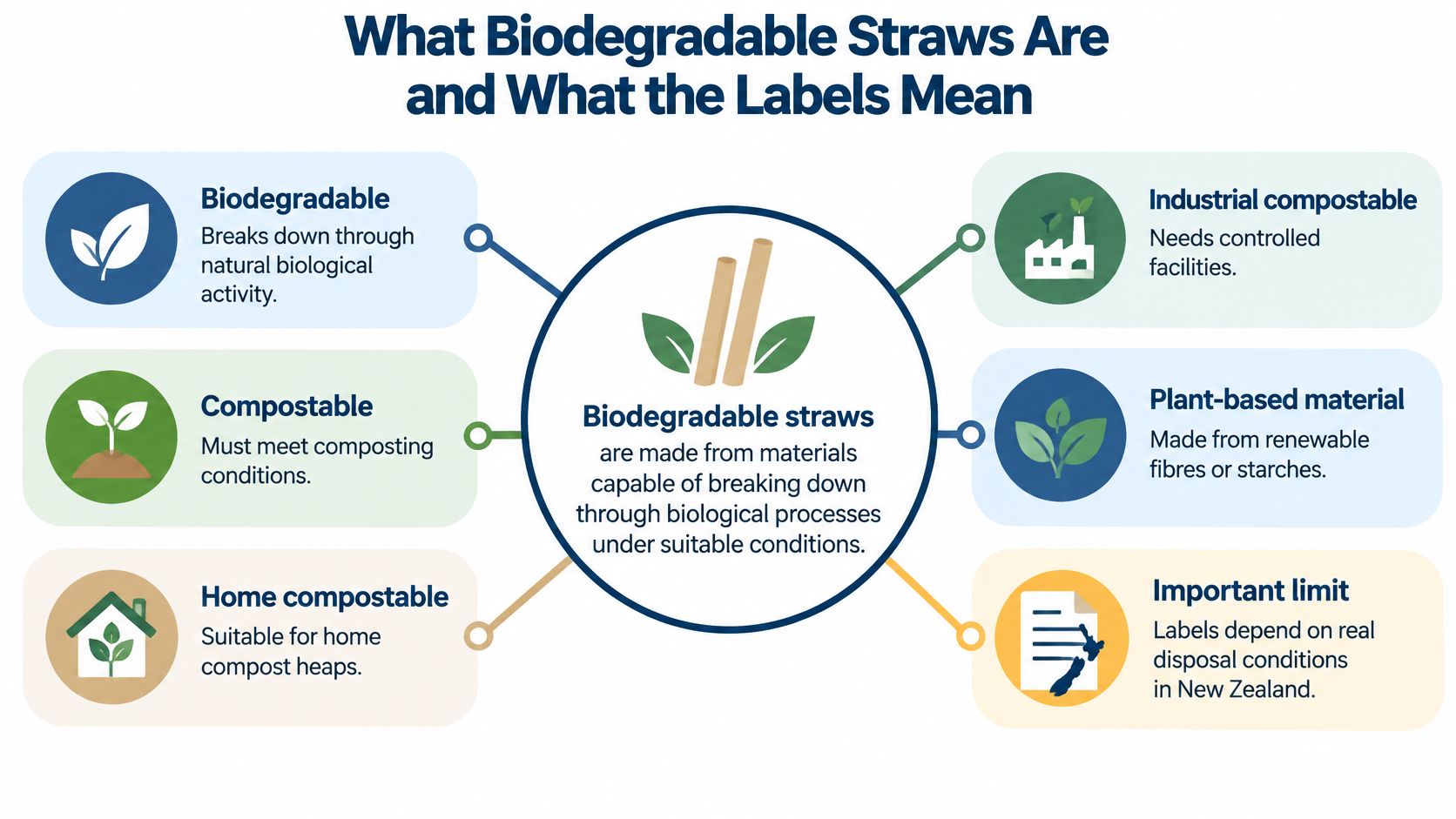
Plant-based describes the origin of material, not necessarily its disposal options or legal status. The Ministry for the Environment's guidance on banned plastic products includes compostable and bio-based plastics within the single-use plastic drinking-straw phase-out.
For procurement, request a named certification, the standard tested against, and documentation showing that it applies to the actual straw, including coatings or binders. The explanation of compostable packaging provides useful context for assessing those claims across foodservice packaging.
Buying rule: A leaf symbol or vague environmental wording isn't a substitute for product documentation.
For consumers considering broader changes, HYDAWAY's resource on reusable drinkware swaps for everyday adventures introduces reuse as a separate approach. Reusable products don't need to be biodegradable to replace a disposable item, but they do need a workable cleaning and reuse routine.
NZ Plastic Straw Rules Before You Buy
| Straw type | Position under the 2023 restriction | What to check before buying |
|---|---|---|
| Single-use plastic straw, including compostable or bio-based plastic | Covered by the restriction | Material composition confirmed in writing |
| Paper straw with a plastic coating or lining | Check, because any plastic content can bring it within the restriction | Coating and lining materials |
| Plain paper straw with no plastic content | Generally outside the plastic restriction | Supplier declaration of materials |
| Stainless steel, glass or other reusable non-plastic straw | Generally outside the plastic restriction | Material and intended reuse |
| Silicone straw | Confirm against current Ministry for the Environment guidance | Material documentation from the supplier |
| Flexible plastic straw for people with a disability or health condition | Access retained under the restriction | Stock kept on hand and offered on request |
From 1 July 2023, New Zealand restricted the general sale and supply of single-use plastic drinking straws while retaining access for disabled people and people with health conditions, as explained by the Ministry for the Environment.
The procurement test is plastic content and single-use status, not whether the carton says biodegradable. A product can have renewable feedstock, compostability documentation and attractive environmental branding without being suitable for general single-use supply.
Build material checks into purchasing
A purchasing specification should name the material rather than request an environmentally friendly straw. For paper or moulded-fibre products, that means checking coatings, linings, binders and other components, not just the main ingredient.
A practical approval routine is:
- Obtain composition in writing: Keep the supplier's declaration for the exact product being ordered.
- Check official guidance: Compare that composition and intended use against current Ministry for the Environment requirements.
- Retain the records: File the declaration and supporting documentation with the product specification so replacement orders don't introduce an unreviewed substitute.
If a product's classification is unclear, seek clarification from the Ministry before committing to a bulk order. A supplier's broad sustainability statement isn't a legal determination.
Accessibility also needs an operational plan. Customers who need flexible plastic straws shouldn't be left with only rigid metal, glass or unsuitable paper alternatives. Keep appropriate accessible stock available and brief staff on the applicable supply arrangements, including how to respond respectfully to a request.
Straw Materials Compared for NZ Venues
| Straw material | Advantages | Limitations | Suitable applications |
|---|---|---|---|
| Paper | Familiar single-use format, straightforward to stock | Can soften with prolonged liquid contact; construction and coating affect performance | Quick soft drinks, takeaway and short service |
| Bamboo | Natural appearance; often reusable | Requires cleaning, thorough drying and protected storage | Dine-in venues with a wash-and-reuse routine |
| Wheat or plant-fibre | Different textures and formats can suit cold drinks | Composition and manufacturing affect durability; check for plastic content | Cold drinks with documented material specifications |
| Sugarcane-fibre | Fibre-based single-use option | Performance and disposal instructions need product-level verification | Cold drinks and takeaway after a service trial |
| Certified compostable straws | Documented end-of-life claim where certification applies | Must be legally suitable; industrially compostable products need an accepted commercial route | Venues with confirmed collection and processing |
| Reusable stainless steel | Avoids discarding a straw after every use; durable construction | Requires internal cleaning, inspection and a return system | Dine-in service and bars with cleaning capacity |
| Reusable glass | Reusable with a distinctive presentation | Breakage risk and careful handling requirements | Controlled bar and dine-in service |
| Reusable silicone | Flexible, reusable format | Requires internal cleaning and material verification | Service needing a flexible reusable option, subject to customer suitability |
Reusable alternatives aren't necessarily biodegradable. Stainless steel, glass and silicone answer a different purchasing question: whether the venue can recover, clean and reuse the item reliably.
Material categories also contain very different products. A hollow bamboo stem isn't interchangeable with a manufactured bamboo-fibre composite, and a sugarcane description doesn't establish everything used in production.
Compare the work behind the straw
Paper is convenient for takeaway because staff don't need to retrieve it. However, operators should compare seam construction, mouthfeel, packaging protection and liquid resistance, rather than assuming every paper straw performs alike.
Bamboo needs a credible washing and drying procedure. A venue should check the manufacturer's cleaning instructions, inspect internal passages, and retire products showing damage or deterioration. Damp storage and incomplete cleaning aren't acceptable trade-offs for a natural appearance.
Reusable stainless steel and glass need a designated collection point so they don't disappear with rubbish or takeaway orders. Staff also need suitable cleaning tools and an inspection process, particularly for glass.
A reusable straw only works operationally when staff can retrieve it, clean its internal surface, inspect it and store it hygienically.
For high-volume takeaway, consider how staff open packs, replenish dispensers and protect loose straws from handling. Individually wrapped formats add packaging but can simplify protected distribution at events or self-service stations.
Match the format to the service model
A cocktail bar may prioritise presentation, customer comfort and reliable performance throughout a leisurely drink. A takeaway café needs compatibility with existing lids, manageable carton storage and consistent replenishment.
Carton price should therefore be compared alongside handling, washing, losses and disposal. The same approach applies when choosing other single-use tableware, including disposable plates for NZ foodservice.
For an overseas comparison of how foodservice consumables are grouped, Material Handling USA's shop food service disposables page can help frame a broader purchasing list. Its listings shouldn't be treated as evidence of NZ compliance or local waste acceptance.
There's no defensible universal environmental winner without credible lifecycle evidence for the products being compared. The practical shortlist is narrower: documented materials, suitable service performance and an achievable handling routine.
Which Straws Work Best for Each Drink
| Drink type | Important straw characteristics | What to check |
|---|---|---|
| Water and soft drinks | Suitable diameter and length for straightforward service | Fit through the cup opening and lid |
| Iced coffee | Resistance to cold liquid throughout a slower drink | Liquid exposure, ice interference and lid fit |
| Cocktails | Length suited to the glass and garnish arrangement | Comfortable drinking position and performance throughout service |
| Smoothies | Wider bore for a thick blend | Flow through the straw using the actual recipe |
| Milkshakes | Wide bore and adequate structural strength | Performance throughout the drink |
| Bubble tea and thicker beverages | Opening large enough for pearls or toppings | Internal diameter against the toppings served |
| Hot drinks | Manufacturer-approved suitability for hot liquid | Written approval covering the temperature served |
A straw that handles a quick soft drink may make a thick milkshake frustrating to consume. Narrow internal diameter restricts flow, while an unnecessarily long straw can feel awkward in a short cocktail glass.
Internal diameter matters more than external appearance. Two straws that look similar can have different usable openings because of wall thickness.
Test the whole drink package
Measure glass height and the lid opening before ordering. Then prepare the actual drink, fit its normal lid, and check flow, taste, texture and comfort through the expected service period.
For bubble tea, check whether the chosen straw can handle the toppings and, where relevant, the sealed lid. Don't assume a wider straw can safely pierce every sealing film.
Takeaway packaging should be assessed as a set. Hospitality's guidance on choosing takeaway coffee cups helps place cup construction and service needs alongside straw selection.
For hot drinks, use only a product with written manufacturer approval for the intended temperature. Customer comfort and the risk of drawing hot liquid directly into the mouth also deserve consideration.
Keep station consumables separate from performance claims
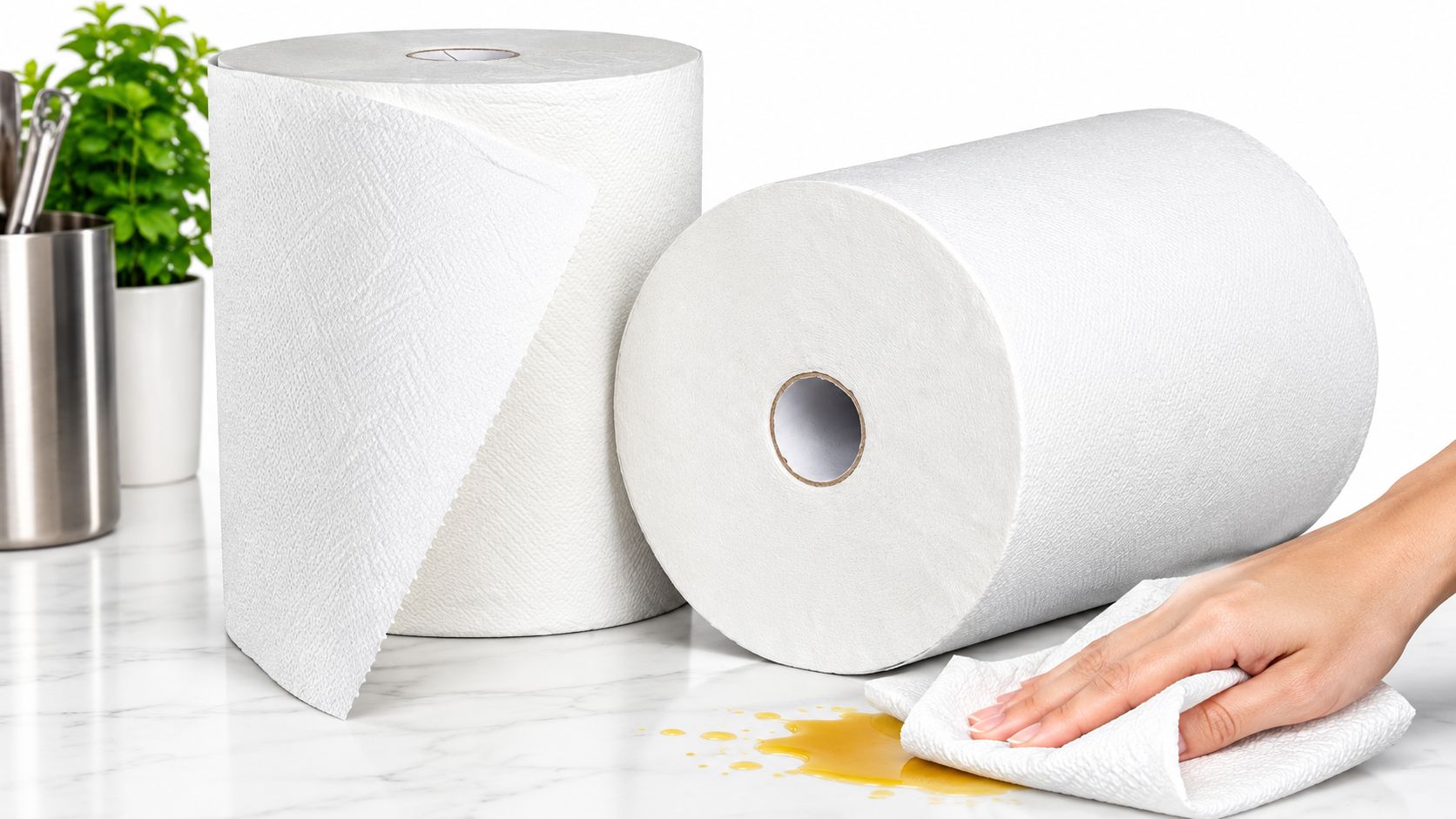
At the beverage station, Matthews Roll Feed Paper Towels dispense from the exterior of the roll and are designed for cleaning oil, grease and water spills. That cleaning role is separate from straw performance, which needs testing in the finished beverage.
The purchasing specification should follow the drink. A short cocktail straw, a smoothie straw and a general takeaway straw don't need to be the same item.
Do Biodegradable Straws Help the Environment in NZ
A compostable label doesn't guarantee that a straw will become compost after use. The Ministry for the Environment's plastic phase-out guidance explains that compostable alternatives often require commercial facilities that aren't available throughout New Zealand, and that littered bio-based plastics can harm wildlife much like conventional plastics.
That makes the local disposal arrangement central to any environmental claim. Certification and facility acceptance answer different questions: one concerns the product's tested properties, while the other concerns what the processor will take.
Look beyond the raw material
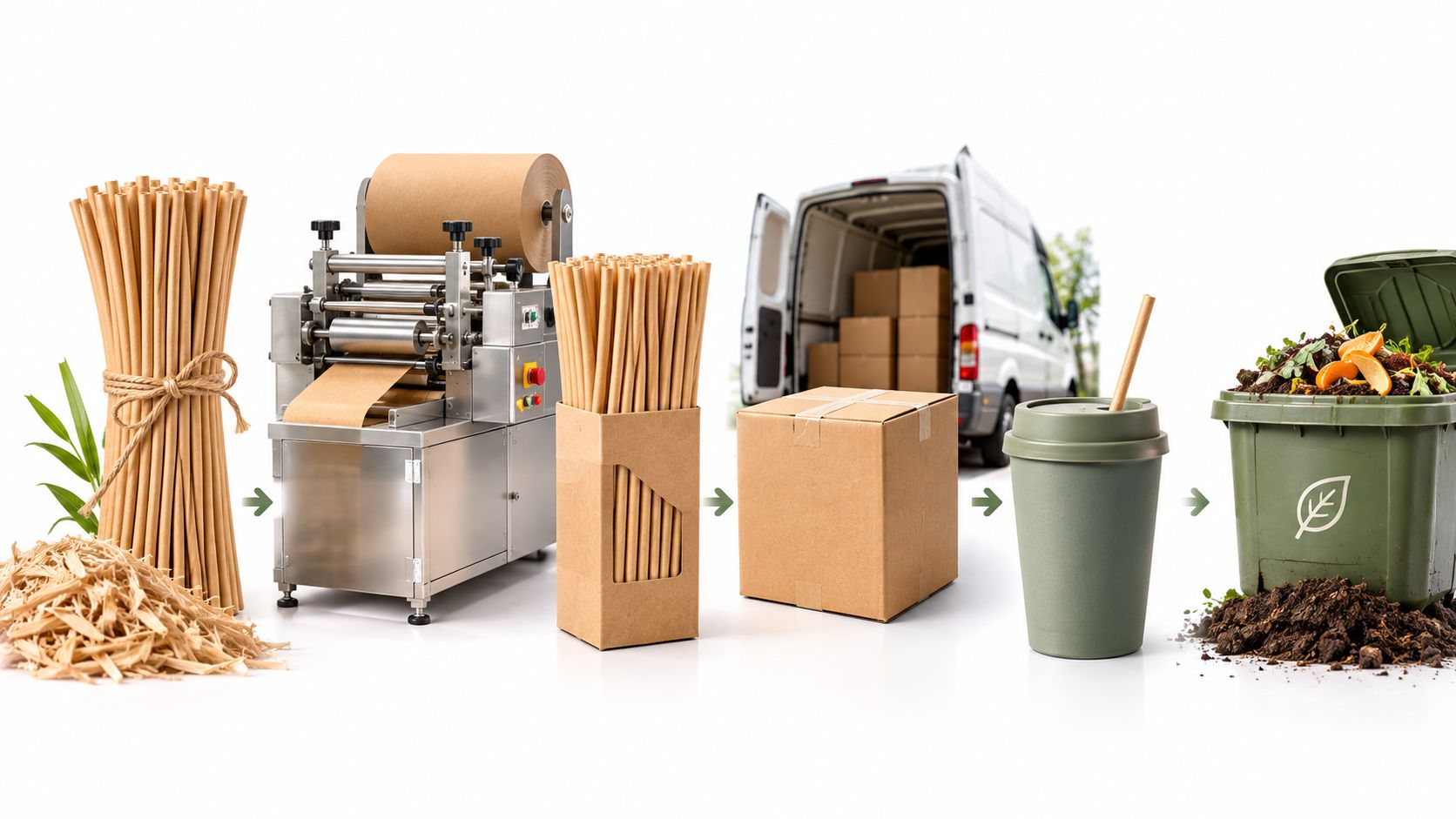
A meaningful comparison considers raw-material production, manufacturing, wrapping, transport, use and final disposal. For reusables, washing and the number of successful reuses also belong in the assessment.
A renewable ingredient doesn't establish a lower overall impact by itself. Equally, a reusable option isn't automatically preferable if the venue repeatedly loses or discards it before establishing a reliable reuse system.
For accommodation providers, this wider operational perspective also applies to guest choices. St Christopher's Inns' resource to explore lower-impact travel options provides broader travel context, rather than evidence for a particular straw's environmental performance.
Confirm the destination before labelling the bin
Putting an unaccepted compostable straw into recycling can contaminate that stream. Sending it to general rubbish doesn't deliver the intended composting outcome, and no biodegradable item should be littered or treated as harmless in waterways.
Disposal check: The processor must accept the specific finished product, not merely the general material category.
Operators reviewing wider packaging choices can also consult Hospitality's article on sustainable foodservice packaging in New Zealand, while checking each item's current documentation separately.
Before making an environmental claim:
- Request evidence: Obtain certification covering the finished straw.
- Confirm acceptance: Ask the waste contractor about that exact product and collection stream.
- Choose a workable alternative: Where collection is uncertain, assess reusable or non-plastic options without promising an unavailable composting outcome.
What Straw Choice Costs a Hospitality Business
Illustrative calculation only, not verified NZ market rates: A café using 200 straws daily across 300 trading days uses 60,000 straws annually. At $0.04 each, that costs $2,400; at $0.07 each, it costs $4,200, a difference of $1,800 annually.
Those hypothetical prices show why unit cost matters, but they don't identify the better purchase. The lower-priced straw could still create extra expense if staff repeatedly replace it or customers struggle to drink through it.
Costs the carton price leaves out
- Replacement straws: Record extra straws supplied because of softening, splitting or poor flow.
- Handling wastage: Include items dropped, crushed, exposed to spills or discarded during replenishment.
- Service disruption: Consider staff time dealing with complaints and avoidable drink remakes.
- Storage: Check carton dimensions, protective packaging and available dry shelving.
- Waste handling: Include any separate collection or sorting arrangements.
- Reusable processing: Account for cleaning, inspection, retrieval and losses.
A cheaper narrow straw isn't good value for a thick smoothie if customers need another solution. Similarly, a premium compostable product may offer little practical advantage where the business has no accepted collection route.
Compare cost per served drink
Run a one-week usage check as an internal purchasing exercise. Record drinks sold, straws issued, replacements and discarded stock, then compare straw expenditure against the drinks served.
For takeaway operations, assess the whole packaging set rather than negotiating each component in isolation. The article on packaging considerations for takeaway businesses gives useful context for that broader decision.
Offering straws on request can reduce unnecessary distribution, provided staff can supply them promptly and accessible options remain available. The aim isn't to make customers justify a need, but to stop automatically adding an unwanted item to every beverage.
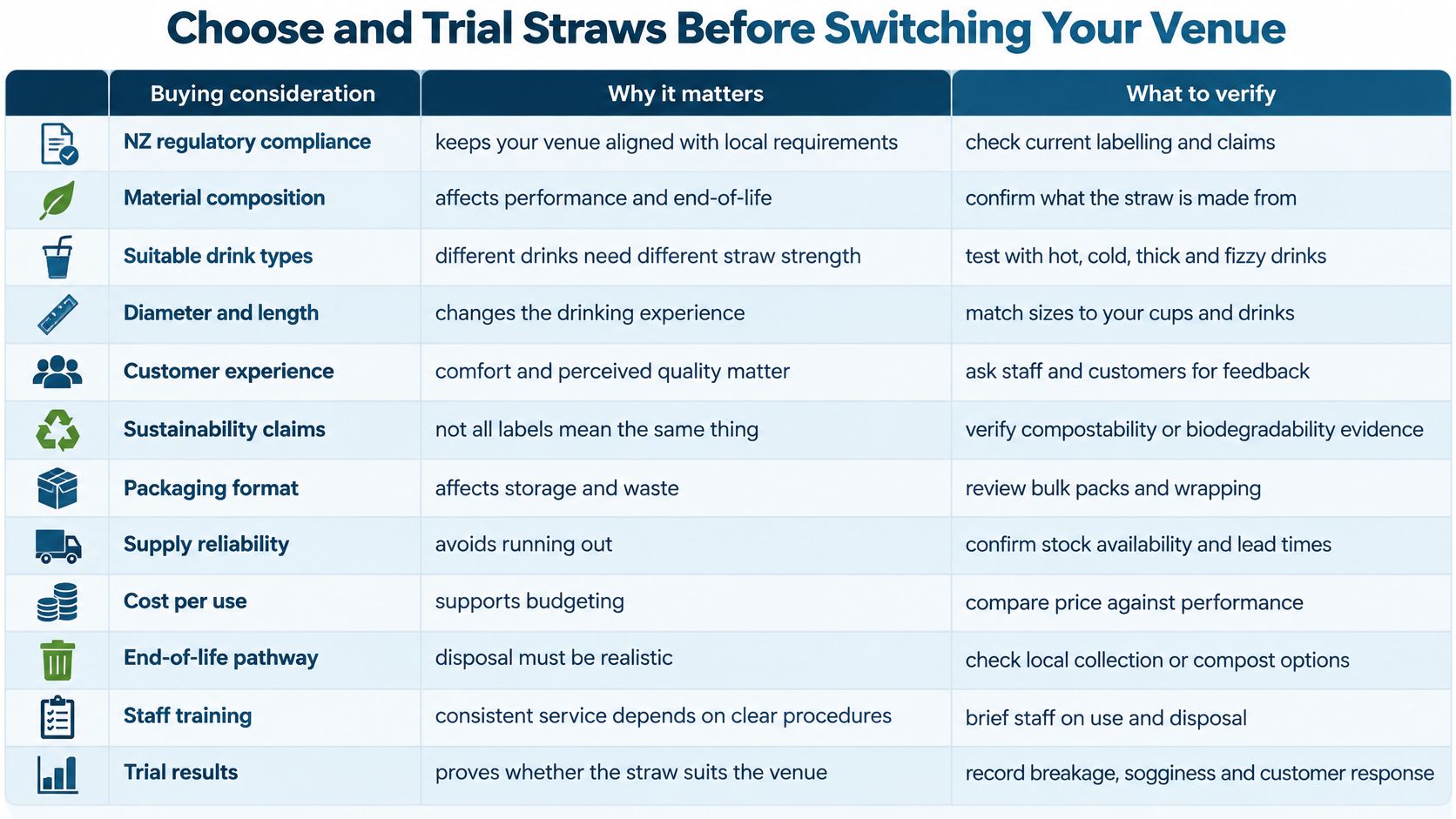
Choose and Trial Straws Before Switching Your Venue
| Buying consideration | Why it matters | What to verify |
|---|---|---|
| NZ regulatory compliance | Plastic content affects whether a straw is covered | Composition and current Ministry for the Environment guidance |
| Material composition | Labels don't identify every component | Supplier declaration of materials |
| Suitable drink types | Drinks place different demands on a straw | Manufacturer guidance for the drinks served |
| Diameter and length | Poor sizing affects flow and comfort | Specifications against cups, lids and glasses |
| Customer experience | Softening or restricted flow creates complaints | A one-week trial across the drink range |
| Food-contact suitability | The straw contacts the beverage directly | Supplier food-contact documentation |
| Relevant certifications | Evidence supports end-of-life claims | Named certification and tested standard |
| Disposal requirements | Local acceptance determines the usable route | Written waste-contractor confirmation |
| Unit cost | Annual expenditure extends beyond headline price | Carton price and expected actual usage |
| Bulk availability | Supply gaps disrupt service | Carton quantities and replenishment lead times |
| Storage conditions | Moisture and crushing can damage stock | Storage instructions and available space |
| Accessibility needs | Customers need suitable drinking options | Appropriate stock and a respectful request process |
The Ministry for the Environment's compostable packaging position statement notes that New Zealand has no national certification or labelling standard for compostable packaging and that most compostable products require specific industrial conditions. A purchasing checklist therefore needs both product evidence and a confirmed destination after use.
Trial a small quantity under normal service conditions
Use a small order for the recommended trial, rather than replacing every straw at once. Include the busiest service, takeaway orders and drinks customers consume slowly.
Staff should log softening, splitting, breakage, restricted flow, unusual taste, customer feedback and the disposal stream used. Reusable options also need a cleaning and retrieval trial, not merely a successful drink test.
Approve specifications rather than a broad material description
The final order should identify the approved product, dimensions, packaging format and supporting documents. A substitute described merely as another paper straw shouldn't bypass the same checks.
Different beverages may justify separate specifications. Businesses should also decide which drinks need a straw, while retaining suitable options for customers who require one.
Hospitality is New Zealand owned and operated. Wherever possible, it works with locally owned and operated businesses, and almost all its suppliers have a physical base and/or staff in New Zealand.
Before committing to bulk stock, check ordering quantities and product information carefully. Hospitality publishes a Returns Policy, but a small service trial is a better way to assess suitability than relying on returning an unsuitable bulk purchase.
Hospitality offers hospitality consumables and advice to help businesses match purchasing decisions to beverage service, handling and disposal needs. Visit Simply Hospitality and contact the team with drink types, cup and lid details, straw dimensions and waste-contractor requirements for help choosing a suitable option.