

Commercial Catering Equipment Auckland Buying Guide
An Auckland catering team can produce an excellent menu in its central kitchen and still struggle at the event. Food may need to travel to a hotel ballroom, conference facility, marquee or outdoor venue, then remain at the right temperature until guests are served. The equipment decision therefore extends well beyond ovens. It covers preparation, cooking, holding, transport, service, clearing and warewashing.
For operators searching for commercial catering equipment in Auckland, the right purchase depends on where food is made, how it moves, what the destination provides and how the team will clean down afterwards. Hospitality sells commercial catering equipment, not equipment hire or rental services, and supports businesses comparing equipment for permanent kitchens, production facilities and event operations.
Auckland provides a substantial hospitality customer base. A Restaurant Association industry report recorded 6,741 hospitality outlets in Auckland in 2017, compared with 5,664 in 2013, and listed 654 cafés and restaurants, 423 takeaway food services, 54 catering services and 45 pubs and taverns in 2017. The report also recorded 49,800 hospitality employees in 2017, with the sector on track to exceed 50,000 in 2018. These figures illustrate why local suppliers need to understand very different operating models, from hotel banquets and conference catering to mobile foodservice. The Auckland hospitality report
Tourism adds further pressure to accommodation and foodservice infrastructure. Auckland Economic Development recorded 2.2 million international visitor arrivals in the year to March 2024, 7.5 million guest nights, and a 22% year-on-year increase in guest nights. Tourism expenditure was estimated at $7.7 billion in the year to March 2023, while tourism employed 5.4% of Auckland's workforce in 2023. Hotels, restaurants, bars and institutional kitchens therefore need equipment that can cope with demand peaks without creating avoidable bottlenecks. Auckland Economic Monitor 2024
This commercial catering equipment guide for New Zealand provides useful background, but Auckland operators still need to apply the principles to their own menu, venue access, utilities, food journey and cleaning process.
What Commercial Catering Equipment Means for Auckland Operators
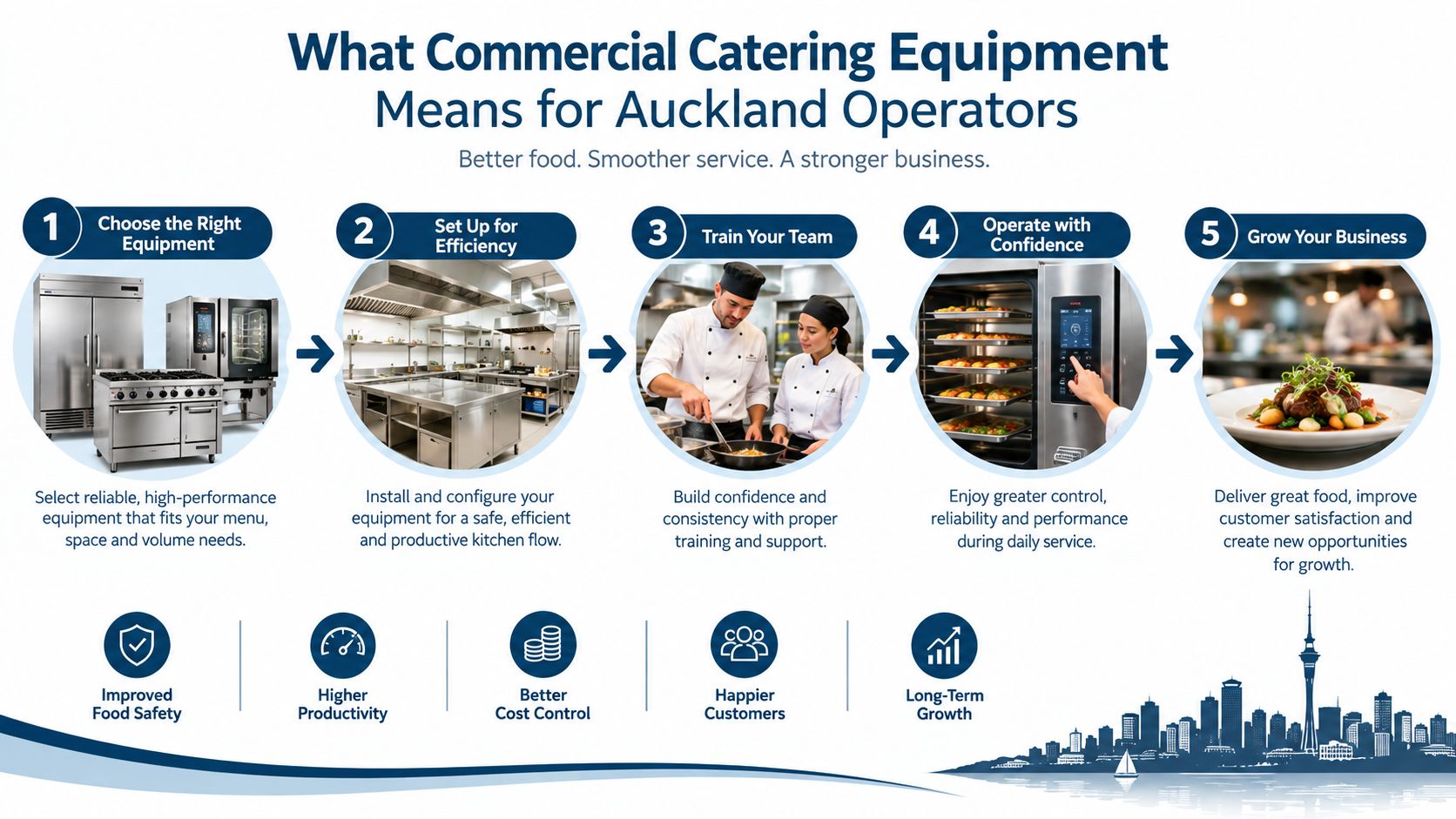
Commercial catering equipment supports a connected production and service system rather than a single kitchen station. A restaurant may cook and plate within the same building. A catering company may prepare food in one location, transport it across Auckland, finish or hold it at a second location, serve guests, return equipment and wash it down later.
The practical sequence is:
- Preparation, including chopping, mixing, portioning and staging ingredients.
- Cooking, using ovens, cooktops, fryers or other menu-specific appliances.
- Holding, keeping food ready without damaging temperature, texture or presentation.
- Transport, moving food, containers, equipment and serviceware safely.
- Service, covering plating, buffet presentation, beverage service and replenishment.
- Clearing, separating used plates, glassware, food waste and equipment.
- Warewashing, cleaning, sanitising, drying and returning items to storage.
The bottleneck is rarely the largest appliance
A combi oven can be a strong batch-production tool, but it won't solve a service problem if the team lacks rack space, hot holding, transport containers or enough people to plate. Likewise, a large refrigerator doesn't help if staff can't retrieve ingredients without crossing the clean preparation area.
Catering companies should map the movement of food and equipment before selecting appliances. Hotels and function centres may prioritise fixed cooking lines, blast chilling, refrigeration, hot holding and warewashing. Conference facilities may need flexible service equipment that can support multiple rooms. Mobile and event foodservice operators must give much greater weight to weight, dimensions, power supply and pack-down.
Practical rule: Specify the equipment around the food's complete journey, not the most impressive appliance in the kitchen.
A small storage vessel can also support a repeated service task when its use is clearly defined. The Mepal Cirqula Round 350ml Nordic Sage is shaped for storing, reheating and serving dips, dressings, baby food or very small leftovers in one round vessel. Made from polypropylene and thermoplastic elastomers, it supports the Cirqula range's use cycle of storing, freezing, reheating without the lid, serving, stacking when full and nesting when empty. Its stated capacity is 350 ml, with a leakproof window lid for stacking and transport.
Choosing Equipment for Each Stage of the Catering Journey
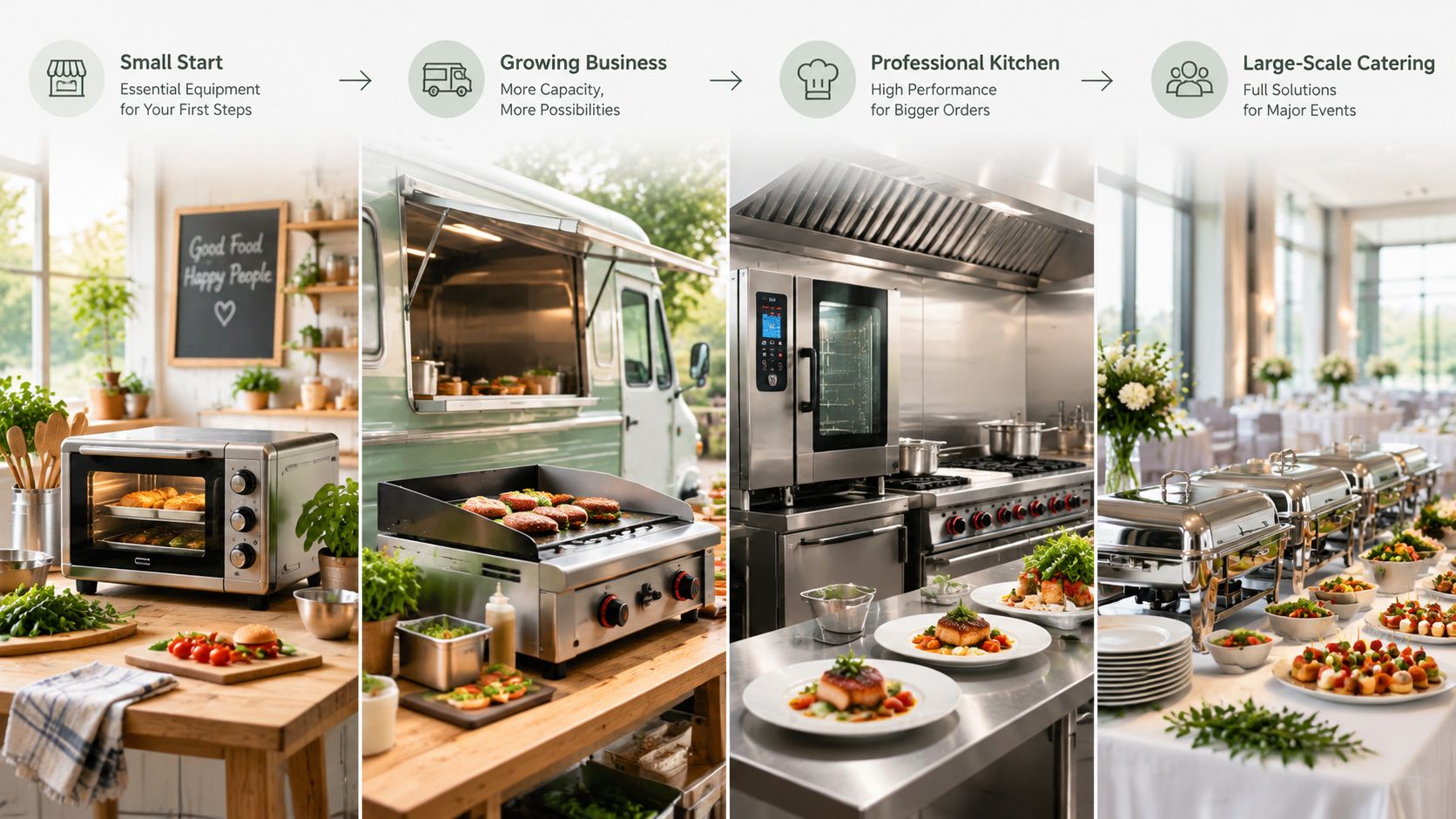
Equipment selection works best when each category has a defined job in the catering flow. A permanent production kitchen may justify larger fixed appliances, while a travelling service team may need lighter equipment that can connect quickly to available utilities.
Preparation and cooking
Food processors such as Robot Coupe models can support repetitive chopping, slicing, grating and blending tasks in a production kitchen. The useful comparison isn't only motor size. Operators should consider batch size, attachment changes, cleaning access, staff handling and whether the machine stays on a bench or travels between sites.
Mixers need the same treatment. A fixed production kitchen may benefit from a substantial planetary mixer for sauces, batters or doughs, while an event team may prefer smaller preparation equipment that can be lifted, secured and cleaned without specialist handling.
For cooking, Convotherm combi ovens provide a combination of cooking modes for teams producing varied menus in batches. Turbofan convection ovens can suit operators who need dependable dry-heat cooking and straightforward operation. A combi oven may offer broader menu flexibility, but it also brings installation, water, drainage, cleaning and staff-training requirements. A convection oven can be simpler to position, but may not provide the same moisture-control options for every menu.
Refrigeration and holding
Commercial refrigeration should be selected around delivery patterns, ingredient volume, access and the need to stage prepared food. SKOPE and Atosa refrigeration options may suit different layouts, but the key decision remains whether the unit supports the workflow without crowding preparation or service areas. Upright storage, underbench access, display refrigeration and mobile cold storage all solve different problems.
Bain maries and hot holding cabinets are not substitutes for cooking capacity. They protect the gap between production and service, which matters when food leaves the kitchen or when several guest groups are served in sequence. Operators should assess container compatibility, access, cleaning, power requirements and how long food will wait before service.
For a wider discussion of selecting refrigeration as a business develops, operators can refer to choosing refrigeration based on your business stage.
Transport, service and clean-down
Insulated food transport, trolleys and suitable containers protect the handover between kitchen and venue. A trolley that fits through the kitchen, lift and venue doors may be more useful than a larger unit that provides greater internal capacity but cannot be manoeuvred safely.
Buffet equipment should reflect the service format. Hotels and function centres may require coordinated bain maries, serving utensils, platters and replenishment storage. Conference facilities may need compact beverage equipment, hot water, coffee service and clear labelling. Mobile operators should prioritise equipment that sets up quickly and doesn't depend on infrastructure that may not exist at the destination.
Commercial dishwashers suit operations processing large quantities of plates, trays and containers, while glasswashers are designed around bar and beverage-service workflows. Cleaning access, drainage, water supply, chemical dosing, ventilation and separation from food preparation all affect the value of the machine. Operators comparing beverage and café requirements may also find AQEEK Coffee's equipment guide useful for reviewing equipment categories before finalising a service layout.
Permanent Kitchen Versus Equipment That Needs to Travel
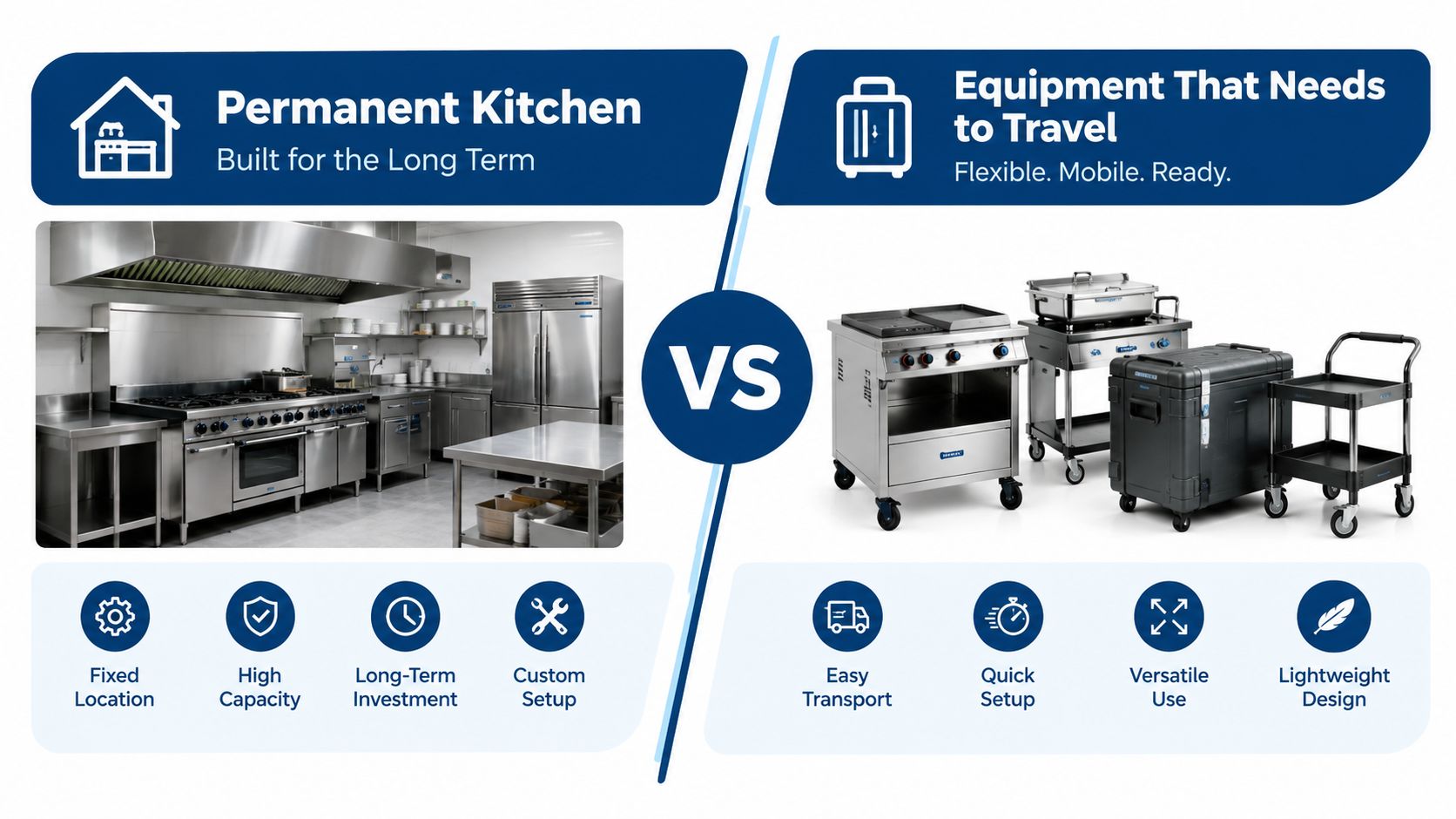
The first decision is where most cooking will happen. If food is produced in a central kitchen, the equipment mix should favour batch preparation, refrigeration, holding, transport and efficient service at the destination. If cooking happens at the event, available power, water, wastewater, ventilation, weather protection and access become part of the specification.
A permanent catering kitchen can accommodate equipment that would be impractical on the road. Fixed combi ovens, large refrigeration, production mixers, stainless benches and commercial warewashers can be positioned around a stable workflow. They may require dedicated services, specialist installation and clearances that aren't available inside a temporary structure.
Travel equipment faces a different test:
- Portability: Can the team lift, wheel or load it safely?
- Dimensions: Will it pass through doors, lifts, corridors and vehicle openings?
- Utilities: Can the venue provide the required power, water and drainage?
- Setup: Can staff connect and test it without lengthy assembly?
- Pack-down: Can it be cleaned, secured and transported without damage?
- Weather protection: Is the equipment protected from rain, wind, dust and unstable ground?
Temporary infrastructure needs early confirmation
Outdoor Auckland venues and temporary event sites can't be treated like fully fitted commercial kitchens. Operators should confirm the location of power and its capacity, water supply, wastewater arrangements, weather protection, ground conditions, vehicle access, loading routes and food transport requirements before buying equipment.
Hospitality can supply commercial catering equipment, but it doesn't manage event-site compliance or specialist temporary infrastructure services. The operator, venue and relevant contractors need to confirm the site arrangements before equipment is specified. Equipment that performs well in a permanent kitchen may be unsuitable if it is too heavy, difficult to position or impossible to power at the venue.
For operators comparing broader event requirements alongside owned equipment, compare party hire options as a separate planning exercise. Hire considerations don't replace the need to select owned production, holding, transport and warewashing equipment that suits the business's regular workflow.
Capacity should be worked out across the whole process:
Guests × portions required × available production and service time
That output must then be tested at preparation, cooking, holding, transport and plating. The slowest stage sets practical capacity, regardless of what the largest oven could theoretically produce. Further planning considerations are covered in catering equipment for New Zealand operations.
How to Size Catering Capacity Without Guesswork
Operators don't need a generic plates-per-hour promise to make a sound decision. They need their own guest count, menu portions, production window, service window and staffing plan.
Start with:
Guests × portions required × available production and service time
Then separate the result into the stages that must support it. Preparation may be limited by chopping, mixing or portioning. Cooking may be limited by oven space, tray loading or recovery. Holding may be limited by cabinet space or container availability. Transport may be limited by vehicle volume, trolley access or the number of insulated carriers. Plating may be limited by bench space and the pace of the service team.
| Stage | What to assess | Capacity question to answer |
|---|---|---|
| Preparation | Ingredients, machines, benches and staffing | Can the team prepare the required portions within the production window? |
| Cooking | Appliance type, batch size, trays and loading sequence | Can cooking keep pace without creating a queue before holding? |
| Holding | Bain maries, hot cabinets, refrigeration and containers | Can food remain safe and presentable until service? |
| Transport | Insulated carriers, trolleys, vehicle space and access | Can the required food reach the venue in a controlled condition? |
| Plating and service | Benches, staff, crockery, buffet equipment and replenishment | Can the team serve guests at the required pace? |
A combi oven might have substantial theoretical output, but that doesn't establish the capacity of the catering operation. If the holding cabinet is full, the transport plan is too slow or the plating bench is congested, the oven's potential is irrelevant.
Food safety should be included in the calculation. Potentially hazardous food must be kept at 5°C or colder, or 60°C or hotter, and food cooled after cooking must move from 60°C to 21°C within 2 hours, then from 21°C to 5°C within a further 4 hours. Food Standards Australia New Zealand temperature guidance
Operators should record the slowest stage, then decide whether to add equipment, change the menu sequence, extend production time, increase staffing or move more cooking to the destination. Planning equipment for consistent meal service can help teams connect the equipment plan to repeatable service.
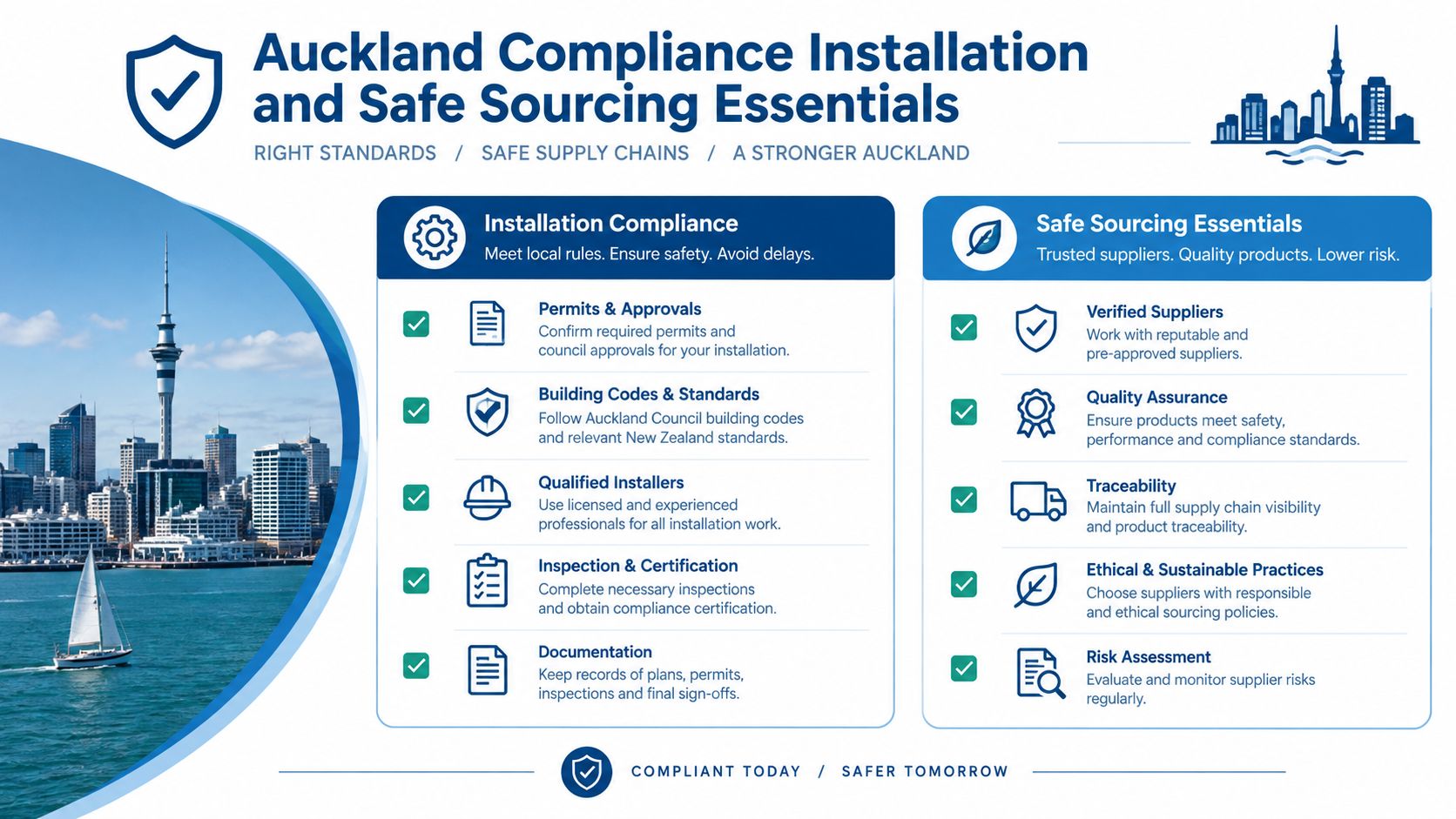
Auckland Compliance Installation and Safe Sourcing Essentials
Auckland operators need to check building services and food safety before equipment reaches the site. For a production kitchen supplying events kilometres away, extraction, power, drainage and holding performance affect both kitchen output and the condition of food at guest service. Mechanical ventilation must extract over cooking equipment, discharge at the building's highest point and avoid creating a nuisance. Canopy size, fan capacity, grease control and duct routing should be designed together, especially in dense urban premises.
New Zealand's Building Code ventilation pathway connects kitchen exhaust design with AS 1668.2. Commonly benchmarked rates include 12 L/s continuous extraction or 50 L/s intermittent extraction, with higher capture targets around hobs. The Building Code G4 ventilation document should be reviewed alongside the project-specific design. Poorly sized extraction can raise heat, moisture, grease deposits and odour complaints. Correct capture and supply-air planning supports safer work and more consistent production.
Holding and display controls
Hot display food should reach 80°C before entering a display case, which must keep it above 65°C. Local authority guidance also states that hot food should not remain on display for longer than one day. Cold perishable food should stay at less than 4°C, or be discarded after more than 2 hours on display. Follow the safe food preparation and display guidance when selecting equipment and setting staff procedures.
For catering, these limits apply across production, holding, transport and temporary service points. Bain maries, hot cabinets, display refrigeration and temperature records must support the required conditions throughout that journey. A unit that cannot hold temperature reliably creates a food-safety risk and can undermine service at the destination.
Electrical and installation checks
Before accepting a quote, confirm:
- Power supply: Voltage, phase, outlet position and available site capacity.
- Ventilation: Canopy, exhaust, make-up air and discharge requirements.
- Water and drainage: Inlet, waste connection, filtration and servicing access.
- Clearances: Door swing, heat separation, cleaning access and staff movement.
- Used equipment safety: WorkSafe requires second-hand electrical appliances sold in New Zealand to be electrically safe. Review the WorkSafe appliance requirements.
- New equipment standards: New Zealand legislation cites IEC 60335-2-64 for commercial electric kitchen machines, with the transition period for the older referenced standard running until 04/05/2026. Check the Electricity Safety Amendment Regulations 2025.
For detailed planning guidance, see the commercial kitchen installation guide before services are fixed.
New, certified-used and trade-supplied equipment need comparison on more than purchase price. Check warranty coverage, documentation, commissioning, servicing and support for equipment that may travel between the production kitchen and event site.
Sourcing Finance and Ongoing Support in Auckland
A catering equipment quote should identify the appliance, required accessories, installation assumptions, warranty terms, service pathway and any site work excluded from the price. Operators should also confirm whether a machine is new or certified used, how it will be commissioned, and who handles parts and servicing when the business is trading under pressure.
Hospitality offers new equipment, certified-used options, trade accounts, quotations and finance pathways, including flexible arrangements associated with SilverChef-style equipment finance. The right structure depends on the operator's business model, cash position and ownership preference, so payback should be assessed using the business's own figures rather than a generic promise.
Maintenance belongs in the purchase decision. Staff need access to clean filters, seals, trays, condenser areas, wash systems and food-contact surfaces. Auckland service access, spare parts availability and manufacturer support can matter as much as the initial specification, particularly for refrigeration, ovens, dishwashers and glasswashers.
For larger projects, kitchen design support through SACH can help coordinate equipment, workflow, services and access before fit-out work begins. Product categories such as commercial refrigeration, commercial cooking equipment and commercial dishwashers can help operators organise the shortlist. Hospitality remains a supplier and advisor, not an equipment-hire company.
Hospitality supplies commercial catering equipment for Auckland production kitchens, hotels, function centres, conference facilities and event operators, including refrigeration, cooking, holding, transport, service and warewashing categories. Visit Simply Hospitality to review suitable equipment and contact the team for practical advice based on the full journey from kitchen to guest.