

Commercial Cleaning Supplies Checklist for NZ Venues
A commercial cleaning supplies checklist shouldn't be a list of every chemical on a catalogue page. For a New Zealand restaurant, café, bar, accommodation kitchen, caterer, school, marae, hospital or aged-care facility, it needs to connect each task with the correct product, tool, safety control, stock level and record. Buying more chemicals won't fix an unlabelled spray bottle, a dirty mop, an unsuitable dishwasher process or a venue that runs out of bin liners during service.
Building a Task-Based Cleaning System
A useful checklist starts with the venue, not the storeroom. Staff should be able to identify what needs cleaning, which surface is involved, what risk the task presents and which product and equipment are approved for it. That approach prevents the common mistake of buying several products that appear similar while leaving important controls undocumented.
Cleaning, sanitising and disinfecting are different
Cleaning removes food residue, grease, dirt and other soil. Sanitising reduces microorganisms to an appropriate level through an approved product or process. Disinfecting is a different process and shouldn't be used as a casual synonym for sanitising.
For food-contact surfaces, effective sanitising generally follows cleaning. MPI guidance states that surfaces and equipment contacting food must be cleaned and sanitised, using hot soapy water or food-grade cleaning chemicals, and that preparation areas and equipment must be sanitised. A bench that looks clean may still need the correct wash, rinse and sanitising process before it's ready for food preparation. See the MPI food-safety guidance for cleaning and sanitising when building procedures for the venue.
The sequence matters:
- Remove loose food and debris.
- Wash with the appropriate detergent or cleaner.
- Rinse where the product or procedure requires it.
- Sanitise using the approved product or process.
- Allow the required contact time and follow any rinse instruction.
- Store or use the item in a way that prevents re-contamination.
Practical rule: A stronger chemical doesn't compensate for the wrong sequence, incorrect dilution, insufficient contact time or a cloth that has already been used in another area.
Most non-food-contact surfaces need cleaning, while food-contact surfaces need the food-safety process specified for the task. That distinction helps operators avoid both under-cleaning and unnecessary chemical use. A toilet cleaner, kitchen degreaser, food-area sanitiser and glass cleaner each have a different job, and none should automatically be treated as suitable for every surface.
Map supplies to risk
A task-based checklist should identify:
- Food-contact areas: Benches, chopping boards, utensils, knives and preparation equipment need products and tools suitable for food-contact use.
- Grease-heavy areas: Fryer surrounds, grills, ovens, splashbacks, walls and relevant extraction surfaces may need a specialist degreaser, subject to surface compatibility.
- Wet and traffic areas: Floors need a system that manages grease, food, water and slip risk, not merely the strongest available cleaner.
- High-touch points: Handles, switches and service areas need a defined cleaning approach appropriate to the surface and venue.
- Separate hygiene zones: Washrooms need dedicated cleaners, cloths, brushes and storage so equipment doesn't travel into food-preparation areas.
A documented cleaning programme for cafés can connect these tasks with responsibilities, frequencies and sign-off records. Commercial flooring also deserves a surface-specific approach, particularly where finish, moisture and traffic affect maintenance. Operators comparing maintenance considerations can use this resource on Denver commercial flooring solutions for broader flooring context.
MPI's National Programme 1 guidance says food-contact surfaces and equipment should be cleaned at least every day food touches them, with “clean as you go” preferred. Surfaces unused for several days should be cleaned before reuse, and cleaning cloths should be washed after each day's use. Brooms, mops and other cleaning tools also need regular cleaning, while chemicals and cleaning equipment must be stored away from food.
Area-by-Area Chemical and Consumable Requirements
The easiest way to stock a venue is to walk through it by area. The same product may appear useful in several places, but the right choice depends on the soil, material, food-safety requirement and staff procedure.
Kitchen and cooking line
The kitchen section of the checklist may include:
- Commercial degreaser: For grease-heavy cooking equipment and surrounding surfaces where the product is approved for the material.
- Food-area surface cleaner: For routine cleaning of suitable benches, preparation areas and equipment.
- Appropriate sanitiser: For food-contact surfaces after cleaning, following the product and food-control procedure.
- Oven or grill cleaner: Only where the equipment and cleaner are compatible.
- Dishwashing detergent and rinse aid: Selected for the dishwasher, water conditions and manufacturer requirements.
- Approved dishwasher descaler: Used only when required and approved for the machine.
- Stainless-steel cleaner: Where appropriate for the finish and surface.
A lightly used staff kitchen won't have the same degreasing needs as a high-volume fryer and griddle line. Cooking equipment, splashbacks, floors, walls and operator-accessible extraction surfaces may all need different approaches. Specialist extraction and duct cleaning shouldn't be treated as an ordinary staff-cleaning task, and aggressive chemicals shouldn't be used on stainless steel, aluminium, coatings or seals unless compatibility is confirmed.
Manual and mechanical dishwashing
Manual warewashing needs dishwashing liquid, brushes, suitable scourers or pads, cloths and drying or storage equipment where required. Scourers should match the surface. A harsh pad can damage finishes, while a soft cloth may not remove baked-on soil.
For a commercial dishwasher, stock the supporting items as well as the chemical:
- Commercial detergent.
- Rinse aid.
- Approved descaler where needed.
- Pre-rinse equipment.
- Scraping tools.
- Dishwasher racks.
- Machine-cleaning products approved by the manufacturer.
The commercial cleaning products guidance provides a useful way to compare chemical categories without treating every venue as identical. Matthews Packaging & Hygiene products available through Simply Hospitality can also fit across relevant cleaning, hygiene, paper, waste and consumable categories, provided each item suits the venue's equipment and procedures.
Front of house, bathrooms and waste
Front-of-house supplies commonly include surface cleaner, glass cleaner, cloths, brushes or dusters and suitable spot-cleaning products. Staff need access to these items without taking kitchen or bathroom tools into customer areas.
Washrooms require toilet cleaner, bathroom or surface cleaner, disinfectant where appropriate, toilet brushes, dedicated cloths and tools, hand soap, paper towels or another hand-drying system, toilet paper and suitable bin liners. Hand-soap refills and paper products must match the dispensers already installed.
Waste handling is part of hygiene control. Check commercial rubbish bags in the right sizes and strengths, recycling liners where the waste system needs them, and food-waste liners only where they're accepted by the actual collection service. Weak or poorly sized liners create leaks, extra handling and avoidable contamination around bins.
Selecting Tools, Equipment and Colour-Coded Systems
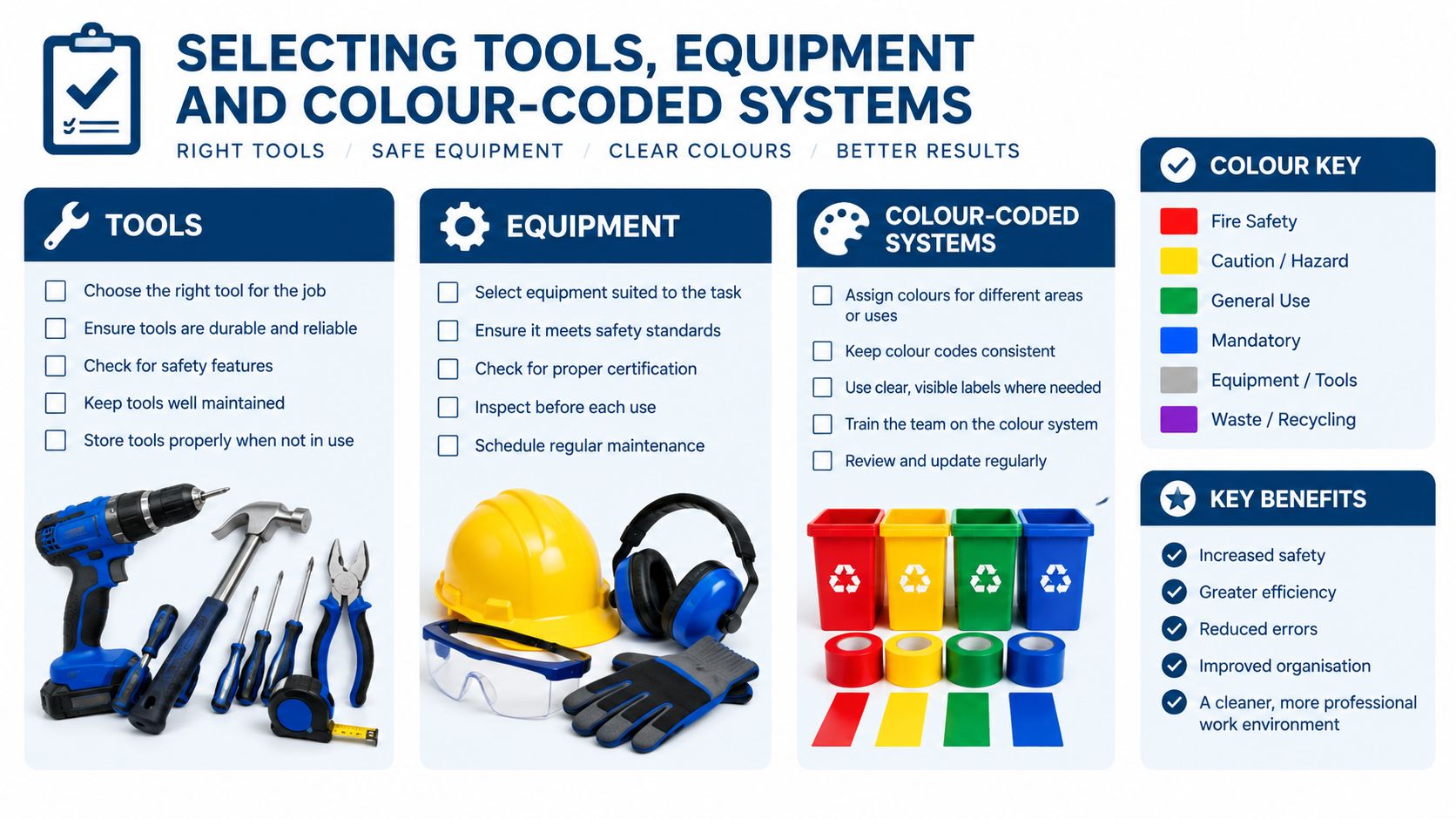
Chemicals only work when staff have the right way to apply, remove and store them. A practical commercial cleaning supplies checklist therefore includes microfibre cloths, sponges, scourers, brushes, brooms, dustpans, mops, buckets, squeegees, spray bottles where approved, cleaning caddies, gloves and wet-floor signs.
Separate tools by zone
Colour coding can reduce the chance that the same cloth, mop or brush moves from a washroom to a food-preparation bench. New Zealand doesn't have one universal colour system that every venue must use, so the important principle is consistency rather than a particular colour.
A venue could assign separate colours for:
- Food preparation.
- General kitchen.
- Bathrooms.
- Front of house.
The system should be written down, labelled where staff store equipment, explained during training and checked during routine supervision. Colour alone isn't enough if staff don't understand the boundary between zones.
Cloths need particular attention. They should be changed and cleaned according to the relevant food-safety procedure, stored so they dry properly between uses and kept from travelling through the entire premises. MPI guidance says cleaning cloths should be washed after each day's use. A cloth that remains damp, dirty or unidentified can spread soil instead of removing it.
The same principle applies to mop heads, buckets, brushes and squeegees. The mops and mop heads range can help operators compare options, but selection should still reflect floor type, cleaning method, storage space and the ability to launder or replace heads appropriately.
Verify the dishwasher process
Dishwasher performance depends on the machine, chemical system, temperature, contact time, soil load and maintenance. FSANZ guidance states that heat-only sanitising requires at least 77°C for more than 30 seconds, while lower temperatures require longer contact times. The FSANZ food-premises and equipment guidance also directs operators to check the dishwasher manufacturer's instructions for adequate temperature and time.
Operators may need temperature checks, test strips or other verification tools where appropriate. A chemical won't make up for food residue left on a plate, an incorrectly loaded rack, blocked spray arms or a machine that isn't reaching its required performance.
A clean tool is part of the cleaning process. Mops, buckets, brushes, cloths and squeegees need their own cleaning, drying and storage routine.
Managing Chemical Safety, Dilution and Compliance
Cleaning products are a significant workplace chemical exposure in New Zealand. WorkSafe's worker exposure survey identified cleaning products as the most commonly reported specific exposure at 68.7%, compared with solvents at 30.3% and degreasers at 20.2%. The WorkSafe worker exposure survey also reports that about one in three New Zealand workplaces use, manufacture, handle or store hazardous substances.
WorkSafe estimates that hazardous substances contribute to approximately 600–900 deaths and 30,000 cases of serious work-related ill health each year in New Zealand. Those figures support a checklist that covers chemical management, not just purchasing.
Keep products identifiable
Each hazardous substance should appear in the workplace inventory. WorkSafe says the inventory should identify the product or chemical name, include its United Nations number where available, and record storage or segregation requirements. Include small-quantity products rather than assuming they're too minor to matter.
A current Safety Data Sheet, or accessible condensed version of its key information, must be available for each workplace hazardous substance regardless of the quantity held, subject to limited exceptions such as consumer products used consistently with household use. WorkSafe explains that the SDS must be accessible to workers and emergency responders and should cover safe use, storage, transport, disposal, PPE, first aid, spills and fire response. A new SDS is required when the substance is first supplied, when five years have passed since it was last supplied, or when it's supplied after changes to the SDS. These requirements are set out in WorkSafe's safety data sheet guidance.
The chemical checklist should include:
- Product name and inventory entry.
- Clearly labelled original container.
- Accessible SDS information.
- Storage location and incompatibilities.
- Spill-response materials.
- Required gloves, eyewear or other PPE.
- Ventilation requirements.
- Staff training and induction records.
- Hazardous-waste arrangements.
Never mix cleaning chemicals
Staff should follow the product label, SDS where applicable, correct dilution, required contact or dwell time, PPE instructions and storage requirements. Cleaning chemicals must never be mixed, including improvised combinations made to create a “stronger” cleaner. Incompatible products can produce dangerous reactions or harmful vapours.
MPI guidance says cleaning and sanitising chemicals must be kept separate, clearly labelled, never stored in product containers and used only by staff trained in safe handling. They must also be stored away from food. General information on home sanitizing best practices can help clarify terminology, but commercial venues must follow the specific product, food-safety and workplace requirements that apply to their operation.
Concentrates can reduce packaging and storage requirements and may offer a lower cost per diluted litre, but only when staff have accurate dosing equipment and training. Ready-to-use products can simplify use and reduce dilution errors, but they may require more storage space and create different packaging considerations. Neither format is automatically safer or cheaper.
The commercial cleaning chemicals guide can support product comparisons, while the final decision should follow the label, SDS, manufacturer instructions and venue risk assessment.
Stock Control, Dispensers and Master Schedules
A venue that runs out of sanitiser, hand soap, paper towels, toilet paper, gloves or bin liners during service has a stock-control problem, not just a purchasing problem. The checklist should show what is on hand, how quickly it's used, how long replenishment takes and what backup stock is sensible for that particular venue.
Set reorder points from real use
For frequently used items, use:
Average weekly use × supplier lead time + sensible safety stock = reorder point
The same approach can apply to dishwasher chemicals, hand soap, paper towels, toilet paper, bin liners, gloves, cloths and cleaning chemicals. Usage differs sharply between a small café, a hotel, a caterer and an institutional kitchen, so universal par levels are unreliable.
A practical stocktake records:
- Product and pack size.
- Current quantity.
- Average weekly use.
- Supplier lead time.
- Reorder point.
- Storage location.
- Opened-date or rotation notes where relevant.
- Person responsible for checking stock.
Keep essential backup stock accessible but not excessive. Over-ordering ties up storage space and can leave products forgotten, expired or separated from their SDS information.
Check dispensing infrastructure
A refill only works if it fits the system. Include hand-soap dispensers, paper-towel dispensers, toilet-roll dispensers, approved spray bottles, chemical dosing systems and any other dispensing equipment used by staff.
The dispenser machine options can prompt a useful compatibility check before a venue changes from ready-to-use products to concentrates. Staff shouldn't have to guess how much product to pour, and a concentrated chemical shouldn't be transferred into an unlabelled bottle.
Link purchasing to a cleaning schedule
The master schedule should answer:
What needs cleaning → how it's cleaned → which product and tool are used → how often → who is responsible → how completion is recorded
Frequency should reflect the task, food-safety requirements, actual usage and manufacturer instructions. MPI's adaptable cleaning approach includes two-week cleaning records, reinforcing that assigned responsibility and documentation are part of an effective process.
A schedule also exposes purchasing gaps. If a task has no approved product, dedicated tool, storage location or sign-off field, the supplies checklist isn't complete.
The Printable Master Checklist and Next Steps
The following list can be printed for a stockroom walk-through. Items should be marked only when they're suitable for the venue's surfaces, equipment and procedures.
Chemicals
- ☐ Degreaser: Approved for the cooking and grease-heavy areas.
- ☐ Food-surface cleaner: Suitable for relevant food-contact areas.
- ☐ Sanitiser: Approved for the required food-safety process.
- ☐ Dishwashing detergent: Compatible with manual or machine warewashing.
- ☐ Rinse aid: Suitable for the dishwasher.
- ☐ Glass cleaner: For front-of-house glass and mirrors.
- ☐ Floor cleaner: Suitable for the actual floor finish.
- ☐ Bathroom and toilet cleaner: Dedicated to washroom tasks.
- ☐ Specialist cleaners: Only where the operation requires them.
Tools
- ☐ Cloths: Sufficient quantity, with zone separation.
- ☐ Sponges and scourers: Matched to surface types.
- ☐ Brushes: Including dish, grout and toilet brushes where required.
- ☐ Brooms and dustpans: Suitable for each area.
- ☐ Mops and buckets: With a cleaning and drying process.
- ☐ Squeegees: For floors or other suitable surfaces.
- ☐ Spray and dispensing equipment: Labelled and compatible.
- ☐ Cleaning caddies: Supporting zone separation.
- ☐ Wet-floor signs: Available where floors are being cleaned.
Hygiene and PPE
- ☐ Hand soap
- ☐ Paper towels or hand-drying supplies
- ☐ Gloves
- ☐ Other PPE required by product instructions
Waste
- ☐ Correct bin-liner sizes
- ☐ Heavy-duty kitchen liners where needed
- ☐ Recycling or waste-stream liners where applicable
Washrooms
- ☐ Toilet paper
- ☐ Hand soap
- ☐ Hand drying
- ☐ Toilet cleaner
- ☐ Dedicated washroom tools
Stock control and compliance
- ☐ Current stock checked
- ☐ Reorder points established
- ☐ Backup stock available
- ☐ Products correctly labelled and stored
- ☐ SDS information accessible where required
- ☐ Cleaning schedule assigned and recorded
- ☐ Chemical inventory updated
- ☐ Colour-coded system documented and staff trained
The checklist can also be converted into a staff-room document or digital reference. Operators considering PDF QR code tips from LinkShip may find a practical way to make the current procedure accessible without relying on a printed copy that quickly becomes outdated.
A strong commercial cleaning supplies checklist is built around the work the venue performs. It identifies the task, surface, product, tool, safety control, storage requirement and stock level, then connects each one to a cleaning schedule that staff can follow consistently.
Hospitality supplies commercial cleaning chemicals, dishwashing products, cloths, gloves, paper products, rubbish bags and cleaning tools for New Zealand hospitality operations. Visit Simply Hospitality to review suitable categories or contact the team for help matching supplies and dispensing systems to the venue's equipment, workflow and compliance requirements.