


Commercial Dishwasher Spray Nozzle Faults and Fixes
A commercial dishwasher spray nozzle is the shaped opening that directs wash or rinse water onto ware inside the machine. A wash arm that still spins doesn't prove every jet is clear, because rotation can continue while one or more openings are partly blocked.
Popular advice tends to stop at that spin test, or at the temperature shown on the display. That's not enough in a working wash-up. A restricted jet can leave the same corner of a rack dirty cycle after cycle, while staff add detergent, extend pre-rinsing or put the load through again.
Three separate issues often get bundled together. A blocked internal jet is a cleaning and inspection job. A cracked or worn jet is a correct spare part job, matched to the exact machine. A tired pre-rinse gun at the sink is a different purchase altogether, and it can't fix poor coverage inside the chamber. Sorting out which problem is present saves money, protects wash results and stops a small part being blamed for faults in loading, filters, chemicals or water supply.
What a Commercial Dishwasher Spray Nozzle Does
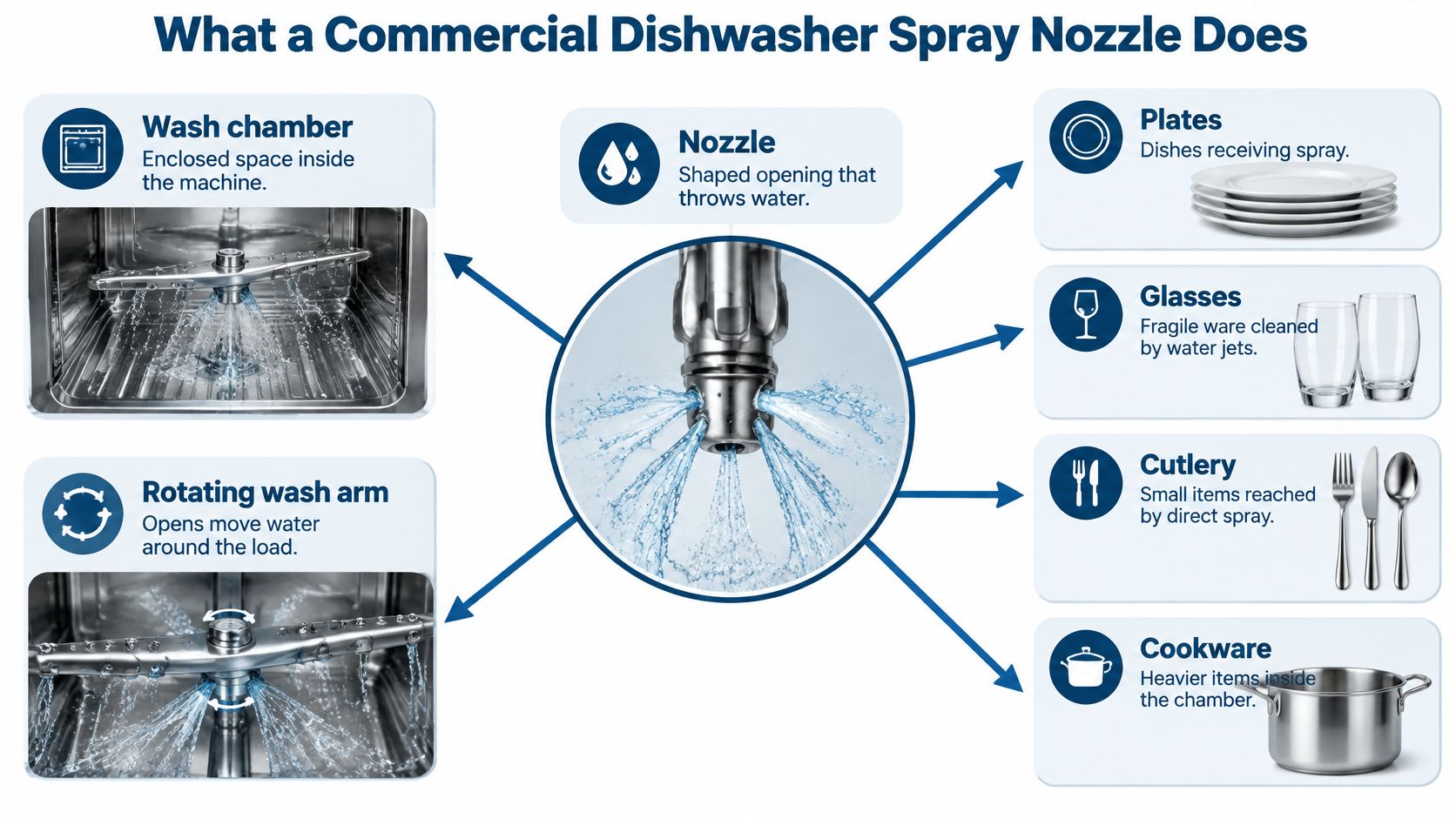
Every drop of wash and rinse water that reaches ware inside the chamber passes through a commercial dishwasher spray nozzle. On most machines those openings sit in a rotating wash arm or in a separate final-rinse assembly, so each nozzle works as part of a designed spray pattern rather than as a loose fitting that can be swapped by eye.
Four Parts That Get Mixed Up
In a hotel kitchen at the end of service, a request for "a new spray nozzle" can refer to four different parts depending on who picks it up. Sorting out which one is needed stops the wrong spare being ordered and the wrong fault being chased.
- Wash nozzles: Circulate detergent solution during the wash stage and provide most of the mechanical action that lifts food soil.
- Final rinse nozzles: Apply clean rinse water near the end of the cycle, so a weak rinse jet shows up as spotting, film or ware that doesn't dry cleanly.
- Complete spray arms: Include the bar, bearings, end caps and nozzles, and on some machines the whole arm is the only listed spare.
- Pre-rinse spray nozzles: Sit on a tap or hose at the commercial sink and strip loose food before the rack enters the machine.
Similar looking plastic or metal tips can have different threads, spray angles and flow characteristics. A lookalike from another model, or a tip taken off the sink gun, isn't a substitute even if it appears to fit. The opening is sized for a particular arm, pump and rack layout.
Why a Small Opening Has a Large Effect
In a café, a weak jet often shows first on glasses, where a narrow bowl needs direct spray to clear milk or lipstick. In a restaurant pass, the same fault may show on one corner of a plate rack, with sauce surviving on plates that sat in the same position. Cookware makes the problem clearer still, because heavy pans need sustained impact rather than a light mist.
A nozzle doesn't clean on its own. It delivers heated, dosed water to the right surface at the right angle, and the rest of the system has to support that delivery.
Hospitality carries Refrigeration & Dishwashing brands including Classeq, Rhima and Winterhalter, and can help match a nozzle or complete arm to the machine's make and model. Checks beyond what the machine's manual permits the operator to do belong with a qualified technician.
Internal Nozzles Compared with Pre-Rinse Guns
A wash arm that still spins proves the bearings turn and water reaches the bar. It proves nothing about whether the jets along that arm are open, and it says nothing at all about the gun at the sink. A restricted internal jet, a lookalike spare and a worn pre-rinse gun are three different problems, and each gets fixed in a different place.
| Feature | Internal dishwasher nozzle | Pre-rinse spray nozzle |
|---|---|---|
| Purpose | Directs wash or final-rinse water onto ware in the chamber | Removes loose food at the sink before washing |
| Where it sits | Wash arm or rinse assembly inside the machine | Tap, deck or hose at the commercial sink |
| Water supply | Recirculated wash water or the machine rinse supply | Mains or pre-rinse valve supply |
| Common fault | Blocked jet, scale, worn arm or wrong seating | Worn face, leaking hose, tired trigger or poor shut-off |
| Maintenance | Isolate, cool, clean permitted parts and refit as designed | Check hose, seals, trigger and spray face |
| Replacement check | Manufacturer, model, serial if required, part number and position | Spray style, hose length, handle comfort and sink layout |
| Limit | Cannot pre-rinse at the sink | Cannot replace an internal wash or rinse component |
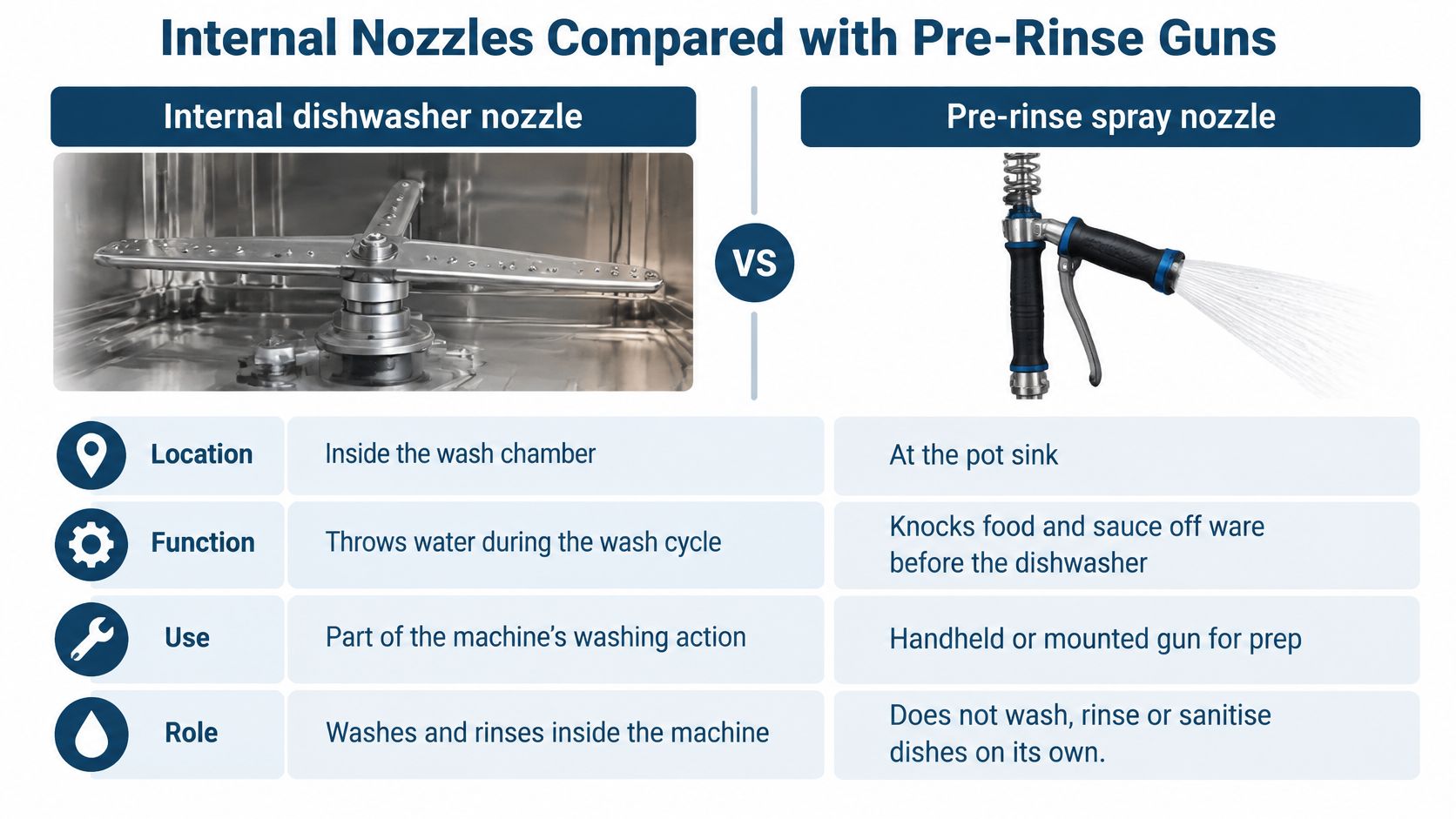
The pre-rinse spray nozzle is the other meaning behind many searches for spray nozzles. It sits on a tap or hose at the pot sink and knocks food and sauce off ware before the dishwasher cycle. It doesn't wash, rinse or sanitise the load, and an internal nozzle can't be taken to the sink to do that preparatory work.
What Pre-Rinsing Does Well
Good pre-rinsing keeps heavy soil, napkins, labels and other debris out of the wash tank and filters. That reduces the loose material that can later lodge in a spray arm opening. It doesn't excuse skipping the scrape, and it doesn't correct overloaded racks or nested bowls that block jets inside the chamber.
A gun with a worn spray face leaves a thin smear of sauce or a scatter of rice on plates that look clean at a glance. That residue goes into the machine with the rack. Filters fill sooner, tank water dirties faster, and fine particles start turning up inside spray arm openings where they narrow the jets. When wash results slide, the sink gun belongs on the checklist alongside the arms.
Choosing a Pre-Rinse Unit
Selection usually comes down to sink layout, volume and staff comfort. A deck-mounted unit suits a tight sink where a wall arm would crowd the bench, while a longer hose helps with large trays and gastronorm pans. Spray force needs balancing against splash, trigger fatigue and water use during a busy pass.
- Spray face and shut-off: Check that the gun closes cleanly and doesn't dribble onto the floor between racks.
- Hose condition: Look for kinks, abrasion and loose fittings, because a leaking hose is a slip and water waste problem.
- Ergonomics: A handle that suits the people on wash-up gets used properly through a long service.
Commercial dishwashers, pre-rinse units and sink accessories are separate ranges, and accessories shouldn't be mistaken for nozzle spares. A Modular Stainless Dishwasher Basket Cassette, for example, is a stainless basket cassette for organising commercial dishwasher racks within a wash-up station. It gives spare or sorted baskets a defined home close to the machine and keeps the floor and working bench clear, but it doesn't change spray coverage.
How Wash and Rinse Spray Patterns Form
A rack of breakfast plates, glasses and cutlery goes into a hood machine on a standard cycle. The pump pushes wash water through the arms first, and each opening throws a jet across the rack. Hole position and direction decide whether that jet strikes the face of a plate, reaches inside a glass or passes over the top of a gastronorm pan.
Detergent travels in the recirculated wash water, so a weak wash jet cuts both mechanical action and chemical contact in that zone. Final rinse is a separate pass of clean water through its own assembly. A machine can wash acceptably and rinse poorly, or rinse well while baked-on soil stays put where a wash jet is restricted.
Rotation, Seating and Flow
Rotation spreads the jets around the load, but only while the arm is correctly seated, free to turn and fed enough flow. A spoon handle hanging through a rack, a tall jug or a tray laid across the arm path can stall rotation for part of a cycle. Ware above the stalled section then gets repeated spray along one line and almost none elsewhere, which reads as a washing fault even though every hole is clear.
Pressure, temperature and litres per cycle differ between makes and programmes, so a Classeq, Winterhalter or Rhima unit should be read against its own manual rather than a headline water figure. Fixed-format racks change the jet path as well. A 500mm glass rack with 36 compartments holds glasses at a set height and spacing, so openings angled for loose-loaded plates do not reach the load in the same way. Where scale starts narrowing the holes themselves, how water quality affects dishwasher performance becomes the next thing to check.
Temperature Is Not Proof of Coverage
New Zealand's historical baseline explains why heat and contact both matter. The Food Hygiene Regulations 1974 required utensils cleaned in a machine to undergo a wash cycle at no less than 60°C, followed by a clean-water rinse at no less than 77°C for at least 10 seconds, and set hot-water supplies at no less than 63°C for sinks and other utensil-washing equipment.
Those figures are benchmarks under a framework that has since evolved, but the operational point still holds. Blocked, worn, misaligned or poorly pressurised nozzles can leave cold or unwashed zones even when the displayed temperature looks compliant. A compliant reading says nothing about whether every jet reached the ware.
The practical test is pattern rather than appearance. If the same rack position fails every cycle, match that dirty zone to arm position and jet direction before changing chemicals. If failures move around with the load, the loading itself is the stronger suspect.
Signs a Spray Nozzle Needs Attention
The first sign usually sits on the ware, not the machine. A rack comes out with egg dried onto one row of plates or a film left on the bowls, while the cycle sounded and timed exactly as normal. MPI draws the line that matters in its food service document: cleaning removes dirt and grease, while sanitising kills harmful organisms. Soil left behind is a cleaning failure, and machines should be run and serviced to the manufacturer's instructions, which also sets the boundary for what an operator may inspect.
Blocked or partially blocked jets produce uneven coverage and leave protein or starch deposits behind. That pattern often triggers false detergent or temperature diagnoses, because the ware looks as though the chemical failed. The useful question is whether the soil lines up with a rack position, one arm or a single opening.
Reading the Symptoms in Order
A closing manager notices results first, then the machine. Food residue after a full cycle may point to a restricted jet, but incorrect rack loading, unsuitable chemicals, inadequate water supply, blocked filters and other faults cause the same complaint. Treating every poor result as a defective nozzle gets parts changed while the cause stays in place.
Uneven results across one rack are more specific. If plates on the left wash cleanly while plates on the right keep a film of egg or rice, the jets nearest that zone become the suspects. Areas that come out almost dry suggest water never arrived, so arm seating and visibly clear openings are the first checks.
Visible evidence separates soil from damage. Crumbs, labels or rice sitting in holes are debris that may come out with permitted cleaning. White crust around an opening points to mineral scale, more likely where local water is hard. Cracked, melted or missing tips are physical damage, and a worn spray-arm bearing or distorted jet will not be corrected by flushing.
| Symptom | Possible cause | Recommended check |
|---|---|---|
| Food residue after a full cycle | Restricted jet, loading, chemical, filter or supply fault | See whether the same rack position fails every cycle |
| Uneven results on one rack | One opening blocked or aimed the wrong way | Match dirty zones to nozzle positions |
| Areas left almost dry | Water not reaching that zone | Check arm seating and whether jets are visibly clear |
| Debris sitting in openings | Food soil | Inspect and clean only as the manufacturer allows |
| White crust around holes | Mineral scale | Note local water and follow the descaling method |
| Cracked, melted or missing tips | Physical damage | Stop using that arm and match a model-specific spare |
| Arm slow or not rotating | Obstruction, seating or bearing wear | Confirm it is free, then look beyond the nozzle if it still stalls |
| Inconsistent or spotty rinsing | Rinse nozzles, rinse aid or rinse temperature | Separate rinse-arm condition from chemical and temperature checks |
Where the manual allows the arm to come off, a flow test isolates a single suspect jet. Run water into the arm through its hub or mounting point and watch every opening under the same supply. A clear jet throws a steady, directed stream. A restricted one dribbles, fans sideways or stays dead, and because every jet receives identical water, the odd one out names itself.
Separating Rinse Faults from Wash Faults
Spotty rinsing needs its own line of checking. The rinse arm may be scaled, the rinse aid may be empty or incorrectly dosed, or rinse temperature may sit outside the machine specification. Glasses usually show it first, which is why what causes spotty glassware is worth ruling out before a rinse nozzle is condemned.
An arm that turns slowly or stalls has several possible causes. Ware may obstruct it, it may be unseated after cleaning, a blocked filter may starve it of flow, or the bearing may be worn. Freeing an obstruction is an operator task on many machines. Replacing a bearing or chasing pump supply may not be.
Practical rule: Repeat soil in the same place points to pattern or loading. Random soil across every rack points more often to soil load, filters, chemicals or water supply.
Smaller cafés, marae, aged-care kitchens and accommodation sites often run without a dedicated engineer or a written preventive schedule. A simple log of which rack position failed, what ware was affected and whether the pattern repeated gives those sites a firmer basis for cleaning, ordering a part or calling a technician.
How to Clean Spray Nozzles Safely
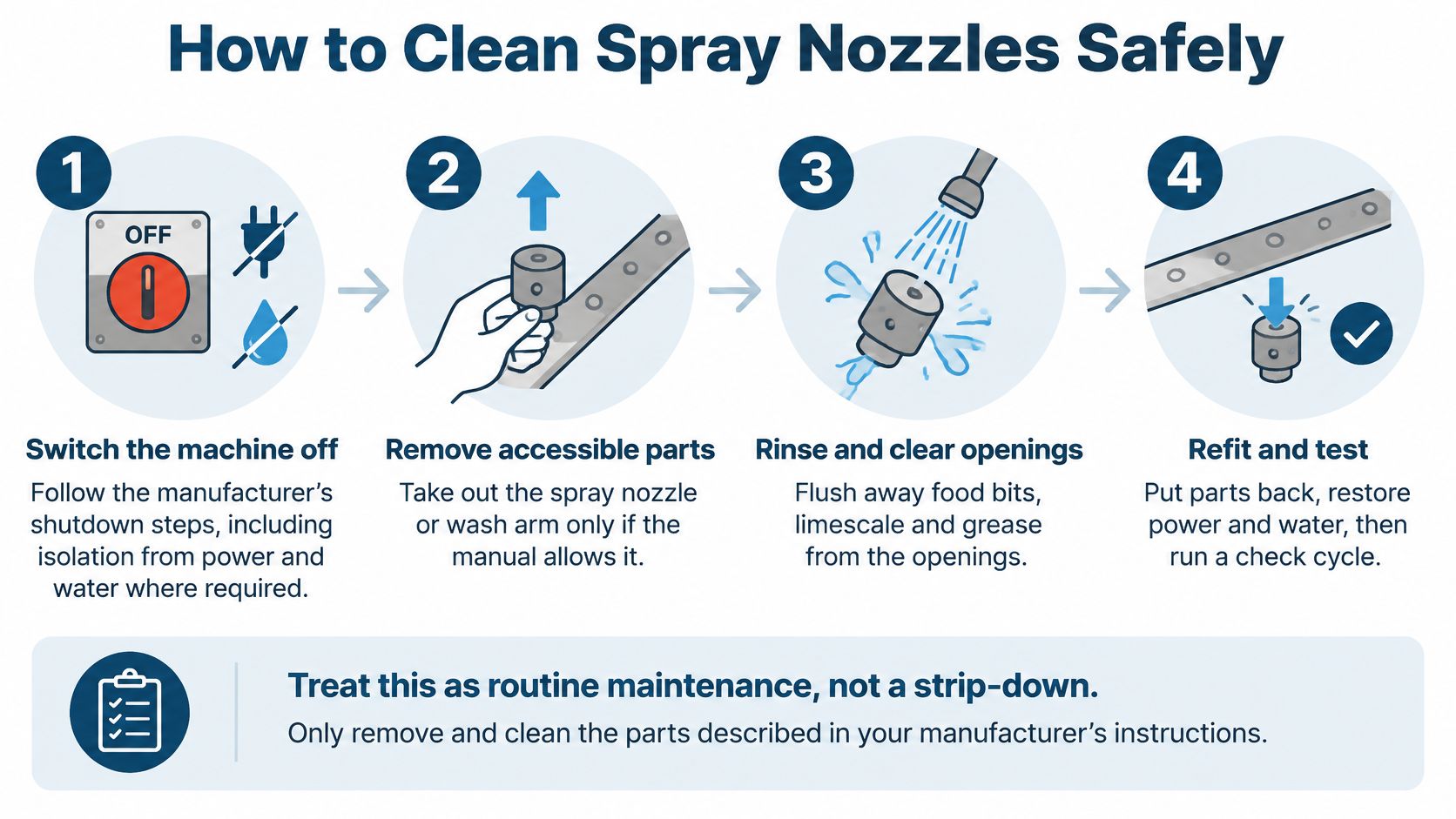
Cleaning a commercial dishwasher spray nozzle should be treated as routine maintenance, not as a strip-down. The manufacturer manual for the exact machine sets the boundary between parts an operator may remove and work reserved for a technician. If the manual says an arm is technician only, work should stop at external inspection and result monitoring.
A Conservative Eight Step Routine
- Switch the machine off: Follow the manufacturer's safe shutdown instructions, including isolation from power and water where the manual requires it.
- Allow components to cool: Let arms, nozzles and the wash chamber cool before anyone reaches inside.
- Locate the assemblies: Find the wash arms and any separate rinse assembly named in the instructions, rather than guessing from appearance.
- Remove only permitted parts: Take out accessible components only where the manufacturer permits operator removal.
- Inspect every opening: Look for food debris, labels, mineral deposits, cracked edges and missing caps.
- Clean by the recommended method: Use the flushing, soaking or brushing method and chemical specified for that machine, then rinse loosened soil away.
- Reassemble correctly: Refit caps, arms and filters in the original orientation and seat them fully.
- Check operation: Run the machine as the instructions describe and watch coverage, rotation and leaks before returning it to normal service.
One simple tip is to note which arm came from which position before cleaning starts. Upper and lower arms aren't always interchangeable, and a reversed cap can send a jet in the wrong direction. Photographing the seated position before removal helps where the manual diagrams are limited.
Tools and Chemicals That Cause Damage
Nozzle openings shouldn't be enlarged with a drill, knife, screwdriver or stiff wire. The opening is a sized part of the spray pattern, and making it larger can weaken neighbouring jets, distort the fan or crack plastic around the hole. Picking at scale with a sharp tool can also leave a rough edge that catches fibres and food sooner.
Unsuitable cleaning chemicals create a similar problem. Aggressive products can craze plastic, mark stainless steel, damage seals and leave residue in the sump that affects later cycles. Where scale is the issue, operators should follow the machine procedure and use a suitable commercial dishwasher descaler approach rather than abrasive tools.
Chemical and Pressure Safety
Concentrated detergents, rinse aids and sanitising chemicals make spray assemblies a splash risk as well as a cleaning component. WorkSafe guidance on hazardous substances requires businesses to manage hazardous substances safely, including safe handling and maintaining an inventory of substances. WorkSafe records a New Zealand incident in which a pressurised hose carrying hazardous liquid disengaged from its clamp and sprayed a worker's eyes, causing chemical-burn injuries.
That record is a useful reminder to inspect more than blocked holes. Hoses, clamps and connections should be checked for secure fitting, wear and leaks, and safe isolation should happen before maintenance. Nobody should open pressurised or electrically energised equipment to reach a nozzle, and gloves or eye protection should follow the chemical safety data for products in use.
If a correctly cleaned arm still produces a distorted jet, the part may be worn rather than dirty. Repeated forceful cleaning at that point usually damages the opening further. The next step is comparison against the replacement criteria, not a larger tool.
Preventing Problems and Making the Call
Cleaning removes soil. It doesn't restore a part that has changed shape, and that distinction decides most spray nozzle calls. A jet blocked by rice can often be cleared, while a cracked tip, oval opening or broken retaining clip needs replacement with a part verified for the exact machine.
MPI guidance in its food service template material specifies pre-cleaning, hot detergent washing, a clean hot-water rinse and air-drying, and requires clean water for food-preparation cleaning. A restricted jet undermines that sequence because staff may add detergent, extend cycles, rewash racks or increase pre-rinsing to compensate for poor coverage. Increasing chemical concentration isn't a substitute for mechanical coverage.
Clean, Inspect or Replace
| Condition | Clean, inspect or replace? | Reason |
|---|---|---|
| Loose food debris in openings that are still the original shape | Clean | Soil can be removed without changing the jet |
| Scale film on an intact arm | Clean and descale | Mineral buildup may clear if the material is undamaged |
| Arm spins but one jet looks weak | Inspect, then clean | Rotation does not prove every opening is clear |
| Opening enlarged, oval or rough | Replace | The spray pattern has changed and the hole must not be redrilled |
| Crack, break or missing piece | Replace | The part cannot hold pattern and may shed fragments |
| Clip, cap or thread will not hold | Replace | A loose nozzle can misdirect water or fall into the sump |
| Blockage returns straight after correct cleaning | Inspect supply, filters and chemicals; replace only if the part is distorted | The cause may be upstream of the nozzle |
| Manual lists a complete arm, not a nozzle | Replace the arm | Individual nozzles may not be a serviceable spare |
Persistent blockage after a correct clean may point to scale bonded into the part, chemical damage or soil arriving from elsewhere. Blocked filters, heavy pre-rinse soil and hard water can refill a cleaned opening quickly. Replacing the nozzle without checking those upstream causes can produce the same failure with a new part.
Incorrect spray direction after reassembly is often more mundane. A reversed cap, an arm fitted in the wrong position or a distorted tip can all send water away from the rack. Operators should check orientation against the manual before concluding that a replacement part is faulty.
The Hidden Cost of Working Around a Weak Jet
A partially blocked nozzle reduces jet velocity and alters spray-angle distribution, creating shadow zones where proteins and starches remain. The Commerce Commission guidance on water efficiency labels notes that New Zealand WELS rules require dishwashers sold in the country to display water-efficiency information, with the rating determined using a specified wash programme at rated capacity. Blocked nozzles can cause repeated cycles, which negates nominal efficiency gains in restaurants, hotels, aged-care kitchens and institutions.
Water-use figures quoted for commercial machines are model-specific and shouldn't be generalised to every machine on a site. Operators should record rack volume, cycle failures, rinse temperature and nozzle condition before judging efficiency. The lowest advertised litres per cycle doesn't automatically deliver the lowest total operating cost if racks need rewashing.
Rewashing also costs labour, tank heat, chemicals and service time, and rejected ware can slow a pass at the worst moment. Restoring a sound nozzle by cleaning is usually the cheapest first step. Replacing a damaged arm is the cost of restoring the designed pattern, not an optional upgrade.
A Prevention Routine Kitchens Can Keep
- Scrape before loading: Remove food waste at the bench so the tank and filters aren't used as a bin.
- Clean machine filters: Follow a schedule staff can maintain during and after service, because starved flow weakens every jet.
- Inspect accessible wash arms: Check nozzle openings whenever results slip, not only at a monthly service.
- Load racks correctly: Keep trays, bowls and tall items from blocking rotation or shadowing smaller ware.
- Use specified chemicals: Match detergent and rinse aid to the machine and water conditions rather than increasing dose to mask poor coverage.
- Manage scale buildup: Descale according to site water hardness and the manufacturer procedure, since water quality influences mineral deposits.
- Monitor wash results: Record repeat failures by rack position so pattern faults are visible early.
- Follow the service schedule: Use commercial dishwasher maintenance routines and manufacturer intervals rather than waiting for a breakdown.
Hospitality carries Refrigeration & Dishwashing brands including Airex, Adande, Atosa, Classeq, Cossiga, Festive, Irinox, Rhima, SKOPE and Winterhalter. That range doesn't make parts interchangeable across brands, and availability of a specific spare still needs confirmation against the machine model.
A qualified technician should be called when the same fault returns after correct cleaning, temperatures won't hold, the machine leaks, an arm bearing is worn or the manual reserves the work for service. Repeated component replacement without that wider investigation usually treats the symptom rather than the cause.
Clean loose soil, descale intact parts, replace damaged parts and investigate filters, loading, chemicals and water when a sound part still washes badly.
How to Identify the Correct Spare Part
Correct identification starts from the machine data plate, not from a photograph of a similar tip. A commercial dishwasher spray nozzle may look generic, but its thread, clip, spray angle and flow are tied to a specific arm and model. Ordering by appearance is the most common avoidable mistake.
Information to Gather Before Ordering
- Manufacturer: Record the brand exactly as shown on the machine, such as Classeq, Winterhalter, Rhima or Starline.
- Exact model number: Copy every letter and digit from the data plate, because small suffix changes can mean a different assembly.
- Serial number: Include it where the parts list requires production identification.
- Part number: Note any number printed on the arm or listed in manufacturer documentation.
- Assembly and position: State whether the failed piece belongs to the upper wash arm, lower wash arm, rinse arm or a single nozzle, and which end is damaged.
- Material and fitting type: Identify whether the part is push-in, threaded or clipped, and whether caps or bearings are included.
Visually similar components may spray at a different angle, pass a different flow or use a different bearing. Operators shouldn't assume a part fits a family of models unless manufacturer documentation confirms that fit. Nothing is interchangeable across brands because the bar length looks close.
Genuine and Compatible Parts
Genuine manufacturer parts provide the clearest match to the original pattern and fitting. A compatible aftermarket component may be suitable where documentation supports its use, but warranty conditions can be affected and should be confirmed before installation. Price alone is a poor selector if the jet angle changes the result in one corner of every rack.
Some dishwashers don't offer an individual nozzle as a serviceable spare. In those cases the correct purchase is a complete upper wash arm, lower wash arm or rinse arm. Buying a single tip for such a machine wastes time and can leave the venue without a working assembly during service.
If the data plate is missing or unreadable, photographs of the plate area, the complete arm and the connection point help a supplier ask the right questions. Photographs don't replace model identity, though, and the old part should be kept until the replacement has been confirmed and fitted. That allows direct comparison of length, caps, clips and jet direction.
Operators who need a technician rather than a part can use guidance on finding commercial kitchen equipment service near me to separate supply questions from repair work. Confirming the specification with Simply Hospitality before ordering helps match the request to the exact model and position, without assuming stock or fit across machines.
If poor wash results keep returning to the same rack position, or a damaged arm needs identifying before a spare is ordered, contact Simply Hospitality for help confirming the machine details and the right warewashing equipment or consumables for the venue. A model number, assembly position and clear photo of the failed part make that conversation faster and reduce the risk of ordering a lookalike that doesn't restore the spray pattern.