


Commercial Kitchen Equipment Maintenance: A Practical Plan
Eleven forty on a Friday. Prep is half finished, the first bookings land at noon, and the walk-in has been running two degrees warm since the morning check. Nobody has time to deal with it now, so the door gets slammed, the seal gets wiped, and the problem is deferred to next week.
That is how most equipment failures begin. Not with a bang, but with a small signal that was noticed, logged mentally and pushed aside. The cost of the eventual failure is easy to underestimate, and the fix is almost always cheaper than the outage.
This is a practical guide to commercial kitchen equipment maintenance for New Zealand venues: which tasks kitchen staff can own, which belong to a qualified technician, how to record both, and how to decide whether a tired unit is worth fixing or replacing. It covers refrigeration, cooking equipment and warewashing, with reference to MPI food safety expectations and WorkSafe NZ guidance.
Why Maintenance Protects Service, Safety and Running Costs
At 11:40 on a Friday, the main oven fails and stays down for two hours. The lost production is obvious. The full cost is not.
If the disruption prevents $1,000 in sales, the hit is not $1,000 of lost profit. Subtract the food and labour those covers would have consumed, then add the emergency callout, spoiled stock, catch-up overtime and customers who do not rebook. A short outage can cost more than the parts or service that might have prevented it. Maintenance belongs in the operating budget, not just the emergency column.
Neglect brings predictable costs: breakdowns during service, slower performance as components work harder, food safety risks when temperature control or cleaning is compromised, and a shorter useful life for the machine. A missed gasket check can turn a small repair into lost service when the oven will not hold temperature.
WorkSafe's 2024 electrical and gas accidents annual report recorded 38 notifiable natural gas accidents involving cookers. Of the cooker cases reviewed, 15 cases (39%) were attributed to lack of maintenance. Gas equipment needs scheduled servicing by a qualified technician.
Three levels of care, not one
Kitchen staff can handle routine cleaning, visual checks, temperature logs and reporting changes. A qualified technician should carry out preventive servicing to the manufacturer's intervals and handle repairs involving gas, electrical or refrigeration systems.
Practical rule: if a task means opening a panel, bypassing a guard or touching a gas line, it is not a kitchen task.
Set aside a recurring monthly amount for maintenance, just as you do for cleaning chemicals. That makes planned work easier to budget for and reduces the chance that service costs arrive as an unexpected bill. The same scheduling discipline applies to servicing commercial air conditioning equipment. Reviewing what preventative equipment cleaning really saves can also help frame the cost of routine care against avoidable disruption.
Daily, Weekly and Monthly Maintenance Tasks and Who Owns Them
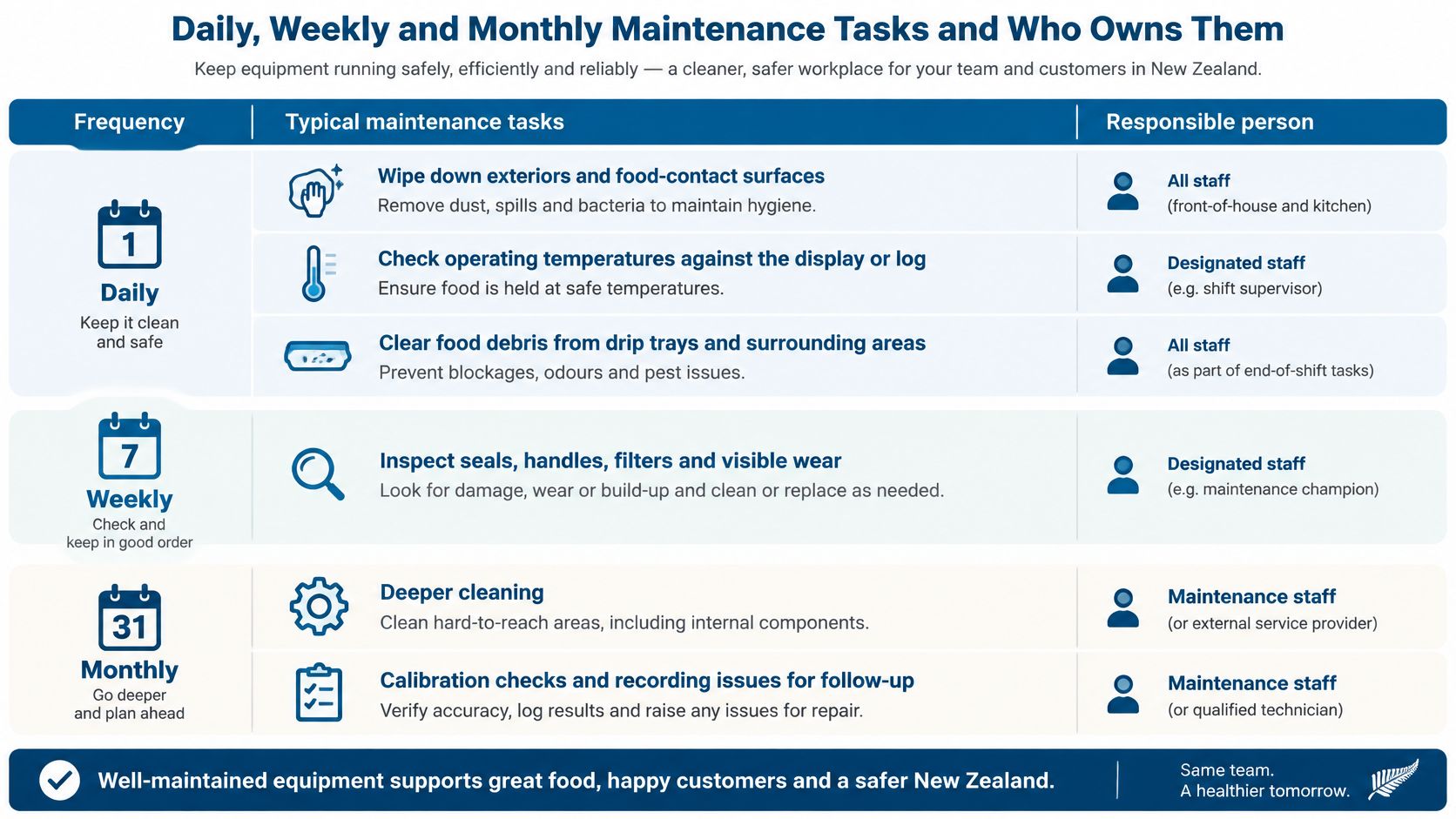
A busy service leaves little room for unclear responsibilities. Assign each task to a role and record what needs attention before a small fault disrupts the next shift.
| Frequency | Typical maintenance tasks | Responsible person |
|---|---|---|
| Daily | Clean exteriors and food-contact surfaces, check operating temperatures, remove food debris, report unusual noises or performance changes | Trained kitchen staff |
| Weekly | Clean filters and strainers where the manual allows, check door seals, clear drainage areas, confirm detergent and rinse aid supply | Kitchen staff, supervised by the shift lead |
| Monthly | Inspect accessible components, seals and filters, review the fault log for repeat issues, confirm cleaning programmes are followed | Kitchen manager |
| As the manufacturer specifies | Professional servicing, calibration, electrical and gas system checks, refrigeration system work | Qualified technician |
The daily tier is mostly observation dressed up as cleaning. Staff wipe exteriors and food-contact surfaces, check temperatures against the display or log, remove food debris, and report changes in noise or performance. Those observations give the manager useful information for deciding whether a fault needs attention.
Food-contact areas must be cleaned at least every day they are used, according to New Zealand food safety guidance. Cleaning removes dirt, grease and most microorganisms; sanitising reduces what remains on a clean surface. After maintenance or repair, clean and sanitise affected food-contact areas before the equipment returns to service.
Weekly tasks give staff a regular chance to catch deterioration: clean filters and strainers where the manual permits, check seals, clear drainage areas, and check detergent and rinse-aid stocks. The shift lead should confirm the work is done and pass on defects that need a manager or technician.
Monthly, the kitchen manager reviews the pattern rather than repeating daily cleaning. Check accessible components and seals, then review the fault log for recurring problems and confirm that equipment cleaning programmes are being followed. Record unresolved issues with an owner and a follow-up date.
Set the schedule according to equipment type, workload and the manufacturer's instructions. Use the task boundaries in the previous section to assign technical work; staff should report a problem rather than attempt a repair outside their training. Timely attention to small faults can help limit avoidable repair costs; cost insights from Sapper HVAC explain the wider cost of skipped maintenance.
Refrigeration Checks That Protect Temperature and Airflow
Two failure families account for most refrigeration complaints: warm air getting in where it shouldn't, and heat not getting out.
Checks in the order staff should do them
Door gaskets come first. Look for tears, gaps and hardened sections, then close the door on a sheet of paper. If the sheet slides out with no resistance, warm air is escaping through the same gap all day. A gasket is cheap. The compressor hours it costs are not.
Condenser cleaning matters next. Where the manual permits, brush or vacuum dust from accessible grilles. Never use a water jet near electrical parts, and never remove a panel that isn't designed to come off.
Temperature monitoring should be a written habit, not a glance. Log readings at the start and end of service and record drift, not just pass or fail. A chiller that used to hold 3 °C and now holds 5 °C is telling you something.
Airflow clearance gets lost to storage. Keep product away from rear vents, respect the clearance the installation documents specify, and stop overloading shelves.
Round it out with drainage (clear condensate lines so water doesn't pool), door usage (shut doors, limit open time during prep), ice accumulation (frost on the evaporator or door frame signals a fault, and it never gets scraped off with a metal tool) and unusual noises (rattling, constant running or short cycling gets logged and reported).
Blocked airflow raises the running temperature inside the cabinet. Damaged seals let warm, humid air in. Either way the compressor works longer to hold temperature, which puts stock at risk and shows up on the power bill. On common commercial units such as SKOPE and Atosa, the access points and cleaning instructions differ, so the manual governs what staff may touch. Professional servicing follows the manufacturer's schedule, not a guessed interval.
Rank faults by stock risk. A failing seal on a walk-in holding prepared food gets actioned before a cosmetic scratch, and every fault gets logged with its date and what was done. EECA lists regular maintenance of commercial refrigeration and HVAC among business energy actions, which is a useful argument when a repair quote needs sign-off. There's more detail in this guide to commercial refrigeration maintenance.
Cooking Equipment Care From Ranges to Combi Ovens
A faulty thermostat, blocked burner or poor oven seal can interrupt service and drive up energy use. Routine cleaning and checks cost staff time, but they can prevent avoidable downtime and protect food safety. Keep daily care within the manufacturer's instructions; send gas, electrical and safety-control faults to a qualified technician.
Ranges and griddles. Scrape plates while warm, empty grease trays before they overflow, and keep burner access clear. Convection ovens. Clean interiors, check door seals and keep fan areas free of debris. Deep fryers. Filter oil as the manual directs, drain and clean the vat, and report thermostat readings that do not match the dial. Chargrills. Manage grease collection and clean accessible burner areas only. Induction. Clean the glass, keep vents clear and check that the cooling fan runs.
Combi ovens need particular attention to water quality, approved cleaning chemicals and the programmed wash cycle. These affect scale, steam performance and element life. Using a generic descaler in a Unox, Convotherm or Giorik can damage equipment or undermine wash results. The Unox CHEFTOP MIND.Maps ONE is a 3-tray GN 1/1 chef-led combi oven. Its automatic washing function can reduce cleaning labour, while daily seal checks and the manufacturer's descaling schedule still need attention.
Follow the manual for each appliance. Instructions vary across Waldorf, Blue Seal and Cobra equipment, so do not assume the same cleaning method or service interval applies to every model. For appliance-specific tasks, see this guide to commercial oven maintenance.
Shutting down safely
- Switch off and isolate the appliance as the manual directs before cleaning or reaching inside.
- Let electrically heated equipment cool before handling racks or panels. Unplug it before removing racks.
- Let gas appliances cool and turn off the gas controls. Keep the area ventilated.
- Record faults for the technician. Do not use a workaround that leaves the machine unsafe or unreliable.
Burners, ignition systems, gas connections, safety cut-outs and electrical components require a qualified technician. Never bypass a safety device. Gas work must be done by a licensed trade, including licensed gas line installation in Caroline Springs.
Extraction needs planned attention too. WorkSafe NZ's local exhaust ventilation guidance describes a cycle of inspection, cleaning, repairs and records, with performance testing at least every 12 months or more often if the risk assessment or manufacturer requires it. Filter washing is only half the job; someone still needs to inspect the duct and fan, record defects and arrange repairs.
Dishwasher Care That Keeps Wash Results Consistent
A dishwasher that cleans badly is usually telling you about a blocked arm, a scaled element or a dosing fault. Work through the components in the order staff would check them.
Isolate first. Before any cleaning inside the machine, switch it off at the isolation point. WorkSafe's review of risk factors in the hospitality sector identifies kitchen machinery as a workplace hazard and makes the point that cleaning and servicing can create exposure unless equipment is isolated before work begins. Moving wash arms and hot surfaces are exactly that kind of exposure.
Filters and strainers come out after each service, get rinsed, and go back correctly seated. A strainer packed with debris blocks the drain and turns wash water into a soup of food soil.
Wash and rinse arms need their nozzles checked for blockage, cleared with a soft brush, and spun by hand to confirm they turn freely. One blocked jet shows up as a permanently streaky rack of glasses.
Detergent and rinse aid supply and dosing are a daily glance and a weekly confirmation. Under-dosing shows as film and spotting; over-dosing shows as foam and smearing. Neither is a machine fault.
What staff can do and what needs a technician
Scale is the technician's conversation. Water hardness drives scale on elements, spray arms and boilers, and the answer is water testing, a softener recommendation and approved descaler, not a stronger chemical guess. Wash performance gets checked against actual results after every cycle, with repeat issues logged. Door seals get wiped and inspected for splits before they start leaking down the front of the unit.
Routine cleaning on a Classeq, Winterhalter or Rhima unit is staff work, and the manufacturer's cleaning procedure governs it. Calibration, thermostat checks, dosing equipment and electrical or drain connections are technician work. This guide to commercial dishwasher maintenance covers the seasonal tasks in more depth.
Building a Register and Service Log You Can Trust
The difference between a maintenance programme and good intentions is a register. It also happens to be the evidence a food safety verifier will ask for.
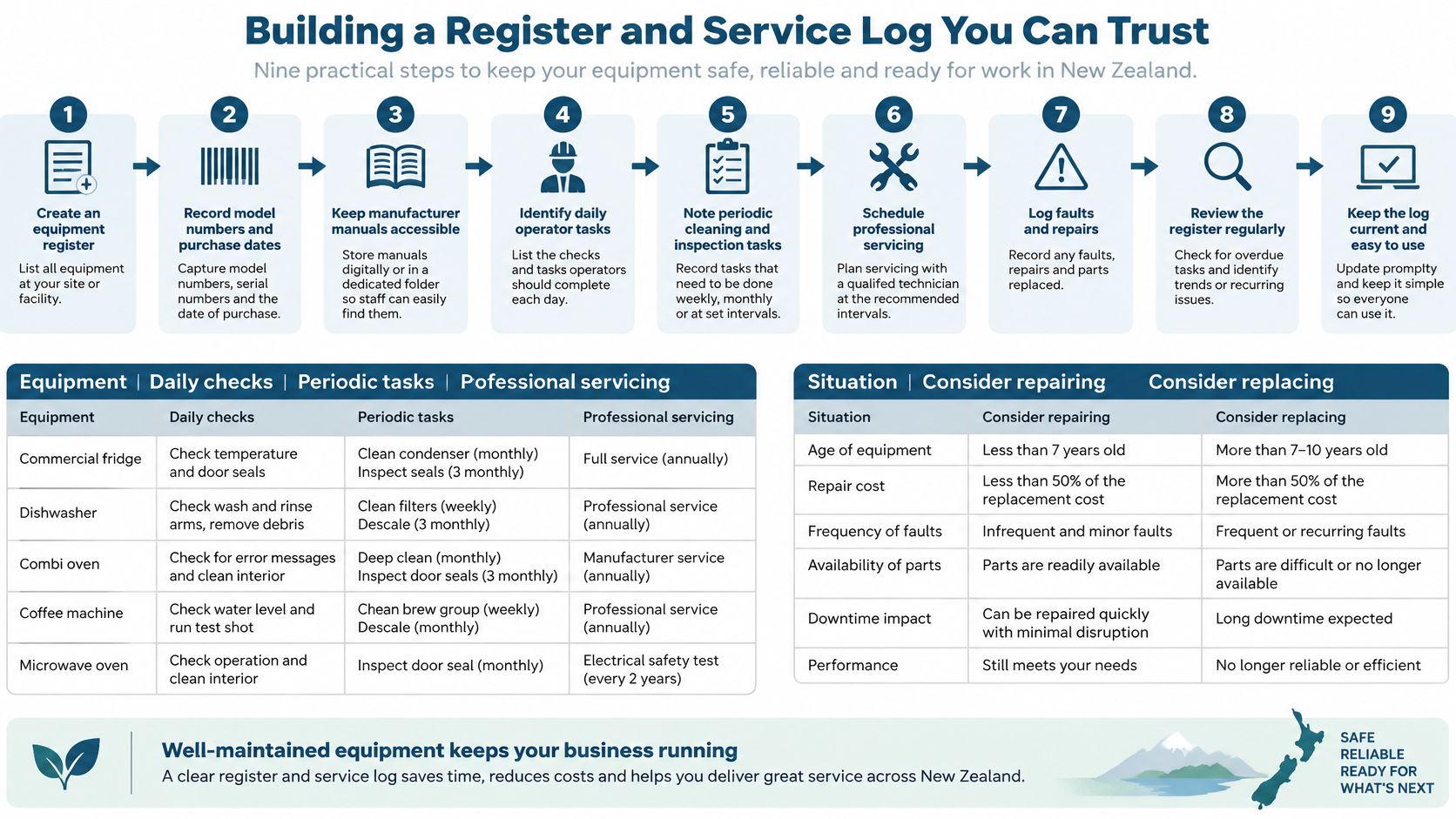
The nine-step framework
- Create an equipment register listing every unit that matters to service, with the most critical at the top.
- Record model numbers and purchase dates, because parts, manuals and warranty claims all start there.
- Keep manufacturer manuals accessible, digitally or in a folder the duty manager can find at 9pm.
- Identify daily operator tasks and write them into opening and closing checklists.
- Schedule manufacturer-recommended servicing for the year, ahead of peak trading.
- Assign responsibilities by name or role, so nothing waits for someone to notice it.
- Record faults and repairs, including who attended and what was replaced.
- Track recurring problems, since the same fault three times is a replacement signal, not a service schedule.
- Review replacement decisions annually with the fault history in front of you.
| Equipment | Daily checks | Periodic tasks | Professional servicing |
|---|---|---|---|
| Walk-in fridge | Check temperature log, door seal and unusual noise | Clean accessible condenser, clear drain, check airflow clearance | Per manufacturer schedule, by a refrigeration technician |
| Combi oven | Check water supply, cleaning programme completion and door seal | Check descaling and cleaning chemicals against the manual, inspect filters | Per manufacturer schedule, by a qualified service agent |
| Commercial dishwasher | Clean filters and strainers, check arms, check detergent and rinse aid | Inspect door seals, check scale, monitor wash results | Per manufacturer schedule, with technician calibration |
| Deep fryer | Filter oil as the manual directs, check drain and thermostat for visible faults | Clean accessible burner area, log oil changes | Per manufacturer schedule, by a gas or electrical technician |
MPI National Programme guidance requires food businesses to use equipment and facilities that are in good condition and working properly, service equipment regularly, calibrate measuring equipment such as thermometers and scales, and keep maintenance records. A custom Food Control Plan goes further and must document how equipment maintenance is managed: what is checked, how often, by whom, and what is retained.
Record-keeping note: a shared spreadsheet with dates, initials and fault notes beats a memory every time. Thermometer checks, refrigeration repairs, oven servicing and the corrective action after a failure should all sit in the same log.
Deciding When to Repair or Replace Equipment
| Situation | Consider repairing | Consider replacing |
|---|---|---|
| One fault on recent equipment with parts available | Get a technician's quote and compare it with the unit's condition | Replace if the repair is unlikely to restore reliable operation |
| Repeated breakdowns of the same component | Repair if the root cause is identified and addressed | Replace if the same fault keeps returning |
| Critical unit such as a walk-in cooler or main oven | Repair if a qualified technician can return it to safe operation promptly | Replace if downtime risk outweighs ongoing repair costs |
| Spare parts no longer available | Ask the technician whether a safe, practical repair is possible | Replace, particularly if the unit supports core service |
| Equipment old but running reliably | Keep it operating with routine maintenance | Do not replace solely because of age |
Age alone is a poor reason to replace a unit. Equipment with available parts and a clean fault history can remain useful for years. The true cost of a third callout to the same walk-in chiller in a season is the service you couldn't run.
Compare repair costs with the unit's condition, age, parts availability, breakdown frequency, energy efficiency, capacity, warranty coverage and replacement lead times. A machine running below capacity during a busy period can reduce covers without that loss appearing on the repair quote. Compare likely ownership costs, including energy use, downtime and product loss, rather than purchase prices alone. This guide to restaurant equipment repair outlines questions to ask before authorising work.
The handover that returns equipment to service
A completed repair does not automatically make a machine safe to use. The steps for returning food equipment to service include protecting or relocating food during the work, defining the work area, and controlling tools, parts and chemicals to prevent contamination. Clean and sanitise food-contact surfaces, check temperatures and operating controls, record who completed the work and when, and note any temporary limitations. A repair can fix the original fault and still introduce a food-safety risk if the work area and handover are poorly controlled.
At purchase, register Atosa, Jasper and Cookrite units for warranty coverage through the supplier's support page. Simply Hospitality supplies commercial refrigeration, cooking equipment, dishwashers and food-preparation equipment, along with cleaning chemicals and consumables to support maintenance routines. Choosing equipment to suit the work helps manage operating risk over its working life.
If you are reviewing equipment for your venue, browse Simply Hospitality's range of commercial refrigeration and cooking equipment, or ask about a model's suitability for your service needs.