


Choosing a Commercial Oven Cleaner for Your Kitchen
A Saturday-night service finishes with grease baked onto the oven walls, carbon around the door and a sharp odour when the unit heats again. The quickest response is often to grab the strongest bottle under the sink. That's usually the wrong decision. The right commercial oven cleaner must match the oven, the soil, the surface and the staff using it, with the label, Safety Data Sheet and manufacturer's instructions controlling every step.
For New Zealand kitchens, this is also a hazardous-substance decision. Commercial oven cleaners can fall under the EPA cleaning-product group standards, which require relevant labelling, safety data sheets, packaging controls and chemical inventory obligations for covered hazardous products (EPA cleaning-product group standard). Restaurants, cafés, bakeries, hotels, caterers and institutional kitchens need a cleaning process that removes grease without creating chemical exposure, equipment damage or food-contact contamination.
Why the Right Commercial Oven Cleaner Is About Fit, Not Strength
The strongest chemical on the shelf isn't automatically the best commercial oven cleaner. A heavy-duty alkaline product may shift established carbon from approved oven surfaces, but it can be unsuitable for aluminium, soft alloys, seals, coatings or components that the equipment maker says must not receive oven cleaner. A mild degreaser may be safer for routine work, yet struggle with polymerised grease and leave staff scrubbing harder for longer.
The practical decision has four parts:
- Equipment: Identify whether the unit is a convection oven, conventional oven, range, grill, deck oven or combi oven with an automatic wash system.
- Soil: Separate fresh grease and loose food residue from baked-on carbon and burnt spills.
- Product information: Check the exact application, dilution, contact time, PPE, rinse method and compatibility statement on the product label and SDS.
- Staff capability: Select a format and process that kitchen staff can follow consistently during real service conditions.
A common failure occurs when a chef treats a filthy combi oven like a basic stainless cavity. Automatic combi systems often rely on manufacturer-approved cartridges or liquids, and a generic spray product may be incompatible with seals, sensors, internal plumbing or the programmed cleaning cycle. The oven manufacturer's process takes priority.
Practical rule: If the oven maker or chemical manufacturer hasn't approved the combination, the product shouldn't be used simply because it cleaned another piece of equipment.
New Zealand-labelled SC Johnson Professional Mr Muscle instructions provide a useful example of how specific product directions can be. The product is directed for use in a cold oven only, at least 24 hours since the oven was last heated, with thorough rinsing and ventilation before reuse (Mr Muscle Oven Cleaner NZ instructions). The same label requires thick rubber or PVC gloves and eye protection, and prohibits use on self-cleaning or continuous-clean ovens.
A fit-first approach also protects the business from avoidable downtime. The purchasing question isn't “Which product is most aggressive?” It's “Which approved product removes this soil from this equipment without creating a bigger problem?” That principle sits alongside broader equipment ownership decisions discussed in buying cheap versus buying once.
Main Types of Commercial Oven Cleaners and What They Actually Do
Commercial kitchens generally choose between light-duty degreasers, heavy-duty alkaline oven cleaners, ready-to-use foams or aerosols, and dedicated combi-oven chemicals. They overlap in some applications, but they shouldn't be treated as interchangeable.
| Cleaner Type | Typical Chemistry | Best For | Avoid On / Watch-outs |
|---|---|---|---|
| Light-duty degreaser or neutral cleaner | Lower-aggression detergent or degreasing formulation | Fresh grease, daily wipe-downs, stainless exteriors and range surfaces | Usually inadequate for carbonised residue. Confirm compatibility with finishes and controls |
| Heavy-duty alkaline oven cleaner | Often based on strong alkaline chemistry such as sodium hydroxide or potassium hydroxide | Cold oven walls, racks, decks and established baked-on grease where approved | Aluminium, soft alloys, sensitive coatings, seals, heating elements and prohibited oven types |
| Ready-to-use foam or aerosol | Pre-mixed cleaner designed to cling to surfaces | Spot cleaning, vertical walls, range tops, grills and localised grease | Aerosol mist, ventilation, overspray and PPE requirements. Never assume convenience means low hazard |
| Combi-oven cartridge or liquid | Manufacturer-specific chemistry for automatic dosing systems | Automatic cleaning cycles in approved combi ovens | Generic oven cleaner, unapproved cartridges, incorrect dosing and incompatible internal components |
Heavy-duty alkaline products deserve particular care. A New Zealand SDS for a commercial oven cleaner identifies EPA Approval Code HSR002530 and classifies the product as an irritant to skin and corrosive to eyes (GreenR Oven Cleaner SDS). Another New Zealand SDS lists sodium hydroxide and potassium hydroxide with a TWA-Ceiling workplace exposure standard of 2 mg/m³ for each substance, which confirms that some oven-cleaning chemistry has explicit workplace exposure considerations rather than being handled like ordinary detergent (commercial oven cleaner SDS).
Ready-to-use foam can be sensible for a busy range or grill because it reduces measuring and can cling to vertical surfaces. Concentrate can suit a documented cleaning programme where trained staff can prepare the correct dilution. The right choice depends on whether the kitchen will use the product as specified.
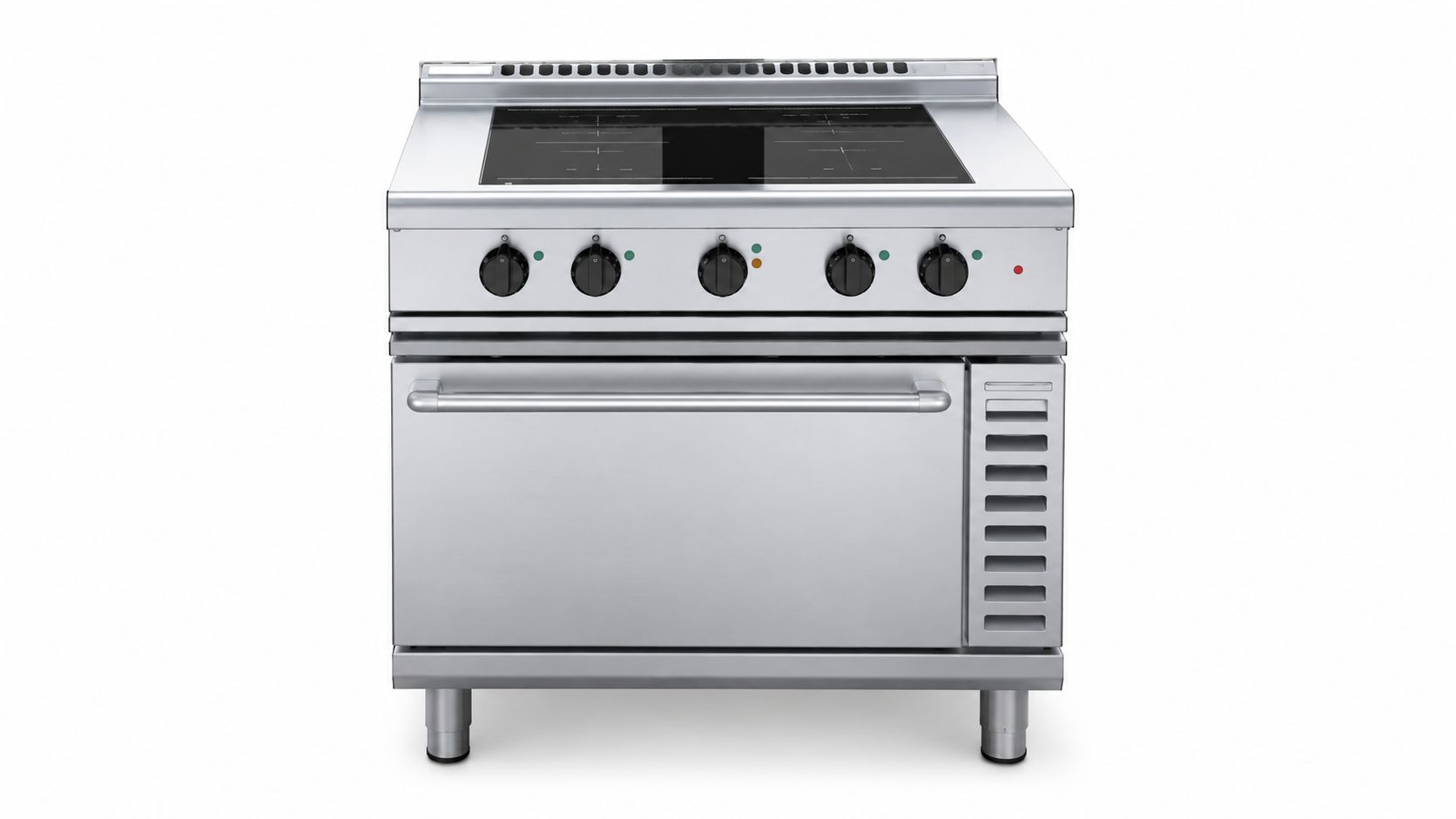
For operators comparing a range and oven combination, the Waldorf 800 Series INL8410ECF, 900mm Induction Range Convection Oven Low Back Version combines four induction cooking zones with a GN 2/1 electric convection oven, a 50 to 320°C thermostatic range and five-position racking. Its flat induction surface and vitreous enamelled control panel still require surface-appropriate cleaning methods, while the convection cavity needs the oven manufacturer's guidance before chemical application.
Product labels, SDS documents and storage duties are covered in more detail in cleaning chemicals in New Zealand. Bulk buying should wait until the kitchen has confirmed the application, surfaces, staff procedure and storage arrangement.
Routine Cleaning Versus Deep Cleaning and Why Frequency Matters
Routine cleaning prevents soil from becoming a chemical problem. It includes clearing loose crumbs, wiping approved cavity surfaces after cooling, removing racks and trays for separate cleaning, and dealing with spills before the next heating cycle bakes them onto the metal.
Deep cleaning deals with established accumulation. It may involve a stronger approved product, more disassembly where the oven design permits it, rack soaking, detailed work around doors and baffles, and a full rinse and inspection before the unit returns to service.
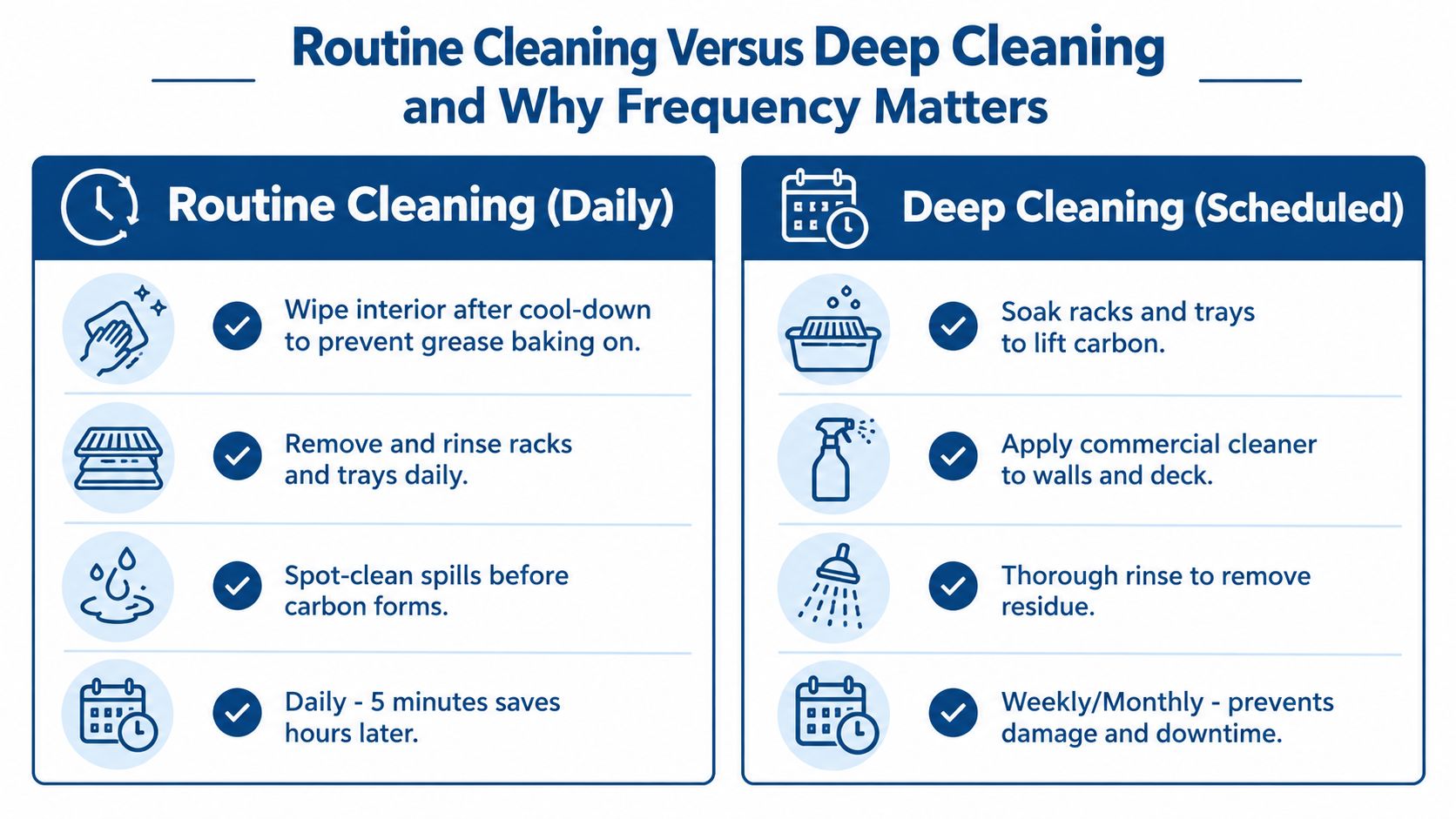
A practical schedule should follow the menu and workload rather than an arbitrary calendar. A bakery with relatively low-grease baking may need a different routine from a restaurant roasting fatty proteins throughout service. A caterer using several ovens intermittently may need a documented check before and after event production.
Routine cleaning triggers
Routine cleaning belongs in the normal closing or changeover procedure. Visible crumbs, fresh splashes, grease around the door and residue on racks are immediate triggers. The oven should be cool and isolated according to its operating procedure before staff begin.
Deep-clean triggers
Visible carbon, smoke during normal cooking, recurring odour after cleaning or a failed hygiene inspection indicate that routine work hasn't kept pace. Those signs call for a planned deep clean, not an unapproved increase in chemical concentration.
Frequent appropriate cleaning generally reduces the amount of aggressive chemistry and hard scrubbing required. It also makes the task easier to train, easier to supervise and less likely to become an emergency job during a busy service.
The cleaning programmes for cafés approach is useful because it treats cleaning as a repeatable operational programme rather than an occasional rescue exercise.
Step-by-Step Commercial Oven Cleaning Procedure
A safe commercial oven-cleaning procedure starts before the chemical is opened. The exact dilution, contact time, application temperature and rinse method must come from the product label and current SDS. No universal dwell time applies to every commercial oven cleaner.
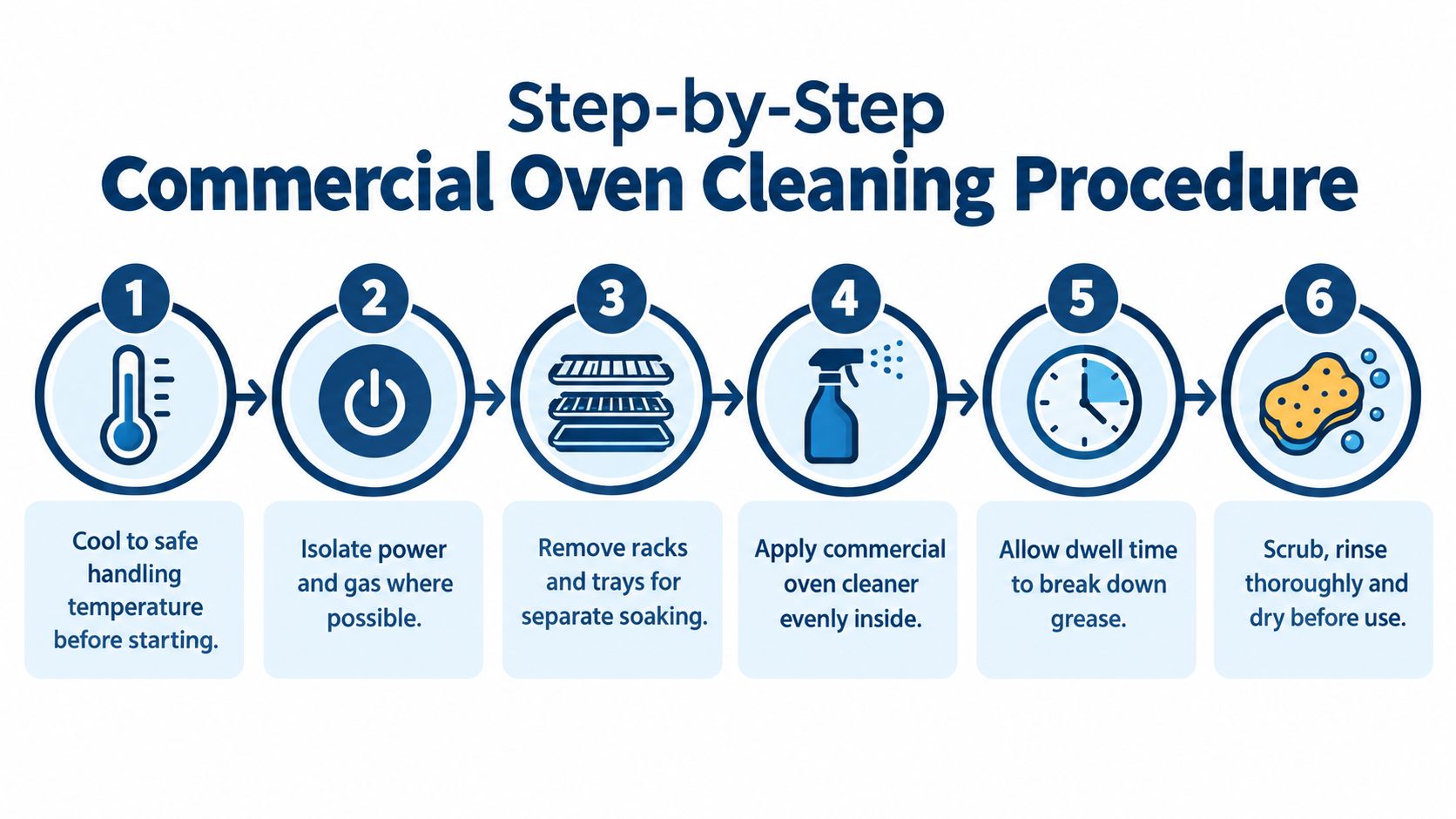
1. Cool and isolate the oven
Switch the oven off and allow it to cool to the temperature required by the equipment and chemical instructions. Isolate electrical or gas supplies where the manufacturer and site procedure require it, and prevent another staff member from restarting the unit during cleaning.
The NZ-labelled Mr Muscle instructions specifically require a cold oven and at least 24 hours since the oven was last heated (Mr Muscle Oven Cleaner NZ instructions). That requirement belongs to that product. It mustn't be copied onto another chemical without checking its own label.
2. Remove loose soil and components
Take out racks, trays and removable supports where the oven design allows it. Scrape or brush away loose crumbs and burnt food using an approved non-abrasive tool before applying chemical. This prevents the cleaner being wasted on debris that could have been removed mechanically.
Soak removable components only in a product approved for their material. Aluminium racks, coated parts and soft alloys need particular caution because strong alkaline chemistry can attack them.
3. Apply the selected cleaner
Put on the PPE specified by the label and SDS. Apply the commercial oven cleaner only to approved surfaces, avoiding heating elements, electrical connections, sensors, fans, burners, seals and other protected components unless the manufacturer expressly permits application.
A spray, foam or concentrate should be used exactly as directed. More product isn't a substitute for correct coverage, and a stronger mixture may increase damage and exposure without improving the result.
4. Respect the contact time
Let the cleaner work for the stated contact period. Don't allow the product to dry onto the surface, and don't assume that doubling the dwell time doubles the cleaning result. If the soil remains, the correct response is to follow the product's repeat-application direction or reassess the cleaner and surface compatibility.
5. Agitate without damaging the finish
Use a non-abrasive pad, nylon brush or manufacturer-approved tool. Wire wool and aggressive metal scrapers can scratch stainless steel and embed particles in the finish. Scrubbing should remove softened residue, not compensate for an unsuitable chemical or missed routine cleaning.
6. Rinse, dry and inspect
Remove all chemical residue using the product's specified rinse method. Where food or packaging could be exposed, surfaces must be thoroughly rinsed with potable water before production begins under the relevant animal-product cleaning conditions (MPI-approved oven-cleaner information).
Check corners, door seals, rack supports, fan covers and the oven floor. Ventilate as directed, reinstall dry components and only return the oven to service once staff can confirm that no cleaner, residue or strong chemical odour remains. The same disciplined approach applies to other chemical maintenance tasks, including commercial dishwasher descaling.
PPE, Ventilation and Safe Chemical Handling in a Working Kitchen
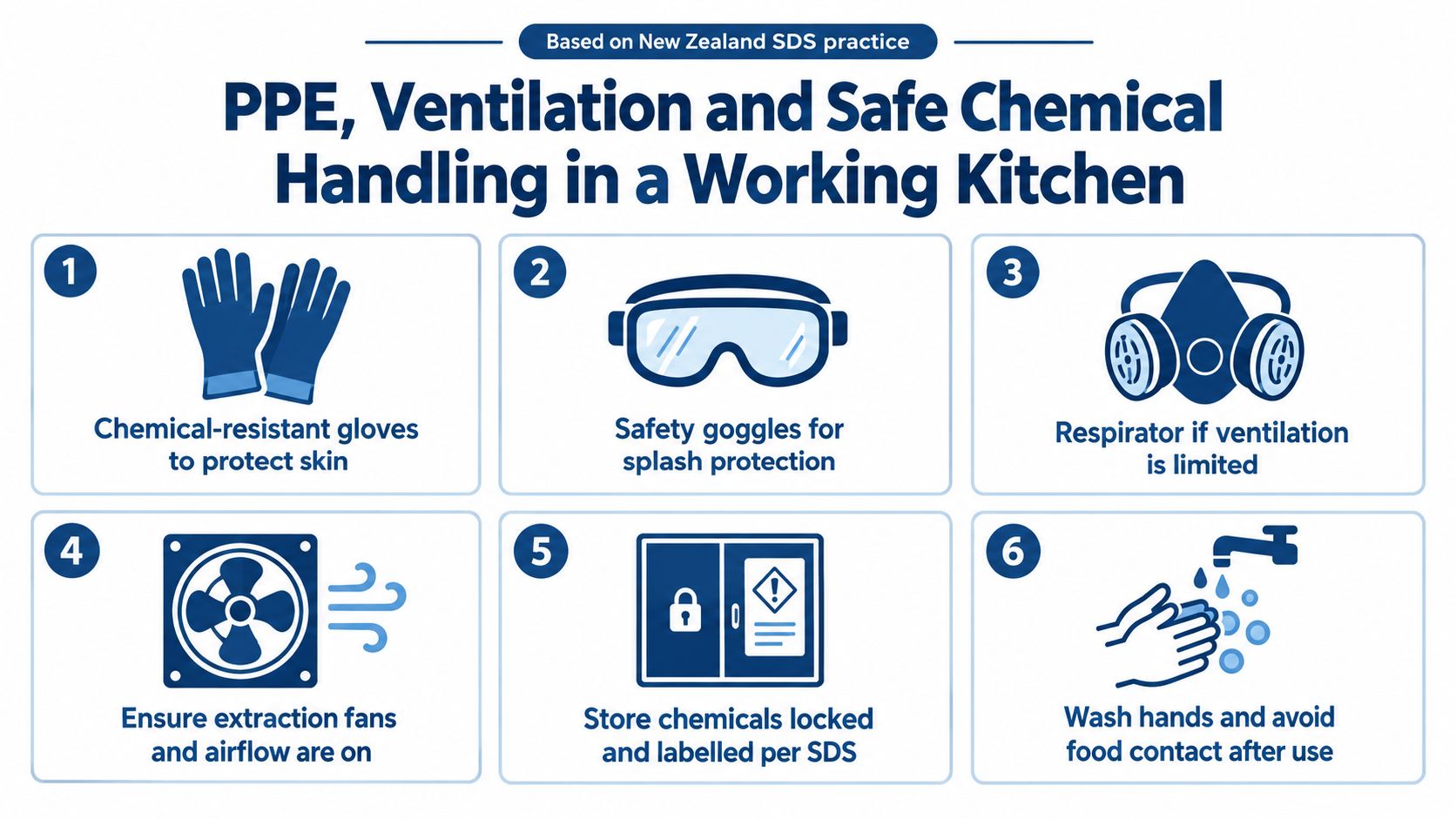
Oven cleaner PPE shouldn't be chosen by habit. It should be selected from the product label and current SDS, because formulations vary in corrosivity, mist risk, skin effects and first-aid requirements.
For many alkaline or caustic products, the baseline controls include:
- Chemical-resistant gloves: Use the glove material and change guidance specified by the SDS.
- Eye or face protection: Protect against splashes during spraying, brushing and rinsing.
- Covered skin and protective clothing: Prevent contact with forearms, legs and footwear.
- Respiratory control: Where mist inhalation is possible, follow the SDS and applicable AS/NZS 1715/1716 selection requirements.
- Ventilation: Use extraction and natural airflow as the product instructions and site risk assessment require.
- Hand hygiene: Wash after handling and keep treated equipment away from food production until rinsed and cleared.
NZ safety guidance notes that cleaning products may require an inventory, a current SDS, safe storage and PPE. It also highlights the added coordination needed when staff clean another business's premises or work alone (New Zealand hazardous-substances guidance).
Ventilation is part of the process
Keep the product away from hot surfaces, pilot flames and other ignition sources where the label requires it. Avoid spraying into a confined cavity with poor airflow, and don't leave staff working in an area where mist or fumes accumulate.
Never mix oven cleaner with another chemical. Combining products can create hazardous reactions or fumes, and a stronger smell isn't evidence of better cleaning.
Storage and first aid
Store containers closed, labelled and separated from food, heat and incompatible chemicals. The cleaning area should have accessible eyewash or clean-water arrangements appropriate to the product, with first-aid directions available from the SDS.
If product contacts skin or eyes, staff should follow the SDS immediately and obtain medical advice when directed. If swallowed or inhaled, the response must come from the product's first-aid information, not a kitchen colleague's assumption about what neutralises it.
A strong cleaning programme also considers the working environment around the appliance. Extraction systems, including the kitchen exhaust hood, affect how fumes, heat and grease are managed, but they don't replace the product's ventilation requirements.
Matching the Cleaner to Convection, Deck, Range and Combi Ovens
Oven type determines where chemical can go and which components need protection. A convection cavity may have fans, heating elements, sensors and seals that are unsuitable for direct application. A deck oven may have stone or specialised deck materials that need a different method from stainless walls. A range combines cooking surfaces, oven cavities and controls, so one product may not be suitable for every part.
| Oven Type | Typical Cleaner Match | Key Cautions |
|---|---|---|
| Convection oven | Approved heavy-duty alkaline cleaner for cold cavity surfaces, or a routine degreaser for light soil | Protect fan assemblies, heating elements, sensors, seals and controls |
| Conventional commercial oven | Routine degreaser for fresh grease, stronger approved oven cleaner for baked-on residue | Confirm compatibility with cavity lining, door glass, racks and coatings |
| Deck oven | Product specifically approved for the deck material and surrounding surfaces | Don't assume a caustic cleaner is suitable for stones, refractory materials or coatings |
| Range oven | Separate products may be needed for the cavity, cooktop, splashback and control panel | Protect burners, induction surfaces, electrical controls and aluminium parts |
| Grill or salamander | Ready-to-use foam or grill-approved degreaser for cling and localised soil | Keep product away from elements, gas components and food-contact areas |
| Combi oven with automatic cleaning | Manufacturer-approved cartridge or liquid used through the programmed system | Don't substitute generic oven cleaner or alter the dosing process |
Convection and conventional ovens
These units often suit a two-level programme. Staff use a gentler routine cleaner for fresh residue, then a stronger approved commercial oven cleaner for established grease and carbon. The manufacturer's manual should identify removable parts, prohibited surfaces and whether the fan cover or baffle can be removed by kitchen staff.
Ranges and grills
Ranges need surface-by-surface thinking. A degreaser that suits a stainless splashback may be wrong for aluminium, enamel, induction glass or a control panel. Grills and salamanders benefit from products that cling to vertical surfaces, but the product must stay away from hot elements and gas components.
Combi ovens
Combi ovens are the hard boundary. If the unit has an automatic cleaning system, the manufacturer's prescribed chemical and cycle should be used. Generic commercial oven cleaner can leave residue, attack seals or interfere with components, even when it appears effective on visible grease.
Troubleshooting Stubborn Grease, Carbon Build-Up and Lingering Odours
Persistent oven problems usually indicate a process failure, not an immediate need for harsher chemistry. The diagnosis should start with where the soil sits, what caused it and whether the previous cleaner was applied to the correct surface for the stated contact time.
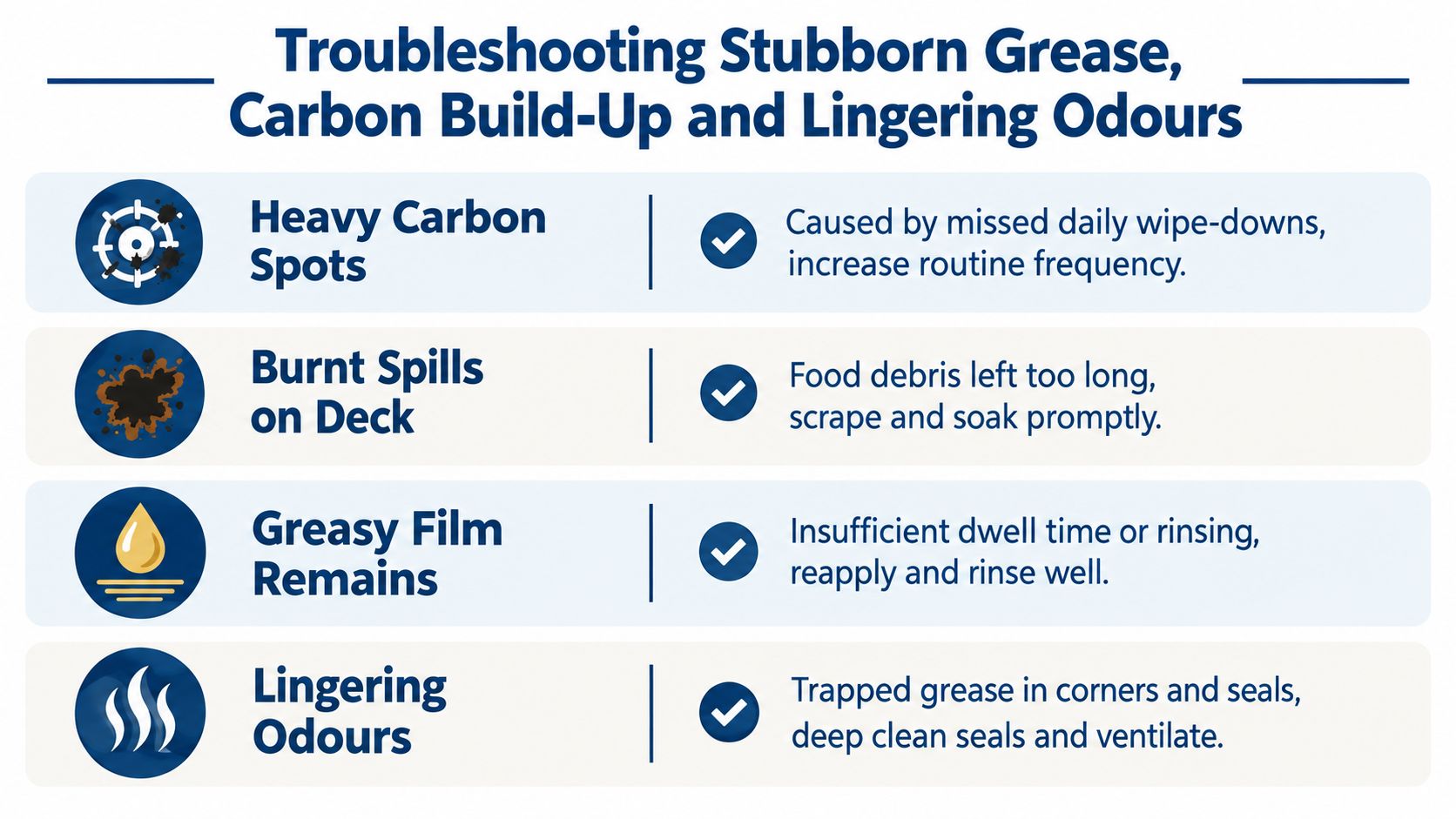
Heavy carbon spots
Small black patches on oven walls or racks usually point to missed routine cleaning, spills left through repeated heating or incomplete removal during the last deep clean. The answer is to remove loose debris, confirm the surface is approved, apply the correct product at the stated concentration and allow the full contact time.
A cold surface is safer for products that require cold application, but some chemicals specify a different application condition. Staff should follow the individual label rather than warming an oven by assumption. A product designed for cold application must never be sprayed onto hot metal.
Burnt spills on the deck
Burnt food on a deck can harden into a layer that resists a quick wipe. Scrape loose material with an approved tool, remove the source of the spill and use a product specifically approved for the deck surface. Don't flood porous, coated or refractory materials with a chemical that hasn't been cleared for that application.
If spills recur, the kitchen should review tray use, loading practices and whether staff are clearing debris during the shift. A stronger cleaner won't fix a process that keeps placing food on the deck.
Greasy film remains after cleaning
A greasy film often comes from insufficient coverage, inadequate contact time, an unsuitable routine degreaser or incomplete rinsing. It may also be grease trapped around a door seal, fan cover, hinge or cavity corner rather than on the main wall.
A second controlled application can be appropriate when the product label allows it. Staff should agitate with a non-abrasive pad, remove the loosened soil and rinse thoroughly. If the film remains after the approved process, the manager should reassess the cleaner, the surface and the equipment manual instead of increasing concentration without authorisation.
Stainless discolouration
Brown or dark staining on stainless steel can result from burnt grease, chemical residue or abrasive damage. Wire wool is a poor shortcut because it can scratch the surface and leave particles embedded in the finish. Once all oven cleaner has been removed, a dedicated stainless-steel product may be suitable for the exterior, provided the equipment maker allows it.
The cavity and exterior shouldn't be treated as the same surface. Control panels, door finishes and brushed stainless often need a cloth-applied product rather than direct spraying.
Lingering odours
An odour after cleaning often comes from residue hidden in seals, corners, fan covers, racks or gaps around the door. It can also indicate that the cleaner wasn't rinsed away properly or that grease remains in a component staff didn't remove.
The corrective sequence is practical:
- Take the oven out of service: Don't keep cooking through smoke or strong chemical odour.
- Inspect hidden areas: Check seals, corners, fan covers, racks, trays and the door assembly where accessible.
- Repeat the approved cleaning process: Use the correct product, contact time and rinse method.
- Ventilate thoroughly: Follow both the chemical SDS and oven manufacturer's instructions.
- Escalate persistent smoke: If smoke or fumes continue during cooking after a proper clean, arrange an equipment inspection rather than applying stronger chemical.
The wider issue is often a poor routine. Guidance on fighting grease in Palm Beach County also reinforces the basic principle that grease control works better when residue is removed before it hardens. The chemistry may differ in a professional kitchen, but the operational lesson is relevant: delay makes cleaning more difficult.
The Monday-morning decision
A kitchen manager can reduce confusion by making four decisions:
- Match the product to the oven and soil: Don't use the heaviest chemical just because the build-up looks unpleasant.
- Choose a usable format: Ready-to-use foam suits controlled spot work, concentrate suits trained dilution, and combi cartridges belong in approved automatic systems.
- Set routine and deep-clean triggers: Link the schedule to menu, volume, visible soil, odour and manufacturer requirements.
- Use the SDS as the control document: PPE, dilution, ventilation, storage and first aid must come from the product in use.
Stronger alkaline chemistry can remove established grease effectively, but it demands stricter PPE, ventilation and rinse discipline. Gentler degreasers are easier to use for routine work, but they won't replace a suitable deep-clean product when carbon has formed. The best commercial oven cleaner is the one staff can use correctly on the right equipment, without leaving residue or damaging the surface.
Hospitality supplies professional cleaning chemicals, including Matthews products, alongside commercial cooking equipment and kitchen supplies for New Zealand hospitality businesses. Visit Simply Hospitality to discuss cleaner selection, product documentation and an ongoing supply approach matched to the venue, menu, equipment and staff procedures.