


Commercial Oven Second Hand
A new café needs an oven before opening, an established kitchen needs replacement capacity, and the budget rarely stretches as far as the equipment list. That makes commercial oven second hand options attractive, but the cheapest listing isn't automatically the soundest purchase. Condition, service history, capacity, site services, compliance and after-sales support matter more than the headline price.
A professionally refurbished oven can preserve capital and deliver capable equipment. An unknown oven from a private sale can create installation problems, repair bills and service downtime. The sensible decision is not just new versus used. It's Certified Used versus unknown-condition equipment, followed by a proper comparison with an appropriate new model.
Why Consider a Second Hand Commercial Oven
A second-hand commercial oven can make sense when a hospitality business needs usable cooking capacity without committing the full cost of a new appliance. A new venue may need to keep cash available for fit-out, stock, wages, rent and opening costs. An established operator may need another oven quickly for a seasonal menu, extra production or a replacement after equipment failure.
The appeal is practical:
- Lower upfront capital requirement: A suitable used unit may leave more budget for other essential kitchen equipment.
- Higher specification within budget: A refurbished premium oven may offer more useful functions than a new entry-level model at a similar purchase price.
- Faster replacement: Available used stock can sometimes provide a quicker route than waiting for a new model.
- Flexible capacity planning: A venue testing a new menu or adding production can avoid committing immediately to a full new installation.
- Project-based fit-outs: New Zealand has an active national second-hand commercial kitchen market, with equipment moving through websites, direct contact, auction houses and trading platforms. The New Zealand used commercial kitchen equipment market includes ovens alongside fryers, combi steamers, griddles, cooktops, pizza ovens, refrigeration, display cabinets and dishwashers.
The mistake is starting with the bargain rather than the kitchen requirement. Menu, batch size, peak service load, oven format, fuel type, footprint, ventilation and available power should be defined first. A convection oven may suit a café using trays of baking and reheating, while a combi oven may be justified where steam, programmed cooking and batch consistency matter. A pizza operation, bakery or production kitchen will have different priorities again.
Practical rule: An oven that can't support the menu isn't good value, regardless of its purchase price.
The total decision should include installation, missing accessories, immediate repairs, energy use, service support and the cost of downtime. A cheap unit that fails during a busy service can force menu changes or an urgent replacement. The buying cheap versus buying once comparison is especially relevant when the oven is central to daily output.
Used equipment isn't automatically better value. A new oven with a known specification, current manufacturer warranty and newer controls may be the stronger choice. The correct order is requirement first, supply channel second, price third.
Not All Second Hand Equipment Is Equal
The phrase “second hand” describes previous use, not present condition. Four common supply channels expose a New Zealand operator to very different levels of responsibility.
Private sales
Private marketplace listings and hospitality groups can show appealing prices, but the buyer often has to establish everything independently. History, cleaning, servicing, electrical safety, gas safety, transport, installation and warranty may be unclear. A seller saying that an oven is “working” doesn't confirm temperature stability, fan operation, safe wiring or suitability for the intended site.
Auction and liquidation equipment
Auction clearances can include equipment from closed venues, refits or business liquidations. Some units may be sound, while others may have worked heavily or been removed without a complete service record. Buyers need to confirm whether racks, trays, stands, probes, hoses and other accessories are included, and whether the oven can be demonstrated before purchase.
Dealer, trade-in or ex-lease equipment
Dealer used and ex-lease stock usually offers more information than a private listing, but the terms vary. A service history may exist without a complete refurbishment process. The written warranty, inspection standard and responsibility for faults should be confirmed rather than assumed.
Certified Used equipment
A Certified Used programme applies a defined process rather than relying on the word “used”. SilverChef states that its Certified Used equipment is mostly ex-rental, generally less than 2.5 years old, refurbished, run-tested and supplied with a three-month parts-and-labour warranty. The Certified Used equipment process includes disassembly, inspection, cleaning, operational testing and certification against relevant electrical, gas and food-safety standards.
| Channel | Typical Price | Warranty | Refurbished | Compliance Checked |
|---|---|---|---|---|
| Private sale | Lowest headline cost may be available | Usually absent or limited | Not necessarily | Buyer must establish it |
| Auction or liquidation | Variable and often auction-led | Usually limited | May be absent | Must be confirmed |
| Dealer or ex-lease | Variable | Depends on seller | May be serviced or refurbished | Documentation varies |
| Certified Used | Set by current stock and condition | Programme terms apply | Defined inspection and refurbishment process | Relevant checks should be documented |
The table isn't a ranking. It shows the risk profile. Private equipment places more inspection and technical responsibility on the operator. Certified Used equipment costs more than an untested listing in some cases, but the purchase includes a process designed to reduce unknowns.
What SilverChef Certified Used Actually Means
Certified Used matters because it turns preparation into a defined workflow. SilverChef says much of this equipment was previously financed through its business and returned when customers upgraded or their circumstances changed. That history doesn't make every oven identical, but it provides a clearer route to assessment than an anonymous listing.
The current process described by SilverChef includes assessment, cleaning or reconditioning, technician servicing, run testing and quality assurance. The equipment is inspected, disassembled where required, cleaned, tested and certified against relevant electrical, gas and food-safety standards. Worn components such as door seals, hinges, fans, elements or burners should be considered during that process, although the precise work depends on the individual oven.
The important distinction is between “powers on” and “has been tested for commercial use”. An oven should be checked at working setpoints, with attention to controls, heating performance, fan operation, door closure, temperature recovery and any steam, cleaning or programmed functions that the model provides. A private seller may not have the equipment, time or incentive to complete that assessment.
Certified Used isn't risk-free. The oven still needs to match the kitchen, and installation must be handled correctly. The advantage is that the operator isn't taking on the full role of inspector, technician and warranty provider before the oven reaches the site.
SilverChef currently states that Certified Used equipment carries a three-month parts-and-labour warranty and can be purchased outright or financed. It also states that its equipment can be accessed through its Rent-Try-Buy offering, subject to current terms. Financing changes the cash-flow structure, not the underlying cost, so operators should review the agreement carefully.
Hospitality works with customers to check available SilverChef Certified Used stock and identify an oven that matches the menu, capacity, services, dimensions and budget. Current inventory changes, and SilverChef says equipment displayed in its Certified Used catalogue is in stock, so availability needs to be checked when a specific model matters. The Simply Hospitality advice on SilverChef Certified Used products provides further context for that sourcing approach.
What to Inspect Before You Buy Any Used Oven
A non-certified oven needs a disciplined assessment. This isn't a DIY repair exercise. It's a decision about whether the seller can provide enough evidence for a qualified technician and installer to take the equipment forward safely.
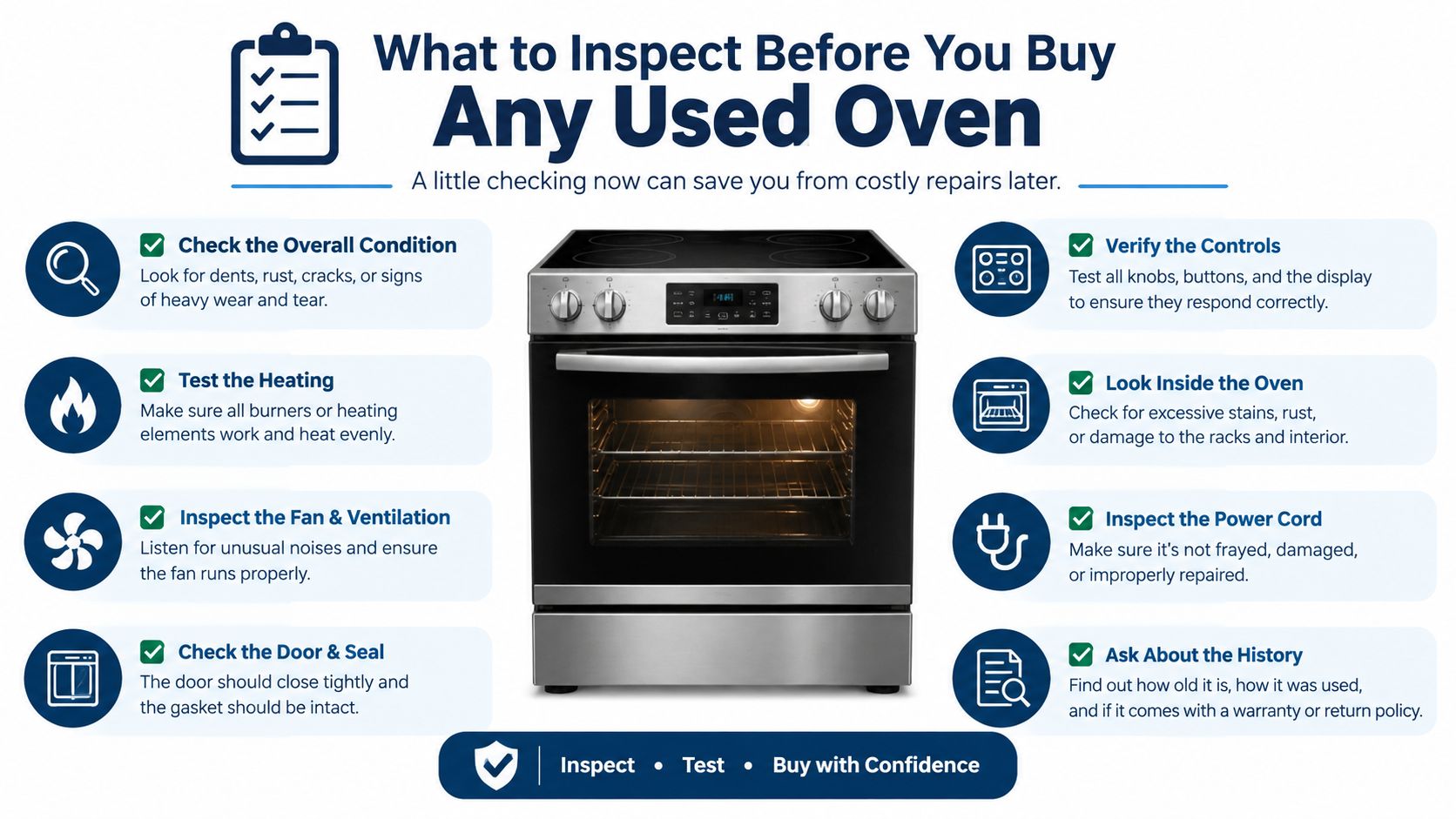
Start with identity and physical condition. The data plate should show the exact manufacturer, model, serial number, electrical rating and, where relevant, gas information. The chamber should be checked for corrosion, damage, cracked surfaces, distorted panels, damaged rack runners and signs of repeated thermal stress. Door seals should sit evenly, hinges should hold the door correctly and latches or interlocks should operate without excessive looseness.
Ask for a meaningful demonstration
A basic power-on demonstration proves very little. The seller should be asked to run the oven at working temperature and demonstrate relevant functions. The assessment should include:
- Heating performance: Confirm that the oven reaches its intended setpoint and maintains it.
- Fan operation: Listen for abnormal noise, vibration or inconsistent circulation.
- Controls: Check displays, switches, timers, thermostats and programmed functions.
- Gas or electrical performance: Confirm that the supply configuration matches the data plate and intended installation.
- Interior operation: Check racks, trays, doors, lights, steam systems and cleaning functions where fitted.
A qualified technician should assess faults that aren't obvious from normal operation. The oven should be rejected or paused for further investigation if the seller won't allow a working demonstration, the rating plate is missing, live parts are exposed, wiring is damaged, elements are cracked, burners are compromised, or the chamber has serious corrosion.
Confirm history and support
The seller should be asked directly about hours of use, the last service, replaced components, recurring faults and the reason for sale. Parts availability depends on the exact model, so the serial number should be used to investigate manufacturer support before money changes hands. Purchase price, installation, immediate repairs and missing accessories belong in one calculation.
Transport also needs planning. A commercial oven can be heavy, awkward and vulnerable to damage if moved incorrectly. Operators arranging specialist removal should review practical guidance on hiring Home Removals Sydney for machines as a general handling reference, then use an appropriately equipped local transport provider for the actual move.
Before committing, the operator should confirm the oven's physical dimensions and the route from delivery vehicle to final position. Doors, corridors, corners, lifts, stairs and kitchen entrances all matter. The commercial oven selection guidance is useful when comparing the required format with the available site.
Used Premium Oven Versus New Entry Level Oven
The strongest used-versus-new comparison is often a premium pre-owned oven against a simpler new model. Neither wins automatically. A used premium unit may provide better construction, controls, insulation, capacity or cooking flexibility, but only if its history and condition are documented.
| Factor | Used Premium Oven | New Entry Level Oven |
|---|---|---|
| Cooking functions | May offer advanced programmes and broader control | Usually focuses on core functions |
| Capacity | May provide greater production capability | Often suits lighter or simpler workloads |
| Condition | Depends on history, refurbishment and testing | Factory-new condition |
| Warranty | Programme or seller terms apply | Current manufacturer warranty generally applies |
| Parts and support | Must be confirmed for the exact model | Current support is usually easier to establish |
| Energy performance | Older design may be less efficient | Newer controls and insulation may offer advantages |
| Installation | Existing specification may require substantial site services | New model still needs model-specific checking |
| Lead time | Depends on available used stock | Depends on current stock and ordering |
| Downtime risk | Lower when certified and supported, higher when unknown | More predictable early ownership |
| Purchase decision | More capability may be available within budget | More certainty and specification choice |
A bakery producing long, steady bakes may place greater weight on insulation, control accuracy and operating efficiency. A takeaway with sharp service peaks may care more about throughput, recovery and the ability to run multiple batches. A café with a simpler menu may not need advanced functions at all.
The comparison only works when the used oven has a documented service history and verified working condition. A tired premium model isn't automatically superior to a dependable new entry-level appliance. The new option may also provide a full current warranty, clearer finance arrangements and more predictable early ownership.
Energy deserves its own consideration. EECA reports that commercial ovens and cooking elements accounted for 15% of energy use in accommodation and food services in 2022, while its baking technology scan says ovens can account for over 60% of total energy use in baking. The same scan says 41% of oven energy is used in core cooking and 59% is lost through exhaust, combustion products and conduction. These figures are available in EECA's food and beverage service sector pathway. A lower purchase price shouldn't override evidence about insulation, controls and operating performance.
Compliance and Safety Obligations for Used Ovens in NZ
A used oven must be safe to sell, install and use. New Zealand's Electricity Safety Regulations cover new and used appliances offered for sale or supply, including commercial electric cooking ranges, ovens, hobs and hob elements.
WorkSafe states that a second-hand electrical appliance cannot be sold or used unless it is electrically safe. The practical process is to verify the compliance mark and records, inspect the supply wiring and plug or connection, obtain relevant electrical safety evidence, and have the installation tested before commissioning. A unit that heats up can still fail safety requirements because of damaged insulation, poor earth continuity, a compromised cord, loose door interlocks or exposed live parts. The WorkSafe requirements for electrical appliances and fittings should be checked with the electrician responsible for the installation.
Gas appliances require separate attention. Gas ovens must meet New Zealand gas safety requirements, and the applicable certification depends on the appliance and installation. The New Zealand Gazette notice for gas appliance safety standards identifies commercial catering ovens and forced-convection ovens against prescribed EN standards.
Ventilation, extraction, make-up air, drainage and clearances must be checked against the specific model and building requirements. Interior condition matters too. A chamber that cannot be cleaned properly, or has damaged surfaces and persistent contamination, creates a food-safety concern even if the controls work.
Safety compliance isn't a cosmetic check. It is a condition of putting the appliance into service.
Compliance should be treated as a fixed cost and an essential step. The New Zealand food safety guidance can support broader planning, while electrical and gas specialists should confirm the oven-specific requirements.
Buying Checklist and How Simply Hospitality Can Help
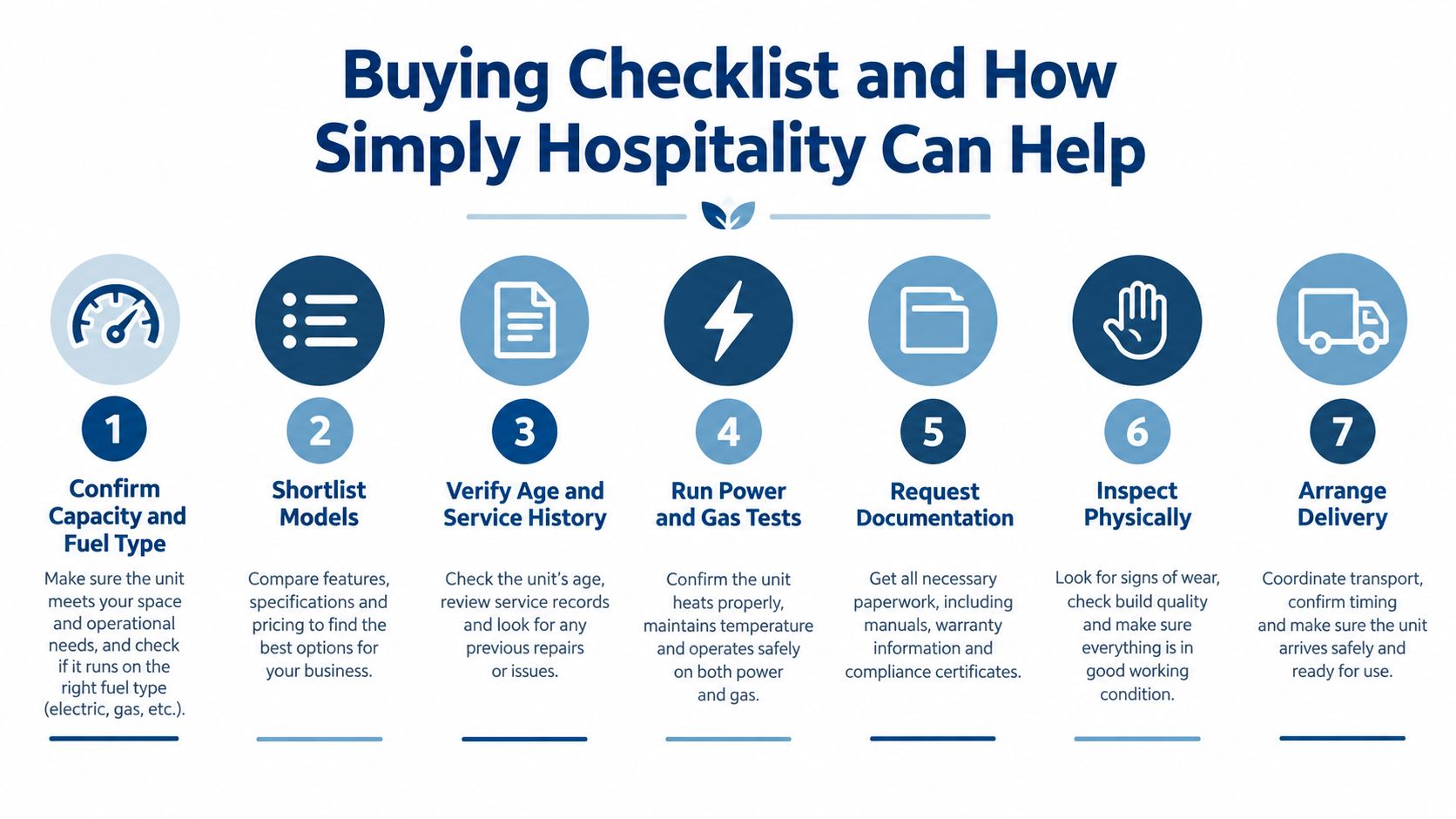
The buying decision should remain structured, even when a supplier is helping with the search. The following checklist keeps the operator focused on suitability rather than urgency.
- Define capacity and fuel type. Confirm whether the kitchen needs a convection, combi, range, pizza, bakery or specialist oven. Establish gas or electric requirements.
- Shortlist suitable models. Compare two or three models against the menu, batch size, peak production and available footprint.
- Verify age and service history. Record the model and serial number, then ask what work has been completed and whether recurring faults are known.
- Confirm power, gas, water and ventilation. Check voltage, phase, electrical load, gas type, water connection, drainage, extraction and installation clearances for the exact model.
- Request a working demonstration. The oven should be run at relevant setpoints, with controls, fans, heating, recovery and applicable steam or programmed functions checked.
- Confirm the warranty and support. Review parts-and-labour cover, exclusions, installation conditions, return terms and who handles a fault.
- Plan delivery and commissioning. Measure the route, organise suitable transport, and book qualified electrical or gas contractors where required.
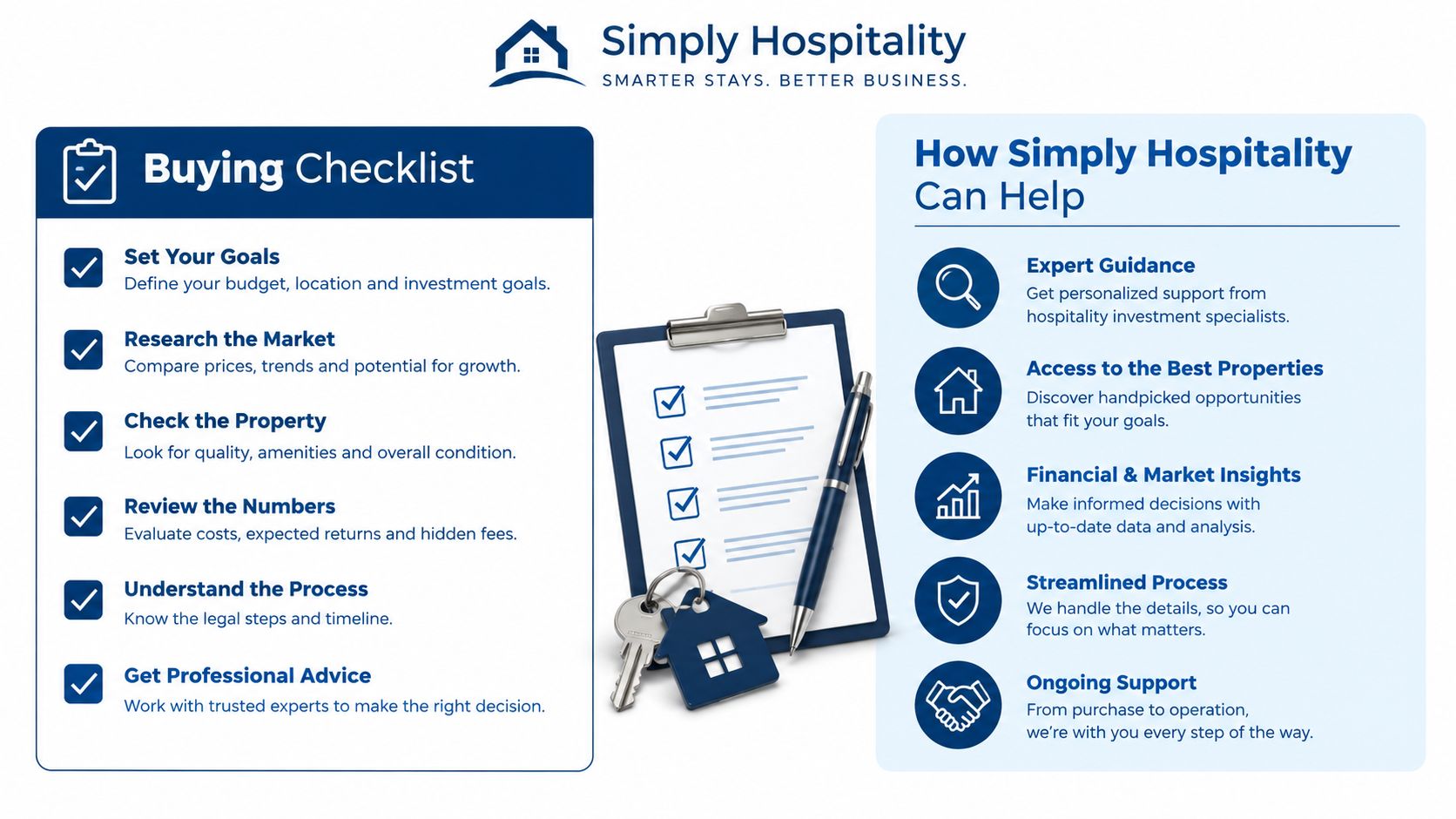
Hospitality can check SilverChef Certified Used stock on a customer's behalf and look for a suitable oven rather than leaving the operator to search through unknown listings. The useful starting information includes:
- Oven type: Convection, combi, range, pizza, bakery or another format.
- Fuel and services: Gas or electric, phase, load, water and drainage.
- Capacity: Tray format, batch expectations and peak production.
- Space: Available dimensions, access route and final position.
- Preferred brands: For example, Turbofan, UNOX, Convotherm or Blue Seal, where suitable stock exists.
- Budget and location: Including whether outright purchase or finance needs to be considered.
- Urgency: The available Certified Used inventory changes constantly, so timing affects the options.
Where used stock doesn't provide the right solution, Simply Hospitality can also compare appropriate new commercial ovens from its current ranges. New alternatives may include Turbofan, UNOX, Convotherm, Blue Seal and Waldorf, depending on the required oven type and site services. The sensible process is to compare the complete Certified Used option with a suitable new alternative, including specification, installation, warranty, support and risk.
The catering equipment checklist can help operators organise the wider kitchen requirements around the oven.
Looking for a second-hand commercial oven? Talk to Simply Hospitality with the required oven type, capacity, services, dimensions, location and budget, and the team can check SilverChef Certified Used stock for suitable options. Where used equipment isn't the right fit, Simply Hospitality can also compare new commercial ovens and help the business choose a practical, supportable solution.