

Catering Equipment Checklist That Covers Every Stage
Can a catering operation cook enough food but still fail before the first guest is served? It can, if the team hasn't planned where ingredients will be stored, how prepared food will be held, how it will travel, how serviceware will arrive, or how the equipment will be cleaned afterwards. A useful catering equipment checklist tests the complete workflow, not just the cooking output.
The practical sequence is storage → preparation → cooking → holding → transport → service → clearing → warewashing → cleaning. This article shows what to include, how to size equipment using guests, portions and available time, and how the checklist changes when food is prepared and served at one venue versus produced in a kitchen and transported elsewhere. It also provides a checkable planning template for catering operators working in the New Zealand hospitality environment.
For NZ businesses, equipment selection is tied to compliance as well as workflow. Food premises and equipment must support safe food handling, cleanability and access for cleaning. Local council guidance specifies that hot-holding equipment must be maintained at not less than 60°C, and handwashing facilities must have hot and cold running water (Waikato District Council food premises requirements). The right checklist therefore asks whether every stage can be controlled, monitored and cleaned.
Practical rule: cooking capacity is only one part of catering capacity. The operation must also store, hold, move, serve and wash everything it produces.
How Catering Service Models Change Your Checklist
Before equipment is selected, the service model needs to be clear. A kitchen preparing food for service in the same building has different priorities from a production kitchen sending meals to an event venue. Treating both operations as though they need the same list often leads to too little holding and transport equipment, or too many appliances with no defined job.
Same-venue preparation and service
When food is prepared and served at the same venue, the main pressure usually sits within the fixed kitchen. The checklist should test:
- Refrigeration: Is there enough commercial fridge and freezer space for ingredients, prepared food and service stock?
- Preparation: Can benches, food processors, mixers and blenders support the menu without blocking access to sinks or cooking equipment?
- Cooking: Can the ovens, cooktops and fryers produce the required food within the available service window?
- Holding: Can bain maries, hot holding cabinets and GN pans keep food ready without crowding the pass?
- Warewashing: Can the dishwasher or glasswasher keep pace while service continues?
A same-venue operator might use a combi oven for several menu components, provided trays, racks, extraction, power and holding space are all compatible. Multi-use equipment can be sensible for smaller operations, but only when changing between jobs doesn't create a workflow bottleneck.
Production kitchen and transported service
Off-site catering adds another system between cooking and service. Food must be packed, protected and monitored while it moves, then unloaded into a venue where power, water, drainage, refrigeration and washing facilities may differ from the production kitchen.
Holding and transport become the decision point. Insulated food carriers, leak-resistant food-storage containers, GN pans with suitable lids, bakery or service racks and trolleys may matter as much as the oven. Service equipment also needs to travel, including crockery, cutlery, serving utensils, beverage equipment, waste bins and cleaning supplies.
For a broader comparison of how layout and equipment requirements change between service environments, operators can review how equipment requirements differ between hospitality and aged care. The same principle applies to catering. Equipment must suit the people, premises, menu and movement of food.
Compliance starts with the premises
A checklist shouldn't stop at appliance names. NZ requirements also cover smooth, impervious and easy-to-clean surfaces, pest resistance, ventilation, wash-hand basins, grease control and sufficient access around fixed equipment (New Zealand Food Hygiene Regulations). A large appliance that can't be cleaned behind or serviced safely isn't a complete solution.
For a transported event, the site audit should include unloading access, trolley routes, temporary handwashing, electrical connections, water access and waste removal. The checklist has to describe the operating system, not just the inventory.
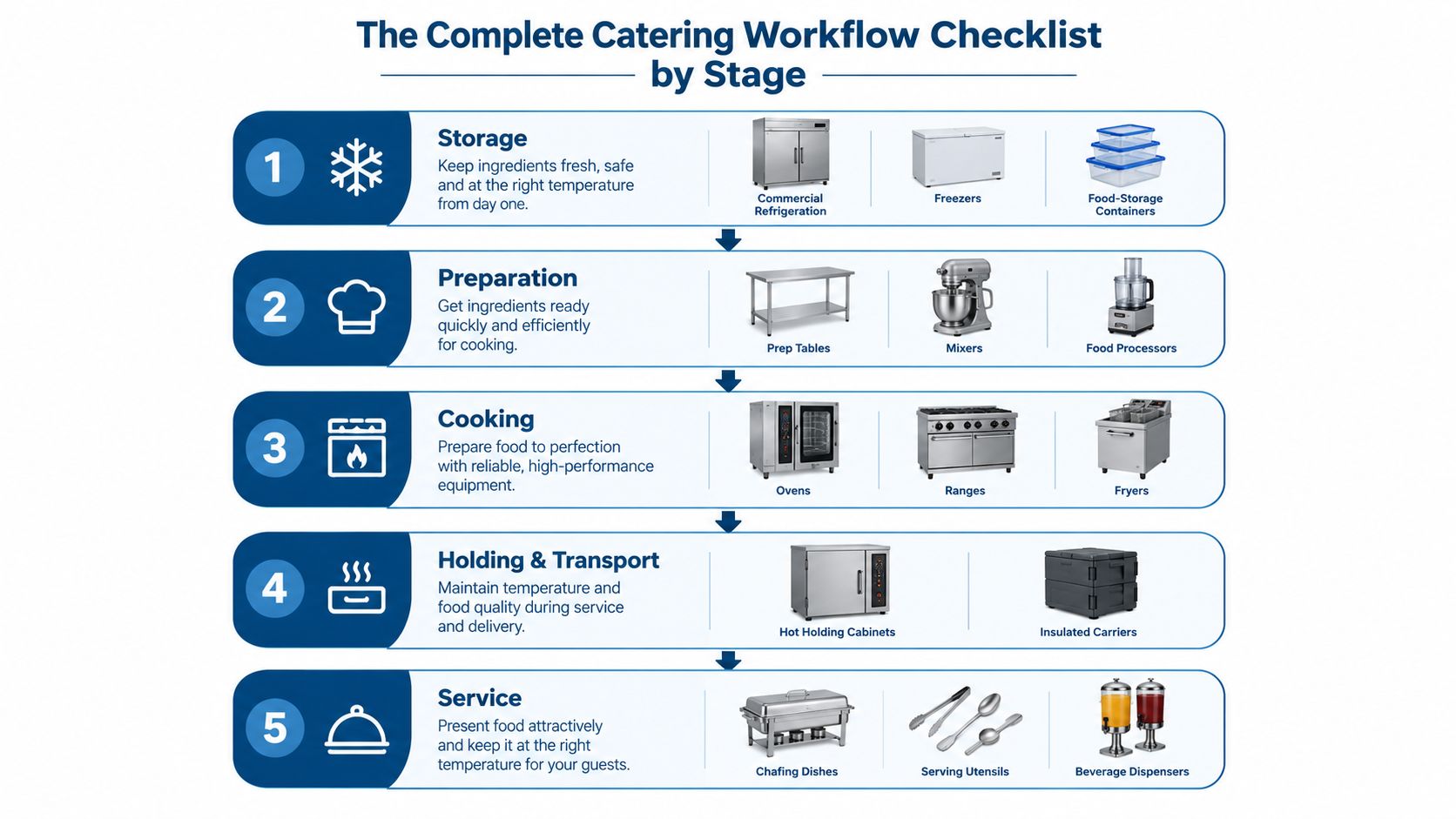
The Complete Catering Workflow Checklist by Stage
A catering checklist works best when it follows food through the operation, from storage to warewashing. Check every stage against the menu, expected portions, service format, venue access and the time food must wait or travel.
Storage
Start with commercial refrigeration, freezers and shelving. Refrigerators should run below 5°C, and freezers below -18°C under NZ operational guidance (Christchurch City Council food premises guide). Choose capacity for the largest expected load rather than an average quiet day.
Include:
- Commercial fridges, cool rooms or underbench refrigeration.
- Freezers suited to the menu and storage cycle.
- Food-storage containers with secure lids.
- Shelving that keeps stock organised and accessible.
- Calibrated temperature probes, visible displays or data logging where required.
Domestic-style fridges are a poor substitute when monitoring, alarms or data logging matter. The NZ Food Regulations 2015 require catering equipment to suit the volume processed, use non-contaminating materials and allow critical parameters to be monitored accurately (New Zealand Food Regulations 2015).
For transported service, add the holding and loading question at this stage. Food that fits the cool room still needs enough carrier space, protection and access for the journey.
Preparation
Preparation capacity includes food processors, mixers, blenders and stainless preparation benches. Benches should support weighing, chopping, mixing, portioning and temporary staging without making staff work across dirty or congested areas.
Record:
- Food processors for chopping, slicing or batch preparation.
- Mixers suited to the dough, batter or sauce work required.
- Blenders for soups, dressings, purées and beverages.
- Stainless benches with cleanable surfaces and practical service access.
- Trays, racks, cutting boards, knives, utensils and storage containers.
Choose processors and mixers by the whole task, not bowl size alone. Staff also need room to load, unload, wash and stage ingredients. The commercial food preparation equipment collection can help compare preparation categories with the menu before purchasing appliances that will sit idle.
Cooking
Cooking equipment should reflect the menu and finishing method. A combi oven provides controlled cooking modes for varied production, while a convection oven may suit baking and roasting with consistent dry heat. Cooktops, fryers and portable induction equipment each affect power, extraction and staff movement.
Check:
- Combi ovens and convection ovens.
- Cooktops or ranges.
- Fryers where the menu requires them.
- Suitable trays, racks, shelving and oven loading space.
- Extraction, gas supply or electrical capacity.
- Heat-safe handling equipment and cleaning access.
An oven without compatible trays, racks, power or extraction is an incomplete purchase. Check the commercial cooking equipment collection alongside the installation and holding plan.
Holding
Holding is often the decision point between a workable catering setup and a service-day bottleneck. Bain maries, hot holding cabinets and GN pans determine whether cooked food can wait safely, remain presentable and reach service without repeated handling.
Ask:
- Can hot food remain at not less than 60°C in the intended holding equipment, as covered by Food Standards Australia New Zealand temperature guidance?
- Are there enough GN pans and lids for cooking, holding, transport and service?
- Can staff replenish service pans without losing control of the remaining food?
- Is there room for finished food before it reaches the buffet or pass?
- Will the same holding equipment work at the venue, or is separate transport equipment required?
Potentially hazardous food should be kept at 5°C or colder, or 60°C or hotter, when received, displayed, transported or stored. If food is cooled, it must move from 60°C to 21°C within 2 hours, then from 21°C to 5°C within a further 4 hours. Holding equipment and temperature records therefore belong in the food-safety system, not as an afterthought.
Transport
Transport equipment separates a production kitchen from a restaurant kitchen. Use insulated food transport, secure lids, food-storage containers, trolleys and racks that fit the vehicle and venue routes without repeated manual handling.
Plan for:
- Insulated hot and cold carriers.
- GN pans and lids that fit the carriers.
- Trolleys or utility carts.
- Bakery and service racks.
- Lidded storage containers.
- Load sequencing, non-slip protection and venue access.
A same-venue service may manage with fewer carriers and shorter movement routes. A transported event needs equipment that protects temperature, prevents spills and allows staff to unload in service order. Confirm the loading sequence before buying containers, because a carrier that holds plenty of food can still slow setup if the first items loaded are the last items needed.
Containers should match the food format and the return journey. For smaller items such as dips or dressings, Mepal Cirqula Round 350ml Nordic Sage keeps liquids sealed in transit and nests flat for the return journey.
Operators planning a wedding or formal event may also find find a wedding planning guide useful for the wider event setup alongside the food operation.
Service
Service equipment must match the format and the replenishment method. Buffet service may require bain maries, serving platters, tongs, ladles, serving spoons and labels. Plated service adds crockery, cutlery, trays, racks and a clear replenishment plan. Drop-off service may use fewer staff-facing items, but packaging and safe holding still need checking.
Include:
- Crockery, cutlery and glassware where required.
- Serving trays and utensils.
- Chafing or display equipment where appropriate.
- Beverage dispensers and cups.
- Food labels and dietary information systems.
- Staff aprons, gloves and hand hygiene supplies.
Count service pieces against the number of simultaneous stations, not just guest numbers. A buffet with several lines can exhaust serving utensils and labels faster than a single service point, while plated service places more pressure on trays, racks and pass space.
Clearing and warewashing
The workflow continues after the last plate leaves the table. Include bus bins, waste equipment, rubbish bins and liners, sorting areas, commercial dishwashers, glasswashers and drying or storage space.
Select a commercial dishwasher around rack capacity, cycle workflow, available water, drainage and staff movement. A glasswasher may be needed where glassware volume or handling differs from plates and pans. For sanitising, hospitality cleaning standards reference a final rinse temperature of 82°C, with about 70°C generally accepted as the minimum sanitation temperature (Rhima NZ cleaning standards guidance).
For transported events, decide where dirty equipment will accumulate, how it will be separated from clean items and how it will return to the kitchen. The commercial warewashing collection should be considered with detergent, rinse aid, cleaning chemicals, waste handling and end-of-service storage. A checklist is complete only when the last pan has a controlled route home.
Sizing Your Equipment for Guest Numbers and Service Time
The starting formula is:
Guests × portions required × available production and service time
That calculation establishes the target output. The next step is to test every stage against it. If a caterer must produce more portions within a shorter window, the pressure may appear first in preparation, oven loading, refrigeration recovery, holding space, transport loading, plating or warewashing.
Smaller operations
A smaller caterer can often use equipment for multiple roles and produce food in batches. A combi oven might roast, steam and regenerate food at different points, while one trolley may serve both production and venue setup. That approach saves space, but it only works if the changeover, cleaning and access time fits the production schedule.
The checklist should record:
- What equipment performs more than one task.
- Which tasks can run in batches.
- Where prepared food waits between batches.
- Whether the same pans, racks or bench space are needed simultaneously.
- How equipment returns to a clean state before its next use.
Larger events
Larger events generally need more capacity across the complete system, not just a larger oven. The operator must ask whether preparation can keep up, whether refrigeration can receive and protect the volume, whether cooked food can be held, and whether staff can serve it before quality or safety controls deteriorate.
| Capacity question | What to verify |
|---|---|
| Can preparation keep up? | Processor, mixer, blender, bench and staff access |
| Is cooking sufficient? | Oven loading, cooktop space, fryer capacity and available time |
| Is holding adequate? | Bain maries, hot holding cabinets, GN pans and temperature monitoring |
| Can transport cope? | Carriers, trolleys, racks, vehicle space and venue access |
| Can service move quickly? | Crockery, cutlery, utensils, labels and replenishment routes |
| Can warewashing cope? | Dishwasher, glasswasher, racks, chemicals, drainage and waste |
A useful test is to identify the slowest stage and size around it. Cooking 200 portions is only useful if the operation can hold, transport and serve those portions appropriately afterwards. The planning equipment for consistent meal service article provides related planning context for operators building repeatable workflows.
What Operators Often Forget Until Service Day
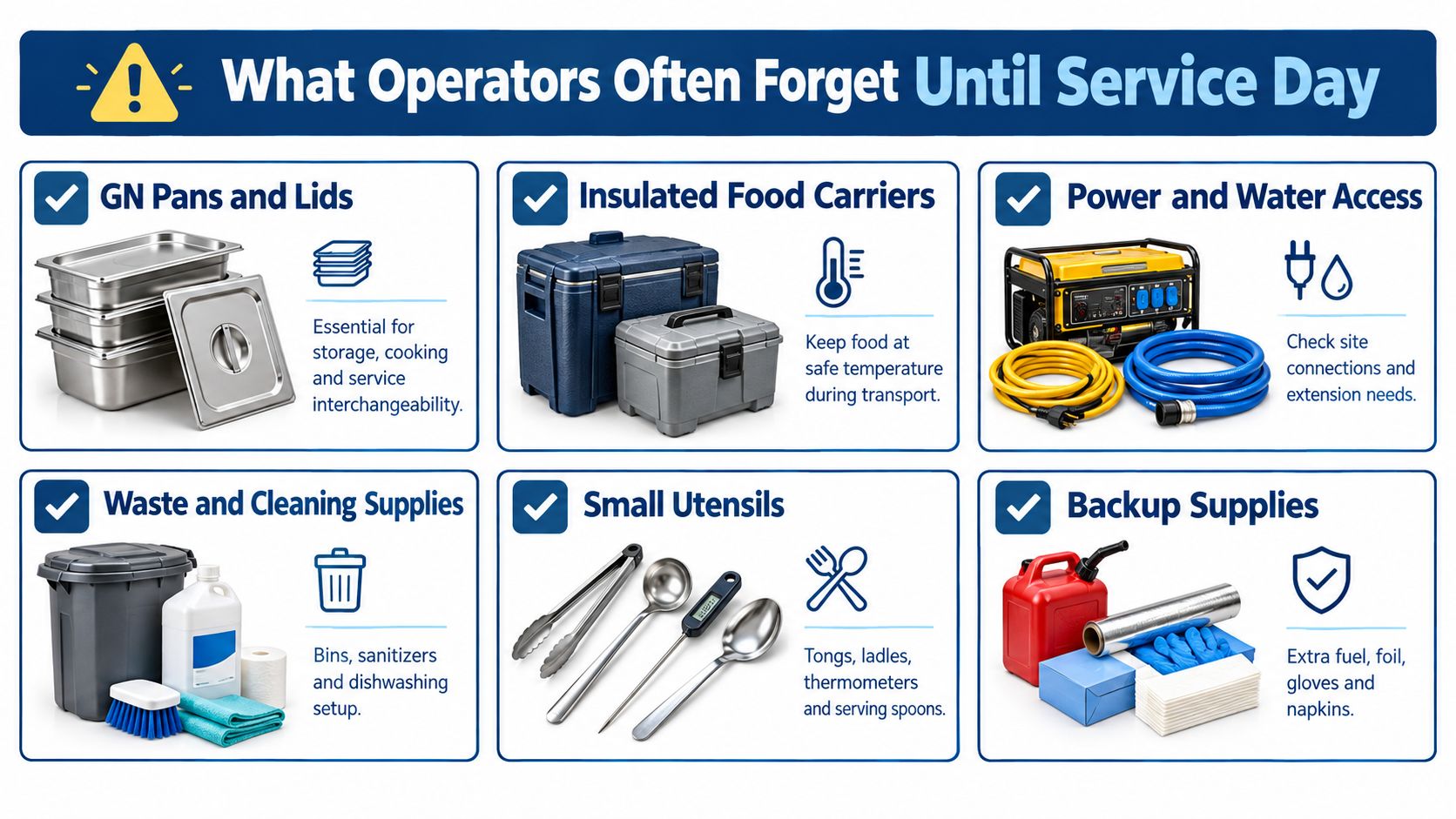
Large appliances are usually the easiest items to remember. Problems often come from the equipment around them, particularly the items that connect one workflow stage to the next.
Supporting equipment
GN pans and lids are used for storage, cooking, holding, transport and service, so incompatible sizes create handling delays. Insulated food carriers, trolleys, bakery or service racks, food-storage containers and shelving deserve the same planning attention as ovens and fridges.
Commonly missed items include:
- Small tools: Tongs, ladles, serving spoons, knives and thermometers.
- Temperature control: Calibrated probes, visible displays and a place to record checks.
- Cleaning supplies: Food-safe chemicals, cloths, gloves, paper products and wash-up accessories.
- Waste equipment: Rubbish bins, liners, recycling containers and a route for removal.
- Spare handling items: Extra trays, racks, lids and storage containers.
Holding capacity is particularly easy to underestimate. The cooking schedule may look achievable on paper, yet finished food can have nowhere suitable to wait before loading or service. That creates crowding, unnecessary transfers and avoidable temperature-control pressure.
Site infrastructure
Power, gas, water, drainage and extraction should be confirmed before an appliance is ordered. Equipment access matters too. A unit that fits the kitchen plan may still be impossible to move through a doorway, position for servicing or clean around safely.
Installation check: specify the appliance, its trays, racks, services, extraction, drainage, access route and cleaning space as one package.
A large oven can create additional work if the electrical supply is inadequate, the gas connection is unsuitable, extraction has not been planned, or the venue lacks room for staging racks and finished food. The commercial kitchen installation guide is useful when the checklist needs to move from purchasing into layout and installation planning.
Staff workflow should be mapped physically. Ingredients need a route to preparation, prepared food needs a route to cooking and holding, and dirty equipment needs a route to warewashing without crossing clean serviceware. A checklist that ignores those movements can produce a technically equipped kitchen that still works poorly.
Printable Catering Equipment Checklist You Can Use On Site
The following template can be copied into a planning document and adjusted for the menu, venue and service model. Add quantities, dimensions, power requirements and notes beside each line.
Storage and preparation
- Commercial refrigeration, quantity and location: __________
- Freezers or cool room capacity: __________
- Food-storage containers and lids: __________
- Shelving and dry-storage space: __________
- Temperature displays, probes or data logging: __________
- Food processors: __________
- Mixers: __________
- Blenders: __________
- Stainless preparation benches: __________
- Trays, racks, knives, boards and preparation utensils: __________
Cooking and holding
- Combi ovens: __________
- Convection ovens: __________
- Cooktops or ranges: __________
- Fryers: __________
- Required trays and racks: __________
- Bain maries: __________
- Hot holding cabinets: __________
- GN pans and lids: __________
- Holding temperature checks and records: __________
Transport and service
- Insulated hot food carriers: __________
- Insulated cold transport: __________
- Trolleys, utility carts or service racks: __________
- Vehicle loading and venue access confirmed: __________
- Crockery and cutlery: __________
- Serving trays, tongs, ladles and spoons: __________
- Beverage dispensers and cups: __________
- Labels and dietary information: __________
Clearing, warewashing and cleaning
- Bus bins and clearing equipment: __________
- Commercial dishwasher: __________
- Glasswasher where required: __________
- Detergent, rinse aid and cleaning chemicals: __________
- Cleaning cloths, gloves and paper products: __________
- Rubbish bins, liners and waste removal: __________
- Drainage, water supply and final cleaning area: __________
- Servicing and maintenance records: __________
For a deeper look at preparation categories, operators can review must-have prep equipment for commercial kitchens. Items without a defined job should be removed, while overlooked supporting equipment should be added.
Choosing What to Buy Rent and Maintain for the Long Term
Purchase equipment that will perform a repeatable role across the menu and service model. Rent or use flexible finance for specialist equipment that is needed occasionally, difficult to store, or tied to a particular event format. The decision depends on volume, venue access, expected use, cleaning demands, warranty support and the cost of keeping the item ready between events.
Maintenance belongs on the checklist from the start. NZ risk guidance recommends annual servicing for air conditioning, refrigeration, cooking and dishwasher equipment, with cooking hood ducts inspected weekly and professionally cleaned annually (Vero hospitality risk checklist). Test-and-tag intervals vary by environment under AS/NZS 3760 guidance. They can range from 3 months on construction and demolition sites, about 6 months in workshops and factories, about 12 months in offices and schools, up to 5 years for low-risk equipment, while hotel, motel, hostel and boarding-house environments are commonly on a 2-year cycle (NZ electrical safety guidance).
Under-specifying holding, transport or warewashing is usually more disruptive than omitting an appliance that has no menu role. Operators comparing equipment categories and wider planning considerations can review catering equipment in New Zealand. For a consistent front-of-house presentation, businesses may also want to choose custom aprons for staff, provided the garments suit the work and cleaning routine.
Simply Hospitality supplies commercial refrigeration, cooking, food preparation, holding, transport, warewashing, cleaning, tableware and catering support equipment for New Zealand hospitality businesses. Operators can contact Simply Hospitality with the menu, guest numbers, service model and venue constraints to work through a practical checklist before purchasing.