

Commercial Scales NZ: Expert Guide for 2026
A busy kitchen can weigh the same ingredient repeatedly and still produce different portions, costs, and customer experiences. The problem often isn't a lack of effort. It's a mismatch between the scale's capacity, graduation, platform, and the work being performed. Choosing commercial scales in NZ starts with a practical question: what's the smallest quantity and largest load the operation must weigh accurately?
That question matters for cafés, restaurants, bakeries, butcheries, caterers, food producers, and any business where weight affects recipes, stock control, portions, or a customer transaction. A suitable scale supports consistency and traceability. The wrong one can create awkward workflows, unreliable readings, avoidable waste, or a compliance problem.
The Hidden Cost of Inconsistent Portions
A busy café may serve the same menu item throughout the day, yet the ingredient quantity can change from one staff member to the next. A little extra coffee, cheese, meat, dough, or garnish may seem insignificant on one plate. Repeated across service, those differences can affect recipe costing, inventory forecasts, and the customer's expectation of consistency.
The objective isn't to serve as little as possible. Portion control means serving what the recipe and menu specification intend, not reducing the amount placed in front of the customer. Consistent weights help protect flavour, presentation, food cost assumptions, and production planning.
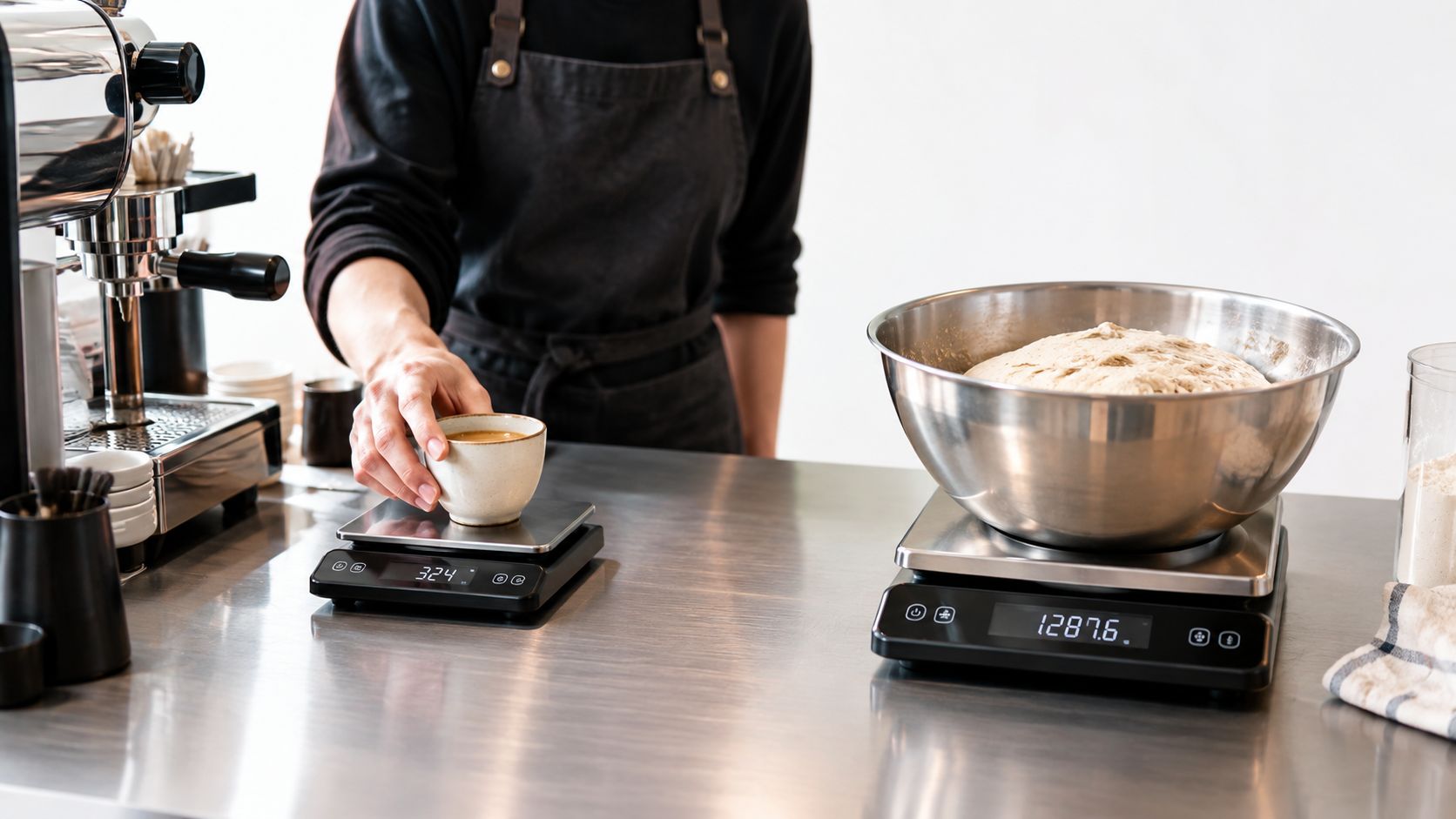
Turning portion variance into a business calculation
The commercial principle is straightforward:
Excess portion weight × ingredient cost per gram × portions sold = cost of over-portioning
The following is an illustrative calculation, not a Simply Hospitality customer result:
- Ingredient cost: $20 per kilogram, equal to 2 cents per gram.
- Average excess portion: 10g.
- Daily volume: 100 portions.
- Daily cost: 10g × $0.02 × 100 = $20 per day.
- Across 300 trading days: $6,000 per year.
That example isn't a forecast. Actual results depend on the ingredient, recipe, sales volume, staff practice, and whether the excess is genuine and avoidable. More expensive ingredients magnify the effect, while under-portioning can create complaints and damage trust.
A scale doesn't automatically create a saving. It gives the kitchen a practical way to compare what staff serve with the approved specification, then reinforce a repeatable process. Accurate weights also support recipe costing:
Ingredient quantity × cost per unit of weight = ingredient cost
This connects a scale with broader kitchen management rather than treating it as a minor smallware purchase. Operators assessing waste may also find the discussion of food waste and vacuum packing useful, although packaging and weighing solve different parts of the control problem.
Practical rule: Weigh for consistency, not simply for smaller portions.
Capacity and Graduation Explained
Capacity is the maximum weight a scale is designed to measure. Graduation, sometimes called resolution, is the increment in which the display shows the weight. These specifications answer different questions, and both must suit the task.
A high-capacity scale isn't automatically more useful. A scale capable of weighing 30kg isn't necessarily a good substitute for a smaller precision scale if the kitchen regularly needs to measure very small quantities. A dough production bench may need room for a large bowl and enough capacity for a substantial batch. A pastry station may need to distinguish small ingredient changes instead.
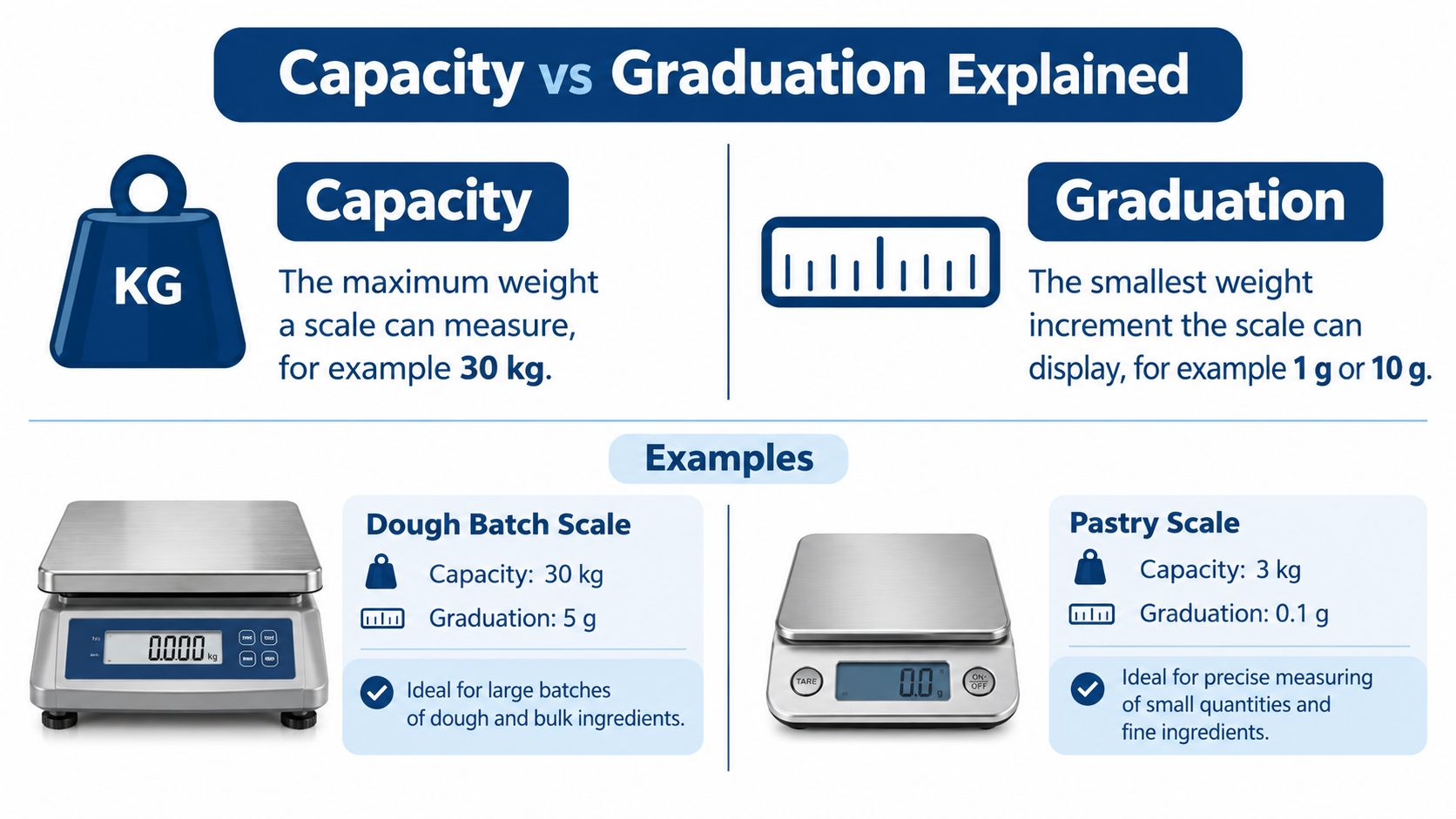
Match both ends of the weighing range
Before comparing products, list the actual jobs:
- Smallest measurement: spices, raising agents, stabilisers, coffee, garnishes, or delicate pastry ingredients.
- Typical working load: portion containers, mixing bowls, trays, or ingredient tubs.
- Largest routine load: dough batches, produce, bulk ingredients, or receiving containers.
- Required repeatability: whether staff need broad production control or fine recipe measurement.
A scale with a coarse graduation may be suitable for bulk preparation but frustrating for small recipes. A fine-graduation unit may provide useful detail but lack the platform or capacity for a full mixing bowl. The practical choice is the model that meets the required range without forcing staff to work at the edge of its intended use.
The digital kitchen scales range can help operators compare this relationship, but manufacturer specifications still need to be checked for the particular model and application.
Capacity isn't the only physical limitation
A container can fit within the weight limit and still be awkward on the platform. A large bowl may cover the display, overhang the weighing surface, or make it difficult to add ingredients safely. Platform dimensions, display position, tare functionality, and bench space all affect whether the stated capacity works in practice.
This principle also applies to other bench equipment. For example, the Waldorf Bold INLB8100F-B, 450mm Electric Induction Cooktop Low Back Version, Bench Model has a defined bench footprint and working configuration. Like a scale, it needs to be assessed as part of the actual cookline, not by one specification in isolation.
Types of Commercial Scales for Hospitality
Different hospitality tasks call for different scale formats. A café portioning coffee, a bakery dividing dough, and a food producer receiving bulk ingredients may all need commercial scales, but they won't necessarily need the same platform, capacity, graduation, or protection.
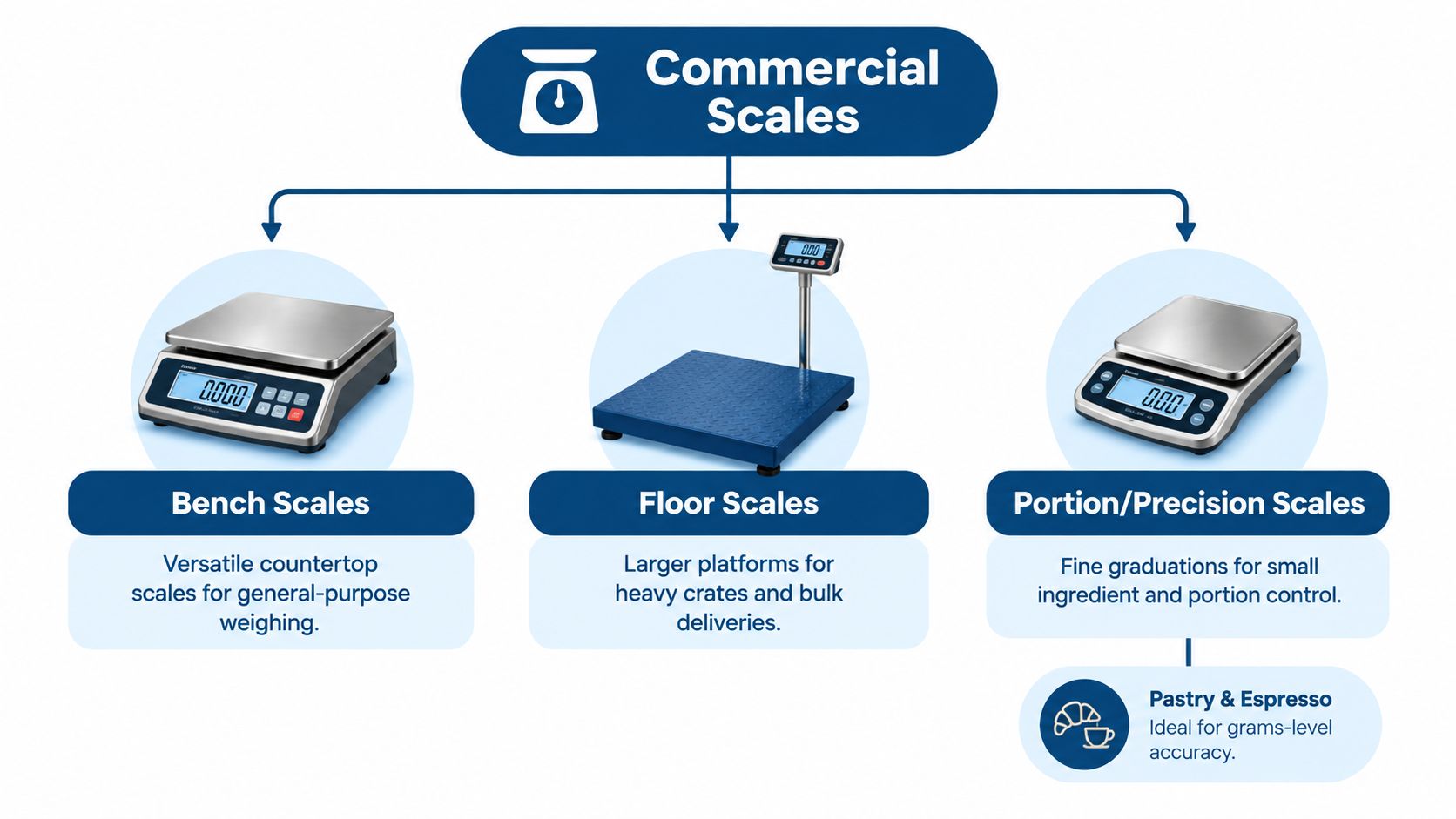
Bench scales for general kitchen work
Bench scales are often the most adaptable format for recipe preparation, portioning, ingredient checks, and small-batch production. They suit operations where weighing happens on a workbench and where staff need to move between containers or workstations.
Their usefulness depends on more than capacity. A suitable bench scale should provide a readable display, a platform that accommodates the working bowl or tray, a practical tare function, and construction appropriate to the surrounding moisture, flour, grease, and cleaning routine.
Floor scales for heavier loads
Floor scales make sense when the item is too heavy, bulky, or inconvenient to lift onto a bench. Receiving teams may use them for larger containers, crates, or bulk goods, provided the scale is appropriate for the load and environment.
They need planned floor space, clear access, and a surface that supports safe loading. A large platform can improve handling, but it doesn't replace the need to confirm graduation and operating conditions.
Portion and precision scales
Portion and precision formats suit smaller ingredient quantities, individual serves, pastry work, and other jobs where finer display increments matter. A pastry chef may prioritise small-quantity measurement, while a production kitchen may prioritise a broader weighing range.
A separate format can also make workflow clearer. Staff aren't forced to move a large production scale into a delicate prep task or overload a small unit with a heavy bowl.
Counting and price-computing applications
Counting scales estimate the number of similar items from their weight, which can assist with stock control or repeat component preparation. The result depends on consistent item weights and correct setup, so the process should be tested against the actual product.
Price-computing scales are different again. If the displayed weight determines what a customer pays, the instrument falls into the trade-measurement category and must meet New Zealand requirements. That use should be separated from internal kitchen weighing.
Legal Requirements for Trade Scales in New Zealand
A kitchen scale used internally for recipe development, production checks, or staff portion control isn't automatically a trade scale. The legal position changes when weight determines the quantity or price in a commercial transaction, such as goods sold by weight at a bakery, deli, butcher, market counter, or food outlet.
New Zealand's trade-measurement rules require weighing and measuring equipment used for trade to be type-approved and stamped with a mark of verification before legal use. If the mark is missing, damaged, or removed, the equipment must be re-verified immediately. Using unverified equipment for trade is an offence and can attract an infringement fee of $200 or a fine of up to $10,000. The requirements and enforcement process are set out in MBIE Trading Standards guidance on equipment used for weighing and measuring.
What operators should check
A trade scale must be an approved type and verified by a Trading Standards Officer or an Accredited Person. The instrument is then stamped with a verification mark, which may be an Accredited Person identifier or the crown stamp, applied through a lead seal or destructible adhesive label. A non-approved or unverified scale can't legally determine the weight used in a transaction.
New Zealand's trade measurement system is metric-only. Legal traceability connects measurements to standards maintained under the Measurement Standards Act 1992 or an approved overseas standard, so buyers should select equipment that can be verified against the applicable NZ requirements.
Consumer Protection explains that goods sold by weight, volume, length, or number must be accurately measured and clearly labelled with the correct net quantity. Its guidance also describes an annual certificate of accuracy sticker and the physical signs that usually indicate a scale has been approved and tested for trade, including a lead plug, crown mark, Accredited Person number, or destructible label. Operators reviewing broader obligations can also use the Ovenbell legal compliance tool as a supplementary reference, while confirming measurement requirements through the relevant New Zealand authorities.
Trade-use checkpoint: If a customer's payment depends on the displayed weight, confirm approval, verification, marking, and documentation before the scale is used.
The compliance question is separate from food hygiene, but both affect customer protection. Operators can review related obligations in New Zealand food safety regulations. Trading Standards guidance also provides for annual accuracy checks and certificates of accuracy for specified instruments, with businesses expected to maintain appropriate records and respond promptly when a verification mark is damaged.
Calibration and Maintenance Best Practices
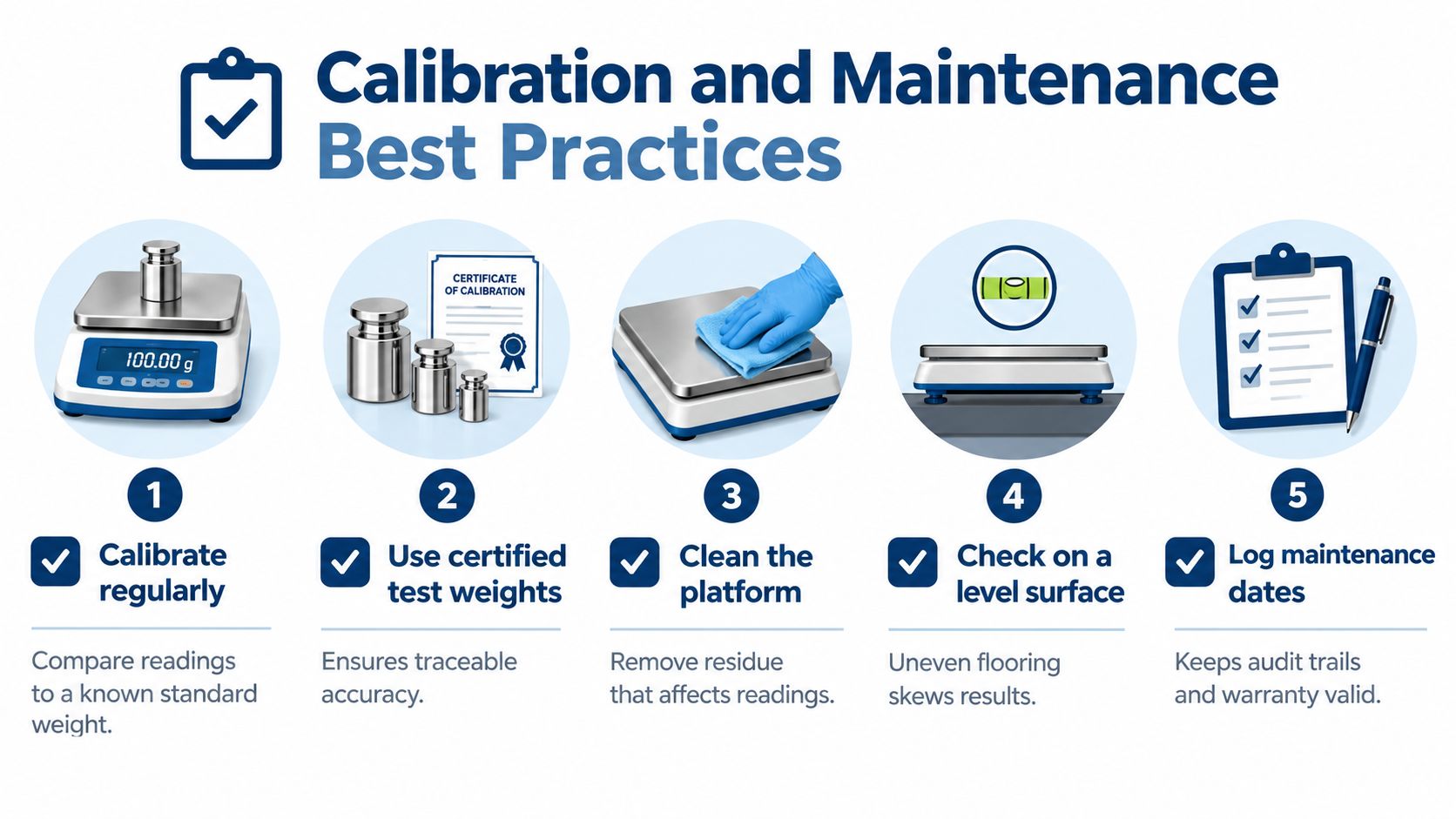
Accuracy depends on installation, handling, checking, and service. There isn't one universal calibration interval for every scale, because usage intensity, movement, environment, manufacturer instructions, and trade status all differ.
Operators should follow the particular manufacturer's instructions and any applicable regulatory requirement. Formal calibration, testing, or verification should use appropriate known standards, not improvised objects whose exact mass is uncertain.
Checks that catch problems early
Staff should know the warning signs:
- Zero problems: The display doesn't return properly to zero.
- Repeatability issues: Identical objects produce different readings.
- Drift: The indicated weight changes without a meaningful change in load.
- Process changes: A familiar recipe or portion suddenly produces an unexpected weight.
- Physical damage: The platform, controls, display, cable, or verification mark is damaged.
- Overload history: The scale has carried more than its rated capacity or received a hard impact.
A daily or weekly check using calibrated test weights may be appropriate where Trading Standards guidance or the operator's process calls for it. The important point is to use known weights and record the result, rather than treating an improvised check as formal calibration.
Cleaning without damaging the instrument
Keep the platform appropriately clean, because flour, grease, food residue, and trapped debris can affect placement and readings. Don't immerse a scale unless the manufacturer specifically designs it for that treatment, and don't assume that an easy-clean surface makes the whole unit waterproof.
Use the cleaning method, chemicals, and protection level specified by the manufacturer. Place the scale on a stable, level surface, avoid impacts, and investigate inconsistent readings instead of continuing to rely on a suspect instrument. Teams planning servicing can also review commercial kitchen equipment service guidance.
Choosing the Right Scale for Your Kitchen
The buying decision becomes clearer when the operation is described before products are compared. A café may need a compact unit for drink ingredients and a separate portioning station. A bakery may need one format for small pastry quantities and another for dough. A butcher or deli may need a trade-approved scale because weight determines the customer's charge.
A practical selection framework
Start with these questions:
- What is being weighed? Identify ingredients, portions, containers, boxes, trays, dough, produce, or retail goods.
- What is the smallest important quantity? This determines how much graduation matters.
- What is the heaviest routine load? Include the container, not just the ingredient.
- Will weight determine a customer's payment? If yes, investigate trade approval and verification before purchase.
- What fits on the platform? Check bowls, boxes, trays, and ingredient tubs against the platform dimensions.
- Can staff read and operate it during service? Display position, tare controls, and access matter.
- Where will it live? Consider moisture, flour, grease, heat, cleaning, movement, and accidental knocks.
- How will it be powered? Mains, battery, and rechargeable systems each suit different locations.
Power choice should follow the workflow. Mains power can suit a fixed prep bench, while battery or rechargeable operation may help where the scale moves between stations. Battery life and charging specifications should be confirmed from the manufacturer, not estimated.
One scale or more than one
A kitchen doesn't automatically need multiple scales, but a single high-capacity unit may be a compromise in both directions. One scale for fine, small measurements and another for larger portions or batches can be more practical when the tasks are different.
The tare function is particularly useful when staff weigh ingredients in bowls, trays, or containers. It allows the operator to account for the container and measure the ingredient itself, then reset the display as additional ingredients are added.
Construction and environmental suitability deserve equal attention. Check the documented IP rating where applicable, but don't call a scale waterproof merely because its surface appears easy to wipe. Buyers should also confirm the display, platform dimensions, overall dimensions, graduation, maximum capacity, tare function, power supply, construction, and warranty for the exact model.
A compact option such as the Joseph Joseph Switch Scale Grey may suit a particular light-duty workflow, but commercial operators should assess the product against the actual volume, environment, and required specifications rather than assuming one format fits every station.
Next Steps for Your Commercial Scale Needs
The right commercial scale is selected from the work outward. A bakery weighing small pastry ingredients shouldn't start with the largest capacity available. A food production operation handling full containers shouldn't choose a fine precision unit that lacks the platform or load range. A retail counter selling by weight must add NZ trade measurement requirements to the technical checklist.
The strongest buying decision usually records the tasks, smallest important quantity, largest routine load, container dimensions, environment, power arrangement, and whether the instrument will determine a customer's payment. That information gives a supplier enough context to compare suitable models without relying on brand name alone or unsupported reliability claims.
The same discipline applies to wider equipment planning. A scale may support portioning alongside food processors, commercial mixers, meat preparation equipment, storage containers, and production benches. It should fit the process, cleaning routine, available space, and documentation requirements.
Hospitality supplies hospitality equipment and related kitchen products for New Zealand businesses, with product selection based on the application and documented specifications. Operators can also assess the wider business case carefully. For example, if a scale and associated process cost $300 to implement and measured ingredient control eventually reduces genuine avoidable over-portioning by an illustrative $150 per month, the basic calculation is $300 ÷ $150, approximately two months. The $150 is illustrative only and must be measured from actual ingredient usage, not assumed in advance.
Simply Hospitality can help hospitality operators compare commercial scales by capacity, graduation, platform size, power, environment, and NZ trade-use requirements. Visit Simply Hospitality with the weighing tasks and product specifications available, and ask the team to help identify a suitable solution for the kitchen.