

Commercial Tandoor Oven for Sale in NZ: A Practical Guide
A restaurant can find a commercial tandoor oven for sale, arrange delivery, and still be weeks away from safely cooking the first naan. The oven may need a specific gas certification, a different LPG arrangement, upgraded extraction, additional accessories, and a working position that suits the chefs rather than the brochure.
For New Zealand hospitality operators, the sensible purchase sequence is menu, peak service, fuel, site, compliance, workflow, then equipment. A tandoor is not just another high-temperature oven. It becomes part of the gas supply, extraction system, kitchen layout, staff routine and commissioning paperwork.
Why Buying a Commercial Tandoor Is More Than Picking an Oven
A commercial tandoor uses a deep vertical cooking chamber and intense radiant heat. Chefs suspend meat, seafood and vegetables on skewers inside the chamber, while naan and other suitable flatbreads are pressed against the hot internal wall. That cooking method differs substantially from a convection oven, combi oven or range oven, where food generally cooks on trays, pans or racks.
The right model starts with the menu. A restaurant focused on naan production may need different chamber access, tools and working space from a venue that mainly cooks tandoori chicken, seekh kebabs or vegetables.
Four decisions before ordering
- Define the menu. List the tandoor dishes, expected portions and the number of products likely to be cooked at once. A broad menu can place more pressure on access and batch planning than a focused naan operation.
- Model peak service. The relevant question isn't how quickly the oven reaches cooking temperature before opening. It is how many tandoor dishes could be ordered during the busiest part of service, and whether the chefs can keep loading, turning and landing food without creating a bottleneck.
- Check the site. Available floor area, canopy position, gas supply, ventilation, make-up air, access routes and heat around the appliance all affect feasibility. A tandoor often needs more project planning than ordinary plug-in equipment.
- Confirm compliance and support. Gas appliances offered for sale in New Zealand must be safe, certified under a recognised regime and supported by the required Supplier Declaration of Compliance. WorkSafe also requires a compliance label and declaration to be lodged before supply for appliances covered by its declaration requirements. WorkSafe's appliance declaration guidance should be checked before a deposit is paid.
Practical rule: The oven specification is only one part of the purchase. The gas, extraction and installation plan must be acceptable before the unit is ordered.
A common failure occurs when an operator chooses by chamber size or appearance, then discovers that the LPG layout, canopy, gas certification or chef access doesn't work. The advertised oven price can look reasonable until the venue needs alterations around it.
The purchase should therefore be treated as a chain:
Menu → portions during peak service → cooking method → batch capacity → tandoor specification → site approval → installation and commissioning
A written discussion with the supplier, gasfitter and kitchen designer before ordering will expose problems earlier than a delivery-day inspection.
Gas or Charcoal Tandoor and Which Suits Your Kitchen
Gas and charcoal tandoors suit different operating conditions. Neither fuel should be declared universally superior. The decision depends on the menu, desired cooking process, staff capability, storage arrangements, extraction design and venue layout.
Gas models can provide convenient day-to-day control, subject to the particular burner system and installation. They also require exact confirmation of the approved fuel. A unit certified for LPG isn't automatically suitable for natural gas, and an uncertified conversion can delay commissioning or create a compliance problem. New Zealand guidance requires gas appliances to be safe for the gas they are intended to use, with installation undertaken under the relevant gasfitting framework. WorkSafe's gas installation requirements should form part of the procurement file.
Charcoal or other solid-fuel tandoors may appeal to operators seeking a more traditional process and flavour profile. They bring additional work, including fuel storage, handling, lighting, ash removal, shutdown, cleaning and fire control. Solid fuel can also change the extraction and approval conversation, particularly where a venue is retrofitting an existing kitchen.
Gas versus charcoal tandoor at a glance
| Factor | Gas tandoor | Charcoal tandoor |
|---|---|---|
| Control | Burner control can suit operators who need a repeatable operating routine. | Chefs manage the solid fuel and cooking conditions through the fuel bed and airflow. |
| Fuel handling | Requires an approved LPG or natural gas arrangement, depending on the model. | Requires safe storage, movement and disposal of solid fuel and ash. |
| Extraction | The system must handle high heat and cooking emissions from the actual appliance. | The system must also account for smoke, ash and additional fire considerations. |
| Menu fit | Can suit restaurants seeking regular gas-fired tandoor production. | Can suit concepts that specifically value a solid-fuel cooking process. |
| Staff training | Training focuses on burner operation, loading, unloading and safe gas use. | Training includes fuel management, lighting, ash handling and shutdown. |
| Site planning | Gas supply, certification, ventilation and cylinder or pipework location are central. | Fuel storage, extraction, fire controls and local approval need early attention. |
Indoor and outdoor use shouldn't be assumed from the fuel type alone. WorkSafe's hospitality guidance addresses kitchen risks such as burns and hot-air exposure, while local building and fire requirements can affect the proposed location. A venue should have the actual model and fuel arrangement reviewed before committing to a canopy or outdoor layout.
A dual-fuel or hybrid approach is only sensible when the manufacturer supports it and the site can satisfy the requirements of both operating modes. More flexibility can also mean more equipment, training and maintenance obligations.
For background on how solid-fuel cooking affects restaurant planning, the commercial charcoal grill considerations provide a useful comparison point, but a tandoor still needs its own model-specific assessment.
Sizing a Tandoor Around Your Menu and Peak Service
Chamber diameter alone doesn't tell a buyer whether a tandoor is large enough. A useful capacity assessment considers skewer count, naan production, batch size, opening access, chef numbers and the ability to maintain cooking conditions during repeated loading.
The starting question is practical: how many tandoor dishes could be ordered within the busiest 15–30 minutes? That peak window should include dine-in orders, takeaway tickets, banquet requirements and any delivery production handled by the same station.
Capacity is a workflow calculation
A naan-heavy menu may place pressure on the number of bread tools in use and the speed at which chefs can safely reach the chamber wall. A protein-heavy menu may depend more on usable skewer space, skewer length, chef access and the landing area beside the oven.
The assessment should include:
- Skewer loading: How many skewers can be used practically without crowding the chamber or obstructing access?
- Bread production: How many naan or roti products need to be handled in succession?
- Menu diversity: Can breads and skewered items be cooked without one product disrupting the other?
- Peak orders: What happens when several tandoor dishes arrive together?
- Chef access: Can the number of chefs assigned to the station work safely around the opening?
- Recovery: Does the manufacturer publish recovery or production information for the exact model? If not, the buyer shouldn't estimate performance from physical dimensions.
A single tandoor may suit a focused restaurant but struggle when it is expected to cover dine-in, takeaway, banquet and catering work at the same time. A second unit, a different configuration or a separate cooking appliance may produce a better service result than choosing the largest chamber.
A 60-cover restaurant and a 90-cover restaurant shouldn't automatically buy the same tandoor. The first venue may have a narrower menu and one chef at the station, while the second may run more takeaway, a broader tandoori section and several chefs working concurrently. Those operating details, rather than the cover number alone, determine the appropriate configuration.
The equipment planning guidance for consistent meal service is relevant because capacity only helps when the full cookline can support the station.
NZ Gas Compliance and Certification Before You Order
Gas compliance has to be settled before the tandoor is ordered, not after it lands on site. In New Zealand, gas appliances supplied since 4 May 2012 must be certified under the Gas (Safety and Measurement) Regulations 2010 or endorsed under the alternative regime. The Gas (Safety and Measurement) Regulations set that baseline.
For a commercial tandoor, ask for proof that the exact model is approved for commercial use in New Zealand. The file should include the Supplier Declaration of Compliance, certification details, permanent English-language safety markings, and the approved fuel gas.
The fuel certificate must match the site
The declaration should state whether the appliance is approved for:
- LPG
- Natural gas
- Both LPG and natural gas, where applicable
A gasfitter must install and commission the appliance under New Zealand requirements. Do not rely on a generic “gas ready” claim, especially for an imported model or a proposed conversion.
New Zealand appliance standards have developed through references including NZS 5262:2003 and NZS 5266:2014. These requirements deal with fire risk, explosion risk, gas leakage, hazardous temperatures, and unsafe combustion products. They do not judge whether the oven looks good or suits a particular cooking style. They set the safety floor for gas appliances used here. The NZS 5262:2003 standards information is relevant when checking the paperwork.
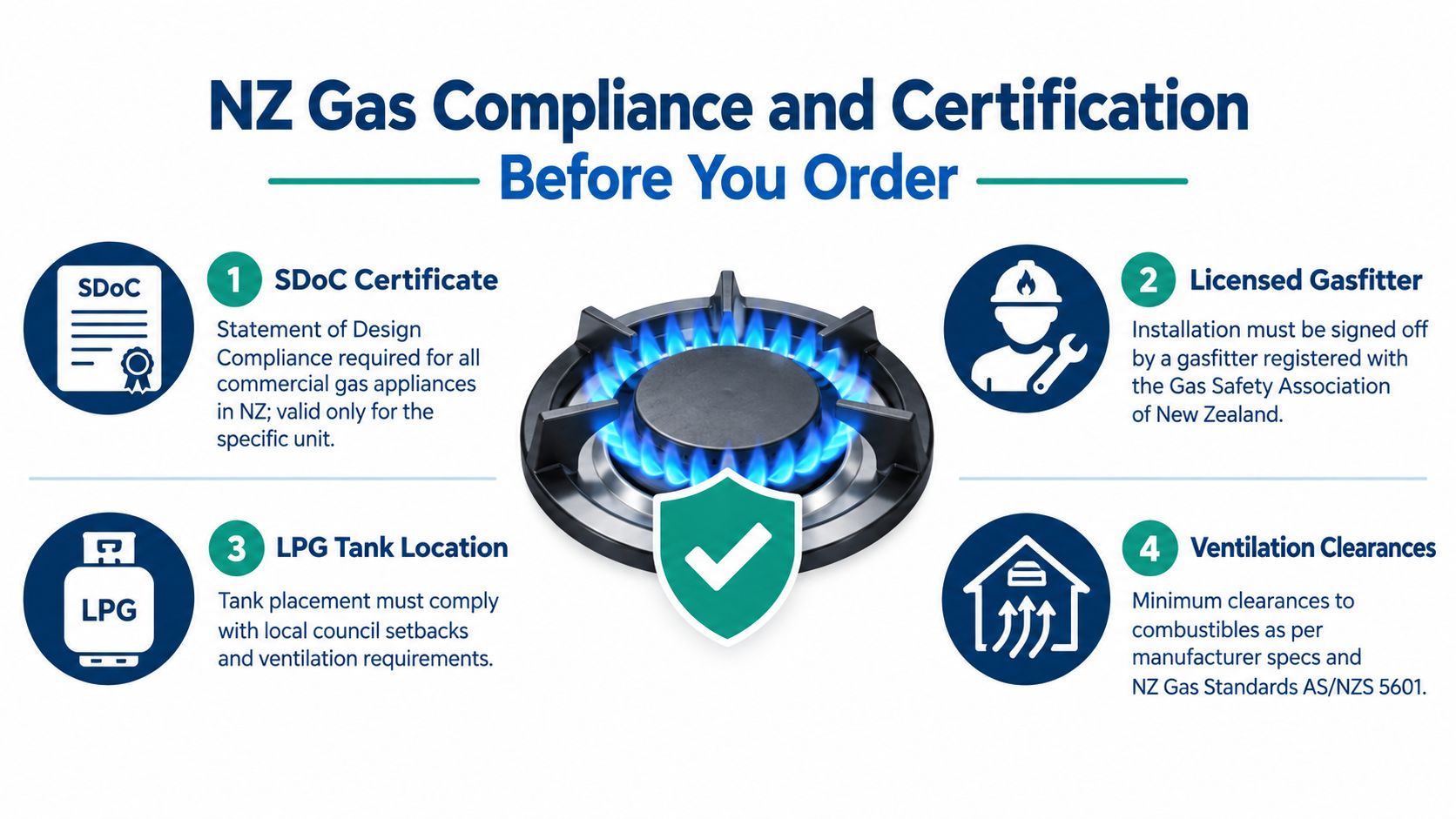
WorkSafe says gas appliances sold by a New Zealand supplier must be certified to an approved regime, carry a compliance label, and have the Supplier Declaration of Compliance lodged before supply. The regulatory update applied from 13 November 2025, with a transition period that ended on 12 November 2026. Any tandoor ordered now must meet the final requirements, so before paying a deposit, confirm the unit already complies with the fully in-force requirements rather than transitional arrangements. WorkSafe's gas safety regulation update sets out the change.
Before you pay, the procurement file should show:
- Exact model identification: The paperwork must match the unit being supplied.
- Fuel approval: LPG, natural gas, or both must be clearly stated.
- Compliance evidence: The Supplier Declaration of Compliance and certification details should be available.
- Label confirmation: Permanent safety and compliance markings should be visible on the appliance.
- Installation responsibility: The supplier and gasfitter should agree who provides commissioning documentation.
For temporary arrangements during a fit-out, operators can review temporary gas bridging safety and still get advice from the gasfitter responsible for the permanent installation. The commercial gas range and oven guidance gives useful context, but a tandoor still needs model-specific confirmation.
Installation, Extraction and LPG Storage on Site
A commercial tandoor shouldn't be treated like ordinary plug-in equipment. The oven, gas supply, extraction system, make-up air, clearances, floor, surrounding equipment and access route need to work together.
Four project dependencies
Gas supply comes first. The gasfitter needs the manufacturer's input and connection data, the approved fuel type and the available site supply. The tandoor may share a gas run with other appliances, so the complete demand and regulator arrangement must be assessed rather than checked in isolation.
Clearances come from the manufacturer. Side, rear and overhead requirements vary by model. Heat shielding, non-combustible surfaces and canopy positioning may affect whether the intended location works. A kitchen designer shouldn't guess these distances from another tandoor.
Extraction must suit the actual cooking process. A canopy that works for a range or fryer isn't automatically suitable for a tandoor. High heat, cooking emissions and the position of the opening all affect capture. Solid fuel adds smoke, ash and fire considerations. The design should be reviewed against the appliance documentation and applicable New Zealand requirements, including the ventilation provisions for gas-fuel appliances in the Building Code guidance. The Building Code ventilation document provides relevant context.
LPG storage can change the layout. For standalone cafés, bars and restaurants, WorkSafe sets an indoor LPG limit of 10 kg per 10 m² of indoor floor area, up to a maximum of 100 kg indoors. More than 100 kg must be stored outside, and the site may need a location compliance certificate or valid compliance plaque. Storage above 50 kg onsite also affects fire extinguisher provision. WorkSafe's LPG hospitality guidance should be reviewed with the relevant professionals.
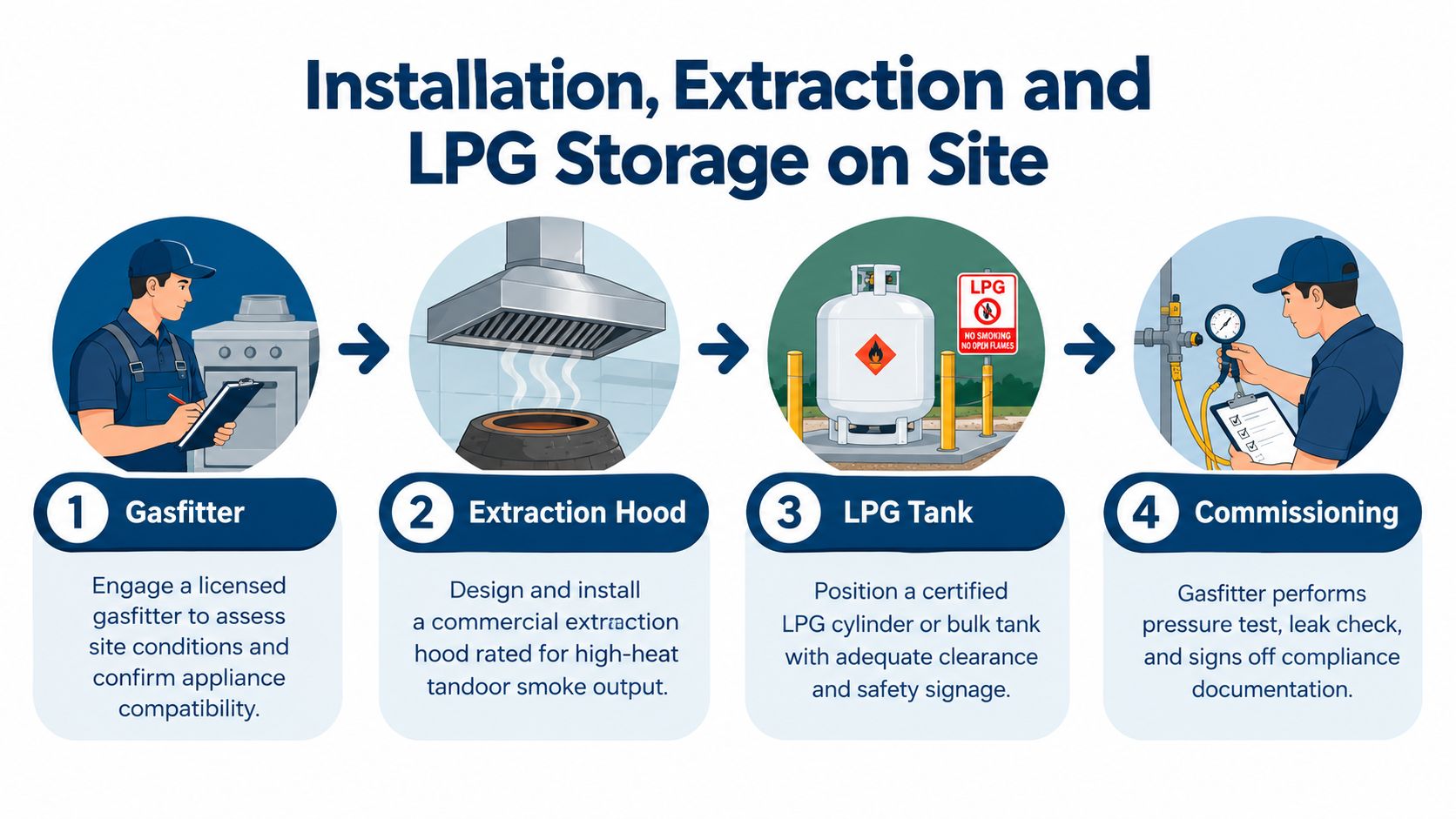
The tandoor's burner rating and flue arrangement should be matched to the site's gas and ventilation plan before purchase. The safest installation process includes a site assessment, appliance compatibility check, gas connection, extraction review, leak and pressure testing, commissioning and a documentation pack for the venue's records.
The commercial kitchen exhaust hood planning guidance can help operators frame the extraction discussion. It shouldn't replace a project-specific design by appropriately qualified professionals.
Total Installed Cost and How to Compare Two Quotes Properly
The advertised oven price is not the project cost. A lower-priced tandoor can become the more expensive option if it needs additional extraction work, a new LPG arrangement, building alterations or hard-to-source accessories.
A proper comparison should include:
Tandoor + freight + installation + extraction changes + gas/services + accessories + any required building work = actual project cost
The quote should also identify GST treatment, electrical interlocks where required, floor or wall preparation, access equipment, commissioning and warranty responsibility. No buyer should compare one unit price against another while leaving those lines blank.
Comparing Two Tandoor Quotes on a Like-for-Like Basis
| Cost line | Quote A, imported entry-level | Quote B, certified mid-range |
|---|---|---|
| Appliance | Confirm the exact model, construction and fuel approval. | Confirm the exact model, construction and fuel approval. |
| Compliance | Check whether the Supplier Declaration of Compliance and listing evidence are included. | Check the same documents and confirm they match the model. |
| Freight and access | Confirm delivery conditions and whether special access is required. | Confirm delivery conditions and whether special access is required. |
| Gas work | Include connection, conversion if approved, regulators and commissioning. | Include connection, regulators and commissioning. |
| Extraction | Price any canopy, ducting, fan or make-up air changes separately. | Confirm whether existing extraction is suitable and price any changes. |
| Building work | Allow for bases, shielding, flooring and heat protection where required. | Confirm the same site requirements. |
| Accessories | List skewers, naan tools, hooks, stands and landing equipment. | List included tools and all separately purchased items. |
| Support | Confirm parts, service contacts and warranty terms. | Confirm parts, service contacts and warranty terms. |
The cheaper quote isn't necessarily poor value, and the higher quote isn't automatically better. The decisive question is whether each quote describes a legal, installable and serviceable tandoor at the venue.
A quote is comparable only when both suppliers have priced the same operating outcome.
Accessories, Tools, Cleaning and Lining Care in Daily Service
The last mile of tandoor planning is often ignored. Chefs need the correct tools, enough landing space and a safe working position, otherwise a technically suitable oven can slow service and increase handling risk.
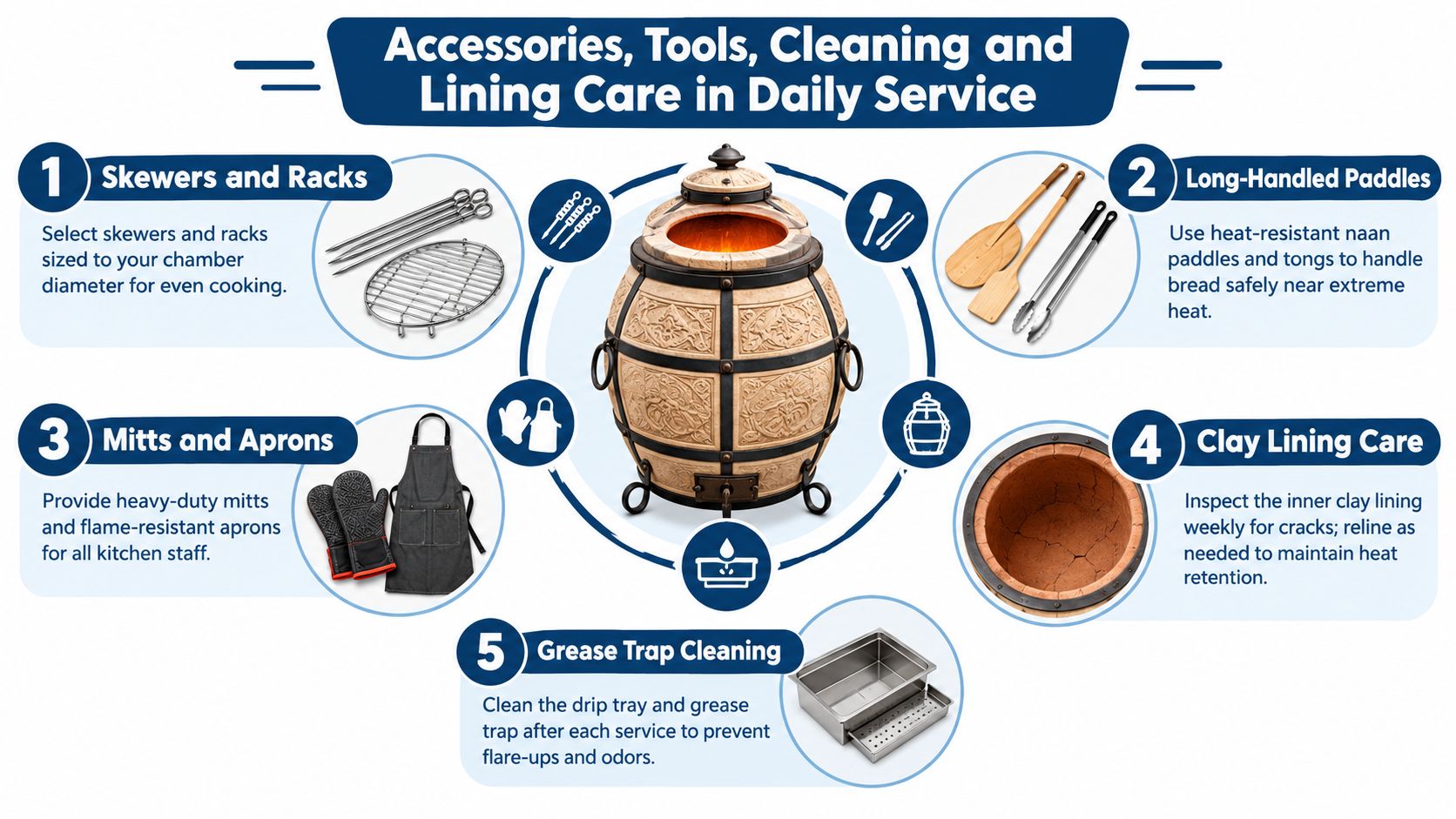
Required accessories vary by model and menu. The purchase list may include:
- Skewers and racks: Confirm the length, quantity and fit for the chamber.
- Naan tools: Include suitable paddles, pads, hooks and long-handled tools.
- Landing equipment: Provide trays, stands or heat-resistant surfaces for cooked food and hot skewers.
- Safety equipment: Supply heat-resistant gloves and other protective equipment appropriate to the work.
- Solid-fuel items: Confirm baskets, ash-handling equipment and related parts where the manufacturer specifies them.
- Spare parts: Ask about burner components, gaskets, tools and replacement lining sections.
A tandoor's internal lining deserves careful attention because naan can be cooked directly against the hot internal wall. Clay, ceramic and other lining constructions should be described exactly as the manufacturer specifies. Buyers shouldn't assume that one material heats faster, lasts longer or produces better flavour without model-specific evidence.
Cleaning needs to follow the construction
The cooking chamber, rim, opening, exterior, burner components and surrounding floor all require attention. Solid-fuel models also need an ash-management routine. The manufacturer should provide the approved cleaning method, because unsuitable chemicals, scraping or water contact can damage the lining.
A practical handover should explain:
- Daily tasks: Remove food residue and clean accessible surfaces according to the manual.
- Burner care: Keep gas burner components available for inspection and service.
- Lining checks: Report cracks, damage or loose sections before they affect operation.
- Solid-fuel care: Follow the specified ash removal and shutdown process.
- Area hygiene: Keep the floor, landing area and adjacent benches free of grease and discarded fuel.
Position also affects ownership. Chefs work down into the chamber, handle long skewers and move hot food immediately after removal. The appliance height, opening position, side benches, skewer length and landing area should be assessed with the actual staff routine.
The commercial oven cleaner guidance can help with broader kitchen cleaning decisions, but the tandoor lining and burner manufacturer's instructions take priority. A cleaning product suitable for stainless steel may not be suitable for clay or ceramic surfaces.
Buying Checklist and Getting the Right Tandoor for Your Venue
Before selecting a commercial tandoor oven for sale, the buyer should be able to answer these questions:
- What will the tandoor cook? Match the chamber and tools to naan, proteins, seafood, vegetables or the actual menu mix.
- What is peak service demand? Count likely orders during the busiest 15–30 minutes, not the average shift.
- Gas or solid fuel? Choose the process that fits the menu, staff and site.
- What fuel and services are available? Confirm approved gas type, supply, connection and storage.
- What extraction is required? Assess the appliance, fuel and cooking emissions together.
- Will the oven fit and remain accessible? Check delivery access, working space, floor and surrounding equipment.
- Is the working height practical? Test the chef's reach, skewer handling and landing position.
- Which accessories are included? List every tool needed for service.
- What maintenance does the manufacturer require? Obtain cleaning, lining, burner and service instructions.
- What is the complete installed cost? Include freight, installation, gas work, extraction, building work and accessories.
Used equipment can reduce the initial purchase commitment, but the exact model, age, lining condition, burner condition, gas compatibility, documentation, accessories and manufacturer support must be verified. A used unit may need fresh compliance work or infrastructure changes before it can be commissioned. Operators should also consider which insurance a restaurant needs and ensure the equipment documentation is suitable for the venue's insurer and records.
A written quote should state freight, gas work, commissioning, warranty, parts availability and any trade-account arrangements for accessories. Simply Hospitality supplies commercial cooking equipment and related kitchen products, and its team can help operators assess an equipment option against the menu, available fuel, extraction and site requirements.
Talk to Simply Hospitality about the menu, expected volume, available fuel and kitchen setup before ordering a commercial tandoor. The team can help identify a suitable equipment option and the installation, extraction, compliance and accessory requirements that need to be resolved around it. Visit Simply Hospitality to start the conversation.