


Key Equipment Considerations for Healthcare Foodservice
A delayed meal trolley exposes a problem that a high-capacity oven can't solve. If trays are still waiting for dietary checks, the ward lift is occupied, or returned items are backing up the dishwasher, patients and residents experience the failure at the end of the chain. Equipment considerations for healthcare foodservice must therefore cover the complete meal system, from receiving and preparation through cooking, portioning, holding, transport, service and warewashing.
Hospitals, aged-care facilities, rehabilitation centres and other healthcare environments need equipment that supports nutrition, food safety, dietary separation, texture-modified meals, reliable production and predictable delivery. The right choice depends less on a catalogue specification than on how the facility's people, menus, spaces and service windows work together.
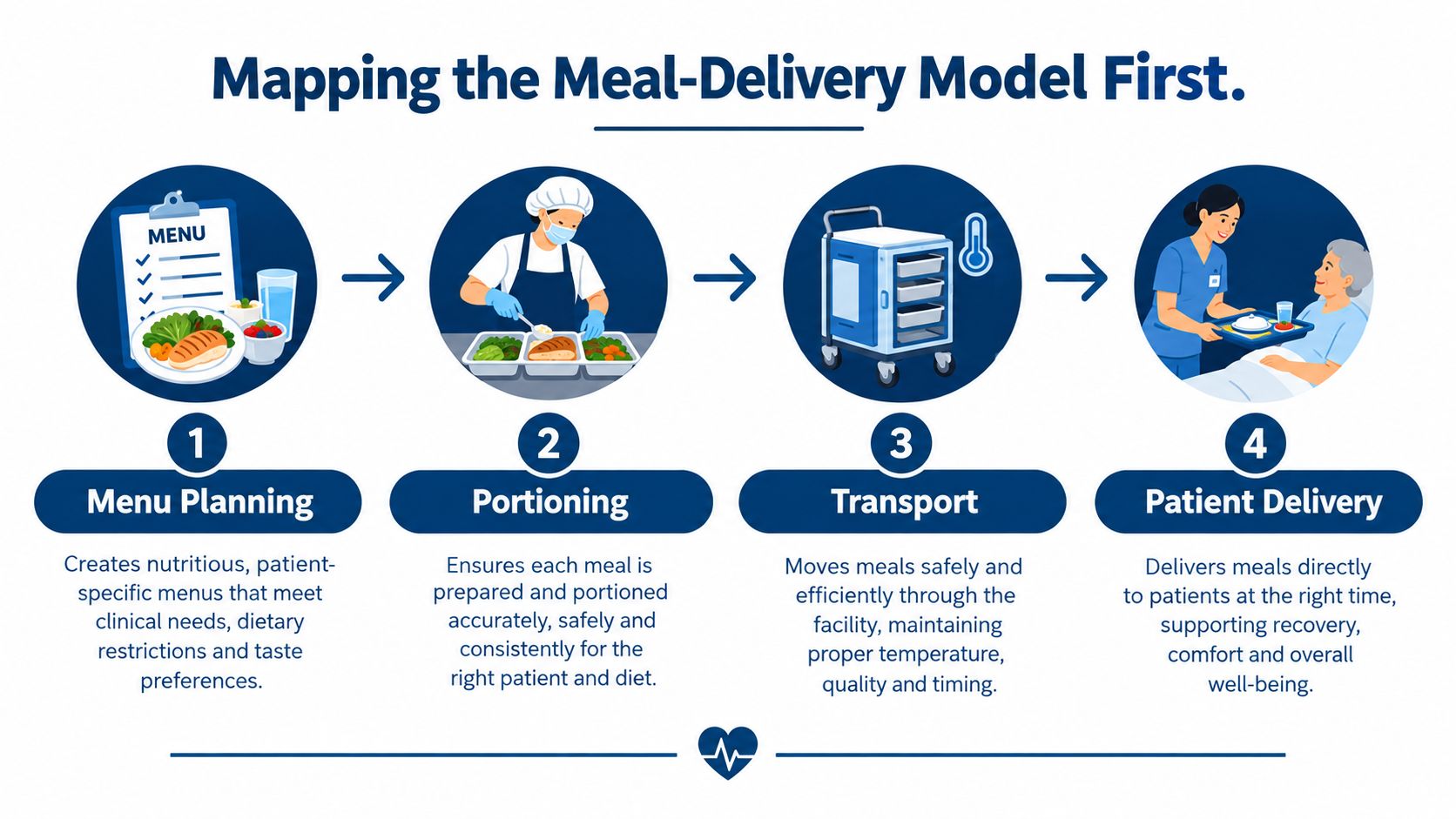
Mapping the Meal-Delivery Model First
Before comparing appliances, the facility needs a clear map of how a meal moves. Start with the people being served and work backwards from the patient or resident:
Patients or residents → meals per day → menu requirements → production method → portioning → transport → service → return and warewashing
That sequence prevents a common purchasing mistake, buying cooking equipment around total daily output while overlooking the portioning bench, meal trolley route or clean-storage capacity.
A central hospital kitchen supplying several buildings may need bulk production, staged holding and transport systems that a smaller aged-care facility with an on-site kitchen doesn't require. A rehabilitation centre may have different menu timing, dietetic coordination and ward distribution needs again. Cook-serve, cook-chill and hybrid models also place different demands on blast chilling, refrigerated storage, reheating, holding and tray assembly.
Questions that define the equipment brief
The meal model should be documented before specifications are written. Useful questions include:
- Service volume: How many meals are produced for each service, and how many are required across the day?
- Production layout: Is food made in one central kitchen, several satellite kitchens, or a combination?
- Timing: How long is available for cooking, portioning, dispatch and delivery?
- Distribution: How many wards, floors or buildings must each trolley serve?
- Menu complexity: How many menu items, therapeutic diets and texture-modified meals compete for the same equipment?
- Staffing: Which tasks are completed by kitchen staff, dietetic teams, ward staff or contractors?
- Future demand: Could the facility's service area, resident numbers or meal model change?
A facility producing meals in batches may need more chilling and storage discipline than one serving immediately. A facility with long routes between the kitchen and patient rooms may need more attention to insulated transport, trolley access and route timing than to cooking speed alone.
The guide to planning equipment for consistent meal service is useful when translating menus and workflow into an equipment schedule. The equipment should follow the meal system, not the other way around.
Practical rule: Trace one complete meal from delivery dock to patient and back to the wash-up area before approving a major equipment purchase.
Production Capacity and System Redundancy
Daily meal totals can hide the underlying production challenge. A facility may produce a large number of meals across a day, yet the critical question is how many portions must be cooked, portioned and dispatched during the narrowest service window.
A useful starting calculation is:
Portions required ÷ available production window = required production rate
That rate must then be tested against the menu. Main meals, vegetables, sauces, purées, thickened fluids where applicable and special-diet alternatives may all need equipment at the same time. The oven may have enough rack space in theory, but the operation can still miss dispatch if trays cannot be assembled quickly enough or if staff must wait for one shared appliance.
Capacity planning should also account for the equipment's usable capacity rather than its advertised maximum. Staff need room to load safely, separate food types where required, remove cooked product, clean between tasks and respond to last-minute diet changes. A practical overview of what is capacity planning in logistics can help teams think beyond the appliance and assess the movement of product through the whole operation.
Build resilience into critical services
Healthcare facilities often have less tolerance for downtime than conventional hospitality venues. Refrigeration, cooking, hot-water production and warewashing can all become business-critical, so the procurement discussion should include what happens when one unit is unavailable.
Assess:
- Service availability: Can qualified technicians support the equipment in the facility's region?
- Parts access: Are replacement parts and consumables realistically available?
- Maintenance planning: Can preventative maintenance occur without interrupting meal production?
- Backup capacity: Is there a practical alternative if a refrigerator, oven or dishwasher is out of service?
- Equipment configuration: Would multiple smaller units allow continued operation, or would one larger appliance be more suitable?
Multiple smaller appliances can create useful redundancy, but they also occupy more space and may require additional connections, cleaning and staff interaction. One larger unit can simplify production and floor planning, but a single failure may affect the entire service. The right balance depends on the menu, building services, maintenance support and available fallback process.
A redundancy plan should be operational, not theoretical. It should identify which meals can be produced elsewhere, where ingredients can be stored temporarily, how trays will be washed and who authorises a change to the service plan.
Cooking Equipment and Texture-Modified Diets
Cooking equipment needs to handle both volume and variation. A bulk-production kitchen may benefit from bratt pans, steam cooking, kettles or large cooking lines, while a smaller operation may gain more from flexible oven and preparation equipment that can support different menus without excessive changeover.
Combi ovens can be valuable where one appliance must support several cooking processes, including combination cooking, steaming and regeneration. Convotherm and Unox can be relevant examples where the selected model matches the facility's capacity, services and menu. Turbofan convection ovens may suit operations that need straightforward dry-heat production, while Waldorf or Blue Seal cooking equipment may be appropriate for facilities that rely on cooktops, ranges or heavier-duty cooking tasks. No single appliance replaces every other cooking method.
Match equipment to the dietetic workflow
Healthcare foodservice may need to manage:
- Allergies and allergen separation.
- Medical diets specified by the facility's clinical team.
- Puréed and other texture-modified meals.
- Thickened fluids where applicable.
- Religious and cultural requirements.
- Individual nutrition requirements.
Equipment selection should support separation, identification and repeatable preparation. A food processor or commercial blender may be used for texture-modified meals, but the unit must fit the recipe volume, cleaning process and segregation policy. Robot Coupe, Vitamix Commercial and Hamilton Beach Commercial may be relevant examples where current models meet the application.
A large processor can handle batch work efficiently, but it may be awkward when only a small quantity needs adjustment. A smaller dedicated unit can provide flexibility and reduce changeover, though it adds another appliance to clean, store and maintain. The decision should consider whether the facility can verify cleaning between diets and whether staff can identify every batch correctly.
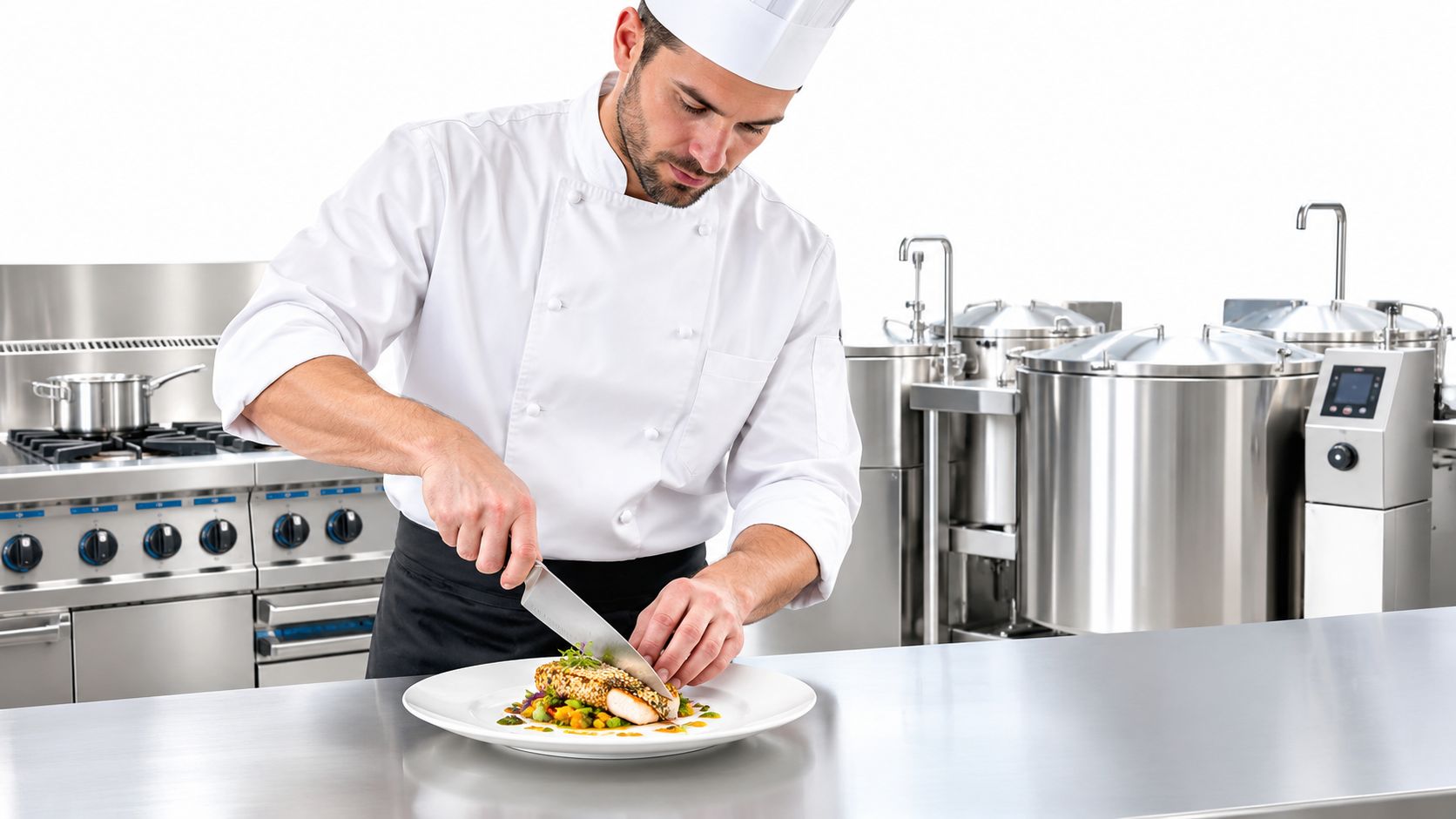
Texture consistency is a process
Owning a powerful blender doesn't guarantee a consistent texture. The working sequence is closer to:
Recipe → ingredients → preparation → processing → portioning → identification → service
Changes in ingredient moisture, batch size, processing order and holding time can alter the result. Facility dietitians, speech-language therapists and other relevant healthcare professionals should define individual patient requirements and the applicable texture framework. Staff should follow current authoritative requirements rather than relying on generic blender settings or assumed processing times.
The same discipline applies to equipment cleaning. A processor that performs well but has difficult-to-remove components may create a cleaning bottleneck or weaken separation between standard and modified meals. In healthcare kitchens, flexibility is useful only when the workflow can preserve food safety, identification and clinical direction.
Refrigeration and Strict Temperature Control
Refrigeration should be planned as a system, not purchased as one large cabinet. Healthcare operations may need bulk chilled storage, frozen storage, preparation refrigeration, point-of-use refrigeration, cook-chill storage and dedicated space for beverages or nutrition products. Each area has a different loading pattern and may need a different access arrangement.
New Zealand food-safety guidance sets specific controls for perishable food and displayed meals. Fridges must hold perishable food below 4°C, while walk-in chillers used for meat or fish must hold below 2°C. Hot food on display must be preheated to 80°C and kept above 65°C. Cold perishable food must be displayed below 4°C or discarded after no more than two hours. These requirements are set out in New Zealand guidance for serving and displaying food.
NZ Healthcare Temperature Thresholds
| Food category | Required temperature limit |
|---|---|
| Perishable food in fridges | Below 4°C |
| Meat or fish in walk-in chillers | Below 2°C |
| Hot food on display | Preheated to 80°C and kept above 65°C |
| Cold perishable food on display | Below 4°C |
| Refrigerated leftovers | Use within three days |
The same guidance places a three-day limit on refrigerated leftovers. That makes storage layout, date labels and rapid-cooling capability particularly important where batch cooking and meal rotation are routine. Equipment should make the safe process easier to follow, with calibrated thermometers, visible monitoring and enough capacity to keep raw, cooked and ready-to-eat foods appropriately separated.
Size storage around the operating pattern
Capacity should reflect:
Delivery frequency + menu cycle + production stock + special-diet stock + peak inventory + contingency
SKOPE and Atosa may be relevant refrigeration examples, but application and operating conditions should decide the specification. A preparation fridge located beside a portioning bench may need different access and loading characteristics from a bulk chiller. A walk-in unit may provide useful volume, but its layout, shelving and traffic pattern still need to support safe stock rotation.
Reliable thermostatic control matters, but so does verification. Operators should define who checks temperatures, where records are kept, how faults are escalated and how food is protected if a unit drifts outside its required range. Further practical context is available in this article about cold-chain management.
Meal Holding, Transport and Tray Assembly
A meal can leave the kitchen in the correct condition and still arrive unsuitable for service. Long corridors, lift delays, multiple buildings, uneven distribution routes and ward-level interruptions all affect the final result. The meaningful question is not only, “What temperature does the meal leave the kitchen?” It is also, “What condition is the meal in when it reaches the patient?”
Heated holding, chilled holding, insulated carriers, meal trolleys and tray systems should be selected around the route. A trolley that suits a short internal journey may not suit a facility with several buildings. Insulated containers can support movement between areas, but staff need a clear process for loading, opening, cleaning and returning them. The practical guidance on insulated food containers helps frame that decision around use rather than container size alone.
Treat tray assembly as production
Tray assembly is often where a capable kitchen loses time. The workflow may include:
Cooking → portioning → dietary identification → tray assembly → trolley loading → transport
Bench length, tray access, ingredient positioning and staff movement all influence throughput. If plates, labels, cutlery, drinks and texture-modified items are stored on opposite sides of the room, staff spend service time walking instead of assembling. If holding equipment is too far from the assembly line, food may wait in unsuitable conditions while trays are completed.
A workable layout gives staff clear positions for standard meals, modified meals and last-minute changes. It also provides a controlled place for checking diet labels before trays leave the kitchen. The route should account for trolley dimensions, doorways, lift access, turning space and the location of clean and returned equipment.
Select transport equipment for the real route
Meal trolleys can support organised distribution where trays need to remain protected and easy to identify. Insulated carriers may suit smaller transfers or satellite areas. Neither option is automatically superior. The choice depends on route length, service timing, trolley storage, cleaning access and whether heated and chilled meals need separate handling.
A useful trial is to run a representative service with empty trays, labels and serviceware. Staff can record where they reach, wait, turn or cross paths. That observation often reveals a tray-assembly constraint that a kitchen plan or equipment brochure won't show.
Warewashing, Hygiene and Infection Control
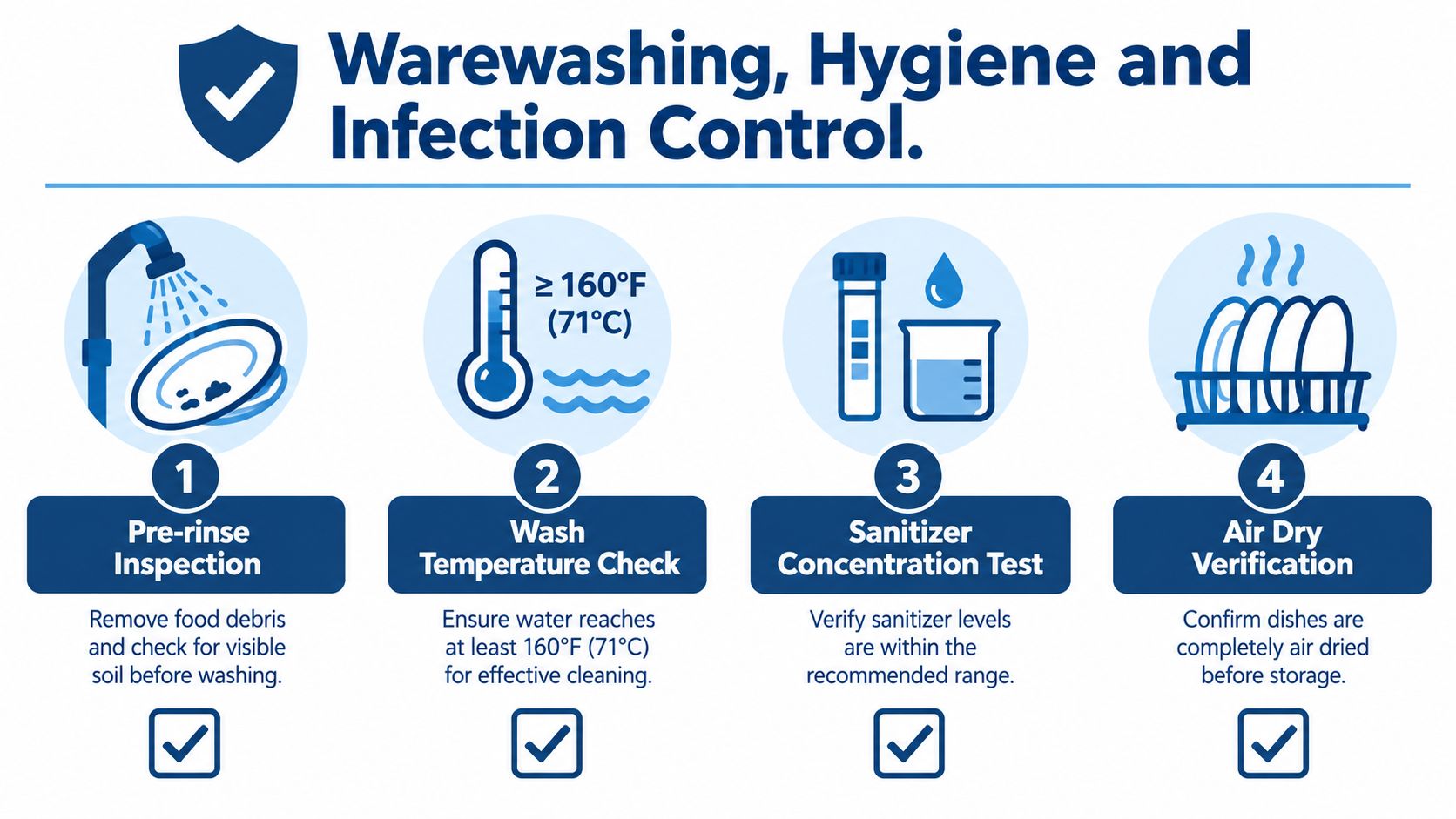
A large commercial dishwasher isn't automatically the right dishwasher for healthcare foodservice. The real test is whether the complete warewashing system can move dirty items away from clean items, process peak returns, dry equipment properly and place clean items into protected storage without creating unnecessary handling.
Healthcare kitchens may process plates, bowls, cups, cutlery, trays, GN pans, preparation utensils and cooking equipment in the same service cycle. Operators should assess:
Items returned at peak → rack and load capacity → cycle throughput → drying and handling → clean storage
The physical route matters as much as the machine. Dirty trays shouldn't need to pass through the clean-storage area, and staff shouldn't have to place washed items on preparation benches because shelving is inadequate. Rack sizes, pre-rinse arrangements, drainage, chemical storage and access for maintenance all affect the result.
Cleanability is a procurement requirement
New Zealand food-contact equipment and containers must be suitable for food contact, designed so they can be adequately cleaned and maintained, and made from non-toxic materials. Where necessary, they should be durable and movable or able to be disassembled for maintenance, cleaning, disinfection and pest inspection, as set out in New Zealand food hygiene guidance.
Food preparation and handling areas also require a cleaning schedule, with food-grade sanitiser used on surfaces under the Food Regulations 2015 and National Programme 2. That makes cleanability practical rather than cosmetic. Hard-to-reach joints, porous finishes and non-food-safe materials can retain residue and increase the workload placed on the sanitation process. Stainless work surfaces, accessible food-contact areas, removable components and sensible equipment spacing are usually easier to manage than complicated assemblies that staff can't fully inspect.
Health NZ guidance covers cleaning, disinfection, reusable equipment reprocessing and environmental surfaces, while care-setting audits check matters such as staff training, reusable versus single-use equipment policies and disinfection of shared equipment. Procurement teams should translate those requirements into questions about materials, crevices, disassembly and verification.
The article on reliability versus features in aged-care warewashing is a useful prompt for comparing cycle performance with the practical burden placed on staff.
A dishwasher only works as part of a controlled dirty-to-clean workflow.
Standards and electrical safety
NSF/ANSI 2 provides minimum food-protection and sanitation performance requirements for food equipment such as cafeteria, kitchen, pantry, counter, hood, shelf and sink units in New Zealand's standards environment. Standards New Zealand also explains that the health sector relies on international and joint Australian/New Zealand standards, including NZS 8134:2021 Ngā Paerewa Health and disability services standard, to underpin quality and reliability across health services.
Electrical safety also belongs in the specification. New Zealand's Electricity (Safety) Regulations 2010 require new or used fittings and appliances supplied for sale to be electrically safe, with kitchen machines included among appliances covered by the applicable standards in Schedule 4. Facilities should confirm that equipment, installation and connections are suitable for the building and intended use.
Whole-of-Life Costs and Future Capacity
Purchase price is only one part of the decision. Healthcare equipment may operate for long hours, require frequent cleaning and support a service that can't stop when a component fails. A more useful assessment is:
Purchase + installation + energy and water + consumables + labour implications + maintenance + downtime risk = whole-of-life consideration
A cheaper unit can become difficult to justify if staff spend more time cleaning it, service access is poor or replacement parts are hard to obtain. Conversely, a larger or more advanced appliance isn't automatically economical if the facility routinely operates it well below its useful capacity. Manufacturer cleaning and maintenance instructions should shape the layout, including access to filters, condensers, service panels and removable components.
Professional planning can help map workflow, equipment, services and capacity before construction begins. SACH may be relevant where a healthcare foodservice project needs coordinated kitchen planning rather than isolated appliance selection. Custom stainless benches, sinks, shelving and storage can also be useful, with Pacific Stainless relevant where custom fabrication is required.
Future capacity should be considered without oversizing every asset:
Current demand → peak demand → realistic future demand
Some infrastructure is difficult or expensive to add later, so initial provision may be sensible. Other equipment can be added modularly if the room, services and access routes are planned properly. The right choice depends on the building, menu model and likely operational change.
The discussion around buying cheap versus buying once is useful when comparing upfront cost with serviceability, durability and disruption risk. For advice on mapping production, dietary requirements, refrigeration, transport and warewashing into a workable equipment schedule, visit Simply Hospitality. The team supplies commercial kitchen equipment and related foodservice solutions, and can help healthcare operators assess suitable options for their facility, workflow and whole-of-life requirements.