

Food Waste Disposer: A Practical Guide for Hostelries
A food waste disposer is useful in a commercial kitchen only when it solves the right problem. It helps move unavoidable soft food waste out of the prep area, but it doesn't reduce how much food a venue throws away in the first place. The operators who get the most value are the ones who already focus on purchasing, portion control, and production planning, then use a disposer to make the remaining waste easier to manage, cleaner to handle, and less awkward to move through the kitchen.
A Food Waste Disposer Manages Waste, It Does Not Reduce It
The wrong reason to buy a food waste disposer is the idea that it will somehow make waste disappear. It won't change over-ordering, poor prep discipline, or oversized portions, and it won't turn avoidable waste into a saving. What it can do is make the unavoidable scraps from preparation and plate clearing easier to move out of the kitchen without filling bins as quickly.
First reduce waste at the source
That difference matters. A kitchen that still throws away a lot of edible food should tighten its controls first, because a disposer only manages what's left after better planning has done its job. For operators thinking about source reduction as a bigger system issue, the practical question is often how much waste can be avoided before it ever reaches the sink, which is why this discussion sits alongside broader planning work such as how much food waste vacuum packing can eliminate.
Practical rule: if a venue hasn't already improved purchasing, prep forecasting, and portioning, a disposer usually treats the symptom rather than the cause.
Where the disposer earns its keep
In busy hospitality sites, the benefit is workflow. Prep waste from vegetables, plate clearing, and production scraps can move out of the work zone faster, which reduces the amount of loose organic waste sitting in bins and tubs. That's especially useful where staff are constantly clearing benches, resetting service, and keeping the pass tidy.
The best-fit venues are usually those with steady food prep, a lot of soft organic scraps, and enough sink and plumbing capacity to support the equipment properly. Smaller kitchens can still use one, but only if the waste stream and wastewater setup make sense. The supplier conversation should start with the waste problem, not the machine.
How a Commercial Food Waste Disposer Works
A commercial disposer sits under the sink between the sink drain and the trap, then grinds food scraps into particles small enough to move through plumbing. The practical point is straightforward: a commercial disposer processes suitable scraps into a much finer discharge that can leave the kitchen through the wastewater system. That distinction matters in commercial kitchens, because the sink setup and what sits beneath it both affect how well the unit performs.
What it handles well, and what it doesn't
For most hospitality sites, the best use case is soft organic food waste. That includes vegetable preparation scraps, plate clearing waste, and general kitchen prep residue. This is the material that fills bins quickly, starts to smell sooner, and creates the most handling inside a busy service area.
It is a poor fit for fatty or fibrous waste that can create maintenance problems. Consumer guidance is clear that fats, oils, grease, shells, corn cobs, artichokes, and large amounts of peels or eggshells are poor candidates for disposal, because they increase clogging and service risk (Consumer Reports guidance). Commercial operators should also follow the manufacturer's permitted food list, because warranty and performance both depend on staying within that limit.
The operating routine is more deliberate than many people expect. One practical guide says to run cold water for 20 to 30 seconds before grinding, keep it running while the unit works, then continue for 20 to 30 seconds after (garbage disposal best practices). Water supply and drainage design need to be set up from day one, especially where a kitchen is already tight on plumbing capacity. For that reason, the disposer should be planned with the sink system, not added as an afterthought. A useful starting point is the discussion of stainless-steel sinks for commercial kitchens, because sink material, depth, and layout affect how the whole wash area is organised.
Why commercial units are different
Commercial disposers are built for heavier use than domestic models. They need stronger motors, sturdier grind chambers, and better endurance across repeated cycles during service. That matters in kitchens where waste is coming in continuously, not just after dinner.
Commercial fit-out also affects how the unit sits with the rest of the wash area. For example, the Modular Stainless 600mm Deep Dishwasher Inlet-Outlet Bench is a 600 mm wide x 600 mm deep x 900 mm high stainless bench with leg bracing rather than an undershelf, and it is designed to work with popular commercial dishwashers. In a tight wash area, that kind of benching can make the difference between a layout that is easy to clean and one that constantly feels cramped.
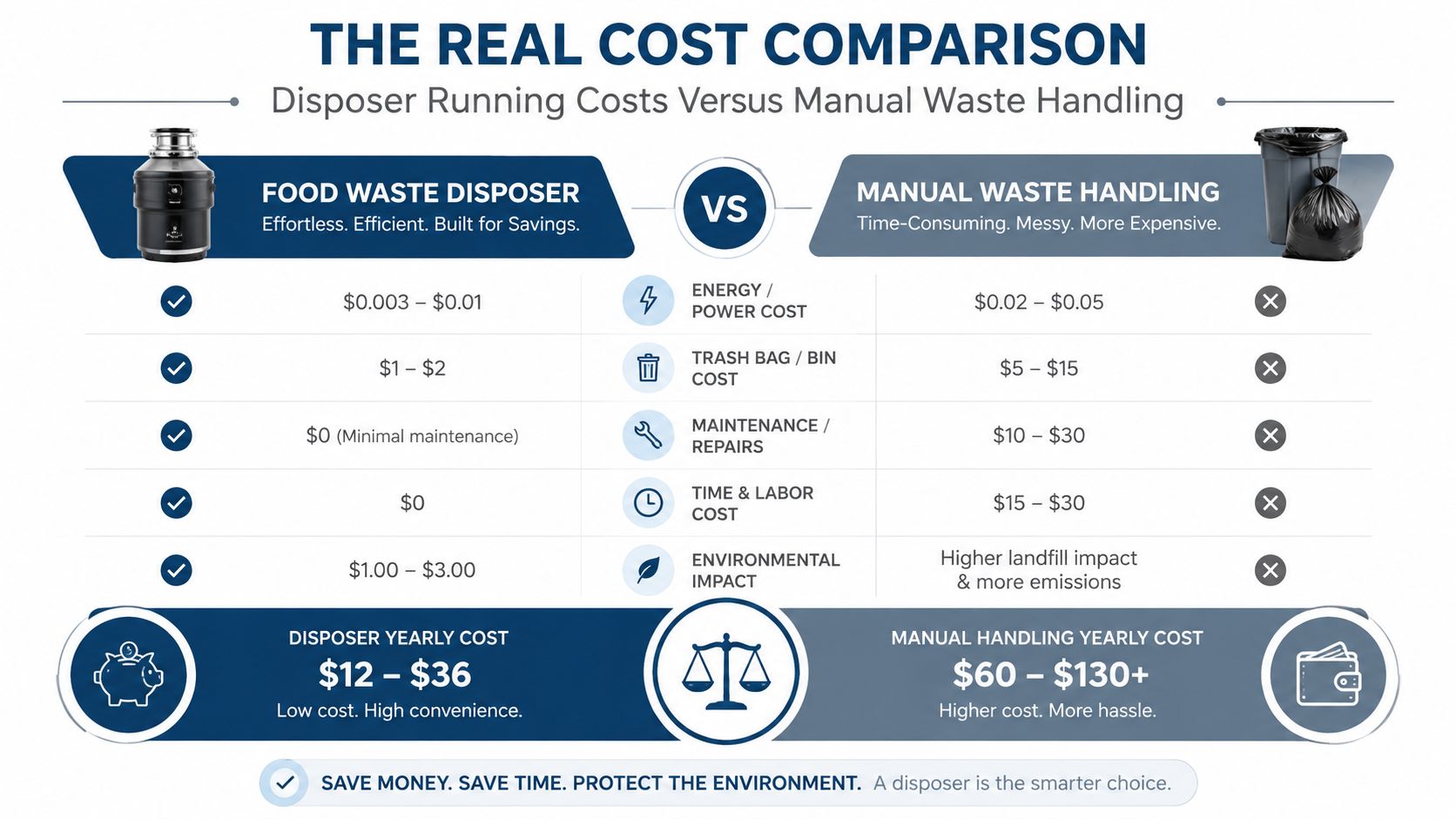
Cost Comparison, Disposer Running Costs Versus Manual Waste Handling
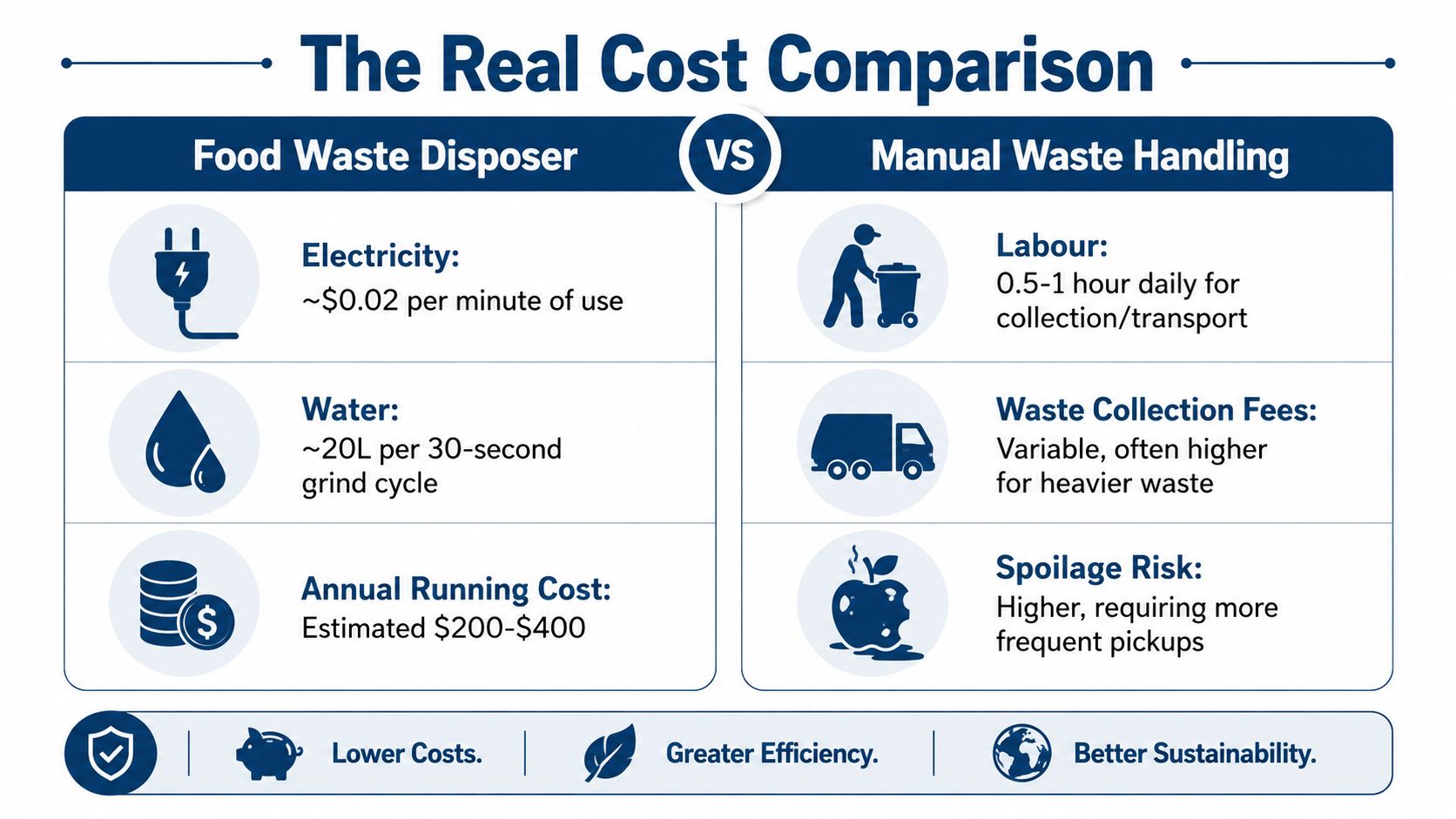
The buying question goes beyond electricity or water use. It comes down to whether the disposer's running cost is lower than the hidden cost of manual waste handling, day after day, with bins, liners, lifting, storage, cleaning, and collection all added together. That is the comparison hospitality managers should make.
What disappears from the manual system
Without a disposer, food waste has to be scooped, carried, stacked, stored, and collected. That creates a chain of small jobs that add up across service, especially in kitchens with frequent prep cycles or high plate turnover. Staff also spend more time cleaning around food-waste areas, and the kitchen needs room for bins and liners.
A disposer shifts some of that burden into the sink system. The operator still pays for electricity, and in many systems water use becomes part of the operating profile too. The Environmental Protection Agency notes that commercial food disposal equipment can draw 3 to 10 gpm of fresh water during operation and may keep using water during idle periods unless controls are fitted (EPA commercial WaterSense guidance). That makes water management a real issue in NZ kitchens where site conditions matter.
The full cost picture includes labour as well as utilities. Bin liners, staff handling, waste storage, cleaning, and collection all sit in the manual workflow, so the disposer should be judged against that whole process, not just the power draw. For a practical labour-side comparison, see this Robot Coupe labour-savings analysis for restaurant kitchens, which uses the same basic question, how much staff time a piece of equipment removes from repeated kitchen tasks.
The useful comparison is electricity and water against the labour of moving waste through the kitchen.
What the numbers say about waste volume
There is evidence that disposers can materially reduce the volume of waste collected. A study recorded garbage collected per collection falling from 251.2 kg to 114.7 kg in a medium-sized village, weekly garbage in a small village falling from 175 kg to 112 kg, and an average reduction rate of 31% across the survey period, with monthly reductions ranging from 25% to 39% (Springer study). That does not translate automatically to every commercial kitchen, but it does show why volume handling belongs in the decision.
For heavily loaded kitchens, the trade-off deserves an honest look early. A venue with lots of soft prep waste may find the disposer pays back through smoother workflow even if utility use rises. A quieter kitchen with modest waste may not.
Simple test: if food waste is already moving cleanly through a small, efficient bin stream, a disposer may be unnecessary. If waste is clogging workflows and taking up service time, the equation changes fast.
Choosing the Right Disposer for Your Kitchen Volume
Specification has to start with workload, not horsepower labels. One of the easiest ways to create reliability problems is to ask a small disposer to process far more waste than it was designed to handle, because the unit can't keep up with the volume or the pace of service. Capacity should match the venue type, the waste stream, and how often staff will use it across a shift.
The main selection points
The practical checklist is straightforward:
| Specification | What to Consider | Why It Matters |
|---|---|---|
| Motor capacity | Match the disposer to expected prep waste and plate clearing volume | Undersizing leads to jams and poor throughput |
| Electrical supply | NZ commercial units are commonly designed around 230V/50Hz | Local supply has to suit the equipment, not a different market |
| Current draw | Examples show around 4.7 A for a 0.55 kW (3/4 HP) unit | Breaker sizing and circuit planning need to match the load |
| Drain connection | A 40 mm drain connection appears in NZ-facing specs | The pipe interface has to suit the installation |
| Permitted food types | Check what the manufacturer allows | Performance, maintenance, and warranty all depend on it |
| Access for servicing | Leave room under the sink | Maintenance is harder in cramped spaces |
NZ-facing commercial specifications show light-to-medium units built around 230V/50Hz, with examples of 0.55 kW (3/4 HP) models drawing about 4.7 A and using a 40 mm drain connection (technical specification sheet). That matters because performance data from a different electrical market doesn't transfer cleanly.
Matching the machine to the venue
A busy restaurant processing waste from high-volume covers needs a different unit than a café dealing mainly with prep scraps. If the disposer sits in a production kitchen, the question becomes whether it can keep up without slowing the team down or forcing staff to wait between loads. For a venue that's already growing out of its current setup, the signs often show up in workflow before they show up in equipment failure, which is why operators often compare the waste handling load with the broader signs of kitchen capacity limits, like those covered in signs your kitchen has outgrown your equipment.
Commercial kitchens also need to be honest about space. If there's no useful room beneath the sink, or if the waste connection is awkward, the equipment can become a maintenance headache very quickly.
Installation and Plumbing Considerations for NZ Kitchens
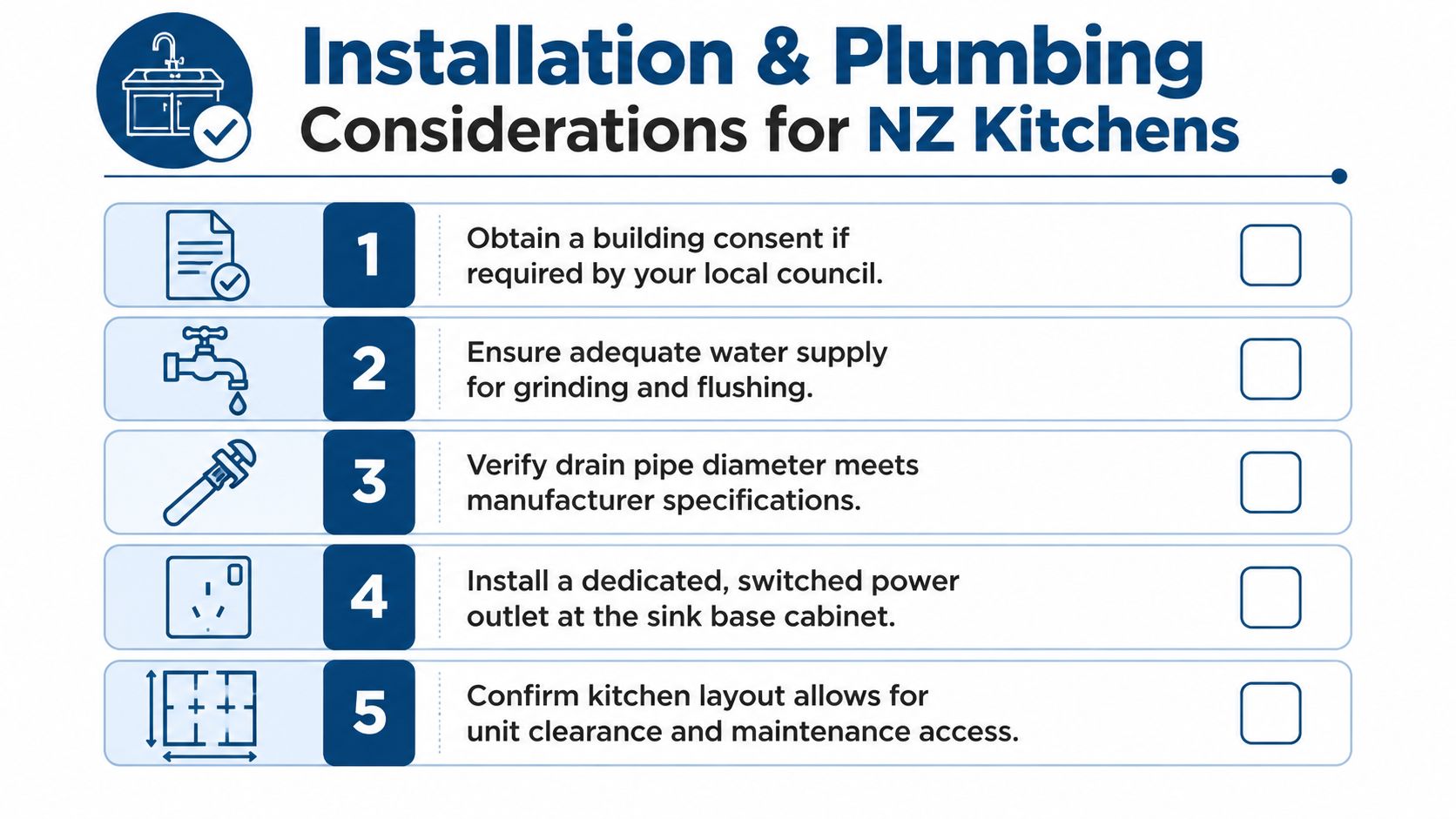
A disposer should be thought about early in a fit-out, not squeezed in later. Sink compatibility, waste connections, electrical supply, available room beneath the sink, and existing plumbing all affect whether the installation is sensible. Retrofitting into an older kitchen usually takes more planning than fitting one during a new build or a planned refit.
Compliance comes first in New Zealand
NZ operators need to treat this as a wastewater issue as much as a kitchen equipment issue. Auckland Council's wastewater guidance says property owners must check whether a disposer is permitted on their site, because the device can increase solids loading to the sewer and may not suit onsite wastewater systems (Auckland Council wastewater guidance). That's a practical commercial point, not a minor admin step.
Local trade-waste and wastewater rules vary by council and by site. A disposer might be acceptable in one location and restricted in another, especially where grease management and wastewater loading are already tight. For operators in food service, that means the council check comes before purchase, not after the box arrives.
Practical rule: if the kitchen has onsite wastewater, an older grease-management setup, or a council-sensitive discharge path, treat the disposer as a compliance conversation first and an equipment choice second.
What needs checking on site
The installation plan should cover the basics, but each one affects the others:
- Sink and bench layout: there has to be enough physical space for the unit, pipework, and servicing access.
- Drain design: the trap, discharge line, and connection path all need to match the disposer.
- Electrical supply: the outlet has to be placed and protected appropriately for commercial use.
- Water supply: the system needs enough water for operation and flushing.
- Wastewater path: the site has to cope with the additional solids load.
The key issue is that a disposer changes what goes into the wastewater system. It doesn't remove the need for grease management, and it doesn't make plumbing constraints go away. The right choice depends on the full site picture, not just the sink opening.
Routine Maintenance and Troubleshooting
A disposer that's selected properly still needs disciplined daily use. The basics are simple, keep water running while it operates, avoid putting non-food items into the chamber, and never force prohibited waste through the unit. That routine protects the grind chamber, the trap, and the discharge line.
Daily and weekly habits that prevent faults
Cold water flushing matters because it helps carry ground particles through the line and reduces buildup. Staff should also listen for unusual sounds, because changes in noise often show up before a full jam. If food waste is being moved correctly, the unit should sound consistent rather than strained.
A tight daily routine usually looks like this:
- Run cold water during use: Keep the flush going while the unit works.
- Watch what goes in: No non-food items, and no forbidden fats or fibrous waste.
- Listen for changes: Grinding noise, rattling, or hesitation can signal a developing issue.
- Check for leaks: Weekly inspection around connections catches small faults early.
Basic troubleshooting that staff can handle
If a unit hums but won't grind, the likely issue is a jam. If drainage slows, the problem may be buildup in the trap or discharge line rather than the grinding chamber itself. Unusual vibration can point to misalignment or worn internal components, which is where service support matters.
One useful maintenance resource for the surrounding sink area is a proven kitchen drain cleaning method, especially when operators are trying to separate disposer issues from drain-line buildup. That distinction matters, because many kitchen drainage problems aren't caused by the disposer alone.
Reliability starts with buying the right commercial unit, then supporting it with routine care and sensible use. Parts availability and servicing access should be part of the original purchase decision, not an afterthought.
Alternatives to a Food Waste Disposer
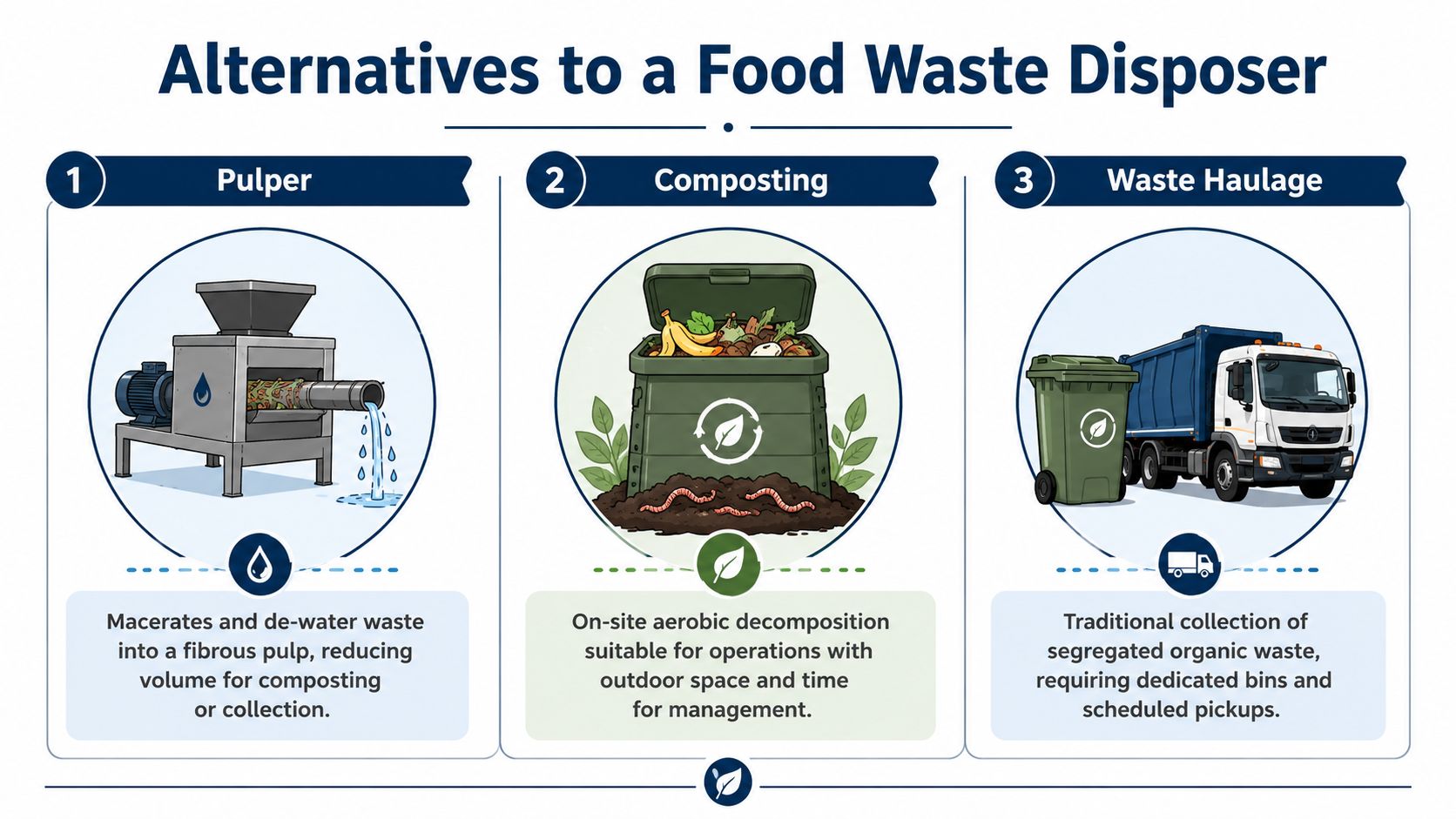
A disposer isn't the only way to manage kitchen food waste, and in some venues it isn't the best one. Pulpers, compactors, and off-site collection all solve slightly different problems, and some kitchens can avoid a disposer completely by scraping waste into strainers and sending pre-rinsed ware straight to a commercial dishwasher. That can suit high-volume NZ operations better than smaller sites with limited plumbing flexibility.
The main alternatives side by side
A pulper macerates and de-waters waste into a fibrous pulp, which reduces volume and suits sites that can manage separate collection. A compactor compresses waste into a smaller form, but it doesn't remove the need for collection. Off-site food-waste collection works when waste can be separated cleanly at source and collected for composting or anaerobic digestion.
There are also on-site biological options for some operations. For hospitality teams exploring those systems, practical BSFL composting tips can be a useful starting point, especially where outdoor space and managed separation are available.
How to choose the right route
The decision depends on waste volume, waste type, space, plumbing, council requirements, and collection infrastructure. A kitchen with tight internal space but good drainage may lean towards a disposer. A site with strong source separation and external storage may do better with collection or composting. A production kitchen with heavy organic waste and dedicated waste handling space may suit a pulper or a mixed system.
Useful filter: if the kitchen's waste problem is mainly in the bin room, look at collection and compaction. If the problem is in the prep line and dish area, a disposer may solve more of the workflow pain.
The point isn't to force every kitchen toward one answer. It's to choose the system that fits the operation without creating a new bottleneck elsewhere.
Making the Right Decision for Your Venue
The practical way to judge a food waste disposer is to work from the kitchen backwards. Cut avoidable food waste first. Then decide whether the remaining waste is better handled by a disposer, a pulper, a collection service, or a no-disposer workflow built around the dishwasher and waste segregation setup. The right answer comes down to how the site runs.
Before buying, operators should ask direct questions. How much food waste is handled each day? What type of waste is it? How much staff time goes into moving it? Is the plumbing suitable? Is there enough space beneath the sink? What capacity disposer does the volume require? What foods does the manufacturer permit the machine to process? Those answers matter more than the sales pitch.
Local wastewater rules still need checking before installation, because requirements vary by council and application. NZ kitchens need a machine that fits under the sink, fits the trade-waste setup, and fits the way the kitchen works day to day. If the disposer loads staff with avoidable cleaning, clogs a weak waste line, or creates trade-waste issues, it is the wrong purchase even if the unit itself looks cheap. For broader equipment planning and kitchen layout thinking, the restaurant quality cookware guide is a useful reminder that hospitality buying should start with how equipment will be used, not just what it costs to purchase.
The comparison is total operating cost. A disposer uses power and water, but manual handling brings its own costs, staff time to carry waste, bin liners, cleaning around the bin room, waste collection fees, and the mess that builds up when organic waste sits too long. In some kitchens, the disposer wins because it removes repetitive handling at the prep line and dish area. In others, especially where waste is already well segregated and collection is simple, a disposer adds cost without solving the main bottleneck.
If you are weighing up whether a disposer suits your kitchen, Simply Hospitality can help you work through the practical fit, the plumbing questions, and the capacity side of the decision. Visit Simply Hospitality to talk through the right waste-management setup for your venue.