

Hibachi Grill NZ: What Buyers Should Check Before Buying
A hibachi grill is a compact, Japanese-style grill, traditionally charcoal-fuelled, that cooks food on an open grate over radiant heat. In New Zealand the term covers small charcoal grills of that kind, and size is the least important thing about one. Cooked food in a New Zealand kitchen must reach at least 75°C for 30 seconds, 70°C for 3 minutes, or 65°C for 15 minutes under New Zealand Food Safety requirements, and a small charcoal hibachi carries those food-safety obligations plus the ventilation rules that sit around it.
Popular buying advice treats a hibachi grill NZ search as a product hunt. Compare the grate, pick a price, and light it. That advice fails in a restaurant, café, marae, or event kitchen. Smoke, grease, heat, and odour set the compliance load for a unit of any size, so fuel type, extraction, and the council position decide whether the grill can run at all.
Treat the grill as one part of a cooking system.
What a Hibachi Grill Is and How It Differs From Yakitori and Teppanyaki
Hibachi originally named a Japanese charcoal brazier used to warm a room. In New Zealand and other Western markets the same word is stuck on small charcoal grills that cook food. A listing can mean a charcoal grate, an electric tabletop, or a heating vessel. Each one needs different fuel, extraction, and installation, so the name alone is a poor buying filter.
Three pieces of equipment get mixed up in the same search.
| Equipment | Cooking surface | Fuel | Typical food | Commercial suitability |
|---|---|---|---|---|
| Hibachi-style grill | Compact exposed grate over the heat source | Usually charcoal, some electric | Meat, seafood, vegetables, skewers | Suited to small, controlled setups; indoor use needs an engineered installation |
| Yakitori grill | Long, narrow grate for skewers | Usually charcoal | Chicken skewers, offal, vegetables on sticks | Suits skewer-focused menus; extraction over the line is essential |
| Teppanyaki grill | Flat metal plate | Usually gas or electric | Seared meats, seafood, vegetables, rice dishes | Common in cooked-to-order restaurants; gas connection and extraction must be verified |
A shichirin is the small ceramic or clay charcoal grill, usually tabletop, that sits closest to the traditional Japanese form. It is not a flat plate and it is not a long skewer line.
Match the equipment to the menu
A skewer bar buying for yakitori needs a long grate and extraction running the length of that line. A compact square hibachi leaves cooks turning sticks in a queue and still produces the same smoke. A table-side teppanyaki concept needs a metal plate and an extraction plan, not a charcoal pit under the table. Guests may call both ideas hibachi. The kitchen cannot.
Practical rule: Ask the supplier to confirm cooking surface, fuel, and whether the unit is designed for indoor commercial use before anyone compares prices.
Three questions sort a shortlist. What fuel does it burn? What surface does the food touch? Where will it sit, outdoors, under a canopy, or inside a registered kitchen?
How a Hibachi Grill Works and Controls Heat
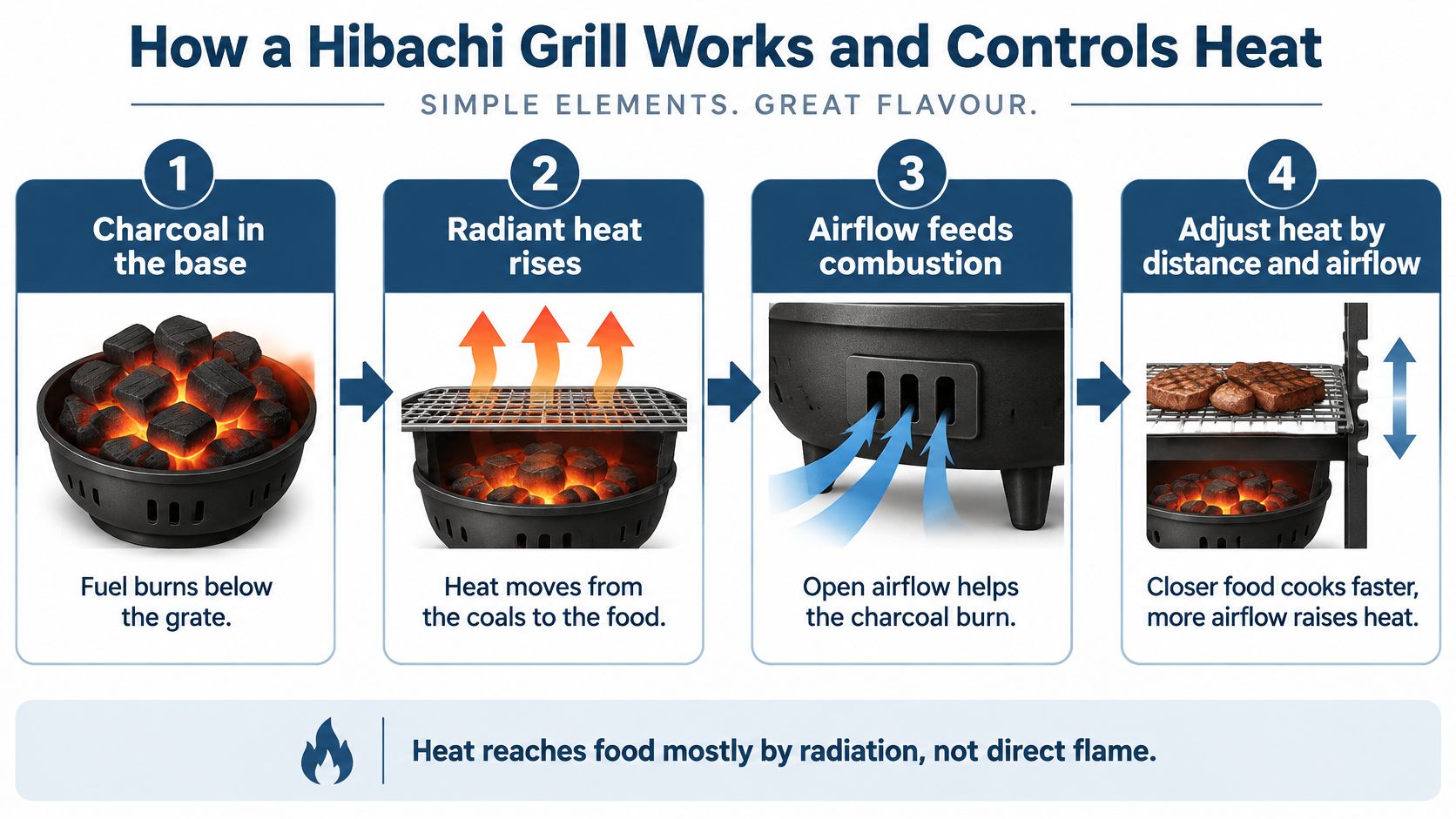
Charcoal sits in the base and glows. Most of the heat that cooks the food is radiant, travelling from the coals up to the grate rather than from a flame touching it. Plenty of units sold as hibachis work differently: some are electric, and some commercial grills push gas under a radiant bed. The label tells you little about what the installation demands, and that gap is where grill purchases go wrong.
Air, distance, and the grate
Vents or dampers set how fast the coals burn. Open airflow raises heat. Closing it slows the fire. Ash builds up and blocks those same paths, so a firebox left dirty between services runs cool and uneven even when the charcoal looks fresh.
Grate height changes the result as much as the vent does. Close to the coals, thin cuts and skewers brown fast, and the outside can char before the centre is cooked. A greater gap gives gentler heat for thicker pieces. The grate itself decides grip, grill marks, and whether fat drips clear or flares.
A gas alternative changes the control method. The Gasmax JUS-TRH60 600mm Benchtop Lava Rock Chargrill is a benchtop lava-rock grill with independent gas control, a stainless-steel body and flame-failure protection, sold in natural gas and LPG variants at NZ$3,169.40 and currently in stock. The wider grate suits a two-zone load better than an occasional finishing grill. It is a gas benchtop chargrill and needs a proper gas connection and extraction, the same obligations a larger chargrill would trigger.
A service routine
- Light the charcoal and wait until the coals are evenly covered in grey ash.
- Set the grate at the height that piece of food needs.
- Adjust the vents for a steady burn, not a flare.
- Cook in small batches and leave space between pieces.
- Shift finished food to the cooler zone while the next batch cooks.
Overcrowding drops the grate temperature and steams the food instead of searing it. Cut and tray the next batch before the current one comes off, and keep someone watching the fire for the whole service.
Hibachi Grill Types Compared for NZ Buyers
Six forms show up in New Zealand listings. Construction decides heat retention, weight, cleaning, and how long the unit lasts, which matters more than the photo on the box.
| Grill type | Main advantages | Limitations | Suitable applications |
|---|---|---|---|
| Traditional-style charcoal hibachi | Compact, low cost, quick heat, authentic smoky flavour | Small cooking surface, open flame and smoke, needs ventilation and ash handling | Outdoor home cooking, controlled pop-ups, small demonstrations |
| Ceramic or diatomaceous-earth Japanese grill | Holds heat steadily, even radiant heat, traditional shichirin style | Can crack if knocked or heated unevenly, slower to start, ash handling needed | Small skewer batches, table-side or outdoor cooking |
| Cast iron hibachi-style grill | Retains heat strongly, durable, good sear | Heavy to move, slow to heat, needs seasoning and careful cleaning | Fixed outdoor positions, cooks wanting strong searing |
| Stainless steel tabletop grill | Lightweight, easy to wipe clean, corrosion resistant | Thinner walls lose heat faster, less heat retention | Mobile catering, short service sessions |
| Commercial Japanese charcoal grilling equipment | Built for repeated service, larger surface, designed around installation | Needs engineered extraction, fire protection and staff training | Restaurants with a dedicated Japanese grilling menu |
| Electric hibachi-style unit | No flame or charcoal, consistent temperature, simpler indoor review | No charcoal char or smoke, different flavour, power supply required | Venues wanting the Japanese-style look without charcoal |
What the material changes
Ceramic and diatomaceous-earth bodies hold a steady radiant bed, which suits a short run of skewers. A knock, or a cold grate dropped onto a hot bowl, can crack them. Cast iron sears hard and stays hot, then punishes anyone who has to carry it or scrub it without drying and seasoning. Stainless steel wipes clean and resists corrosion, so it suits a caterer packing down after a short session, but thin walls lose heat as soon as a cold tray of prawns lands.
Only the commercial charcoal unit is built for repeated service, with a larger surface and an installation path already in mind. An electric unit is a different cooker. Temperature is steady and there is no charcoal to store, and the char and smoke that define the style are gone.
What to check before shortlisting
For each row, confirm the fuel, the usable grate size rather than the outer shell, the weight when hot, and whether a cook can reach the ash and grease without dismantling the stand. Gas-fired radiant grills sit in a different compliance path from charcoal, which is why a commercial gas cooking setup is planned with the gasfitter, not added after the menu is printed. Two types are enough to take into the next conversation with a kitchen designer.
What to Cook and How to Keep It Safe
A compact grate rewards food cut thin and even. Beef and other meats in uniform slices, chicken skewers, prawns and small fish portions, mushrooms, and seasonal vegetables all finish in one pass. One or two bite appetisers suit a tasting menu. A full protein that needs a long cook does not.
Set a batch size per dish before service. The grate has a fixed output per cook, so cooking to the pass, rather than to a planned tray, creates a queue. Pat proteins dry so they brown. Keep sugary marinades to a light coat, because sugar burns on a hot bar long before the centre is done. Write the marinade and the portion weight down so Tuesday's chicken matches Saturday's.
Where the format stops scaling
Table-side grilling and a short Japanese-inspired tasting menu work for a few covers when one cook owns the fire. The same grill feeding a full dining room becomes the bottleneck. Match the number of dishes, not the marketing photo, to what one grate can clear in the busiest hour.
A compact hibachi is a speciality tool. It is not a production grill with a smaller footprint.
Holding and probing
Raw protein stays on its own boards, tongs, and trays, separate from cooked food. Food Standards Australia New Zealand states that potentially hazardous food reheated for hot holding must be heated quickly to 60°C or hotter, ideally within two hours or less. The grate surface is not the temperature at the centre. Probe each batch with a calibrated thermometer and move finished food into controlled hot holding straight away. A grill that cannot hold output at peak pushes staff to park half-cooked portions, which is a buying failure, not a staffing one. Venues already working through New Zealand food safety regulations should write that probe step into the food-control plan before the first service. For outdoor fire craft at home, a beginner's guide to fire cooking covers cast-iron handling over open heat, which is a different setting from a registered kitchen.
Ventilation, Fire and Permit Rules Before You Light One
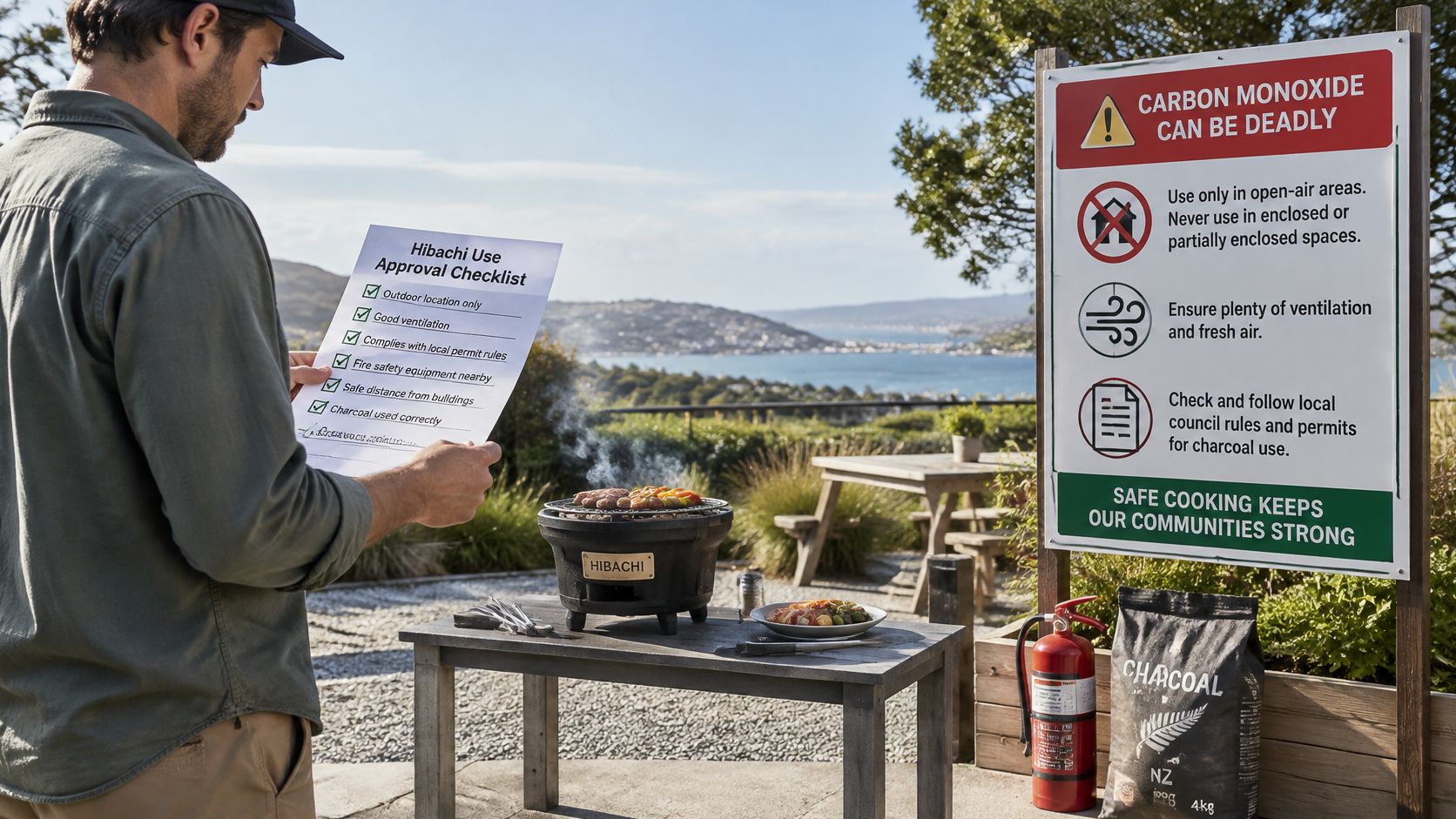
Charcoal produces carbon monoxide, and the gas does not care how small the grill is. A tabletop hibachi on a restaurant table is still an open solid-fuel fire, and smoke and grease aerosols travel with it. Without a professionally designed, approved installation, charcoal cannot run indoors or in enclosed spaces. A domestic rangehood or an open window is not evidence that the room is safe.
Three different sites, three different rules
A backyard grill for private use, a catered event on private land, and a permanent restaurant installation are three different jobs with three different rulebooks. WorkSafe New Zealand states that fixed LPG appliances, with their pipes and hoses, must be installed by a licensed or registered gasfitter, that unflued gas appliances must not be used where ventilation is insufficient, and that portable LPG appliances such as barbecues must not be used indoors. Parking a portable grill under an existing canopy does not create that certificate.
Fire and Emergency New Zealand prohibits charcoal briquette and natural-lump-charcoal barbecues on apartment balconies, decks, under roof overhangs, and in enclosed areas, and its guidance calls for suitable extinguishing equipment within 5 metres with the fire never left unsupervised. Cool ash fully and hold it in a metal container away from the building. Keep the grill clear of doors, windows, and public paths.
Council and land rules still apply outdoors
Auckland Council requires mechanical extract ventilation over all cooking equipment where natural ventilation is insufficient, and exhaust must not create a nuisance or breach noise controls. Other district councils in the same compliance family ask for an easily cleaned canopy with removable filters over cooking units, designed to the ventilation provisions of the Building Code, with discharges controlled so they do not cause objectionable odour. Environment Canterbury allows outdoor cooking, including barbecues, on properties under two hectares only if smoke does not cross the boundary. The Department of Conservation does not permit portable solid-fuel appliances, including charcoal barbecues, on public conservation land without the relevant permission.
Compact size shrinks none of that. The obligations attach to the fuel, the fire and the discharge, which makes a commercial kitchen exhaust hood a load-and-discharge calculation, with grate footprint on a bench being the wrong measure entirely.
Before any purchase, walk the site and write down five checks.
- Extraction route: Where does the canopy discharge, and who signs it off?
- Make-up air: Can the room replace the air the fan removes?
- Neighbours: Will smoke cross a boundary, a door, or a road?
- Fire equipment: Is an extinguisher within reach, and who watches the fire?
- Use type: Is this an outdoor event, or a permanent indoor cookline?
Is a Hibachi Grill Practical for Your Restaurant
Two operators can buy the same style of grill and get opposite results.
The first runs charcoal-grilled specials a few nights a month, on an approved outdoor setup or a designed installation, with a small team trained to watch the fire and cool the ash. The menu is short, the covers are capped, and a cancelled outdoor service has a backup dish.
The second runs a dedicated Japanese grilling menu every service, with set batch sizes and a full clean-down. That kitchen needs a larger usable surface, documented extraction, an ash routine, a training plan, and a way to hold output steady at peak. A compact hibachi will not carry that load, even though it triggers the same class of obligation as larger equipment. Footprint is the wrong measure.
Invercargill City Council guidance on the Food Act 2014 sets the frame. A business that makes or sells food must be registered and verified, whether it is a restaurant, caterer, marae, or mobile operation. The grill sits inside that registered system.
Where a commercial chargrill takes over
Presentation, high heat, and guest interest are real benefits for a short speciality menu. Capacity, fuel handling, staff training, cleaning, and consistency are the limits once the menu is daily. For higher-volume grilling, a commercial chargrill is the practical machine. Blue Seal, Cobra, and Waldorf chargrills give a wide cooking surface, a fixed gas installation, and an operating pattern built for a full service, rather than a small exposed charcoal grate that one cook must tend by hand. They don't reproduce charcoal smoke, and they still need extraction designed with the fit-out. A grill corner planned around the menu shows the same logic. Service style picks the equipment, not the other way around.
Choosing the Right Hibachi Grill for Your Venue
The right hibachi is the one that matches the job. Occasional outdoor cooking, a speciality restaurant dish, and regular commercial production are three different purchases, and picking the wrong one costs you twice: once at the checkout and again when compliance catches up.
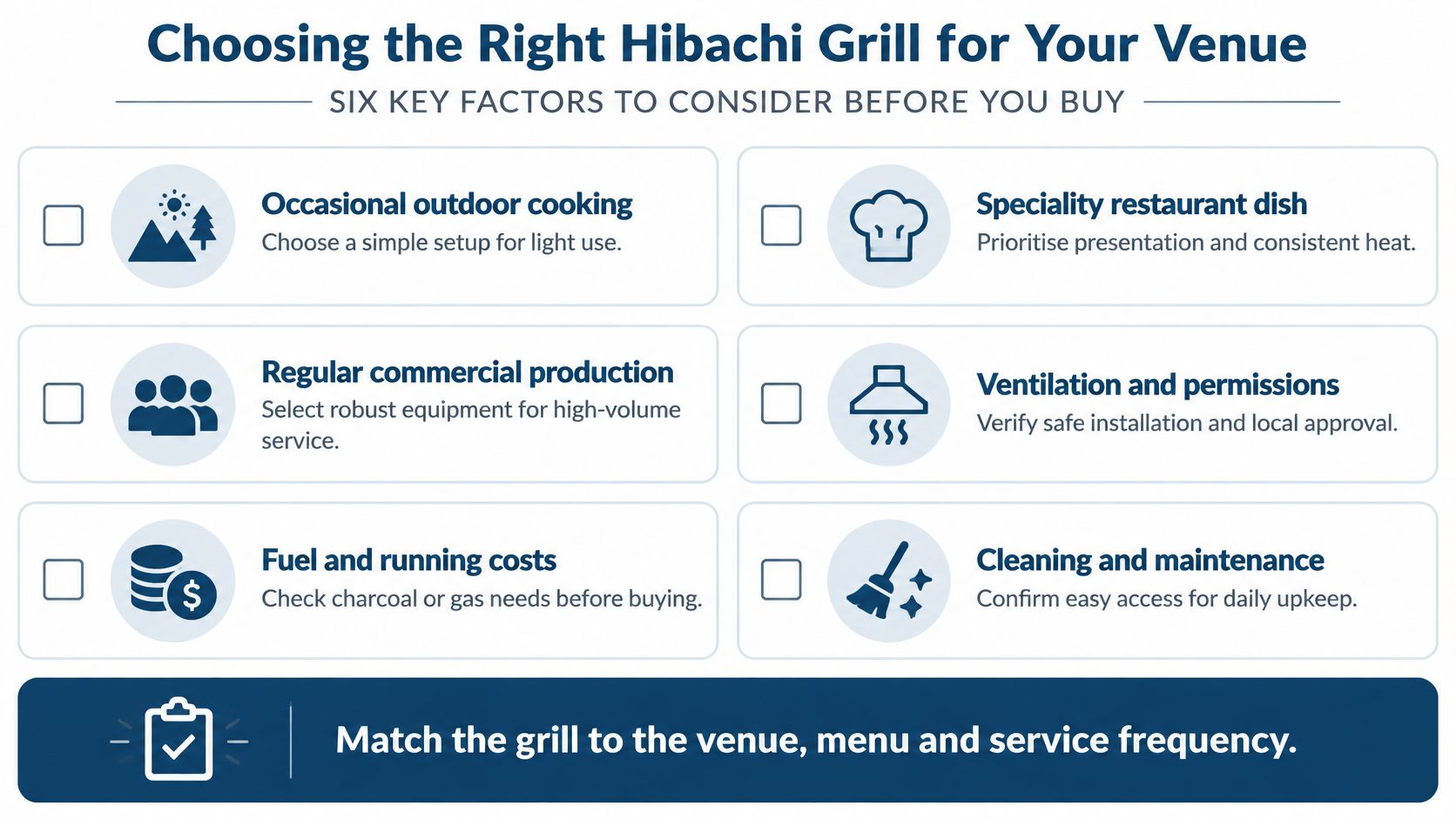
| Buying consideration | Why it matters | What to verify |
|---|---|---|
| Intended cooking application | Sets the surface size, fuel and extraction needed | Menu, expected covers and service hours |
| Charcoal or electric operation | Determines compliance, flavour and indoor options | Council and Fire and Emergency NZ position for the site |
| Cooking surface dimensions | Limits batch size and output per service | Usable grate area in centimetres, not overall footprint |
| Construction materials | Affects heat retention, weight, cleaning and durability | Material, wall thickness and grate type from the manufacturer |
| Heat management | Controls searing and the cooler zone for finishing | Vent or damper design and grate height adjustment |
| Commercial-use suitability | Some units are designed for domestic or outdoor use only | Written confirmation the unit is designed for commercial use |
| Ventilation requirements | Commercial cooking usually needs engineered extraction | Extraction design, make-up air and sign-off with the kitchen designer |
| Cleaning and ash removal | Ash and grease affect safety and hygiene each service | Ash disposal method and access to clean the firebox |
| Replacement components | Grates, vents and linings wear out | Parts availability and lead times from the supplier |
| Fuel availability | A reliable charcoal supply keeps service on schedule | Supplier stock and consistent fuel grade |
| Warranty and supplier support | Repairs and advice affect downtime | Warranty terms, registration process and support contact |
Measure the usable grate in centimetres. A wide outer frame around a small cooking area still bottlenecks the pass. Check whether the vents and grate height adjust, and get written confirmation when a unit is claimed for commercial use. A grill built for domestic or outdoor cooking belongs nowhere near a commercial canopy, whatever its output looks like on paper.
Price is the small number
Installation, extraction, fire equipment, fuel, consumables, training, and cleaning time usually outweigh the purchase price. A cheap outdoor hibachi that cannot legally sit in the kitchen is no saving at all. Get warranty terms, the registration process, and a support contact in writing. Atosa, Jasper, and Cookrite units can be registered for warranty coverage through the supplier's support page. Expect that standard from any commercial cooker supplier.
Buy from a supplier that is New Zealand owned and operated, works with locally owned businesses where possible, and whose suppliers keep a physical base or staff in the country. That local base matters when a grate, a vent, or a gas part is what stands between a Friday service and a closed section. The same planning questions apply to other live-fire equipment, which is why operators comparing solid-fuel cooking often read what to consider before buying a commercial woodfired pizza oven before they commit to a fuel and a canopy.
Confirm the intended use, the extraction path, and the fire plan in writing before anyone talks price.
Hospitality supplies commercial cooking equipment and the refrigeration, preparation tools, and heat-resistant accessories a New Zealand kitchen needs around a grill, including chargrills for venues that have outgrown a compact charcoal grate. If you are weighing a hibachi-style special against a full chargrill service, the team can help match the equipment to your menu, your extraction, and your covers. Talk through the right setup for your venue before you commit.