

How We Help Hospitality Businesses Plan Equipment and Consumables
The list usually arrives before the questions do. Twelve items, a handover date, a budget that has already been trimmed twice. What's often missing is the part that decides whether those twelve items work together: how many covers the kitchen will push on a Friday night, where the cold chain breaks between delivery and service, what the dishwasher will chew through in chemicals each month, and whether the second fridge is a year away or five.
Equipment and consumables aren't two separate shopping trips. They're one operating decision, made once and paid for repeatedly. That's the ground this article covers, and it's how we help hospitality businesses plan equipment and consumables before the money is committed rather than after the first busy weekend exposes a gap.
What follows is the process we work through with cafés, restaurants, hotels, caterers and institutional kitchens. It starts with the brief, works through the equipment categories that carry the most risk, and finishes where a purchase price stops telling you anything useful.
Start With the Business and Your Brief
A café buys a discounted oven that will not clear the servery door. A restaurant sizes the fridge to the gap under the bench, then runs out of cold space when Saturday's delivery lands. A caterer orders packaging by the carton and has nowhere to store it. These mistakes are brief failures, not product failures.
Write the brief before anyone prices a machine. Seven points fit on one page. Drawings can wait.
- Menu and service style. A short menu cooked to order needs different kit from a long menu built on batch preparation.
- Expected volumes, split between a quiet Tuesday and a Saturday peak. An average cover count hides the rush that determines the line size.
- Kitchen size and layout, with real dimensions for doorways, corners, bench runs and power points.
- Staffing numbers and skill levels. Equipment that needs a trained operator is a liability on a Sunday with one junior on.
- Existing equipment, including what already works well and why it stays.
- Available budget, and whether finance forms part of the plan.
- Growth plans over the next two to three years, so today's purchase does not block the next fit-out.

| Venue type | Main volume driver | Equipment priority | Consumable priority |
|---|---|---|---|
| Small café | Morning and lunch bursts with a small team | Compact oven, undercounter refrigeration, one warewashing point | Takeaway packaging, cups, cleaning chemicals |
| Busy restaurant | Dinner turnover and weekend peaks | Warewashing and cold storage sized to peak, prep stations | Gloves, dishwasher detergent, rinse aids, bin liners |
| Catering business | Event-driven spikes and off-site transport | Transport-safe holding, portable cold storage, bulk prep equipment | Bulk containers, foil, disposables, food-safe labels |
| Hotel or accommodation kitchen | Breakfast and function peaks | Batch cooking capacity, large refrigeration, high-volume dishwashing | Breakfast disposables, dishwasher chemicals, cleaning supplies |
Those four venues can sit in the same city and still need different kit, because the volume driver is not the same. A café's morning burst is a different problem from a hotel breakfast plus a function, and the consumables follow that split as closely as the machines do.
I would hold every recommendation against that one-page brief. It keeps the choice on the option that fits the menu, the peak, the room and the people who will run it.
Planning Kitchen Equipment Around Your Workflow
A lunch service stalls because the oven is full and the pass is two metres from the only cold drawer that still has space. Equipment that ignores the menu and the line creates that kind of idle machine and that kind of bottleneck.
Cold storage is sized from daily throughput rather than cabinet volume. What matters is what lands on a delivery day, what is prepped ahead, what is frozen, what is held for service, and the airflow that keeps temperature even through a busy shift. A venue taking two deliveries a week needs materially more cold capacity than one restocking daily at the same covers.
Cooling is where capacity planning meets the food control plan. The Ministry for Primary Industries Food Control Plan requires cooked food to drop from 60°C to 21°C within two hours, then to 5°C or below within a further four hours, and food held between 21°C and 60°C for more than two hours must be used immediately or discarded. A large batch poured into a deep container and left in a crowded fridge does not meet that. Shallow trays, portioning containers, spare refrigeration capacity or a rapid-cooling unit do.
Cooking equipment comes from the menu: how many items are cooked to order, what is roasted, and what is held and for how long. Prep needs enough bench and board space to keep raw and ready-to-eat work apart, plus the Robot Coupe attachments that match the actual prep list. Warewashing is sized from rack counts at peak service, not the daily average. The glasswasher keeping up at 11am is irrelevant at 8pm. Stainless benches and shelving have to clear door swings, trolley routes and access for cleaning. A kitchen designed around service saves labour on every shift for that reason.
Installation and services decide the layout
Power, gas, ventilation, drainage and clearances decide what can physically go where, and they cost money to change later. Hospitality advises checking the final electrical or gas supply, cut-out, ventilation and clearances against the model document before ordering cabinetry. A bench built to the wrong dimension is an expensive way to learn about a door swing.
Testing the choice on a real menu
Say a 60-cover café serves pastries and bread in the morning, toasted sandwiches through the day, and roast chicken with vegetables at lunch. The budget is modest and there is roughly a metre of wall to work with.
| Criteria | Convection oven | Combi oven |
|---|---|---|
| Cooking method | Hot dry air, fan-forced | Steam, dry heat or a combination of both |
| Best menu fit | Pastries, bakery, reheats, trays of similar items | Roasts, vegetables, batch proteins, varied cooking on one unit |
| Installation | Standard power, often a smaller footprint | Higher power and water or drainage needs, check the model document |
| Cleaning routine | Usually simpler, mainly wipe-down and regular checks | Daily cleaning cycle and descaling schedule |
| Budget consideration | Often a lower entry cost | Higher cost, justified only if steam functions are used regularly |
| Suits a venue that | Mainly bakes and reheats | Cooks a wide range of items and needs moisture control |
A convection oven often suits a bakery-led menu. A combi earns its cost where roasting and vegetable work happens daily and moisture control matters. Where the space and services allow it, the Turbofan EC40T5 Full Size 5 Tray Touch Electric Combi Oven is one combi option for that wall run. Its power, water or drainage, ventilation and clearances still need confirming against the model document before anything is ordered.
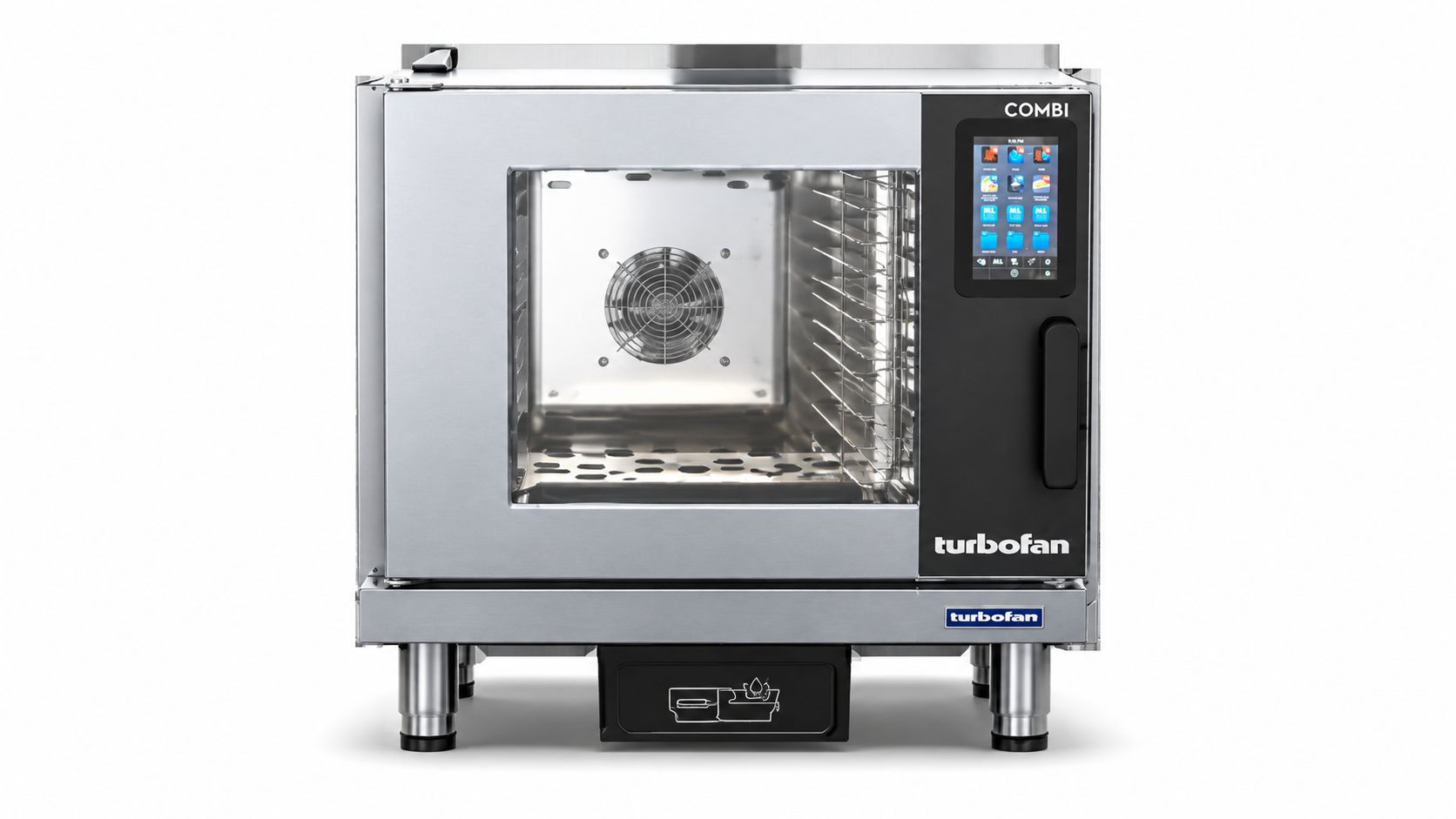
The right answer depends on how often each cooking function gets used.
Comparing Equipment on Total Cost, Not Price Alone
Two quotes, a few hundred dollars apart, and a decision that will run for eight years. Sticker price settles very little of that.
When two options are close, these are the criteria worth putting side by side: purchase price, production capacity per hour and at genuine peak, energy and water consumption, construction quality and how easily components can be reached for service, warranty coverage and its exclusions, cleaning time per day, installation requirements, and the running cost across the life of the unit.
Entry-level equipment can be exactly right. A low-volume café with predictable trade doesn't need a heavy-duty warewasher, and buying one ties up capital that would do more good elsewhere. Higher-specification equipment earns its premium in demanding environments by reducing downtime, labour and consumable waste. Ranges across SKOPE and Atosa refrigeration, Waldorf, Blue Seal and Cobra cooking equipment, Unox, Convotherm and Turbofan ovens, and Winterhalter and Classeq warewashing sit at different points on that scale for good reasons.
Headline numbers mislead in every category. Linen buyers meet the same trap in why thread count misleads shoppers, where a bigger number on the label doesn't guarantee a better product. Kitchen buyers meet it in cabinet volume that holds less usable product than a smaller, better-organised unit.
The cost-per-service method
Add the purchase or finance cost, installation, energy, water, cleaning labour, consumables and a service allowance, then divide by the number of services the unit will run over its expected life.
| Cost line | What it includes | Question to ask |
|---|---|---|
| Purchase or finance | Unit price, delivery, finance repayments | Can cash flow carry this through a quiet month? |
| Installation | Electrical, gas, water, ventilation and cabinetry | Does the site need trade work before use? |
| Energy and water | Running draw at typical and peak loads | How much does peak-hour use add to the monthly bill? |
| Cleaning labour | Daily and weekly cleaning time per unit | How many minutes per shift does this add? |
| Consumables | Chemicals, filters and packaging linked to the unit | Which supply costs change with this choice? |
| Service and downtime | Service access, response time and backup plans | What happens if it fails on a Saturday night? |
Energy deserves a line of its own. In 2022, commercial ovens and cooking elements accounted for 15% of energy use in Accommodation and Food Services, while refrigeration systems accounted for 22%, according to EECA's food and beverage service sector pathway. That's a large share of the monthly bill attached to two purchase decisions.
Cash flow decides as much as payback. Deloitte's New Zealand insolvency trends report notes that labour costs in Accommodation and Food Services rose approximately 25% from the first quarter of 2020 to the first quarter of 2026, against 19% across all industries, and cites Restaurant Association dashboard findings that food costs lead the list of challenges, with two-thirds of surveyed businesses reporting lower profitability than a year earlier. Against that backdrop, the lowest-risk mix often combines staged purchasing, certified used equipment or finance rather than buying everything new at once, a trade-off explored further in buying cheap versus buying once.
Two tests before signing. Can our cash flow carry this through a quiet month, and does this machine's capacity match our busiest service?
Connecting Equipment and Consumables
A busy Friday lunch is a poor time to discover the rinse aid is the wrong pack, or that the takeaway lids do not seat on the cups you already bought. Choose a machine and you also choose its chemicals, filters, packaging and cleaning routine for years.
| Equipment | Associated consumables | Planning consideration |
|---|---|---|
| Commercial dishwasher | Detergents, rinse aids, suitable cleaning products | Match chemical dosing and water conditions to the machine; check pack sizes against weekly wash volume |
| Coffee machine | Cleaning chemicals, filters, takeaway cups | Cleaning frequency drives chemical stock; cup choice depends on the takeaway share |
| Commercial laundry equipment | Suitable laundry detergents | Confirm the detergent suits the machine and fabrics; plan storage for bulk drums |
| Food preparation equipment | Compatible cleaning products and accessories | Blade, bowl and attachment replacement affects par levels; check cleaning access |
| Takeaway operation | Packaging matched to menu items and portion sizes | Container size should suit the portion and the holding temperature the food needs |
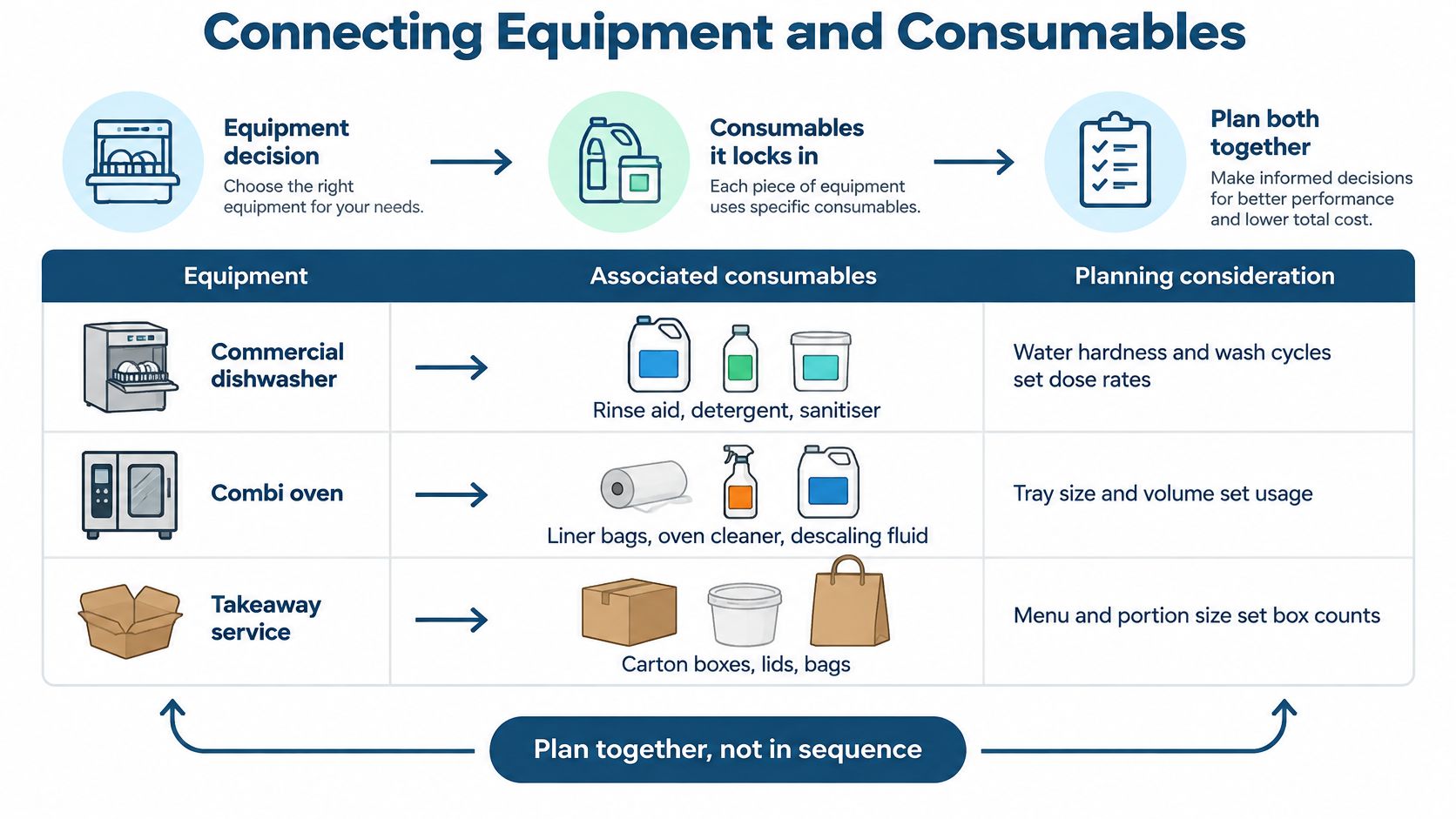
Work from the menu outward. Map items, production volumes, service peaks, how long food sits, and the delivery route. Turn that into equipment capacity and a workflow the bench can run. Then check the design against New Zealand food-safety controls, and only then set monitoring, maintenance and replenishment.
MPI's food safety guidance requires potentially hazardous food to be received and held at 5°C or below, or above 60°C, and food held between 5°C and 60°C for more than four hours must not be sold or used. Refrigeration, hot holding, blast chilling, thermometers and delivery containers get specified from those control points. Food-safety records need to stay accurate, legible and attributable, and ready to produce when they are requested.
I would build the equipment schedule as one row per control point: receiving, cold holding, cooking, hot holding and cooling. Columns cover required capacity, temperature range, verification method, cleaning access, service interval and a backup if the primary unit fails. The Hygiplas Catertherm Digital Probe Thermometer sits in the verification column, with a detachable stainless probe, auto shut off and a large LCD. Against another probe, weigh response speed, range, water resistance and how easily it can be sanitised between checks. Probe wipes and a spare battery belong on the same replenishment list as detergent.
Two consumable gaps show up after the machine is already on site. Chemical orders follow catalogue case size instead of weekly wash cycles, so either the drum runs out mid-service or a half-used container takes floor space you needed for food. Cups, lids and sleeves get bought as a generic pack that does not match the drink size or the holding time, and the waste shows up as crushed lids and double-cupping. Smaller hardware follows the same rule. A bar fit-out should start with the tap and work outward; this beer tap handle buying guide covers the fit and thread details that decide whether a handle stays tight through a Friday night. Once the coffee machine, dishwasher and serviceware are fixed, the same café supply planning applies to cups, lids, filters and cleaning chemicals: match pack size and reorder point to the weekly cycle, not to the cheapest case on the shelf.
Planning Consumables From Measured Demand
A breakfast café with a heavy takeaway window and a Saturday function room burns through containers, gloves and chemicals on a different curve from a 40-cover restaurant that plates everything in house. One supplier par level averages those venues into a single figure. It will be wrong for both.
Weigh waste by source across 7 to 14 representative trading days. Split it into spoilage, preparation waste and plate waste, then calculate waste per cover and per menu item. New Zealand research on café and restaurant operations estimates 24,375 tonnes of food waste a year, 61% of it avoidable, with preparation waste at 60% of the total, plate waste at 33% and spoilage at 7%, and puts the average at about 2.8 tonnes per café or restaurant, as summarised in the Ministry for Primary Industries consultation material. I would treat 2.8 tonnes as a benchmark to beat, not an order quantity. Your own weights decide the buy.
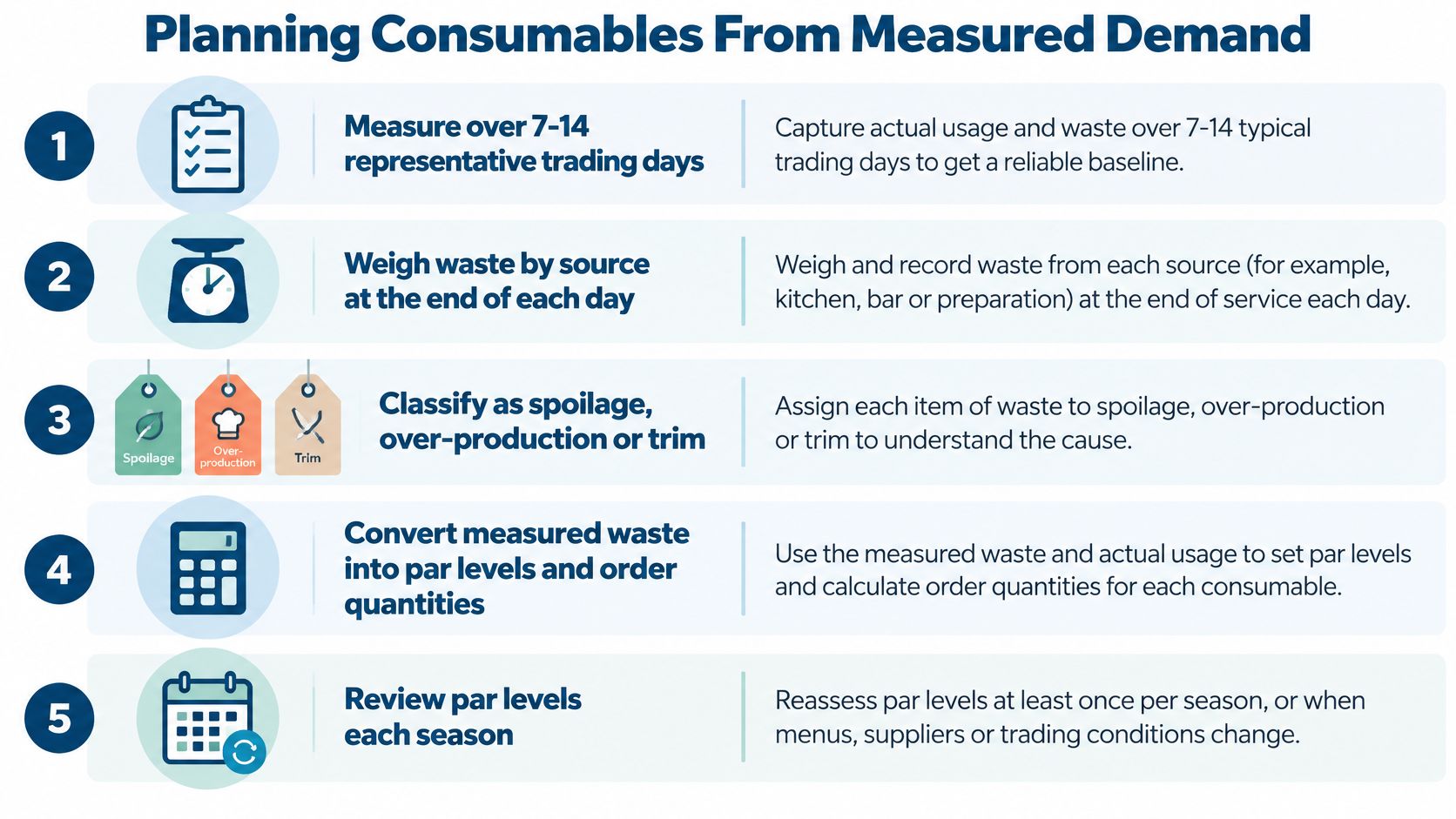
The mix tells you which lever to pull. High preparation waste sends you back to pre-portioned ingredients, yield assumptions, knife and prep kit, and how storage containers are used. High spoilage argues for smaller replenishment batches or clearer date labelling: more frequent drops cost time and freight, wasted stock costs the product. High plate waste is usually a portion or crockery change, not a bigger purchase.
Those weights then set the lines that come back every week:
- Food packaging and takeaway containers, sized to the portion and the holding temperature, such as the BioPak BioBoard Window Lunch Boxes, where a window earns its place when seeing the product helps it sell.
- Cleaning chemicals, bought against measured dilution and shift patterns rather than habit.
- Paper towels and toilet tissue, where storage capacity often constrains the order more than usage does.
- Bin liners, matched to bin size and waste stream.
- Gloves and food preparation consumables, driven by prep volume and menu change.
- Dishwasher detergents and rinse aids, where water hardness and cycle count set the dose rate.
For each line, match pack size to the shelf you have, consumption rate to how often a delivery can land, and minimum order quantities to the cash you can tie up. Accommodation operators run the same check across housekeeping and laundry. Bedding protection belongs in that plan with linen and chemicals, as bed bug proof encasements for hotels sets out.
Adjust the cover forecast for takeaway mix, occupancy, cleaning frequency, linen turnover, seasonal peaks and supplier minimums before you lock disposables and chemicals. Covers still count. They are only one input.
Pre-Order Checklist and Sample Budget
A quote that looks fine on the equipment line can still break once installation, power, water and the first months of stock sit on the same page. Put the decisions in one schedule and check the lines against each other before the order is confirmed.
- Services and clearances. Signed off on every model document, with trade work costed first. Detail sits in the planning section.
- Refrigeration. Sized from daily throughput, not cabinet volume. See the planning section.
- Probe and log. A probe thermometer and a logging method at every cold and hot holding point.
- Cooling. Capacity for the two-hour and four-hour windows. See the connecting section.
- Warewashing. Rack counts matched to peak service.
- Benches and storage. Clear of the workflow, including trolley routes.
- Consumable packs. Sized to storage, with reorder points from measured waste. See the consumables section.
Handling belongs on that list as well. WorkSafe's guidance for cafés and restaurants advises choosing equipment one person can lift safely, or providing trolleys and handling aids where that is not possible, and positioning hot appliances so staff stand to the side when opening doors and lift lids away from themselves.
Build the budget as one line per cost. Use written quotes and your own measured figures, then split first-year spend from monthly running cost.
| Line | First-year figure | Monthly running figure | | Purchase or finance | Cash price, or the year's finance payments | The instalment, if financed | | Installation | Trades quote, paid once | None after commissioning | | Energy and water | Rated use × your hours, annualised | That annual figure ÷ 12, then checked on a quiet month | | Cleaning labour | Hours × wage for the year | Hours × wage for a typical month | | Consumables | Opening stock plus the reorder plan | Measured monthly use | | Service allowance | A set share of the equipment price for call-outs | That allowance ÷ 12 | | Contingency | A set share of purchase plus installation | Not a running cost |
Add the first column for the opening-year total. Add energy, water, cleaning labour, consumables and the service allowance for the monthly figure. Test that monthly figure against takings in your quietest month. I would not approve an order that month cannot carry.
A catering equipment checklist is a sensible companion while smallwares are still being listed. Keep the finished budget with the equipment schedule so both agree on opening day.
Staging Purchases for Openings and Growing Venues
A new venue and an established one are solving different problems with the same catalogue.
A new business needs a full equipment list, opening stock, smallwares, tableware, cleaning supplies and essential consumables before the first service, and almost all of it lands in the same eight weeks. An established operator is dealing with a failing fridge, a menu that has outgrown the cooking line, a capacity upgrade and a recurring consumables order that never quite matches trade.
The sector context explains why staging matters. For the year ended March 2024, hospitality sales reached NZ$15.7 billion, up 5.8%, and the sector directly employed about 145,000 people in early 2024 with employment growing 7.3% year on year, faster than the growth in the number of establishments, according to MBIE's hospitality and tourism employment report. Demand, staffing and service capacity can move faster than premises and supplier networks, which is an argument for buying in stages rather than freezing a single large order.
A workable sequence looks like this:
- Opening phase. Everything required for service and compliance, nothing that can wait. Core cooking, cold storage, warewashing, benches, smallwares, opening consumables.
- Early trading phase. The additions the first months of real trade expose, once you know where the queue forms and which function runs at capacity.
- Growth phase. Capacity upgrades, a second refrigeration unit, extra prep space, additional menu equipment and adjusted consumable volumes.
Take a café adding takeaway lunch service. It needs refrigeration to hold prepared lunch stock within the cooling windows, a second prep station so sandwich and hot service don't collide, packaging sized to the actual portions, and more chemicals and liners. Staging protects cash flow and puts the operational necessities first. Leaving space and power for a second unit, choosing benches that can be moved or extended, and ordering consumables against real pack sizes and storage capacity all preserve flexibility later. The same reasoning sits behind choosing refrigeration around your business stage.
Next Steps With Simply Hospitality
You have the brief and a staged buying sequence. The next move is a conversation that matches products to that brief before a quote hardens into an order.
Business customers can apply for a trade account online. New equipment, replacements and consumables can be ordered through the catalogue from anywhere. Finance sits with SilverChef Finance and SKOPE Funding. I would line those repayments up with the staged plan, so the first year of trade sets the monthly cost, not a single full fit-out.
Purchasing and design are separate jobs. Layout and fit-out coordination can go to Design by SACH. Once equipment is on site, Service Request and Warranty Claim are the listed paths for service and warranty issues. Certified Used is the option when a later phase needs capacity without buying new.
Share the seven points from your brief. Expect suitable products, the alternatives that change workflow or running cost, and a clear call on what can wait.
Hospitality supplies commercial kitchen equipment, refrigeration, warewashing, smallwares, packaging, cleaning chemicals and accommodation furnishings to hospitality businesses across New Zealand, and can work through an equipment and consumables plan before a single order is placed. Send the menu, the volumes and the room dimensions. The shortlist should show ongoing consumable cost beside the capital spend. Open the catalogue, apply for a trade account, and see how the staged plan sits against cash flow.