

Large Cook Pot Sizing for Commercial Kitchens
The most common sizing mistake with a large cook pot is choosing it from the venue's cover count. A kitchen serving 100 covers doesn't automatically need one particular stock pot. The correct capacity depends on the recipe, finished portion size, reduction, working space, cooktop, handling method, and what happens to the food after cooking.
A pot that produces the required volume but can't be stirred, lifted, heated evenly, cleaned or stored safely isn't the right pot. The practical decision starts with the food being produced, then tests whether the vessel and the surrounding workflow can support it.
Why Cover Count Is the Wrong Place to Start
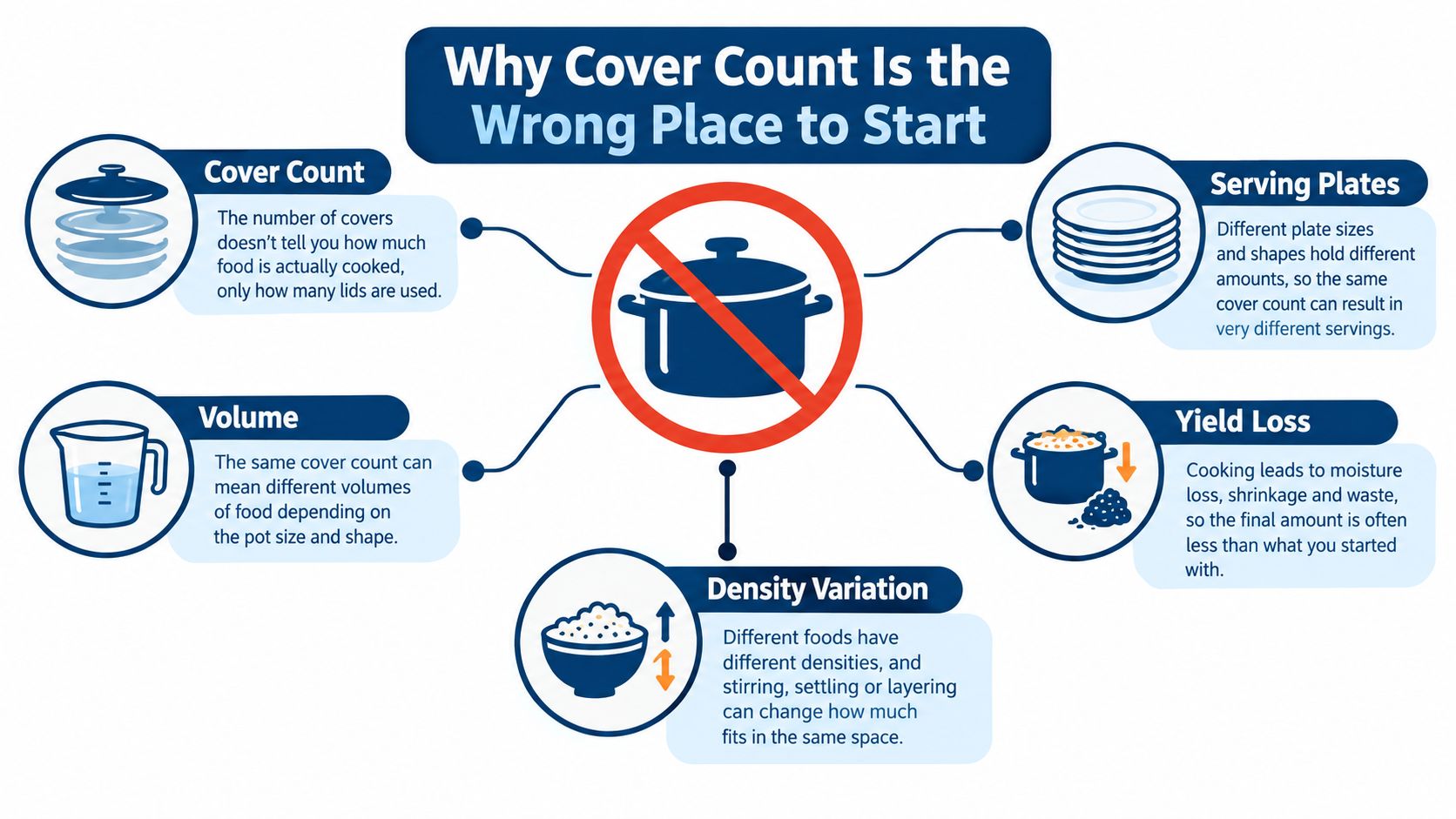
“ What size pot for 100 people?” sounds like a straightforward purchasing question, but it leaves out the information that determines capacity. One hundred portions of a thin sauce and one hundred portions of a dense curry may have very different finished volumes, ingredient behaviour and handling requirements.
A useful starting point is:
Number of portions × finished portion volume = required finished batch volume
That result describes the food required at the end of the process. It doesn't describe the nominal capacity printed on the pot. The vessel also needs room for starting ingredients, stirring, simmering, foam, reduction and safe movement. A thick mixture needs more practical space than a calm liquid, even when the finished volume is similar.
What cover count leaves out
Cover count doesn't tell a supplier:
- Portion volume: A sauce, soup and stew rarely occupy the same volume per serve.
- Recipe yield: Vegetables, bones, meat, starches and reductions change the finished quantity.
- Density: A stock behaves differently from a thick ragout during stirring and heating.
- Working space: The pot can't be treated as though food should reach the rim.
- Service pattern: A venue may need one batch, several staggered batches or a reserve batch.
- Handling limits: A full vessel becomes heavier and harder to move as capacity rises.
The same problem appears when operators buy by diameter alone. A tall, narrow pot may fit a small floor area but be awkward to stir or decant. A wide vessel may heat well on the right cooktop but occupy valuable adjacent space.
Practical rule: Covers are a service-planning input. They aren't a pot-sizing formula.
Recipe volume should therefore come first. Once the finished batch is known, the operator can assess working capacity, heat-source compatibility and downstream handling instead of buying the largest commercial stock pot available.
Working Out Finished Batch Volume From the Recipe
The calculation is simple. The judgement comes afterwards.
Start by identifying the actual finished portion size, not the raw ingredient weight and not the number of customers who might order the dish. Multiply that portion volume by the number of portions required for the batch.
The required finished volume is then:
Number of portions × finished portion volume = required finished batch volume
A kitchen can improve the accuracy of this calculation by weighing or measuring representative portions with a suitable digital kitchen scale, particularly when portioning sauces, soups or prepared meals.
Three illustrative examples
The examples below demonstrate the method only. The portion sizes are illustrative, not recommended commercial serving standards.
| Dish type | Portion size | Portions | Finished volume | Pot capacity |
|---|---|---|---|---|
| Sauce | 150 ml | 100 | 15 L | Larger than 15 L, subject to recipe and working capacity |
| Soup | 400 ml | 100 | 40 L | Larger than 40 L, subject to recipe and working capacity |
| Stew or curry | 500 ml | 100 | 50 L | Larger than 50 L, with additional room for stirring and process control |
A sauce requiring 100 portions × 150 ml produces 15 L of finished product. That doesn't mean a 15 L pot is suitable. Starting ingredients, reduction and movement during cooking may require a larger vessel.
A soup requiring 100 portions × 400 ml produces 40 L finished volume. A 40 L nominal pot could leave no useful headroom once ingredients and liquid are loaded. The operator needs to check the recipe's starting volume and the pot manufacturer's stated capacity.
For a stew or curry, 100 portions × 500 ml produces 50 L finished volume. The mixture is thicker, heavier to stir and more likely to catch if heat is poorly distributed. A larger vessel, or multiple smaller batches, may be more practical than filling one pot close to its limit.
Finished volume isn't working capacity
The pot needs usable space for:
- Initial ingredient volume before reduction.
- Stirring without splashing or pushing food over the rim.
- Boiling, simmering and foam.
- Thickening or settling.
- Safe lifting, decanting and cleaning.
There isn't one universal fill percentage that suits every recipe. The appropriate working level depends on the cookware manufacturer's guidance and the process itself. The useful rule is to size the vessel above the finished batch volume, then validate the working level against the actual recipe.
One Very Large Batch or Several Smaller Batches
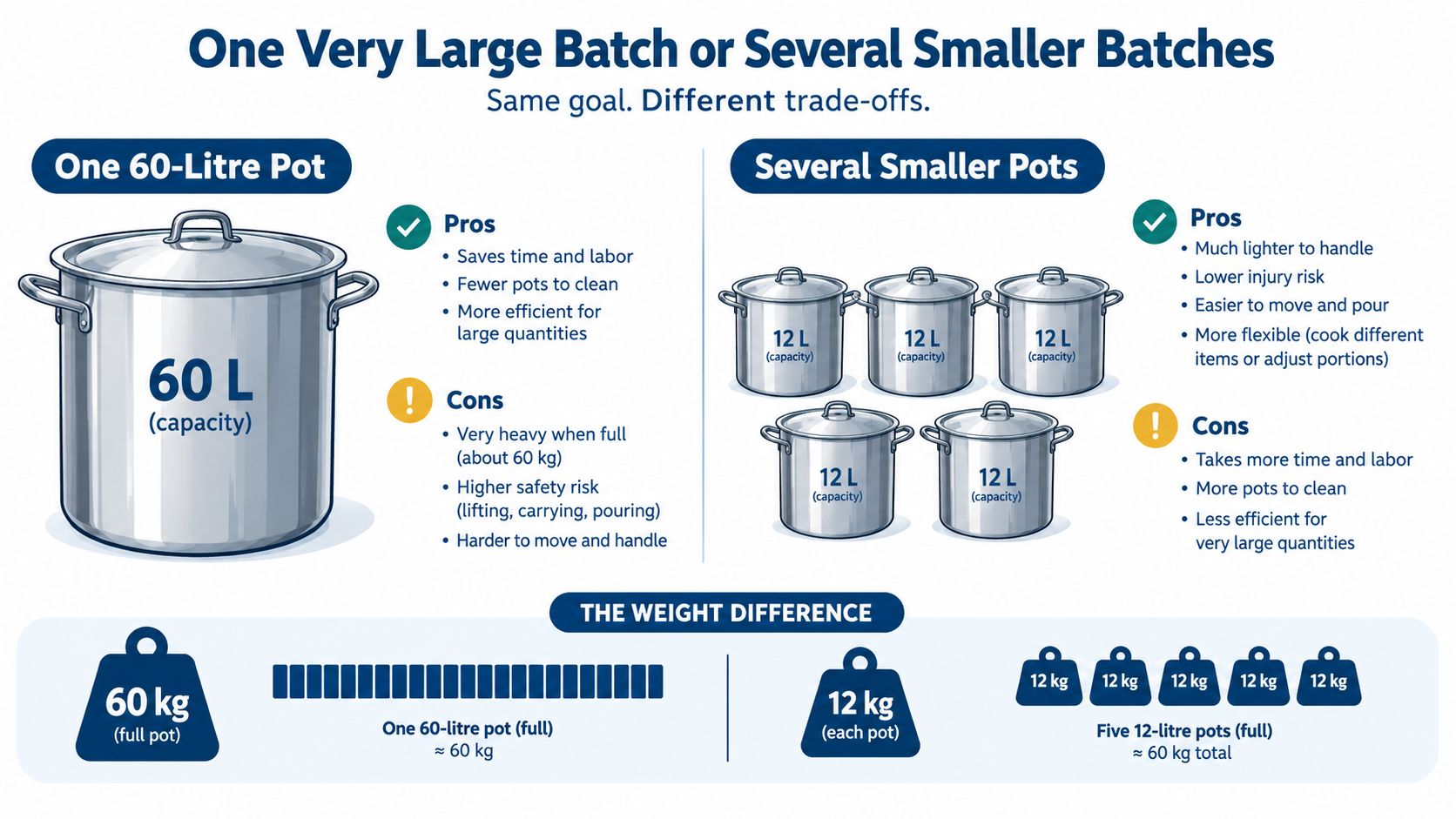
One oversized batch can reduce repetition, but it can also move the hardest parts of the job away from the stove and into manual handling. The full pot still has to be stirred, checked, moved, decanted, cooled, portioned and cleaned.
A 60 L tall stock pot listed in New Zealand measures 555 mm wide, 475 mm deep and 455 mm high, according to its product specification. That footprint is only part of the planning question. The contents, lid, handles and surrounding clearance also affect whether staff can work safely around it.
Where one large pot helps
A single vessel may suit a recipe that benefits from one consistent batch, particularly when the cooktop can support the base and the team can keep the product in place until it is ready for transfer. It may also reduce repeated loading, cleaning between batches and recipe setup.
That advantage disappears if staff must carry a heavy pot across a walkway or lift it from a low or high position. WorkSafe New Zealand advises businesses to keep pots and pans in good condition, secure handles, and ensure equipment is safely liftable by one person or moved using trolleys or handling aids. Its electrical-safety guidance is relevant when the cooking system includes powered equipment, and second-hand electrical appliances supplied in New Zealand must also be electrically safe. WorkSafe's guidance on electrical equipment and appliances provides the compliance context.
Why smaller batches can win
Two smaller pots can distribute weight across separate cooking zones and give staff more control over stirring and transfer. They may also allow staggered production, which can help when the menu requires fresher batches rather than one long-held quantity.
The trade-off is extra setup, repeated ingredient loading and more vessels to wash. The comparison should include:
- Heating: Can the cooktop bring the full load to temperature effectively?
- Handling: Can staff stir and decant without lifting beyond safe limits?
- Holding: Will one batch sit longer than the other?
- Quality: Does the recipe tolerate larger depth and longer heating?
- Cleaning: Can the wash area handle the vessel size?
- Storage: Is there space for the pot, lid and any trolley or handling aid?
Food safety adds another consideration after cooking. New Zealand guidance advises dividing large hot-food volumes into smaller containers or shallow trays for faster, more even cooling, and says leftovers should be refrigerated or frozen as soon as possible or within 2 hours of cooking, with refrigerator storage between 2°C and 5°C. The commercial cookware and food-safety guidance also identifies cooked meat targets such as 75°C for 30 seconds.
The better production model depends on the dish, holding time, service window and available equipment. A large cook pot should save work across the whole process, not just during loading.
Matching Pot Size to the Cooktop Beneath It
A large pot doesn't create useful capacity if the cooking equipment can't heat it effectively. The pot base diameter, cooking zone, available output and vessel stability need to be considered as one system.
A narrow burner under a wide pot can leave outer areas cooler than the centre. A cooking zone that's too large for a small base can waste useful space and complicate simultaneous cooking. On a busy line, the operator also needs to check whether handles, lids and neighbouring pots interfere with access.
Check the physical match
Before selecting capacity, record:
- Base diameter: Measure the part of the pot that contacts the cooking surface.
- Burner or zone dimensions: Confirm the ring or induction area supports the base.
- Heat output: Check whether the appliance can supply the required heat without excessive recovery time.
- Stability: Test whether the loaded vessel sits securely and remains accessible.
- Adjacent clearance: Allow space for handles, stirring and transfer.
- Simultaneous production: Confirm that using one large pot won't remove the zones needed for other menu items.
A manufacturer's capacity label doesn't replace these checks. A 21 L stainless stockpot sold in New Zealand is described with an 8 mm encapsulated base and 18/10 brushed stainless steel construction, but the listing also states that it isn't suitable for induction hobs. The product specification at Savebarn's 21 L stainless stockpot shows why capacity and material alone can't confirm compatibility.
| Pot capacity | Base diameter | Burner width | Heat transfer efficiency |
|---|---|---|---|
| Selection dependent | Confirm from product specification | Confirm from appliance specification | Must be assessed as a matched system |
| Selection dependent | Compare actual contact area | Check ring or zone coverage | Avoid assuming capacity equals output |
| Selection dependent | Review with full load in mind | Allow adjacent working space | Validate before finalising the cookline |
The table deliberately avoids invented universal pairings. There is no reliable rule that assigns every 20 L, 25 L or 30 L pot to one burner size without knowing the specific appliance and cookware design.
Induction needs product-level checking
Induction is responsive and can reduce radiant heat around the cookline, but cookware compatibility must be confirmed for the individual pot. Stainless steel isn't automatically induction-compatible. The base must interact correctly with the induction field and sit within the appliance's detection area.
The same principle applies when planning a freestanding unit. A venue considering a freestanding induction cooker should select the cookware and cooking equipment together, before the cookline is finalised. This is particularly important where several large pots must run at once.
Material, Base Construction, and Heat Distribution
Material choice matters, but the base and the cooking process matter more than a simple stainless-versus-aluminium label. A large stock pot used for water-based stock has different demands from one used for a thick sauce that needs reduction and frequent stirring.
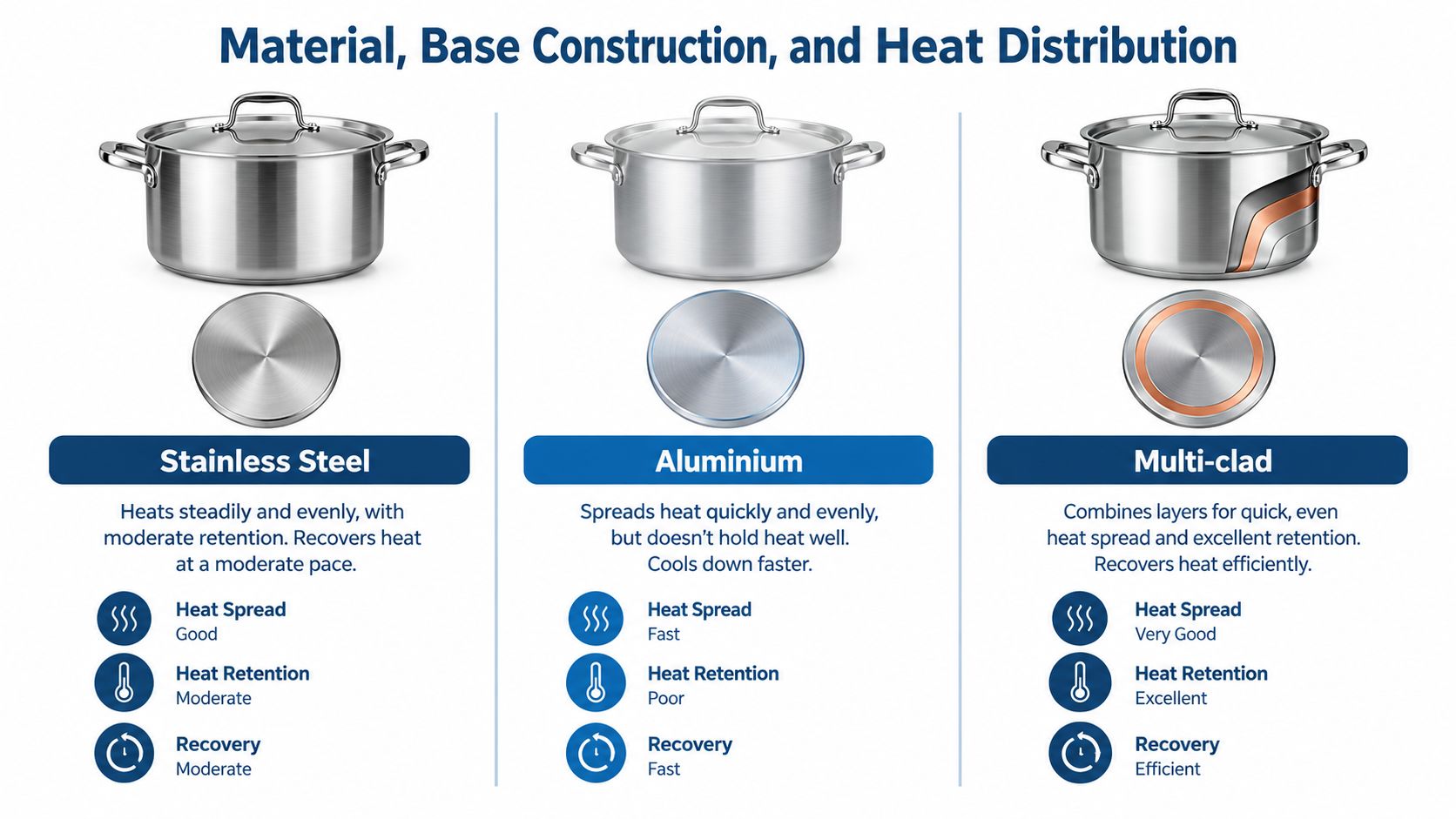
New Zealand consumer guidance notes that stainless steel cookware is generally thicker and heavier than aluminium, and that stainless steel is often combined with aluminium in multiple layers to improve heat conduction. The consumer guide to frying pans and saucepans is useful background when comparing weight and construction.
What the main constructions change
Stainless steel is widely used in commercial cookware because it is non-reactive and suitable for many acidic preparations. A New Zealand stockpot listing specifically advises using non-reactive stainless steel for acidic foods such as tomato-based preserves, cheeses, home brews and court-bouillons, rather than copper or aluminium. The same stock pot selection guidance warns that stock pots can be very heavy and identifies good riveted handles as the safer option.
Aluminium can spread heat quickly and keep overall weight down, where it is stocked and suitable for the recipe. Its finish, cleaning requirements and food compatibility need to be checked against the actual product rather than assumed from the material name.
Encapsulated or multi-layer bases place a more conductive layer beneath or within stainless steel. That can help spread heat across the base, but the result depends on the construction, thickness, diameter and heat source. A pot with an effective base still needs a cooking zone that matches it.
Chef Inox and Force large pots and stock pots available through Hospitality provide examples of why individual specifications should be checked. Operators should compare base construction, dimensions, handle design, lid provision, total weight and induction compatibility rather than treating either brand as universally superior. The discussion of why Force cookware supports commercial performance offers additional context for assessing cookware construction.
For buyers comparing surfaces and materials beyond cookware, a resource such as compare lab casework materials can help clarify how material selection should be tied to cleaning, environment and use conditions. The comparison isn't a substitute for a pot specification, but it reinforces the broader purchasing principle.
Handles also deserve attention. Riveted side handles can provide a secure grip, while helper handles may make a heavy vessel easier to stabilise. Welded loops can simplify cleaning around the attachment point, but their shape and strength still need to be assessed with the loaded pot in mind. Lids add weight and may trap condensation, so the lid design should be considered as part of the handling process.
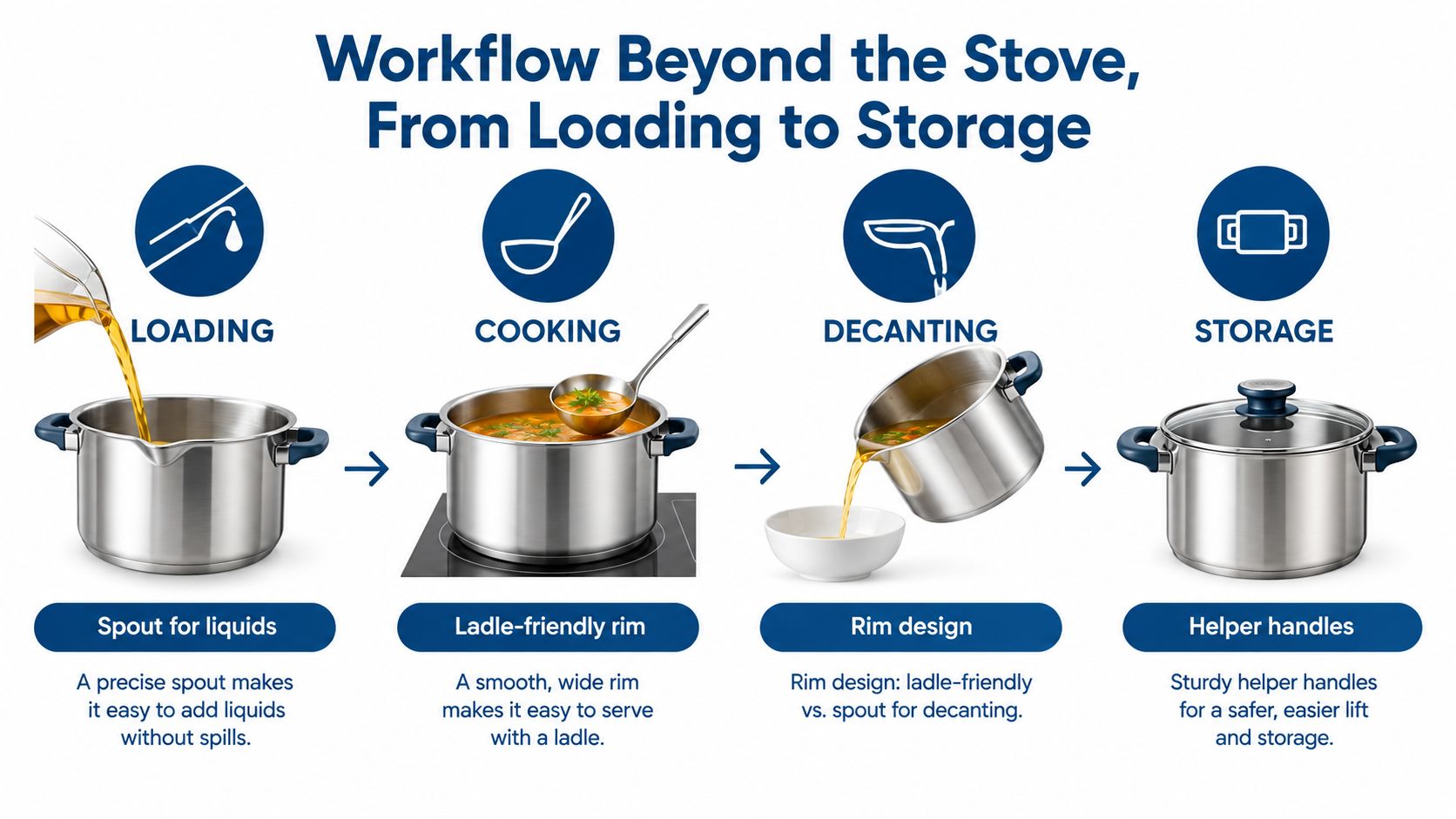
Workflow Beyond the Stove, From Loading to Storage
The pot's job doesn't finish when the heat is switched off. A technically suitable vessel can still slow the kitchen if staff struggle to load ingredients, control the simmer, pour the product or find a place to store the lid.
Follow the pot through the whole process
Loading starts with access. A wide opening may make it easier to add ingredients and reach the base, while excessive height can make the bottom difficult to inspect or stir. Staff should be able to load the vessel without leaning across a hot surface.
Cooking depends on more than heat. The rim needs to accommodate the chosen ladle, whisk or paddle, and the handles must stay clear of adjacent burners and walkways. A lid can help with simmer control, but its weight and storage position affect the next stage.
Moving and decanting are often the weak points. A full large pot may need a trolley, transfer pump or staged decanting into gastronorm containers rather than manual lifting. A pouring lip can assist with liquids, while a clean, open rim may work better where the product is removed with a ladle.
Portioning should match the finished batch plan. If the product is divided into hotel pans, GN containers or smaller storage vessels, those containers need to be positioned before the pot is moved. Operators should also avoid creating a queue around one heavy vessel.
Cleaning requires a method suited to the finish. Non-abrasive pads help protect surfaces, while the detergent should suit the food soil, such as protein residue or baked-on starch. Hard-water areas may require descaling, but chemical concentration and contact time should follow the cookware and cleaning-product guidance.
Drying and storage are operational steps, not afterthoughts. The pot should dry fully before stacking or racking, and the lid needs a defined location. Large storage containers can help organise the product after decanting, but they don't solve a pot-storage problem unless the kitchen has planned shelf height and access.
A useful quote request should include the pot, lid, handles, trolley or handling aid where required, and the storage position. A vessel that blocks the shelf above it or can't be removed without moving other equipment is poorly integrated, regardless of its nominal capacity.
When a Stock Pot Stops Being the Right Tool
A stock pot remains practical for many restaurants, cafés, caterers and institutional kitchens. It becomes less attractive when the production process repeatedly demands very large loads, frequent transfer, controlled discharge or floor-level handling.
At that point, a commercial kettle, boiling pan or another high-volume cooking system may deserve evaluation. The change isn't triggered by a cover count alone. It comes from the relationship between batch size, menu type, labour, heat source, holding method and transfer requirements.
| Criterion | Large stock pot | Commercial kettle | Boiling pan |
|---|---|---|---|
| Batch flexibility | Flexible for recipes and batch sizes | Suited to repeat high-volume production | Useful for broad, shallow cooking |
| Transfer | Often requires ladling, lifting or a trolley | May offer controlled discharge | May support easier decanting or tipping |
| Footprint | Mobile or cookline-based | Larger planned installation | Requires dedicated cookline space |
| Stirring access | Manual | May support integrated process features, depending on model | Broad surface can suit stirring and reduction |
| Cleaning | Pot and lid washed separately | Fixed cleaning access must be planned | Large surface and drain design need review |
| Capital commitment | Lower equipment commitment | Higher installation and planning commitment | Higher than a basic pot in many configurations |
| Best fit | Smaller or flexible production | Repeated high-volume batches | Institutional or broad-batch cooking |
A large pot can be cumbersome to stir and decant once it is heavily loaded. Commercial kettles may improve discharge and reduce lifting, but they need suitable services, floor space, installation planning and cleaning procedures. Boiling pans can suit sauces, curries and other preparations that benefit from a broad cooking surface, although the cookline must support their size and output.
New Zealand's commercial-kitchen environment treats large cooking vessels as part of a controlled food-service system. Council guidance commonly connects cooking equipment with extraction canopies and removable filters, while the Food Act 2014 remains relevant to food-premises operation. Gas-appliance notices also identify catering equipment such as boiling pans as a distinct equipment category. Operators in schools, hospitals, marae, aged care and large-scale catering should therefore assess access, ventilation, certification and installation rather than treating a major vessel as standalone cookware.
For smaller production, a well-matched stock pot can still be the more flexible choice. The point is to recognise when repeated lifting, decanting and cleaning have become the bottleneck, then compare the appropriate equipment category.
A Specification Checklist for Quotes and Next Steps
A supplier quote should answer more than “how many litres?” The specification needs to connect the recipe, vessel, cooktop and staff workflow.
Capacity and recipe
- Finished batch: State the portions, finished portion volume and required finished volume.
- Working level: Ask how the manufacturer defines usable capacity for the intended recipe.
- Recipe behaviour: Note reduction, foam, simmering, starch, bones, meat density and stirring requirements.
- Batch strategy: Compare one vessel with multiple smaller batches before selecting the largest option.
Cooktop and construction
- Base diameter: Compare the actual contact area with the burner ring or induction zone.
- Heat source: Confirm gas, electric or induction compatibility from the product specification.
- Base build: Check whether the pot uses a plain, encapsulated or multi-layer base.
- Weight: Record the empty vessel weight and assess the loaded workflow.
- Handles and lid: Confirm rivets or other attachment details, helper handles, lid weight and storage.
- Cleaning: Check finish, dishwasher guidance, detergent compatibility and access around handle mounts.
Workflow and compliance
- Transfer method: Decide whether staff will ladle, pour, trolley, pump or discharge the product.
- Cooling and storage: Plan containers, shallow trays, refrigeration space and labelling before the pot arrives.
- Installation: Confirm extraction, clearance, stability and access around the cooking unit.
- Electrical safety: Ensure supplied electrical appliances meet New Zealand requirements.
- Documentation: Request product specifications, warranty terms, lead time and after-sales support.
- Validation: Ask whether the quote includes a lid, compatible handling aid and any required commissioning or validation.
The catering equipment checklist can help organise the wider kitchen discussion before a cookware quote is finalised.
The central decision is straightforward. Don't size a commercial pot by the number of customers served. Size it from the food the recipe must produce, allow practical working capacity, then confirm that the cooktop, staff and storage area can handle the vessel.
Hospitality supplies commercial cookware, including Chef Inox and Force large pots and stock pots, alongside cooking equipment and kitchen-planning support. Visit Simply Hospitality with the menu, batch volumes and cookline details available so the team can help specify a large cook pot that fits the recipe and the wider workflow.