

Meal Prep Containers Stainless Steel for Commercial Kitchens
A busy commercial kitchen can lose time without noticing it. Staff portion batch-cooked food into whatever containers are available, lids become separated from pans, different footprints occupy every shelf, and prepared meals take longer to identify, chill, move and wash. Choosing meal prep containers in stainless steel works best when it creates a repeatable system, not when it merely replaces plastic with metal.
For restaurants, caterers, schools, aged-care kitchens and prepared-food operations, that system usually starts with Gastronorm formats. The right combination of GN footprints, depths, lids and storage practices can help food move predictably from preparation to portioning, refrigeration, transport and service. The wrong combination creates heavy, awkward stock that still fails to stack or seal properly.
Why Stainless Meal Prep Containers Matter in a Busy Production Kitchen
During a large preparation run, a kitchen may be cooking sauces, portioning proteins, holding vegetables and assembling meals at the same time. If every task uses a different container shape, staff must stop to find compatible lids, judge portions by eye and rearrange shelves to make space. Those interruptions affect more than convenience. They can complicate labelling, chilled storage, handover between prep teams and the timing of cleaning cycles.
Stainless steel becomes valuable when it supports a standardised reusable workflow. A container can circulate from batch production to portioning, then into a fridge, trolley, service area or wash-up process. The material matters, but the system matters more. A durable pan that doesn't fit the shelving, dishwasher racks or existing equipment can create more friction than a well-planned mixed-material setup.
Practical rule: Choose containers around how food moves through the kitchen, not only around the food being stored.
A caterer preparing large quantities may need deeper pans for batch components, shallower pans for faster cooling or easier portion access, and smaller formats for sauces and individual ingredients. A café with limited cold storage may prioritise compact footprints and clearly assigned shelves. An aged-care or education kitchen may need a more deliberate arrangement so staff can identify meal components quickly and maintain a consistent preparation routine.
Food safety starts with the workflow
New Zealand's Food Hygiene Regulations 1974 require readily perishable cooked food to be held at no more than 4°C, or alternatively at not less than 60°C, subject to the stated exception for food not exposed or exhibited for sale for more than two hours in aggregate. The requirement makes temperature control a purchasing and operating consideration, rather than an afterthought. Read the New Zealand Food Hygiene Regulations.
Container selection can't replace a suitable refrigerator, documented procedures or staff training. It can, however, make it easier to divide batches, cover food, label portions and organise stock without repeatedly handling the product.
The cold-chain process also depends on the relationship between containers, shelving and refrigeration capacity. Operators reviewing that wider process can refer to Hospitality's guidance on cold-chain management, particularly when meal prep is growing beyond a small daily routine.
Reusable Internal Systems Versus Takeaway Packaging
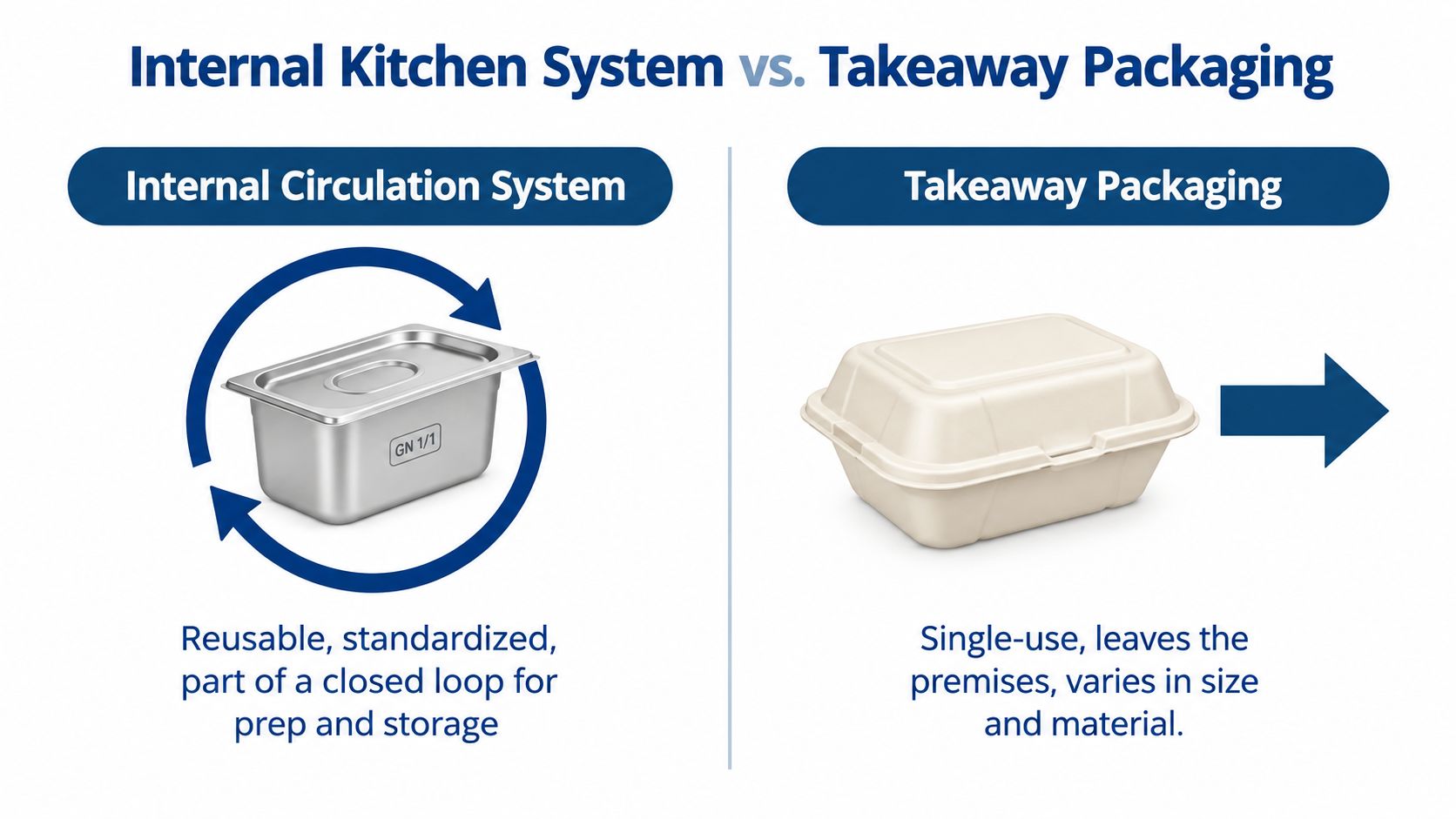
A stainless container works differently depending on whether it stays inside the operation. Internal meal-prep containers circulate through a controlled environment. Staff fill them, label them, store them, empty them, wash them and return them to production. The business controls the container, the cleaning process and the next use.
Takeaway packaging leaves the premises. Once a customer takes the meal away, the operator may not receive the container back, may not know how it was handled and may not have a practical way to clean it. Stainless steel can still be used in a takeaway model, but only where a clear return and sanitation process exists.
A closed loop needs more than a durable material
The practical decision can be made by tracing the container's full route:
- Preparation: Can staff fill the container without slowing portioning or creating spills?
- Storage: Does the footprint suit the refrigerator, shelving and trolley system?
- Return: Will the container reliably come back to the kitchen or catering base?
- Washing: Does the operation have the labour, equipment and space to clean it properly?
- Reuse: Will the business keep the container in service through repeated cycles?
- Retirement: Is there a local scrap, reuse, donation or take-back route when the container is damaged?
New Zealand's steel recovery system provides relevant context. Steel scrap recovery was estimated at 74% for calendar year 2020, compared with an earlier estimate of about 80% in 2015, while another industry summary described roughly 72% of steel scrap in Aotearoa as recycled. The same report identified 31.3 kilotonnes of stainless steel within New Zealand's ferrous waste and scrap stream. These figures support the view that stainless has a meaningful recovery pathway, but they don't prove that every commercial food container will enter that pathway. See the New Zealand steel recycling report.
Where stainless makes practical sense
Stainless is usually easier to justify for production kitchens, event caterers, commissaries, hotel kitchens and institutional food operations where containers remain within a managed loop. For meals sent permanently with customers, disposable or purpose-built returnable packaging may be more workable, depending on collection arrangements, washing capacity and transport requirements.
The sustainability outcome depends on actual behaviour. Reuse frequency, washing requirements, labour, transport and the likelihood of containers returning all matter. Stainless steel isn't automatically the right answer because it can be reused or recovered.
Choosing GN Sizes Depths and Solid Versus Perforated Pans
Gastronorm pans give commercial kitchens a common language for food storage and production. Rather than accumulating unrelated rectangular boxes, operators can choose compatible GN footprints and depths that fit shelving, refrigeration, trolleys, bain-marie equipment and service counters.
The starting point shouldn't be “Which size do busy caterers buy most?” Specific caterer sales data isn't available to support that claim. The better question is how much food each stage handles and where the container goes next.
A large GN format can suit batch preparation and ingredient storage. Smaller formats can hold sauces, garnishes, side dishes or lower-volume components. Depth changes the working height and capacity, but it also affects access, cooling arrangements, stacking and the amount of product staff handle at once.
Match the pan to the task
| GN Size and Depth | Best Fit for Meal Prep | Workflow Benefit |
|---|---|---|
| Larger GN format, deeper pan | Batch cooking, bulk ingredients and production components | Keeps larger quantities within a standard footprint |
| Larger GN format, shallower pan | Broad items, prepared portions and accessible chilled storage | Makes contents easier to portion and organise |
| Smaller GN format, medium depth | Sauces, sides, toppings and individual components | Separates ingredients without filling a large pan unnecessarily |
| Smaller GN format, shallow pan | Garnishes, small batches and low-volume prep | Reduces wasted shelf space and makes stock visible |
| Perforated GN pan | Draining, steaming, blanching or holding food where liquid separation is needed | Allows drainage while supporting a compatible production step |
| Solid GN pan | Sauces, cooked meals, ingredients and chilled storage | Retains liquids and provides a dependable covered storage base |
A range such as Chef Inox Gastronorm Pans can be considered as part of that coordinated format strategy. The important purchasing question is whether the selected footprints, depths and lids remain compatible as the operation expands.
Solid and perforated pans do different jobs
A solid pan is the default for most meal-prep storage because it contains sauces, dressings, cooked grains and prepared meals. A perforated pan is useful where draining is part of the process, such as washed produce, blanching or steaming. It isn't a substitute for a solid storage pan, and loose liquids can create mess if the drainage path hasn't been planned.
Standardisation also affects replacement. If a damaged pan can be replaced with the same footprint and depth, staff don't need to redesign the shelf or change the lid system. Nesting empty pans and stacking filled pans can reduce disorder, but the relevant question is whether the container fits the storage system already being built.
For kitchens producing pasta or noodles continuously, the Waldorf Bold PCB8140G, 450mm Gas Pasta Cooker has a 40 litre water capacity, a 47MJ/hr infrared burner, an easy-clean 316 grade stainless steel open pan and four supplied stainless steel pasta baskets. Its integrated water fill and starch-skimming faucet can make it a defined production station, provided the receiving sauce or plating area doesn't become the next bottleneck.
Lids Seals and Covering Versus Truly Sealed Transport
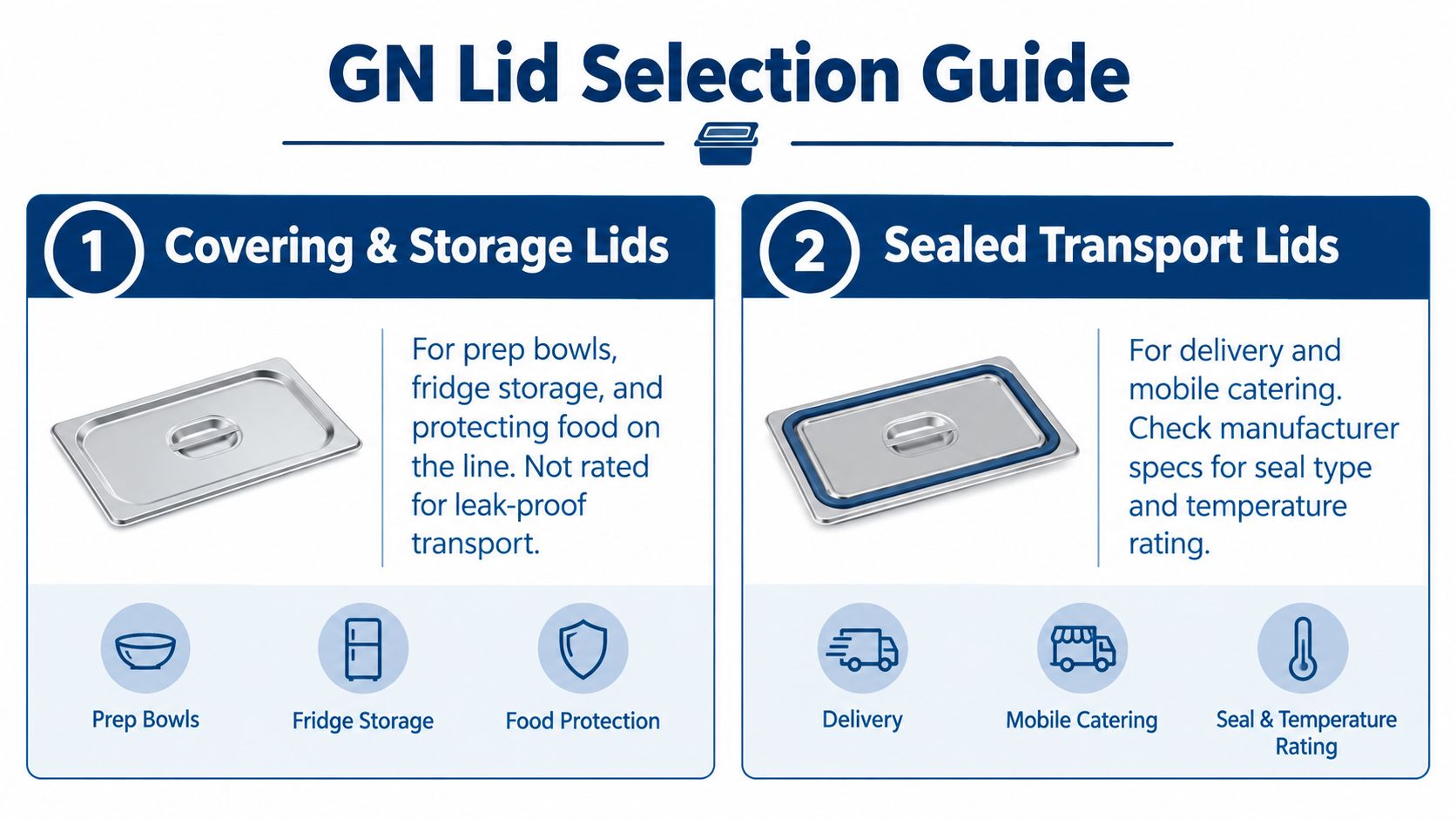
A lid that covers a pan isn't automatically a lid that seals it. Standard stainless GN lids can protect food during preparation, chilled storage and movement around a kitchen, but operators shouldn't describe them as leak-proof unless the manufacturer specifically supports that claim.
The distinction becomes important when food contains liquid or travels off-site. A lid that sits securely on a pan may be entirely suitable for a refrigerator shelf, yet unsuitable for a delivery vehicle where the container could tilt, vibrate or be stacked under pressure.
Specify the lid by risk
For routine internal preparation, operators should check:
- Fit: The lid must match the selected GN footprint and pan design.
- Access: A solid lid protects the contents, while a lid with a handle or suitable opening may make repeated handling easier.
- Temperature: The pan, lid, gasket and any other components may have separate temperature limits.
- Stacking: The lid should support the way filled pans are stored, moved and loaded.
- Cleaning: Hinges, seals and grooves need to be accessible for washing and inspection.
A sealed transport lid requires more evidence. If the container carries soup, curry, gravy or dressing to an event, the supplier or manufacturer should identify the seal type, compatibility, temperature rating and intended transport conditions. A standard covering lid shouldn't be treated as a sealed catering container just because it sits tightly on the rim.
Transport check: If a tipped container would create a food-safety, service or vehicle-cleaning problem, specify a system designed and rated for that risk.
Covering works well inside the kitchen
A covering lid is often the sensible choice for prep bowls, refrigerator storage and food held on a production line. It keeps food protected and helps staff maintain an organised system without adding the complexity of a transport seal.
For mobile catering, deliveries or off-site service, a purpose-designed insulated or sealed solution may be more appropriate than a standard GN lid. Guidance on insulated food containers can help operators assess transport requirements separately from ordinary kitchen storage.
Storage Stacking Refrigeration and Cleaning for Daily Operations
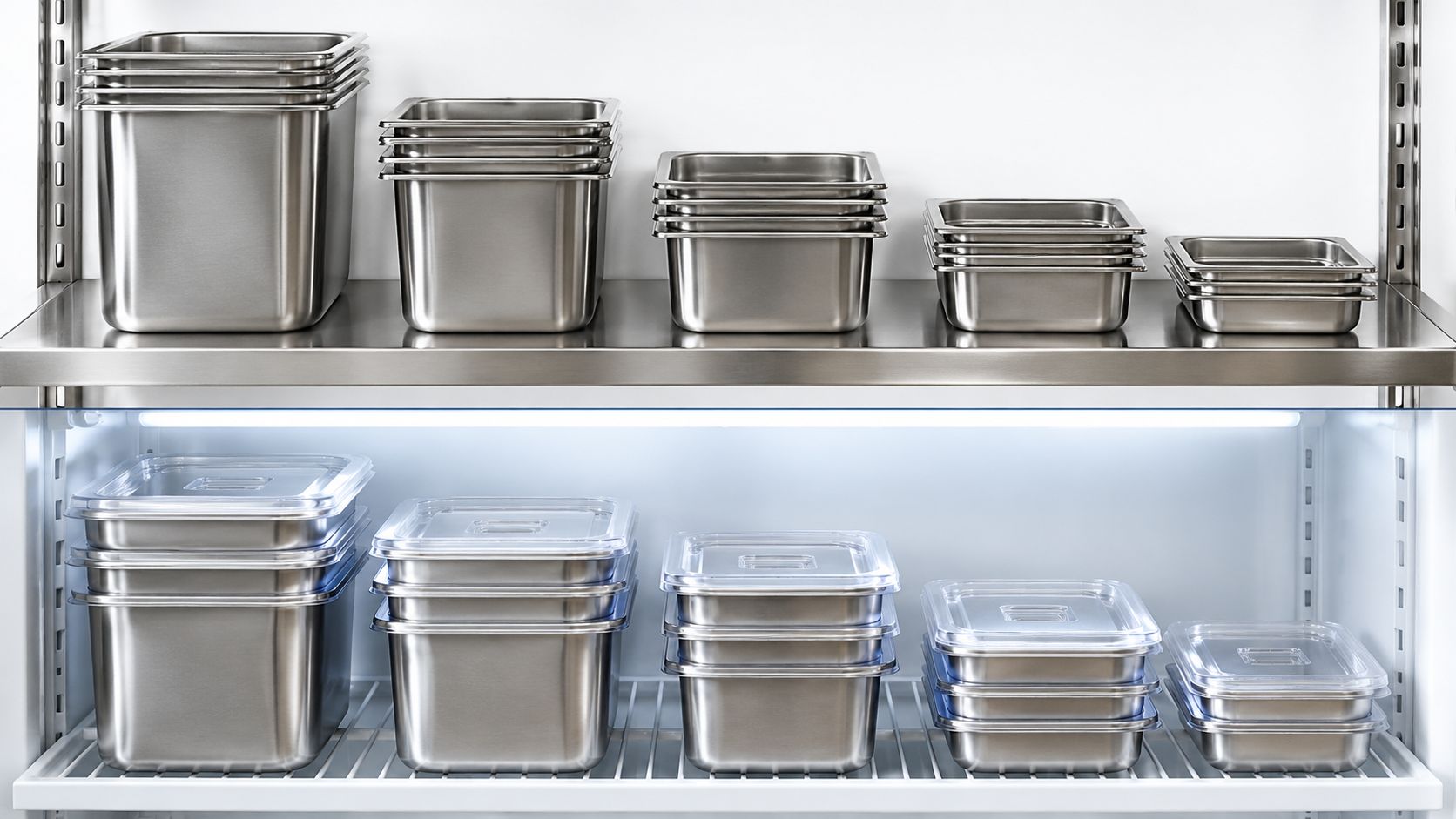
Container systems succeed or fail on the shelf. A pan that fits the menu but not the refrigerator creates daily handling problems, particularly when staff need to lift several containers to reach one ingredient. Before ordering, operators should measure usable shelf dimensions, door clearance, trolley widths and the space available near the dishwasher.
Empty pans may nest, while filled pans usually need stable stacking. Matching footprints reduces the number of odd gaps, but staff still need an agreed storage pattern. Labels, dates and product names should remain visible, especially when stainless steel hides the contents.
Plan the cold room around the containers
New Zealand building guidance for food premises sets minimum perishable food store capacity at 0.5 m3 for up to two people, 1.0 m3 for three to five people, and 1.0 m3 plus 0.2 m3 for each additional person over five. The guidance also says the storage space must provide either refrigeration or ventilation to outside air. Review the food preparation and prevention of contamination guidance.
Those figures help with premises planning, but the container system still needs to match the actual menu and production cycle. Deep pans may use vertical space efficiently for some products, while shallow pans may be easier to access and organise in a busy refrigerator. The correct balance depends on batch size, cooling procedures and how often staff retrieve ingredients.
Make cleaning part of the design
NZ food-premises guidance requires benches, shelves and rails used for food storage to be easily cleaned and to have an impervious, smooth finish free from imperfections. National food-premises requirements also state that equipment and materials must withstand contact with food and with cleaning and sanitising processes. See the kitchen preparation and environmental health guideline.
Stainless pans generally suit repeated wash-down, but good results still depend on process. Staff should separate lids where required, clear food residue before dishwashing, inspect rims and handles, and allow pans to dry before nesting. A damaged rim can prevent a lid from sitting correctly, while deep scratches, corrosion marks or trapped residue may indicate that a container needs review.
Commercial dishwashing also creates practical constraints. Operators should confirm that pan dimensions fit the machine, racks and loading pattern, then check the manufacturer's cleaning instructions for detergents, temperatures and any components that must be removed. For broader kitchen hygiene planning, Arelli Cleaning restaurant care provides relevant context on maintaining food-service environments.
A consistent storage plan is easier to maintain when staff know where each footprint belongs. Hospitality's article on storage containers in the kitchen offers a useful reference for organising that wider system.
Material Grades Durability Food Safety and Lifecycle Value
Stainless steel is widely chosen for commercial food contact because the material can provide a smooth, durable surface that withstands repeated cleaning and sanitising. The relevant question isn't whether a product is labelled “stainless”. Operators should confirm the grade, fabrication quality, intended use and compatibility with the cleaning regime.
New Zealand food-processing guidance says product-contact surfaces must be inert to the product and cleaning materials. It identifies stainless steel, 300 series or better, as the preferred material for equipment that comes into contact with meat products. The related fabrication code is intended to help industry meet quality, structural integrity and food safety requirements. Read the stainless-steel fabrication code of practice.
Food contact still depends on suitability
A stainless container can be a strong choice for batch production, but it isn't automatically low-risk or best-in-class for every application. Operators should check:
- Corrosion resistance: The grade and finish need to suit the food, moisture and cleaning chemicals involved.
- Fabrication: Welds, corners, seams and rolled edges should be easy to inspect and clean.
- Lids and coatings: Any gasket, coating or attached component must remain suitable through its intended wash cycles.
- Temperature use: Refrigerator, freezer, oven, hot holding and dishwasher claims should be checked separately.
- Damage: Bent rims, sharp dents or surface deterioration can affect hygiene and lid fit.
The container also needs to support the food safety system rather than distract from it. Stainless steel is opaque, so staff may need clear labels and date controls to identify contents quickly. It can't be used in a microwave, and any heating or temperature use must follow the manufacturer's instructions.
Lifecycle value depends on actual use
New Zealand's kerbside recycling system accepts standard steel tins and cans, but larger commercial stainless food-service items generally need a different end-of-life route. Operators may use scrap-metal collection, reuse, donation or a supplier take-back arrangement where available. The practical recovery pathway should be identified before purchase, particularly for a large catering fleet.
Durability can support long ownership, but only if the container remains in regular circulation. Washing consumes water, energy, chemicals and labour, while transport adds handling requirements. A reusable internal system can make strong operational sense when containers return reliably and are washed efficiently. A takeaway model without reliable returns may not deliver the same result.
For wider material considerations, the stainless steel containers guide provides broader context. Meal-prep buyers should apply that information to their own menu, cleaning process, storage capacity and return logistics.
How to Build and Buy Your Stainless Meal Prep System
A practical buying process starts with the food journey. List the products prepared in batches, the portions assembled individually, the ingredients held in reserve and the items transported to another site. Then assign each task a GN footprint and depth instead of ordering a mixed collection based on appearance.
A useful procurement checklist includes:
- Standardise footprints: Choose formats that fit existing refrigerators, shelving, trolleys and production equipment.
- Select depths by use: Use deeper pans where batch volume and vertical storage suit the workflow, and shallower pans where access and portioning matter more.
- Separate solid and perforated roles: Keep liquid-containing meals in solid pans, and reserve perforated options for drainage-based tasks.
- Match lids carefully: Use covering lids for internal storage and specify sealed transport products where liquids or off-site movement demand them.
- Confirm cleaning compatibility: Check dishwasher loading, detergent guidance, drying space and inspection requirements.
- Plan replacements: Confirm that matching pans and lids can be sourced as the operation grows or components are damaged.
- Test the storage layout: A container that stacks in a catalogue image may not fit the actual shelf system.
Many operators make the same avoidable mistake, buying unrelated sizes because each one appears useful in isolation. The result is a crowded shelf, multiple lid types and staff uncertainty about where clean stock belongs. Standardisation normally matters more than owning every available format.
The material cost is only one part of ownership. Washing, labour, storage, transport, replacement and end-of-life handling all influence whether stainless is suitable for the operation. Businesses comparing systems can also review practical bulk catering supplies considerations, especially when deciding which items should remain reusable and which need to leave with customers.
Hospitality supplies commercial kitchen storage and related hospitality equipment, with product categories that help operators build coordinated preparation and service systems. To discuss GN meal-prep containers, lids, refrigeration and cleaning requirements, visit Simply Hospitality and contact the team with the kitchen layout, menu volumes and transport needs.