

Packaging Considerations for Delivery Businesses: A Guide
A delivery order can leave the kitchen looking tidy and still arrive with a soggy base, a loose lid or sauce across the bag. That's why packaging considerations for delivery businesses need to start with the journey, not the shelf appearance or the unit price. The right format protects food quality, supports safe handling, makes packing easier and gives customers a clear disposal choice.
In New Zealand, packaging decisions also need to reflect food-contact requirements, delivery conditions and the waste systems customers can use. A package labelled recyclable or compostable won't necessarily be recovered locally. Practical trials, clear specifications and consistent packing procedures help operators choose packaging that works from the pass to the customer's table.
Why Delivery Changes the Job Packaging Has to Do
Once food leaves the kitchen, the container has to do more than hold a portion. It faces transport time and distance, temperature changes, movement during handling, moisture and condensation, and the possibility of spills. It also needs to protect presentation and remain convenient to carry, open and dispose of.
A container that works perfectly for takeaway collected at the counter may not perform as well during a 30-minute delivery journey. Counter collection removes much of the delay and handling between kitchen and customer. Delivery adds a chain of handoffs, stacking and travel conditions that can turn a minor weakness into a damaged order.
Work backwards from the delivery journey
Start by identifying the food, its intended condition on arrival and the longest route it's expected to travel. A hot meal with sauce has different requirements from a crisp fried item, a chilled salad or a bakery product that can be crushed. Packaging should suit the product's moisture, temperature and structure, as well as the way staff and couriers will handle it.
The outside of an order matters too. A secure bag and manageable pack arrangement make it easier to carry, while a container that traps too much steam can compromise food quality. Staff should be able to pack the order consistently without adding unnecessary wrapping or awkward combinations of materials.
The environmental outcome comes after the practical performance test, not instead of it. New Zealand generated approximately 263,000 tonnes of plastic packaging in 2022, but only 17% was recycled, according to the Ministry for the Environment's priority product stewardship information. That context supports reducing excess packaging and choosing formats that match real recovery options.
Practical rule: Choose packaging for the food and the journey it must survive, then assess appearance and price against that requirement.
Choosing Packaging for Different Menu Items
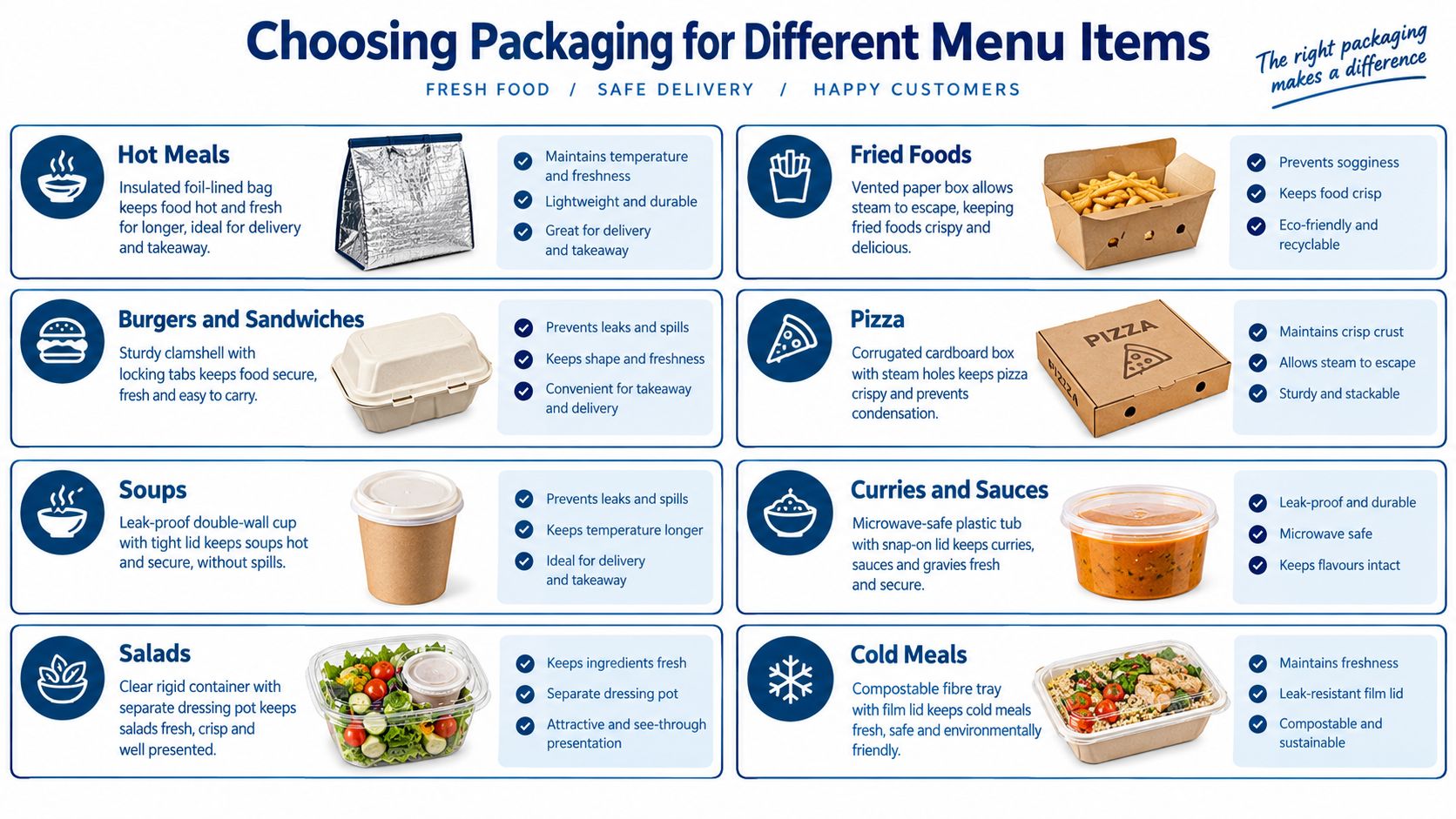
A varied menu rarely works well in one container format. The wrong design can trap steam around fried food, leave a burger loose in an oversized box or allow a drink lid to shift in transit. Match the container's structure and closure to the food, and test with actual portions.
Match the format to the food
Hot meals need a container that handles the food's temperature and moisture, with a lid that stays secure. Heat retention matters, but trapping steam can soften crisp or breaded components. Where condensation is a recurring issue, trial a format that manages moisture rather than sealing everything tightly.
Fried foods usually need ventilation so steam can escape. A fully sealed container may protect against spills but leave chips or fried items soft. For burgers and sandwiches, look for structural support, grease resistance and an opening that makes eating straightforward. A secure clamshell can help keep the item together, but it shouldn't crush the filling.
Pizza calls for a rigid box sized to the product, with enough strength for the intended stacking arrangement and ventilation to manage steam. Oversized boxes let the pizza slide; boxes that are too shallow can damage toppings. For broader format considerations, see disposable food containers for New Zealand hospitality businesses.
Soups, curries and sauces need leak-resistant bodies and closures that remain secure when tilted or stacked. Confirm that the container is appropriate for the food and intended temperature rather than assuming all tubs can handle hot, oily or acidic contents.
For salads and cold meals, consider whether wet ingredients or dressing should be packed separately. Clear or well-presented containers can help customers see the meal, but secure closure and adequate space still matter. Desserts and bakery products need protection against crushing, movement and moisture. Beverages depend on compatible cups and lids, a secure fit and a transport arrangement that limits tipping.
Comparison table
| Menu item | Primary packaging demands | Watch for |
|---|---|---|
| Hot meals | Suitable material, secure lid, moisture management | Excess condensation or heat escaping |
| Fried foods | Ventilation and support | Steam trapped inside |
| Burgers and sandwiches | Structure, grease resistance, easy access | Crushing or movement |
| Pizza | Correct dimensions, rigidity, ventilation | Sliding or weak stacking |
| Soups, curries and sauces | Leak resistance and secure closure | Lid separation or unsuitable temperature rating |
| Salads and cold meals | Cold-food suitability and ingredient separation | Dressing leakage and soggy components |
| Desserts and bakery items | Crush protection and stable fit | Excess space or moisture |
| Beverages | Compatible cup and lid, secure transport | Loose lid or unstable carrying |
Food Safety and Temperature Control
Packaging supports safe food handling, but it doesn't replace temperature management or an effective food safety programme. New Zealand Ministry for Primary Industries guidance says food packaging must be fit for purpose, clean, intact and capable of preventing contamination and deterioration during processing, storage and transport. The MPI food packaging rules and guidance also directs businesses to food-contact requirements, including the Australia New Zealand Food Standards Code.
Specify and verify food-contact use
For each packaging format, document what food it will contact, the expected temperature and moisture conditions, and how long the food must remain protected. Ask for verified information on food-contact suitability, temperature limitations, closure integrity and whether chemicals could migrate into food. The material must suit the food and its intended use. Leave enough room for required labelling and any lot or batch information needed for traceability.
The Food Act 2014 sets the food safety framework for food businesses. Packaging is one control within that framework, not a substitute for correct preparation, storage, packing and transport procedures. Staff should pack food with clean hands and equipment, store packaging in clean, dry conditions and separate items where cross-contamination is a concern. Allergen orders need a process that keeps ingredients and utensils separate, with labels or order identification that don't create ambiguity.
Tamper-evident seals may be useful where they support a clear handover and show whether an order has been opened. They don't make unsuitable packaging safe, and they need to be applied consistently.
Packaging that retains heat is not the same as equipment designed to maintain controlled food temperatures. For a broader view of managing time and temperature across handling and transport, see cold-chain management for hospitality businesses. The MPI guidance on reusable containers also notes that reusable containers need to be clean, dry and fitted with a good seal. Reuse programmes should include documented washing, drying and inspection.
For products sensitive to heat exposure, including wine, operators can also review practical advice on how to protect your vintage from heat. Delivery businesses should set their own controls from the food, route and verified specifications, rather than relying on a universal delivery time or temperature.
Preventing Leaks, Spills and Damaged Orders
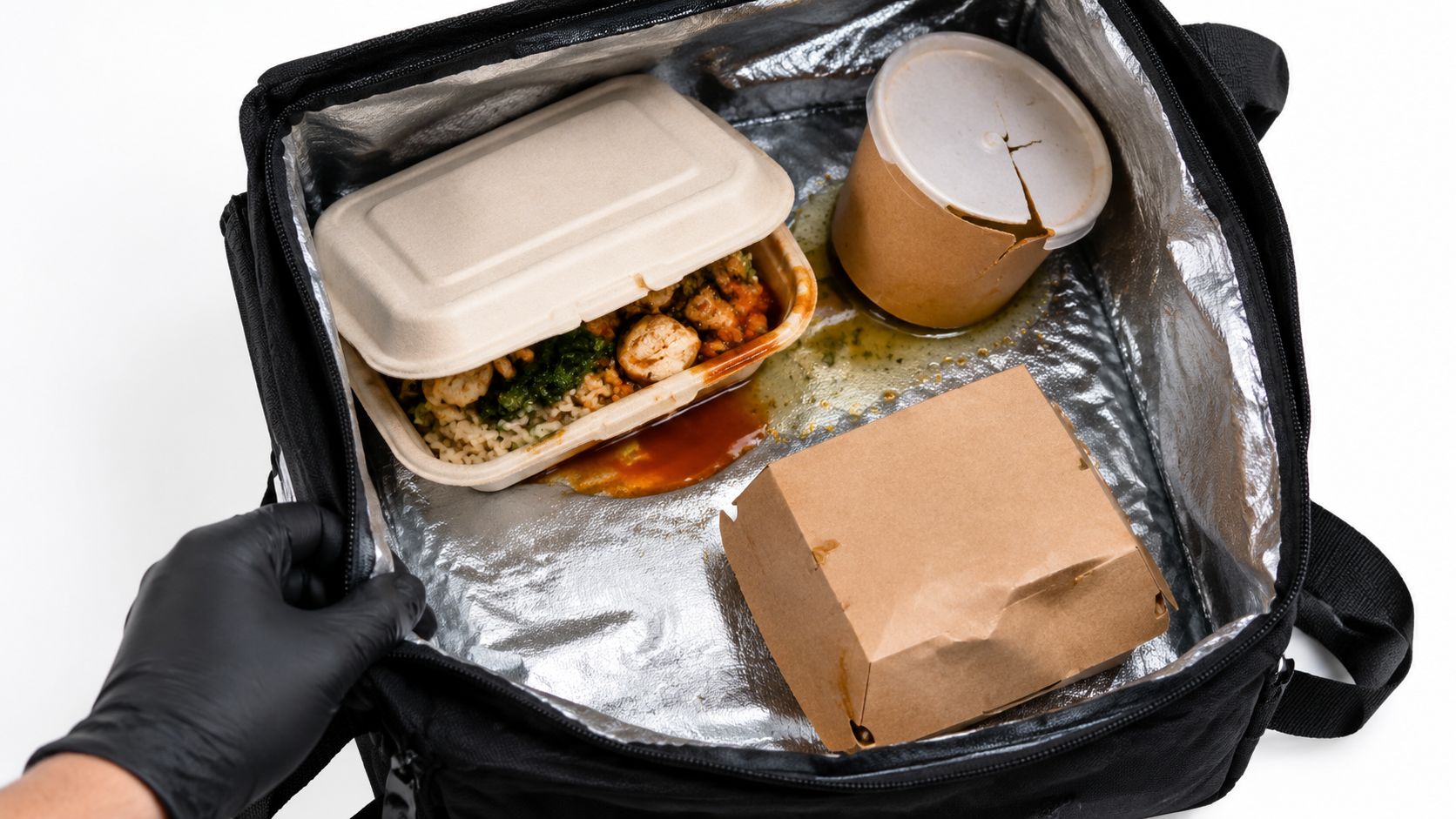
Packaging failure costs more than the container on the invoice. A lid that separates, a tub that collapses or a sauce that leaks can mean a replacement order, extra staff work and a poor customer experience. Hot food can become soggy, drinks can spill, and food can shift inside oversized packaging. Even a sturdy order becomes harder to carry if its packaging is awkwardly balanced.
Run a realistic delivery trial
Test a small number of candidate formats with actual menu items before committing to bulk quantities. Pack the food as staff would during service, then assess how it handles stacking, movement, temperature changes and the expected delivery route. Check closure security, leakage, crushing, condensation and food condition at the end.
A useful trial asks more than whether the container stays closed. Does the meal still look appealing? Can the customer open it without tipping food? Is the bag comfortable to carry? Does the order remain organised when hot and cold items travel together?
The best packaging test is how the meal looks and performs when the customer opens it, not how it looks when it leaves the kitchen.
A pizza box that holds its shape in storage may behave differently when stacked with other orders, so check the finished load rather than just the empty box. Businesses shipping packaged beverages can also consider how craft beer shipping carton sizes relate to the products and arrangement being transported. For takeaway pizza formats, review pizza box options for New Zealand businesses.
Record the test conditions and the problems found. If a lid comes loose or food moves, adjust the format, portion arrangement or packing method, then repeat the trial before making a larger purchase.
Packaging Materials and Sustainability Trade-Offs
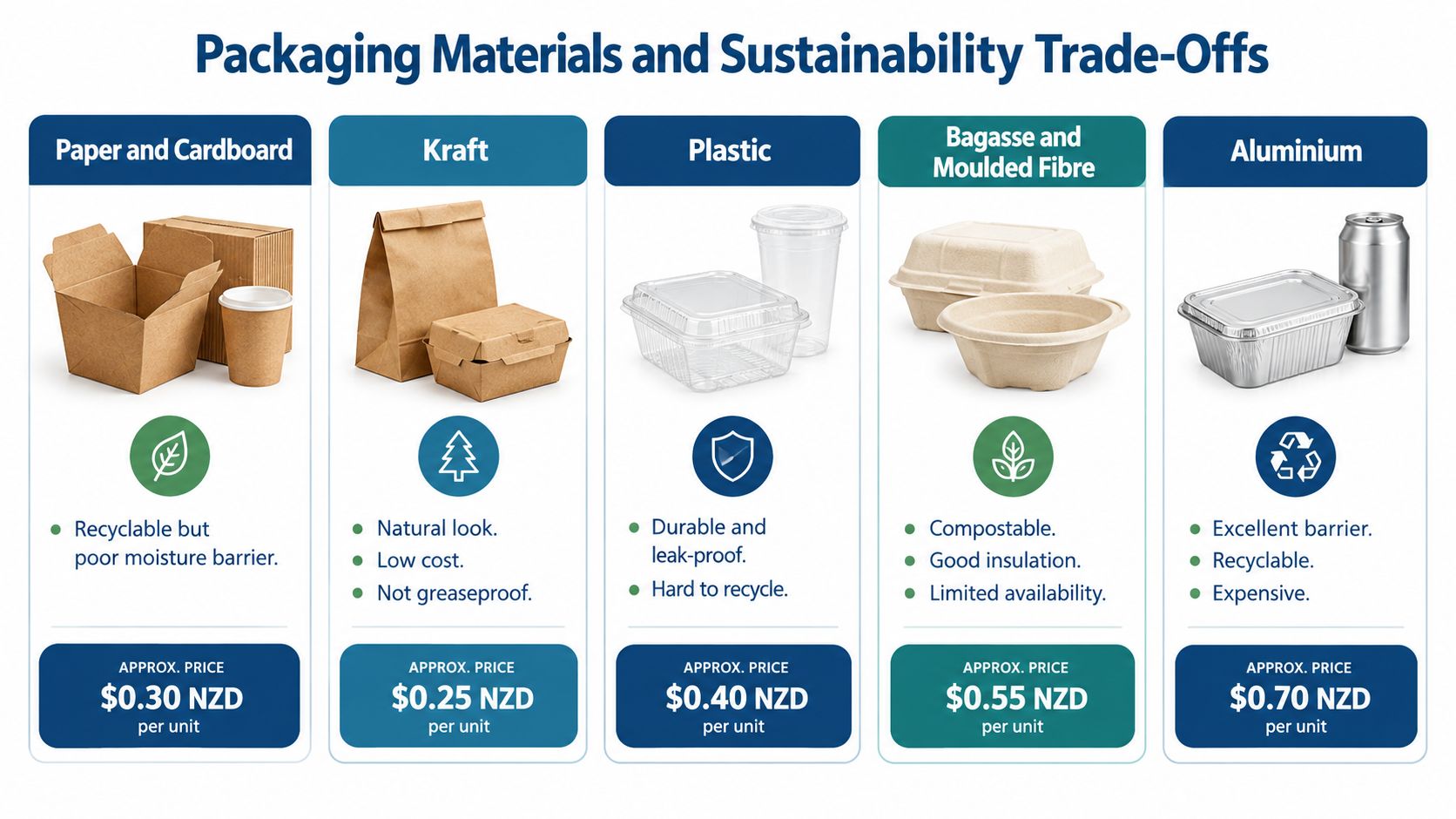
No material is automatically the right choice for every menu item or disposal system. Paper and cardboard can suit dry foods and provide structure, but moisture or grease can limit their performance. Kraft packaging offers a paper-based presentation, yet it still needs to be checked for grease resistance and suitability for the actual food. Plastic containers can provide a secure format for some wet foods, but their end-of-life depends on the material, local collection and sorting.
Bagasse and moulded fibre are options for some food types, but the operator needs to verify their moisture performance and disposal route. Aluminium can work for suitable meals and may be recoverable where collection systems accept it, but the actual pathway still matters. Cost and availability also vary by format, so material choice should be tested rather than assumed.
Check the claim and the disposal route
Recyclable, biodegradable and compostable don't mean the same thing. A recyclable claim doesn't guarantee an item is accepted in the customer's kerbside collection. A compostable item may need particular processing conditions or access to an appropriate commercial organics service. Food residue, coatings, mixed materials, lids and labels can affect whether an item is accepted or recovered.
New Zealand's disposal infrastructure and collection rules vary, so packaging specifications should be checked against the places customers live and the services a business uses. The Ministry for the Environment's analysis of New Zealand's national recycling rate notes that material recovery depends on more than a product's advertised material. Its priority product stewardship information also explains that plastic packaging has been identified as a priority product, with post-consumer management costs largely borne by councils and communities.
Restrictions matter when replacing single-use products. The Government's update on waste policies states that from 1 October 2022, restrictions covered polystyrene takeaway food and drink packaging, all expanded polystyrene food and drink packaging, some PVC food trays and plastics containing pro-degradant additives. From 1 July 2023, plastic plates, bowls and cutlery were also banned from manufacture, sale or distribution. Check the product type and material before purchasing replacements.
For a closer look at what compostable claims mean in practice, read Understanding Compostable Packaging. Clear disposal instructions are more useful than a vague “eco-friendly” claim.
Packaging Costs and Operational Efficiency
The lowest unit price doesn't always produce the lowest cost per order. The full calculation includes the container, lid, bag, napkins, cutlery, labels, staff packing time and the possibility of a replacement order if packaging fails. A format that needs extra wrapping or is awkward to assemble can add work even when its purchase price looks attractive.
Calculate the complete order
Use an illustrative comparison rather than assuming a market-standard cost. If one packaging setup costs $0.10 more per order, the additional spend across 500 monthly orders would be $50. That example is arithmetic, not a claim about typical prices; operators should substitute their own quoted costs and order volumes.
A useful worksheet can compare each option against the same order:
- Packaging components: Add the container, lid, bag, napkins, cutlery, labels and seals used for a complete order.
- Handling: Record whether staff need extra assembly, double-bagging or separate packing steps.
- Storage: Check carton size, pack quantities, shelf space and whether stock can be kept clean and accessible.
- Compatibility: Confirm lids fit the bases reliably and whether the same components work across suitable menu items.
- Failure costs: Include the business's own experience of replacement orders, refunds or discarded food, without assuming a standard failure rate.
Standardising around a manageable range can simplify ordering and training, but forcing every dish into one container can create quality problems. Premium packaging should earn its place through a relevant benefit, such as a more secure closure or better fit for the product, rather than a presumed improvement in customer response.
For planning container formats as order volumes change, see choosing packaging for growth. Revisit the calculation when the menu or packing process changes, so the comparison reflects what staff use in practice.
Packaging for Delivery Platforms and High-Volume Operations
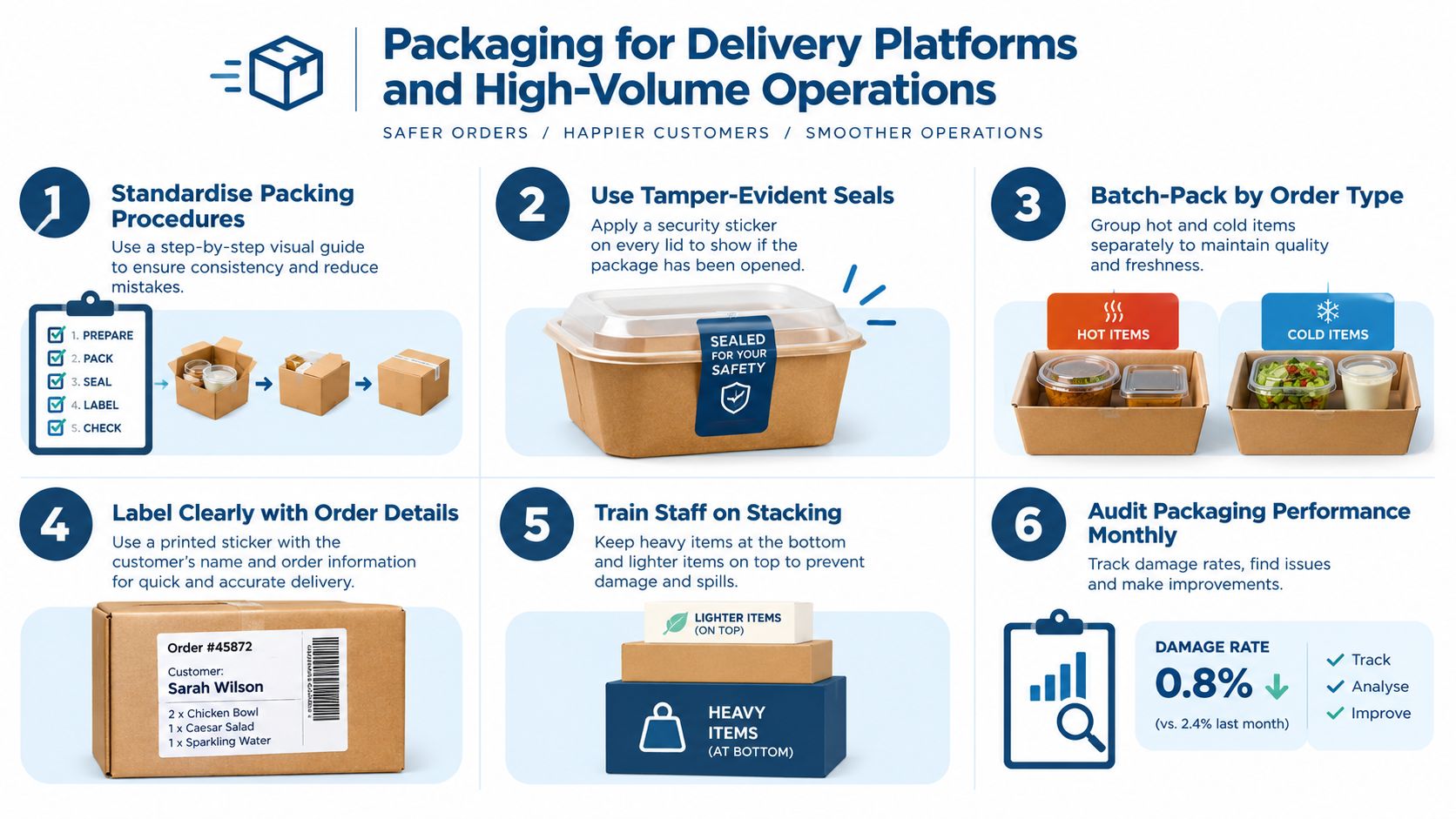
High-volume dispatch depends on repeatable packing, not just a good container. Third-party couriers and in-house drivers both need orders that are clearly identified, properly closed and ready for handover. Staff should know which items travel separately, how orders are stacked and where completed bags wait for collection.
Make the packing process repeatable
A short visual packing guide can show staff which container, lid and bag to use for each menu category. Add clear order labels, and apply tamper-evident seals where appropriate. Keep hot and cold items separated when their requirements differ, and place heavier items beneath lighter or more delicate products.
A defined courier collection area helps prevent packed orders from being mixed up or left in unsuitable conditions. During busy periods, the area should allow staff to identify completed orders without moving or unsealing them. Too many packaging formats complicate this handoff and make it harder to maintain stock.
Forecast packaging needs from the menu mix, ordering patterns and expected busy periods. Keep a simple stock record that shows what is on hand, what is in use and which formats need replenishing. Pack quantities and storage space matter: a low unit price may not help if the cartons take space needed for other essentials or the format is rarely used.
Workflow check: If staff have to pause to find a matching lid or decide which container fits a common item, the range or the packing guide needs attention.
Review packaging performance using the problems staff see, such as loose lids, damaged food or unclear order labels. Adjust the stock range and procedures when a format repeatedly slows dispatch or fails to suit the food. Consistency should make packing quicker without compromising menu suitability.
Choosing the Right Delivery Packaging in New Zealand
A sound buying decision starts with the route and the menu, then checks fit, safety, operation and disposal. Before placing a large order, test several formats with real portions and the longest expected delivery conditions. Confirm product details with the supplier or manufacturer rather than inferring dimensions, capacity, temperature suitability, microwave compatibility or environmental claims from appearance.
Buying checklist
| Consideration | Questions to ask | Why it matters |
|---|---|---|
| Food type | Is the food wet, greasy, crisp, delicate or likely to move? | The format must suit the food's structure and moisture. |
| Temperature | Is the item hot or cold, and is the packaging rated for the intended use? | Material and closure suitability support safe handling and quality. |
| Delivery duration | What is the longest expected route, including rural delivery? | The order must perform through the full service window. |
| Container dimensions | Does the portion fit without shifting or being crushed? | Correct sizing protects presentation and limits unnecessary packaging. |
| Lid security | Does the closure stay attached during handling and stacking? | A weak seal creates spill and contamination risks. |
| Material suitability | Is food-contact use verified for this food and condition? | Supplier documentation is more reliable than visual assumptions. |
| Stacking | Can packed orders be arranged without collapse or damage? | Stable loads support practical dispatch and transport. |
| Customer experience | Can the customer carry, open and eat from the pack easily? | Usability affects the meal after delivery. |
| Environmental claims | Which local collection or processing service accepts the item? | Material claims alone don't confirm recovery. |
| Cost per complete order | What do all packaging components and handling add up to? | Unit price misses the cost of a finished order. |
| Storage and availability | Can cartons be stored cleanly, and is the format available when needed? | Stock fit affects daily operations and continuity. |
Hospitality supplies packaging and consumables, including options associated with Matthews Packaging & Hygiene. Depending on current availability, operators can explore takeaway food containers, paper and kraft containers, food-safe plastic containers, bagasse packaging, pizza boxes, hot and cold beverage cups, compatible lids, paper bags, napkins, cutlery and tamper-evident seals and labels. Product specifications and availability should be checked before purchase.
For café beverage service, further guidance is available on choosing takeaway coffee cups and coffee service consumables explained. Testing a shortlist before committing to larger quantities helps confirm that the chosen packaging works for the actual food, route and packing process.
Simply Hospitality offers takeaway packaging and consumables for cafés, restaurants, caterers and other hospitality businesses, with options to compare for different foods and delivery workflows. Explore Simply Hospitality or contact the team to discuss a practical packaging mix for your menu, delivery routes and storage space.