


Paper Straws Bulk NZ: Sizes, Costs and Supplier Tips
The popular advice is simple: buy the biggest carton at the lowest price per straw and move on. For a hospitality business, that's often the expensive way to do it. A straw that softens in an iced coffee, blocks in a smoothie or doesn't clear a takeaway lid creates replacements, complaints and extra staff handling, and those costs sit outside the carton price.
Buying paper straws bulk NZ operators use well starts with the drinks sold, the cups and lids already in service, and the number of straws used each week. Size, construction, wrapping and carton quantity should follow that information, not the other way around. The cheapest carton only becomes good value if its straws reach customers without replacement and fit the storage and service system around them.
What to Check Before Buying Paper Straws in Bulk
Size the order from actual weekly straw use by drink type, then check it against the largest carton on offer. Pull recent beverage sales, separate drinks that receive straws from those that don't, and group them by thickness and cup height. That exercise shows whether a venue needs one standard size or a small range covering standard, jumbo and cocktail service.
New Zealand regulation shapes this purchase directly. Ministry for the Environment guidance on plastic products banned from July 2023 records that the Government restricted the sale and supply of single-use plastic straws nationwide on 1 July 2023, including straws marketed as biodegradable or compostable plastic. A product described as eco-friendly still needs a material specification showing it contains no plastic.
Start with weeks of cover
Convert every carton into time. A venue using 2,500 straws a week gets 0.4 weeks of cover from a hypothetical carton of 1,000 and four weeks from a carton of 10,000. That calculation exposes ordering frequency, storage demand and cash tied up in stock.
Carton price is the starting point for comparison, not the verdict. The figure that matters is cost per usable straw: a cheaper straw swapped out mid-service costs more per drink than a firmer one at a higher unit price, once replacements and extra handling count.
Purchasing considerations for bulk paper straws
| Purchasing consideration | Why it matters | What to check |
|---|---|---|
| Diameter and length | Must suit the drink and the cup or lid | Measure in mm against cups, lids and thickest drink |
| Standard vs jumbo | Narrow straws can block in thick drinks | Assign jumbo only to smoothies and milkshakes |
| Material construction | Layers and coatings affect how long a straw holds | Ask for layer count, coating and adhesive details |
| Wrapped vs unwrapped | Affects handling, hygiene and packaging waste | Choose by service style and staffing |
| Carton quantity | Sets stock on hand and storage space | Divide carton count by weekly use to get weeks of cover |
| Beverage suitability | Straws must suit the drinks you actually sell | List the drinks each straw format must cover |
Diameter deserves more attention than brand language. Two products called standard may not share the same internal width, wall thickness or length, so operators should compare written dimensions against their tallest cup, shortest glass and thickest drink.
Reliable ongoing supply also belongs in the first check. A suitable straw that can't be reordered consistently creates substitutions mid-menu, and staff then work with several lengths and performance levels. Planning straws alongside cups, lids and delivery packaging reduces that mismatch, a point also relevant when reviewing packaging considerations for takeaway businesses.
Practical rule: Trial the three highest-volume drinks first. A range that fails those drinks won't be rescued by a better carton price.
Finish by confirming the cartons fit the storage space available, since oversized orders can sit long enough to pick up damage or rotation problems.
Paper Straw Sizes and Types Matched to Each Drink
Standard straws suit most soft drinks, juices and iced beverages. Jumbo straws use larger diameters for smoothies, milkshakes and thick blends, while cocktail straws are shorter for selected bar drinks and smaller glasses. Plain straws suit most venues, coloured or patterned options suit themed events and takeaway branding, and samples matter because print appearance can differ between production runs.
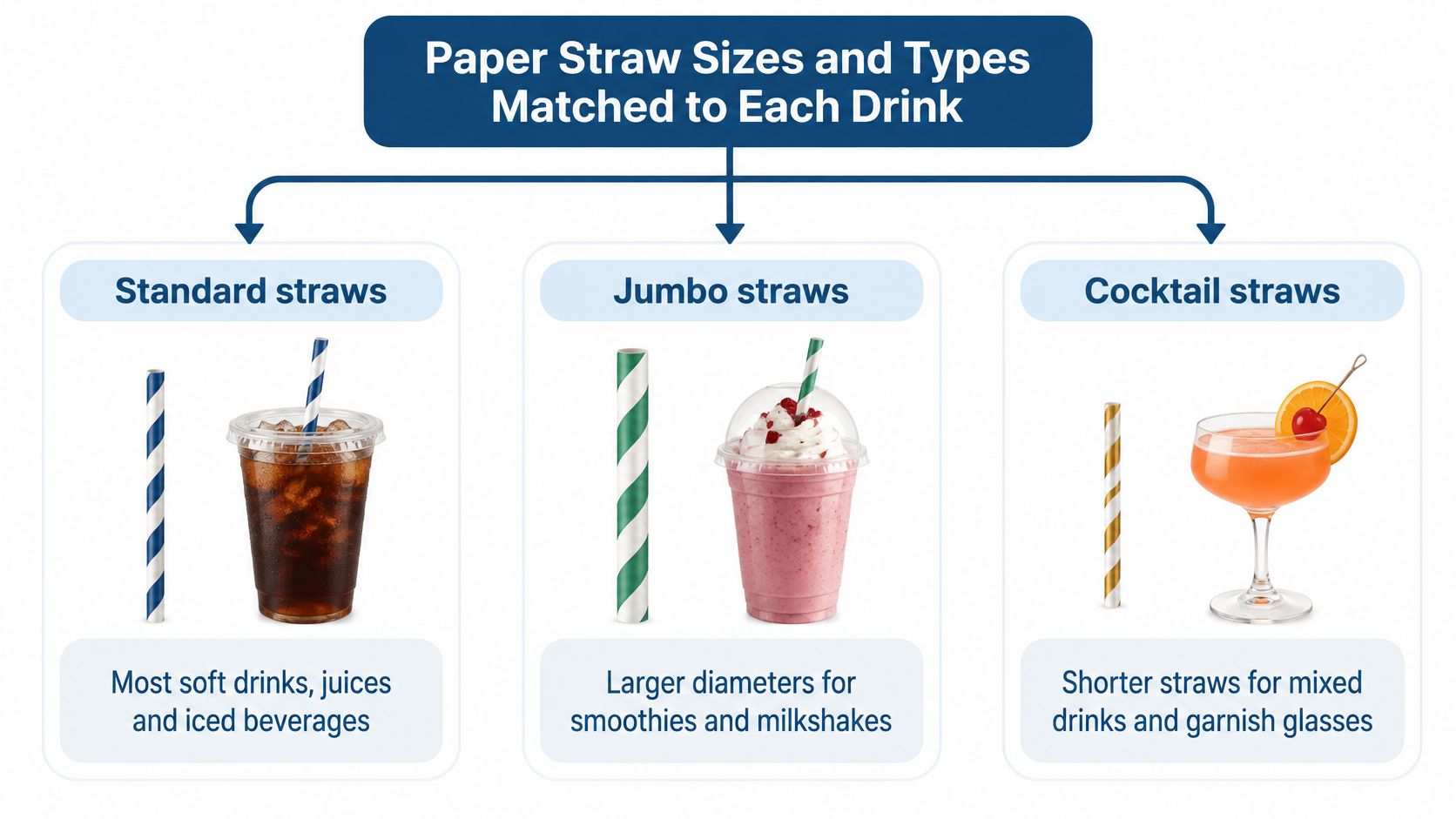
When requesting spec sheets, the fields worth asking for are internal diameter, wall or layer construction, and overall length. Two products carrying the same label can differ on all three, so written dimensions tell a buyer more than category names.
Match the straw to resistance and reach
A narrow straw forces customers to work harder on a thick drink and can block on fruit fibre or ice fragments. An oversized straw in water adds packaging cost without improving service. Length creates a separate problem: a straw that's too short disappears below a lid, and one that's too long levers out of a short glass.
Straw characteristics by beverage
| Beverage | Recommended characteristics | Common purchasing mistake |
|---|---|---|
| Water and soft drinks | Standard diameter and length suited to cup height | Buying jumbo for everything, adding cost without benefit |
| Iced coffee | Standard or wider diameter with enough rigidity for ice | Choosing the narrowest option and finding it bends or blocks |
| Cocktails | Shorter cocktail length matched to glass height | Using long straws that poke out of short glasses |
| Smoothies | Jumbo diameter to handle thick, fibrous drinks | Assuming a standard straw will clear a thick blend |
| Milkshakes | Jumbo diameter with good structural strength | Testing with a thin drink and ordering the wrong size |
| Thick blended drinks | Largest suitable diameter, tested for softening | Ordering a single size for the whole menu |
| Takeaway beverages | Length matched to cup height and lid design | Ordering by cup size without checking lid clearance |
Iced coffee sits between categories. Milk, syrup, ice volume and cup height can make a standard straw adequate in one recipe and frustrating in another, so universal diameter rules aren't useful. Test the actual recipe, including the lid opening staff use during busy service.
Cocktails need proportion as much as flow. A shorter straw suits a low glass, while tall mixed drinks may need standard length with enough rigidity for ice and garnish. Offering a straw automatically isn't always necessary, but customers who need one should be able to get one easily.
The efficient range is usually narrow. Buy standard for most drinks, then add jumbo or cocktail formats only where testing shows a specific failure. That approach limits carton variety, simplifies storage and stops staff reaching for the most expensive straw as the default for every beverage. It also keeps the honest measure where it belongs, on cost per finished drink. A cheap straw that collapses mid-serve and gets replaced costs more than a slightly dearer one that lasts.
How Long Paper Straws Hold Up in Drinks
Softening is the complaint buyers raise most often, but there's no honest universal time that applies to every paper straw and drink. Performance changes with paper layers, fibre density, bonding quality, coating, beverage temperature and acidity. Time immersed, stirring, biting, handling and moisture exposure before service also change the result.
A label saying multi-layer doesn't guarantee a better outcome. Poorly bonded layers can separate, while a well-made straw with a suitable finish may hold its shape through the normal drinking period. Manufacturing quality matters because the straw must resist both liquid from inside and condensation, ice pressure and handling from outside.
Run a service-realistic trial
Samples should go into the drinks customers order, especially milkshakes, iced coffees and cocktails consumed slowly. Staff should prepare them at normal strength, use the usual ice load and leave them for a realistic service period rather than judging the first sip.
- Initial rigidity: Record firmness when the straw first enters the drink.
- Timed rigidity: Check bending, flattening and end softness at intervals.
- Taste transfer: Sip water or the target drink and note paper flavour.
- Mouth comfort: Check whether the end frays, sharpens or collapses.
- Flow: Confirm thick drinks move without excessive effort or blockage.
- Acid response: Include the most acidic drink on the menu.
- Position: Note whether the straw stays upright in the cup or glass.
- Pre-service moisture: Observe straws held near steam, condensation or wet benches.
A straw that performs in a glass of water hasn't passed a hospitality trial.
Temperature can surprise buyers. Paper straws are mainly selected for cold drinks, yet a cold drink held for a long lunch may expose the fibre longer than a quickly consumed takeaway beverage. Acidic mixers, syrups and repeated stirring can also accelerate softening at the submerged end and around the mouthpiece.
Results should become the reorder specification. Record supplier, dimensions, layer or construction details supplied, drink tested and failure point. Without those notes, a later buyer may reorder by colour or carton price and discover that a visually similar straw performs differently.
The right answer is the straw that stays comfortable and functional for the venue's drinks and service pace. Anything stronger than needed may cost more, while anything weaker creates replacements that undermine the reason for buying in bulk.
Choosing the Right Format
At a busy counter, a single straw can pass through several hands before it reaches a drink: the staff member who loads the dispenser, the runner who packs the order, and the customer who finally opens it. Format decides how well that straw arrives. Individually wrapped straws earn their higher unit cost in delivery bags, catering packs, self-service stations and events where loose straws would be handled repeatedly. Unwrapped straws earn their lower cost where trained staff control a clean, covered dispenser at a fixed counter.
Wrapping buys protection between carton and customer, and the trade-offs are concrete: a higher unit price, more packaging in the bins, and slower hands when staff tear wrappers during a rush. Clean storage, intact sleeves and hygienic counters still determine what reaches the drink, so a wrapped straw kept in a damp storeroom gains little from its packaging. Service design settles the choice, and venues running both counter and event service often stock both formats.
Judge the format against service conditions
- Hygiene: Consider who touches the straw before it reaches the drink.
- Staff handling: Check whether unwrapping slows peak service.
- Customer convenience: Make straws easy to find without creating counter clutter.
- Packaging waste: Account for wrappers in bins and collection costs.
- Unit cost: Compare formats on cost per usable straw, including straws discarded before use.
- Service speed: Test both options during a realistic busy period.
Material specification also belongs in the format decision. The Ministry for the Environment business factsheet on the plastics ban recommends uncoated paper, wood, or bamboo as disposable alternatives, with fibre products ideally free from intentionally added PFAS. A compostable label confirms none of that on its own; the storage and disposal guidance later in this article lists the specifications worth requesting from suppliers.
Supply policy needs the same deliberateness. Some venues give straws only on request, while takeaway and accessible service may require a more proactive approach. Whatever the policy, guests who need a straw shouldn't have to explain themselves or wait while staff search for stock.
Format also has to sit alongside cups and lids, particularly where takeaway coffee and cold drinks share a service station. The guidance on choosing takeaway coffee cups is useful when a venue is reviewing the full beverage package. The winning format is the one that puts the most usable straws into drinks for each dollar spent, because a straw thrown away before use costs the same as one that is served.
What Bulk Buying Really Saves Over a Year
A transparent hypothetical makes the trade-off clearer than a carton discount. Assume a business uses 500 straws daily over 300 trading days, which equals 150,000 straws a year. These prices are assumed for illustration only, not verified NZ market rates, and the comparison excludes freight, storage, wastage and product performance differences.
At $0.06 per straw in smaller packs, annual purchasing reaches $9,000. At $0.04 per straw in bulk cartons, the same 150,000 straws cost $6,000. The apparent purchasing difference is $3,000 annually.
Illustrative annual cost of bulk versus smaller packs
| Scenario | Assumed price per straw | Straws purchased per year |
|---|---|---|
| Smaller packs | $0.06 | 150,000 |
| Bulk cartons, no replacements | $0.04 | 150,000 |
| Potential purchasing difference | Not applicable | Not applicable |
| Bulk cartons with 50% replacement | $0.04 | 225,000 |
Where the saving can disappear
If weak bulk straws require so many replacements that the business buys 225,000 straws, that's 50% more than the 150,000 needed. At $0.04 each, purchasing reaches $9,000 and matches the smaller-pack scenario. Replacement doesn't need to mean every customer receives two straws, since staff may discard bent stock, customers may request another, and some straws may soften before drinks are finished.
Freight can narrow the gap further, especially when small top-up orders attract delivery charges. Storage has a cost too, even when it doesn't appear on the invoice, because bulky cartons occupy space needed for cups, lids and food packaging. Cash tied up in slow-moving colours or sizes is another hidden cost.
Operators should calculate landed cost per usable straw instead. Add carton price, freight, storage impact and expected wastage, then divide by straws that reach customers without replacement. That method gives procurement teams a fair basis for comparing two or three real quotes, much like the broader planning approach in choosing packaging for growth.
Cost test: If a cheaper straw needs frequent replacement, its usable cost rises even while its carton price stays low.
Bulk buying still makes commercial sense when the product is right. It reduces order frequency, supports consistent supply and can lower unit purchasing cost. Savings become credible only after performance, freight and wastage are included.
Storage, Disposal and NZ Rules for Paper Straws
New Zealand rules shape the buying specification before storage enters the discussion. Paper straws count as non-plastic alternatives for ordinary service, while medically required plastic straw stock should be held and managed separately for people who need it. Operators should not assume boxed drinks with attached plastic straws remain covered by the former packaging exemption; current requirements need checking against Ministry for the Environment guidance directly, rather than against supplier summaries.
The same caution applies to environmental language. Paper describes the fibre, biodegradable describes breakdown over time under certain conditions, and certified compostable means a defined standard applies to a specified process or facility. The terms are not interchangeable, and not every paper straw can accurately be promoted as recyclable or compostable.
Store cartons as food-contact stock
A bulk carton only saves money if the straws inside still work at service. Storage is where the carton price turns into landed cost, because stock damaged in the dry store has already been paid for and still needs replacing.
- Keep cartons dry: Store off the floor and away from sinks, steam lines and roof or plumbing leaks.
- Maintain packaging integrity: Keep outer cartons sealed until stock is needed for service.
- Protect cleanliness: Use clean storage areas with sensible pest prevention.
- Rotate stock: Date deliveries on arrival and issue older cartons first.
- Limit excessive inventory: Long-holding stock faces more exposure to moisture, damage and menu changes.
- Issue close to service: Move small quantities to the counter instead of opening full cartons early.
Moisture absorbed before use weakens the fibre structure, so a straw can fail within minutes even when its original construction was sound. Storage beside dishwashing steam or chilled-drink condensation is particularly hard on stock. Opened sleeves belong in covered dispensers, and straws from damaged or contaminated packaging should be discarded rather than served. Every straw written off this way pushes the usable cost of the remaining carton upward.
Check the actual waste stream
Disposal is less straightforward than buyers often expect. The Ministry for the Environment household recycling and food scraps document states that national collection standards exclude compostable packaging from food-organics collections and exclude small items from dry recycling. A used paper straw therefore does not automatically belong in kerbside recycling or food scraps, and council or commercial contractor rules can differ from the national picture.
Food-soiled straws may be too small for sorting equipment or excluded by the receiving service, which leaves landfill as the likely destination at many venues. The practical move is to ask the waste contractor what is accepted, then label staff and customer bins to match. Clean unused stock, used straws, contaminated material and anything headed for commercial composting are four different streams, and treating them as one causes problems at both ends.
The comparison in understanding compostable packaging helps separate product claims from collection reality.
Good procurement reduces the confusion. Minimal wrapping, clear bin signage and the written material specification covered when choosing a format give staff one consistent story, and prevent customers being told a straw is compostable when the local facility will not accept it.
Choose a Supplier and Test Before Bulk Ordering
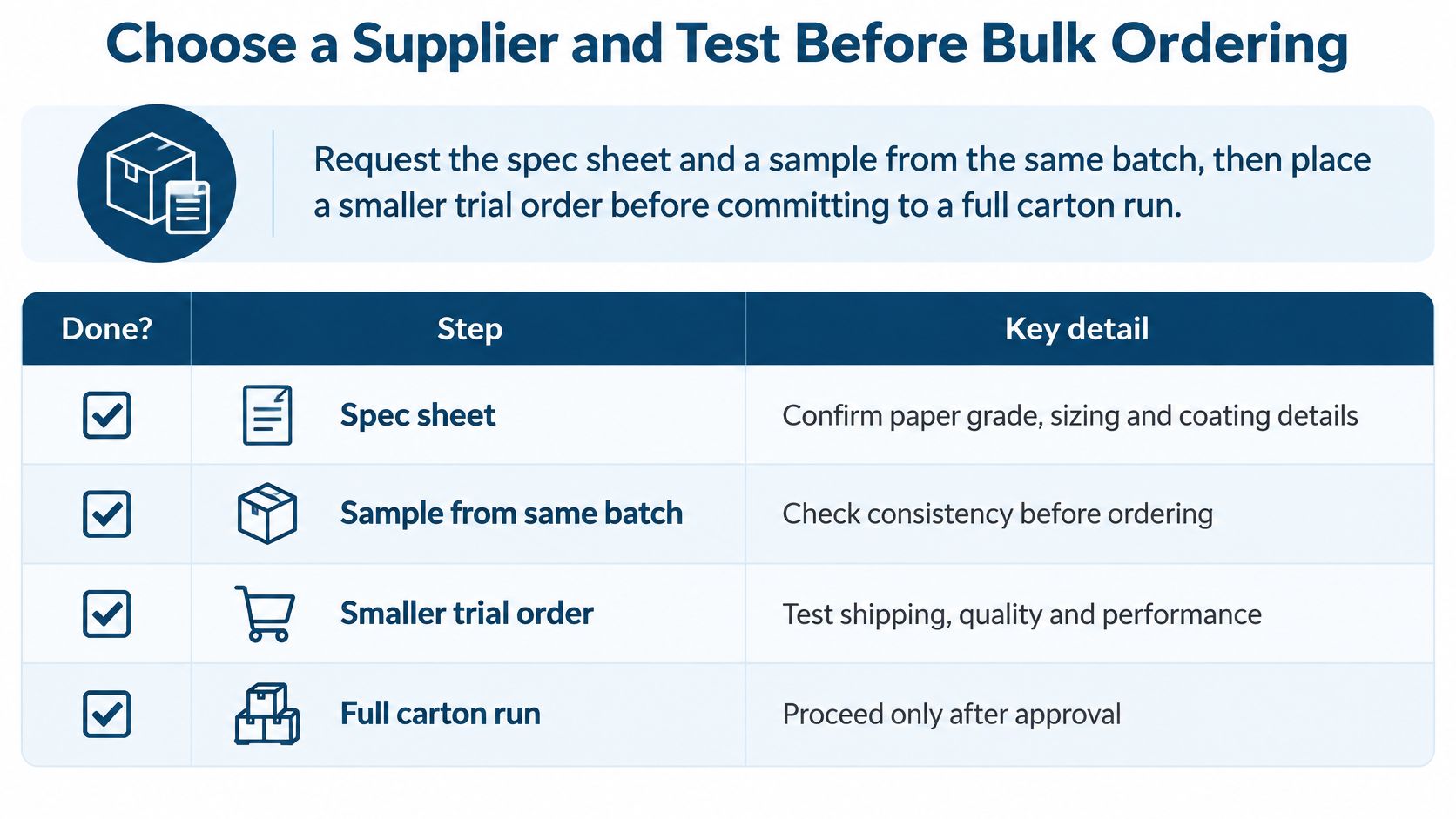
A low carton price can be wiped out by inconsistent batches, replacement stock, storage pressure or freight. Request the spec sheet and a same-batch sample, then place a trial order before a bulk run. Check performance in the drinks you serve, along with carton condition, delivery timing and whether the reorder matches the original product.
Supplier checklist for bulk paper straws
| Supplier consideration | Why it matters | What to verify |
|---|---|---|
| Product consistency | Batch variation changes how straws perform | Spec sheet and sample from the same batch |
| Available sizes | Standard and jumbo sizes may suit different drinks on the menu | Confirmed size list with diameter and length |
| Carton quantities | Sets storage space and cash tied up in stock | Quantity that matches weeks of cover |
| Price per straw | Lowest unit price may not be the lowest landed cost | Compare usable-straw costs using the method in the savings section |
| Freight costs | Small orders can attract higher freight | Freight threshold and rate, in writing |
| Delivery reliability | Stockouts disrupt service | Typical lead times and stock availability |
| Product specifications | Confirms material, coating and plastic-free status | Written material specification |
| Food-contact suitability | Straws touch drinks directly | Food-contact documentation |
| Packaging options | Wrapped and unwrapped formats suit different services | Confirm which formats are available |
| Repeat ordering | Consistent reorders reduce substitution risk | Account and reorder setup |
Confirm freight terms before ordering. Hospitality accepts orders under NZ$60, but charges an increased freight rate on them. Wholesale pricing and terms are available by contacting the dedicated wholesale team; the business phone number is 09 399 2595.
Stockouts have practical costs. A venue may need to substitute a size, buy retail packs or serve a drink without the expected straw. Lead time and suitable safety stock matter particularly for caterers and takeaway businesses with fixed event or delivery commitments.
Check straws, cups, lids and cold-beverage consumables together. Confirm that they fit, and consider whether ordering them together suits your delivery schedule and storage space. The article on BioPak's approach to compatible hospitality packaging explains how packaging choices can be considered across related products; check documentation for each item you plan to order.
Choose a supplier that can provide a consistent straw for your drinks, clear specifications, workable carton quantities and dependable repeat supply. Hospitality supplies hospitality consumables for New Zealand cafés, restaurants, bars, caterers and takeaway businesses. For help selecting a straw size, format and carton quantity, visit Simply Hospitality or contact the team.