

Pizza Oven Temperature: Managing Heat Through Service
A commercial pizza oven may operate around 450°C for high-throughput service, while authentic baking conditions can range from approximately 350°C to 425°C on the hearth, depending on the oven and pizza style. The difficult part isn't reaching that number before opening. It's maintaining the right balance of floor and top heat as every pizza removes energy from the oven during service.
At 7pm on a busy Saturday, the display might read 450°C and the first pizzas may emerge with an evenly browned base, well-coloured crust and properly finished toppings. Later in the rush, bases can become paler, cooking times can lengthen and pizzas placed in different parts of the oven can behave differently, even though the control panel still shows the same setting.
That difference between pre-service temperature and service performance is where many commercial operators lose consistency. The right pizza oven temperature is an operating condition, not just a number entered into a control panel. It depends on the cooking surface, top heat, loading rate, pizza position, dough, pan or deck interface, and the oven's ability to recover between loads.
Why Pizza Oven Temperature Changes During Service
A pizza oven can look ready while its cooking surface is still struggling under demand. The displayed chamber temperature may remain stable because the sensor is reading the air or a particular control point, while repeated pizzas continue drawing energy from the deck beneath them.
This is especially important in a high-turnover kitchen. A traditional refractory oven stores heat in its dome, floor and surrounding materials. A commercial electric deck oven uses heated elements, controls and a cooking surface to deliver heat. Both systems can produce high-temperature pizza, but they manage and restore heat in different ways.
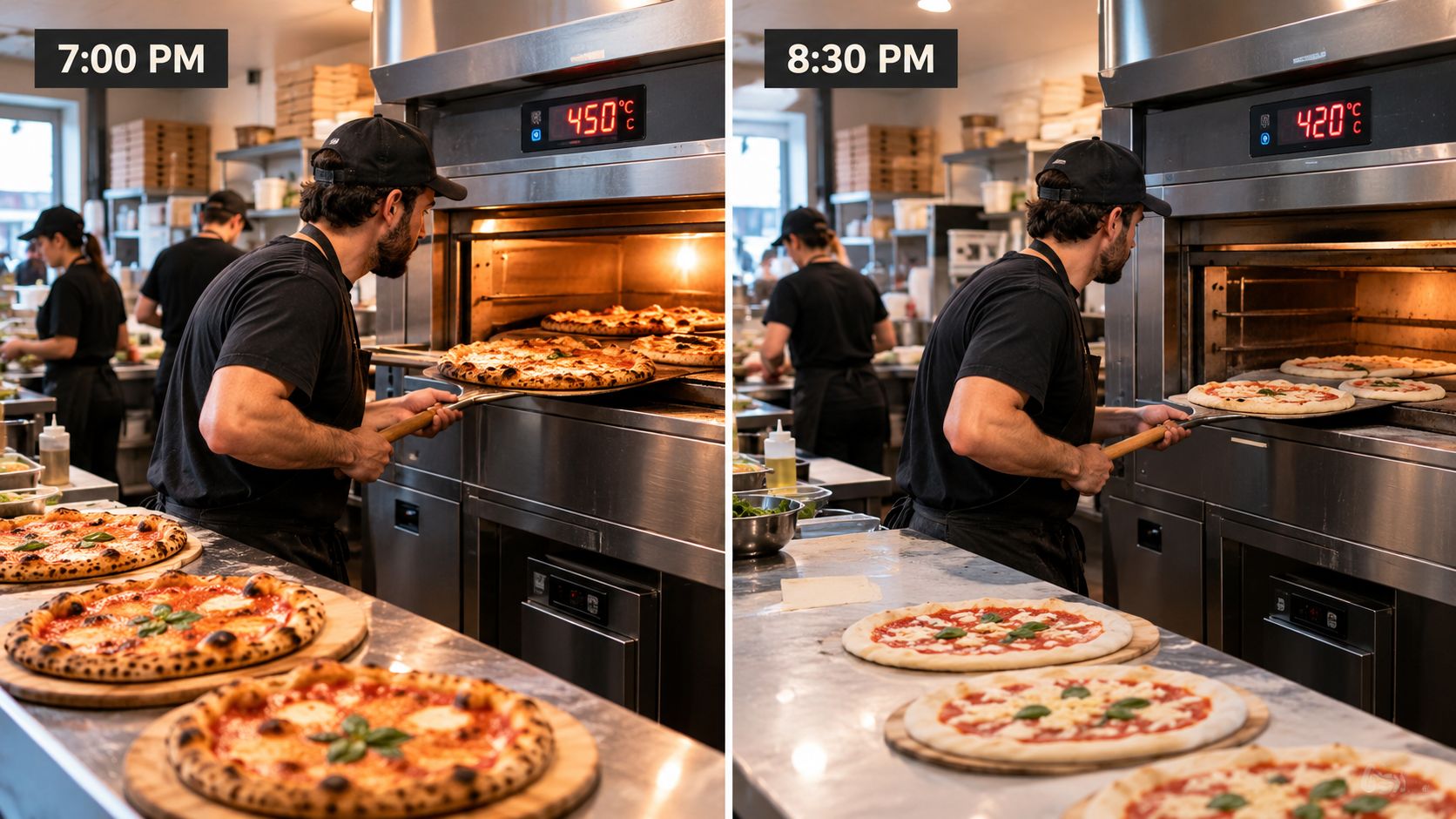
The display tells only part of the story
A control panel reading of 400°C doesn't prove that every part of the cooking floor is at 400°C. The front of the deck may behave differently from the centre, and the floor can recover at a different rate from the air above it.
A common mistake is to treat a longer bake as proof that the set temperature is too low. The actual cause may be excessive loading, poor pizza positioning, insufficient recovery, a changed dough condition or a different heat balance between the top and bottom of the oven.
Wood-fired operators also need to account for fire position and the down-heat phase. NZ guidance describes commercial pizza baking around 400°C, with pizza sometimes cooking in 90 seconds to 2 minutes, while the oven may be deliberately brought down from its firing temperature to a more suitable cooking range. The practical considerations for wood-fired pizza ovens are therefore broader than watching a single gauge.
High heat isn't automatically the right heat
The suitable range depends on the menu and service model. NZ guidance places Neapolitan-style pizza around 430°C to 500°C, with cooking in under two minutes, while thicker bases and deep-dish styles are better suited to approximately 300°C to 380°C. Consumer NZ's reviews also reports a claimed maximum of up to 500°C and a cold-to-maximum heating time of 15 minutes for that particular portable unit.
Those figures shouldn't be turned into a universal staff target. A venue needs a repeatable operating condition that suits its dough, toppings, oven design and expected flow. The question isn't only whether the oven can become hot. It's whether the oven can stay productive when the order rail fills.
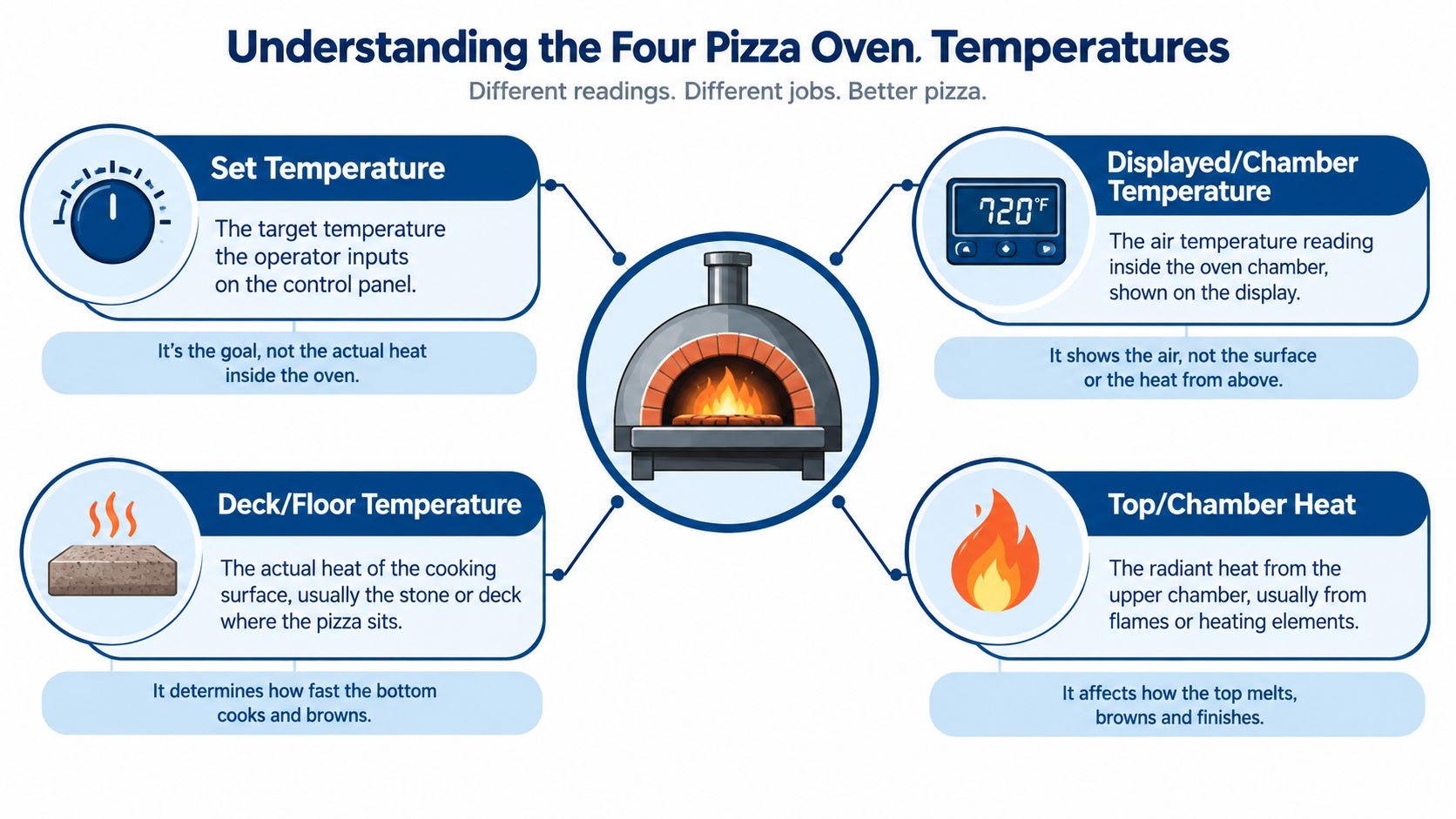
Understanding the Four Pizza Oven Temperatures
Commercial teams often speak about “the oven temperature” as if there were one measurement. In practice, four related temperatures affect the result.
Set temperature
This is the value entered into the controls or selected by the operator. It represents the intended target, not necessarily the heat available at the point where the pizza sits.
A set temperature can be useful for repeatability, but it can't reveal whether the deck has recovered after several loads. Increasing it may change the heating response, yet it won't instantly replace energy removed from a heavily used cooking surface.
Displayed or chamber temperature
This is the reading reported by the oven's sensor or control system. Depending on the model, it may reflect chamber air or another monitored point inside the cavity.
It remains useful, especially when staff follow the manufacturer's operating procedure, but a stable display doesn't guarantee uniform conditions across the oven. A reading of 400°C can coexist with a cooler section of deck or a floor that recovers more slowly than the surrounding chamber.
Deck or floor temperature
The deck is the surface transferring heat directly into the dough, either beneath the pizza or through a pan. Its condition strongly affects base colour, crispness and cooking time.
A refractory floor stores heat and releases it into each pizza. An electric deck oven may use controlled heating elements and a heated surface, with the exact arrangement varying by model. Where appropriate, a suitable high-temperature infrared thermometer can give a more direct indication of surface temperature than the oven display.
Top or chamber heat
Radiant and circulating heat from above affects the upper crust, cheese, toppings and overall finish. Top heat and floor heat don't always rise and fall together.
A base that burns while the top remains underdone can indicate excessive floor heat, a pizza placed over a hotter area, a pan interface or a changed heat balance. A top that finishes first may point towards insufficient floor heat, loading conditions or the way the pizza is being supported.
The commercial pizza oven design factors matter because insulation, heating layout, controls, deck material and chamber geometry all influence how these temperatures interact.
Practical rule: Treat the display as one piece of evidence. Judge the oven by the deck condition and the finished pizza as well.
Thermal Mass and Recovery in Commercial Pizza Ovens
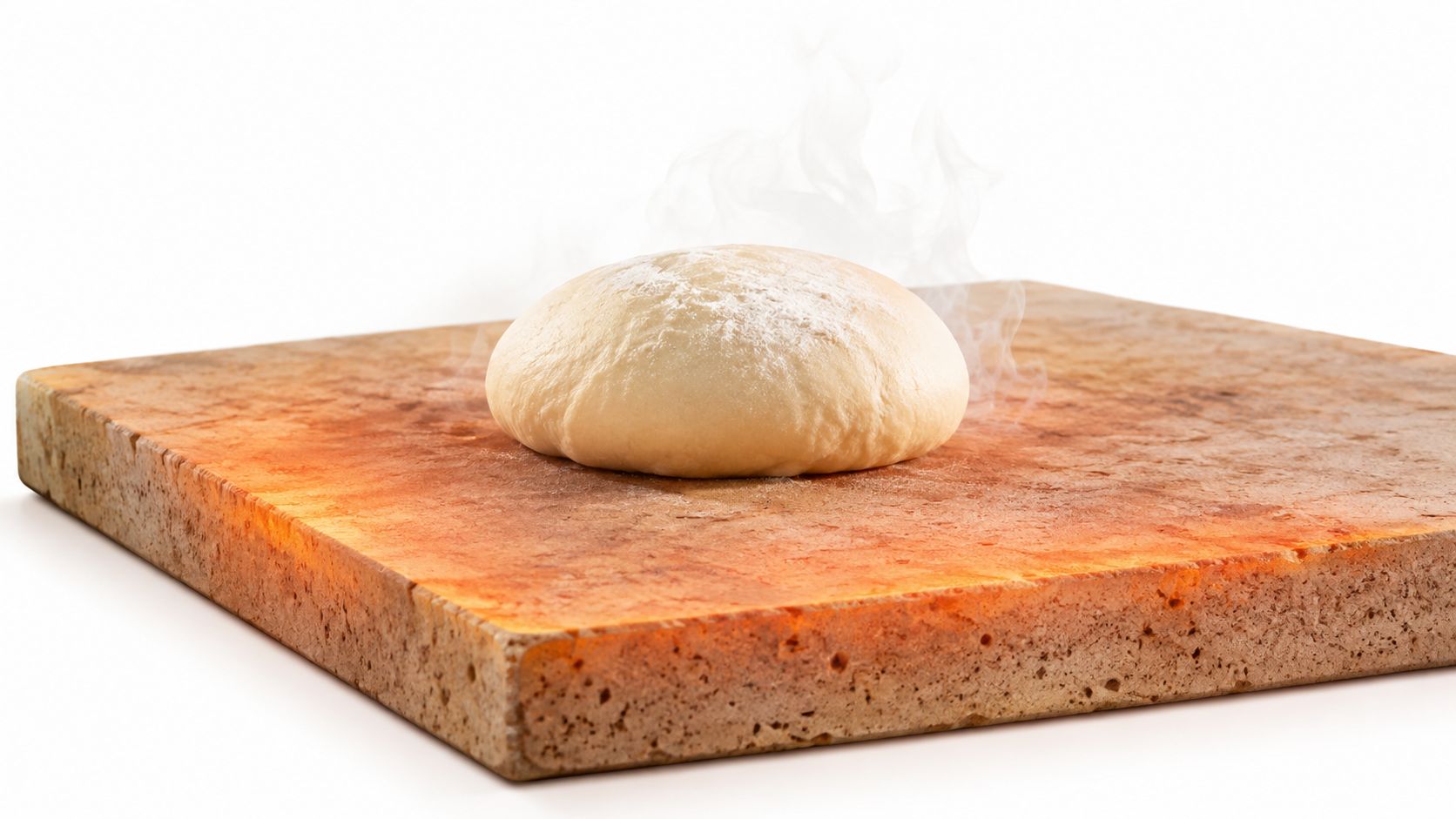
Thermal mass is easiest to understand as a thermal reserve. The oven stores energy in its deck, refractory floor, dome, hearth and other heated materials. That stored energy allows the cooking surface to keep transferring heat when a cold pizza is loaded.
A hot pan behaves similarly. One cold ingredient may cause a small drop in temperature, and the pan can recover quickly. Add cold ingredients repeatedly and the pan spends more time replacing lost heat. A pizza oven deck faces the same basic challenge during a busy service.
Preheating and recovering are separate tests
An oven that reaches its operating condition before opening has passed a pre-service test. It hasn't necessarily proved that it can maintain the required cooking performance through the rush.
Repeated loading removes heat from the deck. The effect may first appear as a slightly longer bake, then as paler bases, inconsistent browning or greater variation between pizzas. The top may still colour correctly because chamber or radiant heat remains available while the floor falls behind.
The operating calculation is not just the oven's maximum temperature. Operators need to consider:
- Pizzas per load: How many pizzas enter together and how much cold product reaches the deck at once.
- Loading frequency: How quickly the next pizzas replace those that leave.
- Cooking time: How long each pizza occupies the surface.
- Recovery between loads: Whether the oven restores useful deck heat before the next load arrives.
The relationship can be expressed as pizzas loaded per batch × loading frequency × cooking time × recovery between loads. It isn't a universal output formula, because pizza size, dough, toppings, placement and staff technique all change the result. It is a useful way to test whether a proposed oven matches the service pattern.
Different oven designs recover differently
Valoriani refractory and wood-fired units rely on stored heat, fire management, floor temperature, chamber position and the recovery contribution of the live fire or gas configuration. Staff may need to manage where pizzas sit in relation to the flame and the hottest parts of the hearth.
Moretti Forni high-temperature deck ranges, including iDeck, Serie S, Serie X and Neapolis, use model-specific heating systems and controls. Their operating methods shouldn't be treated as interchangeable. Operators need to confirm the documented temperature range, control arrangement, deck construction and heating balance for the particular model rather than assuming every deck oven behaves identically.
The right pizza oven for a restaurant, bar or food truck depends on more than peak heat. Capacity, loading pattern, available space, ventilation, fuel supply, staff capability and the expected menu all affect whether the oven can maintain useful performance.
A Practical Service Routine for Pizza Oven Temperature
A busy service exposes weak temperature routines quickly. A repeatable process helps staff identify falling deck heat before it produces uneven bases, pale centres or inconsistent crusts. Follow the manufacturer's guidance and the venue's recipe process, then adapt checks to the oven rather than forcing every model into one target.
Before service
Bring the oven to its required operating condition and allow the deck, hearth or refractory materials to stabilise according to the manufacturer's instructions. The chamber display may reach its target while the cooking surface still lacks the stored heat needed for repeated loading.
Check the cooking surface before the rush where appropriate. A high-temperature infrared thermometer can measure deck temperature without contact, provided the instrument covers the required range and staff use it as directed.
Map the cooking surface
One reading can hide a problem. Check several points:
- Front: Shows conditions near the opening and loading area.
- Centre: Provides a reference for the main cooking zone.
- Rear: Identifies differences deeper in the chamber.
- Left and right: Reveals side-to-side variation and positioning effects.
Record what the readings mean for actual pizzas. Mapping helps the team understand its oven's behaviour, including hot spots, flame paths and areas that recover at different rates. A live-fire oven does not need perfectly uniform heat if staff can manage pizza position consistently.
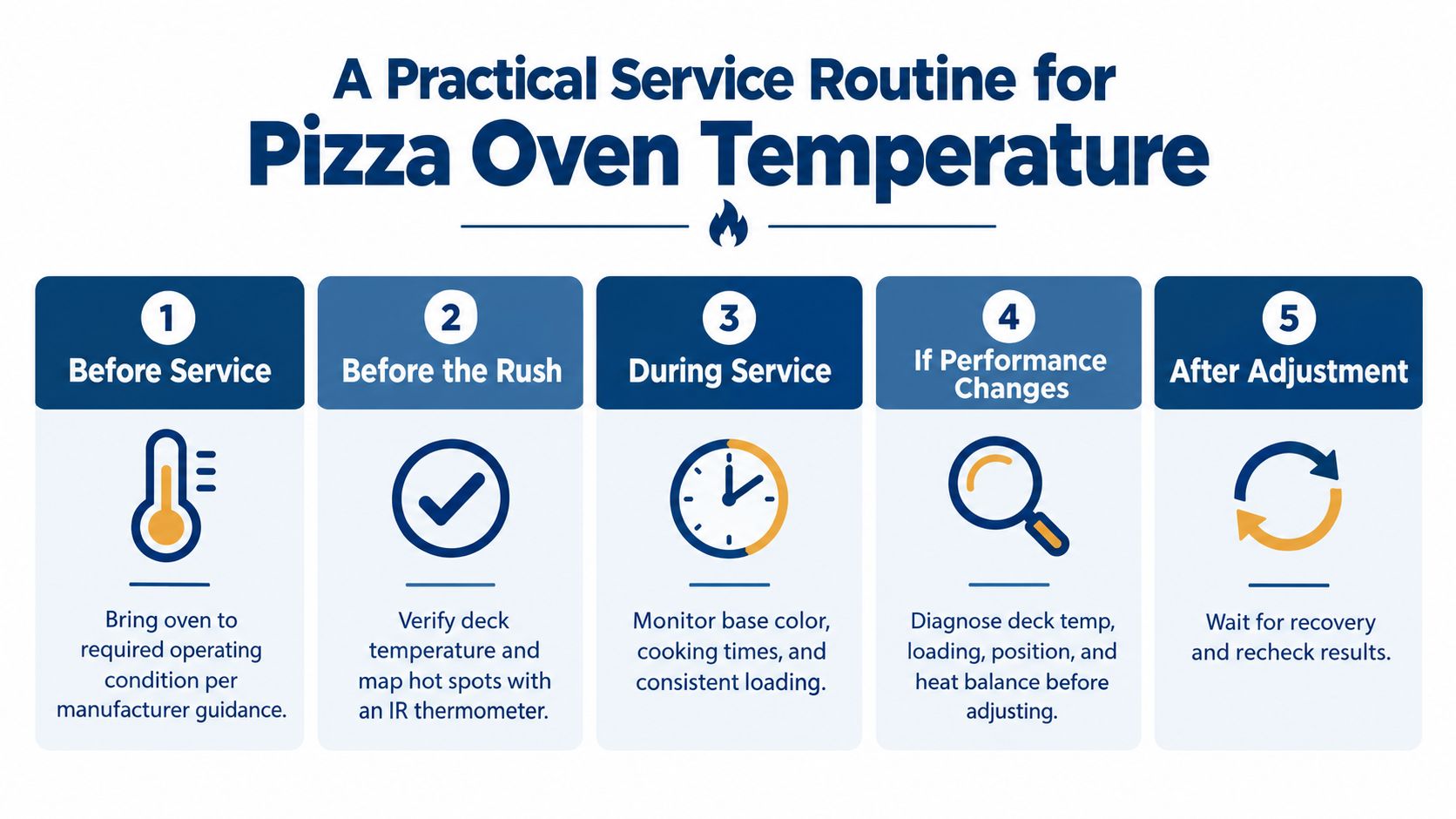
During the rush
Cooking time and finished-product consistency usually reveal performance changes sooner than the display. Watch base colour, centre doneness, crust development and whether pizzas placed in the same position continue to cook alike.
If results change, investigate before making a large control adjustment:
- Check the deck or floor condition.
- Review the loading rate and the number of pizzas entering together.
- Confirm whether staff have changed pizza positions.
- Compare top heat with bottom heat.
- Review dough, toppings, pan use and other product variables.
- Assess whether recovery capacity matches the current production rate.
After an adjustment, observe several consistent pizzas before changing another variable. If the oven cannot keep up at peak, the issue becomes throughput rather than settings. The analysis of whether a faster pizza oven can increase your restaurant's revenue provides a useful way to assess that capacity decision.
The commercial pizza equipment options available from Simply Hospitality span deck, conveyor and wood-fired formats. Match the routine to the selected equipment, including its heating system, cooking surface and loading pattern, rather than copying a process from another kitchen.
Why You Should Not Chase the Thermostat
When pizzas start cooking slowly, the instinctive response is often to raise the set temperature. That may change the chamber reading, but it won't necessarily restore energy to a depleted deck immediately.
Repeatedly increasing and decreasing controls in response to individual pizzas can create a moving target. One pizza may be loaded while the oven is recovering from the previous adjustment, then the next may encounter a different balance of floor and top heat.
Diagnose before adjusting. A slower pizza is a symptom, not a complete diagnosis.
The investigation should follow a deliberate order:
- Deck temperature: Is the cooking surface cooler than expected, or has one area become hotter?
- Loading rate: Are more pizzas arriving, or are they being loaded closer together?
- Pizza position: Has the team moved pizzas into a different part of the chamber?
- Top and bottom heat: Is the upper heat finishing before the floor, or vice versa?
- Dough and product variables: Have thickness, hydration, toppings, pan use or loading conditions changed?
- Recovery capability: Can the oven restore useful heat at the current production rate?
High heat also needs to suit the product. NZ guidance identifies Neapolitan-style pizza at about 430°C to 500°C, with cooking in under two minutes, while thicker bases and deep-dish pizzas suit approximately 300°C to 380°C. A higher set temperature isn't a correction if it pushes the product outside its intended cooking process.
A base can cook too fast for the wrong reason
Suppose a pizza base suddenly browns faster while the top remains underdone. Blaming the dough immediately may send the kitchen in the wrong direction.
The operator should check whether the cooking surface has become hotter than normal, whether the pizza was placed over a hotter section, whether the pan or deck interface changed, or whether the top-to-bottom heat balance shifted. One variable should change at a time, followed by observation across consistent pizzas.
This approach also protects against over-correction. A thermostat adjustment might reduce one hot spot while creating a slower zone elsewhere. Staff need a stable process that explains the result, not a sequence of hurried reactions.
Troubleshooting Temperature-Related Problems
Temperature problems rarely have one guaranteed cause. Dough condition, loading technique, pizza position, pan choice, topping quantity and oven recovery can produce similar symptoms.
The following framework helps staff investigate without treating each symptom as proof of insufficient recovery.
Temperature Troubleshooting Framework
| Symptom | Factors to investigate |
|---|---|
| Base burns before top is ready | Floor heat, pizza position, dough, and top-to-bottom heat balance |
| Top cooks before base | Floor temperature, pan or deck interface, and heat balance |
| First pizzas are good, later pizzas become pale | Loading rate, deck recovery, and production capacity |
| Cooking time gradually increases | Heat recovery, loading pattern, and current oven conditions |
| Results vary across the oven | Temperature distribution, loading position, and fire or heat management |
A suitable digital thermometer for commercial kitchen checks can support investigation, but a probe thermometer isn't a direct substitute for measuring deck temperature. The instrument needs to suit the measurement range and surface, and staff should follow the instructions for distance, surface characteristics and use.
Check the interface as well as the oven
The oven isn't the only factor controlling heat transfer. Direct-on-deck cooking and pan cooking create different conditions between the heat source and the dough. A change of pan can alter base browning even when the oven setting stays identical, which is why the pizza oven pan guide belongs in the same operational discussion.
The reference guide on pizza oven temperature in Celsius is useful for selecting a starting range by pizza style. This article's operational question is different: whether the chosen condition remains stable through service.
Capacity can be the real problem
If an oven repeatedly reaches the required condition before opening but can't maintain productive deck performance at peak demand, the problem may be capacity rather than the temperature setting. The purchasing calculation should consider:
- Required pizzas during the peak period
- Cooking time for the menu
- Simultaneous oven capacity
- Loading frequency
- Required heat recovery
That assessment also belongs in broader planning around what waiting costs during peak service. A larger or differently configured oven may be more appropriate than asking a smaller unit to recover beyond its practical operating pattern.
Food safety remains separate from pizza-baking performance. MPI guidance says cooked food should reach 75°C, hot food should be kept above 60°C until served, and food between 5°C and 60°C sits in the danger zone. Operators should manage toppings, finished food and holding processes against those requirements rather than assuming a hot oven alone controls every food-safety risk.
Hospitality helps hospitality businesses assess commercial pizza ovens, cooking equipment, pans, thermometers and related kitchen requirements against their menu and service pattern. Visit Simply Hospitality to discuss equipment selection, operating conditions and a practical solution for maintaining consistent pizza oven temperature through service.