

Quality Assurance Procedures for Hospitality Venues
A returned dish, a complaint about portion size, or a refrigerator found outside its expected range at opening time can all point to the same weakness: quality has been checked too late. Quality assurance procedures in hospitality work best when they prevent failures across purchasing, preparation, equipment, service and training, rather than relying on someone to catch every mistake at the pass. For New Zealand restaurants, cafés, hotels, caterers and commercial kitchens, the practical objective is simple: create repeatable systems that produce safe, consistent and suitable results on both a quiet shift and a packed service.
Why Quality Assurance Procedures Matter in Hospitality
The strongest venues aren't necessarily those with the most paperwork. They're the ones where staff know what good looks like, equipment supports the required process, and problems are reported before customers discover them. A supplier specification, a labelled container, a calibrated thermometer, a clear handover and a short pre-service check can matter more than a large manual that nobody uses.
Quality assurance is therefore a preventative operating system. It connects the decisions made when products are purchased with what happens when ingredients arrive, how food is stored, how staff prepare and cook it, how dishes reach the customer and how the venue learns from errors.
Many successful operators share this focus on repeatability, ownership and practical routines. Their approach is reflected in observations about what successful hospitality operators have in common, particularly the discipline of making good practice easy to repeat.
Where QA creates value
A useful procedure should answer four questions:
- What should happen? Define the required result.
- Who is responsible? Assign the task to a role or shift.
- How is it checked? Choose a realistic observation, measurement or record.
- What happens when it fails? Set out the immediate correction and escalation point.
This structure applies to food safety, but also to service timing, glassware presentation, refrigeration, cleaning, stock rotation and staff training. It helps managers distinguish a one-off mistake from a process that regularly creates mistakes.
Practical rule: If a problem keeps returning, the answer usually isn't another reminder. The process, equipment, training or responsibility needs review.
Quality assurance doesn't eliminate judgement. It gives staff a reliable baseline so they can make better decisions under pressure. The following procedures show how to build that baseline without turning a working kitchen into a paperwork exercise.
QA, QC and Food Safety Compliance Explained
A busy service exposes the difference between three connected disciplines. Quality assurance designs the process, quality control checks the result, and food safety compliance confirms that the venue is meeting its legal obligations.
| Term | Main purpose | Hospitality example |
|---|---|---|
| Quality assurance | Prevent inconsistent results through reliable processes | A recipe specification, preparation SOP and staff training |
| Quality control | Find a product or service problem before it reaches the customer | A tasting, plating check or review of a completed order |
| Food safety compliance | Meet applicable legal food safety obligations | Operating under a Food Control Plan and keeping required records |
A recipe specification is QA because it sets the method before cooking starts. A chef tasting sauce at the pass is QC because the finished product is being assessed. A temperature record required by an approved food safety system supports compliance, while also giving the team information about process performance.
New Zealand's food safety system uses documented food control plans or national programmes, with independent verification rather than relying only on a business's own records, as set out by New Zealand's Ministry for Primary Industries. Operators can also use Simply Hospitality's practical overview of food safety regulations in New Zealand for regulatory context.
Why the distinction matters
A dish can be legally safe and still miss the venue's quality standard. The cooking may be correct, yet portions vary, plating is careless or the wait is too long. The reverse also happens. An attractive dish may be unsafe because staff skipped allergen controls or temperature checks.
The distinction shows where corrective work belongs:
- QA lowers the likelihood of failure by improving the process.
- QC identifies defects that have already appeared.
- Compliance provides evidence that legal requirements are being met.
A reliable operation connects all three. The loop may start with a procedure, continue through staff training and equipment checks, then finish with a pass check and a recorded correction. That information should feed back into the procedure when the same fault returns.
Final checks alone put too much pressure on the pass. Compliance records alone do not confirm consistent presentation, service or equipment performance. Treating QA as a cross-functional system gives managers a clearer response: fix the method, maintain the equipment, retrain the team or correct the immediate result.
Setting Clear Quality Standards for Your Venue
“Maintain high standards” sounds reasonable, but it doesn't tell a cook how much sauce belongs on a plate or a cleaner what acceptable glassware looks like. Standards need to be specific enough that different staff can produce a similar result without asking a supervisor every time.
A venue's quality standards should cover the details that shape both safety and customer experience:
- Recipes and portions: Ingredients, weights, yields, substitutions and serving size.
- Presentation: Plate choice, garnish, arrangement, temperature at service and photographs where useful.
- Cooking consistency: Required methods, visual cues, texture and approved holding approach.
- Service expectations: The sequence for greeting, order confirmation, dietary communication and issue escalation.
- Cleaning: What must be cleaned, with which product, by whom and to what visible standard.
- Equipment operation: Start-up, shut-down, cleaning, calibration and fault-reporting steps.
- Customer care: Communication style, complaint ownership and handover expectations.
Build SOPs for the actual shift
A practical SOP might fit on one page. For a signature dish, it could show the ingredients, weights, preparation sequence, cooking instructions, plating photograph and the checks required before service. A separate short procedure could explain how to label prepared components, where they are stored and what to do when a batch doesn't meet the standard.
The value comes from usability, not length. A process that takes too long to read during service won't be followed consistently, even if it looks impressive during an office review.
Useful standard: Write the procedure so a trained staff member can follow it with one hand while working, then test it during a real busy shift.
Operators should involve the people who will use each SOP. Cooks can identify an impractical preparation step, front-of-house staff can flag an unclear handover and cleaners can explain where a chemical instruction doesn't match the actual workflow. The final document should reflect the venue as it operates, not an idealised version of it.
Food Quality Assurance Procedures From Supplier to Service
A menu item can fail long before it reaches the customer. Consider a chilled ingredient arriving with damaged packaging or inconsistent condition. If the receiving team accepts it without recording the issue, preparation staff may compensate with extra trimming, the portion cost may change, the kitchen may run short and the final dish may be delayed or altered during service.
The most useful quality assurance procedures follow the complete journey:
Supplier and receiving
Agree product specifications before ordering. These may cover grade, size, pack format, ripeness, approved substitutions and delivery condition. At receiving, staff should compare the delivery with the order, inspect packaging and product condition, check relevant temperatures and record rejected or questionable items.
Storage and preparation
Label stock clearly, rotate it consistently and separate ingredients according to the venue's food safety system. Before preparation, staff should check condition rather than assuming an accepted delivery remains suitable. A damaged container, wilted produce or unexpected substitution can affect taste, yield and presentation even when the item is still safe to use.
Cooking, holding and service
Recipe controls should cover batch size, portioning, cooking method, holding method and presentation. A final check can confirm the correct component, garnish, plate, dietary instruction and order before dispatch, but it shouldn't be the first point at which quality is considered.
Cooling also requires a defined process. MPI specifies that food must cool from 60°C to 21°C within two hours, then from 21°C to 5°C or below within a further four hours, with shallow containers, smaller portions, cooling racks or an ice bath among the practical controls described in the prescribed cooling procedure.
Operators can use cold-chain management guidance to connect receiving, storage, monitoring and corrective action. The key distinction remains important: a venue's portion, flavour and presentation standards are internal quality expectations, while temperature and handling controls may also form part of mandatory food safety requirements.
Food Safety and Hygiene Assurance Under NZ Rules
Quality assurance supports compliance with the Food Act 2014, but the business still needs the legal food safety system that applies to its activities. Depending on the venue's operations and risk profile, this may be a Food Control Plan or an applicable National Programme, with procedures and verification requirements set by New Zealand's framework and current MPI guidance.
A practical system must make the right response clear during a busy service. It should cover:
- Temperature control: Use a suitable, calibrated thermometer and record checks where the applicable plan or procedure requires them.
- Cross-contamination prevention: Separate raw and ready-to-eat work, control utensils and organise storage deliberately.
- Allergen management: Identify ingredients, communicate changes and prevent avoidable contact.
- Cleaning and sanitising: Specify products, contact instructions, surfaces, responsibilities and completion checks.
- Staff hygiene: Set expectations for handwashing, illness reporting and protective practices.
- Corrective actions: State when food is reheated, cooled, held, discarded, equipment isolated or a supervisor called.
- Records: Keep evidence required by the relevant plan, programme and verification process.
These controls also connect with training, equipment reliability and customer experience. A missed handwashing step can create a safety risk, while unclear allergen communication can damage trust even when the rest of the service runs smoothly.
MPI requires food held in the 5°C to 60°C danger zone for up to four hours to be reheated above 75°C before service. A documented temperature check gives staff a practical basis for deciding whether food can be retained, reheated, cooled or discarded, according to MPI food-control guidance.
What useful records look like
| Area | Record or evidence |
|---|---|
| Receiving | Delivery condition, exceptions and rejected items |
| Refrigeration | Temperature checks and action taken when results are outside the procedure |
| Cooling and reheating | Time and temperature results |
| Cleaning | Completed schedule and missed-task follow-up |
| Training | Induction, competency checks and refresher conversations |
| Incidents | Complaint, allergen concern, equipment failure or corrective action |
A formal HACCP plan or certification is not universally required for every New Zealand hospitality business. Operators should identify the system that applies to their activity, then build workable controls around it. Simply Hospitality's NZ Food Act 2014 compliance guidance and material on HACCP plans for commercial kitchens can help frame that decision, while keeping certification separate from the daily checks that make assurance work.
Equipment and Maintenance Quality Assurance
Equipment is part of the procedure, not a separate purchasing decision. A perfectly written temperature-control process won't protect stock if a refrigerator operates outside its required range, and a careful recipe won't produce consistent food if an oven has uneven heat or a damaged probe.
Common failure patterns include:
- Refrigeration drift: A refrigerator may appear cold while product temperatures become unreliable. Staff need a defined response, not just a note that the unit “feels warm”.
- Uneven cooking: An oven can produce different results across trays or shifts when settings, loading and maintenance aren't controlled.
- Poor wash results: A dishwasher leaving residue on glassware can create rework, presentation problems and customer complaints.
- Insufficient ice: An ice machine that can't meet peak demand changes beverage service and may force rushed substitutions.
- Prep inconsistency: Worn blades, incorrect settings or poorly maintained food preparation equipment can alter cut size, texture and yield.
Ranges such as SKOPE and Atosa can support refrigeration planning, while Unox and Convotherm offer cooking equipment with programmable operation on suitable models. Winterhalter and Classeq are relevant warewashing options. Brand selection still isn't a substitute for commissioning, correct installation, calibration, cleaning, staff training and preventive maintenance.
Make maintenance visible
A reliable equipment procedure should identify the daily user checks, the scheduled maintenance responsibility, the fault escalation point and the decision about whether the unit can continue operating. Staff should know what to do when a refrigerator alarms, a dishwasher leaves residue or an oven produces an unexpected result during service.
WorkSafe recorded 37,581 work-related injuries resulting in more than a week away from work from September 2024 to August 2025, alongside 49 fatalities in the same period, in national data that isn't hospitality-specific but reinforces why task and equipment controls belong in a wider assurance system, as reported in WorkSafe's industry risk guidance.
The commercial refrigeration maintenance guidance provides a useful operational reference. The same principle applies across the kitchen: equipment should be cleaned, checked and serviced before a failure becomes a food safety, worker safety or service problem.
Service Quality and the Customer Experience
A venue can produce safe food and still deliver a poor experience. A drink may arrive after the meal, a dietary requirement may not be communicated between the floor and kitchen, or a clean table may remain uncleared while staff focus on another section. These are quality failures because the customer receives an inconsistent service, even if no legal food safety rule has been broken.
Service assurance starts by defining the moments that matter for that particular venue:
- Order accuracy: Confirm modifications, quantities, table numbers and dietary information before sending the order.
- Communication: Set a clear handover method between front of house, bar, kitchen and management.
- Presentation: Check plates, drinks, cutlery, glassware and packaging before they reach the customer.
- Flow: Identify who monitors delays and who communicates with customers when the expected sequence changes.
- Table readiness: Assign responsibility for clearing, resetting and checking visible cleanliness.
- Complaint ownership: Give staff a clear first response and escalation route instead of making customers repeat the problem.
- Shift consistency: Use the same core expectations across weekday, weekend, lunch, dinner and event service.
Procedures that survive pressure
A useful service checklist is short enough to use before opening and specific enough to prevent ambiguity. It might include confirmation that reservations or event details are understood, dietary communication is active, menus and service areas are ready, glassware is clean, and staff know who handles escalations.
The checklist shouldn't turn people into robots. It should remove avoidable decisions so staff can concentrate on hospitality. Each task needs an owner, a sensible point in the shift and a way to report completion or a problem.
Waiting times are especially sensitive to local context. A café, hotel breakfast operation, tasting-menu restaurant and event caterer won't use identical service targets. The practical standard is the one the venue can define, communicate and deliver consistently, with a process for explaining genuine delays.
Training is the connection point
Procedures only work when employees understand them and can perform them in real conditions. Training should be role-specific and demonstrated, not limited to handing over a folder or asking someone to sign that they read an SOP.
A practical training loop includes:
- Induction: Explain the venue's quality, safety and service expectations.
- Demonstration: Show the correct process at the workstation or service point.
- Supported practice: Let the staff member perform the task while a supervisor observes.
- Shift handover: Pass on equipment issues, stock concerns, bookings, complaints and unfinished corrective actions.
- Supervisor checks: Observe a small number of important controls during service.
- Refresher coaching: Revisit procedures after an error, menu change, equipment change or recurring complaint.
- Easy reporting: Make it safe and simple to raise a problem before it reaches a customer.
A simple, well-understood procedure often beats an extensive manual nobody opens. Staff should be able to find the relevant instruction where the work happens, whether that is beside a preparation bench, near a dishwasher, at the pass or in the service station.
MPI's verification model also makes consistent daily practice relevant to oversight. Verification frequency in New Zealand is performance-based, ranging from once every 18 months for strong performers to once every three months for weaker systems, while new businesses using a template Food Control Plan need an initial verifier visit within six weeks of registration, according to MPI's template Food Control Plan guidance.
This isn't a reason to train staff to pass an inspection. It's a reason to build a workplace where people can report a failed check, explain what happened and help improve the process without fear of blame. Operators should involve staff when SOPs are refined, because the people working the busiest shifts often know exactly where a procedure breaks down.
Monitoring Audits and Continuous Improvement
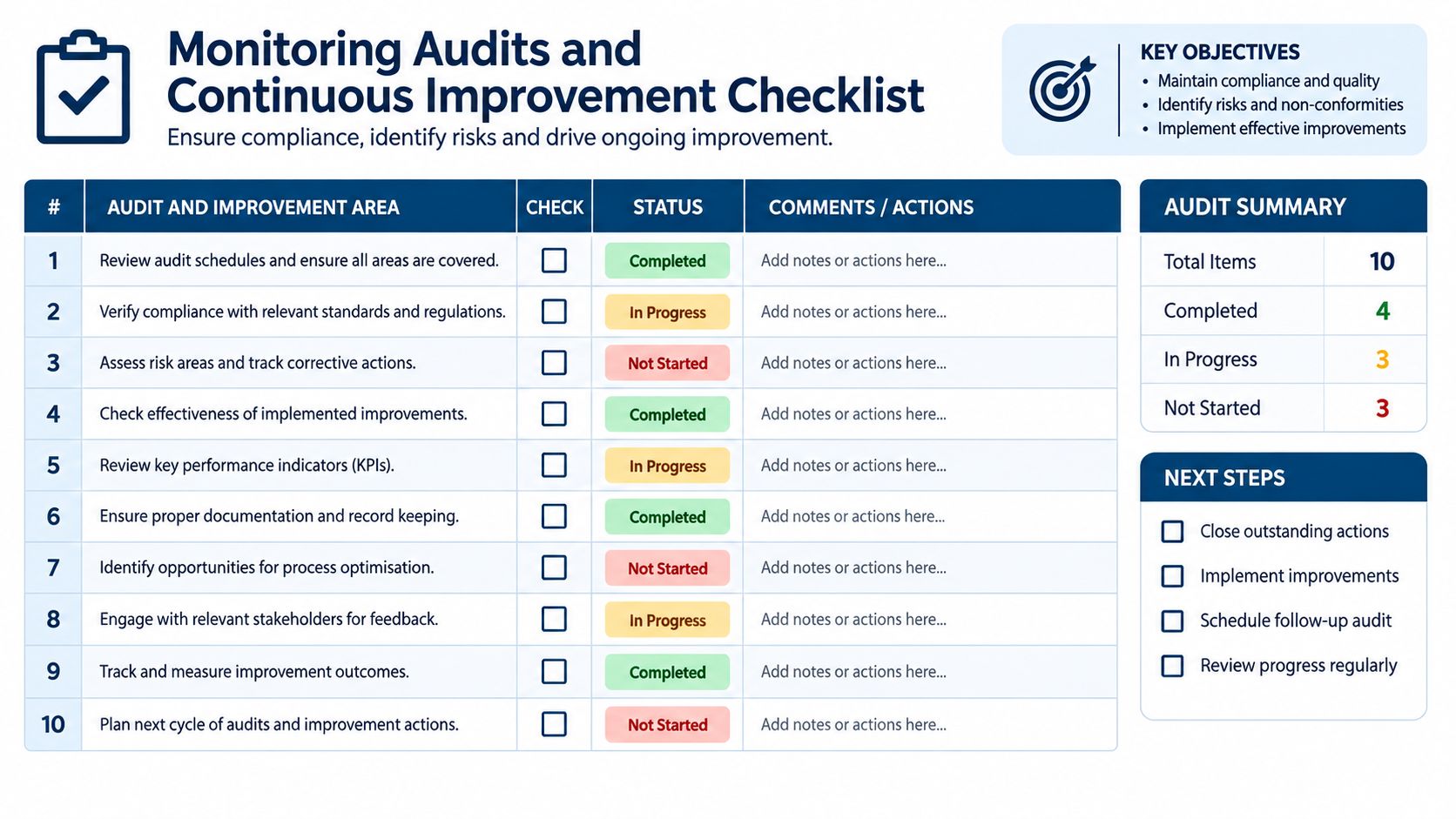
A quality system needs evidence that it works. That evidence doesn't have to mean a large dashboard. For many venues, a small set of useful indicators gives a clearer picture than recording every activity without reviewing the result.
Relevant measures can include:
- Customer complaints and feedback: Look for repeated themes, not just isolated comments.
- Order errors: Record where mistakes occur, such as taking, entering, preparing or delivering the order.
- Food waste: Identify whether waste comes from purchasing, storage, preparation, overproduction or rejected quality.
- Rewashed dishes: Check whether the cause is loading, chemical dosing, water conditions, equipment condition or rushed inspection.
- Equipment downtime: Record the fault, operational effect, temporary control and final repair.
- Temperature exceptions: Review whether the cause was equipment, process, staffing or recording.
- Cleaning non-conformances: Identify missed areas and whether the schedule or responsibility is realistic.
- Service delays: Trace the delay back to ordering, preparation, communication, equipment or staffing.
Use a simple improvement loop
The operating cycle is straightforward:
Set a standard → monitor performance → identify problems → correct the cause → review results.
If customers repeatedly report that a dish arrives lukewarm, a final plate check may identify the symptom. A broader review could find that the pass is overloaded, plates aren't warmed as intended, holding instructions are unclear or a service handover is missing. Correcting the cause is more valuable than asking staff to “be quicker”.
Routine internal quality checks are different from formal food safety verification. MPI describes independent verification as part of New Zealand's food safety system, while a venue's own checks help managers control daily performance. Hospitality doesn't provide formal QA audits or food safety certification, so operators should use an appropriately recognised verifier or adviser when formal services are required.
For multi-site businesses, MPI's minimum sampling proportions are 33% for National Programmes 2 or 3, 50% for template Food Control Plans and 66% for custom Food Control Plans, as explained in MPI's multi-site verification guidance. Consistent records across locations help management identify whether an issue is isolated or systemic.
Teams that need help turning recurring issues into practical workflows may also benefit from streamlining business workflows with experts. The emphasis should remain on clear ownership and workable changes, not on adding administration for its own sake.
Useful equipment and hygiene resources can support the loop. Operators may refer to a commercial cleaning supplies checklist, digital cooking thermometer guidance, advice on reducing kitchen downtime, and guidance on which commercial kitchen equipment saves the most labour. For ongoing refrigeration checks, commercial refrigeration monitoring systems can be considered where alerts and documented escalation suit the venue's operation.
A practical QA checklist
| Operational area | Quality standard | How to check | Corrective action |
|---|---|---|---|
| Deliveries and ingredients | Products match specification and arrive in suitable condition | Receiving inspection against the order | Reject, quarantine or report the item and review the supplier issue |
| Refrigeration and storage | Stock is organised, labelled and maintained under the applicable control | Review labels, storage condition and temperature records | Move affected stock, investigate the cause and escalate when required |
| Food preparation | Recipes, portions, hygiene controls and allergen instructions are followed | Observe preparation and review the relevant records | Stop, correct, retrain or discard where suitability is uncertain |
| Cooking and presentation | Food meets the recipe, cooking and plating standard | Supervisor or pass check | Hold, remake, adjust the process or review the recipe |
| Cleaning and warewashing | Surfaces, utensils and serviceware meet the venue standard | Opening, during-shift and closing checks | Reclean, check the equipment or revise the cleaning method |
| Equipment condition | Equipment operates reliably and faults are reported | Pre-start observation and maintenance record | Isolate unsafe equipment, use an approved contingency and arrange service |
| Customer service | Orders, dietary requirements, communication and presentation are handled consistently | Shift observation and complaint review | Resolve the customer issue, record the cause and coach the relevant team |
| Staff training | Staff can demonstrate the procedures relevant to their role | Induction record and observed competency | Provide supported practice, update the SOP or schedule refresher training |
Responsibility should sit with named roles rather than “the team”. Checking frequency should reflect the venue's operation, the risk of failure, equipment requirements and applicable food safety procedures. The system should start with the most frequent or costly problems, document a clear response, train staff and improve gradually as evidence shows where the next weakness lies.
Hospitality supplies commercial refrigeration, cooking equipment, warewashing systems, food preparation equipment, cleaning products and hospitality operating supplies that can support a venue's quality assurance procedures. Operators can visit Simply Hospitality for practical product guidance and help selecting equipment that suits their workflow, capacity, maintenance approach and food safety responsibilities.