

Stackable Storage Containers That Actually Save Space
The most common mistake with stackable storage containers is treating “stackable” as the feature that matters. In a busy kitchen, that usually leads to a shelf full of shapes that sit neatly on top of one another, but still waste space, hide labels, and slow staff down at exactly the wrong time.
The better approach is a standardised storage system. In practice, that means standardised footprints + compatible depths + appropriate lids + logical labelling + defined storage positions = an effective commercial storage system. Once that is in place, stackable containers stop being loose accessories and start doing operational work, from dry store to cool room to service pass.
Why Stackable Does Not Automatically Mean Space Saving
A container can stack well and still be a poor fit for the kitchen. That happens when the footprint is wrong for the shelf, the lid takes up more room than expected, or the container shape forces staff to rearrange everything just to reach one item. A kitchen filled with unrelated “stackable” containers often looks tidier than it is.
The true test is whether the containers support the way the operation moves food. That means thinking about where ingredients live, who touches them, how often they are accessed, and whether staff can still read labels and rotate stock without rebuilding the shelf every shift. A storage system that looks efficient during procurement can become clumsy on a prep line.
Practical rule: buy containers as part of a layout, not as isolated items.
That same logic applies outside hospitality too. A good general overview of container use for storing and moving goods is the storage container for renovations article from MG Self Storage, which is useful as a reminder that storage works best when the container and the storage location are planned together.
In our experience, operators get the cleanest result when they start with the shelving, refrigeration, and prep spaces already in the venue. After that, the container range can be standardised around those fixed points. That's very different from buying a mix of tubs first and hoping they'll somehow organise the room later.
One simple way to judge the setup is to ask whether staff can find, lift, return, and relabel items without disrupting the whole stack. If the answer is no, the containers are stacking, but the system isn't.
Understanding Gastronorm Sizing for Commercial Kitchens
Gastronorm, or GN, is the clearest example of why standardisation matters. A GN 1/1 container is the full reference size, and smaller formats such as GN 1/2, GN 1/3, GN 1/4, and GN 1/6 are designed to relate back to that same modular footprint. That's useful because compatible combinations can share the same bench space, shelf runs, or refrigeration bays without staff having to improvise around random container widths.
The value of GN sizing is not just that the containers are standard. It's that the same dimensional logic can flow through storage, prep benches, and refrigeration, which is why it shows up so often in commercial kitchens. A bench, a fridge, and a prep station can all be planned around the same family of footprints, so product handling stays consistent instead of fragmented.
A practical example is the Chef Inox Gastronorm Pan 1/1 65 mm, which sits within that standard GN logic and helps operators think in compatible modules rather than one-off tubs. That said, GN does not mean every GN container fits every appliance automatically. Depth, rim design, and the equipment specification still need checking.
The same caution applies to commercial refrigeration. The SKOPE ActiveCore 3 Door Storage Freezer - Stainless - SKFT1500NS-A is a good example of why the cabinet specification matters as much as the container format. It uses a removable refrigeration platform, has solid swing doors, and comes with shelving sized at 502 mm wide by 467 mm deep on the sides and 571 mm wide by 467 mm deep in the middle, so the usable space still needs to be matched to the storage format chosen.
GN works because the whole kitchen speaks the same sizing language, not because every container is universally interchangeable.
For operators weighing up deeper planning, the logic is similar to the Cube Storage Boxes concept, where one standard size makes stacking and packing simpler. In hospitality, the difference is that GN has to work in a wet, fast-moving, food-safe environment, so fit and handling matter just as much as stacking.
Container Footprint Versus Depth and How to Choose Both
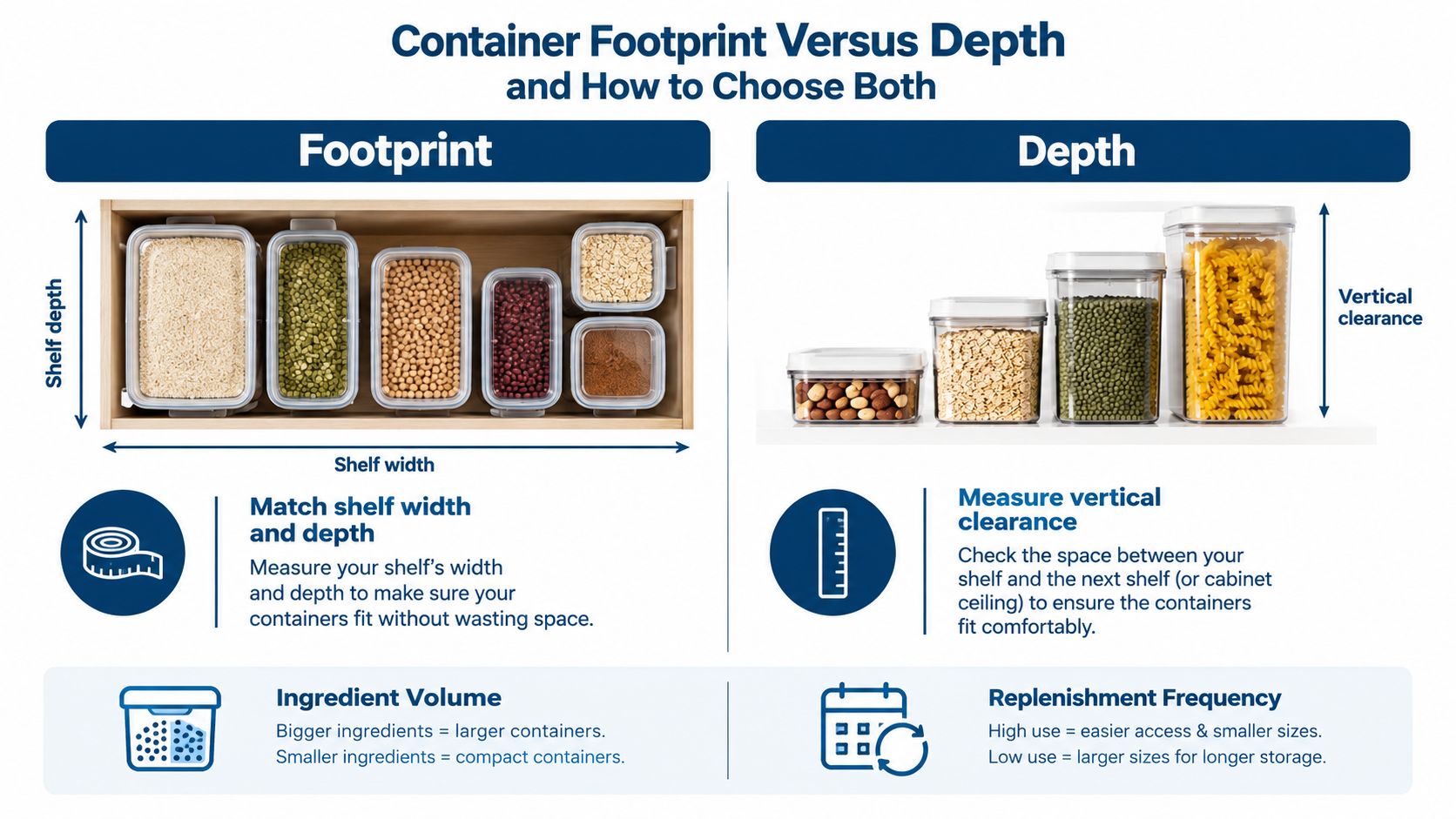
The easiest mistake to make is to focus only on how much a container holds. In a working kitchen, the better question is how the container fits in three dimensions, shelf width × shelf depth × usable vertical clearance. That's what determines whether a system feels organised or awkward.
A container that is too deep for the ingredient volume can create dead space inside the tub and wasted space above it. It can also make the product harder to reach, especially once several containers are stacked or shelved in front of each other. The container might look efficient from the outside, but the staff still end up lifting extra units to get to the one they need.
A better approach is to match the container to normal ingredient volume and replenishment frequency. High-turnover items can justify larger, deeper containers if the stock is used quickly and accessed often. Lower-volume ingredients usually work better in shallower formats that preserve visibility and keep the shelf easier to manage.
The same logic applies to refrigeration planning. A fridge can feel cramped when the containers are poorly chosen, even if the cabinet itself is adequate. That's why container layout should be assessed before blaming the unit. For a broader look at the fridge side of that equation, the related article on commercial fridge NZ is the natural companion reading.
A useful rule of thumb is to improve usable storage density first, then decide whether the refrigerator itself is undersized. Containers can make cold storage feel more orderly, but they can't create capacity that isn't there.
Operational takeaway: depth only helps when the staff can still see, reach, and rotate the product without turning storage into a digging exercise.
Building a Stackable System That Staff Can Actually Use
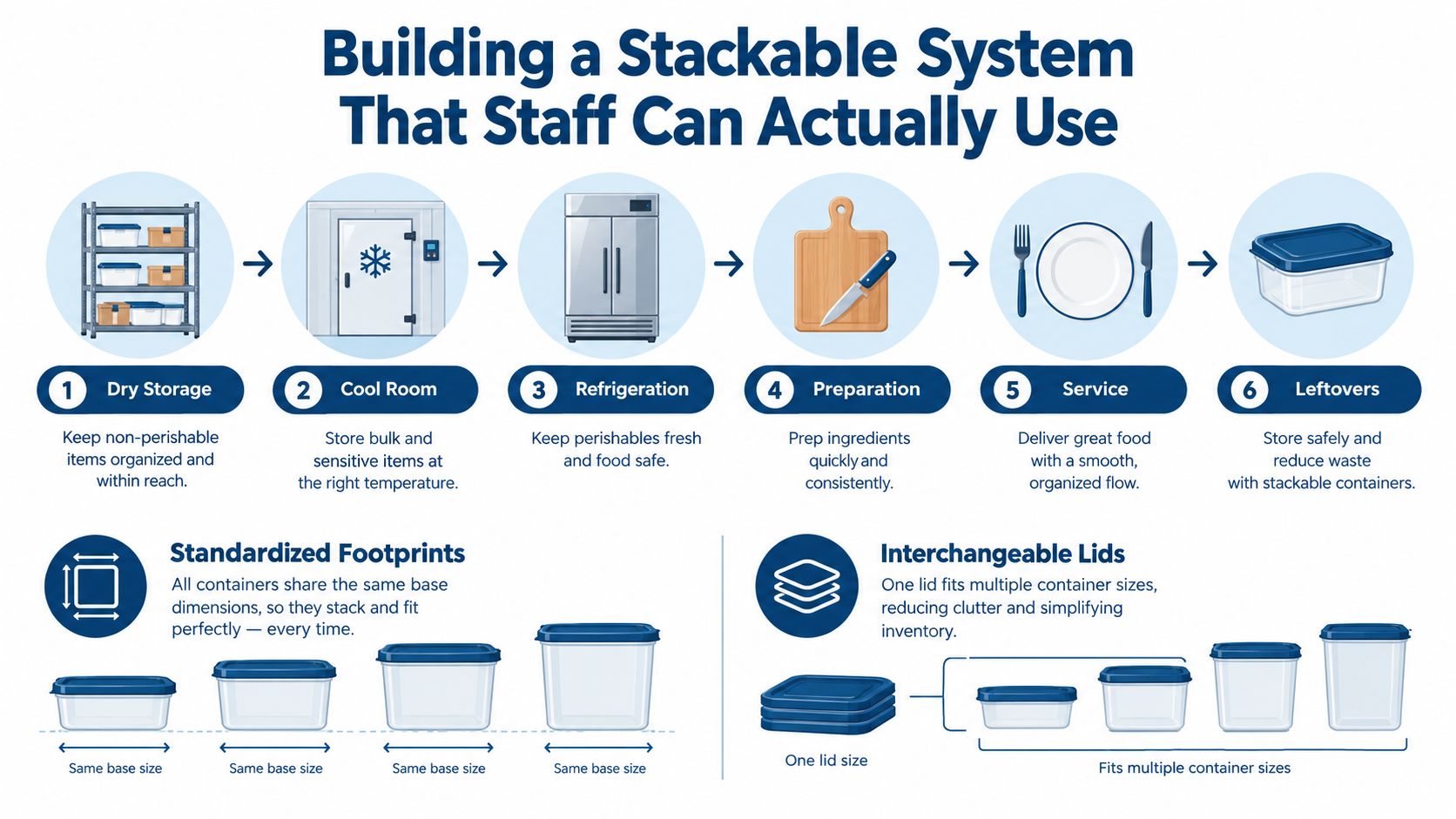
The strongest systems map the kitchen in the order staff move product. Dry storage feeds cool room, cool room feeds refrigeration, refrigeration feeds preparation, preparation feeds service, and service eventually produces leftovers or prepared product that needs its own home. When the storage plan follows that chain, containers stop crossing paths and the whole process becomes easier to keep clean.
A good setup standardises each range where practical, then keeps the lids and footprints consistent within that range. That's especially helpful in mixed operations like restaurants, cafés, hotels, bakeries, and production kitchens, where the same bench may need one type of tub for prep and another for holding mise en place. The goal is not to stack everything as high as possible. The goal is to make the right container easy to find and put back.
The stacking itself still needs common sense. Stable bases matter, weight distribution matters, and retrieval height matters. In New Zealand, operators also need to think about seismic restraint. WorkSafe points building operators to NZS 4104 for seismic restraint of building contents and NZS 1170.5 for earthquake actions, which means stackable systems in warehouses, kitchens, and back-of-house storage should be treated as part of a risk plan, not just as convenient shelving accessories.
For new staff, training matters as much as the hardware. A practical storage system should let people identify contents quickly, read labels without moving three other containers, rotate stock, and return each unit to a defined position. The more often staff have to reshuffle the shelf to access one item, the more labour the system burns.
Hospitality businesses often find that the most accessible arrangement is not the densest one. It's the one that leaves enough clearance for safe lifting, fast identification, and clean restocking. The how to train kitchen staff on new equipment article aligns well with that thinking, because storage systems work best when staff know exactly how they're meant to be used.
Stainless Steel Versus Food Grade Plastic for Hospitality Use
Material choice affects more than appearance. Stainless steel and food-grade plastic both have a place in commercial kitchens, but they solve different problems. The right answer depends on visibility, weight, temperature use, cleaning routines, lid options, and what the storage area requires of the container.
The stainless steel side of the argument is straightforward. It suits harder-wearing environments, handles demanding use well, and is usually the better fit when durability and temperature handling matter most. The trade-off is that it's heavier and you can't see the contents at a glance, so it often works best where the product is known, labelled, and rotated regularly.
Food-grade plastic does the opposite job well. It's lighter, easier to see through in many cases, and often simpler to move in and out of fridges, shelves, and prep stations. That makes it practical for fast-moving storage, provided the material, lid type, and cleaning method suit the job. Plastic can also be easier to standardise across a system when visibility is important.
The practical choice is rarely absolute. Many operators use stainless steel for some applications and food-grade plastic for others, then keep the whole range consistent enough that lids, labels, and storage positions still make sense together.
| Criteria | Stainless Steel | Food-Grade Plastic |
|---|---|---|
| Visibility | Low | Higher in many cases |
| Weight | Heavier | Lighter |
| Durability | Strong for hard use | Good, depending on grade and handling |
| Temperature use | Suits demanding environments | Depends on the product and application |
| Cleaning | Easy to clean properly | Also easy if non-porous and well maintained |
| Lid compatibility | Depends on the range | Depends on the range |
| Equipment fit | Good for specified commercial systems | Good when dimensions match the system |
For operators comparing container types directly, the Stainless Steel Containers article is a useful companion. That comparison becomes more helpful when it's tied back to the storage system, because a material that performs well in isolation can still be awkward if it breaks the footprint or lid standard your kitchen already relies on.
Labelling Stock Rotation Cleaning and the Real Efficiency Gain
Stacking only works when the labels still do their job. The label position needs to stay visible while the container is stored or stacked, otherwise staff start shifting stock around just to identify what's inside. That creates friction, and friction is where kitchens lose time.
The same principle applies to rotation and cleaning. New Zealand food-safety practice requires operators to follow their food control plan and current guidance for food identification, date marking where required, storage, and temperature control. Reusable containers also need to stay protected from contamination, and damaged containers should be removed from use so broken surfaces don't create a physical contamination risk.
The Food Hygiene Regulations 1974 are clear that reusable trays and containers must be stored and handled so they're protected from contamination and cleaned before and after every use. In practical terms, that means using non-porous, easy-wash containers, keeping clean and dirty units separate, and doing a wash-down and reinspection step before restacking.
A consistent label position helps with that process, and durable tags can make a real difference in messy environments. The InchBug durable container tags article is a useful reminder that labelling has to survive actual kitchen use, not just the first day of setup.
For operators looking at the broader operational side, the storage containers NZ article gives helpful local context on fitting storage to New Zealand conditions and workflows.
The efficiency gain is often not dramatic in a single retrieval. It becomes meaningful because the task repeats constantly. If better-organised storage saves 30 seconds per retrieval and ingredients or containers are retrieved 100 times per day, that's 50 minutes per day. Across 300 operating days, that's about 250 staff hours per year. That's an illustrative example, not a guarantee, and the value may show up as more productive labour capacity rather than a direct cash saving.
Procuring and Maintaining Your Stackable Storage System
The best purchase list starts with the shelves, fridge bays, prep benches, and storage positions already in the venue. After that, the container range can be standardised around those real dimensions instead of guessed around a catalogue photo. That's the point where footprint, depth, lid fit, and labelling all start working together.
A practical checklist keeps the system honest:
- Match the footprint to the actual shelf or cabinet: Measure the usable width, depth, and clearance before choosing the range.
- Confirm lid compatibility: Lids should suit the whole range where possible, otherwise the system becomes awkward fast.
- Keep labels visible: Decide where the label sits before the first container is filled.
- Check cleaning requirements: Choose containers that fit the sanitation routine and the food type.
- Think about access, not just density: If staff can't reach product cleanly, the layout needs adjusting.
- Review service and warranty needs: Containers are simple, but the wider storage system still benefits from long-term support thinking.
For operators also reviewing refrigeration and workflow more broadly, the related articles on How Much Revenue Can Better Kitchen Workflow Generate?, What Does Waiting Cost During Peak Service?, and Is Your Commercial Refrigerator Too Small for Your Business? are the right next reads, because storage only pays off when it improves the whole working path.
The central decision is simple. Buy containers that support a standardised storage system, not a mixed collection that just happens to stack. That's where the value sits, in easier retrieval, cleaner rotation, better visibility, and a layout staff can use every day.
If the right stackable system would make your kitchen easier to run, Simply Hospitality can help you compare container footprints, GN compatibility, refrigeration fit, and material options for your venue. Visit Simply Hospitality to talk through the storage setup that suits your operation.