

What Hospitality Operators Prioritise When Buying Refrigeration: Key Trade-Offs
The usual advice is simple and wrong in practice. Buying the cheapest cabinet that fits the gap, or the biggest one the budget allows, ignores how refrigeration earns its place during service. What hospitality operators prioritise when buying refrigeration is suitability under real conditions. Operators weigh temperature reliability, usable capacity, physical fit, energy use, access, cleaning, warranty support and long-term operating costs together, then rank those factors according to menu, volume, space and trading hours.
What Matters Most When Buying Commercial Refrigeration
No single factor settles a good refrigeration purchase. A café may rank compact dimensions and quick access first because milk, prepared fillings and display items compete for the same small footprint. A high-volume restaurant may put recovery after door opening and peak capacity ahead of appearance. The menu, production volume, available space and trading conditions change the order for every venue.
The table below doesn't claim to rank buyer priorities across New Zealand. It's a practical shortlist of common purchasing considerations and the checks that stop a neat specification from failing on a Saturday night.
| Purchasing priority | Why it matters | What operators should check |
|---|---|---|
| Reliability and temperature performance | Keeps chilled food at 5°C or below during service | Temperature range, recovery after door opening, alarms |
| Purchase price | Sets the upfront budget but not the full cost | Quotes that include delivery, installation and accessories |
| Storage capacity | Decides whether stock fits at peak trade | Usable shelf and drawer space, not gross volume |
| Physical dimensions | Must fit the space and the doorways | Measured install space, clearances and delivery access |
| Energy efficiency | Runs continuously, so draws power all day | Manufacturer energy data under stated test conditions |
| Accessibility and workflow | Affects prep and service speed | Position relative to prep stations and the pass |
| Cleaning and maintenance | Affects hygiene and downtime | Access to coils, drawers, door seals and filters |
| Warranty and service support | Limits the cost of a fault | Warranty terms, local parts and service response times |
| Long-term operating costs | Adds up across years of use | Running cost estimate over the expected service life |
In our experience working with hospitality businesses, the best starting point isn't a catalogue. Operators should name the three failures that would hurt most during a busy service, such as running out of chilled storage, slow access at the pass or a cabinet that can't recover after loading. Those three issues become the shortlist criteria before models, finishes and discounts enter the conversation.
Practical rule: Judge the cabinet by the busiest hour it'll face, not by how tidy it looks empty in a showroom.
Why Temperature Reliability Outranks Purchase Price
A low-cost fridge can become an expensive choice when it cannot hold safe temperatures through a busy service. A fault can turn into a food safety decision, a prep problem and a trading problem at once. Stock may need to be moved, checked or discarded while staff manage storage instead of service.
The Ministry for Primary Industries Food Control Plan requires cooked potentially hazardous food to be cooled from 60°C to 21°C within 2 hours, then from 21°C to 5°C within a further 4 hours. Once cooled, potentially hazardous ready-to-eat food must be stored at 5°C or below. Chilled food displayed for sale must also be held at no more than 5°C.
A cabinet may hold temperature when lightly loaded and still drift during service. Frequent door opening, warm product loading, high ambient temperatures near cooking equipment, blocked airflow and tightly packed shelves all test its performance. Overnight recovery after a full evening service matters too. A fridge that recovers slowly can leave stock exposed for longer than expected.
Equipment reliability is only part of the result
Reliability depends on the cabinet, its installation and daily use. Overfilling, poor ventilation beside an oven, blocked coils and using a storage fridge for rapid cooling can all undermine performance. Commissioning, probe checks, cleaning access and a clear response to alarms help staff catch problems before they disrupt service.
For frozen storage, the MPI Food Control Plan specifies -18°C or colder for frozen fish and fish products, while certain frozen products must be maintained at -12°C or colder during storage and loading. Check the requirement for the food being stored rather than assuming one freezer setting suits every product.
Before buying, check:
- Display: Staff need to read the cabinet temperature during service.
- Alarms and logging: High-temperature and power-failure alerts help staff respond to a fault.
- Test conditions: Confirm the ambient conditions and loading assumptions behind performance claims.
- Warranty and service: Check terms, exclusions, parts availability and service response, since each can affect downtime.
- Recovery: Ask how the model performs after door opening and warm loading.
The cost of a lower-priced cabinet can rise through discarded ingredients, disrupted preparation, emergency repairs and lost trading time. Hospitality's article on how poor refrigeration wastes staff time and disrupts cold chain management explores the labour cost. Brand reputation alone does not establish suitability. Check whether the exact model can maintain temperature in the venue's conditions and at its busiest load, with service support available if it fails.
Sizing Capacity Around Peak Trade, Not Average Stock
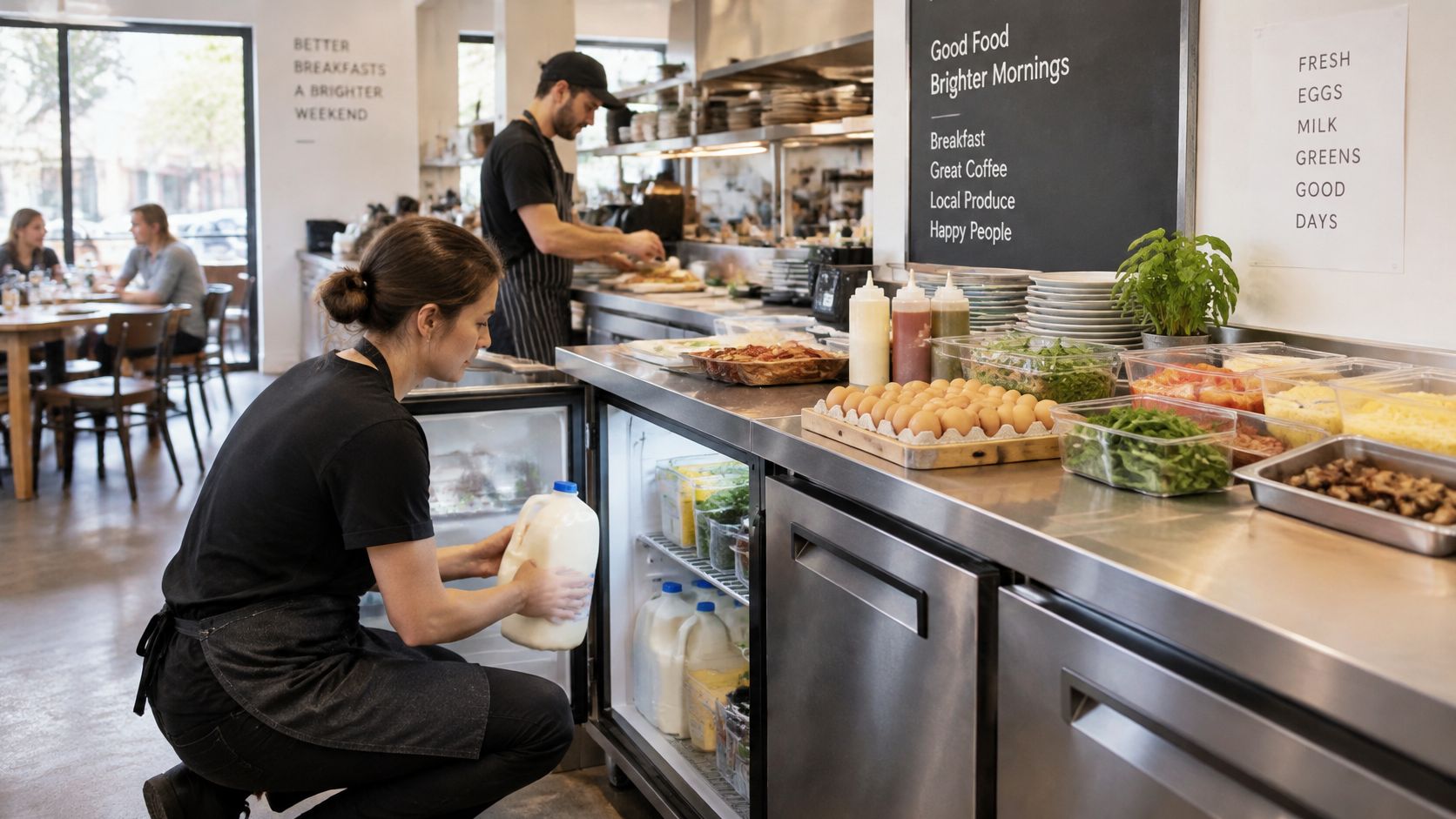
A 40-seat café may manage weekday service with one underbench unit for milk, eggs, sauces, salad ingredients and prepared fillings. Saturday breakfast changes the load: more milk arrives for the rush, demand for eggs and bacon increases, and brunch components need space. By 9am, tightly packed containers can make stock hard to find and prevent the door from closing properly. Sizing to an average weekday misses the pressure point.
Work backwards from the busiest realistic service. Account for daily ingredient needs, delivery frequency, weekend trade, seasonal demand, menu changes, bulk purchasing, stock rotation and shelf layout. Twice-weekly deliveries require less holding space than one large weekly delivery. A menu change can also make a cabinet that once worked awkward for the new containers and ingredients.
Gross capacity is not the same as usable capacity. Shelves, drawers, dividers, evaporator outlets, container shapes and space for airflow all affect what fits safely. MPI fridge storage guidance recommends maintaining fridges between 2°C and 5°C and warns that overfilling can restrict cold-air circulation. It also advises against putting hot food straight into a refrigerator, where it can raise the temperature of food already inside.
The cost of getting size wrong
An undersized cabinet leads to rushed packing, poor separation of raw and ready-to-eat food, restricted airflow and temperature drift. An oversized unit costs more upfront, takes floor space away from prep and can encourage over-ordering, leaving older stock at the back. More capacity is useful only if the kitchen can organise and rotate it well.
Sometimes the better fix is a second small unit near the station that runs short first, or a change to delivery frequency rather than one large replacement. For a practical way to assess whether your current unit is limiting storage, see how to tell if a commercial refrigerator is too small for your business.
List the items needed for peak service, count the containers they occupy, then allow for shelf supports and airflow. Compare that layout with the usable shelf dimensions in the model documentation before ordering. This check shows whether stock will fit in a workable arrangement, not just whether the cabinet's stated capacity looks sufficient.
Matching Refrigeration Type and Layout to Your Kitchen
Location can matter as much as litres. A slightly smaller unit at the station it feeds can save staff repeated trips across a hot kitchen, while a larger cabinet placed badly can slow every service. One consideration regularly discussed with customers is whether refrigeration holds bulk stock, supports prep, displays product or does a combination of those jobs.
| Refrigeration type | Main advantage | Common purchasing consideration |
|---|---|---|
| Upright refrigerator | Large storage in one footprint | Floor footprint, door swing and shelf configuration |
| Underbench refrigerator | Keeps ingredients at hand under the bench | Bench height, clearances and ventilation space |
| Refrigerated preparation counter | Cold ingredients at the point of prep | Top size, depth and position on the prep line |
| Drawer refrigeration | Quick, organised access that separates quantities | Number and size of drawers against daily use |
| Display refrigeration | Shows product to customers | Glass type, lighting, customer-side visibility and temperature control |
| Walk-in cold storage | Bulk storage and delivery holding | Floor area, installation requirements and service access |
Upright units suit centralised storage where staff can organise shelves by product group and delivery day. Underbench and drawer refrigeration keep frequently used ingredients at the cookline, although drawers need disciplined portioning so working quantities don't sprawl. Preparation counters put chilled ingredients directly into the workflow for sandwiches, pizza and salads. Display refrigeration has a different job again. Visibility, lighting and customer access matter alongside holding temperature.
Specialist self-service formats show the same layout principle. A Vendmoore Enterprises chill center is useful context for thinking about how chilled presentation and access differ from back-of-house storage, even though hospitality kitchens generally need equipment specified for food preparation and service conditions.
Measure the route, the swing and the service position
Operators should measure installation space, doorways, corridors, bench height and door swing before ordering. Tipping refrigeration as it enters the premises is not covered under warranty, so the delivery route matters as much as the final footprint. Hospitality advises checking the final electrical or gas supply, cut-out, ventilation and clearances against the model document before ordering cabinetry.
Staff movement is the test that catches poor layout early. During service, operators can mark the path from fridge to prep bench to pass, then check whether doors open into that path or force staff to queue behind one another. Cleaning access behind and under the unit also needs room, not guesswork. For wider layout planning, the restaurant kitchen layout ideas connect equipment placement with workflow.
Keep ingredients opened every few minutes near the station using them, and keep bulk backup stock centralised where it won't interrupt the line.
Weighing Purchase Price Against Running and Service Costs
A low purchase price can become expensive if a cabinet wastes energy, loses usable capacity or needs frequent servicing. Refrigeration runs day and night, including closed days when it protects stock. According to EECA's food and beverage service sector pathway, refrigeration accounted for 22% of energy consumed by the Accommodation and Food Services sector in 2022. Compare whole-of-life costs, not just the invoice.
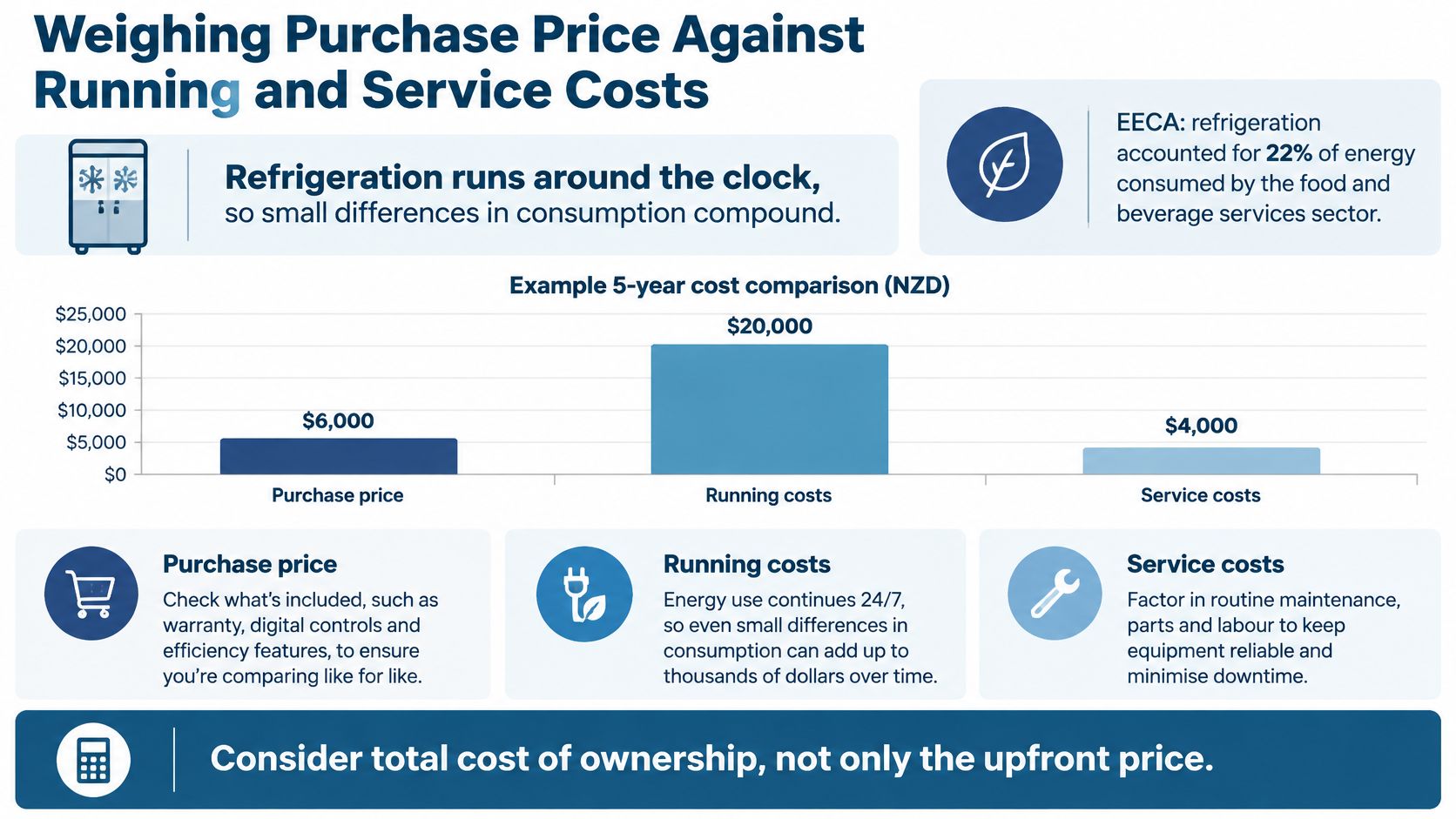
Running costs depend on cabinet size, insulation, door seals, compressor and fan efficiency, how often doors open, kitchen temperature, ventilation and maintenance. Poor seals or inadequate ventilation make a cabinet work harder. So does leaving a door open while searching for stock. Door-opening patterns also affect recovery time and can disrupt service; a convenient layout helps staff retrieve stock quickly and close doors promptly.
A transparent illustrative calculation
Suppose two refrigerators differ in consumption by 2 kWh per day, and electricity costs $0.30 per kWh. These are illustrative assumptions, not verified performance figures for any model.
| Period | Calculation | Illustrative cost difference |
|---|---|---|
| Daily | 2 kWh × $0.30 | $0.60 |
| Annual | $0.60 × 365 | Approximately $219 |
| Five years | $219 × 5 | Approximately $1,095 |
The calculation does not establish that a more expensive cabinet is worthwhile. Compare the estimated saving with the purchase-price gap, likely service costs, expected lifespan and the value of protecting stock from temperature problems. Check manufacturer energy data under stated test conditions, including cabinet volume, ambient assumptions and expected duty cycle. Confirm compliance with New Zealand's Minimum Energy Performance Standards (MEPS) where they apply to the cabinet type.
Price tiers need an operating context
Compare models on build quality, intended environment, temperature performance, energy use, warranty terms, spare parts and servicing arrangements. A lower-priced suitable unit may work well for light back-of-house storage. On a busy cookline, a higher-specification cabinet may be worth the extra cost if downtime interrupts service or compromises stock.
Hospitality carries SKOPE and Atosa refrigeration. Compare specific models and warranty terms rather than assuming one brand is better across the board. The guide to whether premium refrigeration makes sense can help frame the trade-off.
Finance changes cash flow, not suitability. Compare finance costs alongside running costs and service risk, whether buying outright, leasing or financing. A low monthly payment will not solve inadequate usable capacity, difficult cleaning or poor service access. Account for food waste too: if the cabinet cannot hold stock at suitable temperatures or is awkward to use, the apparent saving at purchase can disappear.
How Priorities Shift Across Cafés, Hotels and Institutions
A café and a hotel can buy the same cabinet and still need different equipment. The café needs fast access at the coffee station. The hotel has to support several services and departments, each with its own stock and handling routine.
At a café, the practical test is whether staff can reach milk without interrupting coffee preparation. Compact underbench refrigeration may suit that workflow, provided it holds the stock needed for busy periods. At a hotel, breakfast, functions and room service create different storage demands. Separate areas or clearly organised capacity can help keep departments' ingredients apart.
Restaurants often need prep counters and reach-in storage that suit busy service. Bars prioritise bottle access and beverage presentation, while takeaway kitchens need refrigeration that fits the prep line. Caterers may need larger storage and shelving suited to organised holding. The right format depends on how stock moves through the operation.
Institutional kitchens, including schools, hospitals, aged-care facilities and marae, often need documentation and temperature records as well as equipment suited to daily use. EECA explains which food-storage and display cabinets are covered by MEPS in its food and beverage energy-efficiency guidance. The guidance also describes exclusions, including catering roll-in and pass-through cabinets, water-cooled-condenser cabinets, vending machines and ice-makers. Check the requirements for the specific equipment type rather than assuming every refrigerated unit follows the same rules.
For institutional or clinical settings, refrigeration requirements in healthcare environments can help clarify what to consider. Suitability includes the records and controls the kitchen needs, not just the cabinet's storage capacity.
Fit-outs also depend on building services. Check drainage, water supply and waste connections before equipment arrives. If existing services may need attention, review the signs of business plumbing trouble before installation work begins.
Work Through the Buying Checklist Before You Order
The cheapest cabinet can cost more once unusable capacity, awkward access, slow recovery and food waste are counted. Before comparing models, define the job and work through these checks in order.
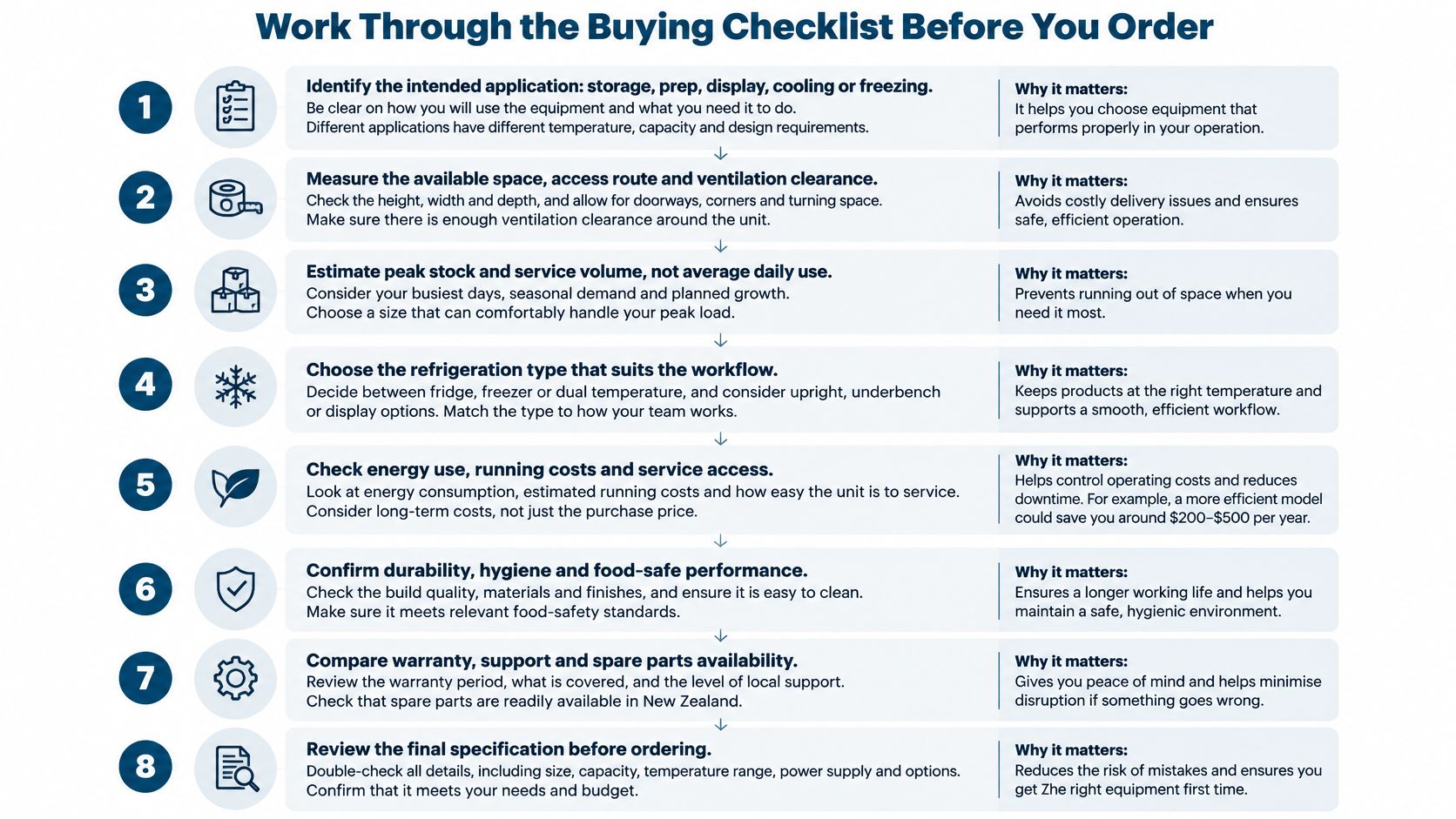
- Identify the intended application. Storage, preparation, display, rapid cooling and freezing call for different equipment. Choose a cabinet for the work it will do, not just its listed capacity.
- Calculate realistic peak storage. Use the busiest service, actual container sizes and usable shelf space. Leave room for airflow and stock rotation.
- Measure the route and installation space. Check doorways, corridors, bench height, door swing, ventilation clearance and cleaning access. Tipping a refrigeration unit as it enters the premises is not covered under warranty, so confirm the route and measurements before ordering.
- Check ingredient access and workflow. Keep frequently used items near the station that needs them. Check that open doors and staff movement will not obstruct service.
- Confirm the operating temperature range. Match the required range to the food or beverages being stored. Check alarms, displays and expected recovery after doors are opened.
- Compare energy and running costs. Use manufacturer data under its stated conditions, then consider energy use alongside usable capacity, recovery and likely food waste.
- Review warranty and service support. Check warranty terms, parts availability, service arrangements and the evidence required for a claim.
- Confirm installation details and total cost. Check the final electrical or gas supply, cut-out, ventilation and clearances against the model document before ordering cabinetry. Include accessories and freight: charges for larger or bulky equipment are calculated separately, and may be confirmed or adjusted before dispatch.
| Question to ask | Why it matters |
|---|---|
| What job will this cabinet do every day? | Keeps storage, preparation and display requirements distinct |
| What fails first at peak trade? | Pinpoints whether capacity, access or recovery is the main problem |
| Can staff clean coils, seals and drawers easily? | Makes routine cleaning easier and helps limit avoidable downtime |
| What happens when a part fails? | Clarifies warranty terms and access to service |
| What will ownership cost beyond delivery? | Brings energy, servicing and replacement costs into the comparison |
For a replacement, write down what the current unit does poorly. It may be too small, awkward to access, slow to recover, difficult to clean or costly to run. Repeating the same footprint can preserve the problem along with the space it occupies.
Hospitality carries Refrigeration & Dishwashing brands including Airex, Adande, Atosa, Classeq, Cossiga, Festive, Irinox, Rhima, SKOPE and Winterhalter. Compare the specifications of the exact model against the application, dimensions and workflow you have identified. Before placing the order, confirm the warranty conditions and what evidence is required if you need to make a claim.
Hospitality supplies commercial refrigeration for cafés, restaurants, bars, hotels, caterers and institutional kitchens across New Zealand, including SKOPE and Atosa upright, underbench, display and preparation ranges, commercial freezers and accessories. Operators comparing capacity, dimensions, energy use and service support can contact the team for practical help choosing equipment that fits the venue and workload. Visit Simply Hospitality to discuss the right refrigeration solution for the business.