


What Is a Pass Through Dishwasher and Is It Right?
A pass through dishwasher, also called a hood-type dishwasher, is a commercial machine where a loaded rack is slid in at bench height, the hood is lowered for the wash and rinse, and the clean rack is removed on the opposite side.
But what happens if the machine finishes a rack before staff have somewhere to put it? For hospitality operators, the purchasing decision is about the whole dishwashing station, including bench space, hot-water recovery, sanitising checks and staff handling, not only the speed of the wash cycle.
What Is a Pass Through Dishwasher?
A pass-through dishwasher uses a rack-based washing process, with a lifting hood enclosing the wash chamber. Staff move racks between adjoining benches rather than repeatedly carrying them down into a front-loading machine.
Consider a busy restaurant clearing plates after its main service. Staff scrape the plates at the dirty bench, arrange them in a rack, slide that rack into the machine and lower the hood. Once the programme finishes, the rack moves onto the clean bench, leaving the loading area available for the next batch.
Pass through describes the loading arrangement and workflow. It doesn't mean a conveyor belt automatically carries dishes through the machine. A conventional hood machine still needs staff to load, start and unload each rack.
A one-way lane for dishes
The useful analogy is a single lane running from the dirty bench to the clean bench, rather than a faster domestic dishwasher. Crockery, cutlery, suitable glassware and utensils move through a controlled cleaning process without returning to the food-soiled landing area.
These machines suit restaurants, hotels, commercial catering kitchens, busy cafés and institutional foodservice. Hospitals, aged-care facilities, marae and other high-volume operations can also benefit where their demand and available space justify the arrangement. For broader operational context, EECA's food-and-beverage service pathway addresses resource use across New Zealand hospitality businesses.
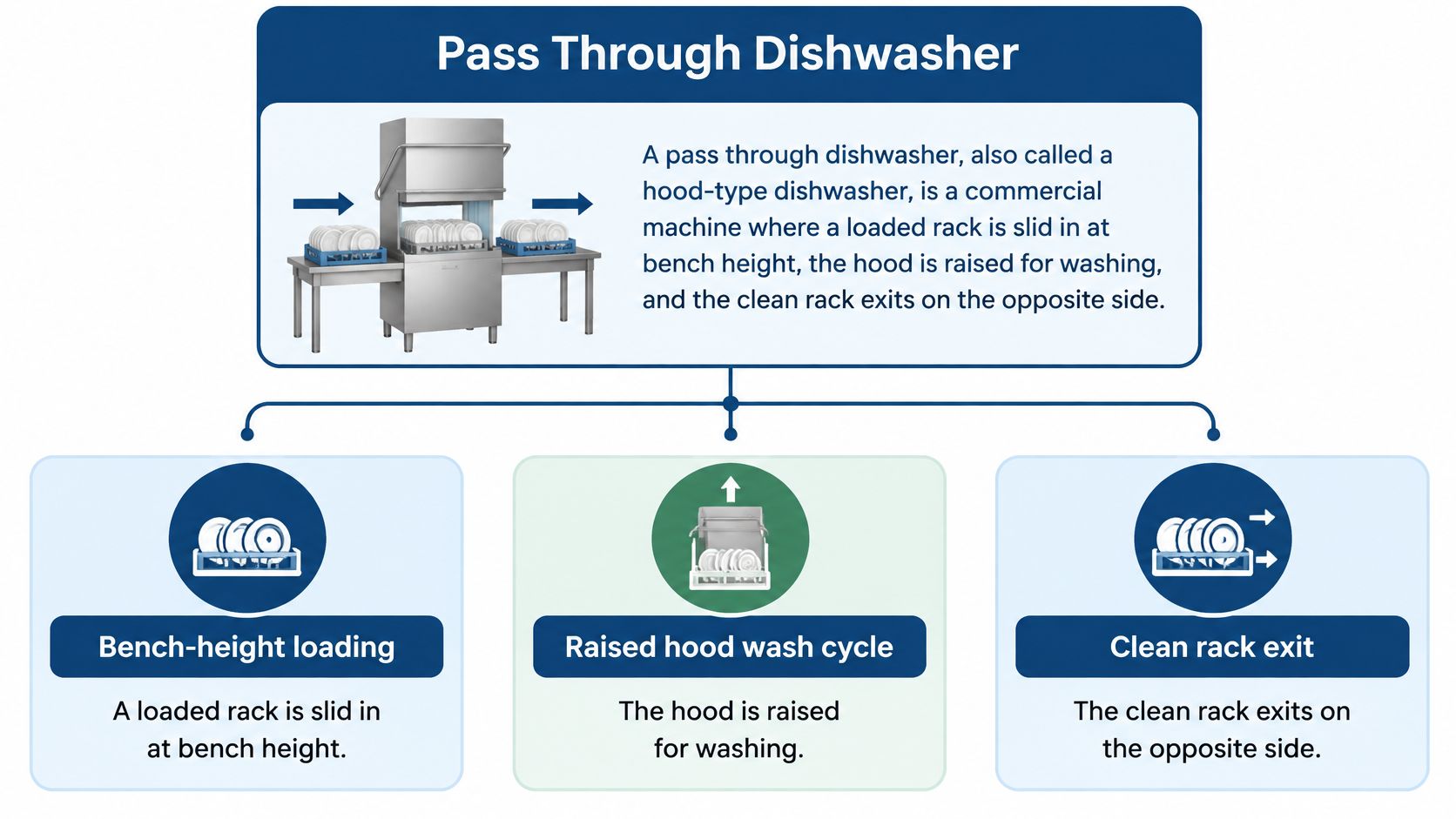
The operating distinction matters: the hood is lowered during washing and rinsing, then raised for rack transfer. Loading height alone doesn't guarantee an ergonomic station either. Bench alignment, rack weight and the distance to storage determine how much lifting staff still need to do.
Practical rule: A hood machine is most useful when dishes can move forward through the wash-up area without staff repeatedly carrying racks backwards.
How a Pass Through Dishwasher Works Step by Step
Good results begin before the hood closes. The Christchurch City Council guide for food premises operators emphasises removing visible food residue, following manufacturer operating and servicing instructions, and using suitable drying methods.
Preparing and washing a rack
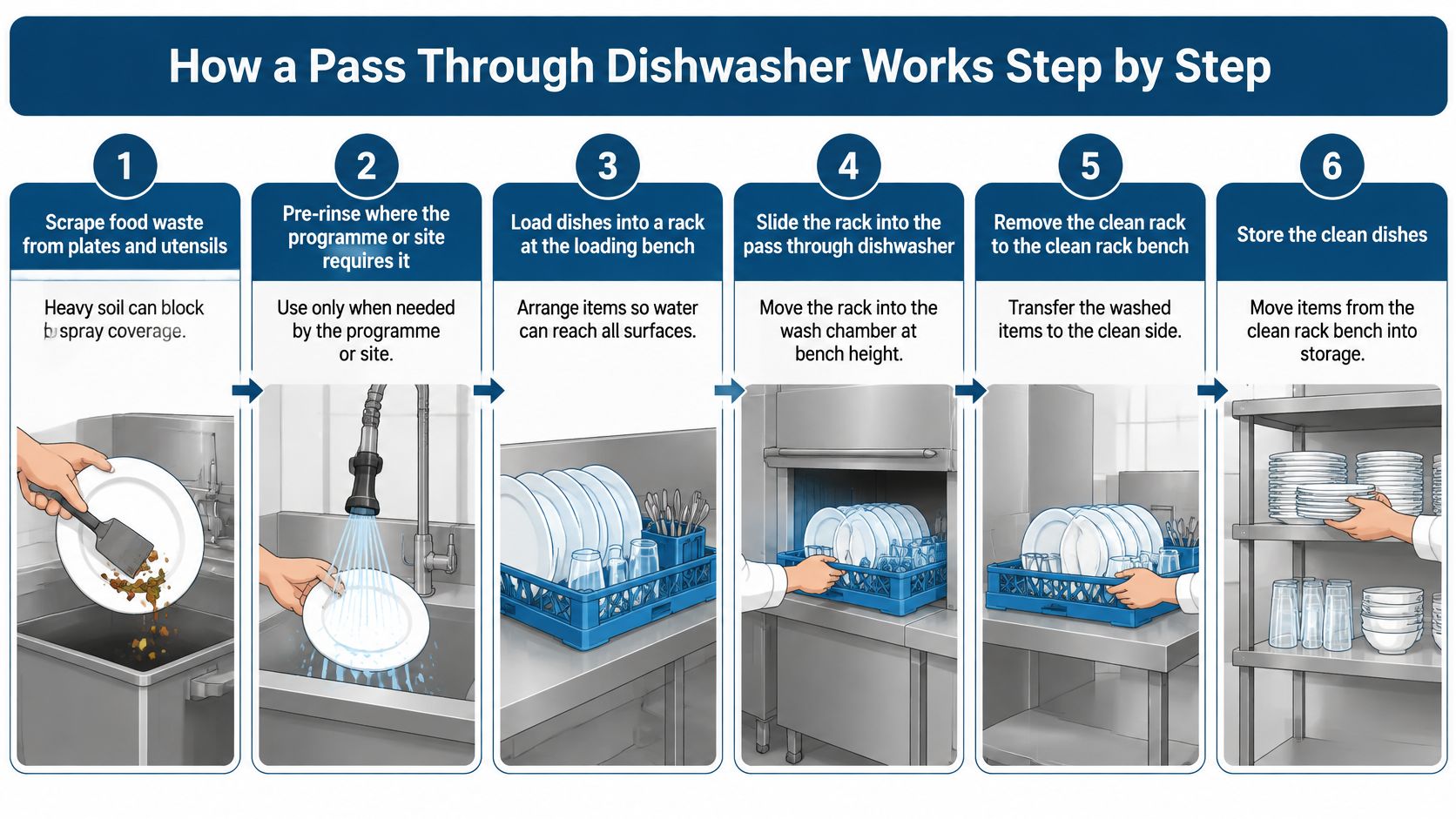
- Scrape food waste from plates and utensils. Remove scraps into the appropriate waste container before loading. Heavy soil adds unnecessary contamination to the wash water and can obstruct filters or spray coverage.
- Pre-rinse where the programme or site requires it. Remove remaining loose residue without treating the pre-rinse as a substitute for washing. Baked-on food may need soaking or a more suitable programme.
- Load a compatible dishwasher rack. Keep plates separated and position utensils so water can reach their surfaces. Nested bowls and overlapping cookware can shield food residue from the spray.
- Slide the rack into the machine. Transfer it from the loading bench without forcing it across mismatched bench edges. Check that tall items won't obstruct the hood or spray arms.
- Lower the hood. This encloses the wash chamber; some machines start automatically when the hood closes. Staff shouldn't assume every model operates this way.
- Select or start the appropriate wash programme. Match the programme to the load and soil level. The shortest available setting isn't necessarily appropriate for cookware or dried-on residue.
- Allow washing and rinsing to finish. Don't interrupt the programme to recover an urgently needed plate. An incomplete cycle cannot be treated as a completed sanitising process.
- Remove the rack and allow draining and drying. Move it onto the clean-rack bench and follow the manufacturer's drying instructions. Avoid stacking wet items immediately or drying them with a shared kitchen cloth.
What the water and chemicals do
Wash water and detergent loosen and remove food soil. Rinse aid helps water sheet off surfaces, supporting draining and reducing spotting; it isn't a replacement for detergent or a sanitiser.
The final rinse completes the machine's specified sanitising process. Cycle times, temperatures, dosing settings and operating procedures differ between manufacturers and models, so the technical documentation takes precedence over a generic operating routine.
At the clean bench, staff should check for visible soil, trapped water and incomplete draining. A failed rack needs investigation and appropriate rewashing, not a quick wipe before returning it to service.
Pass Through and Undercounter Dishwashers Compared
Undercounter dishwashers load from the front and keep the wash-up station compact. Pass-through models use a hood that lifts over a rack, with entry and exit benches supporting movement through the machine. The choice depends on rack flow and available space, not capacity figures alone.
| Feature | Pass through dishwasher | Undercounter dishwasher |
|---|---|---|
| Installation footprint | Larger, with hood clearance and room for entry and exit benches | Compact and installed under a bench |
| Loading method | Rack loaded at bench height and transferred through the hood | Rack loaded and unloaded from the front |
| Rack handling | Supports a one-way flow from dirty to clean side | Loading and unloading usually happen at the same position |
| Wash capacity | Suited to higher, more continuous volumes | Suited to moderate volumes |
| Staff movement | Dirty and clean sides can be separated by the machine | Staff handle racks at one position |
| Purchase cost | Generally higher upfront cost; obtain model-specific quotes | Generally lower upfront cost; obtain model-specific quotes |
| Installation requirements | Hot water, drainage, electrical supply and bench layout planned together | Simpler layout, though water, electrical supply and drainage still need checking |
Benefits come with practical trade-offs
At 7pm on a Friday, a rack queue at the machine may slow service even when the wash cycle is short. A pass-through setup can keep racks moving between dirty and clean sides, provided staff can scrape, load and unload without blocking the station.
- Bench-height handling: Sliding racks avoids repeatedly lifting them from a low opening, but entry and exit benches take up floor space.
- Defined rack flow: Separate dirty and clean landing areas help keep handling organised. They also require room for both sides of the machine.
- Consistent operation: Programmes support repeatable washing when staff load racks correctly. Filters, spray arms, dosing equipment and hood components still need regular attention.
- Capacity for sustained demand: A larger machine and station can handle a steady stream of racks, but may be underused if demand is only occasional.
Glassware can have different washing requirements from plates and cookware. The guide to choosing between a glasswasher and a dishwasher explains the distinction.
Find the actual bottleneck
During a typical busy service, note where racks wait: collection, scraping, loading, washing, unloading or storage. A queue on the dirty side may point to slow preparation; a full clean bench may make unloading the constraint.
If staff are not filling the existing machine consistently, a larger model may leave the underlying handling problem unchanged. A pass-through setup makes sense when the station can keep racks moving through it; otherwise, an undercounter machine may use the available space more effectively.
Space, Hot Water and Layout to Plan First
The machine's width and depth describe only part of the installation. An effective station also needs hood clearance, service access and somewhere for staff to prepare, unload and store racks.
Start at the dirty landing area and follow the work towards storage:
Dirty dish collection → Scraping and pre-rinse → Loading bench → Pass-through dishwasher → Clean rack bench → Storage
Measure the station, not just the machine
- Machine envelope: Check width, depth, hood opening height and overall installation height against the technical drawing.
- Dirty-side preparation: Allow space for returned dishes, waste separation, pre-rinsing and rack loading without blocking the kitchen route.
- Clean-side handling: Provide room for draining racks and moving dry ware into storage.
- Services: Confirm water connections, drainage, electrical requirements and access for isolation and maintenance.
- Steam and circulation: Assess ventilation requirements and ensure an open hood or parked rack won't obstruct staff.
Separating food-soiled returns from cleaned ware helps reduce cross-contamination risk. It also prevents staff from placing clean racks on the floor because the exit bench is full.
Confirm the plumbing requirements locally
The historical Food Hygiene Regulations 1974 specified continuous piped hot water with minimum temperatures of 63°C at sinks and 83°C for dishwashing units. These historical figures aren't a substitute for confirming the requirements applicable to the premises' current food control plan, machine design and local authority.
A licensed plumber should check hot-water capacity and recovery under peak demand, along with the correct waste connection. Confirm locally whether the dishwasher discharge must bypass the grease trap rather than assuming the existing sink connection is suitable.
Erica's Plumbing, Air Conditioning & Restoration outlines general hot water heater installation steps, useful background on the work involved, but its overseas guidance doesn't establish New Zealand commercial installation requirements.
Stainless steel entry and exit benches should be planned alongside the machine. A water test also belongs in the assessment, with further context in how water quality affects dishwasher performance.
Sanitising Temperatures Every Operator Should Check
A plate can look clean without having completed a valid sanitising process. Temperature, exposure time and the machine's approved programme matter more than a high-temperature label on a sales sheet.
The historical Food Hygiene Regulations 1974 machine-washing provisions specified a detergent wash of at least 60°C, a clean-water rinse of at least 77°C for 10 seconds, rinse-temperature control at 83°C subject to the stated design exception, and a chemical alternative using at least 50°C water with 50–75 mg/L available chlorine.
Those provisions provide useful technical context, but operators should confirm current requirements with their verifier or local authority rather than treating historical legislation as a universal current specification.
Sanitising control points for a pass through dishwasher
| Control point | Historical minimum requirement | What to check |
|---|---|---|
| Thermal wash stage | Detergent wash threshold stated above | Confirm wash temperature during commissioning and servicing |
| Thermal final rinse | Rinse temperature and exposure time stated above | Have the technician verify performance at the rack or utensil interface |
| Rinse temperature control | Operation prevented below the stated control threshold unless the design accounts for heat loss | Check controller operation and service records |
| Chemical sanitising rinse | Water temperature and available chlorine concentration stated above | Confirm automatic dosing and test concentration using the approved procedure |
| Items leaving the machine | Hot after a correctly completed thermal rinse | Monitor results and record faults without touching hot ware directly |
A boiler display doesn't establish the temperature reaching the utensils. Commissioning should verify the machine's actual sanitising performance using suitable measurement equipment, not merely confirm that its display illuminates.
MPI's cleaning guidance describes correctly rinsed items as too hot to touch. That's an operational warning and useful indicator, not an instruction to test sanitisation with bare hands.
Give staff a failure procedure
If the machine can't sanitise properly, staff shouldn't keep pushing racks through to clear the queue. Stop using it for sanitising, identify affected ware, report the fault and follow the premises' approved alternative procedure.
MPI's fallback sequence is to remove visible food, wash with hot water and detergent, rinse with clean hot water, apply a food-safe sanitiser, then air-dry or use a single-use drying cloth.
Fault response: A clear stop-and-report procedure is more useful than a temperature log that records repeated alarms without action.
Arrange regular servicing with a reputable technician and keep temperature checks, corrective actions and service records accessible. The overview of New Zealand food safety regulations provides additional context for documenting these controls.
Buying Checklist and Running Costs to Compare
A useful quotation covers the machine, compatible racks, required accessories and the conditions needed to achieve its stated performance. The cheapest machine price isn't necessarily the cheapest workable station.
| Buying consideration | Why it matters | What to check |
|---|---|---|
| Expected racks per hour | Quoted capacity may exclude normal handling delays | Achievable throughput during the busiest service |
| Rack dimensions | Racks must suit existing ware and benches | Compatible sizes, usable loading height and availability |
| Water consumption | Influences utility and heating costs | Manufacturer technical data in litres per cycle |
| Detergent and rinse aid dosing | Affects results and ongoing cost | Automatic dosing, calibration and chemical compatibility |
| Water quality and treatment | Scale affects heating, spray arms and results | Water test results and treatment requirements |
| Hood operation and service access | Staff use and clean these components routinely | Lift mechanism, clearance and cleaning access |
| Warranty and local servicing | Faults can interrupt service | Parts availability, service arrangements and warranty exclusions |
Compare achievable capacity
Theoretical rack capacity generally assumes uninterrupted cycles. Actual service includes scraping, loading, programme selection, unloading and occasional rewashing, so the supplier's capacity figure needs to be tested against the venue's workload.
Check wash programmes, available utilities and the manufacturer's installation documentation before ordering. Water hardness can contribute to scale on heating components and spray outlets, while unsuitable chemical settings can undermine otherwise adequate equipment.
The Commerce Commission's water-efficiency labelling guidance explains labelling obligations for covered products. A water label doesn't establish total commercial operating cost, and domestic energy-labelling assumptions shouldn't be transferred to a commercial hood machine.
Include handling and maintenance
Operating costs include water, electricity, detergent, rinse aid, treatment consumables, routine cleaning, maintenance and staff handling time. Compare cost per successfully cleaned rack, including rewashes, rather than dividing costs by every cycle started.
For a plate-only comparison, divide the total attributable cost by the number of successfully cleaned plates, then multiply by 100. Mixed racks need a consistent loading assumption or the comparison becomes misleading.
Hypothetical handling calculation: If one workflow requires 20 seconds of staff handling per rack and another requires 35 seconds, processing 60 racks requires 20 minutes versus 35 minutes of handling. These are illustrative assumptions, not machine performance claims.
That difference may free staff for other tasks without reducing payroll. The discussion of manual dishwashing versus commercial dishwasher costs explores the broader cost comparison.
- End-of-shift cleaning: Empty and clean strainers and filters, following the machine's shutdown procedure.
- Mechanical checks: Inspect spray arms, hood seals and rack guides for obstruction or damage.
- Fault records: Log temperature alarms and incomplete cycles for the technician.
- Descaling: Set the approach from water-test results and manufacturer instructions, not an arbitrary chemical schedule.
A higher purchase price is justified only when the required capacity or operating advantages have practical value for the business.
Confirm Peak Demand Before You Buy a Pass Through Dishwasher
The right pass-through dishwasher depends on the busiest service period, not the daily average. Record how many racks arrive during each peak, then note when they queue and why. A queue caused by scraping, loading or storage needs a different fix from one caused by the wash cycle.
Measure the constraint before shortlisting
- Count peak racks: Track racks across a typical trading week, including meal services and functions.
- Record where time is lost: Note machine waiting time separately from scraping, loading, drying and putting racks away. Assess the cost of waiting during peak service to help identify where delays affect service.
- Check rack flow: Confirm that staff can move dirty racks to the machine and clean racks away without crossing paths or blocking work areas.
- Request written specifications and quotes: Compare utility, accessory and installation requirements with the manufacturer's documents.
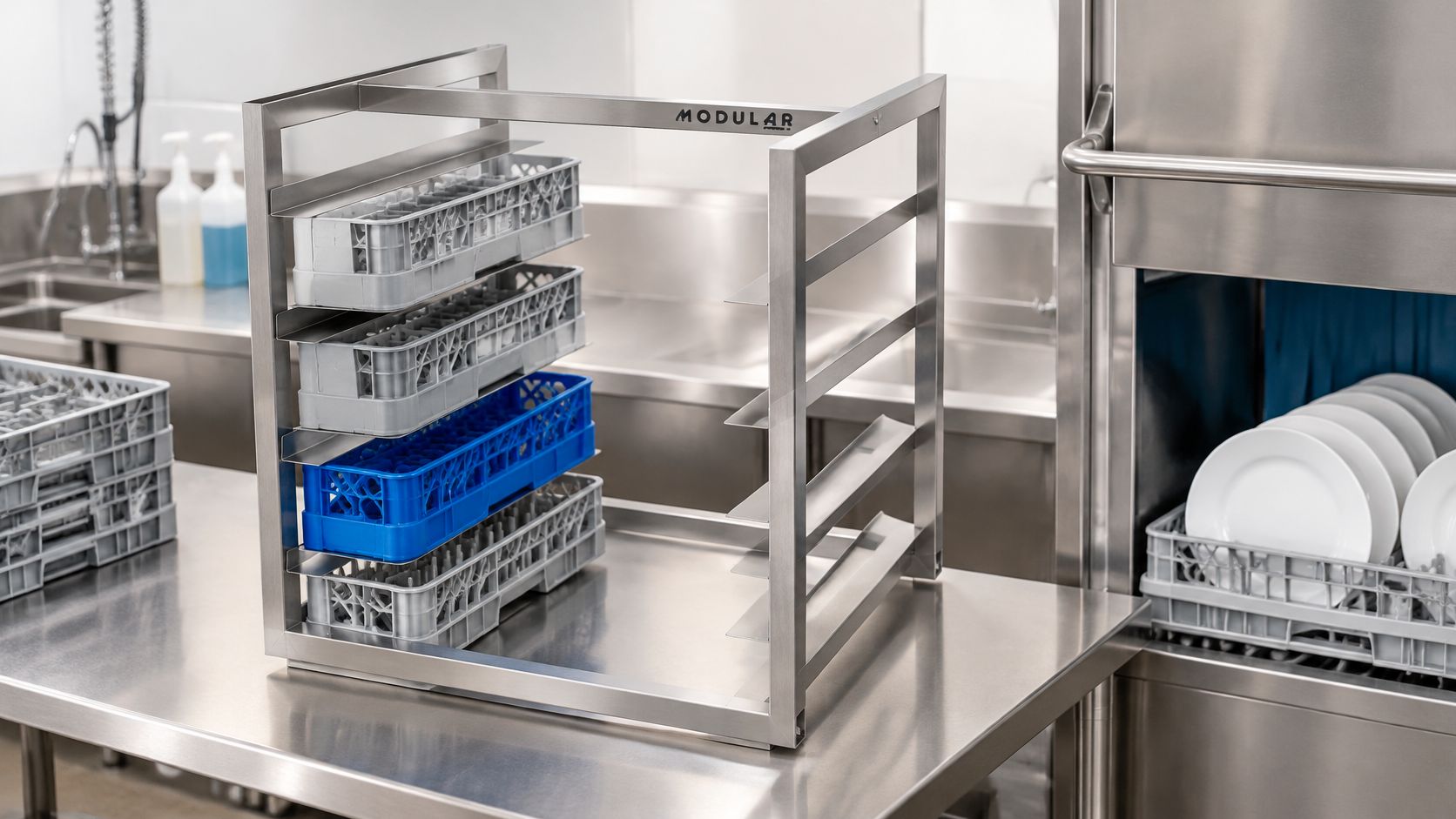
A defined home for spare baskets can also improve the wash-up station without changing the dishwasher. The Modular Stainless Dishwasher Basket Cassette organises commercial dishwasher racks within the station. Match the selected configuration to the planned installation.
Hospitality carries dishwashing brands including Classeq, Rhima and Winterhalter. Check the catalogue for current hood-machine models and availability rather than assuming a particular model is offered.
Ask the supplier to include compatible racks, detergents and rinse aids, water-treatment accessories, and stainless entry and exit benches in the quotation. Confirm that each item suits the selected machine and the available space.
Installation, repairs and servicing should be arranged with qualified trades. Supply advice does not replace commissioning.
Hospitality supplies commercial dishwashing equipment and accessories. Bring a wash-up area sketch, peak rack counts and existing utility details when you discuss a dishwasher and station layout.