

What Does Waiting Cost During Peak Service? Explained
A busy lunch or Saturday dinner can look productive while hiding a costly problem. Tickets collect at the pass, chefs hover beside a full fryer, servers return to ask about delayed dishes, and guests remain at tables longer because one part of the order hasn't arrived. The visible queue may be at the dining room, but the core constraint could be preparation, refrigeration, cooking capacity, plating, or clean ware.
That is the practical answer to What Does Waiting Cost During Peak Service? It costs more than the minutes shown on a ticket. One delay can consume labour capacity, hold tables, disrupt production, increase customer frustration, and prevent the rest of the operation from moving at its normal pace. New Zealand data gives the wider problem a useful local context. Consumers spent an estimated 22.3 million hours on hold in 2023, up from 19.7 million hours in 2022, with the lost work time valued at NZ$167 million in productivity by ServiceNow's 2024 report, as recorded in the New Zealand transport study.
Hospitality operators shouldn't respond by buying the first appliance that appears to promise speed. The better approach is to identify where work waits, understand why the queue forms, fix that constraint, and measure the flow again. The following sections apply that method to kitchens, front of house, equipment selection, layout, and peak-service planning.
Introduction Why Waiting Matters More at Peak
Peak service changes the economics of delay because demand is arriving while the kitchen has less spare capacity to absorb disruption. A small preparation hold can become a cooking hold, then a plating hold, then a table-service problem. Staff may still be working continuously, but the system produces less useful output because each person is waiting for the next stage.
A common example is a table with several dishes that depend on the same preparation station. One component isn't ready, so the order remains open. The cook moves to other tickets, the delayed dish joins a growing queue, and the server can't complete the table's service. Meanwhile, guests waiting for tables see occupied seats that aren't turning over naturally.
Practical rule: The expensive part of waiting isn't necessarily the staff member standing still. It's what the kitchen and customer can't do while that person or order is held up.
The New Zealand Government's lunchtime-demand guidance makes the operational link clearly. When only one person serves at the counter, customers wait longer, tables remain occupied longer, and prospective customers may choose a nearby café instead. The lunchtime demand and capacity guide treats the issue as a capacity problem, not just a hospitality problem.
That distinction matters for purchasing decisions. A second fryer may help if fryer baskets are the queue. It won't help if food is waiting for plating, if staff can't reach the underbench fridge, or if the dishwashing area can't return clean ware quickly enough. In the work with hospitality businesses, the most useful conversations usually start with the workflow rather than the catalogue.
This article uses three practical lenses:
- Name the waiting: Find out whether guests, orders, ingredients, equipment, plated food, or clean ware is held up.
- Trace the propagation: Follow one delay from preparation through to the table.
- Diagnose before spending: Time each stage during peak, then choose a process, layout, or equipment response.
The aim isn't to turn every venue into a high-speed operation. A café, a tasting-menu restaurant, a pub, and a hotel breakfast service have different service promises. The aim is to remove waiting that adds no value to the guest or the business.
The Different Types of Waiting in a Hospitality Kitchen
Waiting appears in several places at once, which is why operators can misdiagnose it. The server sees a guest waiting for food. The chef sees an order waiting for preparation. The prep cook sees ingredients held up by a crowded bench. Each observation is accurate, but none identifies the constraint alone.
Eight places where queues form
- Guests waiting for tables: This is the most visible front-of-house queue. It can signal strong demand, slow table clearing, delayed payment, or existing tables occupying seats longer than the concept requires.
- Guests waiting for food: A guest-facing ticket delay may reflect a problem well upstream. The server can communicate the delay, but communication doesn't create fryer, oven, preparation, or plating capacity.
- Orders waiting for preparation: Tickets may sit before anyone starts portioning, chopping, mixing, or assembling. This often points to insufficient mise en place, an overloaded prep station, or unclear ownership between shifts.
- Chefs waiting for equipment: A cook waiting for an available fryer, oven shelf, grill section, mixer, or processor is waiting on capacity. The queue becomes especially disruptive when several menu items depend on the same appliance.
- Staff waiting for ingredients: Ingredients may be in another cool room, stored below other stock, still being portioned, or unavailable because replenishment has fallen behind. Underbench refrigeration and organised storage can affect this type of delay.
- Food waiting for oven, fryer, or grill capacity: Prepared food can be ready while the cooking line is full. This is different from a prep shortage. Buying more prep equipment won't resolve a cooking bottleneck.
- Completed food waiting for plating or service: The dish has been cooked, but the pass, plate supply, garnish station, or server handover is holding it. This can create quality issues as food sits after cooking.
- Staff waiting for clean ware: A shortfall of clean plates, pans, baskets, or utensils can stop an otherwise capable team. The queue may belong to warewashing rather than the cooking line.
The article about slow preparation and the right operational response is useful when preparation appears to be the first visible hold-up. The key is to name the queue precisely before selecting a remedy.
A queue in one area can mask a constraint elsewhere. If the pass is full, the team may blame plating, even though the actual cause is that the oven releases several dishes together. If servers keep asking for updates, the kitchen may appear slow when the warewashing cycle is restricting plate availability. Correct diagnosis starts by watching the entire chain, not the most visible queue.
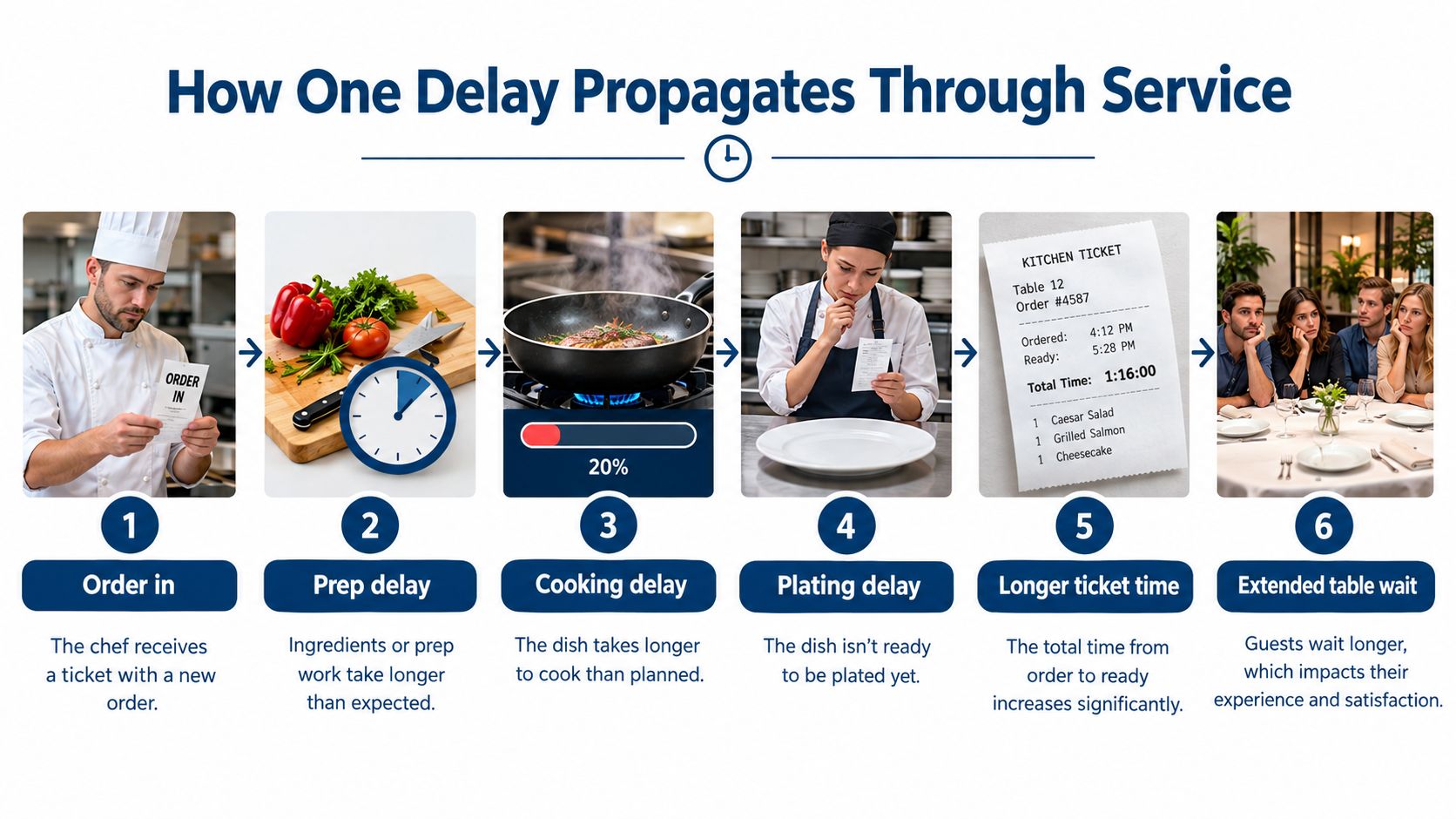
How One Delay Propagates Through Service
A peak-service delay usually travels through connected stages rather than remaining in one station. The sequence can be represented as:
Prep delay → cooking delay → plating delay → longer ticket time → longer table occupancy → potentially fewer covers
Suppose a garnish or component isn't ready when the order arrives. The cook may hold the ticket, or start the other components and wait for the missing part. Once the cooking stages no longer finish together, the pass has to manage staggered dishes. That creates extra handling, more communication, and a greater chance that a completed item waits for the rest of the table's order.
The longer ticket then affects the dining room. Guests may remain at the table while waiting for food, while servers spend time explaining the delay or returning to check progress. If payment and clearing also happen later, the table remains occupied beyond the point at which the guests would otherwise have finished. During a period when other guests are already waiting, that can potentially reduce the number of covers served. It shouldn't be treated as an automatic revenue calculation, because table occupancy, menu style, booking patterns, guest expectations, and venue concept all change the outcome.
Faster isn't always better. The useful target is removing delay that contributes nothing to food quality or the guest experience.
A short ticket can still be the wrong objective for a restaurant that deliberately paces courses or protects a relaxed service style. Conversely, an avoidable hold at a takeaway counter or busy café can undermine the entire proposition. The operator needs to distinguish intentional pacing from unplanned waiting.
The same chain can begin at a different point. A full fryer can hold prepared food, which pushes plating back and leaves the server waiting. A lack of clean ware can stop plating even when cooking is complete. A chef waiting for ingredients can leave the grill underused while the preparation station becomes crowded.
The dough-production bottleneck article provides a useful example of why an upstream constraint deserves attention. If dough production sets the pace for later cooking and service, adding capacity at the final cooking stage may leave the actual queue untouched.
Quantifying the True Cost of Waiting
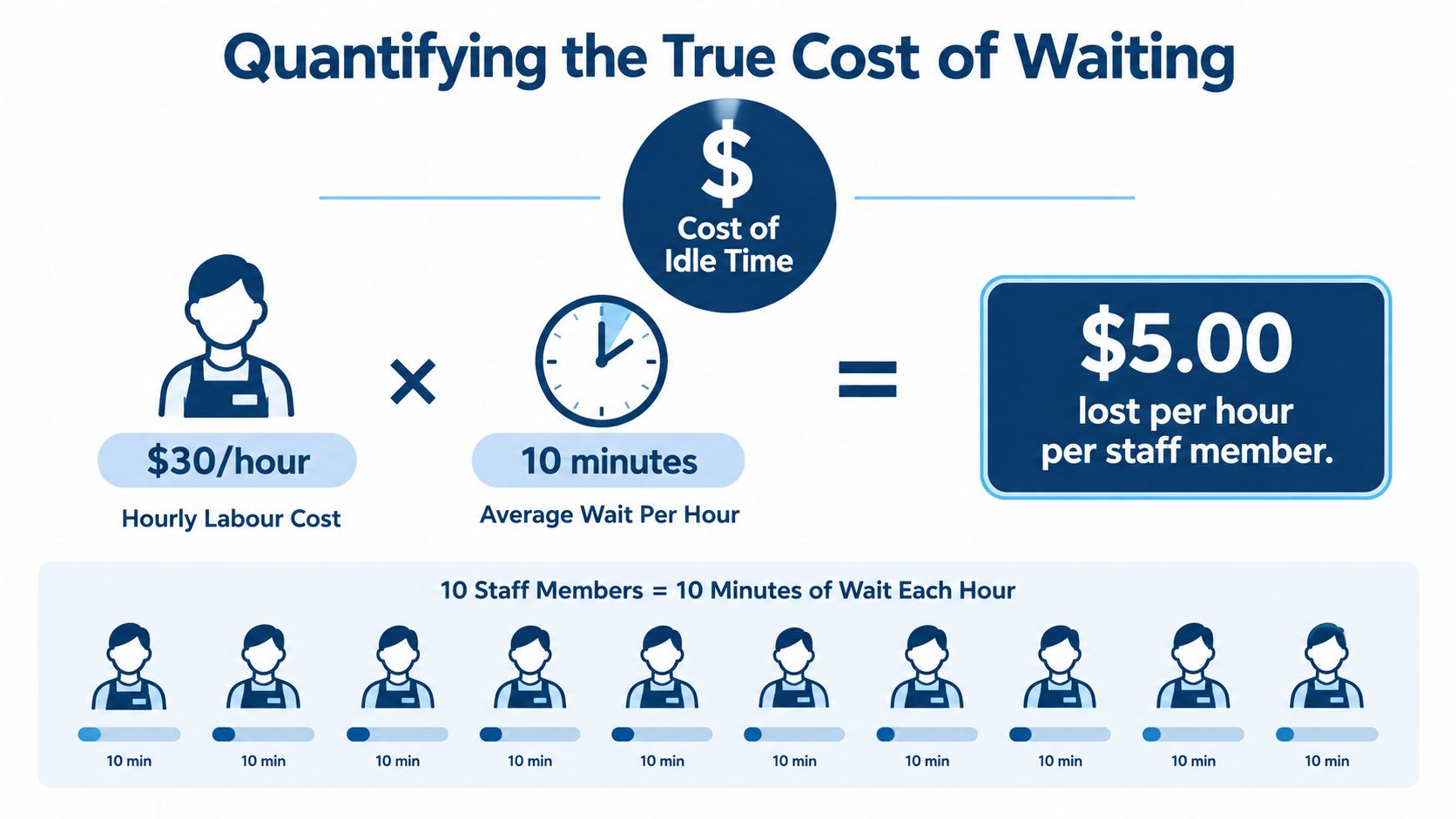
Waiting has a direct labour component, but that is only the starting point. Illustration, not industry data: if a staff member costs the business $30 per hour and spends 10 minutes of each hour waiting, the unused labour time represents $5 per hour. The calculation is $30 multiplied by 10 divided by 60.
That $5 is easy to understand, but it may be the smaller opportunity cost. During those 10 minutes, the staff member might have prepared ingredients, completed orders, replenished the line, cleared tables, or supported another station. If the delay blocks a cook, the lost output can continue into the next stage and affect customer orders.
A useful assessment should separate several exposures:
- Labour inefficiency: Record how often staff wait for ingredients, equipment, space, instructions, or clean ware.
- Production loss: Identify what could have been prepared, cooked, plated, or served during the waiting period.
- Customer impact: Track delayed orders, repeat questions, complaints, walkouts, and tables held longer than necessary.
- Food and quality waste: Look for food that is over-held, remade, cooled, or discarded because components finish at different times.
- Reputation and repeat business: Consider whether an avoidable delay changes how guests judge the venue and whether staff must spend additional time recovering the experience.
New Zealand policy already provides a local precedent for valuing time during congested periods. The NZTA Bus Policy Model assigns a peak in-vehicle time value of NZ$7.20 per hour, or 12 cents per minute, compared with NZ$6.00 per hour off-peak, while the Domestic Transport Costs and Charges Study reports an average gross cost per public-transport boarding of NZ$8.77 nationally. These figures come from the NZTA transport appraisal material, not hospitality operations, so they shouldn't be used as a restaurant ROI claim. They do show that New Zealand's own economic tools treat peak delay as more costly than ordinary waiting.
Operators can calculate their own exposure without pretending there is a universal table-turnover benchmark. No average table-turnover loss is being quoted because restaurant concepts differ too widely.
A basic internal model can examine:
- Average table occupancy time during the peak.
- Average spend per table, using the venue's own records.
- Number of available tables and the number occupied by delayed service.
- Peak demand, including guests waiting while existing tables remain unnecessarily occupied.
- Delay location, such as preparation, cooking, plating, service, or clearing.
For broader operational thinking, a practical managing system performance guide can help frame measurement around constraints and repeatable process performance. The relevant question isn't whether every minute can be monetised perfectly. It is whether the measured queue is preventing useful work and creating avoidable customer delay.
The discussion of one hour of kitchen downtime is also relevant because a waiting constraint can resemble partial downtime. The equipment may be switched on, and the team may be present, but the operation still can't produce at the required pace.
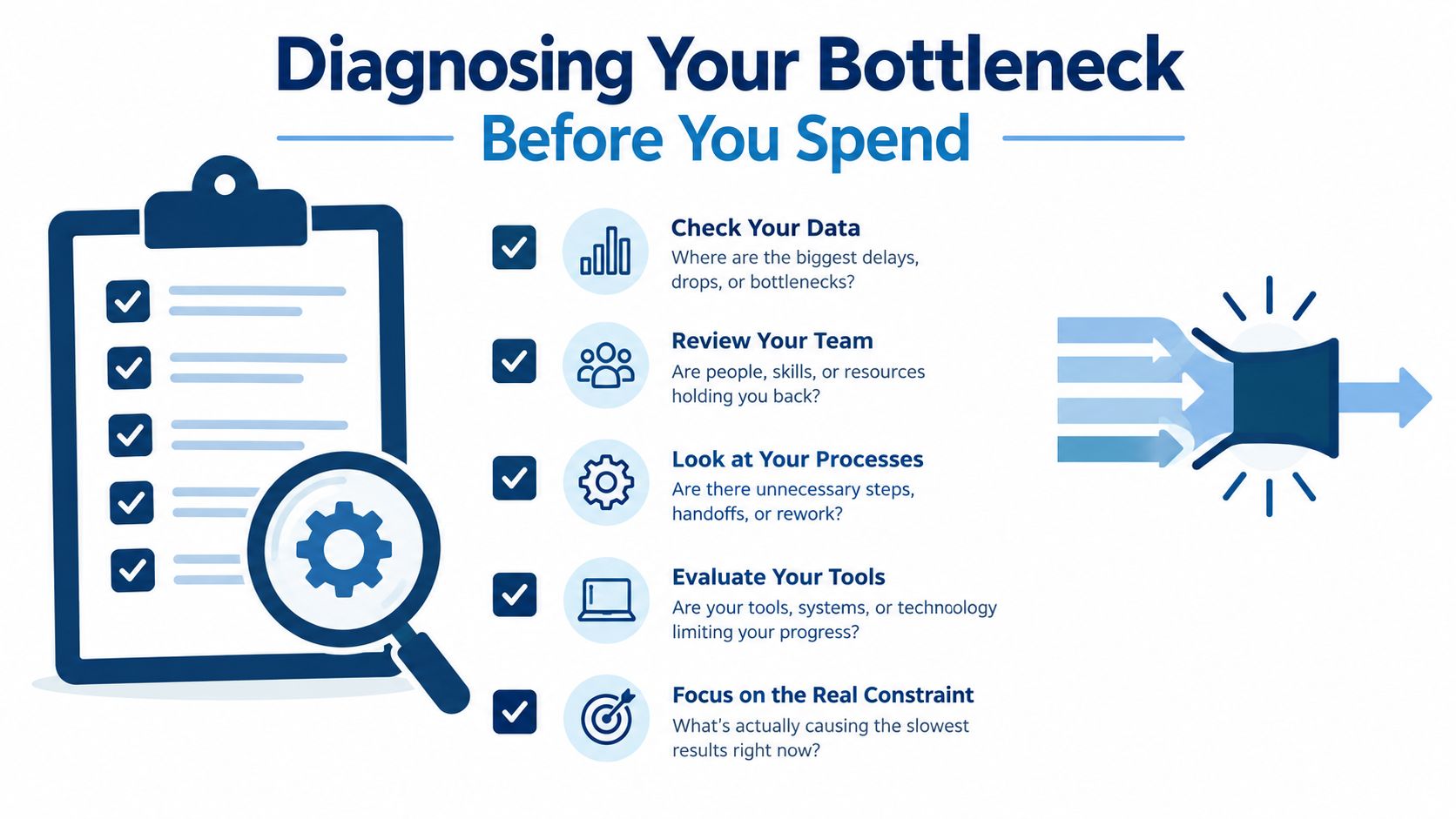
Diagnosing Your Bottleneck Before You Spend
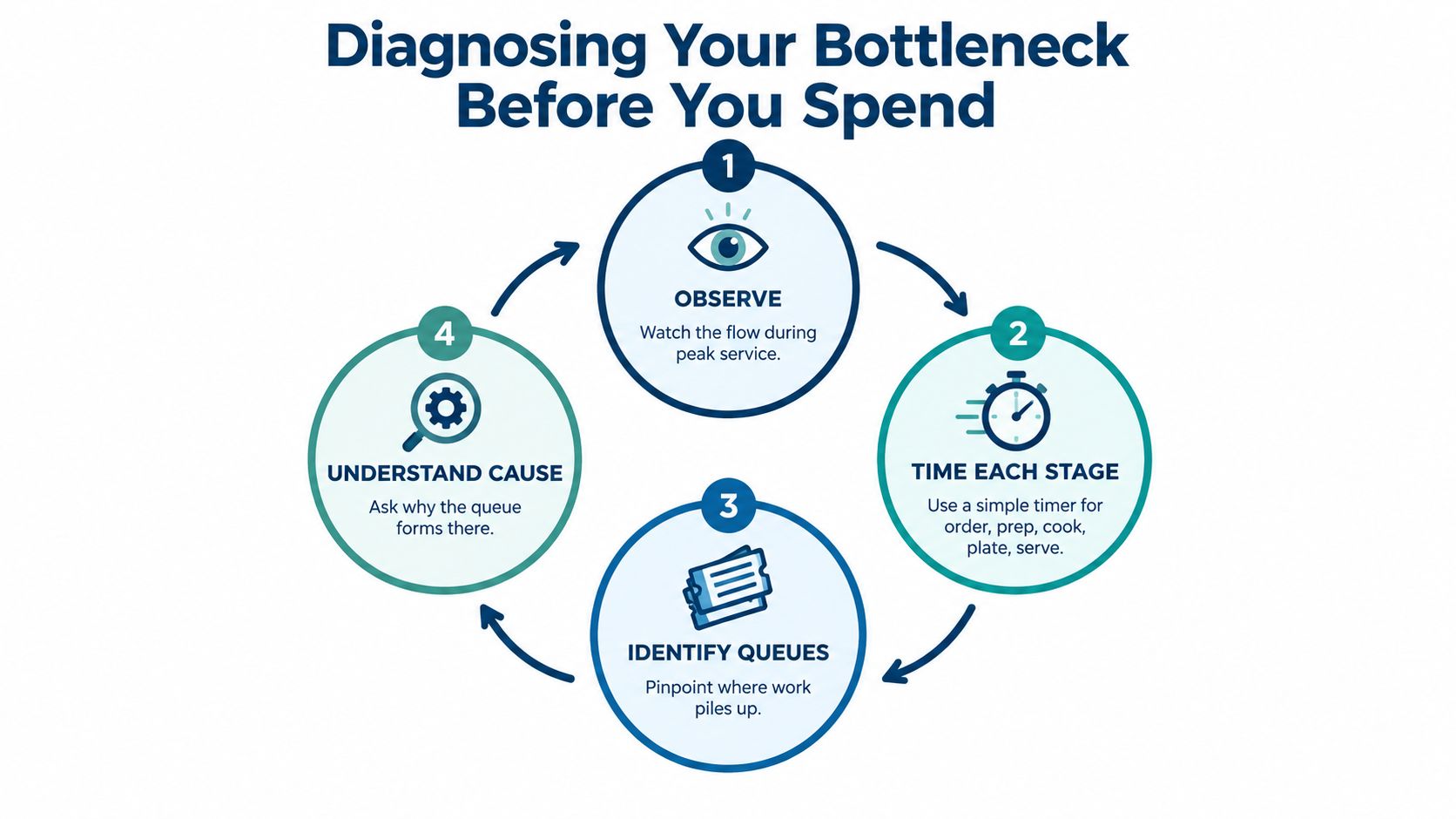
The most reliable diagnostic loop is straightforward:
Observe → time each stage → identify where work queues → understand why → fix that constraint → measure again
The order matters. Measuring only completed ticket times tells an operator that service is slow, not where the time went. A five-minute delay on one order may sound minor, but if the same bottleneck affects 40 orders during one service, it becomes a system problem rather than an isolated slow ticket.
A practical peak-service test
- Observe the peak: Watch the busiest service window, not a quiet mid-afternoon period. Note where staff stop, turn back, ask questions, or carry unfinished work.
- Time each stage: Record when the order arrives, preparation starts, cooking begins, the food reaches the pass, plating finishes, and the server receives it.
- Identify queues: Look for ticket piles, ingredient shortages, full fryer baskets, occupied oven shelves, crowded grill space, incomplete plates, and missing clean ware.
- Understand the cause: Ask whether the queue comes from capacity, layout, replenishment, recipe design, equipment reliability, training, or a handover between staff.
- Fix one constraint: Change the process or equipment at the point where work accumulates.
- Measure again: Compare the same stage during a comparable peak. A change should be judged by flow, not by how modern the new appliance looks.
One common mistake is to average the whole service and hide the spike. An operation may look acceptable across an entire shift while a concentrated rush creates the guest-facing damage. Another mistake is timing only the kitchen. Table occupancy, clearing, warewashing, and server handover can hold back the dining room even when cooking appears stable.
Don't buy a second fryer until the queue proves the fryer is the constraint.
The same logic applies to ovens, mixers, refrigeration, dishwashers, and benches. A second fryer won't fix a plating bottleneck. A larger oven won't solve a missing ingredient. More staff won't necessarily improve a cramped layout if two people still can't work at the same bench without crossing paths.
For front-of-house planning, operators can also review guidance on how to optimise tables for busy service. That assessment belongs alongside kitchen timing, because guest waiting and kitchen waiting often reinforce each other.
The commercial kitchen design article is particularly useful when repeated delays point to the physical arrangement. A workflow problem built into the kitchen may require design work rather than another appliance.
Practical Ways to Reduce Waiting and Improve Flow
The right response depends on where the queue forms. Process changes are usually easier to test, while equipment and layout changes can offer more durable capacity but require space, installation planning, cleaning routines, staff training, and ongoing maintenance.
Start with the flow before adding capacity
If staff repeatedly walk across the kitchen for commonly used ingredients, moving underbench refrigeration closer to the preparation or cookline may remove unnecessary movement. If prep is waiting for a clear surface, adding productive stainless bench space can improve the handover between preparation and cooking. Neither change requires a larger fryer or oven.
Other practical adjustments include:
- Reorganising mise en place: Keep working quantities in a predictable order and replenish before the peak rather than during the queue.
- Separating preparation and plating: Give each activity a defined area so completed food doesn't compete with raw preparation or dirty equipment.
- Changing rack and tray flow: Position incoming, in-process, and completed trays so staff don't cross the same path repeatedly.
- Repositioning equipment: Place appliances according to the actual sequence of work, service access, extraction needs, cleaning access, and food-safety separation.
The peak-service kitchen efficiency article offers related practical considerations. The useful test is whether the proposed change removes a measured queue, not whether it adds more equipment to the room.
Match the purchase to the constraint
Underbench refrigeration can help when staff wait for ingredients or walk to a remote storage point. The SKOPE ProSpec 9 Drawer Underbench Fridge - PG11.UBR.3.D9 has a 9-drawer configuration, a 1°C to 4°C operating range, adjustable from -2°C to +15°C, and a stainless steel 304 AISI cabinet. Its left-hand configuration, R290 refrigerant, SCS Connect controller with Bluetooth wireless technology, ambient rating up to 40°C, and 5 Year Warranty are relevant selection details when the unit forms part of a chef-led workflow.
Fryer capacity makes sense when baskets remain full and prepared food waits specifically for frying. Operators still need to consider extraction, oil management, cleaning, floor space, and whether menu demand is consistent enough to justify the added capacity.
Oven capacity should be assessed by shelf availability, recovery, loading patterns, and product mix. More oven space won't help if the pass or plating area is already saturated.
Preparation equipment can address a measured bottleneck in chopping, mixing, slicing, dough handling, or portioning. The purchase should fit batch size, cleaning requirements, storage, staff skill, and the venue's menu rather than only increasing output potential.
Warewashing deserves equal attention. If clean plates, pans, or utensils are unavailable, a fast cooking line still cannot complete service. Consider machine capacity, rack movement, drainage, chemical dosing, pre-rinse space, ventilation, and where clean ware returns to the floor.
When the same people, equipment, and surfaces repeatedly interfere with one another, a kitchen designer may be more valuable than another appliance. SACH Design can be introduced where poor layout has created a permanent workflow problem. Design can address adjacency, bench allocation, traffic paths, utilities, extraction, storage, and cleaning access as one system.
Consider ownership, not just peak output
Equipment needs to remain accessible for cleaning and servicing. Refrigeration needs correct ventilation and food-safe organisation. Ovens and fryers need suitable extraction and installation planning. Warewashing needs the right drainage, water, chemical, and workflow arrangements.
The most suitable solution for a small café may not suit a hotel breakfast operation or a high-volume event venue. Many operators choose a process adjustment first, then invest when repeated measurement shows that the constraint is structural.
Measuring Improvement and Planning Next Steps
A change isn't proven because the kitchen feels calmer. Operators should repeat the same peak-service observation and compare the stages that originally created the queue.
Useful measures include:
- Ticket time by stage: Separate order, preparation, cooking, plating, and service handover.
- Queue length: Record ticket, fryer, oven, grill, plating, and warewashing queues.
- Table occupancy time: Compare delayed tables with the venue's normal service pattern.
- Peak covers: Review the number served during the relevant period without assuming every faster ticket creates extra revenue.
- Warewashing turnaround: Note whether clean plates, pans, and utensils return quickly enough for the line.
If the queue has moved to another station, that doesn't necessarily mean the first change failed. It may show that the original constraint was relieved and a secondary one has become visible. The next step is to measure again, then decide whether a process adjustment, layout change, roster change, or equipment purchase is justified.
The central answer remains practical: the costly part of waiting is what the rest of the kitchen and the customer can't do while they wait. A staff member standing still for two minutes is visible. The delayed preparation, unused cooking capacity, extended table occupancy, remade food, and extra service recovery are easier to miss.
Hospitality operators can compare commercial refrigeration, preparation equipment, cooking capacity, warewashing, stainless fabrication, and kitchen workflow options against the bottleneck they have measured. Visit Simply Hospitality to discuss a practical solution suited to the venue, service pattern, available space, and maintenance requirements.