

What Is Commercial Cooking? Home vs Professional Kitchens
Commercial cooking is the preparation of food for sale or service in a professional foodservice setting, built around consistency, food safety and efficient output at volume. In New Zealand, a lot of it is happening on any given day.
At 11.40am, a café has twenty minutes before the lunch orders land. Between then and 2pm the kitchen will send out the same omelette, with the same fill, the same fold and the same plate, dozens of times, and each one has to look and taste like the last. A home cook makes one omelette for four people, tastes it, adjusts the seasoning and moves on. Both are cooking. Only one is a production system with a paying customer on the other end of it.
That gap, between cooking as an act and cooking as a repeatable process, is what this whole subject turns on. It also decides what equipment a venue needs, because the right answer follows volume and menu, not the size of the room.
What Commercial Cooking Means in Practice
Cooking becomes commercial the moment the food is sold. A café with two induction hobs and a single combi oven is running a commercial kitchen. A home kitchen with a six-burner range and a wood-fired oven is still domestic. The label follows the transaction and the obligations attached to it; the badge on the appliance changes nothing.
That commercial population spreads across restaurants, cafés, takeaway outlets, caterers, hotels and other food-service providers (Stats NZ business demography statistics). Tourism demand sits on top of it. Food and beverage services were the largest contributor to the rise in direct tourism employment in the year ended March 2025, adding 2,574 people, or 4.4 percent, inside an industry employing 327,888 people, equal to 11 percent of all employment (Stats NZ tourism satellite account).
What strains each of those kitchens is different, and the pressure that matters most is rarely the same one twice:
- Fast-casual café. Speed at the counter and reliable hot holding matter more than a vast menu, because the queue sets the pace.
- Hotel or function venue. Batch timing decides everything. Two hundred plates leave the pass together or the function fails.
- School or hospital kitchen. Menu consistency and allergen control drive the design, since the same meals repeat on a cycle and the customers can't choose to eat elsewhere.
- Aged-care and retirement kitchen. Reliable cooling, documented temperatures and records that stand up to audit sit at the centre of the operation.
- Caterers, marae and event kitchens. Flexible equipment that travels or adapts, plus a plan for holding food safely across an unpredictable service window.
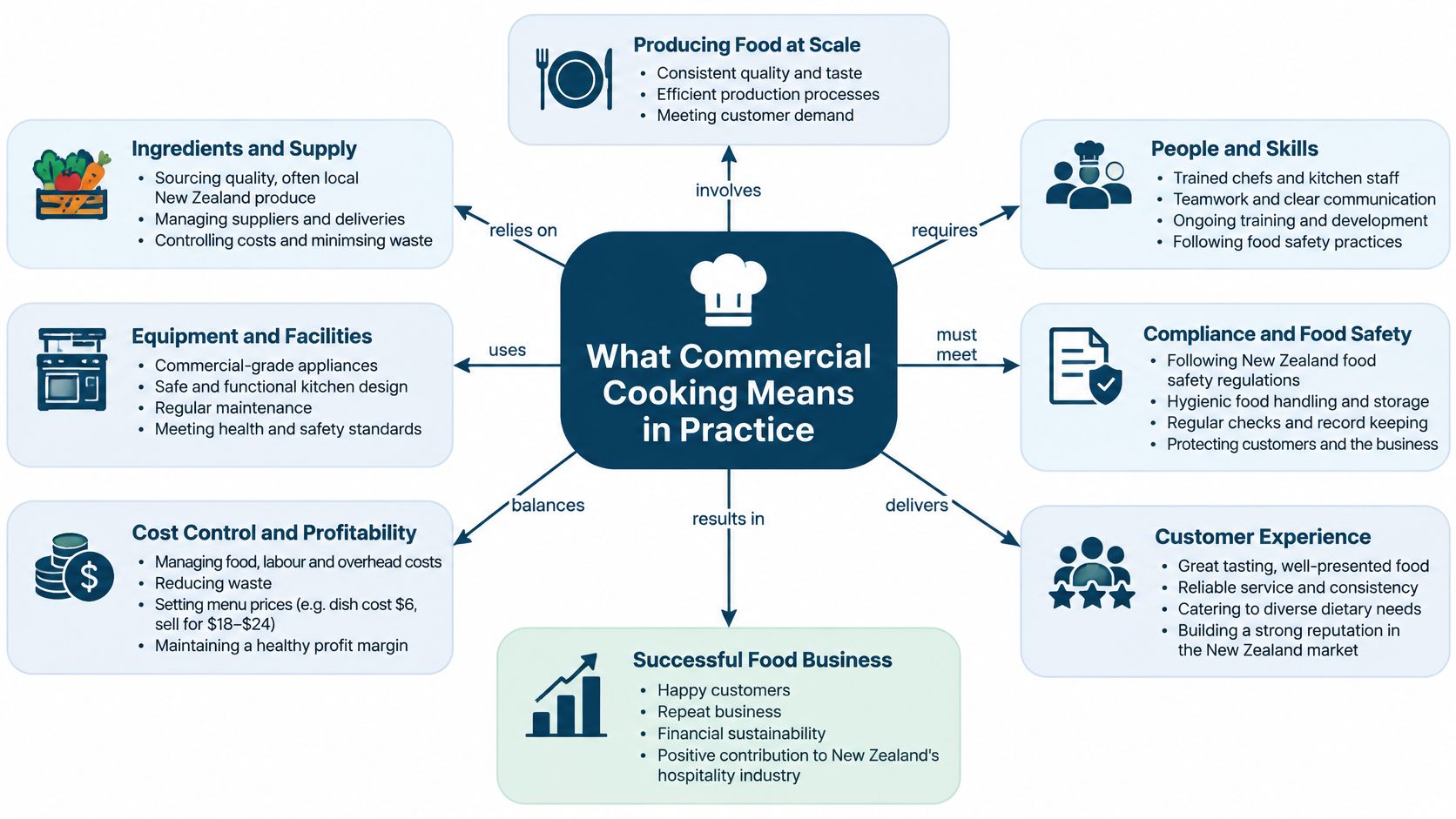
A café that buys for the function venue's problem ends up paying for batch capacity that sits idle between peaks, while the hot holding that keeps its queue moving was never in the budget. The function venue that buys for counter speed hits the reverse wall on the night two hundred plates need to leave together. Match the equipment to the environment first, and the specification writes itself.
Commercial and Home Cooking Side by Side
| Consideration | Commercial cooking | Domestic cooking |
|---|---|---|
| Food production volumes | Batches for many covers, repeated across service | One household meal at a time |
| Equipment requirements | Ranges, ovens, refrigeration and dishwashers sized for continuous use | Standard domestic range, oven and fridge |
| Consistency | Same product, portion and quality across orders and peaks | Varies with the cook and the day |
| Food safety obligations | Food business obligations under the Food Act 2014, with documented controls | General household food hygiene |
| Preparation speed | Paced to order volume with stations and timing | Set by one person at their own pace |
| Staff responsibilities | Defined roles across prep, cooking, pass, washing and management | Usually one person or household members |
| Kitchen layout | Built around workflow stations and separated raw and ready-to-eat areas | Built for storage and convenience |
| Cleaning procedures | Scheduled, documented cleaning and sanitising | As needed, often by hand |
| Operating costs | Commercial power, labour, waste handling, servicing and compliance | Household utilities and groceries |
A commercial kitchen has to produce the same dish on a quiet Tuesday and a packed Saturday, with different staff on the line, and have it arrive the same both times. That's why written recipes, portion specifications and prep lists aren't paperwork for its own sake. They're the mechanism that makes consistency survive a change of cook.
Home cooking carries no such burden. One person works for one household, tastes as they go and adjusts. A food business has to be able to show how its food is controlled, which is where records, checks and verification enter the picture, and where the two worlds stop resembling each other at all.
Practical rule: if the dish can't be reproduced by someone who didn't invent it, it isn't a menu item yet. It's a personal skill.
Configuration varies just as much. A bakery-café baking on site needs a different layout from a caterer who cooks in a production kitchen and reheat at events, and a school canteen serving hot lunches needs holding and cleaning routines that a bar snack menu never has to think about.
Operating costs follow the same logic in general terms: commercial power loads, labour, waste handling, servicing and compliance all sit alongside the grocery bill, and the balance shifts with the business. A short, high-margin menu cooked to order carries a different cost shape from a broad menu held hot for hours.
Before shortlisting anything, list the three busiest service periods in a normal week and ask one question of each: can the kitchen put out the same quality at that pace without extra people or extra equipment? If the answer is no, that's the equipment conversation, and it's a better starting point than a catalogue.
Cooking Methods and the Equipment Each Needs
| Cooking method | Typical equipment | Common hospitality applications |
|---|---|---|
| Grilling and chargrilling | Chargrill, griddle or salamander | Steaks, burgers, vegetables and flatbreads |
| Frying and deep frying | Deep fryer or fry range | Chips, tempura, schnitzel and battered items |
| Baking and roasting | Convection oven or deck oven | Bread, pastry, pizza and roast meats |
| Steaming | Combi oven, steamer or tiered steamer | Vegetables, rice, dumplings and banquet batches |
| Boiling and simmering | Boiling pan, bratt pan or stockpot | Stocks, sauces, soups and pasta |
| Combination cooking | Combi oven | Roasting with steam, rethermalising and cook-chill production |
| Batch cooking | Tilting bratt pan, convection oven and blast chiller | Braises, sauces and prepared meals for holding |
| Sous vide | Water bath or sous vide circulator and vacuum sealer | Proteins held at a set temperature before finishing |
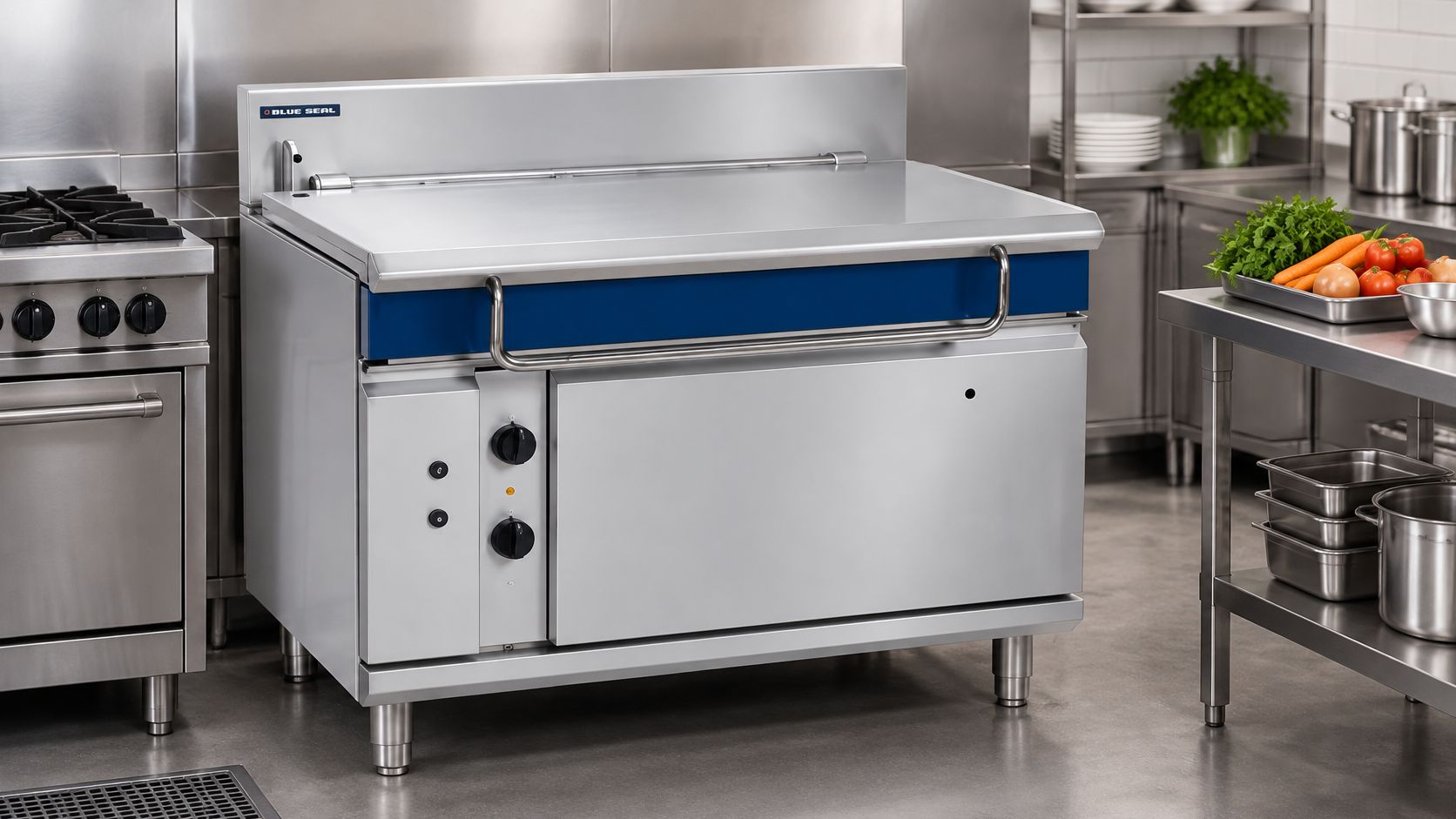
A heavy-duty batch vessel changes what a production kitchen can do in a single shift. The Blue Seal Evolution Series G580-12E 1200mm gas tilting bratt pan pairs a gas-fired stainless steel pan with an electric power tilting mechanism, so braises, sauces and stocks discharge straight into pans or gastronorms without anyone lifting the vessel.
Method sets the equipment list before brand or budget does. A chargrill or a fryer throws heat and grease into the room, so extraction and clearances become design constraints from the start. Steaming and sous vide sit at the other end of that problem, asking more of water supply and drainage than of the extraction canopy.
Recovery time matters as much as raw output. Load cold product onto a hob or grill and the surface temperature drops. The equipment has to climb back quickly, or the next four orders go out late and the bottleneck moves to the pass.
The menu decides the method. Pan-fried proteins cooked to order want fast hobs and a flat-top within arm's reach of the pass. A menu built on braises, soups and sauces wants batch capacity with rapid chilling behind it, because the cooking is only half the job.
One simple tip: count the cooking methods on your menu before you count appliances. Four methods usually need three well-chosen pieces, and the fourth appliance is often what crowds the line.
A bistro adding a slow-roasted lamb special may need a second oven cycle or a tighter batch plan more than another pair of hands. Sous vide holds proteins precisely before finishing, but it only earns its bench space when time and temperature records are kept as part of the routine. Where the choice comes down to fan-forced or steam-assisted cooking, the comparison between combi ovens and convection ovens is the one to read before committing.
Pan work trips up more new cooks than any other method, and the common sautéing mistakes beginners make are worth covering with junior staff before service pressure exposes them.
List the ten best-selling items on the menu, tag each with its cooking method and total the equipment and extraction each method demands. That list is a stronger purchasing brief than a wish list of brands.
Which Equipment a Venue Needs
Two venues can share the same floor area and need completely different equipment lists. Kitchen size tells you almost nothing; the menu and the cover count tell you nearly everything. The useful question is which pieces the menu can't be produced without, and which supporting capacity keeps one failure from halting service.
The cooking categories are familiar: commercial ranges, griddles and chargrills, deep fryers, convection ovens, combi ovens, induction equipment and commercial microwaves. Refrigeration, food preparation and warewashing sit on the same list even though none of them apply heat, because a fridge that can't hold temperature stops service as fast as a dead oven.
Two venues show how differently the list lands.
A small café running a counter menu of toasties, soups and cakes may need a convection oven, a sandwich press, a commercial fridge and a soup kettle. Induction hobs or a sous vide circulator earn their place only when a menu item calls for them. Buying them early means paying for capacity that sits idle through most services.
A high-volume restaurant is a different problem. It may need ranges, a combi oven, a fryer, a blast chiller and a longer refrigeration run, because it produces across several methods at once and has to cool the surplus afterwards. The same equipment name can also mean a different size: the restaurant's line is sized for simultaneous orders, while the café's oven only has to match the batch it bakes each morning.
Preparation equipment either saves labour or doubles it. A commercial vegetable preparation machine with interchangeable discs delivers consistent cuts, which improves presentation, portion control and cooking behaviour, and removable feed components make cleaning between products practical rather than painful. The Robot Coupe CL50 Ultra Pizza Pack vegetable preparation machine suits venues running varied prep through one station. The wider guide to must-have prep equipment for commercial kitchens covers the rest of that station.
Hospitality stocks these categories across Waldorf, Blue Seal, Cobra, Convotherm, Unox and Turbofan for cooking and ovens, SKOPE for refrigeration, Robot Coupe and Fimar for food preparation, and Chef Inox and Force for cookware and utensils.
Warewashing sets the cleaning rhythm for the whole kitchen, since sinks and dish machines decide how quickly clean stock returns to service. The Tiles Mate sink selection guide is a useful primer on sizing that station.
How a Commercial Kitchen Moves Food Through Service
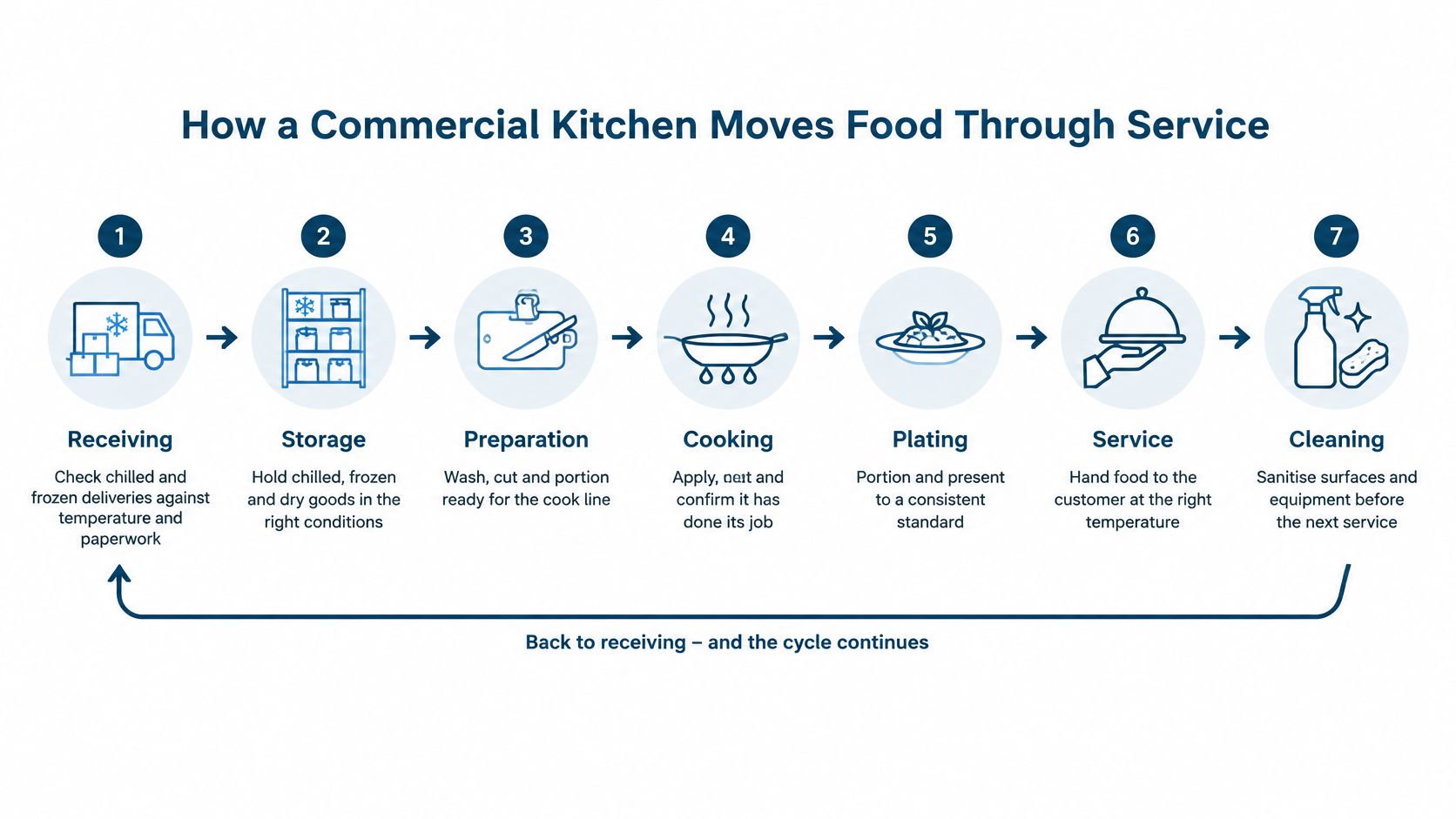
Follow a single menu item from the back door to the bin and the weak points show up fast.
Receiving is where most kitchens lose control first. Chilled and frozen deliveries get checked against temperature and paperwork before they go anywhere, and anything out of range gets refused rather than absorbed into stock. Storage runs on first-in-first-out rotation with labels showing the date and prep time, because an unlabelled container is a decision nobody can make later.
Preparation follows: mise en place, defined stations for cold prep, hot line and pastry, portion control by weight or scoop size, and prep lists built from forecast covers rather than habit. Cooking and plating run to the pass, where the grill, fryer and oven have to finish together so plates leave as a table rather than a trickle.
Holding is where food safety and equipment selection meet. MPI states that reheated food must reach at least 75°C in the coolest part of a liquid or the centre of a solid, then stay above 60°C until service. Bain-maries and hot cabinets don't reheat food; they hold it, so food must already be reheated before it goes in. If reheated food is held between 5°C and 60°C, it may be reheated again to above 75°C and served hot above 60°C within four hours, otherwise it must be discarded, and hot-held food needs checking after two hours and every two hours after that (Ministry for Primary Industries).
Cleaning and waste close the loop. Clean-as-you-go, sanitising stations and waste tracked per shift reveal overproduction, because batch sizes and holding practices are what generate most kitchen food loss. Nationally, roughly 1.22 million tonnes of food is lost or wasted each year, equivalent to around 5 to 10 percent of total food production (Ministry for the Environment).
Workflow beats technique more often than anyone admits. A strong chef on a badly sequenced station loses time all night, while a clear layout with consistent prep lets ordinary cooks hit service speed.
There's a trade-off buried in batch sizes. Larger batches improve labour efficiency but raise overproduction; smaller batches cut waste but demand more labour and equipment that recovers quickly between rounds. The design of the flow decides which side of that you land on, and designing a kitchen that saves time on every service is where that decision gets made.
Food Safety Controls Commercial Cooking Must Meet
Commercial cooking is a heat-treatment process and a verification process at the same time. A browned surface proves nothing about the centre, so the kitchen needs a calibrated probe thermometer and a documented habit of using it at the centre and at the coolest point of the product.
MPI publishes validated temperature and time combinations rather than treating one figure as the only acceptable target: 75°C for 30 seconds, 73°C for 60 seconds, 70°C for 3 minutes, 68°C for 5 minutes, 65°C for 15 minutes, or 63°C for 31 minutes. A business either follows the manufacturer's cooking instructions or uses the approved combinations in its food-control procedures, then serves immediately, holds above 60°C or cools rapidly under the prescribed rules (Ministry for Primary Industries cooking guidance).
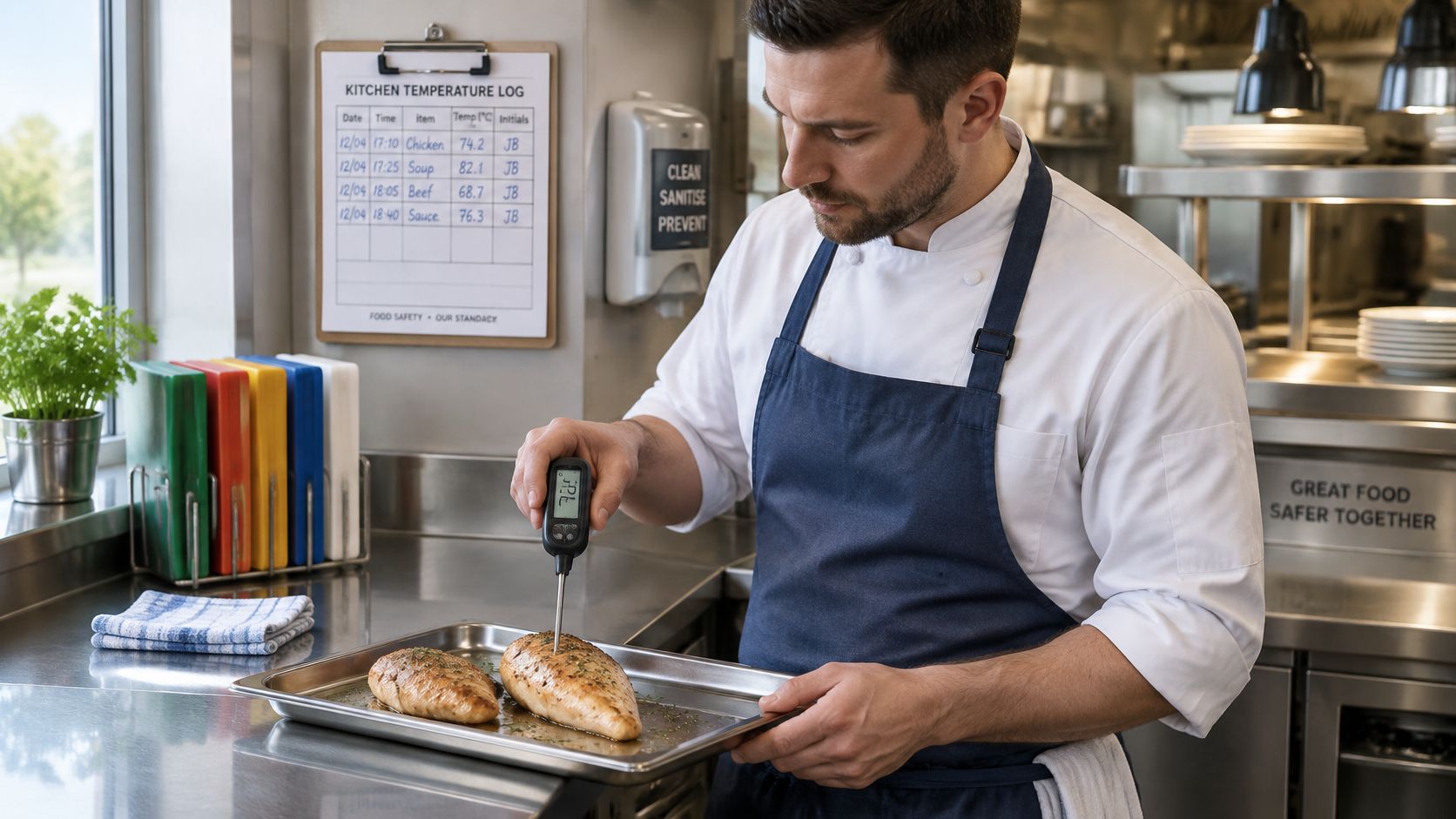
The controls a kitchen builds into daily routine:
- Temperature verification. Probe readings at the centre and the coolest point, recorded where the food-control plan requires it.
- Raw and ready-to-eat separation. Colour-coded boards, separate prep zones and handwash points positioned where staff work.
- Cleaning and sanitising schedules. Named, timed and signed off, not left to whoever has a spare minute.
- Allergen management. Managed at prep and again at the pass, because the plate is the last chance to catch a mistake.
- Training records. The plan only holds if the people running the line have been shown what it requires.
The classic failure looks like this: a combi oven signals the cycle is complete, the surface reads hot, and the centre of a thick protein sits below the required temperature. Only the probe check catches it.
Cooking safely is one obligation; registering and verifying the business is another, and it sits above the kitchen floor. Under the Food Act 2014, the pathway depends on the business and its activities: a template Food Control Plan, a National Programme, or a custom plan. The same cooking activity can fall under different pathways depending on risk and operating model, and the Food Business Levy introduced from 1 July 2025 was initially set at $57.50 plus GST for the 2025–26 year under the relevant registration arrangements (Far North District Council food premises guidance). The wider picture on food safety regulations in New Zealand is worth working through before a fit-out is signed off.
For staff moving into supervisory roles, formal training helps, and the route to obtain a NSW food safety certificate shows how other jurisdictions structure that qualification.
The question to settle before buying anything is simple: who checks temperatures, when, and where is it recorded?
Why Commercial Equipment Is Built Differently
A small café buys a six-burner commercial range because it looks indestructible. Two burners end up carrying most services, the larger gas connection and extraction canopy were paid for anyway, and the extra floor space it occupies could have held a prep bench. The unused capacity keeps costing money every day it sits there.
The design differences worth comparing are practical ones. Production capacity and tolerance for continuous use across a full shift. Heat output under sustained loading. Stainless construction with sealed joints, because washdown happens daily rather than weekly. Cleaning access, such as removable shelves or a pan that tilts to empty. Serviceability and local parts supply, since a failed element on a Friday can cost a weekend of trade. Power and extraction requirements. Warranty terms written for commercial duty. Energy consumption across a working day rather than a rating sticker.
Suitability test: domestic appliances suit occasional use at household scale, semi-commercial equipment suits light daily use in a small café, and fully commercial equipment suits continuous, high-volume or multi-shift work. Domestic appliances placed into a food business often struggle with the workload and may not support the cleaning and hygiene routines the business needs.
The reliable way to place a venue on that scale is to log a normal week's peak loads before committing: covers per service, batch sizes, and how many hours each appliance will run. An honest log usually narrows the choice to one tier, and it shows which of the build differences above will earn their keep.
Plan the Operation Before You Buy Equipment
A commercial kitchen should be planned around the food it needs to produce, the pace of service and the people running it. Use this checklist to define the operation before choosing equipment.
| Planning consideration | Why it matters | Common mistake |
|---|---|---|
| Menu and service model | Sets the cooking methods, holding needs and service pace | Buying equipment before the menu is settled |
| Daily and peak meal volumes | Determines capacity, batch size and number of stations | Sizing for average days and ignoring busy peaks |
| Cooking and preparation methods | Determines equipment type, ventilation and energy requirements | Choosing a method staff cannot run consistently |
| Food safety requirements | Sets probe, holding, cooling and cleaning needs | Treating food safety as paperwork after installation |
| Equipment selection | Matches capacity and build quality to the workload | Choosing by purchase price alone |
| Kitchen workflow | Keeps prep, cooking and washing in a practical sequence | Placing stations around equipment rather than the work |
| Ventilation and building services | Confirms power, water, drainage and extraction before ordering | Discovering a service requirement after delivery |
| Staffing requirements | Sets how many people are needed at each station during peak service | Designing for one cook when the kitchen needs three |
| Operating costs | Covers energy, labour, waste, cleaning and servicing | Counting the purchase price but ignoring running costs |
| Future growth | Allows for a larger menu or higher volume | Designing so tightly that a menu change requires a rebuild |
A mismatch between the menu and the layout can be expensive to correct. An oven may no longer suit the menu, a fridge may occupy needed prep space, or extraction may require building work to extend. These are operational decisions to resolve during planning, not after equipment arrives.
Use a plan for consistent meal service to connect menu, volume and workflow before requesting quotes.
Hospitality supplies commercial cooking equipment from Blue Seal, Convotherm, Unox, Turbofan and Cobra, refrigeration from SKOPE, food preparation equipment from Robot Coupe and Fimar, warewashing from Winterhalter, and cookware and utensils from Chef Inox and Force. Freight for larger, bulky or commercial equipment is calculated separately. Hospitality may contact customers to confirm or adjust freight costs before dispatch.
For a complex layout, SACH Design provides professional commercial kitchen planning and fit-out design.
Before requesting a quote, write a one-page brief covering the menu, peak covers, cooking methods and holding needs. It gives suppliers a practical basis for recommending equipment that fits the operation.
Hospitality supplies commercial cooking equipment, refrigeration, preparation equipment and cookware to hospitality businesses across New Zealand. For a fit-out, upgrade or replacement, the team can discuss practical requirements such as power, extraction, holding and cleaning. Visit Simply Hospitality to browse its ranges or start a conversation about your kitchen.