


Why Glasses Washed Through Winterhalter Look Better
Service starts in twenty minutes and someone is at the end of the bar with a cloth, working through a rack of wine glasses one at a time because the machine has left them spotted on the bowl and cloudy at the rim. It happens in bars, cafés and hotel restaurants most nights, and the machine usually takes the blame. The cause is rarely a single fault. Glass appearance is an output of the whole washing process, and a dull glass is telling you something about water, temperature, chemistry, loading or drying.
The practical answer to why glasses washed through Winterhalter look better isn't a brand promise. Winterhalter builds commercial glasswashing as an integrated system of machine, water treatment, chemistry, racks and programmes, and that coordination is what removes the visible marks. Put the same components together properly on any competent machine and results improve. Get them wrong on a premium one and the glasses still come out marked.
Why Glassware Looks Better and What Winterhalter Adds
A properly washed glass is bright and transparent. The bowl has no water spots, the sides show no streaking, the rim carries no detergent film, and last night's lipstick is gone. Every glass in the rack should match its neighbour. It should also be dry enough to pour the moment it comes out.
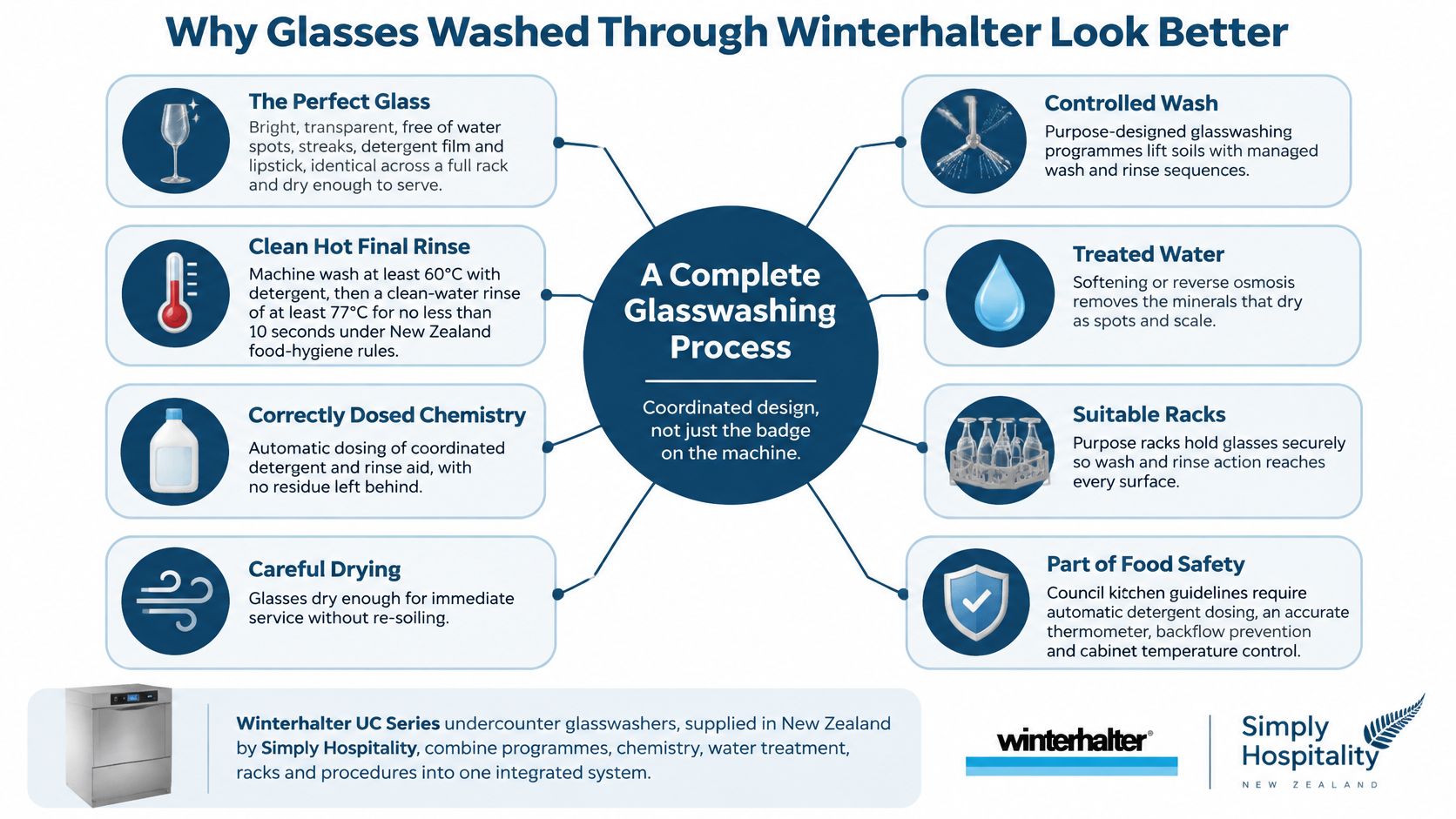
Getting there takes a controlled wash, a hot final rinse held at the right temperature for long enough, water treated to suit the site, chemistry dosed accurately, racks that hold glasses apart, and drying that does not undo the wash. Winterhalter's advantage is how tightly those pieces are designed to fit together. Hospitality supplies the brand in New Zealand, and the UC Series undercounter glasswashers are the machines most venues meet the brand through.
The New Zealand standard behind the result
The country's food-hygiene rules already set the temperatures and contact times that make machine washing more consistent than washing by hand. Under the Food Hygiene Regulations 1974, eating-house utensils must be washed in machine water of at least 60°C with detergent and rinsed in clean water of at least 77°C for no less than 10 seconds, a manual fallback requires a wash at no less than 43°C then immersion in clean water at no less than 77°C for two minutes with controlled separation in a wire basket, and licensed premises must clean glasses, jugs and other beverage-service utensils in an approved glass-washing machine.
That manual path is a full station: hot immersion, a timer, and glasses kept apart in a basket. Once the pass is full and the person on glass is also serving, those steps get shortened and the marks come back. Glassware was written as its own provision rather than folded into general crockery rules, which shows the weight the drafters put on beverage service.
Repeatable temperature, detergent exposure, rinse time and drainage are what keep greasy films, lipstick marks, cloudy deposits and water spots off the glass. A cycle that drifts on any one of those puts them back. I judge a glasswasher on what it delivers every cycle, not on a quiet afternoon when someone has time to watch it.
What a properly specified glasswasher has to provide
A local-authority kitchen guideline sets the equipment bar for New Zealand food premises. Where reusable plates, crockery and glasses are used, the Whakatāne District Council kitchen guideline requires a commercial glasswasher with automatic detergent dosing, an accurate thermometer and a suitable backflow-prevention device, and it requires temperatures to be measured inside the cabinet rather than at the incoming hot-water supply.
That detail changes day-to-day results. Automatic dosing closes the gap between careful measuring and a hurried squeeze of the bottle. Cabinet measurement records what the glass experienced, not what the tap was supplying. Backflow prevention keeps the wash circuit out of the potable supply. Those three belong in the food-safety plan when the machine is chosen, rather than being left to a convenience purchase.
The components that have to line up are easier to see in one view.
Where Winterhalter fits in
Winterhalter is a specialist commercial warewashing manufacturer rather than a general catering brand. Glasswashing is built around purpose-designed glass programmes, matched wash chemistry, water treatment options and racks shaped to specific glass profiles. Hospitality carries refrigeration and dishwashing brands including Airex, Adande, Atosa, Classeq, Cossiga, Festive, Irinox, Rhima, SKOPE and Winterhalter.
Programmes, dosing, water treatment and racks are specified together and commissioned against the site, so fewer of those variables are left to whoever is on shift. Glass shape still sits in that specification. A thin rim and a rolled rim take heat and handling differently, and the commercial glassware range covers the shapes most New Zealand venues pour into.
Why Water Quality Makes Such a Difference
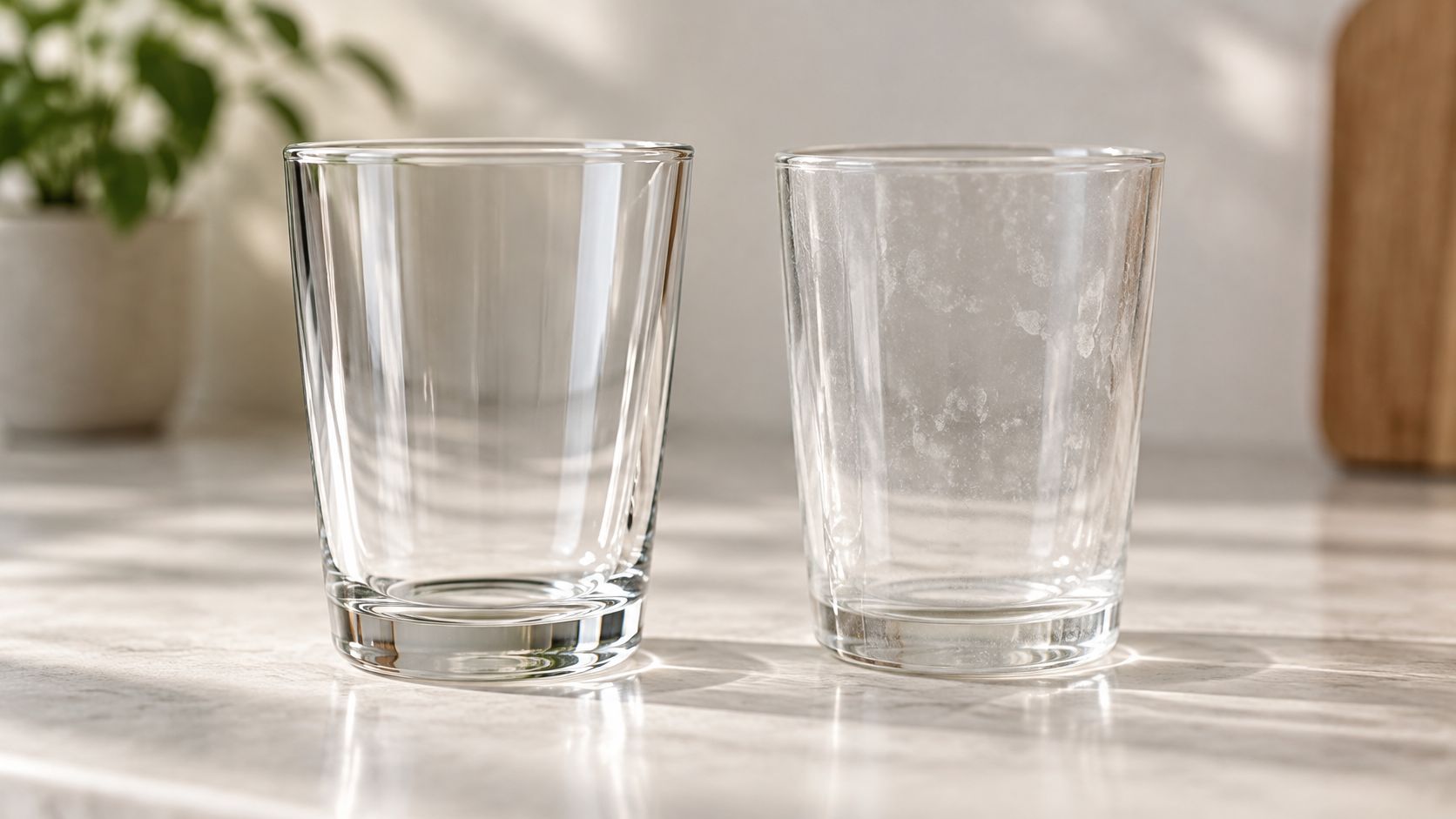
A rack leaves the machine looking clean, then dries into faint rings. Every droplet of rinse water that evaporates leaves whatever was dissolved in it. Calcium and magnesium stay on the surface as a ring or a spot, so a customer reads a finished wash as dirty glassware. The wash lifted the soil. The minerals arrived with the rinse.
Drinking-water guidance in the New Zealand Gazette identifies calcium and magnesium hardness as a contributor to scale deposition, links hard water to spots or streaks on dishes and glassware, and shows how far local supplies diverge: Gisborne city water sits at approximately 30 to 70 mg/L as CaCO3 in its soft-water catchment but reaches roughly 100 to 180 mg/L when river water is blended, while Whanganui is approximately 175 mg/L. The same guidance recommends keeping dishwasher salt topped up to limit spotting, and using rinse aid so the final rinse sheets off rather than drying in beads.
| Supply example | Hardness (mg/L as CaCO3) | What it means for glassware |
|---|---|---|
| Gisborne city supply (soft-water catchment) | 30-70 | Low spotting risk, but still confirm with a site water test |
| Gisborne with blended river water | 100-180 | Visible spotting likely without softening or reverse osmosis |
| Whanganui supply | approx. 175 | Hard water; expect spots and scale unless treatment is in place |
The same glasswasher, the same detergent and the same staff can produce brilliant glassware in one town and speckled glassware in another. I treat that jump, including a seasonal blend of river water, as a change to water treatment and dosing, not as a fault in the wash cycle. Water is the variable that decides how everything else should be set.
Softening and reverse osmosis do different jobs
Softening takes calcium and magnesium out by ion exchange before the final rinse. It is a consumable system, not a fit-and-forget one. When the salt runs out, hardness passes straight through. That is how a venue that once had spotless glasses develops spots without anyone changing the programme.
Reverse osmosis forces water through a membrane that strips dissolved minerals far more completely, producing a near-mineral-free final rinse and the clearest finish available. It costs more to install, needs membrane care and generates reject water, so it belongs where the presentation standard and the hours spent hand polishing justify it. A soft supply with correct dosing may be enough, and not every Winterhalter installation includes reverse osmosis.
Set dosing against measured site hardness, keep salt and rinse aid replenished, and check the result with a final-rinse conductivity or water-quality reading. Extra detergent does not pull minerals off the glass.
The mistake worth flagging first: adding more detergent when glasses spot. Detergent does not remove minerals. It adds another layer that still has to rinse off cleanly.
The dishwasher performance and water quality guide covers what shifts when supply conditions change through the year, which matters in towns where river blending alters hardness seasonally.
Where the finish is part of the customer experience and staff time is disappearing into polishing, an integrated approach is worth comparing. Winterhalter UC Excellence-i Undercounter Warewashers build reverse osmosis into the cabinet, with integrated dosing, quadruple filtration with a clouding sensor and VarioPower adjustable pressure, so water quality becomes a controlled part of the wash process rather than a separate freestanding unit plumbed in beside it.
The Role of Detergent and Rinse Aid
A Saturday service glass that looks dull usually failed in one of two places. The wash did not lift the soil, or the final rinse did not leave the surface cleanly. Detergent does the first job in the wash phase, lifting beverage residue, oils, food fats and lipstick so they can be carried away. Rinse aid does the second job in the last seconds of the cycle, so water sheets off the bowl instead of sitting on it.
How minerals in drying droplets mark a glass is already set out in the water section. Dose rate is the part of that finish you still set on the machine.
Both dosing failures show up on the glass
Under-dosing shows as a greasy film, a smear when you breathe on the bowl, or drink marks that survive the cycle. Soil then stays in the wash water. Later racks are washed in progressively dirtier water, so the next round looks worse even if the glasses went in lightly soiled.
Over-dosing is quieter, and I would check it before blaming the supply. Detergent that is not fully rinsed leaves its own film, raises how hard the rinse has to work, and over time dulls softer glass. Too much rinse aid shows as streaks after drying, the mark often read as hard water. A cloth can hide it for one service. It does not correct the dose, and the polishing time comes straight off the bar.
Why chemistry, machine and water belong together
Winterhalter designs machines, dosing equipment and wash chemicals to work as a set, so the recommended dose sits with the machine rather than as a generic figure on a bottle. Putting in whatever chemical is on special breaks that match. The wash underperforms, and the wrong product can affect machine components and the warranty position. Follow the manufacturer's recommendations for that model.
The glass has to suit the chemistry as well. Soft glass and delicate crystal-style stems that have lived through aggressive dosing for years cloud permanently. No rinse aid brings that surface back, and hand polishing only spends labour on a finish the wash already took.
Chemical format is a separate decision from chemistry quality. A practical comparison of best dishwasher detergent for venues explains how powder, liquid and gel formats differ in dissolve behaviour and dosing, which matters when the dosing system expects a particular type.
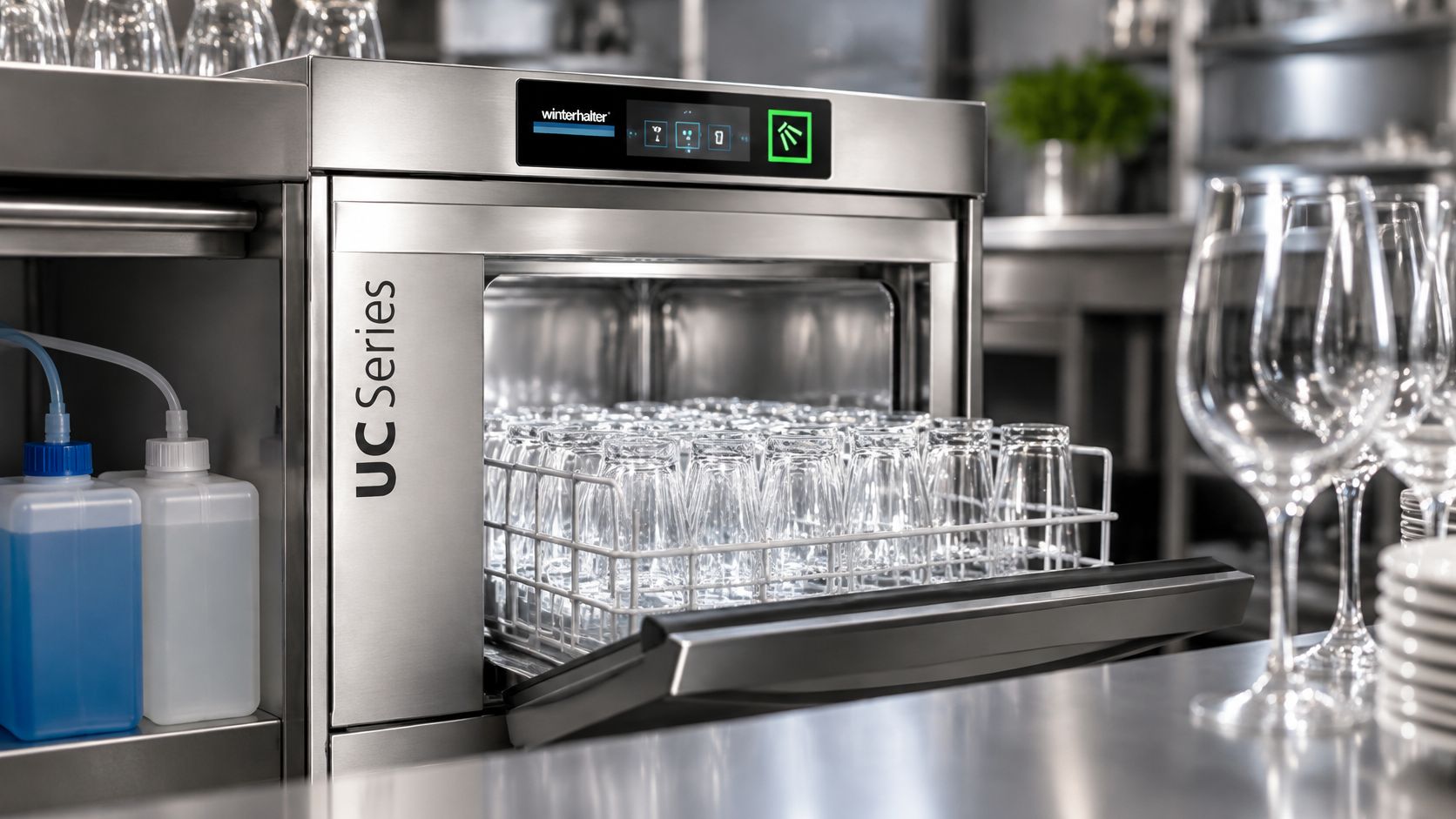
Holding that dose is easier when chemical storage sits with the machine and someone looks at it at open, not when a jug on a back shelf runs out mid-service. The Winterhalter UC Series Undercounter Warewashers are offered in several variants, so match the model to the bar's throughput before you assume every unit doses the same way.
The guide to how rinse aid dose and water hardness affect drying is the reference for setting that rate against the supply. Put chemical levels and the dosing equipment on the opening check, next to the coffee machine and the fridge temperatures. A short look at tanks and injector lines costs less than a rack of glasses that need a cloth before they can go back on the shelf.
How Glasswashing Programmes Protect Presentation
A Saturday service can put three glasses through the same pass: a thin-rimmed wine stem, a heavy beer tumbler, and a water glass that has only held ice. They differ in rim thickness, bowl shape, how they sit in a rack, and how much mechanical load they take before a chip. The reason is physical. One setting cannot match all three.
Temperature and contact time are the standard
New Zealand's food-hygiene rules put a measurable heat-and-time standard on beverage glassware in licensed premises. Glasses must be cleaned and rendered hygienic in an approved glass-washing machine, with rinse water reaching at least 83°C and maintaining contact for no less than 10 seconds; an authorised officer may accept a 77°C control point where the machine design prevents meaningful heat loss before the rinse reaches the glass, according to the Food Hygiene Regulations 1974.
The standard is about delivery, not heating. The required temperature has to arrive at the glass surface for the required exposure time, on every cycle, including the tenth rack of a busy Saturday. A machine that hits the target reliably gives a more repeatable finish than one that reaches it on a quiet Tuesday.
Matching wash energy to the glass
- Soil level. Sticky liqueurs, cream-based cocktails and egg white residue need more wash energy than a water glass. Reserving an intensive cycle for heavy soil keeps the standard programme gentle on everything else.
- Glass type. Fine stemware benefits from reduced mechanical action and secure support at the bowl, not the rim. Heavy tumblers can take far more.
- Mechanical action. VarioPower adjustable wash pressure lets one platform be turned down for delicate glassware and up for bistro loads, so the same machine can serve a cocktail list and a function menu.
- Rack configuration. Glasses that touch in the rack convert wash movement into rim contact, and that is where chips begin. Row dividers and the correct rack depth do more for breakage than any handling instruction.
A bar running wine service, draught beer and a short cocktail list typically works from three programmes: a standard glass cycle, a delicate option for stemware, and an intensive cycle for heavy soil. Those three are specific enough that casual staff still pick the right one at 11pm.
Running glassware through a plate machine is one of the quickest ways to break stems and bake on spots, and the glasswasher versus dishwasher comparison sets out when a dedicated machine earns its bench space.
The glass itself sets the ceiling on results. Ranges such as Zwiesel, Stölzle, Pasabahce, Ocean and Luigi Bormioli reward operators with clarity and durability, but only when the programme and racks respect the glass. RCR Professional Glassware is sold by Simply Hospitality and is a common choice where survival through a busy wash matters as much as brilliance on the table. Correct support is the other half of that equation, and Winterhalter glass-washing racks come in multiple row counts and depths so spacing matches the glass rather than the rack being a compromise.
Diagnosing Spots, Streaks and Hand Polishing
A bar that still finishes service with a cloth is usually washing around a fault. Polishing is a symptom, not a routine. Twenty minutes a day looks harmless until you match the mark on the glass to the step that left it.

Hardness, rinse temperature, contact time and dose belong to the water and chemical setup. This check is what those settings failed to clear, plus the habits a machine cannot correct on its own: soil left on the rim, glasses touching in the rack, and a cycle picked because it was the last one used.
| Symptom | Most likely cause | First check |
|---|---|---|
| Lipstick or drink marks | Soil left on before the wash | Scrape rims, then select a programme that matches the soil rather than the previous pour |
| Chips or fine scratches | Glasses touching, shallow rack depth, or rough handling after the cycle | Check pegs and row spacing, and how glasses are lifted out |
| Permanent cloudiness | Long-running imbalance of treatment and dose, or glass never suited to machine washing | Confirm the glass is machine-rated, then review treatment and dose together |
| Marks that return after a correct dose | Rinse contact blocked by nesting, or water that never sheeted off | Watch one rack: bowls should drain clear, not sit filmed or stacked |
What a shine does and does not confirm
New Zealand Food Safety guidance describes cleaning as separate wash, rinse, sanitise, final-rinse and drying stages, and notes that air-drying is preferable because wet utensils can pick up dirt or contaminants, as set out in the Ministry for Primary Industries cleaning and sanitising guidance. A glass can look brilliant and still have skipped a stage. It can also carry a faint mineral mark after a sanitising rinse that did its job.
Raising the wash temperature to chase a spot usually wears the bowl faster and leaves the cause in place. Contact time, an accurate dose and an unblocked rinse decide whether that heat did any useful work.
A spotless glass shows that visible soil came off. Sanitising and drying still have to be checked on their own.
What polishing actually costs
Take a bar where staff spend 20 minutes a day polishing, across 300 trading days. That is about 100 hours a year. At an illustrative labour cost of $30 per hour, that is $3,000 in staff time annually, before the glasses that get rewashed or the ones that break in the hand.
I would not budget that figure as money coming off the wage bill. Cutting polish time rarely drops a shift. The hours usually go back into service. The return shows up as capacity: glasses that leave the machine ready to pour, and fewer rims chipped while someone hunts a mark the wash should have prevented.
Why Better Glasswashing Matters Commercially
A premium wine pour or a $22 cocktail is undermined by a lipstick mark on the rim or a haze of mineral spots on the bowl. Guests read the glass before they read the menu. Consistently clear glassware is one of the cheapest signals of standards a venue has, and one of the most obvious when it slips.
Clear glass is a process output. Hardness in the supply, rinse temperature held long enough for water to sheet off, dosing that stays accurate, and racks loaded so the jets reach the bowl all show up in the same place. New Zealand water varies sharply from town to town, so one machine on one programme will not finish every glass the same way.
Operationally, reliable results change the rhythm of service. Glasses come out ready to use, so turnaround is faster, rewashing drops, and staff handle each glass fewer times. Presentation holds at 8pm on a Friday, which is when inconsistency shows most. Well-matched cycles and correct racks treat glass more kindly than an overloaded machine or a sink wash. That gentler handling protects rims and slows the clouding that ends a glass's working life. Breakage will not fall by a set amount from the machine alone. The practical gain is fewer extra touches, and racks that stop glasses knocking.
Hygiene records get simpler too. Automatic dosing and a rinse you can set and check give a procedure to repeat, rather than a habit that changes by shift.
A Winterhalter system is a capital purchase plus water treatment, salt, detergent, rinse aid, servicing and power. I would fit one where presentation and labour time already cost the venue, not as a default upgrade.
The commercial case rests on total cost of ownership, not purchase price. A venue washing 200 glasses a night in a hard-water town will get more from treatment and correct dosing than from a bigger machine. A small café with soft water may need neither reverse osmosis nor an intensive specification. Venue type, glass volume, water supply and how much polishing time is currently disappearing all change the answer.
The cost of hand polishing glassware is worth measuring against your own numbers rather than a generic claim. Record the rewash rate, polishing minutes, chemical use and breakage for a normal trading month before any change, then compare afterwards. That baseline is the only evidence that means anything for your site.
How to Achieve Better Results With a Winterhalter Glasswasher
A full rack of stems comes off the machine mid-service and the rims still look dull because the shift around it slipped: a blocked filter, salt that ran out, glasses stacked so the rinse never reached the bowl, or a programme someone changed because the bar was behind.
Clear glass is the result of the whole wash, not a setting on the panel. Supply hardness, rinse temperature and how long that rinse contacts the glass, dose accuracy, and loading discipline all show on the finished piece. A Winterhalter will not override a missed check.
The three checks that fix most complaints
Salt and rinse aid first. Spotting that turns up after a heavy service often tracks to an empty salt reservoir, or a rinse aid drum that ran out two shifts earlier. Check both levels before anyone opens a setting or treats it as a machine fault. Top up, run one rack, and watch how water sheets off a single glass before you change the chemistry.
Filters and wash fields second. A blocked filter sends the same soil back through every rack that follows. Pull the filters, clear the wash field and the rinse nozzles, and refit them as the manual describes. That job takes minutes. Leave it, and one dirty rack becomes a day of smeared glassware.
Loading third. Glasses packed bowl to bowl do not get a proper rinse. Sit each glass inverted on the pegs with a gap between bowls. Spacing costs nothing, and on a busy bar it is the mark that shows up when salt, rinse aid and filters are already in order.
I would stop there before anyone starts moving temperatures or swapping products. If those three are right and the glass is still marked, the fault has left the pass. It is now a specification or servicing question: supply hardness that no longer matches the treatment in use, a dose that has drifted, or a service visit that is overdue. Size the machine and the baskets to peak glass throughput, not to a quiet Tuesday. Keep the glass programme for stemware and save the intensive cycle for heavy soil. Record dose checks and service visits so the next shift is not guessing.
Replacement parts sit in that same category. A cover or jet can look interchangeable and still be wrong for the appliance. Lugs, clearances and airflow differ by model, version and product code, so verify those before ordering. Opened model-specific parts may be difficult to return once used.
Glasses that leave the machine clean and then sit wet in a crowded rack will mark again. Air-dry them in a clean space and pick them up by the stem or the base. That handling is part of the wash.
Winterhalter commercial glasswashers are supplied in New Zealand alongside glasswashing chemicals, racks and commercial glassware that make a system work as a set. If the glasses coming out of your machine aren't where they should be, the team can work through the whole process with you, from supply water hardness to rack loading, and help specify a setup that suits your venue and glass volume. Visit Simply Hospitality to see the range or get advice on the right specification for your bar, café or hotel.