

Why Some Operators Outgrow Their Refrigeration
Most advice about commercial refrigeration starts with litres. Buy a bigger cabinet, get more storage, problem solved. That framing misses how venues outgrow their equipment. A fridge that suited opening week can be mechanically sound five years on and still be the wrong tool, because the kitchen no longer works the way it did when the cabinet was sized. Outgrowing refrigeration is often a recovery, access and post-cook cooling problem, not a shortage of advertised litres.
The shift is rarely sudden. Stats NZ reported that employment in accommodation and food services grew by 24.7% over the five years to February 2018, after a 3.9% decline in the preceding five-year period, a rebound that shows how quickly hospitality activity can expand. More covers, longer peaks and a second daypart all add stock on hand. Purchasing moves from frequent small drops to larger deliveries, which means peak pressure lands on delivery day, not the mid-week average. A wider menu adds ingredients that should not share one crowded shelf. Extra prep, grab-and-go, catering or takeaway all hold product while the original fridge is already working.
Before anyone buys more litres, rule out the mechanical basics. A failed fan, a dirty condenser, a wrong setpoint or skipped cleaning can all masquerade as a capacity problem. If the cabinet holds temperature when lightly loaded but not during service, that's a clue worth chasing, but it doesn't automatically mean the unit is too small.
Why Opening-Day Refrigeration Stops Fitting
Operators outgrow refrigeration when storage, temperature recovery, access or the ability to cool cooked food can no longer support how the kitchen now works, even if the original cabinet still runs. Capacity should follow operational demand, not a customer-count rule of thumb or the quiet menu from opening week.
Growth changes the load in several ways. More covers and longer peaks mean more stock on hand and more door openings in service. Purchasing often moves to larger drops, so delivery day becomes the main peak. A wider menu adds ingredients that should not share one crowded shelf. Extra prep, grab-and-go, catering, takeaway or a second daypart all hold product while the original fridge is already working. Opening-day equipment can be mechanically sound and still be the wrong configuration for an established cafe, restaurant, bar or caterer.
The historical pattern backs this up. Stats NZ figures show that in the year to February 2017, accommodation and food services added 9,300 employees, a 6.1% increase, while the number of enterprises rose 3.8% to 21,340. That kind of growth isn't limited to sales. It can add prep volume, delivery requirements, catering production, breakfast service or extra outlets. Refrigeration becomes a capacity and workflow constraint rather than merely a storage purchase.
A cabinet that ran at 80% capacity on a quiet Tuesday can be hopeless on a Friday delivery. The fix isn't always a larger door. Sometimes it's a second unit near the pass, a drinks fridge to free up food space, or a dedicated cooling step for hot product. The important distinction is between a genuine capacity limit and a maintenance problem. A failed fan, a dirty condenser, a wrong setpoint or skipped cleaning should be ruled out before anyone buys more litres.
Signs the Cold Storage Is Now the Constraint
These limits usually arrive slowly and get treated as normal. Staff shuffle containers, decant into takeaway tubs, or store dairy in a drink fridge. Nobody questions it until a delivery arrives and there is nowhere safe to put it.
Watch for these patterns. Shelves stay packed after a normal delivery. Nobody can find an ingredient without unpacking the cabinet. Incoming stock has nowhere safe to go. Product lives in the dry store, office fridge or a unit not meant for it. The cabinet is slow to come back to temperature after a busy prep or a warm drop. The line has no refrigerated storage within reach. Buyers turn down a useful order because it will not fit.
Practical rule: Write down which row matches the worst service, not the quietest Tuesday.
The constraint usually points to:
| Operational issue | What it usually means | Refrigeration to investigate |
|---|---|---|
| Deliveries will not fit | Peak stock exceeds bulk storage | Larger upright cabinet or coolroom |
| Staff leave the bench to fetch food | Storage is too far from prep | Refrigerated preparation counter |
| The cooking line waits on a distant fridge | No cold storage at the station | Undercounter refrigerator |
| Bottles and garnishes fill the food fridge | Beverage and food are sharing one cabinet | Dedicated beverage refrigerator |
| Frozen stock is packed solid | Freezer volume or airflow is used up | Additional or larger freezer |
| One cabinet does every job | No backup if it fails or is being cleaned | A second independent refrigerator |
| Temperature is slow to recover after prep or a delivery | Load, door openings or warm product exceed what the cabinet can pull down | Separate storage zones and check peak load before buying a single larger door |
Overcrowding and slow recovery can also come from blocked vents, iced evaporators or doors left ajar. A service check comes before a purchase. But when the pattern repeats across a normal week, the equipment itself has become the constraint.
Usable Capacity Is Smaller Than the Spec Sheet
A litre rating is a storage figure, not a promise of how the cabinet behaves at 7pm. Usable space is what remains after airflow gaps, GN pans that fit, and room for a warm delivery. Overpacking a finned evaporator or a vented shelf stops cold air moving. Some designs tolerate a full shelf better than others, so the same habit is harmless in one cabinet and a temperature problem in another.
Every door opening dumps warm, humid kitchen air in. A pass-through or a prep fridge opened all service works much harder than a storage fridge opened twice a morning. Ambient heat matters too. A cabinet beside an oven, dishwasher or in a closed plant cupboard can run continuously and still struggle. That's a reason to check condenser clearance and measure temperature on the hottest service before lowering the thermostat.
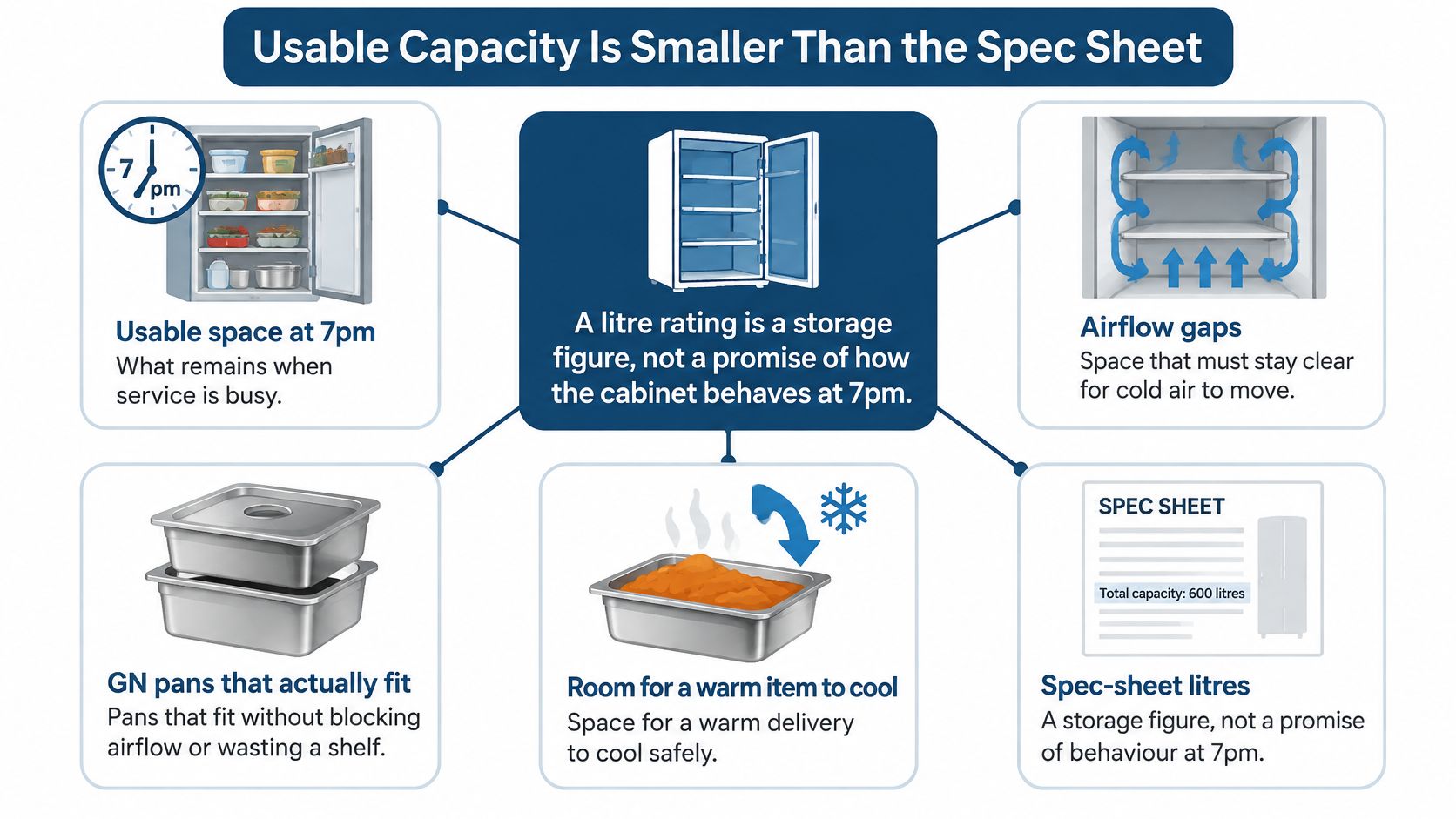
New Zealand guidance requires chilled, readily perishable food to be held at or below 4°C, frozen food at or below -18°C, and refrigerated and display temperatures to be checked and recorded regularly, as the Ministry for Primary Industries material confirms. The practical effect of overloaded shelves and frequent door opening is that usable capacity is lower than the cabinet's advertised gross volume. Repeated temperature recovery problems after deliveries or prep periods signal insufficient refrigeration capacity or inadequate compartment separation, not merely poor organisation.
Cooling Hot Food Is a Separate Job
Cooked potentially hazardous food must cool from 60°C to 21°C within two hours, then to 5°C within a further four hours, or be discarded unless a validated alternative is in place, as set out in New Zealand food safety guidance. A bigger holding fridge does not automatically do that job. Shallow pans, a probe and a schedule that avoids loading hot stock into a full cabinet matter more. Sometimes a blast chiller is the right answer.
On compatible SKOPE models, SKOPE Connect can log temperature so a pattern of slow recovery is visible rather than guessed. A storage upright, an undercounter, a prep counter and a coolroom are different tools. Matching the tool to the role matters more than chasing the largest number on a brochure.
How New Menus and Channels Change the Cold Chain
New revenue usually adds ingredient variety, prepared-food holding and a need for zones. Raw, ready-to-eat, frozen and service stock want different homes. One larger mixed cabinet often makes cross-contamination and door traffic worse.
Say a cafe moves from cabinet food to cooked lunches. It suddenly holds raw protein, cooked components and a service fridge staff open constantly. A storage cabinet out the back doesn't fix the pass. A restaurant adding takeaway and delivery needs plated or packed food held separately from raw prep, often at a different time of day. A bar that grows its drinks range fills the food fridge with mixers, garnishes and bottled product. A dedicated beverage refrigerator gives the food cabinet back.
A caterer moving to larger advance batches may have enough shelf space and still fail the cooling clock on deep pots of sauce, soup or protein. The overlooked question is not "How much fridge space do I need?" but "Can the operation cool cooked food safely at its new production volume?" Cooked potentially hazardous food must cool from 60°C to 21°C within two hours and then to 5°C within a further four hours, or it must be discarded unless the business uses a validated alternative process. Adding a larger holding refrigerator may not solve that bottleneck; production scheduling, shallow-pan loading, probe verification and dedicated rapid-cooling capacity can matter more than nominal litres.
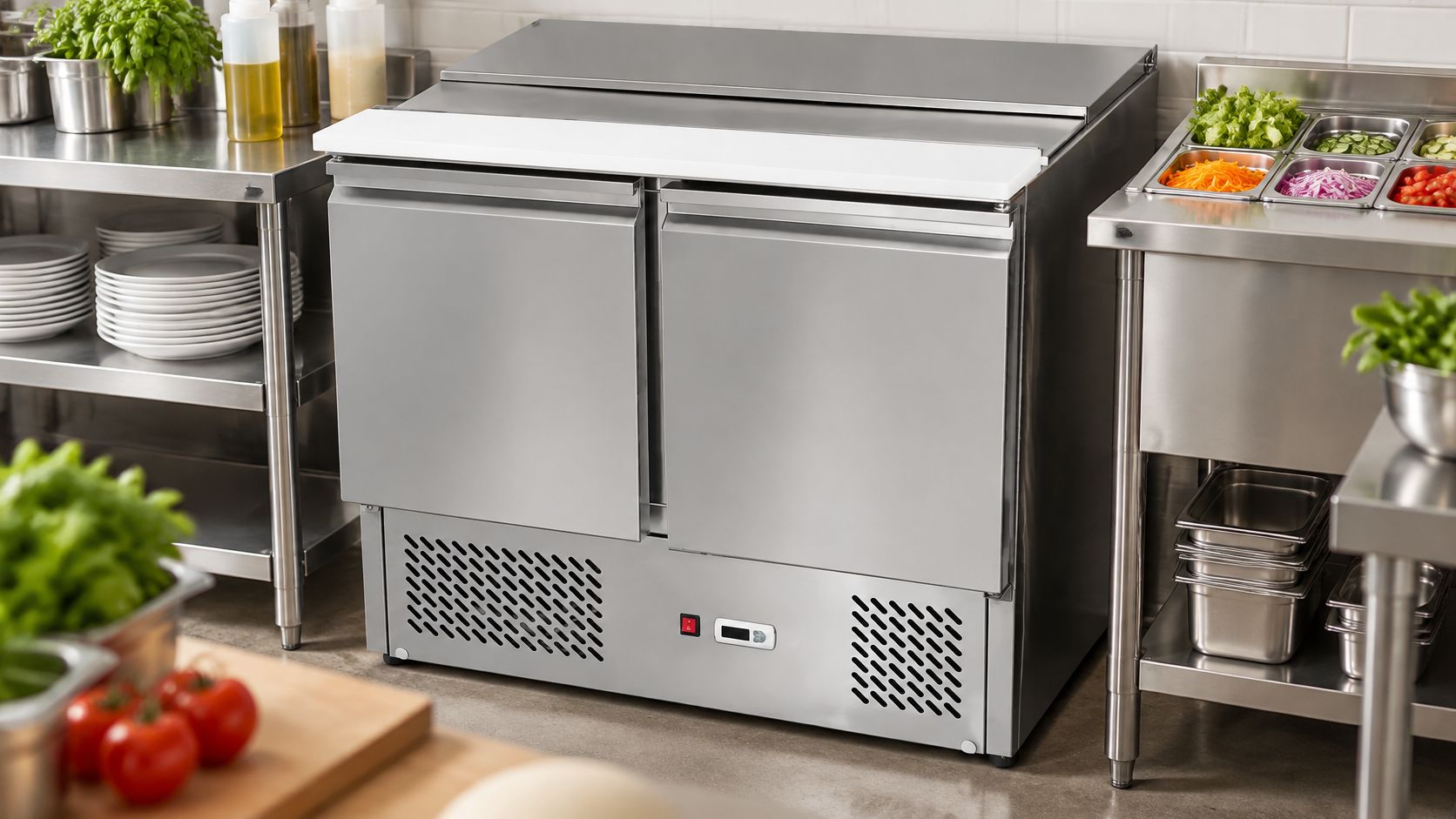
For a cafe or salad-style station, a preparation format such as the Atosa Sliding Lid Saladette Fridge - Two Door puts ingredients at assembly height. Its 300 L stated capacity and 900 mm by 700 mm by 950 mm footprint suit a station where two people need access without crossing the same bench, and its 43°C ambient rating means it performs in a hot kitchen. The right size is the one that fits the peak menu without making the team walk further.
The shared lesson applies across venues: growth changes the cold chain, not just the shelf count. Read more on keeping that chain intact in Simply Hospitality's cold chain management guide.
What Tight Refrigeration Costs in Daily Work
Insufficient cold space doesn't always announce itself as spoilage. It often shows up as friction that slows the whole kitchen. Operators make more frequent supplier orders because a bulk drop will not fit, which removes the option of buying ahead when a price or delivery day suits. Staff walk further, re-stack the same shelves and handle food more often. Organisation suffers, so product gets used out of date order. Prep capacity is capped by what can be held safely overnight, which matters for caterers and venues that wanted to cook in the quiet hours.
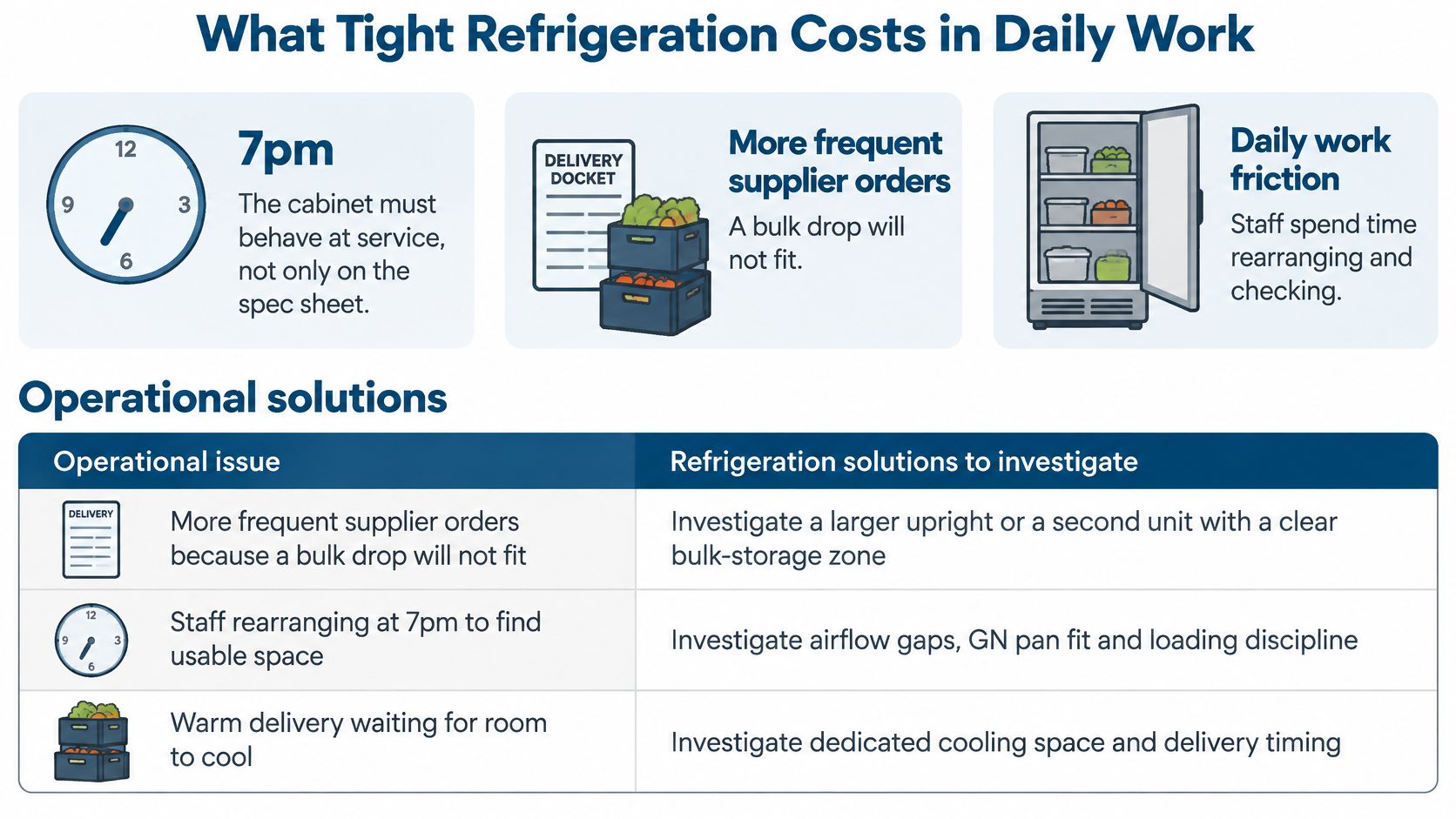
The expensive part is often the decision the fridge forces, such as refusing a useful delivery or sending someone off the line, not the electricity of a second cabinet.
One clearly labelled hypothetical: if staff collectively spend 20 additional minutes a day fetching ingredients from poorly placed refrigeration, that is 100 hours across 300 trading days. At an illustrative labour cost of $30 an hour, that equals $3,000 of staff time. Recovering those minutes does not automatically cut the wage bill. It may instead come back as calmer service, fewer mistakes or the ability to prep ahead.
The next spend should remove one of these frictions. More on what those bottlenecks cost appears in Simply Hospitality's piece on kitchen bottlenecks.
A Bigger Cabinet or Another Unit
More refrigeration does not automatically mean a more efficient kitchen. The right choice depends on where the friction lives. Five routes cover most situations.
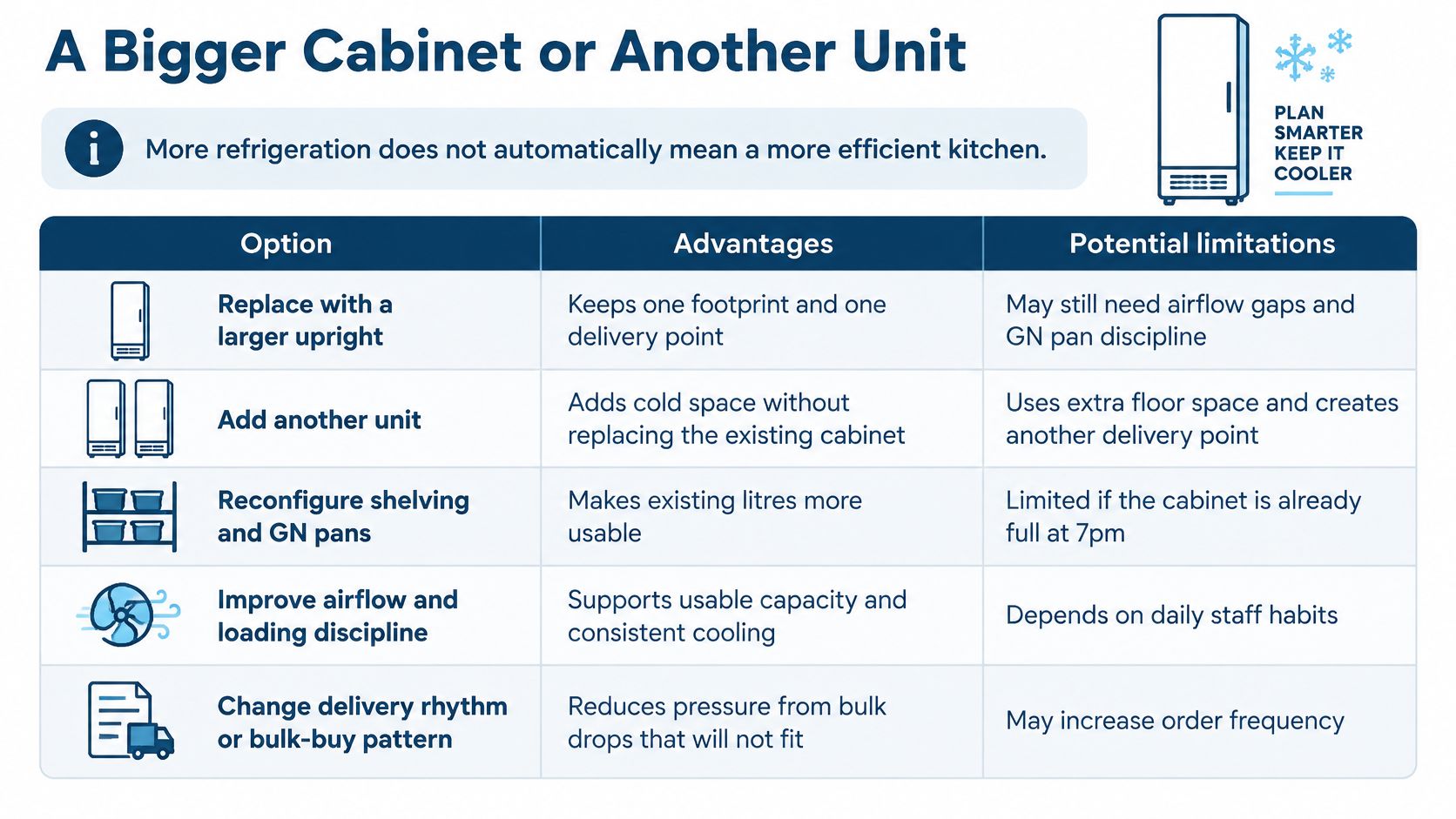
| Option | Advantages | Potential limitations |
|---|---|---|
| Replace with a larger cabinet | More storage in a similar position and one place to receive stock | Still one point of failure; may not shorten the walk; a bigger door can be slower to recover |
| Add another upright refrigerator | Redundancy and easier separation of raw and ready-to-eat food | Uses floor space, needs power and clearance, and adds cleaning |
| Install undercounter refrigeration | Cold storage at the cooking or service station | Limited volume; heat and ventilation around the line can reduce performance |
| Add a refrigerated preparation counter | Ingredients at bench height for repeated assembly | Not a bulk store; frequent opening affects recovery; bench length must match the menu |
| Install a walk-in coolroom | Bulk storage, segregation and room on delivery day | Floor area, drainage, panels, electrical supply, lead time and access for service |
Several smaller units in the right places can be more useful than one large door. A second upright creates redundancy and lets raw and ready-to-eat food live apart. A refrigerated preparation counter, including Atosa saladettes and SKOPE prep cabinets where the format suits, puts ingredients at assembly height for cafes, pizzerias and garnish stations. A walk-in coolroom suits bulk storage and heavy delivery days for restaurants, hotels and caterers, and it needs floor area, drainage, panels, power and maintenance access that a plug-in cabinet does not.
Energy use, noise and heat rejection depend on the model, the kitchen and how often doors open. Fixed plant and coolrooms need qualified installation. For the wider point that scale without a job to do is just a larger obstacle, Simply Hospitality's walk-in chiller overview and the piece on whether bigger catering equipment is always better both apply. Operators weighing redundancy and risk may also want to review what ABS Insurance Brokers restaurant cover addresses, since equipment failure and business interruption can sit on the same side of a claim.
Planning Cold Storage Before the Next Growth Spurt
Audit use before auditing brochures. Count what is in the fridges at the busiest delivery, not the weekly average. Note what is raw, ready-to-eat, frozen, drinks or waste that also needs cold storage. Sketch where people walk during the worst hour. A different shelf layout, fewer half-empty containers or moving drinks out may free a cabinet before any purchase.
Then look forward only as far as decisions already in view. A menu section, a catering contract, a second daypart or a known refit matter. A vague hope of being twice as busy does not. Modular additions, a second upright now and a coolroom later, often suit venues that cannot stop trading for a rebuild.
Ministry for Primary Industries material reports that increasing ambient temperature from 17°C to 25°C produced an 11% increase in average refrigeration power consumption, while warning that higher temperatures increase food-poisoning and spoilage risk unless the cold chain is extended and improved. Hotter kitchens raise cabinet heat load, compressors run longer, recovery after door openings slows, and less cooling capacity remains for newly loaded product. Assess the cabinet on the warmest prep period rather than treating a higher power bill alone as proof it is too small.
Before committing, check the boring limits that make a good cabinet the wrong order: ventilation and condenser clearance, heat from ovens and dishwashers, electrical supply, door swings, drainage for a coolroom, and whether service technicians can reach the plant. Where the building work is the main project, SACH Design provides layout and infrastructure coordination alongside the refrigeration choice. Simply Hospitality's advice on underestimating future growth and the companion piece on kitchen layout and productivity both help separate the room from the fridge as the limiting factor.
Choose the Refrigeration That Removes the Bottleneck
Work through a short assessment in this order. First, write down the single worst moment: delivery, prep, service or a cooling failure after cooking. Second, record peak stock and whether temperature recovers, so a fault, a blocked condenser or a bad setpoint isn't mistaken for a small cabinet. Third, decide whether the missing thing is bulk litres, a shorter walk, a drinks fridge, freezer space, a second independent cabinet or a way to cool hot food. Only then shortlist a format.
The best spend is the one that removes that constraint. More refrigerated space that staff still cannot reach, or that cannot cool a stockpot, will be outgrown again. What Hospitality Operators Prioritise When Buying Refrigeration helps when ready to compare models.
Hospitality supplies commercial refrigeration for venues at different stages, including SKOPE and Atosa upright refrigerators and freezers, undercounter cabinets, refrigerated preparation counters and beverage refrigeration, with SKOPE Connect on compatible models for temperature monitoring. Measure doorways before ordering, because tipping a cabinet as it enters the premises is not covered under the warranty. Fixed appliances should be installed and commissioned by qualified trades, and the final electrical supply, ventilation and clearances should be checked against the model document before cabinetry is built. Freight for bulky equipment is confirmed separately.
Bring your peak stock list, a photo of the space and the job the new plant has to do, and the team will match the recommendation to the venue rather than a generic size. The team supplies SKOPE and Atosa refrigeration across uprights, freezers, undercounter cabinets, prep counters and beverage units, with advice shaped around how your kitchen runs. Visit Simply Hospitality to start that conversation.