

What Do Kitchen Bottlenecks Really Cost a Hospitality Business?
It is 7pm on a Saturday, the pass is full, and one station is still catching up. A cook waits on a shared oven. A kitchen hand walks the length of the line for stock. Plates sit while the dishwasher clears a backlog. Asking what kitchen bottlenecks really cost a hospitality business is not answered by the clock. The cost sits in labour paid while nothing extra is sold, food that never reaches a guest, orders the kitchen cannot take, and complaints that follow a slow service.
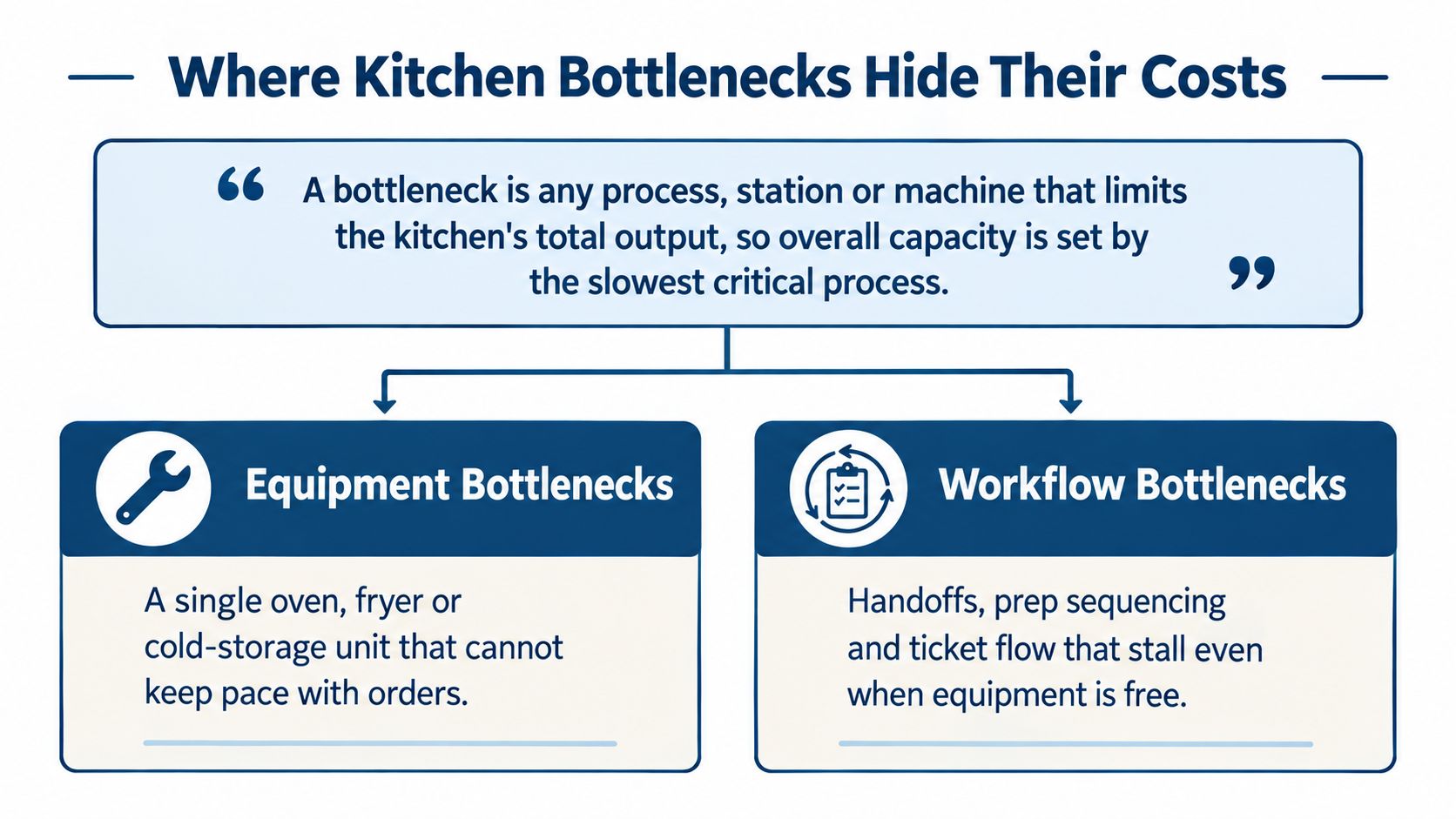
None of those losses appear as one line on the profit and loss unless someone measures them. A bottleneck is any process, station or machine that limits total output. The slowest critical step sets how many covers the kitchen can produce, even when the rest of the team is ready.
Where Kitchen Bottlenecks Hide Their Costs
A kitchen bottleneck costs money through four buckets: extra labour, lost contribution, food waste, and reputation. The first three can be turned into dollars from the venue's own records. Reputation should be counted, not priced with a made-up figure.
A bottleneck is any process, station or machine that limits the kitchen's total output, so overall capacity is set by the slowest critical process.
It shows up where the line actually stops. Typical stops include ovens that cannot keep up with ticket volume, fryers with too little basket capacity, congested prep benches, refrigeration sited far from the line, slow dishwashing turnaround, inadequate plating space, staff waiting on shared equipment, and inefficient walking between stations.
These constraints surface at peak, not on a quiet Tuesday. A kitchen can look fine midweek and still lose money on a Saturday, because that is when every station is loaded together. An occasional hold-up is noise. A station that jams on most busy services is a cost line.
| Cost bucket | What it looks like | Basis for calculation |
|---|---|---|
| Labour | Extra paid minutes, overtime, extra shifts | Minutes lost multiplied by loaded hourly cost |
| Lost contribution | Declined orders, delayed tickets, unavailable menu items | Unfulfilled orders multiplied by average order value and contribution margin |
| Food waste | Overproduction, discards after holding too long, remakes | Ingredient and disposal cost of food thrown away or remade |
| Reputation | Complaints, slower ticket times, fewer repeat visits | Count complaints and track them; do not assign an arbitrary dollar value |
The dollar figure only becomes real once it is measured. List the constraints that recur on most busy services, then cost each one in the bucket that holds the loss.
The Labour Cost of Waiting, Walking and Rework
Paid time disappears in small, repeated tasks. Staff wait for shared equipment, walk between stations, search for ingredients, repeat preparation, reorganise a congested bench, handle the same dishes more than once, and correct mistakes made in a rush. None of that looks like a roster problem. It is still wages.
An illustrative shift
Say three staff each lose 15 minutes per shift through avoidable delay. That is 45 minutes of paid time. At an illustrative employment cost of $30 per hour, each minute costs $0.50, so the shift costs $22.50. Across 300 operating days, that is $6,750 of annual labour time. These inputs are illustrations, not a benchmark, and they exclude employer on-costs.
| Calculation step | Working | Result |
|---|---|---|
| Minutes lost per staff member per shift | Illustrative avoidable delay | 15 minutes |
| Total paid minutes lost per shift | 3 staff × 15 minutes | 45 minutes |
| Cost per minute | $30 per hour ÷ 60 | $0.50 |
| Cost per shift | 45 minutes × $0.50 | $22.50 |
| Annual labour time | $22.50 × 300 operating days | $6,750 |
New Zealand kitchens have little spare margin for that idle time. The Restaurant Association's 2025 Remuneration Survey, covering 13,945 employees, reported an average hospitality wage of NZ$27.84 per hour and labour costs averaging 40% of revenue, the highest level in that survey. At that average wage, 100 hours of avoidable labour time is NZ$2,784 before employer on-costs.
Practical rule: Recovered minutes are not a payroll saving unless paid hours or overtime actually fall. Otherwise the time is capacity, such as prep finished before service or the same team handling the peak without an extra shift.
Slow prep is often where those minutes hide, which is why the hidden cost of slow prep is worth reading beside a time study. Substitute the venue's own headcount, minutes and wage rate. The table only shows the arithmetic.
Lost Sales and Why Contribution Is the Real Number
A constrained kitchen doesn't only run late. It sells less during the window when guests are right there. Waits lengthen, orders are declined at the peak, takeaway capacity drops, tables turn more slowly, larger groups cannot be seated, and menu items go off for the rest of the service. A short lunch trade makes that loss sharper, because there is no later sitting to catch up.
Work the contribution, not the ticket
Assume a recurring bottleneck stops five orders on a busy service, and assume an average order value of $35. That is $175 of sales at stake. Sales are not profit. Assume variable costs of 35% of sales for food, packaging and card fees, which leaves a 65% contribution margin. Each order then contributes $22.75, and five orders contribute $113.75 for that service.
These figures assume enough demand to sell the extra orders. They are potential contribution, not guaranteed revenue, and some turned-away guests may come back later.
| Orders not taken | Sales at $35 | Contribution at 65% |
|---|---|---|
| 2 | $70 | $45.50 |
| 5 | $175 | $113.75 |
| 8 | $280 | $182 |
Two orders put $70 of sales and $45.50 of contribution at stake. Eight orders put $280 of sales and $182 of contribution at stake. Change the order value or the margin and the result moves with them.
Buying more equipment is not automatically the right spend. If demand is weak, extra capacity adds fixed cost without extra covers. If demand is strong but skilled labour is the limit, a machine that shortens training or lets one person cover two stations can be worth more than raw throughput. Booking limits, a shorter menu, staggered tickets or a tighter service window can also shrink the queue without a purchase. Test whether capacity is the binding constraint before assuming it is. Targeted process and equipment changes can lift output without adding headcount for its own sake. Hospitality productivity rose 1.6% a year over the decade to 2024, against 0.5% nationally, according to the Restaurant Association 2025 Hospitality Report.
Food Waste, Remakes and Customer Experience
Say 2 kg of prepared protein is discarded after being held too long, at an assumed ingredient cost of $14 per kg. The ingredient waste is $28. Labour already spent on that batch sits in the labour bucket, so it is not counted again here. Cost waste at the ingredient price plus disposal, never at the menu selling price, because the kitchen never received the selling price for food that went in the bin.
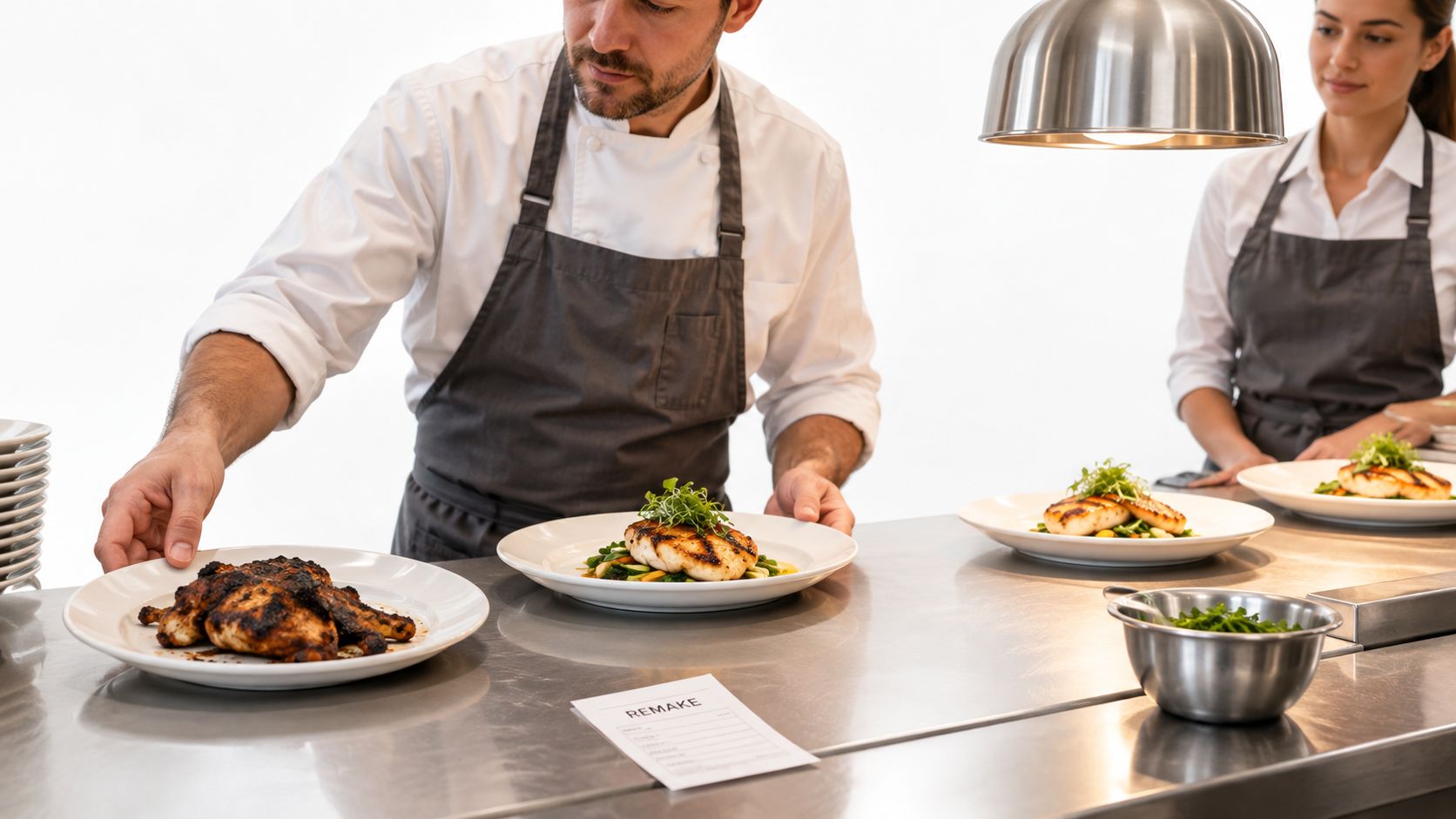
Delays create that waste in familiar ways. Plates sit too long before service. Batches overcook or come out uneven. Prep is done for orders that never arrive. A mistake triggers a second cook, and poor temperature control spoils a batch that was sound at receiving. Complaints rise as consistency slips under pressure.
What not to invent a dollar for
A slow or inconsistent plate can cost a return visit, and guest experience is where bottleneck damage lingers longest. There is still no honest way to put one dollar figure on a bad review or a lost regular without the venue's own sales history. Track complaints, remakes and delayed tickets by service, and look for the station that keeps appearing. Leave reputation as a count, and let the counts point at the fix.
Where the kilograms come from
New Zealand cafes and restaurants discard approximately 24,400 tonnes of food a year, with 61% classified as avoidable at an estimated cost of about NZ$58 million annually, which puts roughly NZ$35.4 million of that loss in the avoidable column, according to the Ministry for the Environment's national food waste reduction programmes. Waste reduction programmes that train kitchen teams to measure and separate what they throw away have cut waste per cover and produced meaningful annual savings per business, which makes in-house measurement worth the effort before any equipment spending.
Constrained refrigeration, a poor mise-en-place flow, limited storage and slow hand-offs drive overproduction, spoilage, trim loss and returned food. Measure waste by stage: receiving, storage, preparation, production, service and plate returns. Then track waste per cover, batch size, holding time and fridge utilisation, and fix the stage carrying the highest avoidable cost first. Cold storage only helps if the layout matches service, which is the point of how to store food in a restaurant fridge.
How to Measure a Bottleneck Before Changing It
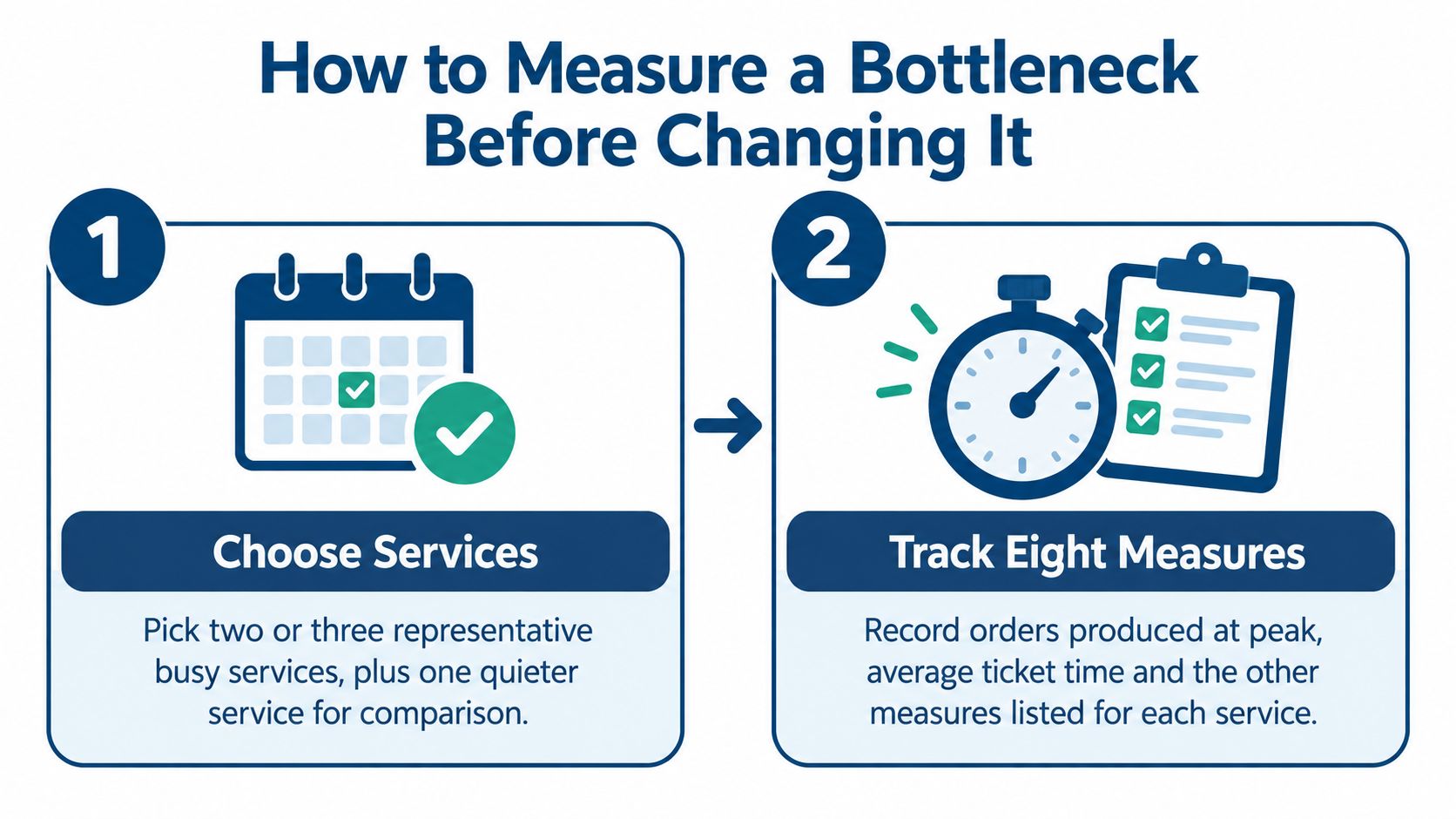
- Pick two or three representative busy services, plus one quieter service as a comparison.
- On each service, record orders produced at peak, average preparation and service time, staff waiting or unnecessary movement, equipment utilisation, delayed or unfulfilled orders, food waste and remakes, overtime or extra staffing, and complaints linked to delays.
- Write the baseline down before any layout or equipment change.
- Use one formula, and label every line as an actual cost or a potential figure.
Estimated bottleneck cost = actual additional labour expense + avoidable food waste + lost contribution from unfulfilled demand + other measurable costs.
- Check for double counting. A remake uses both labour and ingredients, and overtime already sits in the labour line, so count each cost once.
- Keep actual losses, estimated opportunities and theoretical productivity gains in separate columns.
- Repeat the same eight measures after the change, on comparable services.
Why minutes per order matter
Wage rates in the sector have been moving, so waiting is not a fixed cost. Stats NZ's Labour Cost Index shows the accommodation and food services salary and wage index rising from 1,410 in the March 2024 quarter to 1,454 in the March 2025 quarter, about 3.1%, in the labour cost index salary and wage rates. Compare labour minutes per completed order before and after a change, alongside ticket times, remakes and overtime. That separates a real gain from a queue that has just moved to the next station.
One busy service, added up
Using the illustrations above for a single busy service: labour $22.50, avoidable ingredient waste $28, and lost contribution $113.75. The estimated total is $164.25. The $113.75 is potential, not money already lost. Labour and waste stay on their own lines so the total can be checked without mixing a banked cost and an opportunity.
Equipment Constraint or Workflow Constraint
Run a short test before spending. For two to three weeks, resequence batches, move daily-use stock to the station, and finish prep before service. Measure the same services again. If the queue remains once the equipment is loaded as efficiently as it can be, the constraint is probably the machine. If the queue shrinks, the constraint was the way the work was organised.
An equipment bottleneck means the machine cannot deliver the capacity, speed or reliability the menu needs. A workflow bottleneck means layout, prep timing or movement restricts output even though the machine has spare capacity.
| Problem | Likely cause | Potential improvement |
|---|---|---|
| Ovens queue at peak | Batches timed to finish together, or genuine capacity shortfall | Stagger batches; add capacity only if the queue remains after resequencing |
| Fryer backlog | Too few baskets for the ticket mix, or poor loading rhythm | Batch by ticket type; review basket capacity against peak orders |
| Cook waits at a shared refrigerator | Fridge sited away from the line, or overfilled | Move daily-use stock to the station; size refrigeration to par levels |
| Prep bench congested | Prep done during service, benches crowded with finished product | Schedule prep before service; relocate or add a bench |
| Dishes backing up | Rack sequencing and double handling, or machine throughput | Clear as you go; check rack flow before buying a larger dishwasher |
| Plating slows the pass | Limited plating space, plates travelling a long way | Relocate the pass or add plating space beside the line |
| Staff searching for ingredients | Unlabelled storage, no par levels | Label stock, set par levels and store items in order of use |
Buying another oven will not fix a batch sequence that dumps every tray at once. Moving benches will not fix a fridge that is too small for the par levels. Match the spend to the cause. How to design a kitchen that saves time on every service sets out the layout questions before anyone orders a larger machine.
Practical Fixes, Starting With the Measured Constraint
Cheap fixes come first because most constraints turn out to be habits, not hardware. Name who owns each station and each task, so a queue has an owner rather than an audience. Build a prep list that finishes before service starts. Cross-train the stations that jam, so one absence doesn't create the queue. Put the most experienced hands on the peak rather than spreading skill evenly across the roster. Keep dishwashing tight so clean ware keeps moving and the pass isn't waiting on plates.
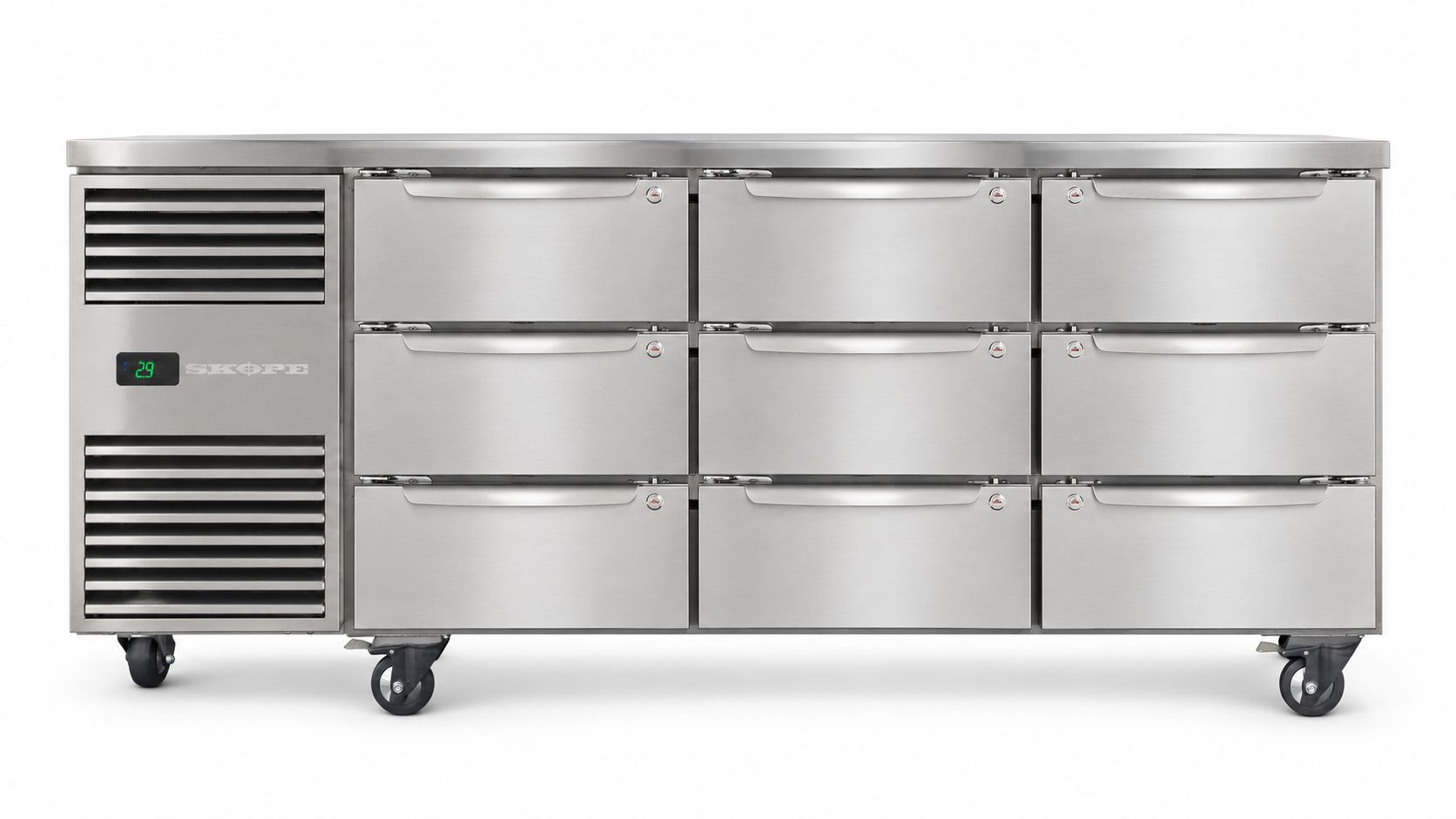
When the machine is the limit
Equipment spend comes next, and only against the constraint the measurement found.
- Cooking: a higher-capacity oven or fryer sized to the ticket mix. Unox, Convotherm and Merrychef ovens suit different cooking jobs, so match the model to the menu rather than to a brand preference.
- Repetitive prep: a Robot Coupe food processor where the same chop, mix or puree is eating minutes every service.
- Cold storage: SKOPE or Atosa refrigeration sized to par levels and placed where the cook works. A SKOPE ProSpec 9 Drawer Underbench Fridge - PG11.UBR.3.D9 puts nine drawers at the cookline, keeping working quantities separated by station or day part.
- Warewashing: a Classeq or Winterhalter dishwasher once rack flow is already clean and the machine is still the limit.
- Space: an extra prep bench or a storage system that cuts searching and double handling.
The busiest-looking station isn't always the constraint. A crowded pass may be waiting on a full dishwasher, and clearing one stop often reveals the next, such as the fridge or the pass after an oven change. Fix the measured limit, then measure again. For a major layout redesign, SACH Design is the specialist route. The right mix still depends on venue type, menu and trading pattern, and day-to-day habits keep earning their keep; five ways to improve kitchen efficiency during peak service covers the service-floor side of that work.
Deciding Between Workflow Fixes and Equipment Investment
If the measured constraint is workflow, fix that first. If it persists once equipment is loaded as efficiently as possible, invest. That is the decision rule. An upgrade can still be worthwhile without a payroll cut when it supports extra profitable orders or makes the peak reliable.
| Investment | Potential benefit | What to measure |
|---|---|---|
| Higher-capacity oven or fryer | Fewer queued batches at peak | Queue time and orders produced per peak hour |
| Robot Coupe food processor | Less time on repetitive preparation | Preparation minutes per batch |
| Appropriately sized refrigeration (SKOPE or Atosa) | Stock reachable at the line, fewer trips | Walking minutes and stock-outs at the line |
| Faster or larger dishwasher (Classeq or Winterhalter) | Shorter turnaround for clean ware | Dish turnaround time and clean-ware shortages at peak |
| Additional preparation bench | Less crowding and double handling | Prep finished before service and idle time at the bench |
| Storage system | Faster retrieval of ingredients | Search time, over-ordering and waste from misplaced stock |
Payback from measured benefit
Simple payback is total installed cost divided by the annual measured net benefit. As an illustration only, a $10,000 installed cost and $4,000 of measured annual benefit is a payback of 2.5 years. Installed cost is more than the purchase price. Add freight, installation, and any electrical or gas work. Don't treat theoretical minutes as cash unless paid hours, waste or contribution actually move.
Simply Hospitality shows prices excluding VAT to business customers and including VAT to individual customers, so confirm the basis on the quote. Freight for larger or bulky equipment is calculated separately and may be confirmed before dispatch. Check the final electrical or gas supply, cut-out, ventilation and clearances against the model document before ordering cabinetry. Record the same measures before and after the change. Which commercial kitchen upgrade delivers the fastest return is a useful companion when several upgrades are competing for the same budget.
Simply Hospitality supplies commercial kitchen equipment for New Zealand restaurants, cafés, caterers and accommodation kitchens, including refrigeration, cooking, prep and dishwashing. If a recurring bottleneck is costing labour, waste or missed orders, the team can help match workflow changes and equipment to the constraint that was measured. Visit Simply Hospitality to talk through the right fit for the menu and the room.