

Why Winterhalter Remains the Gold Standard in Commercial Warewashing
The usual advice is to buy a commercial dishwasher by comparing cycle times and purchase prices. That approach misses the actual decision. In a New Zealand hospitality business, warewashing is a production system involving water quality, chemistry, heat, racks, staff movement, hygiene control and service support. Winterhalter's premium reputation comes from addressing that wider system, not just from selling a stainless-steel machine.
That doesn't make every Winterhalter suitable for every venue. A smaller café may be better served by a simpler undercounter unit, while a hotel, aged-care kitchen or busy restaurant may need dependable throughput, controlled sanitisation and specialist water treatment. The practical question is whether the complete system solves a genuine operational constraint.
Rethinking the Dishwasher as Kitchen Production Capacity
A dishwasher isn't a background cleaning appliance. It determines how quickly plates, glasses, cutlery and utensils can return to service, particularly when a venue has a concentrated rush and limited bench space.
A kitchen may have capable cooking equipment and a well-organised pass, yet still lose momentum when clean ware can't keep pace with orders. Staff then wait for racks, polish glasses by hand, stack items wherever space allows, or send partially clean items through again. The effect reaches the dining room through slower table resets and inconsistent presentation.
The warewashing station controls the service rhythm
Commercial warewashing also consumes more than water. Each cycle can involve heating, detergent, rinse aid, staff handling and machine cleaning. National guidance notes that dishwashers consume water, energy and detergent, so the machine affects both operating cost and environmental impact. EECA's dishwasher guidance also advises that a full cycle generally averages about 13 litres of water and usually doesn't require pre-rinsing.
The workflow matters as much as the appliance:
- Clearing: Used ware must leave tables and service areas without obstructing staff.
- Scraping: Food residue needs to be removed without turning the sink into a bottleneck.
- Loading: Racks must support the correct spacing and orientation.
- Washing: The selected programme must suit the soil level and ware.
- Unloading: Clean items need a clear destination, not a temporary pile.
- Storage: Plates, glasses and utensils must return to service without contamination or unnecessary handling.
A properly planned pass-through station can separate dirty and clean flows more effectively than a compact unit positioned wherever a gap is available. The layout principles discussed in planning a pass-through dishwasher are therefore part of the purchasing decision, not an afterthought.
Why specialist equipment enters the conversation
The Energy Efficiency and Conservation Authority reports that commercial ovens and cooking elements represented 15% of sector energy consumption in 2022, while refrigeration represented 22% across the accommodation and food services sector. EECA's food and beverage service pathway places those figures within a wider operating environment where hot water, heating and equipment efficiency all influence hospitality costs.
Warewashing deserves the same attention because its demand repeats throughout every service. Winterhalter remains a premium benchmark because it treats the machine as part of a broader operating process. The value lies in matching throughput, water control, chemistry, racks, hygiene procedures and support to the venue's actual workload.
Practical rule: A dishwasher should be assessed by how reliably it returns usable ware to service, not by its cycle time in isolation.
The Integrated Approach to Wash Results and Water Treatment
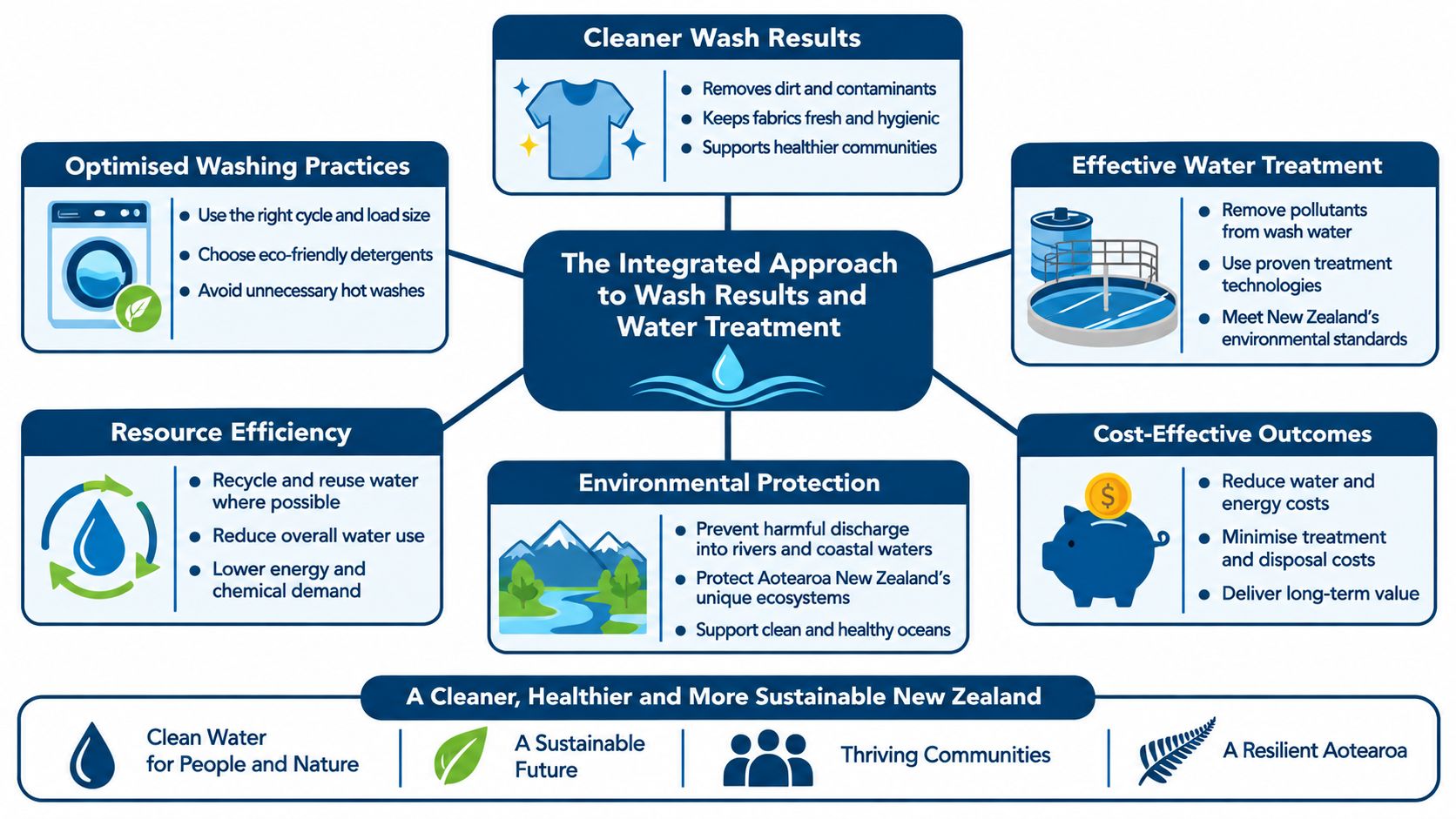
A clean-looking machine can still produce poor results if the water is unsuitable, the chemicals are incorrectly dosed, the rack is overloaded or the programme doesn't match the residue. Commercial warewashing hygiene depends on the combined effect of wash-water temperature, detergent concentration, water agitation and cycle duration. The final rinse should reach at least 82°C for effective thermal disinfection, as explained in this technical discussion of commercial warewashing.
The machine is only one part of the result
Winterhalter's proposition centres on a connected system that can include:
- Wash programmes designed for different ware and soil levels.
- Detergent and rinse-aid dosing suited to the machine and application.
- Filtration to manage food residue within the wash water.
- Water-treatment equipment for the incoming supply.
- Application-specific racks that control how items sit in the wash.
- Service and operating procedures that support repeatable results.
Not every model includes every technology, and not every venue needs every option. A compact glasswasher in a bar has a different job from a utensil washer in an aged-care kitchen. The important distinction is that the operator can assess those elements together rather than choosing a machine based only on the headline cycle or cabinet size.
Water quality is especially important for glassware. Mineral deposits can produce spotting, streaking, cloudiness and an uneven finish, even when the machine is otherwise operating correctly. A premium restaurant, wine bar or cocktail venue may place greater value on presentation because staff and customers see the glassware directly.
When treatment becomes commercially sensible
Winterhalter offers compatible water-treatment options, including reverse osmosis where the application justifies it. Reverse osmosis can help reduce dissolved minerals reaching the final rinse, but it isn't a universal requirement and it doesn't guarantee completely spotless results. Operators still need suitable racks, correct chemical dosing, sensible loading and regular cleaning.
The right choice depends on the incoming water, the ware being washed and the presentation standard expected. A useful assessment should consider:
- Whether glasses show recurring mineral spotting.
- Whether the venue is repeatedly polishing or rewashing glassware.
- Whether the supply creates scale on heating elements or internal components.
- Whether the machine's rinse performance is stable during peak use.
- Whether treatment equipment can be installed, maintained and monitored correctly.
The relationship between water quality and machine performance is explored in how water quality affects dishwasher performance. The commercial lesson is straightforward. A premium dishwasher can't compensate for untreated water, unsuitable chemicals or poor loading discipline. The complete system produces the result.
Matching Winterhalter Ranges to Venue Throughput
The right Winterhalter range depends on what the venue washes, where the machine can sit and how much ware arrives during the busiest part of service. Buying a larger format purely because it appears more professional can waste space and capital. Choosing a compact model for a high-volume operation can create a daily bottleneck.
Winterhalter's main professional categories serve different workflows.
UC Series for compact professional washing
The UC Series covers undercounter dishwashers and glasswashers suited to bars, cafés, restaurants and other applications with limited floor space. These machines can work well where staff need a dedicated wash point near the bar or kitchen and where the venue primarily handles glasses, crockery or smaller items.
The main advantage is proximity and flexibility. Staff don't need to move dirty ware across a large dish-pit, and a compact unit can fit into a carefully planned bench arrangement. The limitation is capacity. If racks accumulate faster than the machine can process them during a concentrated rush, the small footprint becomes a constraint rather than an advantage.
PT Series for a dedicated dish-pit
The PT Series pass-through format suits higher-throughput operations with room for a dirty-side table, machine and clean-side table. Staff can load racks at one side, operate the hood and unload on the other, creating a clearer separation between dirty and clean handling.
This format is often a better fit for restaurants, hotels and institutional kitchens processing substantial crockery during short service periods. It requires more planning than an undercounter unit, including suitable services, extraction considerations where relevant, drainage and enough room for staff to work without crossing flows.
UF Series and larger systems
The UF Series is designed for utensils and pots, where larger, heavier or more heavily soiled items don't fit comfortably into a standard dishwashing workflow. A pot washer should be considered when kitchenware cleaning is consuming sink space, staff time or hot water capacity.
Rack conveyor and flight-type systems serve larger operations such as hotels, hospitals and other venues with sustained volumes. Winterhalter's New Zealand-facing hotel material cites a CTR conveyor capacity of up to 195 racks per hour and water consumption as low as 130 litres per hour for that model. Those are manufacturer-published figures for a specific system, not a promise for every installation.
A practical comparison of machine formats appears in commercial dishwasher selection for New Zealand venues. Operators should measure peak racks, largest items, staff movement and available services before selecting a range.
Navigating Hygiene Compliance and Temperature Control
Hygiene performance depends on controlled conditions, not the label “commercial grade”. A high-temperature warewasher typically separates the wash stage from the final rinse. New Zealand technical guidance describes a wash stage of approximately 55°C, influenced by the residue and detergent, followed by a final rinse of at least 82°C. It also identifies pre-wash, detergent wash, rinse and disinfection as common stages in washer-disinfector operation. The technical FAQ on commercial warewashing explains why cycle design and heating capacity matter.
Auckland Council requires dishwashers to be operated and serviced according to manufacturer instructions, with suitable appliances for cleaning and sanitising food-contact equipment. MPI guidance provides a practical check: items should emerge from the dishwasher hot, described as “too hot to touch”, after the rinse cycle. Auckland Council's food-business guidance also identifies the need for a hot-water system with sufficient temperature and capacity.
Controlled stages reduce avoidable variation
Winterhalter's architecture addresses this risk through controlled wash and final-rinse processes, filtration and water-treatment options across its undercounter, pass-through, utensil and conveyor categories. These features don't remove the need for correct loading or staff training, but they can make the operating conditions more repeatable.
The procurement team should verify:
- Whether the installation can supply the required electrical load.
- Whether incoming water temperature and pressure are adequate.
- Whether drainage is correctly positioned and sized.
- Whether chemicals are compatible with the machine and ware.
- How temperature and hygiene information is monitored and recorded.
- What cleaning and servicing tasks staff must complete.
The published PT-L Utensil specification identifies hygiene certification to DIN 10534, giving buyers a technical reference beyond visual appearance or advertised speed. Certification should still be read alongside the machine's intended application and the operator's food-safety procedures.
A dishwasher that can't heat water reliably creates more than a quality problem. It can trigger rewashing, interrupt service and make it harder for the business to demonstrate consistent sanitisation. The NZ food safety regulations resource should sit alongside manufacturer instructions and the venue's own cleaning records.
Calculating the True Cost of Ownership and Efficiency
A low purchase price can become an expensive choice once operating conditions are included. Compare purchase price, installation, water, energy, chemicals, maintenance, labour and downtime exposure as one system. Winterhalter can make commercial sense where it addresses a costly bottleneck, such as hard water, repeated rewashing or limited service capacity. The higher initial investment still needs to produce a credible operational return.
Water consumption should be calculated from the venue's actual pattern. For example, an undercounter glasswasher running continuously at 30 cycles per hour with 2.5 litres per cycle would use about 600 litres across an eight-hour shift, calculated as 30 x 2.5 x 8. A further 30% for rinse water is an illustrative estimate, not a machine-specific result. Confirm the relevant figure from the model's technical information and the site's operating records.
Build the comparison around the rack
Record racks or cycles per day, incoming-water temperature, utility tariffs, chemical usage and rewashing. Then compare the venue's measured cost per rack with the proposed machine's documented requirements. Catalogue capacity rarely reflects a part-loaded rack, peak service, or the stop-start pattern of a New Zealand bar or kitchen.
| Cost Category | Operational Impact | Mitigation Strategy |
|---|---|---|
| Water | Frequent cycles increase consumption, particularly when racks are only partly full. | Run full racks where practical and measure water per rack. |
| Heating | Incoming water temperature and final-rinse requirements affect energy demand. | Confirm site capacity and assess heat-recovery options where fitted. |
| Chemicals | Incorrect dosing can leave residue, reduce cleaning performance or waste product. | Use compatible chemicals and have dosing checked by qualified support. |
| Labour | Scraping, loading, unloading, polishing and rewashing add handling time. | Compare rack choice, bench position and staff routines. |
| Maintenance | Scale, blocked filters and neglected spray components can reduce wash performance. | Follow the manufacturer's cleaning and servicing requirements. |
| Downtime | A failed machine can delay service and force manual washing or external arrangements. | Check local support, spare-parts access and contingency procedures. |
Heat recovery has a specific mechanism
Winterhalter's EnergyPlus concept recovers heat from warm exhaust vapour and waste water to preheat incoming cold water. Its UC Energy system is designed to reduce energy consumption while limiting warm, humid vapour released into the room. Results depend on the fitted model, site conditions and operating pattern. Treat heat recovery as a site-specific efficiency measure, not a guarantee that every installation will cost less than every alternative.
New Zealand dishwashers are covered by the Water Efficiency Labelling Scheme. Verify applicable WELS information at purchase and retain service records. A five-year comparison is useful only when its assumptions are documented, including daily cycles, tariffs, chemical dosing, maintenance and downtime.
Commercial test: If the venue cannot measure racks, rewashes and downtime, it cannot reliably judge whether premium efficiency is paying for itself.
The Reality of Labour Efficiency and Workflow Design
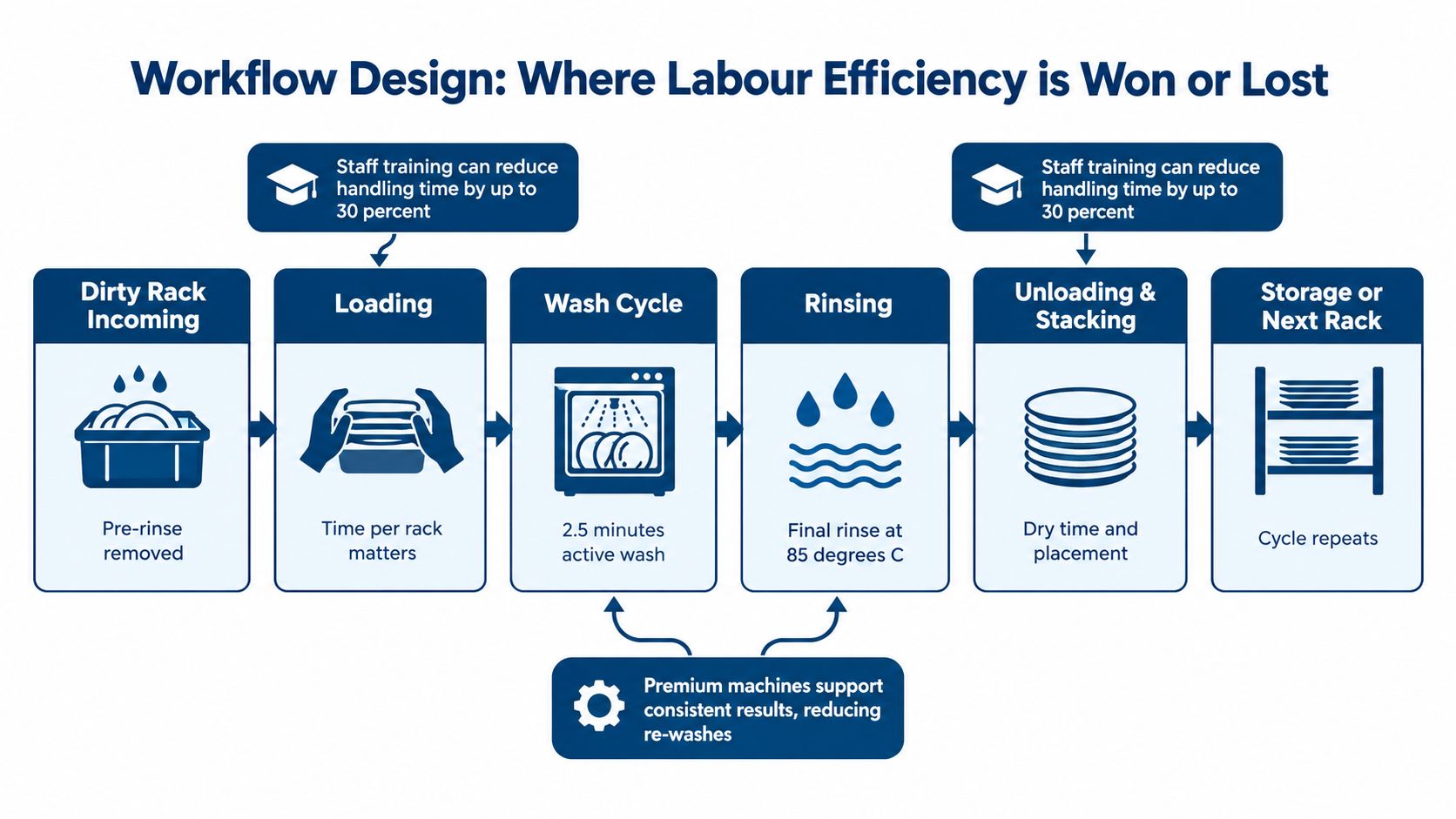
Less labour doesn't mean no labour. A machine may complete its wash programme quickly, yet staff still need to clear tables, scrape residue, load racks, move clean ware, clean filters, replenish chemicals and check sanitation.
The most useful audit follows the whole path:
Clearing → scraping → loading → washing → unloading → clean storage
A pass-through machine may improve movement where the dish-pit has separate dirty and clean sides. An undercounter unit may be more practical where the bar needs quick access to a glasswasher and there isn't room for a dedicated tunnel. Neither format fixes a poorly positioned sink, inadequate racking or a storage area that forces staff to retrace their steps.
Measure handling, not just machine time
New Zealand hospitality employment reached 146,300 in 2024, while the Restaurant Association's 2025 survey reported average labour costs of 40%, its highest recorded level. Those figures are reported by Restaurant Association New Zealand. The practical response is to measure labour minutes saved per rack and prevent rewash events, rather than repeat a general claim that automation improves productivity.
A useful workflow audit records:
- Time spent moving dirty ware to the station.
- Rack loading time and the number of items that fit correctly.
- Waiting time caused by full racks or an occupied machine.
- Unloading and stacking time.
- Glass polishing or crockery checking.
- Filter cleaning, chemical replenishment and end-of-service tasks.
- Rewashing caused by residue, spotting or poor loading.
Demand-based staffing can also help venues place people where pressure builds. Operators reviewing broader roster decisions may find demand based scheduling tips useful when matching staff coverage to service patterns.
Premium equipment still needs disciplined operation
A Winterhalter system can support consistent results, but it won't compensate for staff putting mixed ware into unsuitable racks or leaving filters blocked. Training should cover scraping without unnecessary pre-rinsing, correct rack selection, chemical checks, safe unloading and daily cleaning.
The strongest business case appears where the machine and workflow reinforce each other. If racks are missing, bench space is inadequate or clean storage is too far away, a faster cycle can just move the bottleneck to another point in the dish-pit.
Securing Local Support and Planning Your Installation
A premium dishwasher only performs properly when the site can support it. Before ordering, the venue should confirm electrical capacity, water connection, drainage, clearances, bench layout, chemical storage and access for delivery and servicing.
The installation conversation should include more than the machine footprint. A supplier needs to understand peak service, ware type, staff movement, incoming-water conditions and whether the venue needs a separate glasswashing, dishwashing or pot-washing workflow.
A practical procurement sequence
- Record the workload: Count racks or cycles during the busiest service periods and identify the largest items.
- Inspect the services: Confirm water, drainage and electrical requirements before the equipment arrives.
- Plan dirty and clean flows: Keep used ware away from clean storage and avoid unnecessary staff crossings.
- Select treatment and chemistry: Match water treatment, detergent and rinse aid to the supply and application.
- Document operating routines: Include loading, filter cleaning, chemical checks and end-of-day shutdown.
- Confirm support arrangements: Check warranty conditions, service access and spare-parts processes before purchase.
A correctly planned fit-out reduces the risk of discovering that the machine doesn't fit through the access route, the drainage falls the wrong way or the available electrical supply can't support the selected configuration. Guidance on commercial kitchen installation planning is useful before finalising the order.
Winterhalter's New Zealand operation states that it was established to meet local market requirements and support customers through warewashing specialists, customer service and a partner network. Its wider proposition includes professional warewashers made in Germany and Switzerland, application-specific chemicals, water-treatment equipment and coordinated accessories. Those manufacturer-reported arrangements help explain the brand's premium positioning, but operators should still verify current local availability, warranty terms and service arrangements for the exact model being considered.
The same standard should apply to every brand. Winterhalter may suit a venue where hygiene consistency, glassware presentation, throughput and water control justify the investment. A smaller café or lower-volume operation may find that a suitable Classeq, Rhima or Starline machine meets its requirements at a lower initial cost.
Simply Hospitality supplies commercial kitchen equipment, dishwashing systems, racks and cleaning products for New Zealand hospitality businesses, with advice focused on matching equipment to workload, layout and operating conditions. Visit Simply Hospitality to discuss the right warewashing configuration for the venue, from compact glasswashing through to higher-throughput commercial systems.