


Should You Upgrade Equipment or Hire More Staff?
Hire when people are the constraint, upgrade when machinery caps output, and fix workflow first when neither is clearly the problem. The decision should turn on the work that needs doing, not whether an equipment quote looks cheaper than another employee's wages.
A café's Friday lunch is slowing down, the chef is staying late, and preparation never quite catches up. Another cook might help, but only if there's somewhere productive for that person to work. The useful question is what the next dollar buys: more capable hands, more usable production capacity, or a better way of using what's already there.
Why Busy Kitchens Default to Hiring
Hiring feels like the immediate answer because an overloaded team is visible. An oven's recovery time, an awkward fridge position or an inefficient washing routine is less obvious when everyone's concentrating on getting orders out.
The symptoms tend to look familiar:
- Longer waits: Orders take longer during peak periods.
- Overtime: Chefs regularly stay beyond their rostered hours.
- Preparation backlogs: Ingredients aren't ready when service starts.
- Shared equipment queues: Staff wait for the same appliance.
- Dishwashing delays: Clean plates, utensils and trays become scarce.
- Repeated manual work: Chopping and mixing absorb preparation time.
- Inconsistent output: Quality changes when the kitchen gets busy.
Pressure doesn't identify the cause
An additional chef can't significantly increase oven output if every usable shelf is occupied throughout the rush. Conversely, a larger oven won't solve a shortage of people preparing ingredients, finishing plates and coordinating service.
Hiring also isn't necessarily quick. In February 2023, 80% of surveyed hospitality employers weren't fully staffed, according to MBIE's hospitality workforce appendix. That's a dated finding, not a description of today's recruitment market, but it demonstrates why an available wage budget doesn't guarantee an available employee.
Equipment therefore deserves a proper comparison, not an automatic preference. The practical checks in improving kitchen efficiency during peak service can help separate operational pressure from its cause.
Practical rule: Name the task that's holding service back before committing money to either a person or a machine.
Finding the Real Constraint During Peak Service
A labour constraint means equipment has usable capacity, but there aren't enough people to complete necessary tasks. An equipment constraint means staff are available but waiting for machinery or production space. A workflow constraint means organisation, layout or processes restrict output despite sufficient people and equipment.
The diagnosis needs to happen during representative peak trading. A quiet afternoon won't reveal whether an oven, dishwasher or plating station can cope when orders arrive together.
Watch work, not just ticket times
A manager who isn't working a station should record where work queues, which appliances sit idle, when staff wait and how many usable batches leave each station. A simple timestamped worksheet is enough.
Peak symptoms, likely constraints and what to check
| Operational symptom | Likely constraint | What to investigate |
|---|---|---|
| Cooks queue for the one combi oven during the rush | Equipment | Oven load and cycle times, batches per hour, whether cooks are idle while waiting |
| Prep backlog while ovens and fryers sit idle | Labour | Prep task count against prep hours, equipment idle time before service |
| Plating slows and runners wait at the pass | Labour | Table-to-plate times, hands at the pass, whether plating tasks are shared |
| Staff repeatedly open reach-in fridges across stations | Workflow | Fridge placement, door openings, stock held at each station |
| Dish racks queue while the washer runs part-loaded cycles | Workflow or equipment | Rack cycle time, completed racks, whether loading or washing is the holdup |
| Hand chopping or mixing takes a cook off the line each shift | Labour or equipment | Time spent on repeatable prep, machine suitability and typical batch size |
| Output varies between shifts with the same staff numbers | Workflow | Recipe and station standards, skills on shift, written prep par levels |
| Every oven is full at peak while staff stand idle | Equipment | Peak oven utilisation and which appliance staff are waiting for |
Cooks waiting beside a fully loaded combi oven suggest a machinery limit. A preparation backlog while ovens remain empty points towards labour availability, preparation scheduling or skills.
Repeated trips to a distant fridge suggest a different purchase question. Moving stock closer to the station might help more than increasing total refrigerated storage, provided safe storage and separation remain intact.
Check the work around the machine
A dishwasher's advertised cycle doesn't include scraping, sorting, loading, unloading and putting items away. Part-loaded cycles with dirty racks still queuing deserve investigation before a larger machine is ordered.
The same applies to food processors. Measuring chopping time alone overlooks ingredient preparation, attachment changes, cleaning and transferring finished product into storage.
The financial significance of those delays is explored in what waiting costs during peak service. For the investment decision, the confirming test is straightforward: if another person couldn't increase completed output because the appliance remains occupied, labour probably isn't the immediate constraint.
What Hiring Another Employee Really Costs
The advertised hourly wage is the starting point, not the employment budget. A realistic calculation includes the costs of bringing someone into the business, supporting them and covering their absence.
The main cost layers are:
- Gross wages: Agreed paid hours, including any applicable additional payments.
- Employer contributions: KiwiSaver contributions where required under the applicable rules.
- ACC levies: The business's applicable employer levy costs.
- Leave obligations: Annual holidays, public holidays, sick leave and any necessary cover.
- Recruitment: Advertising, interviews and administration.
- Training: Paid learning time and supervision by existing staff.
- Employment essentials: Uniforms and other role-related expenses.
- Management: Rostering, payroll administration and ongoing supervision.
Hypothetical wage calculation
Assume an additional employee works 30 hours weekly at $30 per hour:
- Weekly gross wages: 30 × $30 = $900.
- Annual gross wages: $900 × 52 paid weeks = $46,800, before additional employer costs.
These are hypothetical inputs, not a quoted market wage or a complete employment-cost estimate. Annual paid wages shouldn't have ordinary paid leave added again as though it were automatically an extra wage payment, although replacement cover can create additional expenditure.
For a legal wage floor, Employment New Zealand's minimum wage guidance lists the adult minimum as NZ$23.95 an hour from 1 April 2026, equivalent to $718.50 for a hypothetical 30-hour week before additional costs.
Flexibility has boundaries
Part-time permanent employment can suit a reliable recurring peak. Genuine casual employment can suit irregular work, but calling someone casual doesn't remove holiday obligations or necessarily describe the actual employment relationship.
Agreed hours and employment terms also matter. An operator shouldn't assume permanent hours can disappear when trading softens, or that holiday pay can always be rolled into an hourly rate.
Current Employment New Zealand, Inland Revenue and ACC requirements should be checked with the business's payroll adviser before finalising the budget. No universal overhead percentage will accurately cover every arrangement.
For optional benefits planning, Benely's guide to small business benefits offers a separate checklist of package considerations, rather than guidance on New Zealand statutory entitlements.
What an Equipment Upgrade Really Costs
The equipment price is only the first line of the investment. A machine that needs a supply upgrade, difficult delivery access or extensive cleaning can have a very different ownership cost from the initial quote.
Build the installed and operating budget
The cost sheet should follow the purchase through its working life:
- Purchase and delivery: Equipment, freight, access arrangements and positioning.
- Installation: Electrical, gas, plumbing, ventilation and clearance requirements.
- Commissioning and training: Qualified trades for fixed appliances, plus operator instruction.
- Routine operation: Energy, water, chemicals, consumables and cleaning labour.
- Maintenance: Scheduled servicing, replacement components and repair access.
- Finance: Interest, fees and contractual obligations.
- Downtime and replacement: Backup arrangements, interrupted production and expected useful life.
For larger, bulky or commercial equipment, Hospitality calculates freight separately and may contact the customer to confirm or adjust freight costs before dispatch. Finance is listed through SilverChef Finance and SKOPE Funding, but spreading payment doesn't remove the underlying cost.
The lease-versus-buy equipment comparison is useful when considering cash timing alongside ownership obligations.
Test the quiet month as well as the rush
Industry reporting in Restaurant & Café's hospitality assessment places average labour costs at about 40% of revenue, with food costs consuming 28–35%. There's limited room for an asset that remains underused.
A higher-capacity machine only helps commercially when the venue can use its extra output. A fixed finance repayment remains payable during quiet trading, whereas staffing flexibility must be assessed against actual employment commitments.
Before ordering, model these clearly labelled scenarios:
- Normal trading: Expected use across ordinary services.
- Hypothetical sales decline: A quieter trading period with unchanged equipment commitments.
- Peak-season demand: Whether the proposed appliance and surrounding stations can cope.
- Equipment downtime: How production continues while the unit is unavailable.
For a small venue, a targeted upgrade can be less exposed than replacing an entire station. The priority is the process preventing service, not the largest appliance that fits the budget.
Comparing Equipment and Staff Costs Side by Side
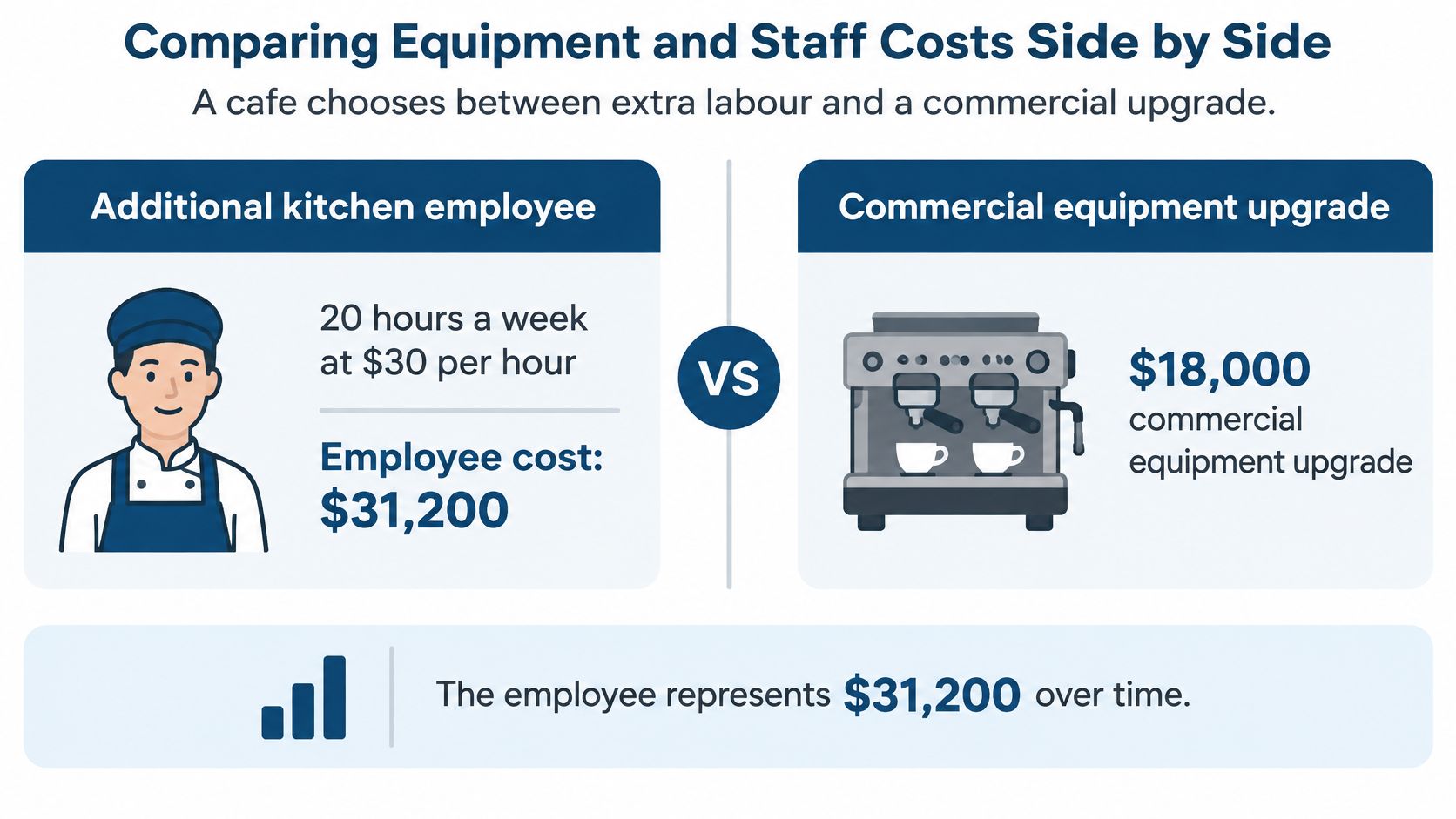
In a hypothetical café comparison, an additional employee working 20 hours weekly at $30 an hour represents $31,200 in annual gross wages across 52 paid weeks. An $18,000 equipment upgrade requires that upfront purchase amount, plus installation, maintenance and operating costs.
Those figures aren't interchangeable. One buys paid working time across a year; the other buys an asset with a particular function and working life.
Compare what each option actually delivers
MBIE's hospitality and tourism workforce survey supports considering technology that frees workers for customer service and higher-value activities. That's a stronger purchasing rationale than assuming machinery substitutes for an entire employee.
Additional employee compared with an equipment upgrade
| Consideration | Additional employee | Equipment upgrade |
|---|---|---|
| Upfront cost | Recruitment and onboarding, priced for the role | Hypothetical $18,000 purchase, plus freight and installation |
| Recurring expense | Hypothetical $31,200 annual gross wages, plus employer costs | Servicing, power, water and consumables, costed for the model |
| Flexibility | Casual, part-time or permanent arrangements within NZ employment requirements | Installed capacity remains during busy and quiet weeks |
| Capacity | Extra hands across prep, plating and other tasks | Additional output on a specific process |
| Training | Onboarding and supervision | Operator training and cleaning routines |
| Maintenance | Leave cover and day-to-day management | Scheduled servicing and repairs |
| Operational risk | Turnover, recruitment delays and skill gaps | Downtime, unsuitable installation or unused capacity |
Roster records should show whether additional labour is consistently required or concentrated around particular tasks. Resources discussing workforce scheduling and attendance tools can help operators identify useful records, without replacing payroll or employment advice.
Check the supporting infrastructure
Hospitality advises checking the final electrical or gas supply, cut-out, ventilation and clearances against the model document before ordering cabinetry. An equipment budget that excludes necessary site changes isn't ready for approval.
For warewashing specifically, manual dishwashing versus commercial dishwashers helps frame the tasks involved. Washing capacity still requires someone to scrape, load, unload and maintain the machine.
Can the proposed machine remove enough required work to change the roster, or create capacity that earns contribution profit?
Situations Where Extra Labour Is the Right Call
Hiring makes sense when available equipment could produce more, but necessary work isn't getting done. Another capable person can also protect quality where the operation requires simultaneous decisions, manual finishing and communication.
The strongest cases include:
- Simultaneous demand: Preparation, cooking, plating and service need attention together.
- Spare equipment capacity: Appliances are available but staff can't load or operate them promptly.
- An overloaded pass: Completed components wait for assembly and dispatch.
- Judgement-intensive production: Doneness, presentation and special requirements need skilled attention.
- Fluctuating demand: Appropriately structured staffing can support changing requirements.
- Cross-role coverage: A trained employee can move between preparation, washing and service support.
- Persistent overload: Existing staff can't complete their responsibilities safely within reasonable working arrangements.
Recruit for the missing capability
An entry-level employee won't necessarily relieve a senior chef who is supervising every station. The missing resource may be decision-making authority, technical competence or the ability to coordinate service independently.
Skilled staff contribute through quality control, adaptability and customer experience, not just meals produced. A machine can repeat a suitable process, but it can't take responsibility for an unfamiliar dietary request or reorganise a disrupted service.
Recruitment and training also need a realistic plan. A new employee may initially require substantial attention from the very person who is already overloaded.
Where existing employment arrangements permit, an operator can trial additional rostered support during comparable peaks. Recording completed orders, service times and overtime helps establish whether extra hands solve the problem.
Hiring test: Define the tasks, required skill level and productive shift before advertising the role.
Situations Where Equipment Is the Right Call
Equipment deserves priority when a repeatable process holds back otherwise available staff. The purchase should follow the blocked station, with capacity checked against the actual product, batch and service pattern.
Match the appliance to the work
- Food preparation: Robot Coupe processors can suit repetitive chopping, slicing and mixing. Attachment suitability, finished texture, loading and cleaning belong in the assessment.
- Cooking: Unox, Convotherm or Giorik ovens merit consideration when cooking capacity or process requirements restrict output. Tray spacing and the actual menu matter more than nominal chamber size.
- Refrigeration: SKOPE or Atosa refrigeration should be assessed for ingredient access, safe storage, ventilation and station placement.
- Warewashing: Classeq or Winterhalter dishwashers suit investigation when machine throughput, rather than loading practice, limits clean-item availability.
- Mixing: Planetary or spiral mixers can address repeated manual preparation, with selection based on product type and suitable working batch sizes.
Hospitality's equipment range includes preparation, cooking, refrigeration and warewashing options, with stocked brands including Robot Coupe, Unox, Convotherm, SKOPE and Winterhalter. Custom-built equipment requires plenty of lead time during peak season, so a fit-out programme needs to allow for that.
Include maintenance tasks in the decision
A dedicated maintenance appliance can address a specific manual process without increasing cooking capacity. The Frymax EOF-25 25L Electric Oil Filter Machine, for example, is a mobile electric unit for removing crumbs and sediment from fryer oil away from the cooking tank.
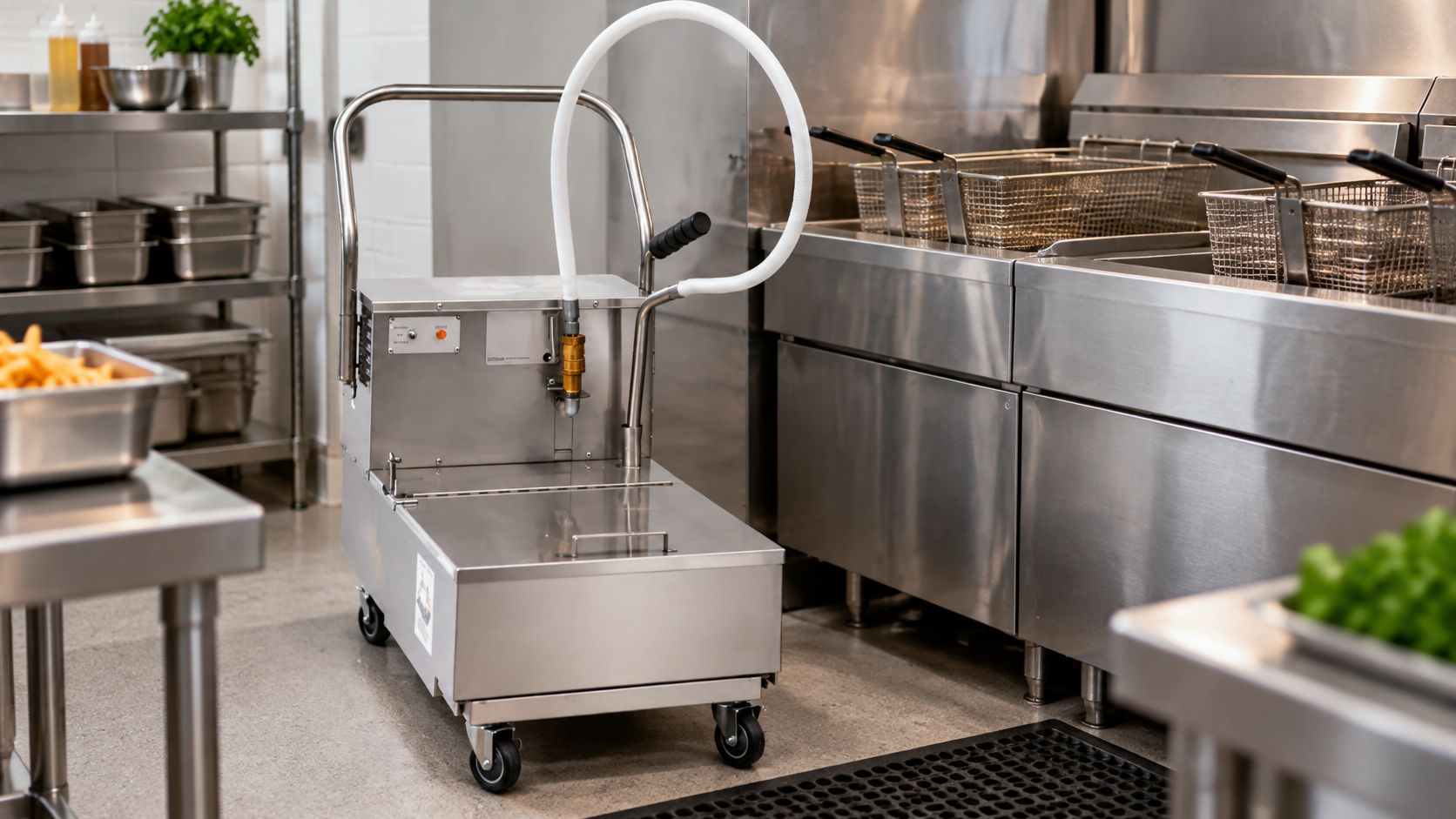
Its relevance is the filtration task, not a promise that fewer kitchen staff will be needed. Filter media, handling, cleaning and storage still belong in the operating assessment.
The Robot Coupe labour-savings discussion provides related reading on evaluating preparation equipment. Manufacturer-rated capacity should always be checked against the specific application, preferably using representative ingredients and batch sizes.
An upgrade can make the existing team more productive while leaving employee numbers unchanged. That can still be worthwhile if the team can use the released capacity profitably.
Choose the Constraint Before You Sign
The question “Should you upgrade equipment or hire more staff?” becomes manageable when the operator separates operational improvement from financial benefit. Faster production isn't automatically lower payroll, and extra sales aren't automatically extra profit.
Hospitality New Zealand reports productivity growth averaging 1.6% annually over the decade to 2024. That sector result isn't a saving to insert into an individual equipment proposal. Each venue needs its own measurements.
Run the decision on the venue's figures
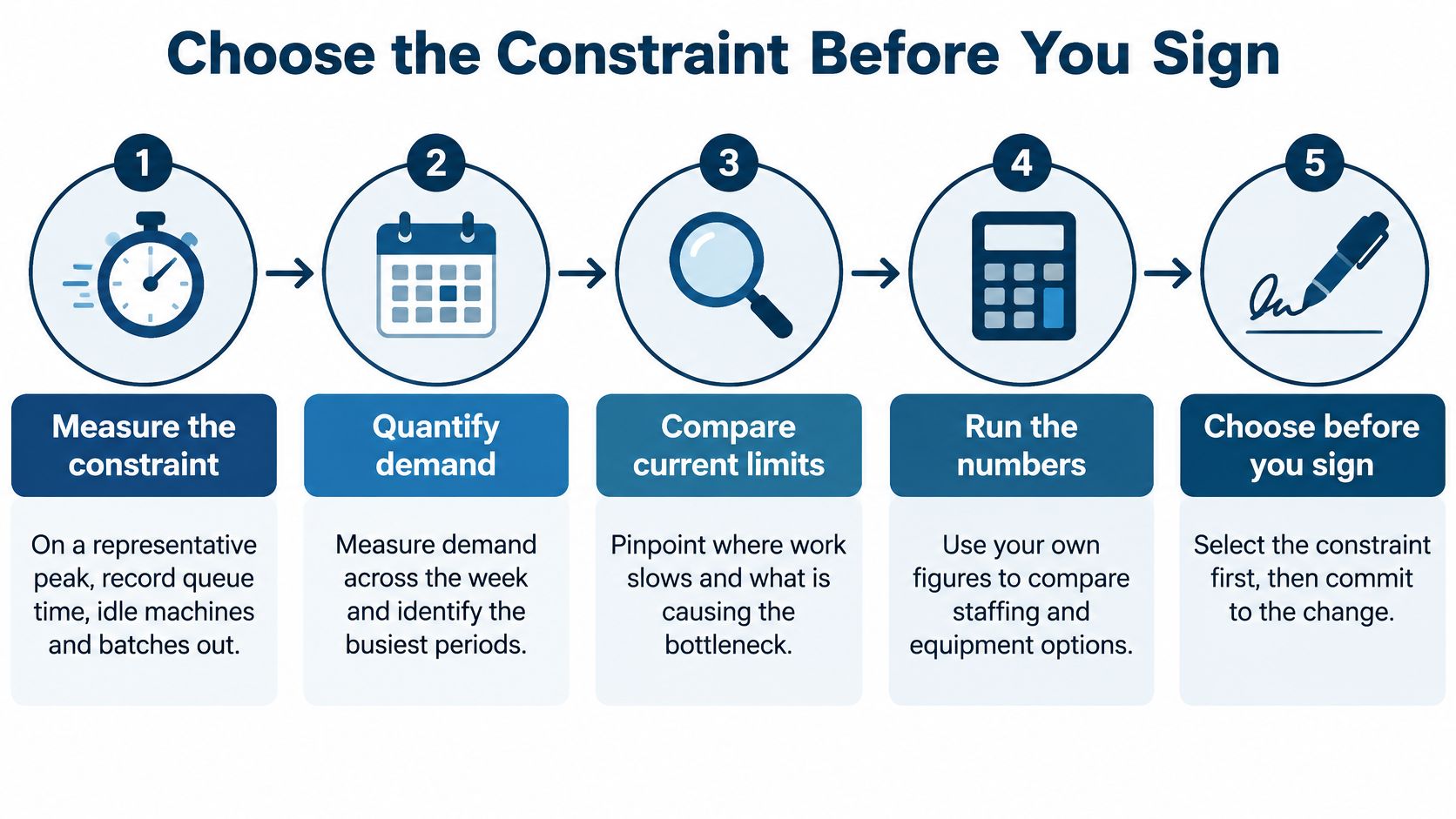
- Measure the constraint. During representative peaks, record queue time, idle machines and completed batches. Count meals, trays or covers per paid labour hour.
- Quantify demand. Establish whether additional capacity will be used across ordinary trading and seasonal peaks, rather than just an exceptional service.
- Calculate costs. Compare fully loaded employment costs with purchase, freight, installation, finance, utilities, servicing and downtime costs.
- Estimate benefits separately. Record recovered staff time, actual payroll savings and additional contribution profit on different lines.
- Test the outcome. Repeat the original measurements under comparable conditions, including service times, waste, output per labour hour and profitability.
Recovered staff time means employees remain paid but can do other work. Actual payroll savings require a genuine reduction in paid hours or avoided expenditure, achievable within employment obligations. Additional contribution profit means extra sales less the associated food and other direct costs.
Calculate payback without double counting
Simple payback in years = net upfront investment ÷ genuine annual net financial benefit.
For the hypothetical café upgrade, the worksheet starts with the $18,000 purchase, adds installation and other upfront costs, and leaves annual benefit unfilled until the business enters defensible figures. Annual net benefit should deduct incremental running and maintenance costs.
The same released hour can't be counted both as a payroll saving and as paid time producing additional sales.
| Situation | Consider hiring | Consider equipment | Consider workflow changes |
|---|---|---|---|
| Appliances idle while necessary tasks queue | Yes, with the right skills | Not initially | Check scheduling |
| Staff wait beside fully occupied machinery | Only for supporting tasks | Yes, subject to demand | Check loading and sequencing |
| Walking, searching and handling dominate | Not initially | Only where placement needs an asset | Yes |
| Demand is irregular and uncertain | Assess suitable arrangements | Avoid unsupported excess capacity | Yes |
| Capacity exists but quality needs judgement | Prioritise skilled capability | Only for suitable repeatable tasks | Standardise supporting routines |
Before approval, confirm dimensions, installation requirements and return conditions. Returns of larger equipment incur a 10% to 40% restocking fee, depending on whether the item is opened or in its original packaging.
The strongest answer may combine a process correction, a targeted appliance and appropriate staffing. The order matters: establish the constraint, verify demand, then commit.
Simply Hospitality offers commercial kitchen equipment and practical selection advice to help operators match capacity, installation requirements and ownership costs to the job. For help assessing an upgrade against the work holding a kitchen back, visit Simply Hospitality with the menu, peak-service requirements and site details.