


Is Bigger Catering Equipment Always Better? a Sizing Check
Not necessarily. Size equipment for realistic peak demand and useful output, not the largest rated capacity on the spec sheet. The popular advice to buy big for the future sounds prudent, but it ignores utilisation. A machine only earns its place when staff load it well, often enough, during periods customers pay for.
Why Maximum Capacity Is Not the Same as Useful Capacity
Maximum capacity is the manufacturer's rated output under ideal conditions. It usually assumes a full load, a set cycle, suitable product and no interruption. Useful operating capacity is narrower. It's what a kitchen produces across a real service once loading, unloading, cleaning, staff availability and menu mix enter the picture.
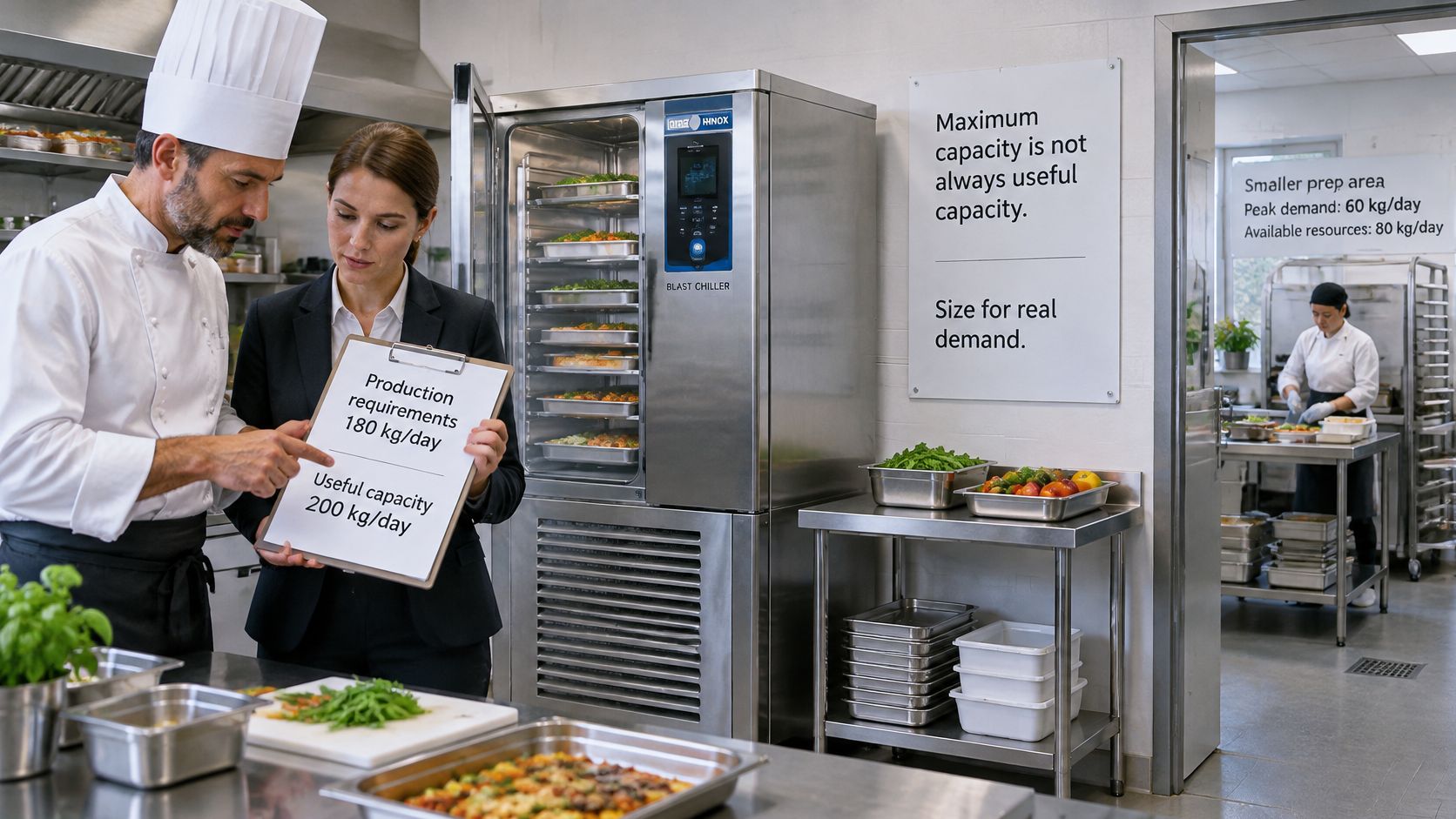
Say an oven is rated by trays per load. That figure doesn't tell operators how long trays wait for a free pair of hands, whether menu items can share a load, or how much time cleaning removes between batches. A smaller unit loaded promptly can outperform a larger unit that sits open, part-filled or waiting for product.
Where size helps and where it doesn't
In a high-volume kitchen, each larger batch can remove repeated handling and waiting. Staff load once, cook once and move a meaningful quantity to service. That logic weakens in a café with predictable covers and short peaks. The same machine brings higher capital cost, occupies prep space and still needs heating, cleaning and servicing when demand is modest.
Six considerations separate a sensible purchase from an impressive spec sheet:
- Throughput: finished portions or racks completed within the available window
- Utilisation: how fully and how often the machine is loaded
- Space: footprint, clearances, door swing and access for service
- Utilities: power, gas, water, drainage and extraction capacity
- Labour: staff available to load, monitor, unload and clean it
- Whole-of-life cost: purchase, installation, running, maintenance and downtime
Practical rule: Buy for the busiest realistic pattern measured over real trading, with a workable margin, not for a theoretical maximum the kitchen rarely reaches.
Is bigger catering equipment always better? No. The best equipment is appropriately sized for production requirements, peak demand and available resources.
The Hidden Costs of Oversized Equipment
The purchase price is only the first commitment. A larger model can cost more to deliver, position and connect, while tying up capital that might have funded refrigeration controls, smallwares, maintenance or a workflow fix with a faster return. If it then runs part-loaded most days, the business carries the full fixed cost for only part of the output.
Space is another continuing cost. Every square metre given to equipment is unavailable for prep, storage or safe movement, a point explored in the guide to what one square metre of commercial kitchen space is worth. Installation can grow with output too. Higher-output cooking, dishwashing or refrigeration may require stronger electrical or gas supply, extraction, drainage or hot-water capacity.
Energy depends on use, not size alone
Larger machines don't always use more energy or water per portion produced. Design, insulation, controls and load factor matter. Still, idle and part-load running costs money. The EECA food and beverage service sector pathway reports that, in 2022, commercial ovens and cooking elements accounted for 15% of all energy consumed by the Accommodation and Food Services sector, while refrigeration systems accounted for 22%. Together they represented 37%, so sizing errors concentrate in the two categories kitchens can least afford to run wastefully.
| Potential cost | Why it matters | What to investigate |
|---|---|---|
| Capital investment | Larger units cost more to buy and deliver, and the money stays tied up when the machine runs part-loaded | Price the right-sized and oversized models together, including freight |
| Floor and bench space | Every square metre given to equipment is space lost to prep, storage or movement | Measure footprint plus door swing, service clearances and the access route |
| Energy and water use | Bigger does not always mean more per unit produced, but idle or part-load running still costs | Compare rated power, idle consumption and typical load per service |
| Installation and infrastructure | Higher output can trigger larger extraction, electrical, gas or hot-water requirements | Check supply, cut-out, ventilation and clearances against the model document |
| Cleaning and maintenance | Larger bowls, cavities and surfaces take longer to clean, and servicing can scale with size | Ask for cleaning time per cycle and the recommended service schedule |
| Underused capacity | A machine at a fraction of its rating carries the same fixed costs as a fully loaded one | Track average load per service over four weeks of trading |
| Reduced kitchen flexibility | One large unit can become a single point of failure and fixes the layout around it | Note what service looks like if the unit stops for a day |
Cleaning time deserves honest measurement. A bigger cavity, bowl or tank may add only minutes per cycle, but staff repeat that task daily. Flexibility also suffers when one oversized unit dictates the layout and becomes the only route for a core menu item. Price both the right-sized and oversized options on the same whole-of-life basis before deciding.
When Larger Equipment Makes Commercial Sense
Larger equipment earns its cost when demand is sustained, predictable and large enough to fill it. Event caterers working to fixed delivery windows, central production kitchens supplying several sites and hotels running multiple meal services from one kitchen often meet that test. High-volume restaurants with repeatable covers and operators batch cooking for several days can also use capacity productively.
The mechanism is straightforward. Fewer production cycles mean fewer loads to prepare, monitor, unload and clean between. Staff handle product less often, and service is less likely to wait for a machine to finish. Those savings are real only when the larger batch matches orders. Capacity that produces food nobody has ordered isn't efficiency. It's inventory and risk.
Sustained demand versus occasional peaks
A kitchen that's full every Friday to Sunday across the year has a stronger case than one overwhelmed for a few days before a holiday. Rapid growth also needs evidence, not optimism. Booked functions, committed wholesale orders, added seats or extended hours support a step up. A hope that trade might grow doesn't.
For occasional peaks, operators have options short of permanent oversizing:
- Batch earlier: move suitable production ahead of the peak within food safety limits
- Add temporary capacity: hire, borrow through an arrangement or outsource a defined task
- Use a second smaller unit: cover overflow without replacing the main machine
- Simplify the peak menu: reduce items competing for the same equipment
If the larger unit would sit lightly loaded for most of the week, the commercial case is weak.
The deciding question is whether demand is repeatable, measured and expected to hold for the life of the equipment. Seasonal demand can justify size when the season is long and profitable enough. A handful of unusually busy days usually can't.
How to Calculate the Capacity You Need
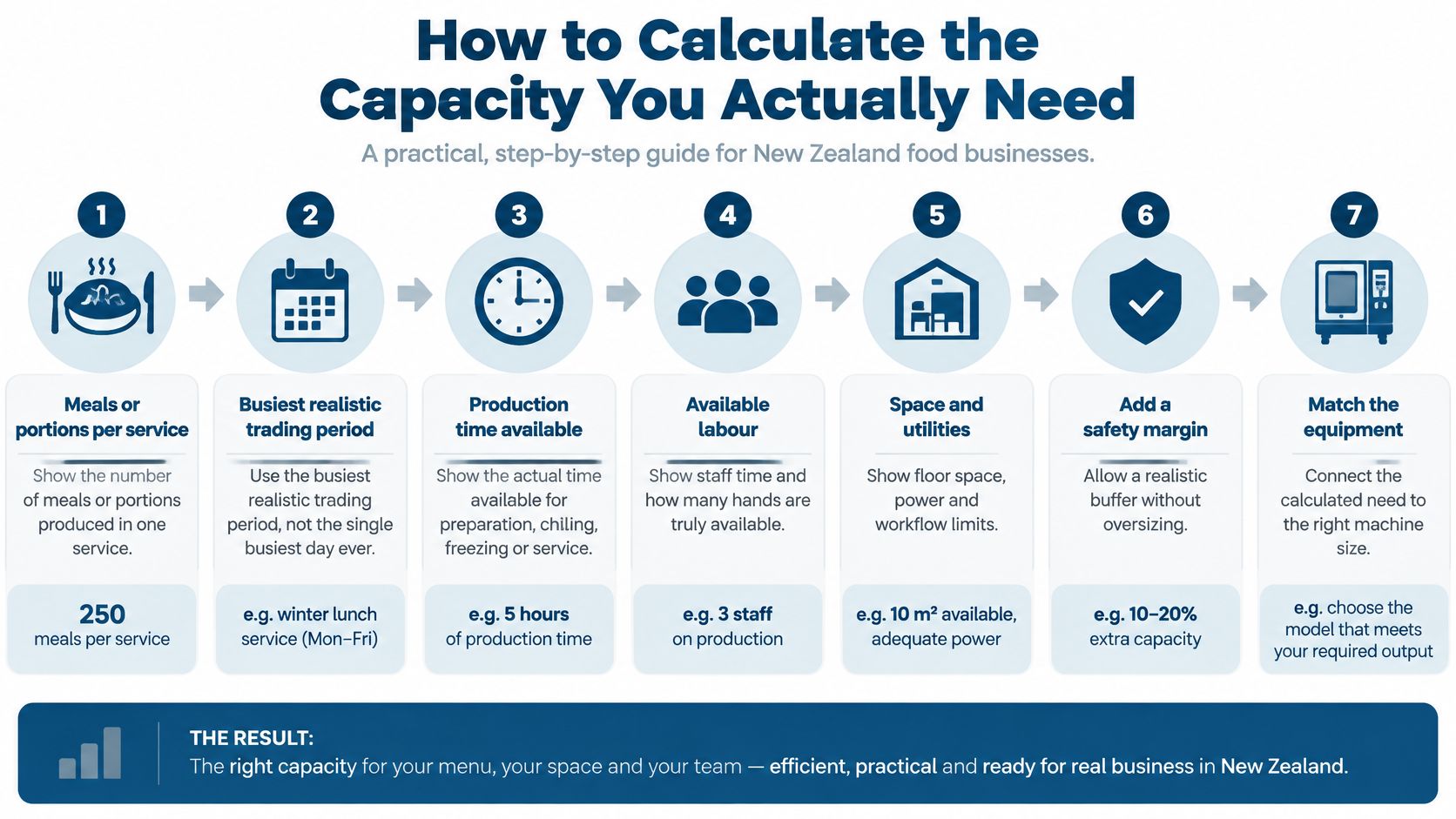
Capacity planning starts with the service you must deliver. The spec sheet comes second. Record meals or portions per service, then choose the busiest period that repeats. A record day is a poor design brief. A normal Friday, a repeatable function size or a predictable lunch peak gives a usable target.
The nine inputs that matter
- Portions per service: count finished portions, racks, trays or kilograms by menu item.
- Realistic peak: use repeated busy trading, not a one-off record day.
- Batch size: calculate how many batches fit the required quantity and product size.
- Production window: measure the time before service, dispatch or chilling must occur.
- Full cycle time: include loading, processing, unloading and any recovery time.
- Preparation and cleaning: add changeover, washing and sanitation between batches.
- Staff availability: confirm who can load and unload without creating another queue.
- Menu separation: note allergens, flavours, temperatures or timings that prevent shared batches.
- Expected growth: allow only for growth supported by bookings, seats, hours or contracts.
This is the discipline behind planning equipment for consistent meal service, where timing matters as much as nominal capacity. The method also exposes false bottlenecks. A machine can look too small because prep starts late, trays are the wrong depth or one staff member is expected to run two stations.
A 120 portion worked example
Take a kitchen that must produce 120 portions in a two-hour preparation window. A unit producing 30 portions per batch needs four batches. A unit producing 60 portions per batch needs two. The larger unit is not automatically twice as fast.
The cycle times below are assumptions. Substitute timed cycles from the models you are comparing.
| Option | Portions per batch | Batches needed | Cycle time including cleaning | Total time |
|---|---|---|---|---|
| 30-portion unit | 30 | 4 | 20 min | 80 min |
| 60-portion unit | 60 | 2 | 45 min | 90 min |
Here the smaller unit finishes sooner because its full cycle is shorter. Change the larger unit's cycle to 35 minutes and its total becomes 70 minutes, which reverses the answer. Loading effort also matters. Four small batches need four timely interventions. Two large batches need fewer interventions, but each delay affects more portions.
Cooling can overrule the arithmetic. The MPI food safety guidance requires freshly cooked potentially hazardous food to cool from 60°C to 21°C within two hours, then from 21°C to 5°C or below within a further four hours. A batch that is too deep, tightly packed or loaded into a cabinet with poor airflow may miss that limit even when the cabinet's advertised volume looks ample.
Shallow trays, sensible portioning and purpose-built blast chilling may solve that problem more effectively than a bigger storage fridge. The Irinox MultiFresh Next S Excellence Blast Chiller & Freezer - MFNS.EX is a rapid-chilling unit for cook-chill production. Its relevance depends on whether controlled chilling, rather than storage volume, is the constraint.
Bigger vs Smaller Equipment Across Different Categories
A spec sheet gives you a capacity figure. A kitchen gives you a workflow. Loading pattern, door openings, incoming water temperature, oil condition, product thickness and cleaning time can turn a generous rating into modest useful output. Compare usable tray, shelf, pan or bowl capacity against the peak you run, not the external dimensions.
| Equipment category | Benefits of larger capacity | Potential drawbacks |
|---|---|---|
| Commercial ovens | More tray capacity for batch cooking and room for mixed loads | Higher heat output and extraction demand; energy wasted on small loads |
| Refrigeration | More storage volume and easier stock separation by service or food type | Overloaded cabinets can slow cooling; more floor space and more stock held longer |
| Commercial mixers | Larger batches and fewer runs for bulk preparation | Minimum workable quantities may be too large for small jobs; longer bowl cleaning |
| Dishwashers | Higher rack throughput at service peaks | Space, hot-water and drainage demand; often run part-filled in quiet periods |
| Food processors | Bowl capacity for bulk preparation | Large bowls handle small quantities poorly; more parts to clean |
| Commercial fryers | More cooking capacity and faster recovery between batches | More oil to manage and filter; higher energy demand |
Ovens show the trade-off most clearly. Extra trays help batch cooking and mixed loads, but a larger cavity can demand more extraction and energy for small runs. Unox and Convotherm ovens differ in tray count and footprint, and the useful comparison is how many trays you can load, cook and unload inside the peak window. Waldorf, Blue Seal and Cobra cooking equipment raise the same question about burner or fryer capacity versus recovery and oil volume.
Refrigeration needs temperature performance, not just litres. The MPI guidance on temperature control identifies 5°C or below as the key cold-holding temperature for potentially hazardous food, while food held hot should generally remain above 60°C. Frequent door opening, warm stock loading, blocked air circulation and tightly packed shelves can erode those limits. SKOPE and Atosa refrigeration should therefore be compared by usable shelf arrangement and recovery during peak access, not headline volume alone. If cooked product waits between cooking and service, temperature-controlled holding cabinets should be judged on shelf spacing, door openings and recovery, not pan count alone.
Commercial mixers and Robot Coupe food processors bring a minimum quantity problem. A large bowl may not mix, knead or process a small load properly, forcing staff to overproduce or use another method. That cost is easy to miss because the bowl looks efficient on paper. Dishwashers from Classeq, Winterhalter and Rhima need matching to rack volume at the actual peak, plus bench space for dirty and clean racks. A fast cycle doesn't help if racks queue on the floor.
Could Multiple Smaller Machines Be Better?
Two smaller machines can provide flexibility that one large machine can't. Staff can run only the unit needed during quiet periods, prepare different menu items simultaneously and place equipment closer to separate workstations. If one unit fails, the other may keep a reduced menu moving. That resilience is valuable, but it isn't automatic.
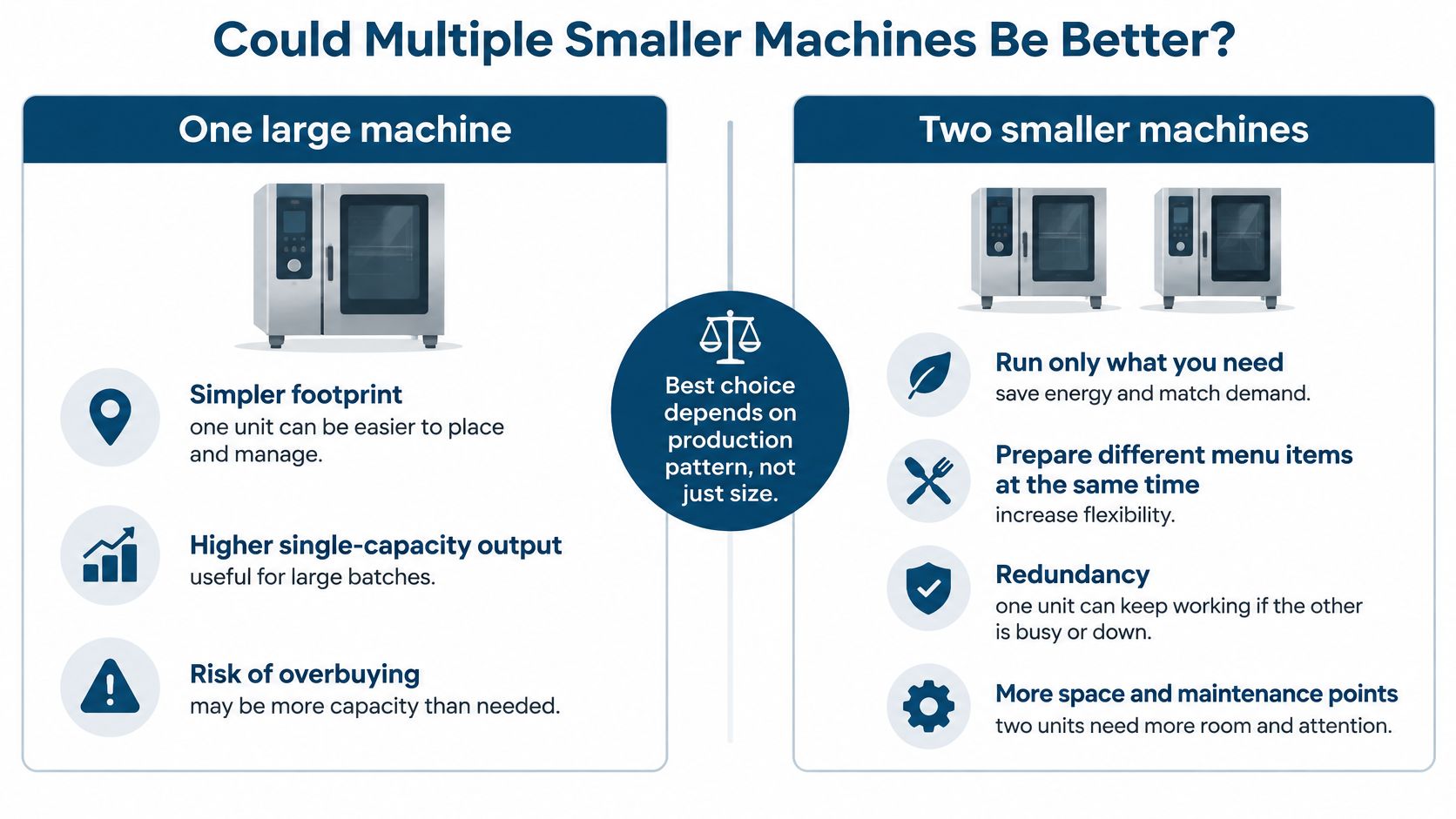
The costs are equally concrete. Two units may cost more combined, need two sets of connections and occupy more total space once clearances are included. Staff clean more bowls, cavities, filters or tanks. Servicing involves more components and potentially more visits. Operators weighing consolidation should also consider whether a combi oven can replace three pieces of kitchen equipment before adding another standalone machine.
Resilience is not the same as excess
Two half-sized units running all day may use more energy than one efficient unit at full load. A second unit also provides no meaningful backup at peak if both are already required to meet normal demand. Real resilience means spare usable capacity, rapid recovery, service access and a menu plan for reduced output.
The Auckland Council Waste Minimisation and Innovation Fund recipients document records a 2025 hospitality project targeting organic waste through inventory control, menu planning and portion management. That supports a broader point for schools, hospitals, aged-care kitchens, marae, hotels and event caterers. Flexible production and stock control can deliver more usable capacity than one permanently oversized installation, especially when occupancy and menus fluctuate.
A café with two sharp peaks might favour one main unit plus a smaller overflow unit near service. A hotel might split breakfast and dinner production by station. The deciding question is blunt. What fails, what continues and what can staff realistically produce if a machine stops for a day?
What Extra Capacity Is Worth in Practice
Capacity has value only when it creates profitable sales, removes paid hours, reduces outsourcing or prevents service failures that cost customers. It may also improve consistency by reducing rushed batches and repeated handling. Without one of those outcomes, extra capacity is capital sitting in stainless steel.
There's also a waste risk. The New Plymouth District Council composting for business page summarises research estimating annual café and restaurant food waste at approximately 24,375 tonnes, with 61% classified as avoidable. The same study estimated an average café or restaurant generated about 2.8 tonnes per year, with preparation waste representing 60%, plate waste 33% and spoilage 7%. Those figures don't prove large equipment causes waste. They do warn against equipment that encourages batches bigger than demand justifies or refrigerated stock that stays out of sight too long.
An illustrative return calculation
Say an upgrade costs an additional $8,000 and allows a business to fulfil 20 extra orders weekly. At an illustrative contribution margin of $12 per additional order, the potential contribution is $240 weekly or $12,480 annually over 52 weeks. Dividing $8,000 by $240 gives about 33 weeks of that contribution before other costs are covered.
Those numbers must be read narrowly:
- Potential contribution only: this isn't guaranteed profit.
- Real demand assumed: the 20 orders must be incremental, not shifted from another time or channel.
- Costs excluded: servicing, energy, finance charges, added ingredients and staff time still need accounting for.
- Capacity must be usable: labour, refrigeration, packaging and service capacity must support the extra orders.
A practical demand test is to record orders declined, items removed during service and production delays for four weeks. That record distinguishes lost sales from a feeling of being busy. It also frames the comparison in whether an extra commercial fridge is cheaper than running out of space, where the right answer depends on measurable stockouts rather than anxiety about empty shelves.
Capacity without customer demand has limited commercial value, however impressive the rating looks.
How to Choose the Right Catering Equipment Size
The right size is the smallest configuration that clears realistic peak demand without relying on rushed prep, overtime or borrowed space. Size for the demand you can show, then test whether workflow changes release capacity before capital is committed.
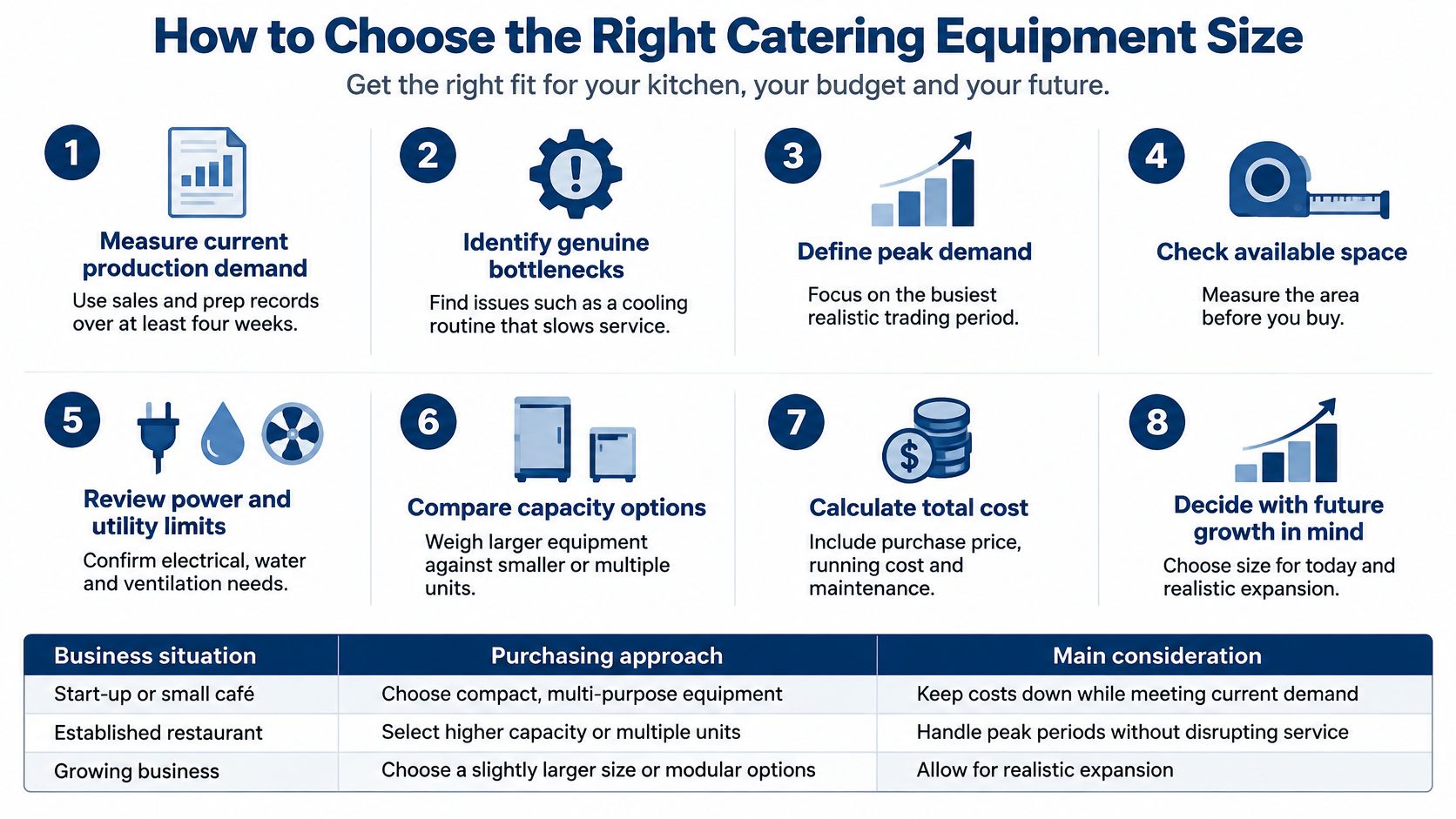
- Measure demand and calculate peak requirements using the method set out in the capacity calculation above.
- Review existing utilisation by recording average load, idle time and number of cycles per service.
- Consider workflow improvements including batch scheduling, shallow trays, blast chilling and staffing changes.
- Compare configurations against that measured peak, not the headline capacity on the spec sheet.
- Check installation and utilities for electrical or gas supply, extraction, clearances, drainage and hot water.
- Evaluate total ownership cost against realistic financial return, including cleaning, servicing and downtime.
Before buying new equipment, price layout and refurbishment options on the same whole-of-life basis. Moving a bench, reworking the extraction zone or refitting cabinetry may release enough capacity or improve access to change the model required. That test is often cheaper than upsizing, and it can reveal whether the constraint is the machine or the room around it.
The table below applies the method to a café with a sharp lunch peak and flat mid-afternoon trade. The verdict changes with the evidence, so use the logic rather than copying the row.
| Option in the worked example | What it fixes | What would make it the right call |
|---|---|---|
| Keep the current machine and reschedule prep | Batch timing and queueing at the pass | The bottleneck clears when prep moves earlier and the machine is loaded more evenly |
| Upsize the main machine | Usable output at every peak | Lunch demand exceeds output on most service days, not only on the busiest one |
| Add a smaller second unit | Menu clashes and short, intense peaks | Two temperatures or two locations cut waiting, and the extra footprint earns its keep |
| Use temporary or outsourced capacity | Occasional event or seasonal spikes | The extra volume is infrequent enough that permanent capacity would sit idle |
| Stage the purchase with a review date | Measured growth that is not yet committed | Demand is rising, but the next level of output can be funded and installed later |
Once the choice is made, ordering checks decide whether the installation runs smoothly. The Hospitality team advises checking the final electrical or gas supply, cut-out, ventilation and clearances against the model document before ordering cabinetry. Freight for larger, bulky or commercial equipment is calculated separately, and the Hospitality team may contact the customer to confirm or adjust freight costs before dispatch. Custom built equipment requires plenty of lead time during peak season, so ordering shouldn't wait until demand has already outrun the kitchen.
Operators who want help comparing oven tray capacity, refrigeration volume, dishwashing throughput or a one-large versus two-small configuration can talk through measured peak demand and installation constraints with Simply Hospitality. That conversation can narrow the options before capital is committed, while engineering certification and direct installation remain matters for appropriately qualified specialists.