

What Does One Extra Step Cost Your Kitchen Every Day?
Five unnecessary steps per trip, at 80 trips per employee and four employees, comes to about 16 minutes and $8.53 of staff time a day, or about $2,560 over 300 operating days, assuming 0.6 seconds per step and a $32 fully loaded hourly employment cost. That answer matters because the trip in question usually looks harmless. It's a chef crossing to a fridge, a cook hunting for tongs, or a kitchen hand backtracking with clean plates, repeated until it sets the pace of service.
Why Repeated Steps Add Up in a Busy Kitchen
Say a chef works a prep bench with a reach-in fridge placed about three metres too far away. Each trip takes under a second of extra walking, so nobody flags it during a busy service. Across prep, service and close-down, that same detour can repeat every few minutes.
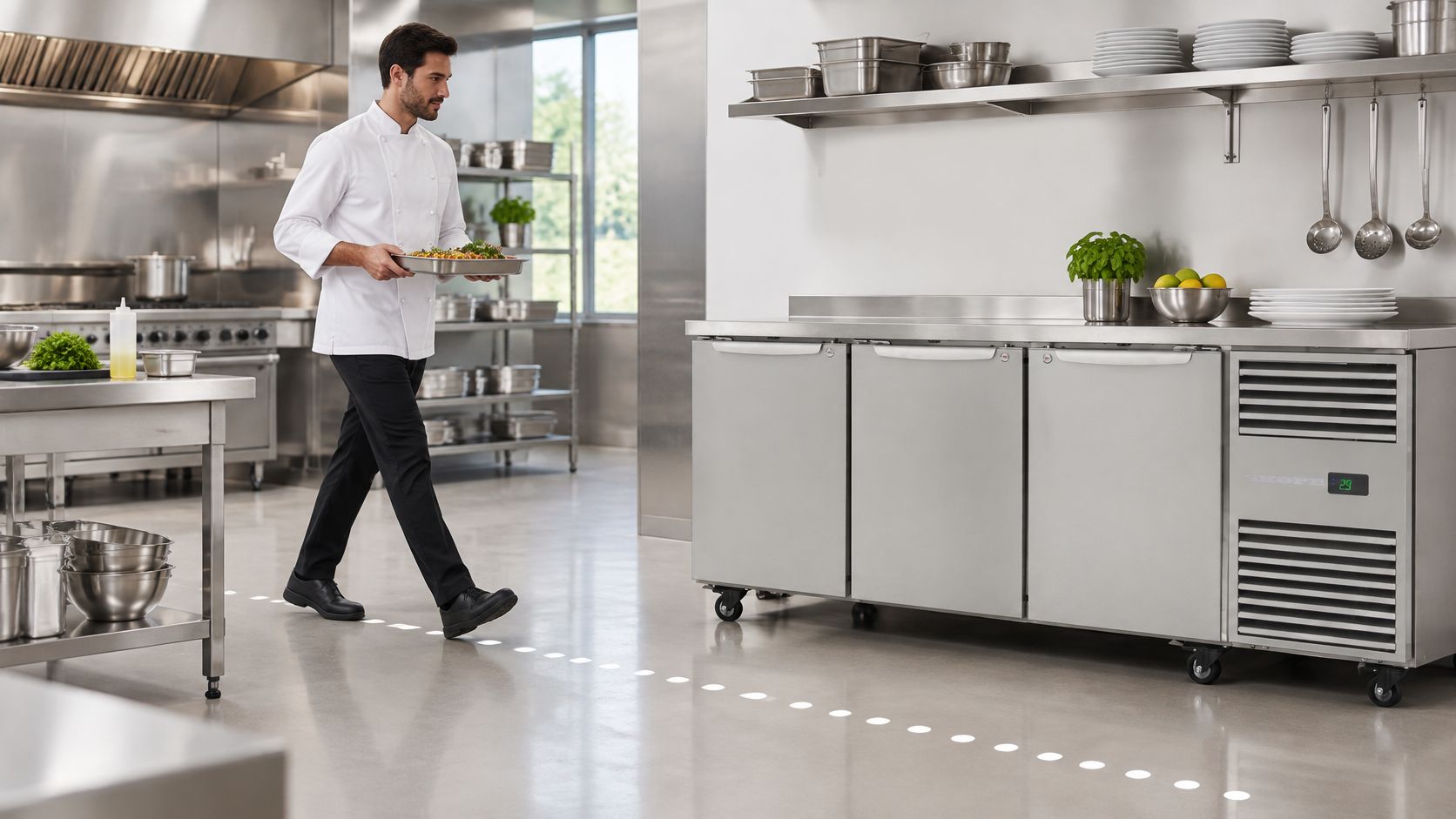
High-frequency movement deserves more attention than an occasional long journey. A dry store visited twice a shift costs little, even if it's distant. A fridge opened constantly, a utensil drawer across the room, or a pass separated from clean crockery shapes the rhythm of every order.
The trips that repeat most
- Refrigeration trips: Collecting chilled ingredients away from the bench.
- Utensil trips: Crossing for knives, tongs, containers or boards.
- Bench to cooking line: Carrying prepped items to ovens and fryers.
- Plating trips: Fetching garnishes, plates and finishing tools.
- Dishwashing returns: Moving clean items back against the dirty flow.
Essential movement shouldn't be confused with waste. Carrying raw protein to a sanitised board, moving hot food promptly to the pass, and separating dirty from clean dishes protect food safety and quality. Unnecessary movement is the detour created only because something sits in the wrong place.
The wider labour setting makes those detours harder to absorb. The Stats NZ productivity statistics reported that labour productivity in accommodation and food services fell 9.1% for the year ended March 2024, while output declined 3.8% and labour inputs increased 5.8%. More hours didn't produce more output.
Practical rule: Fix the trip made every few minutes before fixing the longest trip in the kitchen.
For a worked sense of scale, five extra minutes per person in a 10-person venue equals 50 labour minutes a day, or about 250 hours over 300 operating days. The aim isn't zero steps. It's a logical, safe flow where staff movement supports service rather than filling gaps in the layout.
How to Calculate the Daily Cost of One Extra Step
The calculation only helps if every assumption stays visible. Operators can replace each input with a measured figure from their own kitchen, then judge whether the recovered time justifies a layout change or a purchase.
The formula
Extra steps × repetitions × employees × seconds per step ÷ 3,600 × hourly employment cost = value of time lost daily.
The divisor converts seconds into hours. The hourly figure should be a fully loaded employment cost, not just the base wage, if the business wants the value of paid time rather than a narrow wage-only estimate.
| Input or result | Working | Value |
|---|---|---|
| Unnecessary steps per trip | Assumed | 5 |
| Repeated trips per employee per day | Assumed | 80 |
| Employees | Assumed | 4 |
| Unnecessary steps per day | 5 × 80 × 4 | 1,600 |
| Seconds lost per day | 1,600 × 0.6 seconds | 960 seconds, or 16 minutes |
| Staff time value per day | 960 ÷ 3,600 × $32 | $8.53 |
| Value across 300 operating days | $8.533 × 300 | $2,560 |
The 0.6 seconds per step figure is illustrative. Actual pace changes with the person, the load being carried, floor congestion, turns, doors and whether another staff member blocks the path. Timing real trips gives a better input than borrowing this assumption.
What the result does and doesn't mean
That $8.53 is the value of recoverable time, not an automatic wage saving. Paid hours only fall if rosters, overtime or extra staffing actually change. In many kitchens, the benefit appears as faster prep, fewer delays at the pass, or time redirected to cleaning and restocking.
A quick screening rule is to multiply extra seconds per order × daily covers × staff affected. If that product stays tiny, the issue probably doesn't warrant new equipment. If it grows quickly, the route deserves proper measurement.
Recovered minutes carry weight in kitchens already stretched across long weeks. A 2023 national survey published in Hospitality Insights found that 30% of chefs reported working more than 50 hours per week. In that setting, avoidable walking isn't just an abstract efficiency issue. It competes with cooking, breaks and close-down.
A saving only counts financially when recovered time is rostered out, redirected to a measured bottleneck, or used to complete more paid work.
Operators should also watch secondary effects. An interruption can delay plating, extend ticket times, create a queue at a shared bench and push close-down later. Measuring labour minutes per completed order captures more of that cost than judging one walk in isolation.
For a cleaner test, record trips and ticket times during representative services, change one route, then repeat the same count. That before-and-after approach turns what does one extra step cost your kitchen every day from a guess into a venue-specific number.
Where Unnecessary Steps Build Up Across the Kitchen
In the kitchens we see most often, time leaks through six ordinary station layouts. The recurring issue is a mismatch between where items are stored and where staff use them, or a route that cuts across another task.
| Kitchen activity | Unnecessary movement | Possible improvement |
|---|---|---|
| Refrigeration | Frequently used ingredients stored away from the prep station | Keep high-use items at the point of use |
| Food preparation | Knives, containers and utensils spread across several benches | Group tools and containers at each station |
| Cooking | Repeated trips between ovens, fryers, benches and ingredient storage | Stage ingredients for each cooking station before service |
| Plating | Garnishes, crockery and finishing equipment spread across the kitchen | Stage a plating point near the pass with clean crockery |
| Dishwashing | Backtracking between dirty collection, washing and clean storage | Set a one-way dirty-to-clean flow |
| Dry storage | Daily-use stock kept in a distant storeroom | Move daily-use stock to shelving closer to the work area |
Refrigeration and preparation often share the same route. When herbs, dairy, proteins and sauces sit in separate cold locations, cooks leave the bench repeatedly to assemble one dish. Keeping working quantities together by station can reduce those crossings without changing the menu.
Cooking and plating create reversals. A cook may move food forward, then turn back for a pan, seasoning, plate or garnish stored behind the work zone. During peak service, that return route can cross another worker's path. Check the floor plan against the task sequence, not just the distance between benches.
Dishwashing has a less obvious return leg. Clean crockery stored far from plating adds carrying, while a dirty landing area beyond the machine can send staff across the clean route. Clear, labelled commercial food storage containers in NZ can reduce searching when working quantities are decanted consistently for each station.
Point-of-use storage matters in home kitchens too. The guidance on kitchen planning for Southwest Michigan homeowners makes the same practical point: storage should follow the task, rather than fill leftover space. In a commercial kitchen, frequency sets the priority. Mark the three most repeated trips on a floor plan, then check whether moving storage or adjusting a station can remove the crossing. A short route repeated constantly may deserve attention before a longer route made only occasionally.
How to Measure Unnecessary Kitchen Movement
A tape measure, phone stopwatch and simple floor plan are enough for a useful first audit. The method needs consistency more than precision, because the same count will be repeated after a change.
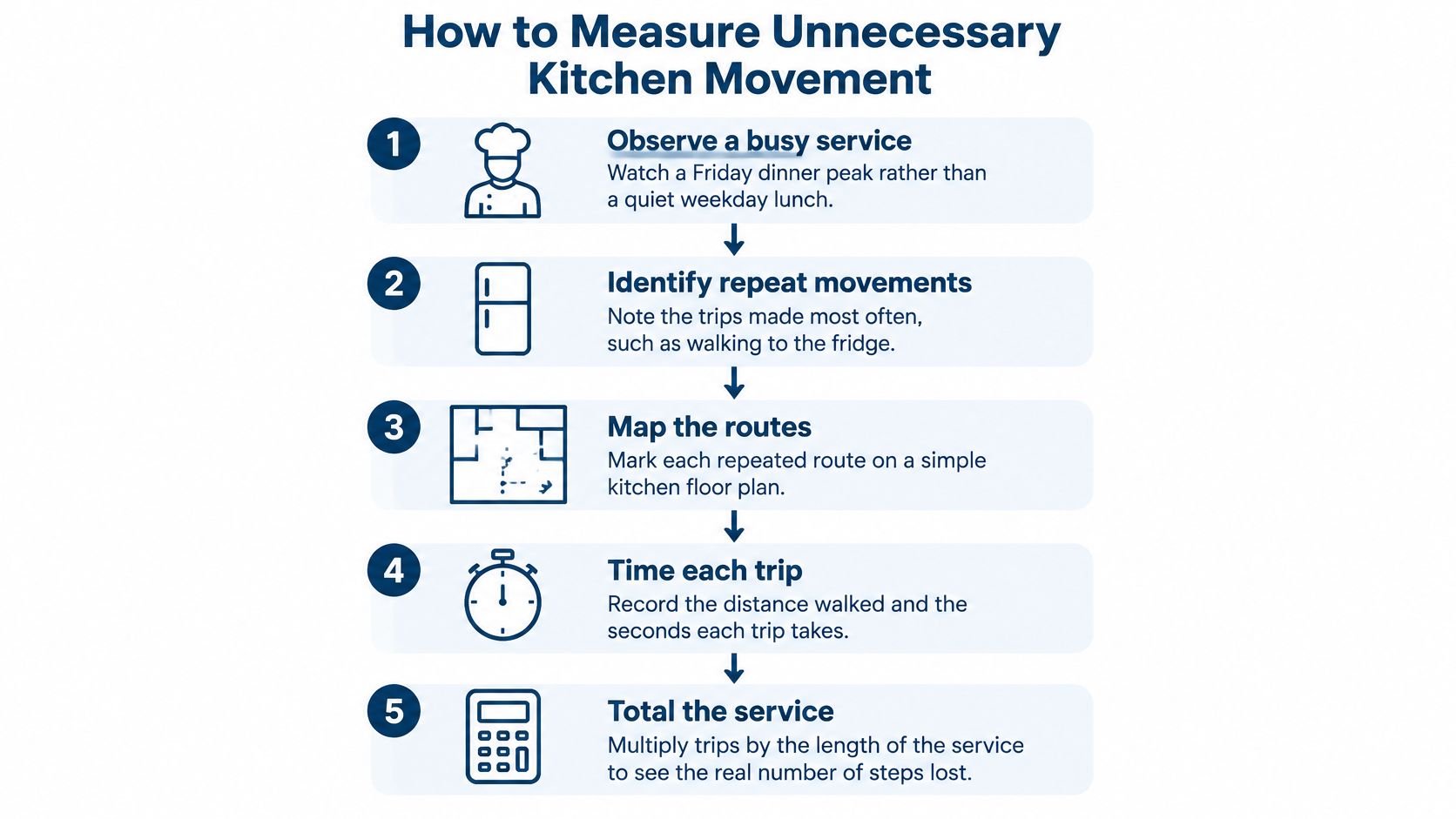
A practical eight-step audit
- Observe a representative busy service: Choose a Friday dinner peak rather than a quiet weekday lunch.
- Identify repeat movements: Note fridge, utensil, dry store, bench and dishwasher trips.
- Record start and finish points: Write down the exact bench, shelf, fridge or pass involved.
- Count repetitions: Tally each route during a defined peak period.
- Measure distance: Use a tape measure or pace a known length for approximate metres.
- Time sample trips: Use a phone stopwatch, including turns, doors and waiting.
- Mark improvements: Sketch relocated storage or equipment on the floor plan.
- Remeasure after changes: Repeat the same period and method for a fair comparison.
Staff feedback should shape the shortlist. Employees performing the tasks usually know which route frustrates them, where two people compete for the same drawer, and which trip only becomes a problem when orders peak. Managers watching from the pass can miss those details.
A floor plan makes congestion visible. Draw each repeated route in a different colour, then circle crossings, reversals and shared access points. A route that looks short on paper may still be costly if it crosses the hot line or dishwasher exit.
Measure both distance and time: Step counts alone miss waiting, door opening, searching and carrying.
Counts from a short peak window shouldn't be stretched carelessly across a full day. Record the observation period, covers completed and staffing level alongside the tally. That context lets operators compare services fairly and spot whether a change reduced movement or merely coincided with a quieter night.
What Small Distances Add Up to Over a Year
An ingredient station two metres further than it should be adds up quickly. Saving two metres per retrieval across 200 retrievals a day means 400 metres less walking daily, or 120 kilometres over 300 operating days.
| Retrievals per day | Metres avoided per day | Kilometres per year |
|---|---|---|
| 100 | 200 | 60 |
| 200 | 400 | 120 |
| 300 | 600 | 180 |
The table assumes 300 operating days and a two-metre saving on every retrieval. Treat these figures as an illustration, not a benchmark. A café with fewer retrievals, seasonal trading or a smaller team should use its own count.
Saved metres need timing to become savings
Less walking does not automatically mean a financial gain. The effect depends on how often the route is used, who makes the trip and how it fits into the workflow. A clear two-metre path used occasionally may have little impact. The same distance on a congested route can mean repeated waiting and interruptions.
The operational cost may appear as interruptions, slower preparation and rework. When a cook leaves a station, another person may take the space; on returning, the cook may have to wait or work around them. Distance shows how much movement a route creates, while timed trips show how it affects service.
Separate peak retrievals from quieter prep trips. A repeated journey during the busiest service window can delay orders already moving through the kitchen. If considering more bench or storage space, use the frequency test alongside the practical trade-offs in whether another metre of stainless bench space pays for itself. The key test is how often the route occurs and when.
Low-Cost Changes That Cut Steps Safely
The easiest way to sort this is through prevention. Using a qualified hospitality kitchen design team like SACH Design is the best way to ensure the steps are managed and workflow is optimised from the outset. If you have an existing kitchen, I would also consider chatting with them about revisions and improvements.
Start with small, frequently used items. Relocating them can reduce repeated trips without buying major equipment, though staff need time to reset stations and follow the new layout.
- Relocate daily utensils: Keep tongs, knives and thermometers at their point of use.
- Organise by frequency: Place daily ingredients closer than weekly backup stock.
- Improve mise en place: Stock each station for the service window ahead.
- Use accessible shelving: Store daily tools and containers within safe reach.
- Consolidate prep: Complete related cutting, portioning and packing in one pass.
- Stage clean crockery: Hold plates near plating, away from the wash area.
- Batch dry-store restocks: Replace several single-item trips with one planned carry.
- Use mobile trolleys carefully: A kitchen trolley suited to the route can carry supplies, provided it does not block walkways or work areas.
Open shelving can shorten retrieval routes when it holds the right items at a safe, accessible height. The Knotty Lumber Co. shelf plans show how a shelf layout can be planned around reach and storage zones. In a commercial kitchen, choose materials and positions that meet cleanability, clearance and food safety requirements.
Steps that shouldn't be removed
Keep walkways clear, guards fitted, and machinery isolated before cleaning or maintenance. A WorkSafe report on food manufacturing safety visits identifies machinery injuries as a major harm source in food production, with about 200 injuries each year resulting in more than a week off work. A shorter route does not justify bypassing a safety control; an injury can disrupt work and require replacement labour.
Check chilled food temperatures after changing storage locations, especially beside a hot line. The MPI food safety guidance states that high-risk food must be cooked to at least 75°C, hot food must remain above 60°C until served, and chilled food must be stored below 5°C. Use a thermometer to check that the revised position keeps food within the required limits during service.
Protect cooling procedures when reorganising prep. The MPI cooling guidance requires food to cool from 60°C to 21°C within two hours, then to 5°C or below within a further four hours. Portioning food into shallow trays adds handling, but supports that timed process. Compare the cost of each extra step with the time and control it protects before changing preparation, cleaning or checking routines.
When Equipment Positioning Removes the Extra Step
Equipment earns its place when it removes a repeated trip without obstructing another task. Underbench refrigeration keeps working quantities below or beside the prep surface. A refrigerated preparation counter combines chilled storage with bench space. Both can help when cooks regularly leave the station to retrieve ingredients.
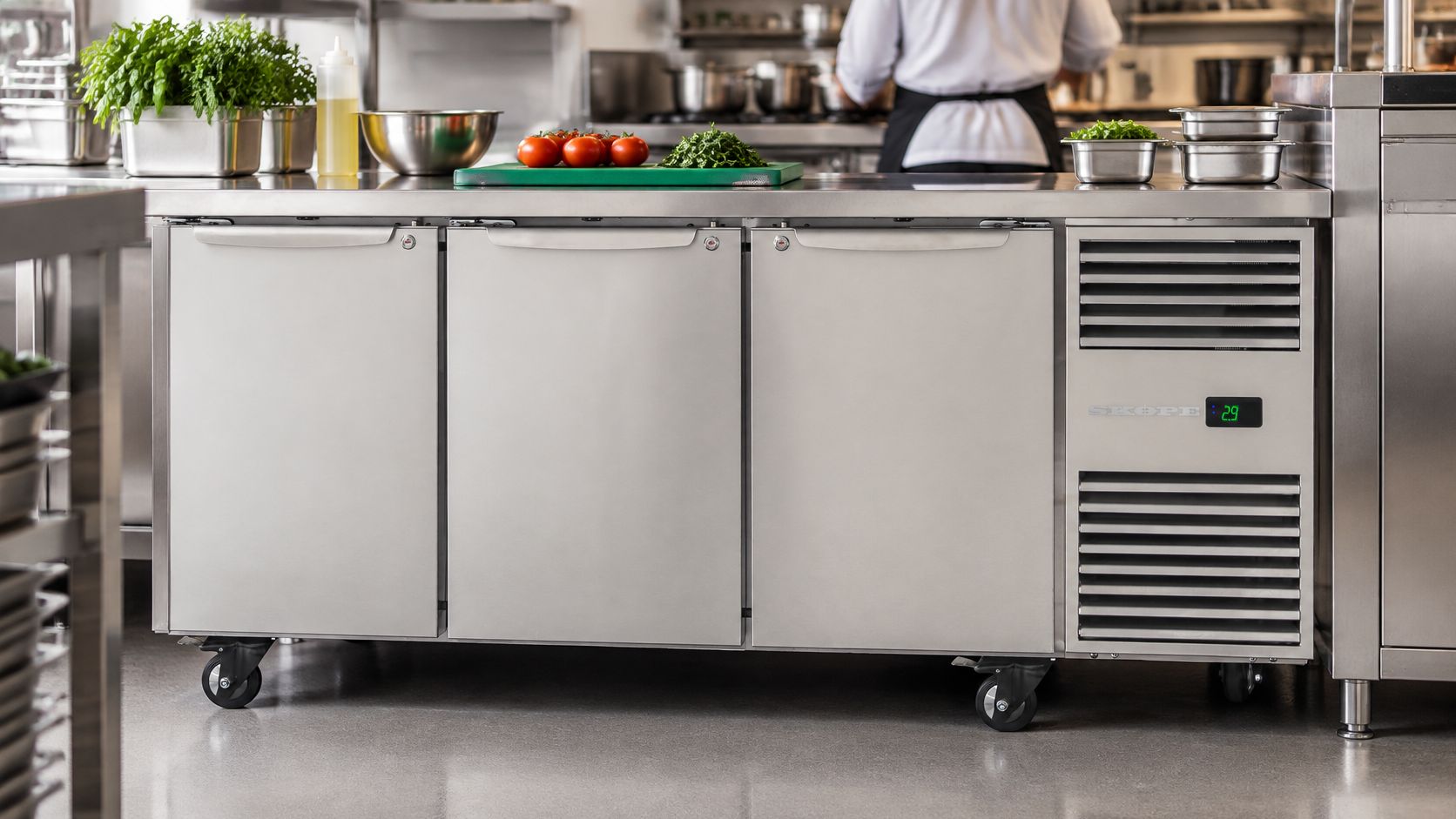
The SKOPE ProSpec 3 Door Underbench Fridge, model PG11.UBR.3.SD.RH is a three-door, right-hand configuration. Its value here is point-of-use access: ingredients can be stored close to the work surface, reducing trips to a main fridge during preparation.
Check the door swing, access pattern, bench height and service clearance against the actual station. Stainless steel benches and shelving can keep utensils and containers near the tasks that use them. A Robot Coupe food processor may also consolidate repetitive preparation at one station, provided cleaning and storage do not create extra trips.
Placement affects energy use as well as movement. The EECA food and beverage service sector pathway reports that commercial ovens and cooking elements account for approximately 15% of sector energy consumption, while refrigeration accounts for 22%. Repeated door opening, holding doors open during collection and fragmented partial-load cooking can use energy without adding saleable output. Batching work and keeping high-use items within the main work zone can reduce unnecessary access.
A new unit can create a worse route if it narrows a walkway, blocks cleaning access, pushes two stations into one path or sits too close to heat. Dishwashing equipment improves movement only when dirty landing, washing and clean storage follow a workable sequence.
Before ordering cabinetry, check the final electrical or gas supply, cut-out, ventilation and clearances against the model document. Simply Hospitality stocks commercial equipment brands including Blue Seal, Convotherm, Unox, Turbofan, Robot Coupe, Vitamix (Commercial), SKOPE, and Winterhalter. For station planning, designing a kitchen to save time on every service can help assess equipment positions as part of the overall layout. After installation, compare energy use per cover, ticket times and remake rates with the earlier baseline.
Confirm Which Steps Are Worth Fixing First
Priority should follow measured frequency, time recovered and the cost of change. A cheap storage move on a constant route can outperform an expensive equipment purchase aimed at an occasional trip.
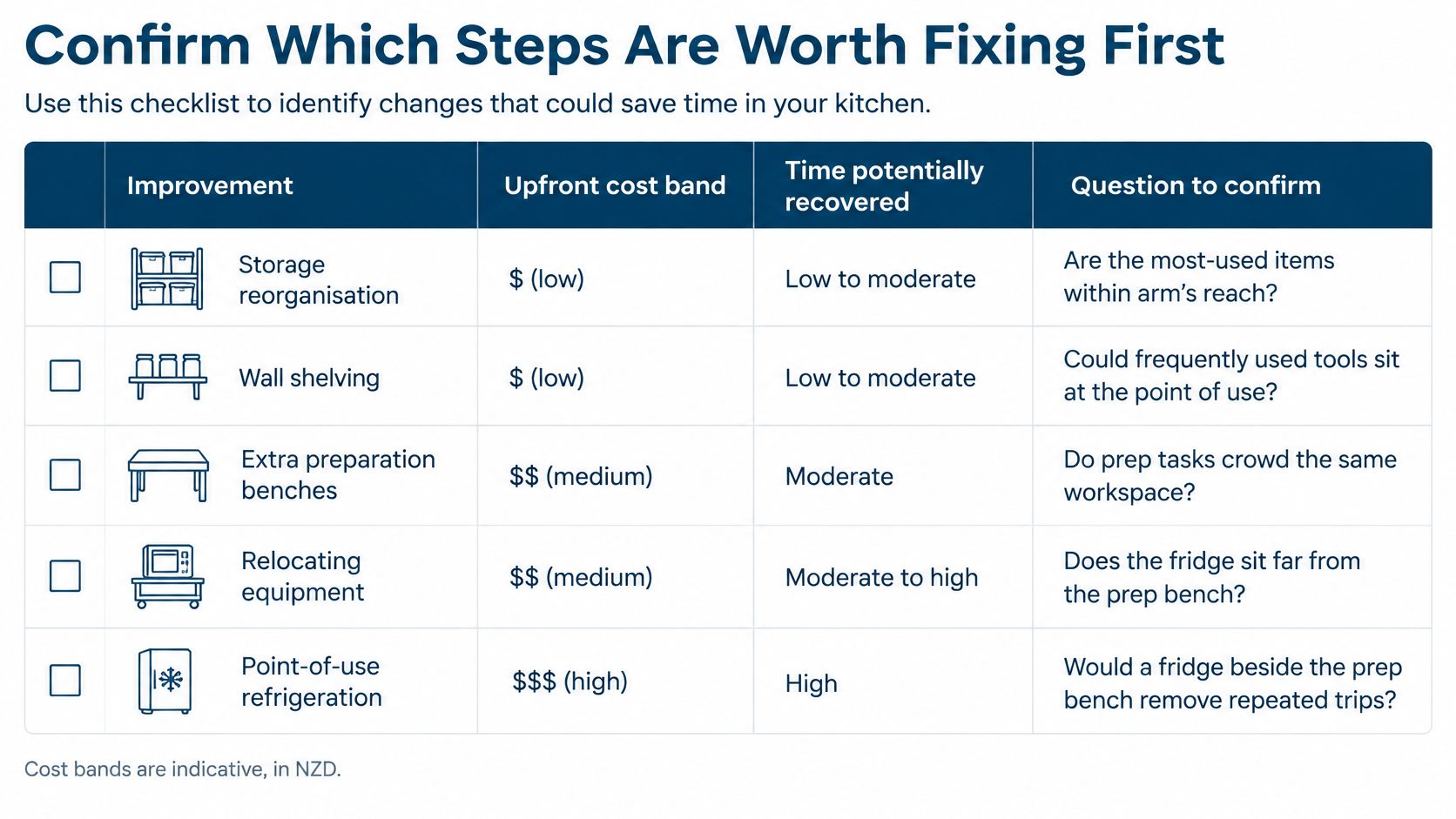
| Improvement | Upfront cost | Time potentially recovered | Financial consideration |
|---|---|---|---|
| Reorganising existing storage | Low, staff time only | Measured trips × seconds saved per trip | Value counts only if time is redirected or rostered out |
| Adding wall shelving | Low to moderate | Retrievals removed × timed seconds per retrieval | Check clearances, hygiene and storage heights first |
| Installing additional preparation benches | Moderate to high | Station trips removed × timed seconds per trip | Adds capacity and cleaning work; include installation |
| Relocating equipment | Moderate, quoted after services review | Route trips removed × timed seconds per trip | Service disruption and compliance checks may apply |
| Purchasing point-of-use refrigeration | Moderate to high | Main-fridge trips removed × timed seconds per trip | Compare labour and energy effects; check finance options |
Three different kinds of benefit
Productivity gains mean staff spend recovered minutes on useful work. Actual labour savings mean paid hours, overtime or extra staffing fall. Revenue opportunities mean improved capacity allows additional profitable orders. Those outcomes shouldn't be added together casually, because the same recovered minute can't be counted three times.
Payback can be screened with a simple formula: upfront cost ÷ monthly financial benefit = months to payback. Only include a monthly benefit that can be measured through roster changes, reduced overtime, fewer delays at a proven bottleneck, or extra orders completed.
Total project cost needs equal care. Moving items inside, unpacking, and installation are not included in kerbside delivery, so operators should confirm exactly what delivery and installation cover before committing. SilverChef lets customers own top-tier commercial kitchen equipment without paying the full upfront cost, which may change cash-flow timing without changing the underlying payback test.
Related reading on How Much Does Poor Kitchen Workflow Cost Every Shift?, What Do Kitchen Bottlenecks Really Cost? and Should You Buy New Equipment or Improve Workflow First? covers broader workflow decisions. For upgrade sequencing, which commercial kitchen upgrade delivers the fastest return on investment provides a useful comparison. The practical next step stays narrow: measure one route, change one station, remeasure, then invest only where repeated movement proves the case.
Operators who've measured a costly route can contact Simply Hospitality for help comparing point-of-use refrigeration, stainless steel benches, shelving, storage and food preparation equipment for the space available. Bring the trip count, timed distance and station dimensions, and the conversation can focus on the layout change most likely to suit the business rather than on guesswork.