

Should You Buy New Equipment or Improve Workflow First?
Improve workflow first unless measured data from three or four representative services shows a repeatable capacity limit that process changes cannot resolve. The two checks that make that call are whether equipment runs flat out while a queue remains, and whether staff wait, walk, or search while equipment sits idle.
That distinction matters because both problems look identical from the pass. Tickets slow down, plates wait, and the kitchen feels short of capacity either way. Treating new equipment as a claim to be proven protects cash, and it also produces the evidence needed to size a later purchase correctly.
For any operator asking, should you buy new equipment or improve workflow first, the sequence is consistent. Measure the constraint, test the cheaper fix, re-measure, and then buy only for the bottleneck that remains.
Why Equipment Is the First Idea in a Slow Kitchen
Friday service at 6.30pm in this illustrative scenario, tickets stack at the grill, the pass runs three plates behind, and the head chef asks whether a second combi oven would fix service. It's a reasonable question, but it's asked at the point where the symptom appears, which is the machine. A new unit is also easy to price, and buying feels like progress.
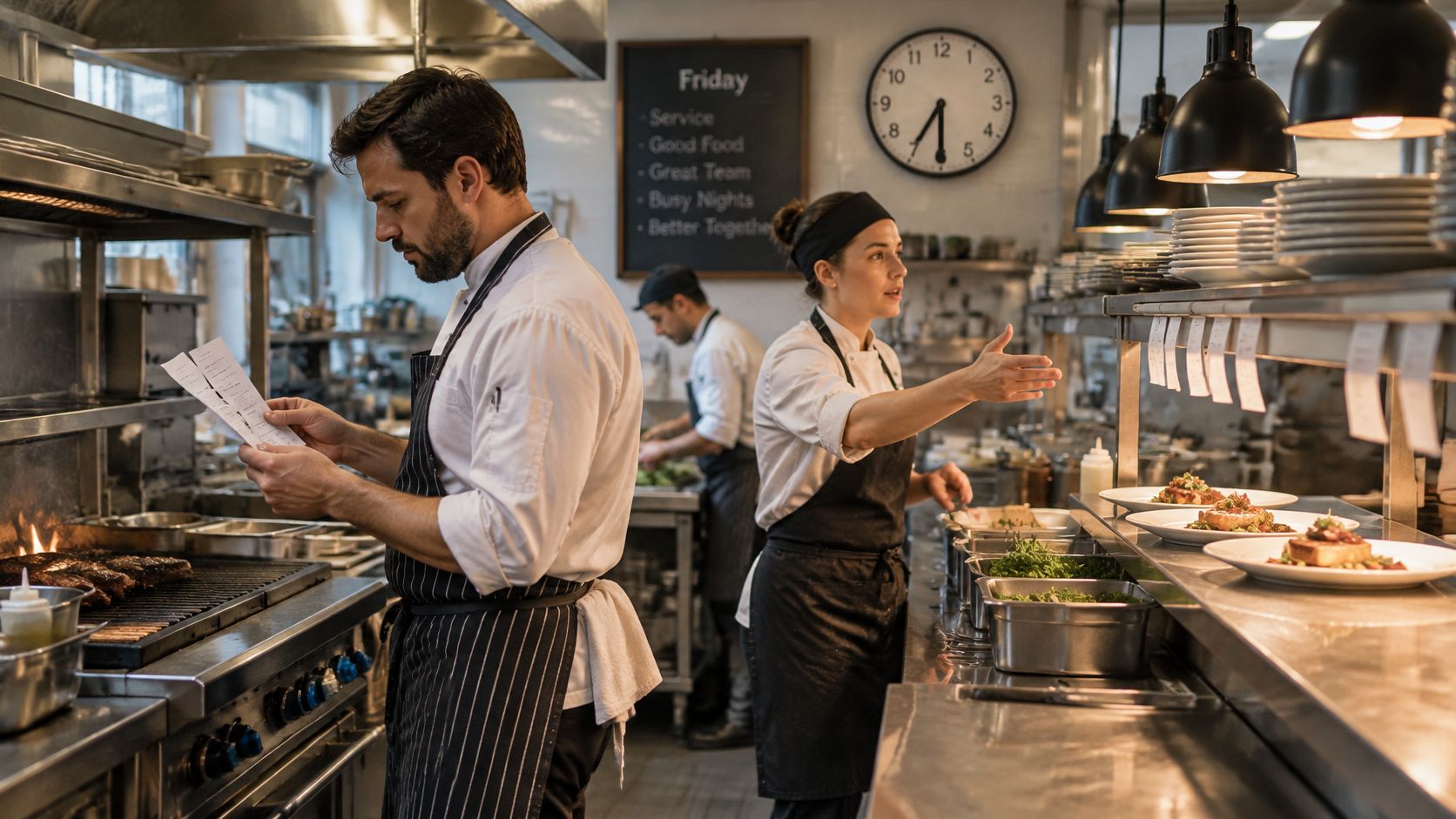
The same symptom can hide causes well upstream of the grill. A common issue is a line designed around convenient plumbing rather than the ticket sequence staff repeat hundreds of times.
- Misplaced refrigeration: Protein sits across the kitchen from the grill, so every order starts with a walk.
- Incomplete preparation: Cut-to-order work that belongs in the afternoon lands in peak service.
- Crossing paths: Two cooks share one aisle and pause for each other on every ticket.
- Poor sequencing: Fast items fire first, then wait while slower components catch up.
- Congested plating: The pass doubles as a dish drop, so clean and dirty work collide.
None of those problems is solved by an oven. Adding capacity to a disorganised line often adds cost, cleaning, and congestion instead.
Practical rule: A slow service is a capacity problem, a workflow problem, or both. Price nothing until the kitchen knows which one it's dealing with.
The workforce context supports starting with process. The Ministry of Business, Innovation and Employment hospitality and tourism employment survey reported approximately 145,000 people directly employed by early 2024, up 7.3% from the previous year, with employment growth outpacing growth in new establishments. Many businesses have already added capacity through labour, so how that labour moves matters before more machinery arrives.
How to Find the Real Bottleneck During Service
Observation works best across several representative services, including one busy night, one midweek service, and one weekend lunch where relevant. Basing a purchase on a single unusually busy Saturday is the most common diagnostic error. A simple tally sheet on a clipboard near the pass is enough to start.
What to Record
A time check roughly every 15 minutes keeps the log usable without disrupting service. Staff log ticket-to-pass time, stations waiting for equipment or product, and trips between stations. Dish returns and clean ware shortages get logged too, because warewashing delays surface as plating delays.
- Queue location: Note where orders accumulate and which station falls behind first.
- Waiting direction: Record whether people wait for machines or machines wait for people.
- Walking count: Tally trips to distant refrigeration, dry stores, or utensils.
- Timing: Record how long preparation, cooking, and plating each take at peak.
Operators wanting a wider operational framework for this kind of observation will find value in understanding QSR management, which covers how structured service systems track flow and consistency.
Two Types of Constraint
A capacity constraint means equipment runs continuously at peak and output still falls short of demand. A process constraint means equipment sits idle part of the service while people wait, walk, or search for product. Only the first type justifies a purchase, and both can exist in the same kitchen.
| Observed problem | Possible cause | What to investigate first |
|---|---|---|
| Tickets queue at the grill from about 7pm | Grill capacity, or the grill waiting on product from cold storage | Time from ticket to first item on the grill, and whether the grill is full or empty |
| Cook waits for a pan or oven shelf | Cooking capacity, or poor sequencing of batches | Minutes of cook waiting versus minutes of equipment idle |
| Cook walks to a distant fridge 15 or more times per service | Refrigeration placed too far from the station | Map the walking path and count trips per service |
| Prep runs out mid-service | Pre-service prep incomplete or not planned by volume | Compare the prep sheet with the items that ran out and when |
| Plates held under the pass | Plating station congested or components finishing at different times | Gap between the last component cooked and plate-up |
| Dirty ware blocks benches | Dishwashing throughput or no scheduled clear-down | Times when dish returns peak and how long racks wait |
| Equipment runs all service with a queue | Genuine capacity limit | Run time and recovery time at peak, logged across services |
| Delays only on busy Fridays or Saturdays | Demand spikes or roster gaps | Compare several services before deciding anything |
A waste log adds another lens. New Zealand café and restaurant data puts the food waste mix at preparation waste 60%, plate waste 33%, and spoilage 7% in the Love Food Hate Waste review of New Zealand food waste. A preparation-heavy profile points to production planning, a plate-heavy profile points to portioning, and rising spoilage points to storage practice.
The final test is recurrence. Problems appearing across most services deserve action, while one-off spikes usually reflect roster gaps or a single large booking. Kitchens that want to quantify delays further can work through the cost of waiting during peak service before committing to any spend.
Workflow Changes Worth Testing Before You Buy
Each change below costs little, targets a specific observation from the service log, and can be reversed if it doesn't help. Testing one change at a time keeps results readable. Running five changes at once makes improvement impossible to attribute.
Station Level Fixes
Workstation organisation starts with the three most used garnishes, sauces, and utensils at each station. Moving those items within one arm's reach of the cook who uses them removes dozens of small interruptions per service. Tongs, squeeze bottles, and seasoning belong at the point of use, not on a central bench.
Preparation planning means marinated proteins, portioned sauces, and cut items are finished before service, with par levels written on a board the whole team can see. Prep sheets built from expected covers beat prep sheets copied from habit. When a par level runs out twice in a week, the sheet changes, not the equipment list.
Equipment positioning can be as simple as relocating a reach-in fridge or prep bench so a cook stops crossing the pass on every ticket. Even a short move changes the walking count recorded in the log. Benches on castors make trial layouts cheap to test.
Flow Level Fixes
Storage organisation puts high turnover ingredients at the front and at waist height, rotated first in, first out. Slow moving stock moves to the back or the storeroom. Order sequencing fires slow items first and batches similar tasks, so components land together instead of one element drying out under the lamp.
Staff responsibilities need a named station owner and a short handover checklist at shift start. Unclear ownership is where tickets stall because two people assume the other has started a component. Dishwashing workflow improves with a return point away from the pass and racks cleared on a schedule, so dirty ware never competes with plating space.
New Zealand evidence shows process controls of this kind move results before any capital purchase. The Kai Keepers pilot final report recorded participating businesses reducing food waste per cover from 134 grams to 112 grams, a 16.4% decrease, with flexible portion sizes cutting waste per cover by 20.6%. That pilot also put average potential savings at NZ$5,520 per year per business from improved food waste practices.
A workflow change isn't proven when it's introduced. It's proven when the same service log, run two to three weeks later, shows shorter ticket times or fewer walking trips.
These changes won't solve every constraint, and they shouldn't be stretched past their limit. Deeper detail on sequencing and station setup sits in ways to improve kitchen efficiency during peak service.
When New Equipment Is the Better Investment
Some bottlenecks survive every sensible process change, and those are the ones worth spending on. Treat every purchase as a claim that measured service data has to prove. Each trigger below pairs with a measurement that confirms it.
Capacity Triggers With Proof
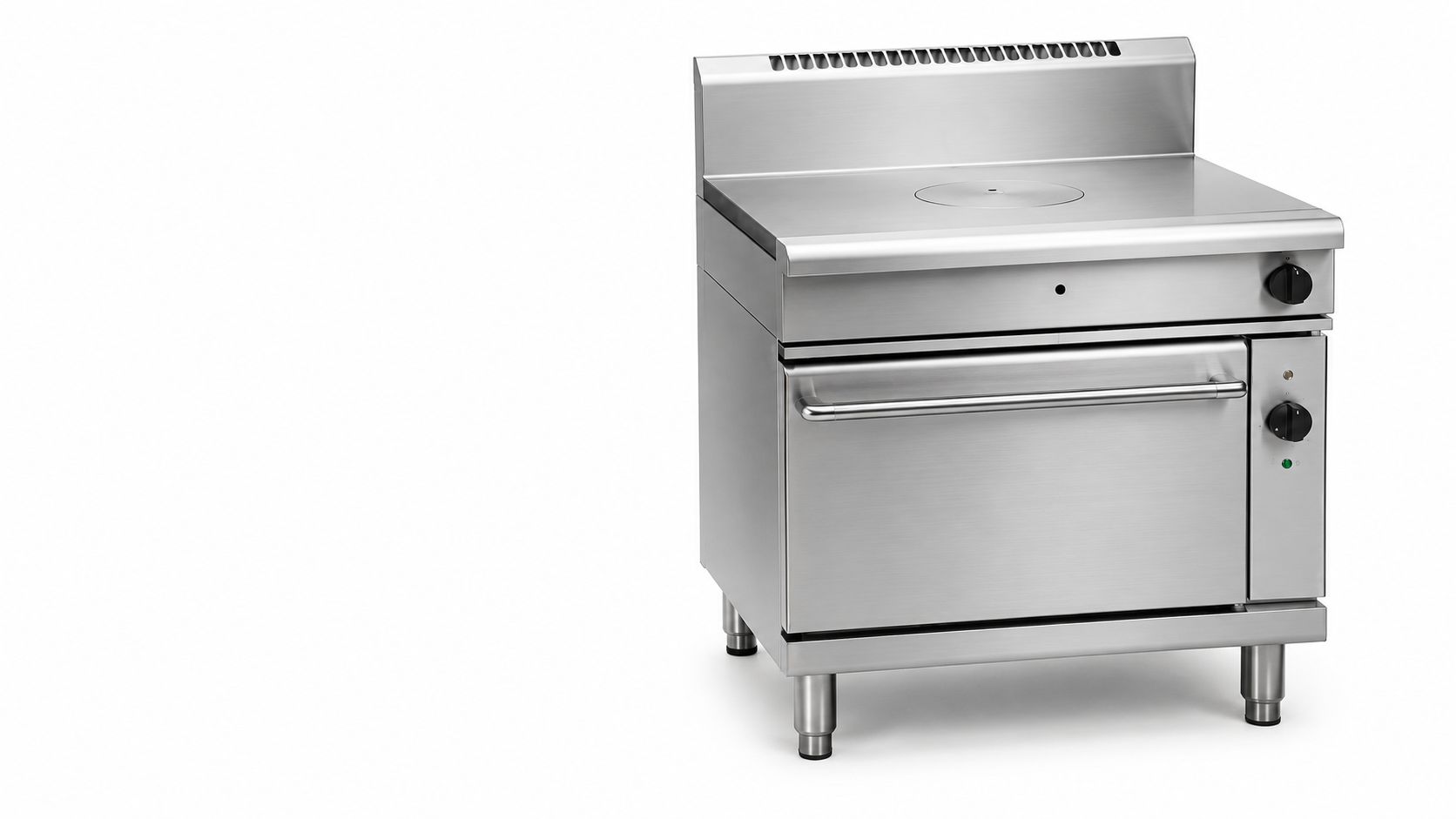
Insufficient cooking capacity shows up as trays, pans, or cook cycles needed at peak exceeding what the oven, fryer, or grill delivers, logged across several services. The selection rule is straightforward. A combi oven earns its place when the menu needs steaming, roasting, and regenerating in one cavity across the same service, while a dedicated convection oven suits a line built around one dominant cooking mode. Where intensive pan work is the measured constraint, the Waldorf 800 Series RN8110GEC - 900mm Gas Target Top Electric Convection Oven Range puts a gas target top and an electric convection oven in one 900mm floor module, suiting concentrated centre-to-edge heat rather than separate flames per pan.
Cooktop capacity follows the same logic. A 900mm induction cooktop may add zones at a station, but the spec sheet needs checking for zone count, pan base compatibility, and electrical supply before anything is ordered. Slow repetitive preparation is proven by timing a batch by hand over several services, then weighing a Robot Coupe food processor only if batch volume justifies the spend.
- Inadequate refrigeration: Repeated mid-service replenishment trips point to SKOPE or Atosa units sized to measured stock volume.
- Warewashing bottlenecks: Rack counts at peak size a Winterhalter or Classeq machine correctly.
- Unreliable equipment: A repair call history with growing parts downtime supports replacement.
- Menu changes: A proven new method may need capability the kitchen doesn't have.
Energy use provides a useful screen before replacement. The EECA food and beverage service sector pathway reports commercial ovens and cooking elements accounted for 15% of sector energy use in 2022, while refrigeration accounted for 22%. Those categories justify metered comparison of run hours, set-point performance, and door-opening frequency before any replacement decision.
Where performance is adequate, low-cost controls such as full dishwasher loads come first. The workflow tests from the earlier sections produce the evidence either way: ticket logs and trip counts that keep showing the same constraint are what turn a purchase from a guess into a justified spend. Operators unsure whether a kitchen has crossed the line can check signs a kitchen has outgrown its equipment.
Comparing the Payback of Workflow and Equipment
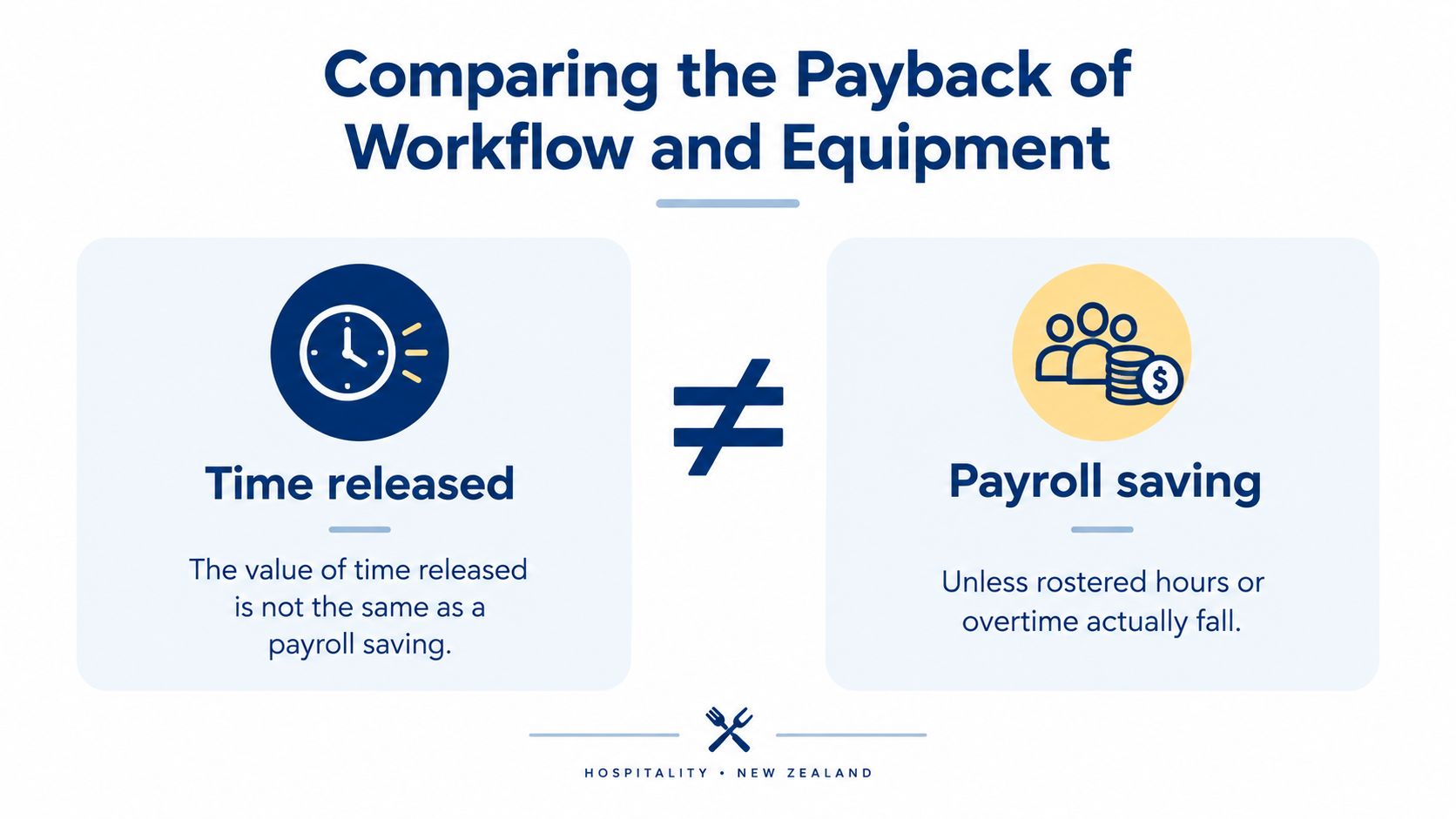
One distinction drives every honest comparison in this area. The value of time released is not a payroll saving unless rostered hours or overtime fall. Time released only becomes money when it's redeployed into more covers, less overtime, or another saleable output.
The two scenarios below are a clearly hypothetical New Zealand example using an illustrative labour cost of $30 per hour across 260 trading days. They show the arithmetic method, not a promised outcome for any venue.
| Option | Time released per day | Annual value of time released | Upfront cost | Simple payback |
|---|---|---|---|---|
| A: Reorganised prep area | 20 minutes | $2,600 | No upfront cost in this example | Not applicable |
| B: Preparation machine | 45 minutes | $5,850 | $5,000 | Roughly 10 months |
Scenario A saves 20 minutes of staff movement a day, worth $10 per day. Scenario B saves 45 minutes a day, worth $22.50 per day, which produces the roughly 10 month payback before maintenance, training, and downtime. Scenario B only pays back if that recovered time lifts covers per labour hour or cuts overtime hours.
The simple calculation also omits utilisation, energy, wastage, potential additional sales, and contribution margin. A machine used twice a week cannot carry a payback built on daily use. Timing the change over several services matters because one quiet shift overstates the saving.
National context supports testing practice changes seriously. Hospitality productivity rose 1.6% a year over the decade to 2024 compared with 0.5% nationally in the Hospitality New Zealand State of the Nation report. A worked example of the same method applied to preparation equipment appears in whether a Robot Coupe pays for itself.
How Layout Limits What Any Machine Can Deliver
Follow one typical ticket across the kitchen and layout problems announce themselves. The cook walks to refrigeration, carries product to prep, moves to cooking, and finishes at the pass. Every backtrack in that path is time a new machine cannot return.
Where Layout Adds Steps
Refrigeration access distance is usually the largest hidden cost. A fridge placed for delivery convenience rather than station use adds trips all service. Preparation-to-cooking movement and cooking-to-plating flow should run in one direction, with dirty and clean dish handling kept apart so returns never cross the plating line.
- Clearances: Doors, service access, and cleaning space around each unit affect daily speed.
- Services: Power, extraction, and drainage decide where equipment can realistically sit.
- Congestion: Aisle width at peak determines whether two staff can pass without pausing.
- Storage placement: Dry goods and smallwares belong near their point of use.
Adding a refrigerator or preparation bench to an overcrowded kitchen can slow the line it was meant to speed up. The new unit consumes aisle space, creates another door swing in a walkway, and gives staff one more surface to work around. Equipment arrangements should be designed around the menu, production volumes, and the ticket sequence instead.
A 900mm induction module illustrates the point. Beyond pan compatibility, it needs clearance, adequate power, and ventilation planning, and it changes how the neighbouring stations are worked. Major purchases assessed as isolated machines routinely disappoint.
Layout check: If a proposed unit makes any existing walking path longer or any aisle narrower, its rated capacity won't show up in ticket times.
When a change touches several machines, specialist input helps, and SACH Design handles commercial kitchen planning, equipment specification, and layout development for that scale of project. Practical layout principles are covered further in designing a kitchen that saves time on every service.
A Step-by-Step Test for Improving Workflow or Buying Equipment
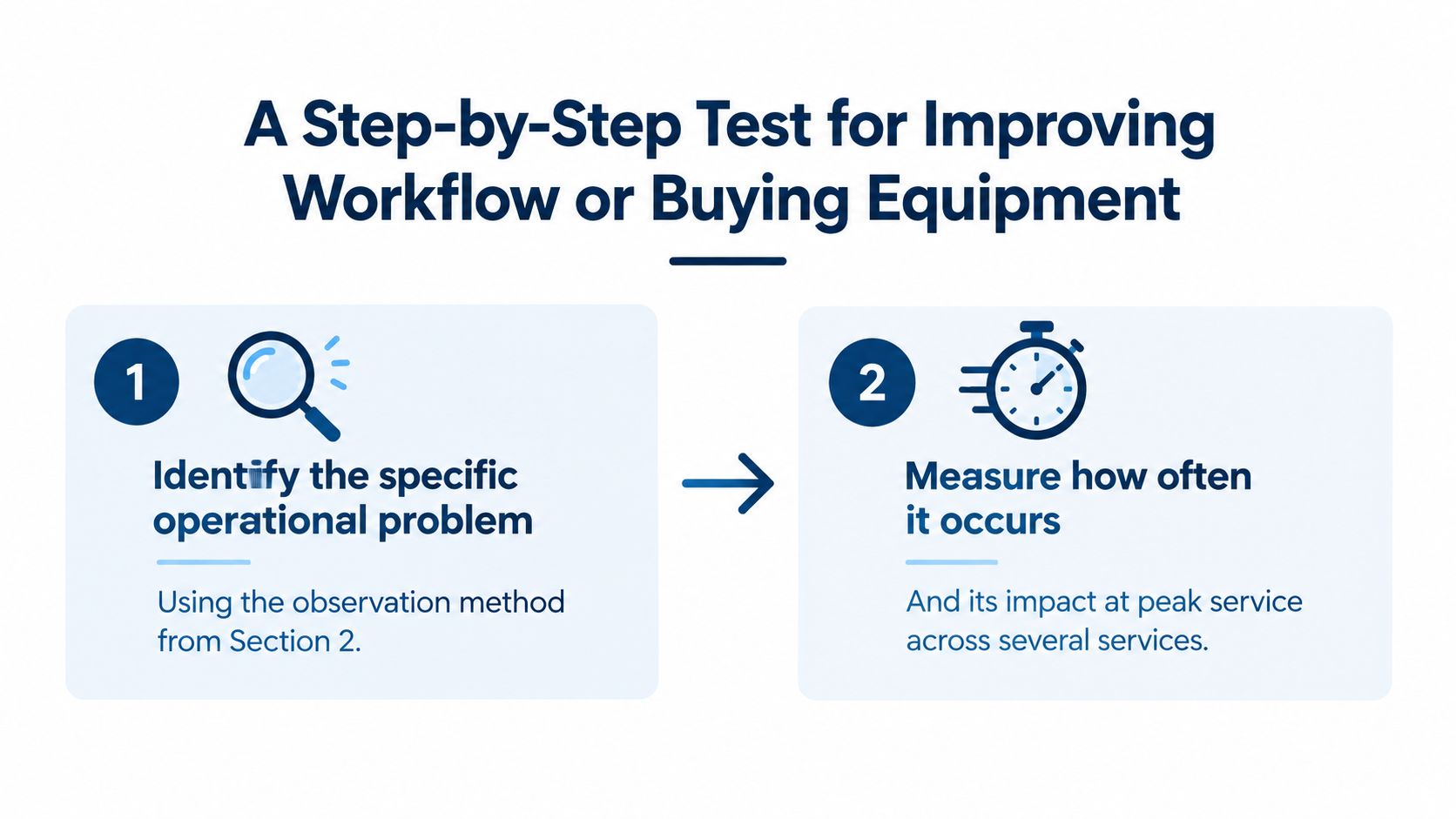
Run the test in this order. Each step leaves a record the next step can use, and the order matters because a purchase decision is only as good as the measurement underneath it.
The Seven Steps
- Name the operational problem in plain terms: where the queue forms, what waits, and who is held up.
- Measure frequency and impact across several peak services, using ticket time, covers per labour hour, queue length, or idle machine time.
- Classify the constraint as equipment capacity, workflow, or both, based on whether machines or people are doing the waiting.
- Test the cheapest credible workflow fix for two to three weeks where trading patterns allow.
- Re-measure against the original baseline, same daypart, same menu mix, same staffing level where possible.
- Specify any remaining capacity gap in the unit that matters: trays per cycle, racks per hour, litres of holding, portions per peak.
- Price only the proven gap and compare cost with the measured benefit using the payback method set out earlier.
Step 5 is where the test earns its keep. Example: a cafe baseline shows mains averaging 18 minutes at Friday peak. Staff move plating closer to the pass and hold garnishes in reach. Two weeks later, the same measure reads 13 minutes. The remaining five-minute gap, not the original complaint, is what any equipment quote has to close.
| Situation | Measurement that triggers action | Improve workflow first | Consider new equipment |
|---|---|---|---|
| Equipment has idle spells while tickets still wait | Idle time during peak alongside ticket time | Re-sequence tickets, move stations, adjust prep timing | Hold off until re-measurement shows a residual gap |
| Cooking equipment is saturated and the queue remains | Utilisation at peak plus queue length | Batch cooking, holding checks, prep ahead | Higher-capacity cooking only for the measured shortfall |
| Manual prep absorbs labour every day | Prep minutes per menu item and labour hours | Standardise recipes, batch prep, set a prep schedule | A food processor such as Robot Coupe where batch volume justifies it |
| New dish needs a method the line cannot run | Test tickets for time, yield, consistency | Trial during a quiet period on existing gear | Equipment matching the proven method |
The point of the sequence is discipline. Workflow tests either clear the bottleneck or leave clean evidence of what remains, which makes the eventual spend smaller, later, or easier to defend.
Confirm the Constraint Before You Sign
A machine's rated output matters only if it addresses the constraint measured during service. Before signing, record peak demand, current equipment use and the frequency of the bottleneck. A queue that appears on several busy shifts deserves more attention than a one-off spike.
Final Checks
- Staff feedback: Ask the cooks and dishwashers who work at the affected station where delays build and what interrupts the task.
- Installation: Check the unit's rated amperage against the available power supply. Confirm extraction, clearances, floor loading and access for cleaning against the kitchen layout.
- Running costs: Compare expected energy use, servicing costs, cleaning time and staff training requirements with the cost of the workflow change.
- Future fit: Check the purchase against planned menu and volume changes over the next year.
Check the payment route as closely as the equipment. Compare total finance repayments with the measured benefit, not just the weekly payment. Used equipment can suit a proven constraint if its warranty, service support, parts, controls and power requirements meet the kitchen's needs. Trade accounts may help with timing when cash is tight.
Training time can limit output. If staff cannot operate a machine consistently under service pressure, its rated capacity will not resolve the queue. After each change, measure the same indicators used for the baseline.
Set a go/no-go threshold before ordering. For example, if the same station queues on three busy services after a workflow trial, and the delay still exceeds your agreed limit, compare equipment options against the recorded demand. Start with the cheapest change that addresses the measured constraint. The supplier offers commercial kitchen equipment for cooking, refrigeration, food preparation and warewashing, and can discuss suitable categories based on your measurements.
Bring the bottleneck records, layout details and power requirements into the purchase discussion. Advice can cover workflow changes, equipment sizing, finance and used options. Visit Simply Hospitality to discuss the decision before committing.