

Chafing Dish NZ: How to Choose the Right One for Your Venue
The buffet opens in twenty minutes, the first pans are coming out of the kitchen, and guests are already circling the drinks station. It's the point where a mismatched chafing dish NZ operators bought for looks alone starts to show its limits. The lid won't clear the food, the pan doesn't match what's in the kitchen, or there's nowhere safe to plug it in. Choosing well before that moment means matching the dish to the food, guest numbers, service length, space and heating method, not just picking the shiniest unit on the shelf.
What Is a Chafing Dish and How Does It Work
A chafing dish is a foodservice vessel designed to hold prepared food warm during buffet or catered service. It sits on the buffet, not in the kitchen line, and its job is presentation plus temperature holding while guests serve themselves or staff serve from it.
That distinction matters more than many operators expect. A chafing dish isn't a cooking appliance, and it shouldn't be treated as a substitute for a dedicated commercial hot-holding cabinet where food needs to be held back of house for extended periods.
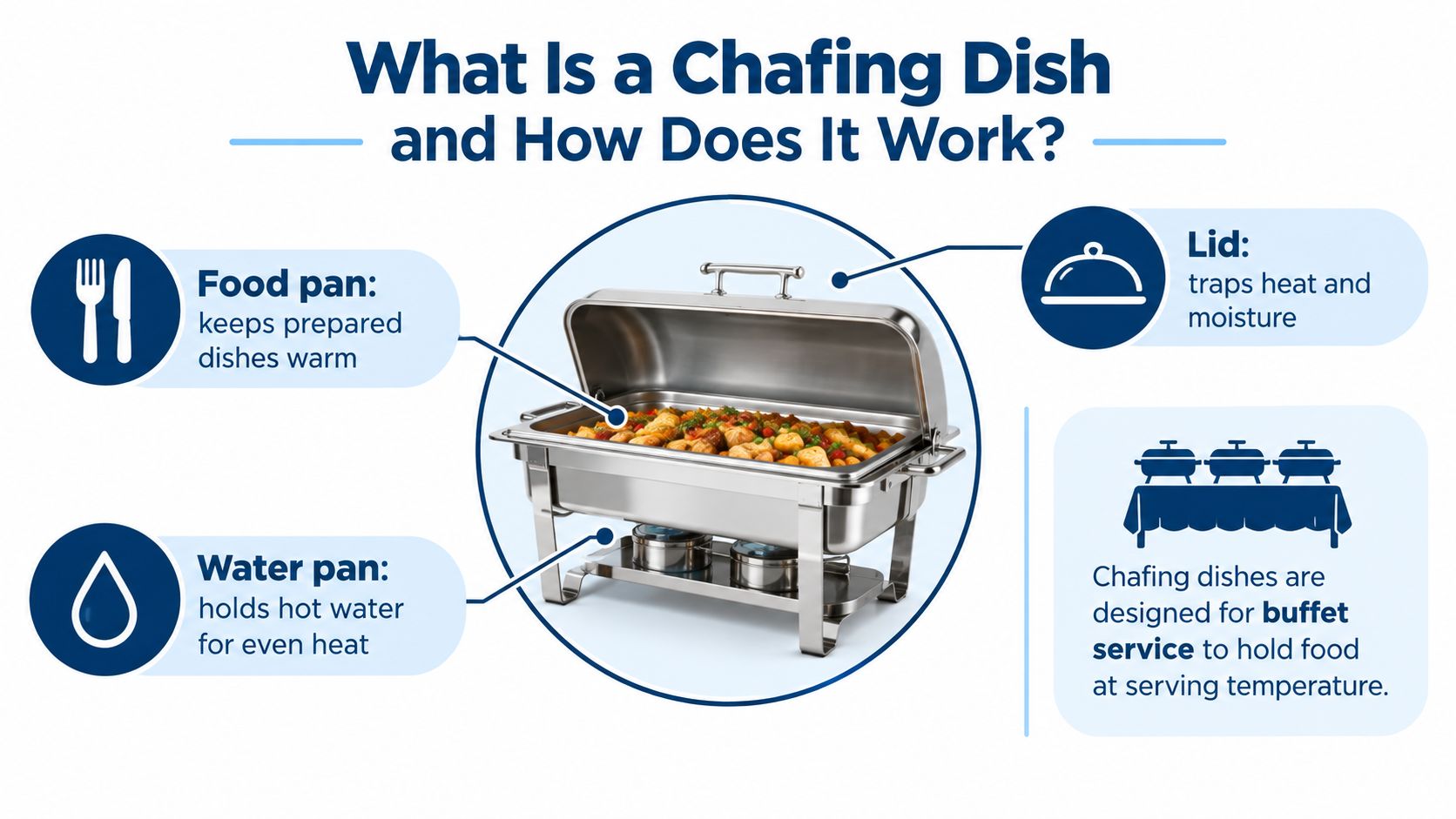
The Main Components
Most models share the same basic parts, even though the styling varies widely.
- Food pan: Holds the food itself and is usually removable for filling, swapping and washing.
- Water pan: Sits below the food pan on water-bath models and holds hot water.
- Outer frame or housing: Supports the pans and gives the unit its finished buffet appearance.
- Heat source: Electric element or fuel holder positioned beneath the water pan.
- Lid: Covers the food between serves to limit heat and moisture loss.
- Stand or base: Raises the unit, keeps it stable and creates clearance for the heat source.
How Indirect Heat Works
On a traditional water-bath model, the heat source warms the water, and the water warms the food pan sitting above it. That indirect heat spreads more evenly across the base of the pan than direct heat would, which helps reduce localised scorching on sauces, curries and other foods that catch easily.
Not every chafing dish works this way. Some electric buffet warmers heat a surface directly, so operators shouldn't assume every unit has a water pan or behaves the same way in service.
Practical rule: Load food that's already hot. A chafing dish holds temperature, it doesn't create it from cold.
Food should arrive at the buffet fully cooked and properly heated in the kitchen first. Operators who load chilled or lukewarm food and expect the chafer to bring it up to temperature are asking the equipment to do a job it wasn't designed for, and they're creating a food safety problem at the same time.
Different Types of Chafing Dishes
No single design suits every buffet. The right shortlist depends on what's being served, whether guests help themselves, and how polished the setup needs to look. Operators comparing options often start by looking at shape and lid style, then narrow down by heating method.
Rectangular models are the workhorses. They suit larger quantities, line up neatly along a buffet table, and usually align with standard pan formats used in commercial kitchens. Round models take up their footprint differently and often suit soups, sauces and curries, where guests ladle rather than scoop, and where a softer presentation fits the event.
Lid Style Changes the Service Experience
A roll-top lid slides back into the unit, so guests don't need to find somewhere to put a loose lid while holding a plate. That convenience comes with a taller profile and a mechanism that needs to stay clean and undamaged. A lift-off lid is simpler and often cheaper to replace, but it needs bench space beside the unit and guests handle it constantly.
Hinged lids sit between the two. They stay attached, open with one hand, and don't need separate space, although the hinge angle and how far the lid opens affect how easily guests can reach the back of the pan.
Operators weighing chafer styles against other front-of-house holding options may also find it useful to compare broader food warmer options for NZ venues before committing to one format.
Chafing Dish Types at a Glance
| Chafing dish type | Best applications | Advantages | Considerations |
|---|---|---|---|
| Rectangular | Buffets, mains, larger volumes | Efficient table layout, pan compatibility | Needs adequate table depth |
| Round | Soups, sauces, curries | Good for ladled foods, softer presentation | Less efficient in a straight buffet line |
| Roll-top | Hotels, weddings, self-service | One-handed guest access, polished look | Mechanism needs care, taller profile |
| Lift-off or hinged lid | Functions, catered service | Simple construction, flexible placement | Loose lids need space, heat escapes when open |
| Electric | Venues with reliable power access | No separate fuel to manage | Cable placement and outlet position |
| Fuel-heated | Off-site and temporary setups | Works without electrical access | Open flame and fuel handling controls |
The trade-off is rarely about quality alone. A simple lift-off rectangular unit can outperform a premium roll-top in a tight marquee where height, transport and quick pack-down matter more than presentation.
Chafing Dish Sizes and GN Pan Compatibility
Size is where buying mistakes become expensive. A unit that looks right in a catalogue can still be wrong for the kitchen if its pans don't match what the venue already cooks, stores and transports food in.
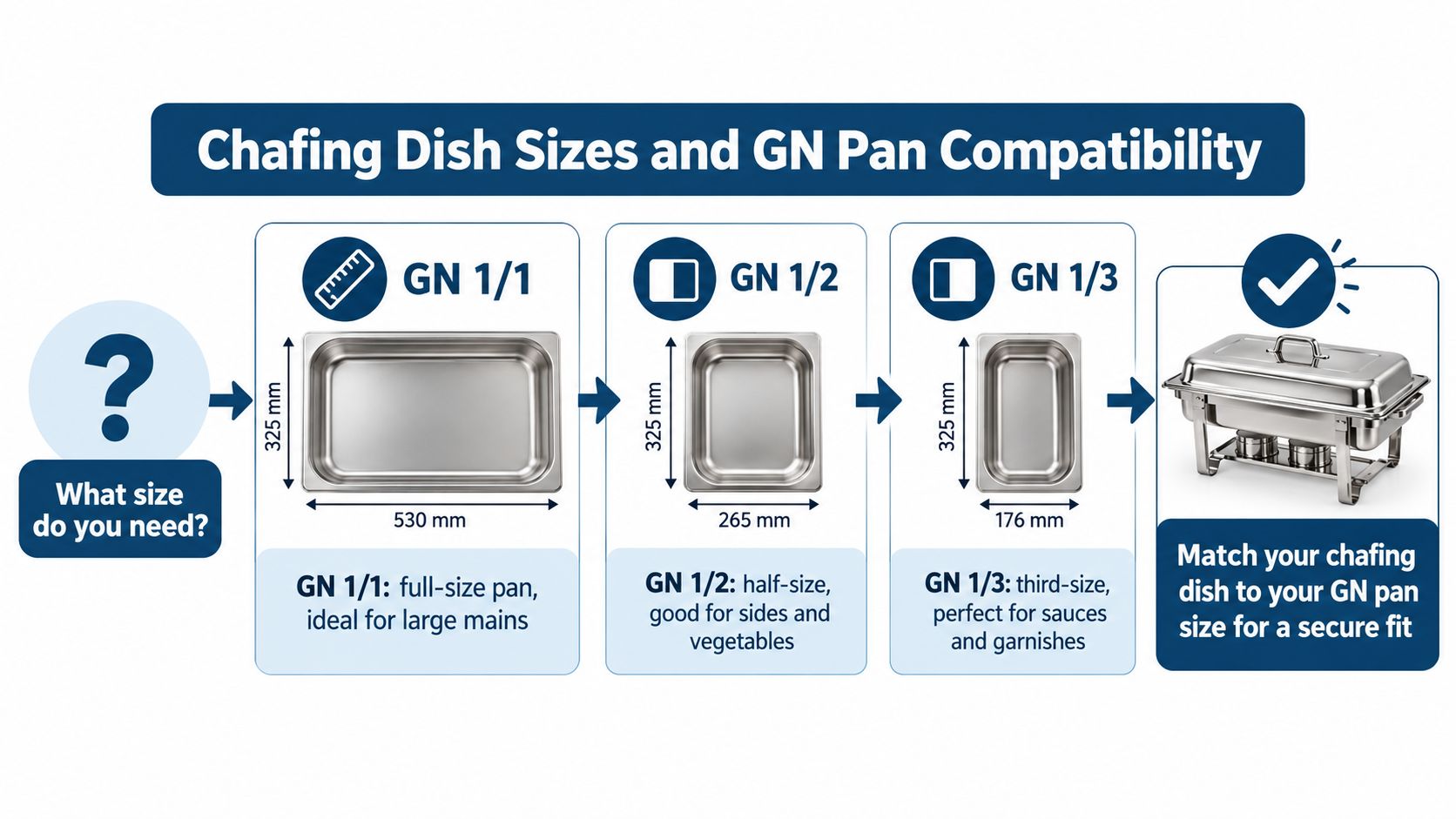
That's why gastronorm, usually shortened to GN, sizing matters so much in commercial catering. GN is a standardised pan format, so a pan used for cooking or storage in the kitchen can move to the buffet without decanting food into a different vessel.
The Common GN Formats
- GN 1/1: The full-size format, typically used for a single large main or high-volume side.
- GN 1/2: Half size, so two pans can sit where one full-size pan would, giving two menu items in one footprint.
- GN 1/3: Third size, useful for smaller quantities, sauces or offering more variety without committing a full pan to each item.
- Other configurations: Some setups combine smaller fractions to match menu balance, provided the frame and any support bars suit that layout.
What to Check Before Buying
- Pan dimensions: Confirm the chafer accepts the GN format the kitchen already uses, rather than a similar-looking proprietary pan.
- Pan depth: Deeper pans hold more but can make the last portions hard to reach and slow to serve neatly.
- Actual capacity: Brim capacity and comfortable serving capacity aren't the same thing, since overfilled pans spill and look messy.
- Lid clearance: Domed or roll-top lids need room above heaped food, and flat lids can crush taller items.
- Replacement pans: Check that spare GN pans and lids are readily available in the same format.
- Buffet space: Measure the table, including room for serving utensils, plates and guest movement.
A pan's stated capacity doesn't tell an operator how many guests it will serve. Portion size, menu mix and how popular that dish is decide that.
Working Out Portions With Stated Assumptions
A simple illustrative calculation shows the method. Assume, purely for planning, a 250 mL serve of a main dish and a pan filled to a comfortable serving level of 8 litres. Dividing 8,000 mL by 250 mL gives roughly 32 serves from that fill. Change the assumed serve to a smaller side portion and the same pan covers far more guests, which is exactly why capacity alone can't be converted into a guest number without stating the assumptions first.
Why Compatibility Pays Off in Service
When pans are interchangeable, kitchen staff can cook in a GN pan, transport it covered, and place it straight into the chafer. Replenishment becomes a pan swap rather than spooning hot food between vessels in front of guests, and wash-up is simpler because the venue isn't managing odd-sized inserts. Operators moving food between venues also benefit from pairing compatible pans with suitable insulated food containers for transport, so food arrives hot and transfers without fuss.
Electric Versus Fuel-Heated Chafing Dishes
Heating method is often decided by the venue, not by preference. A hotel buffet with outlets built into the servery is a different proposition from a marquee wedding with one extension lead already running the coffee machine.
Electric Models
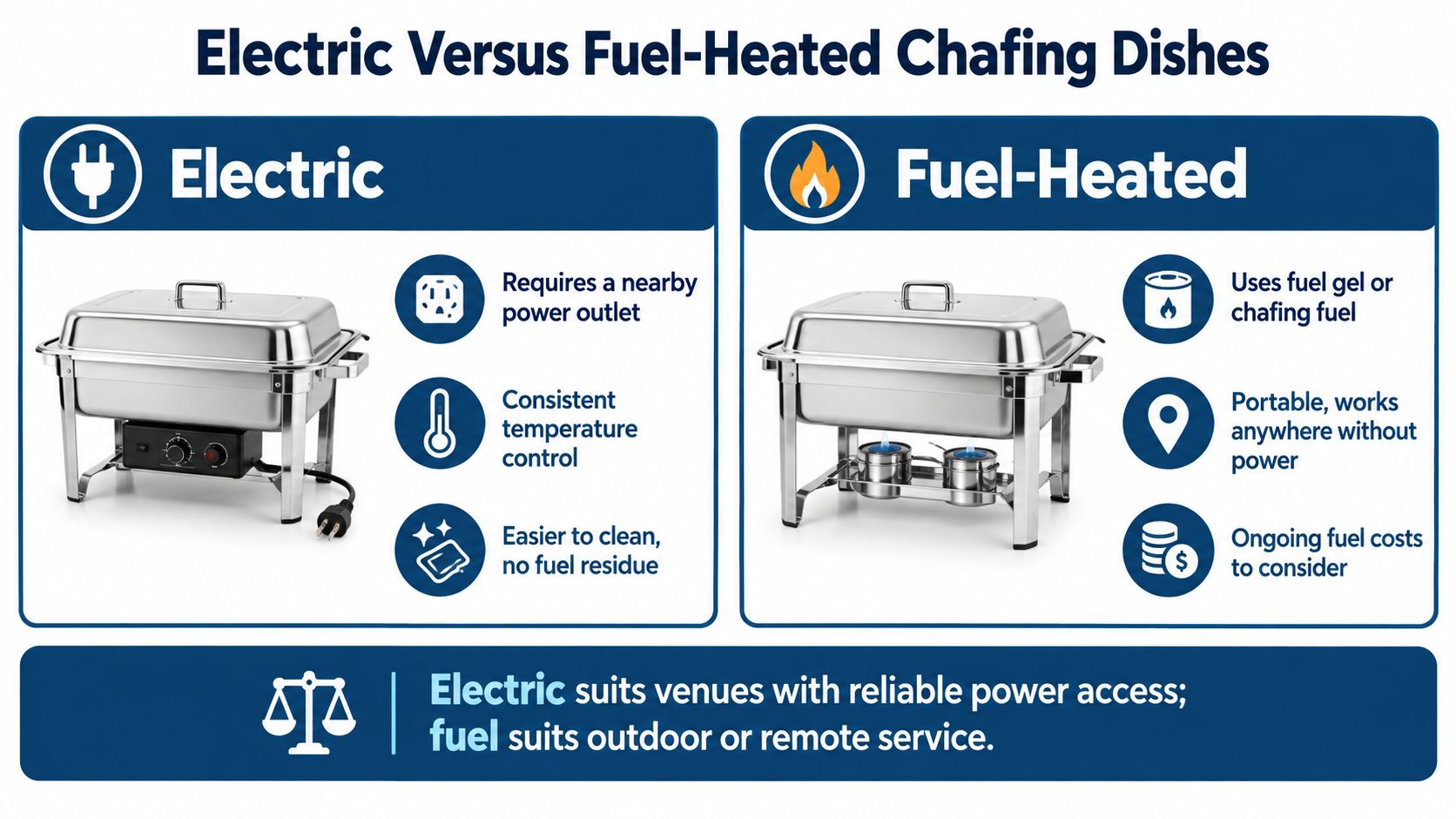
Electric chafing dishes and buffet warmers need suitable electrical access close to the buffet. Depending on the model, they may offer adjustable heating, which gives staff more control than a fixed fuel flame. They also remove the need to buy, store and dispose of separate chafing fuel.
The constraints are practical. Cables crossing guest walkways create trip hazards, outlets may not be where the buffet looks best, and temporary setups need appropriate electrical safety checks. For a permanent hotel breakfast buffet, those issues are usually solved once during fit-out. For a hired hall, they can rule electric out entirely.
Fuel-Heated Models
Fuel-heated units offer flexibility for off-site catering because they don't depend on power at the table. They need compatible fuel holders and the approved fuel for those holders, and they introduce open-flame and hot-surface considerations that electric models don't.
Placement matters. Fuel-heated chafers need stable positioning away from draughts, decorations and guest reach, with adequate ventilation and staff who know how to light, adjust and extinguish them safely. Outdoors, wind can disturb a flame and make heating uneven, so sheltered positioning becomes part of the setup decision.
A Note on LPG Equipment
Larger LPG-heated catering equipment is a different category from small purpose-designed chafing fuel systems, and the two shouldn't be mixed. WorkSafe guidance on LPG in hospitality advises that cylinders remain upright, stay away from ignition and heat sources, use correct connections and be regularly serviced, with testing every 10 years by an authorised test station. The same guidance notes that LPG appliances and associated pipes and hoses generally require installation by a licensed or registered gasfitter, with a certificate of compliance.
Operators should never substitute cylinders, adapters or burners just because a connection appears to fit. For most buffet work, the choice stays between electric and purpose-designed chafing fuel, matched to what the venue can safely support.
Food Safety and Temperature Control
Presentation gets the attention, but temperature control is the specification that matters. A buffet can look immaculate and still be unsafe if food sits lukewarm while guests drift through service.
The NZ Hot-Holding Requirement
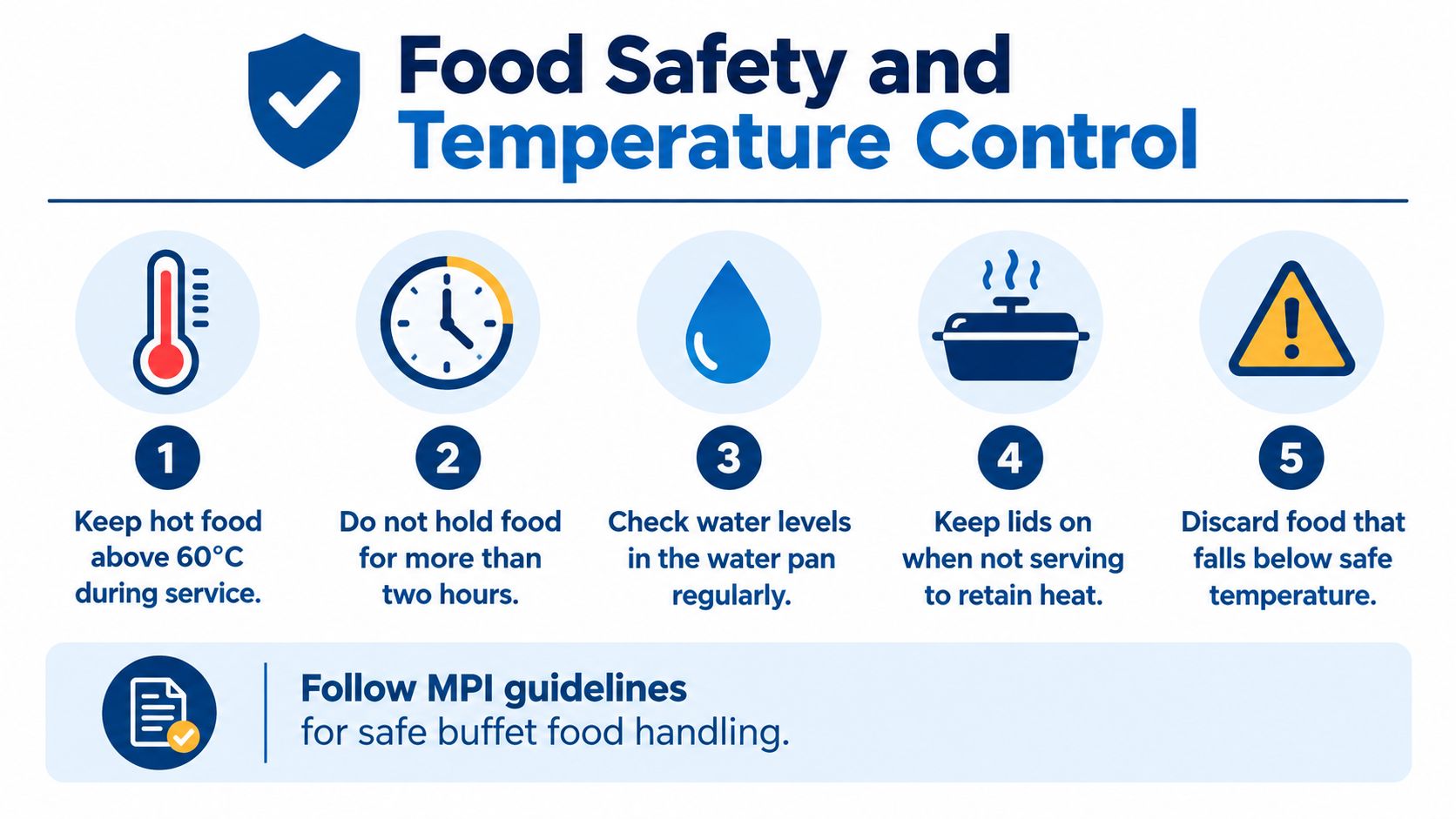
MPI food safety guidance on hot holding states that hot food must remain above 60°C until served, because the range from 5°C to 60°C can support the growth of harmful microorganisms. The same guidance requires operators holding food hot for more than two hours to check its temperature every two hours throughout the trading day using a probe thermometer, and hot-holding equipment must be capable of keeping food above that threshold without being overloaded.
That check needs the right tool and the right technique. Staff should probe the food itself, at its coldest point, rather than relying on the water temperature, the dial setting or how hot the pan feels. Choosing a suitable digital thermometer for NZ food service and building the checks into the venue's food control procedures makes the process defensible, not guesswork.
Building Safe Habits Into Service
- Preheat first: Warm the water pan before loading so the unit isn't spending its early service period catching up.
- Load food hot: Food should go in already heated in the kitchen, since the chafer can't safely bring cold food up to serving temperature.
- Keep lids down: Minimise unnecessary opening, because every lift releases heat and repeated opening during busy service drags temperature down.
- Replenish properly: Swap in a fresh hot pan rather than topping up old food with new, which mixes holding times and complicates control.
- Watch holding times: Avoid keeping food out longer than the venue's procedures allow, even if it still looks acceptable.
- Clean between uses: Wash and sanitise pans, lids and frames after service so residue doesn't carry into the next event.
One distinction catches operators out. The equipment setting is not the food temperature. A dial position or a lit fuel can says nothing reliable about the centre of a deep pan of food that's been opened forty times in an hour.
On the day: If nobody on the floor owns the thermometer checks, they don't happen. Assign the task to a named role for each service.
Choosing Chafing Dishes for Different Hospitality Applications
Venue type changes what good looks like. The unit that suits a daily hotel breakfast may be a poor choice for a caterer packing a van five days a week.
Hotels and Restaurants
Hotels running recurring breakfast buffets need durability, a consistent look across multiple units and lids guests can operate one-handed while holding a plate. Electric models often suit fixed serveries where power is built in. Restaurants running buffet nights or function stations usually need fewer units, but they need pans that match the kitchen's existing GN stock so service doesn't require special inserts.
Caterers and Event Venues
Caterers prioritise portability and pack-down. Frames that stack or nest, handles that survive transport and fuel-heated flexibility for venues without power all rank ahead of decorative finishes. Wedding and event venues sit at the other end, where coordinated layouts, roll-top presentation and smooth guest flow matter most. Planners weighing catered formats generally may find the Texas Old Town caterer guide a helpful starting point for thinking about service style, which then shapes how many buffet stations a venue needs.
Schools, Clubs and Community Events
For schools, clubs, marae and community functions, straightforward operation wins. Simple lift-off or hinged lids, stable frames and practical capacity matter more than premium finishes, particularly when volunteers or rotating staff run the buffet.
Why Several Smaller Dishes Often Beat One Large One
Guest numbers, menu variety and replenishment frequency together decide how many units a buffet needs. Several smaller pans let staff refresh one dish without disturbing others, keep presentation tidy as volumes drop, and avoid committing a full large pan to a slow-moving item.
There's a cost angle too. Restaurant Association food waste reporting puts hospitality food waste at an estimated 24,400 tonnes annually, with about 61% classified as avoidable, and notes a programme that reduced average food waste per cover by 16.4% with estimated savings of approximately NZ$5,500 per participating business. Filling an oversized pan too early for a small function is exactly the kind of habit that turns avoidable waste into a real cost, while smaller pans replenished as needed keep both quality and waste in check.
Materials, Cleaning and Long-Term Value
Purchase price is the easiest number to compare and often the least useful. How a chafing dish is built decides how it looks after a season of functions, how long cleaning takes, and whether parts can be replaced or the whole unit gets binned.
What Construction Quality Looks Like
Stainless steel is the standard commercial choice because it handles heat, moisture and frequent washing well, and it suits most buffet presentation styles. Beyond the material itself, operators should check the details that take the punishment:
- Frame stability: The unit shouldn't rock or flex when a full pan is loaded and guests are serving from it.
- Handle design: Handles need a secure grip for staff carrying hot, full pans.
- Lid mechanisms: Hinges and roll-top tracks should move smoothly and tolerate repeated cleaning.
- Surface finish: Polished finishes present beautifully but show fingerprints and water marks faster during service.
- Replacement components: Spare pans, lids and fuel holders should be available without replacing the complete unit.
Cleaning and Storage Realities
Water pans collect scale and residue, frames collect splashes, and roll-top tracks collect crumbs. Units that come apart easily get cleaned properly, while fiddly assemblies get wiped and put away dirty. Building chafers into the venue's routine, in the same way operators formalise cleaning programmes for cafés, keeps that work from depending on whoever happens to notice.
Storage and transport deserve the same attention. Caterers moving equipment constantly will dent thin frames and bend ill-fitting lids, while a venue using chafers four times a year faces a different wear pattern entirely.
Frequent use justifies spending more on build quality. Occasional use rarely does, provided the unit still holds temperature properly and cleans up well.
Whole-of-life cost brings it together. Fuel or electricity, staff cleaning time, replacement pans and how long the finish stays presentable all belong in the comparison alongside the sticker price. A cheaper unit that needs replacing sooner, or takes twice as long to clean after every function, isn't cheaper for long.
Buying Chafing Dishes in New Zealand
Demand for buffet equipment tracks the health of the wider industry. The 2024 Hospitality Report figures put hospitality sales at NZ$15.7 billion for the year ending March 2024, up 5.8%, with restaurants and cafés at NZ$7.8 billion and catering recording the largest sector growth at 19.4%. That catering growth is exactly the segment where chafing dishes earn their keep, across banquets, conferences, weddings and functions.
Operators building out a full buffet setup often review chafers alongside wider catering equipment options in NZ so pans, warmers and serving utensils all work together.
Purchasing Checklist
| Consideration | What to check | Why it matters |
|---|---|---|
| Buffet style | Self-service or staff-served | Decides lid type and guest access needs |
| Guest numbers | Peak covers and service length | Drives unit count and replenishment plan |
| GN pan size | Compatibility with kitchen pans | Allows straight transfer from kitchen to buffet |
| Food capacity | Comfortable serving volume, not brim volume | Prevents spills and overfilling |
| Heating method | Power access or fuel suitability at the venue | Determines safe, workable placement |
| Lid design | Roll-top, hinged or lift-off | Affects access, heat loss and table space |
| Material | Stainless steel build and finish | Influences durability and presentation |
| Portability | Weight, stacking and handles | Critical for off-site catering |
| Cleaning | How fully the unit comes apart | Decides real cleaning time after service |
| Replacement pans | Availability of spares in the same format | Keeps the unit in service long term |
| Budget | Price against whole-of-life costs | Avoids false economy on high-use equipment |
A complete setup usually extends beyond the dish itself. Matching GN pans and lids, compatible chafing fuel and holders for fuel-heated models, electric buffet warmers for fixed stations, and suitable buffet serving utensils all need to be specified together. Rectangular, round and roll-top stainless steel models cover most commercial requirements, and confirming capacities, dimensions and included accessories against manufacturer specifications for the exact model prevents surprises on delivery.
Operators comparing stainless steel chafing dishes, roll-top and electric models, GN pans, fuel holders and buffet serving utensils can browse the range and talk through venue requirements with Simply Hospitality. The team helps NZ caterers, hotels, restaurants and event venues match buffet equipment to guest numbers, menu and service style, so the gear bought is the gear that gets used.