

Commercial Kitchen Faucet: How to Choose the Right Tap
The right commercial kitchen faucet is chosen by matching its height, reach, flow, and mounting to the task at the sink, not by choosing the cheapest option or the product that looks most durable. In New Zealand, tapware for potable water also needs to fit the relevant Building Code, AS/NZS 3718 and WELS expectations, with copper-alloy products contacting potable water moving to a maximum lead content of 0.25% during 2025–2026 according to MBIE's tapware product recognition notice.
A café owner can order a heavy-looking commercial kitchen tap online, install it above a pot-wash sink, and still end up with a poor result. The hose might not reach the back of the bowl, the spray might miss a full-size GN pan, or the tall assembly might collide with shelving above. Those problems usually start before installation, because the faucet was selected as an isolated product rather than as part of the sink and the working routine.
Why Starting with the Sink Task Changes Everything
A commercial kitchen tap is used repeatedly, often while staff are handling hot cookware, food residue, racks, cleaning chemicals or heavy containers. Its value isn't limited to the metal, finish or visual impression. The useful test is whether staff can complete the sink task without stretching, lifting awkwardly, redirecting the item several times or stopping to work around the fixture.
A hand basin, preparation sink, pot-wash sink and dishwasher pre-rinse station each impose different demands. A compact hand basin needs accessible operation and dependable warm water. A pot-wash station needs clearance for large cookware. A pre-rinse position needs a spray assembly that reaches the working area and returns neatly when released.
Start with the job, not the product page
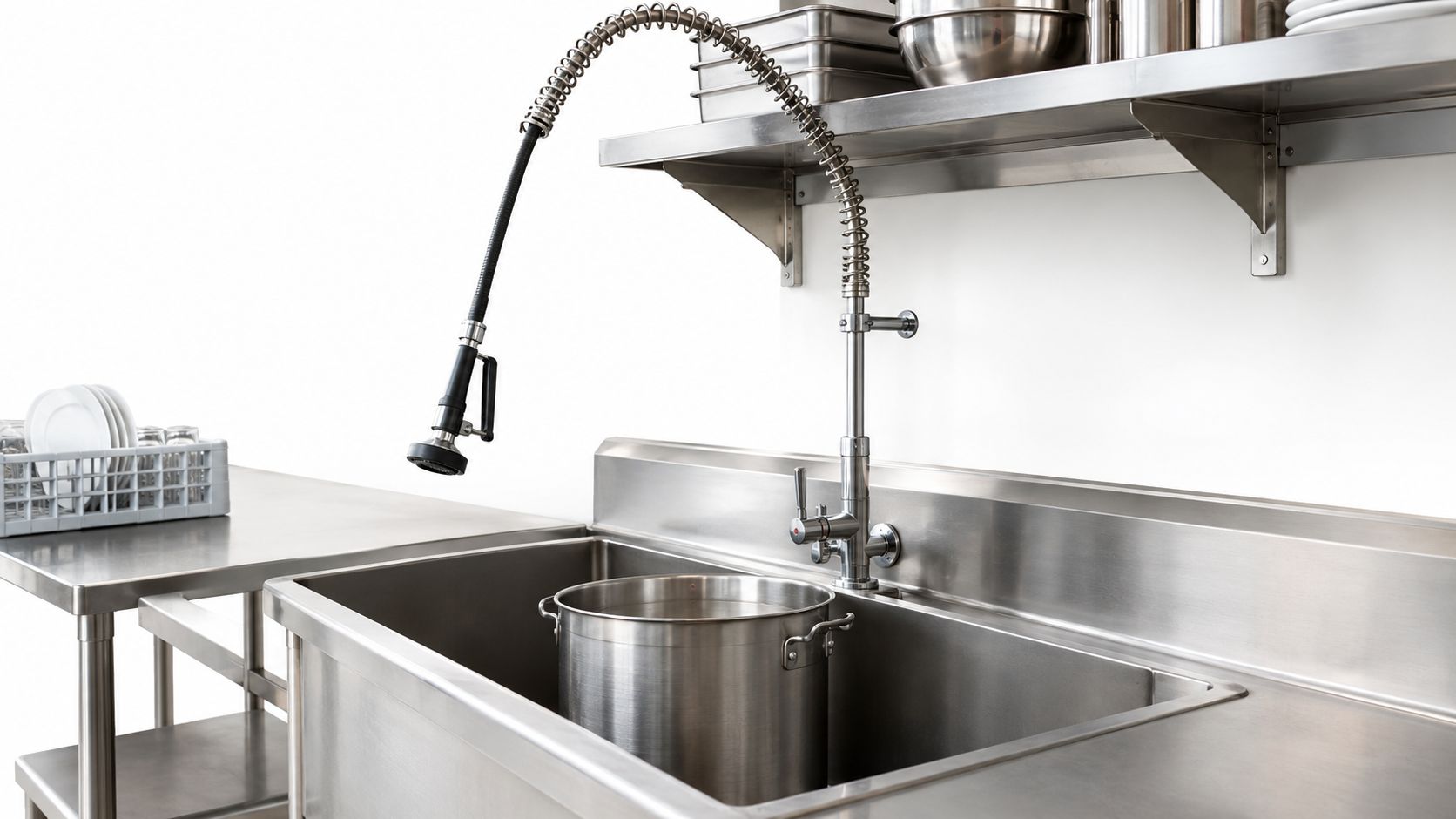
Before comparing tap styles, the operator should write down what happens at the sink:
- Hand washing: Staff need quick, uncomplicated access, with the basin positioned for immediate use in the work area.
- Food preparation: The tap should support rinsing ingredients without creating splash or cross-use problems.
- Filling pots and containers: Spout position and vertical clearance matter more than a spray trigger.
- General washing: A standard sink mixer may be adequate where the bowl is accessible from the outlet.
- Pot washing: Deep cookware demands reach, clearance and a spray pattern that can be directed inside the item.
- Pre-rinsing dishes: A pre-rinse unit supports the movement of loose food debris before warewashing.
- Utility work: Cleaning equipment and other non-food tasks may need a separate, practical configuration.
A common issue is that a buyer measures the mounting hole but not the work being done underneath it. The tap fits the bench, yet staff can't comfortably rotate a large pot or direct water into the rear corner of the sink. The stainless steel sink guidance from Simply Hospitality is useful because it reinforces the relationship between bowl design, material, installation and the work area.
Practical rule: Ask “what needs to happen at this sink?” before asking “which commercial kitchen faucet looks right?”
The workflow loop matters
At a dishwashing station, the tap sits inside a sequence rather than beside a standalone basin:
Dirty dish → scrape → pre-rinse → rack → dishwasher
Pre-rinsing removes loose food debris before the rack enters the dishwasher. It doesn't replace the dishwasher's washing and sanitising process. If the spray valve is difficult to operate, the hose pulls against the user, or the unit can't cover the sink, staff may spend every service compensating for the installation.
The same principle applies to pot washing. The operator should consider the largest item that enters the bowl, where it is placed, and how it is filled, rinsed, rotated and removed. A specification can look impressive while the installed position reduces usable sink space.
What works and what doesn't
A standard sink mixer often works well for a preparation or general-washing sink where staff don't need a long flexible spray assembly. It can be the sensible choice for a café with modest washing duties and limited overhead clearance.
A tall pre-rinse assembly can work extremely well at a busy warewashing station, but it isn't automatically suitable for a low-ceiling area or a sink beneath shelves. A pot filler or high-reach tap may suit repeated filling of large containers, while being unnecessary at a hand basin.
The most reliable buying decision starts with sink purpose, workflow and surrounding space. Product durability still matters, but it comes after the operator knows what the tap must enable.
Main Types of Commercial Kitchen Tapware and When to Use Each
Different commercial tap configurations solve different sink problems. Treating every basin as though it needs a pre-rinse unit usually creates unnecessary height, reach and cleaning demands. Treating every sink as though it needs a simple mixer can leave staff without the control required for large cookware or warewashing.
| Tap Type | Best Suited For | Key Consideration |
|---|---|---|
| Standard sink mixer | General washing, preparation and filling | Check reach and whether spray functionality is actually required |
| Pre-rinse unit | Dishwashing and pot-wash stations | Compare spray valve, hose movement, support and overall height |
| Pot filler or high-reach tap | Filling large pots or containers | Confirm clearance, mounting and the task it will perform |
| Wall-mounted assembly | Sinks designed around wall plumbing | Check wall position, pipework and outlet reach |
| Bench or deck-mounted assembly | Sinks and benches with suitable mounting holes | Confirm cut-out, connections and underside access |
| Sensor-operated tap | Handwashing or selected hygiene-focused areas | Confirm power or battery arrangements and the intended application |
Standard sink mixers
A standard sink mixer is often the right answer when the sink handles general duties and staff don't need a long hose or powerful pre-rinse spray. It can keep the area visually and physically simpler, which helps where overhead clearance is tight or the basin is compact.
The useful questions are straightforward. Does the outlet reach the part of the bowl where work takes place? Can staff fill a container without holding it at an awkward angle? Are the handles accessible while carrying out the routine? A mixer that answers those questions may be more practical than a larger industrial-looking assembly.
Pre-rinse units
A pre-rinse tap is a workflow tool for removing loose debris before warewashing. Its performance depends on more than whether it has a spring. The spray-valve design, hose reach, support method, overall height, flow characteristics, mixer controls, construction and availability of replacement components all affect everyday use.
The unit needs to work with the sink and the dishwasher position. A spray valve that feels precise in a showroom may be awkward if the hose doesn't cover the rear of the bowl or the support bracket forces the user to pull sideways. Operators comparing styles can also consult this external overview of top tapware for your reno, while remembering that commercial hospitality duties require closer attention to workload, installation and parts support than a domestic renovation.
Pot fillers and high-reach taps
A high-reach outlet can make filling large pots and containers easier where that is a regular job. It isn't a universal substitute for a pre-rinse unit, because filling and debris removal are different tasks. A pot filler also needs suitable positioning so a full vessel doesn't have to be carried farther than necessary.
The operator should confirm whether the tap belongs over the sink, beside a cooking area or at another designated filling point. The mounting arrangement and dedicated plumbing requirements need to be checked before ordering.
Wall-mounted and deck-mounted options
Wall-mounted tapware suits a sink and plumbing layout designed around a fixed wall position. It can preserve bench space, but the outlet must align with the bowl and the wall structure must support the installation.
Bench or deck-mounted tapware suits a sink or stainless bench with the correct hole arrangement. The Simply Hospitality information on Butler sinks illustrates why the sink and tap should be considered together, particularly when the bowl, deck and surrounding cabinetry are being specified at the same time.
Sensor-operated taps may suit selected handwashing applications where touch-free activation supports the intended hygiene workflow. They add another layer to the decision, including power or battery arrangements, sensor placement and servicing access. They shouldn't be added just because the technology appears modern.
Measuring Height, Reach, and Clearance Before You Buy
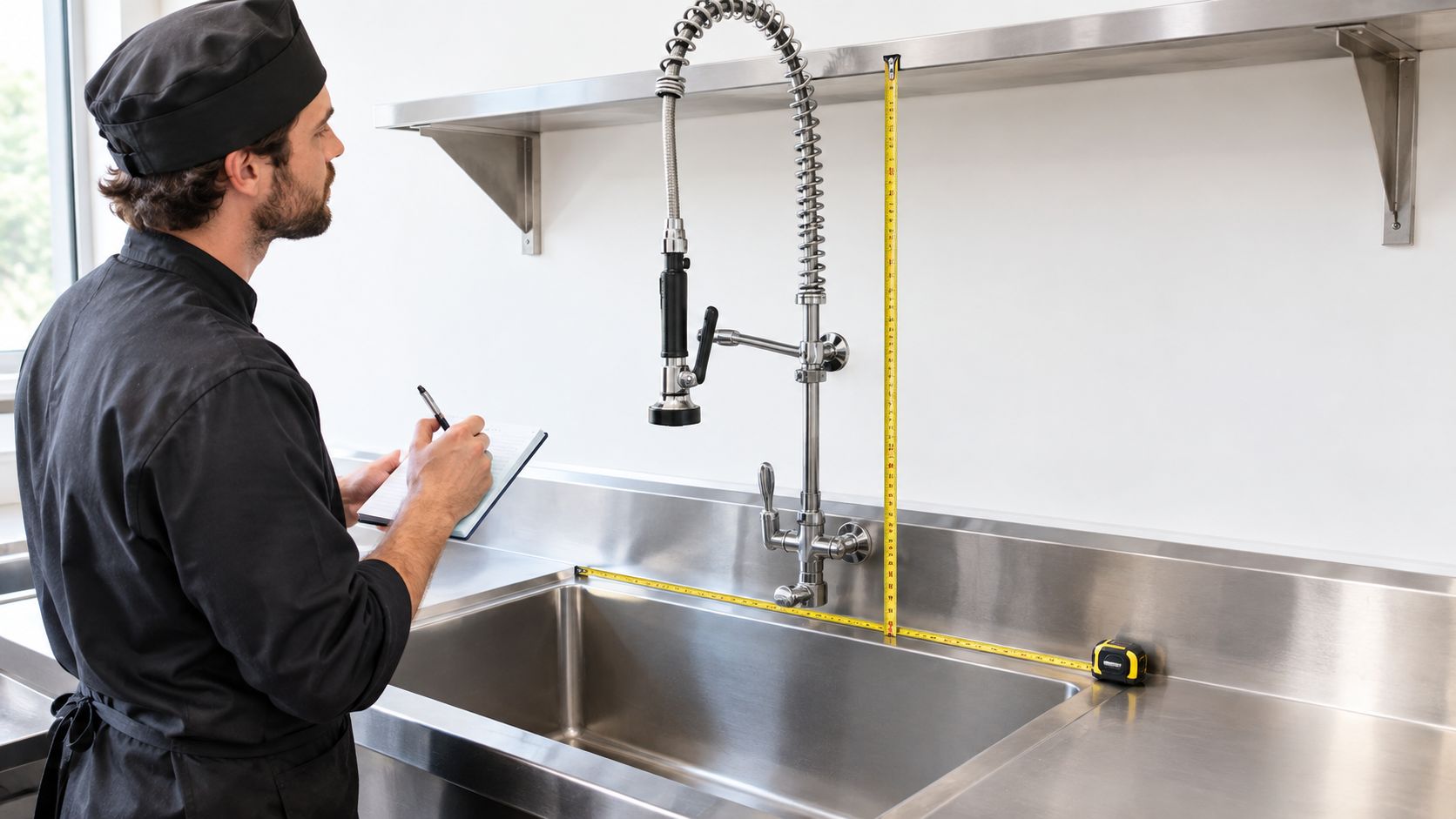
A tap can be technically compatible with a sink and still be wrong for the room. The most frequent spatial problem is an assembly that rises into a shelf, splashback fitting, pipe or service panel above the basin. The second is an outlet that doesn't reach the useful part of the bowl.
Measure the space before opening a product catalogue. A short site check can prevent a replacement, a fabrication change or an installation that staff dislike from the first service.
Record the whole installation zone
The following measurements give the supplier, plumber or fabricator a useful starting point:
- Sink position: Record the distance from nearby walls, corners, equipment and work surfaces.
- Bowl dimensions: Measure length, width and usable depth, including each bowl where the sink has more than one.
- Backsplash: Note the height and whether it contains services, joins or obstructions.
- Overhead items: Measure shelves, cupboards, extraction components, pipework and any equipment above the sink.
- Mounting area: Confirm the available deck space and the number and position of mounting holes.
- Required reach: Identify the part of the bowl where staff rinse, fill or wash.
- Tap dimensions: Check the manufacturer's stated overall height, spout projection, hose length and support position.
Manufacturer drawings matter here. A photograph can make a tap look compact while the technical drawing reveals a tall spring assembly or a projection that reaches beyond the bowl.
Match the outlet to the useful part of the sink
The outlet shouldn't merely land somewhere inside the basin. It should serve the area where staff place dirty items, fill containers or rotate cookware. If the tap reaches only the front half of a deep bowl, staff may lean across the sink or drag heavy items closer to the edge.
A pre-rinse hose also needs a usable path. The hose should move across the working area without catching on a shelf, striking the tap body or pulling the operator off-centre. Wall brackets and support arms require their own clearance check.
A tall assembly is only an advantage when the room has enough vertical clearance and the sink has enough depth to use it comfortably.
Consider the largest item
Sink and faucet selection should be treated as one decision when large cookware is involved. The largest item might be a deep stockpot, a full-size GN pan, a tray or a long utensil. It must be possible to place that item into the bowl, fill it, rinse its internal surfaces, turn it and remove it without the tap restricting movement.
The same question applies to the operator's body position. If a staff member must reach under a low outlet or work around a side-mounted hose, the problem will be repeated every service. A stainless-steel benchtop planning resource from Simply Hospitality can help when the tap position is being coordinated with a new fabricated work surface.
Water Efficiency, Flow, and NZ Compliance Requirements
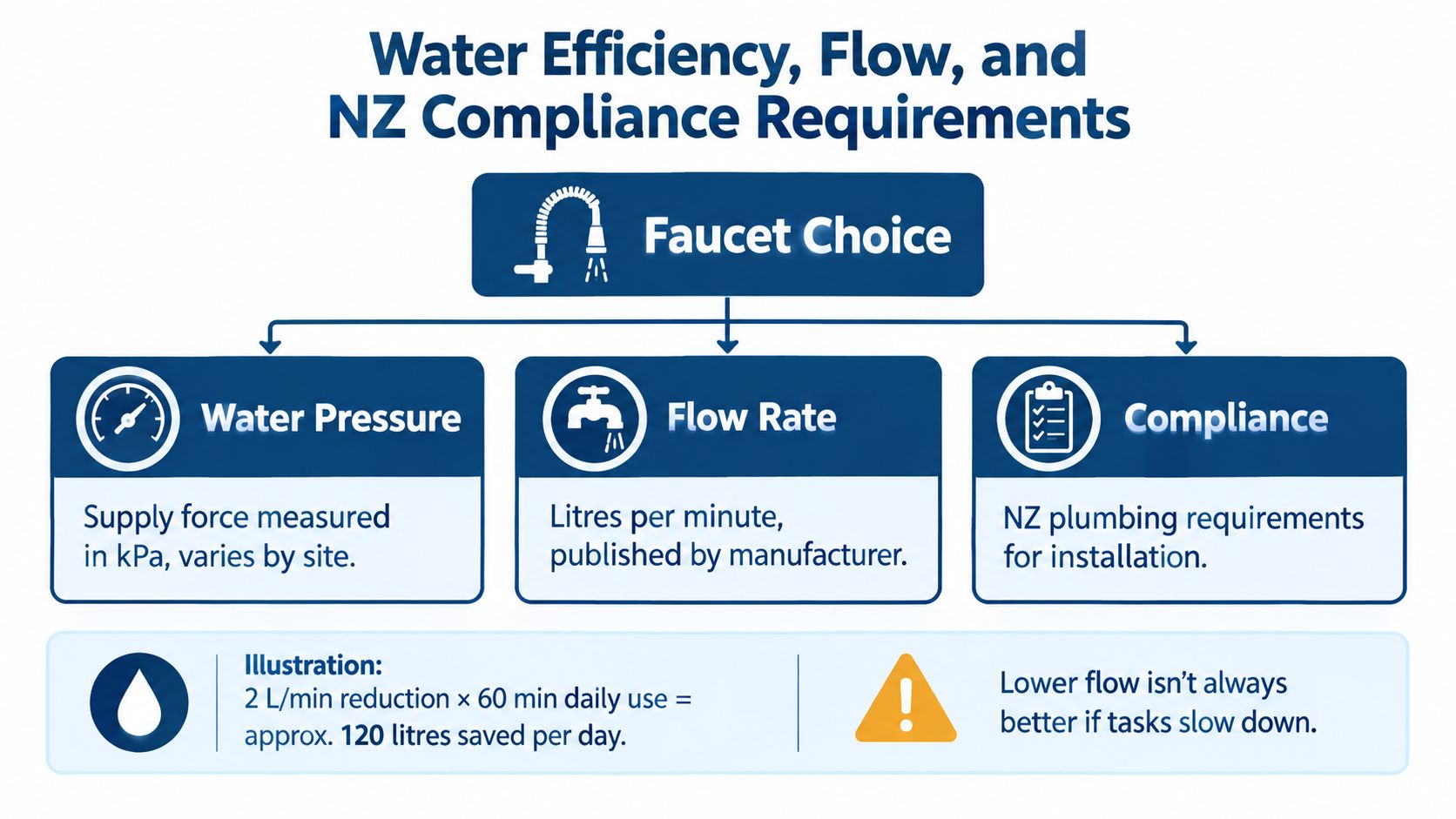
Flow rate and water pressure describe different things. Flow rate is the volume of water delivered over time, commonly shown by a manufacturer in litres per minute. Pressure is the force available from the site supply, and it can vary between premises and plumbing arrangements. A tap may have a published flow rate, yet its practical performance still depends on whether the installation operates within the manufacturer's specified range.
Compare flow with the work required
Where product specifications publish flow rates, operators can compare like with like. A simple planning calculation is:
Flow rate × minutes of actual use per day = approximate daily water use
For illustration only, a 2 litres per minute reduction used for 60 minutes of actual daily operation equals approximately 120 litres less water passing through the tap per day. This is not a claim about any particular product. It shows why the operating pattern matters more than a headline figure alone.
Lower flow isn't automatically better. If staff need materially longer to remove food debris, fill a container or rinse a large surface, the lower-flow option may undermine the task. The practical target is appropriate water use with sufficient performance for the job.
Operators looking at tapware in a broader bathroom context can also review guidance on finding bathroom taps and showers, but commercial kitchen decisions need to account for food handling, repeated spray use, sink geometry and plumbing integration.
New Zealand compliance is part of selection
In New Zealand, commercial tapware for potable water sits within the Building Code and the tapware standard AS/NZS 3718:2005. The standard covers metallic and plastic taps, mixing taps, sensor taps, lever taps, timed-flow taps and tap sets in sizes from DN 6 to DN 50, generally for continuous operating temperatures not exceeding 80°C, as described in MBIE's recognition notice for tapware.
Building Code clause G12 concerns safe and adequate water supplies for food preparation, utensil washing and hygiene, including protection against contamination and legionella growth. For food businesses, Auckland Council states that potable water must be available at a volume, pressure and temperature suitable for its purpose, with enough hot-water capacity for effective washing of equipment and fixtures. Waikato District Council also requires an adequate potable-water supply and says sinks must have a continuous supply of piped hot water while the premises is operating, as set out in local food-premises requirements.
This is why commercial-grade and compliance-ready aren't interchangeable descriptions. A tap can look solid while lacking the correct traceability, product marking or intended application. In New Zealand, water-using products sold in-store or online must carry the relevant WELS label, and the Commerce Commission states that supplying or advertising covered tapware without the correct label can breach the Fair Trading Act. Operators should check the label and product documentation before treating an online listing as suitable for a commercial fit-out.
Lead content and backflow protection
The 2025–2026 lead-content change is important for new purchasing decisions. New Zealand will require copper-alloy products that contact potable water, including taps and mixers, to have a maximum lead content of 0.25%, so specification records should identify whether the proposed product meets the applicable recognition requirements.
Backflow protection is a system issue, especially where a tap connects to a hose. Premises with cross-connection risk are assessed as low, medium or high hazard. Hose-connected taps require at least a hose-connection vacuum breaker as the minimum acceptable protection in the accepted solution, while containment protection may also be needed near the point of supply. Automatic backflow devices can require annual testing under compliance-schedule and building-warrant requirements, so the faucet, hose arrangement and site hazard category should be discussed with the appropriate plumbing professional.
Handwashing adds another practical constraint. Waikato District Council guidance requires hand wash basins to have piped hot and cold running water or tempered running water at a minimum temperature of 38°C, with a basin in each kitchen area and bar positioned in the same room as the work area. The Simply Hospitality article on NZ food safety regulations provides relevant context, but the local authority and qualified tradesperson should confirm the requirements for the specific premises.
A Practical Selection Sequence for Hospitality Operators
A short sequence helps prevent a tap purchase from getting ahead of the kitchen plan. The order matters because later checks depend on earlier decisions. There's little value in comparing spray valves if the chosen assembly can't clear the shelf above the sink.
- Identify the sink task. Decide whether the station is for hand washing, food preparation, pot filling, general washing, pre-rinsing, or utility work. The task determines the appropriate starting category.
- Measure the space. Record bowl dimensions, backsplash, surrounding equipment, shelves, available deck area and wall position. A measurement taken after ordering is too late to prevent a mismatch.
- Identify the largest item. Consider the largest pot, GN pan, tray or container staff need to place in the bowl. The tap should allow that item to be filled, rinsed, rotated and removed.
- Choose the tap type. Select a standard sink mixer where ordinary sink duties are enough. Choose pre-rinse functionality where staff need flexible spray control for dish or pot washing.
- Check height and reach. Compare the manufacturer's overall height and spout projection with the room. Confirm that the outlet covers the useful sink area without forcing staff to lean.
- Confirm mounting. Establish whether the assembly is wall-mounted or bench/deck-mounted. Check the mounting holes, wall position and access beneath the bench.
- Review flow and pressure. Compare published flow information, then check the manufacturer's operating range against the site supply. Don't assume a published flow rate guarantees the same result in every building.
- Verify plumbing connections. Confirm hot and cold inlets, connection sizes, valve arrangements and any support or bracket requirements. The existing plumbing may need alteration.
- Assess commercial suitability. Review construction, frequency of use, replaceable components, warranty conditions, cleaning requirements and spare-parts availability. Industrial styling alone doesn't prove commercial suitability.
- Read installation instructions before ordering. Model-specific clearances and fitting requirements can change the decision. Plumbing work should be completed by an appropriately qualified person where required.
Relevant commercial kitchen taps, pre-rinse units, commercial sinks and stainless-steel benches can then be compared against the actual site measurements. The practical lessons gathered from helping hospitality businesses select equipment are also set out in this equipment-planning article.
Working with Simply Hospitality on Tapware Selection
A useful specification brings together the sink task, physical measurements, plumbing arrangement, compliance documents and likely maintenance needs. That approach reduces the chance of choosing a high-reach unit for a low-clearance space, or a simple mixer for a station that really needs flexible pre-rinsing.
Hospitality can help hospitality operators compare commercial kitchen faucets, pre-rinse units, sensor taps, commercial sinks and stainless-steel bench solutions against the intended workflow. Operators can request quotes, discuss trade accounts, consider certified used equipment where appropriate, and explore SilverChef finance for larger fit-outs. Where a wash area is being rebuilt as part of a wider project, professional kitchen design support is available through SACH.
The right tap is determined by what staff wash, rinse or fill, how often they do it, and what must fit around and beneath the outlet. A supplier discussion is most useful when the operator has the sink dimensions, photographs of the surrounding space, the largest items being handled and the existing connection details.
Simply Hospitality supplies commercial kitchen taps, pre-rinse units, sinks and stainless-steel bench solutions for New Zealand hospitality businesses. Visit Simply Hospitality with the sink task and site measurements ready, and contact the team for practical help matching tap height, reach, mounting and workflow to the venue.