


Commercial Kitchen Faucet with Sprayer: Buying Guide
A busy dish station can expose a poor tap choice within the first service. Staff scrape plates, rinse trays, wrestle with large pots and feed racks into the dishwasher, while a hose that's too short, a spray head that splashes everywhere or a fitting that blocks overhead shelving slows every stage. A commercial kitchen faucet with sprayer should therefore be chosen as part of the wash station, not as an isolated piece of commercial tapware.
The right configuration gives staff usable reach, controlled spray force and a sensible path from dirty arrival to clean storage. It also needs to suit the sink, dishwasher position, available clearance, plumbing arrangement and New Zealand compliance requirements. A commercial pre-rinse tap can improve control, but only when its height, flow and mounting match the work being done.
Why the Pre-Rinse Station Matters
At the start of a busy wash cycle, dirty trays land beside the sink. Staff scrape off loose food, pre-rinse the tray, place it in a rack and move the rack to the dishwasher. After the machine finishes, items go to clean storage. The faucet with sprayer sits at the point where much of the loose debris is removed, so its position affects the whole sequence.
A poorly located spray unit forces staff to twist around the sink, lift heavy cookware too high or carry dirty items across a clean area. A well-matched commercial pre-rinse tap lets the operator direct water at corners, rims and food residue without repeatedly repositioning the item. The sprayer supports the workflow, but it doesn't replace scraping, proper dishwasher operation or sanitising.
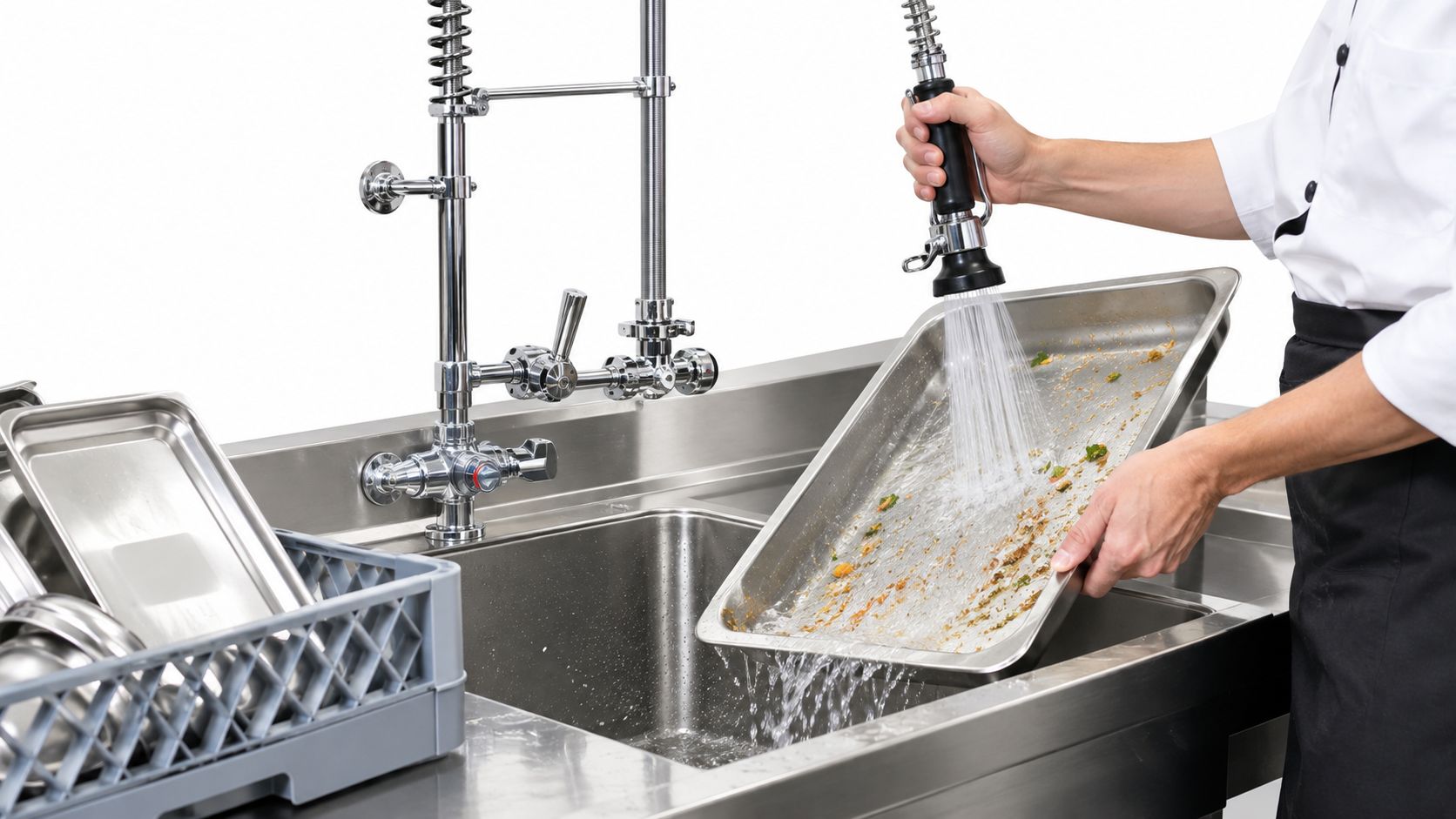
The tap belongs to the whole station
Operators often concentrate on dishwasher capacity and treat the sink mixer as an afterthought. That can create a gap between equipment that is technically capable and equipment that staff can use comfortably throughout service. The practical questions are simple:
- Dirty landing area: Can incoming trays reach the scrape area without crossing clean storage?
- Pre-rinse position: Does the spray head reach the working bowl and drainboard?
- Rack movement: Can staff load a rack without walking backwards or stretching across it?
- Dishwasher relationship: Is the machine close enough to support steady rack movement?
A commercial dishwasher workflow guide is useful when the spray station is being planned alongside the machine. The faucet should help staff move from scrape to pre-rinse, rack, dishwasher and clean storage with as little unnecessary movement as possible.
Practical rule: Specify the faucet after considering the sink and dishwasher positions together. A powerful spray can't correct a badly arranged wash station.
What Makes Up a Commercial Pre-Rinse Tap Assembly
A commercial pre-rinse tap usually combines several components into one working assembly, but exact configurations vary. Product specifications should be checked carefully because a unit may include a spray valve and flexible hose without including a separate pot filler, wall bracket or support arrangement.
Main components to check
- Mixer or tap body: This controls hot and cold water and provides the connection point for the spray system. The body may be designed for deck mounting or wall mounting.
- Flexible hose: The hose gives the operator control over where water is directed. It should have enough usable movement for the sink, but excessive length can make the station awkward.
- Spray valve: The trigger or control valve starts and stops the spray. Operators should check its flow information, spray pattern and published operating limits where available.
- Spring or support assembly: Some pre-rinse units use a spring to hold and guide the hose. Others use a different support arrangement, so the visible shape shouldn't be treated as proof of performance.
- Wall bracket or support: A bracket may be needed to keep the spray head in a safe resting position. This is particularly relevant where the tap is wall mounted or the assembly extends away from the sink.
- Fixed spout or pot filler: Some models include a separate spout for filling pots, containers or the sink without holding the spray trigger. This feature is useful only when it's included in the specific model.
The advantage over a fixed spout is directional control. Staff can bring the spray head to a tray, large pot or GN pan instead of trying to manoeuvre the item under a stationary outlet. That control still depends on the hose reach, sink dimensions and mounting position.
Look beyond the industrial appearance
A tall spring and exposed hose can make a fitting look commercial, but appearance alone doesn't confirm duty rating, replacement-part availability or suitability for a busy dish station. A commercial dishwashing pre-rinse spray arm should be assessed through its actual specifications, installation requirements and intended application.
Before ordering, confirm which parts are supplied, which parts are serviceable and whether the assembly fits the existing sink or bench. A replacement hose or spray valve can be more useful than a decorative feature, especially where the unit will receive repeated daily use.
Wall Mounted versus Deck Mounted Commercial Faucets
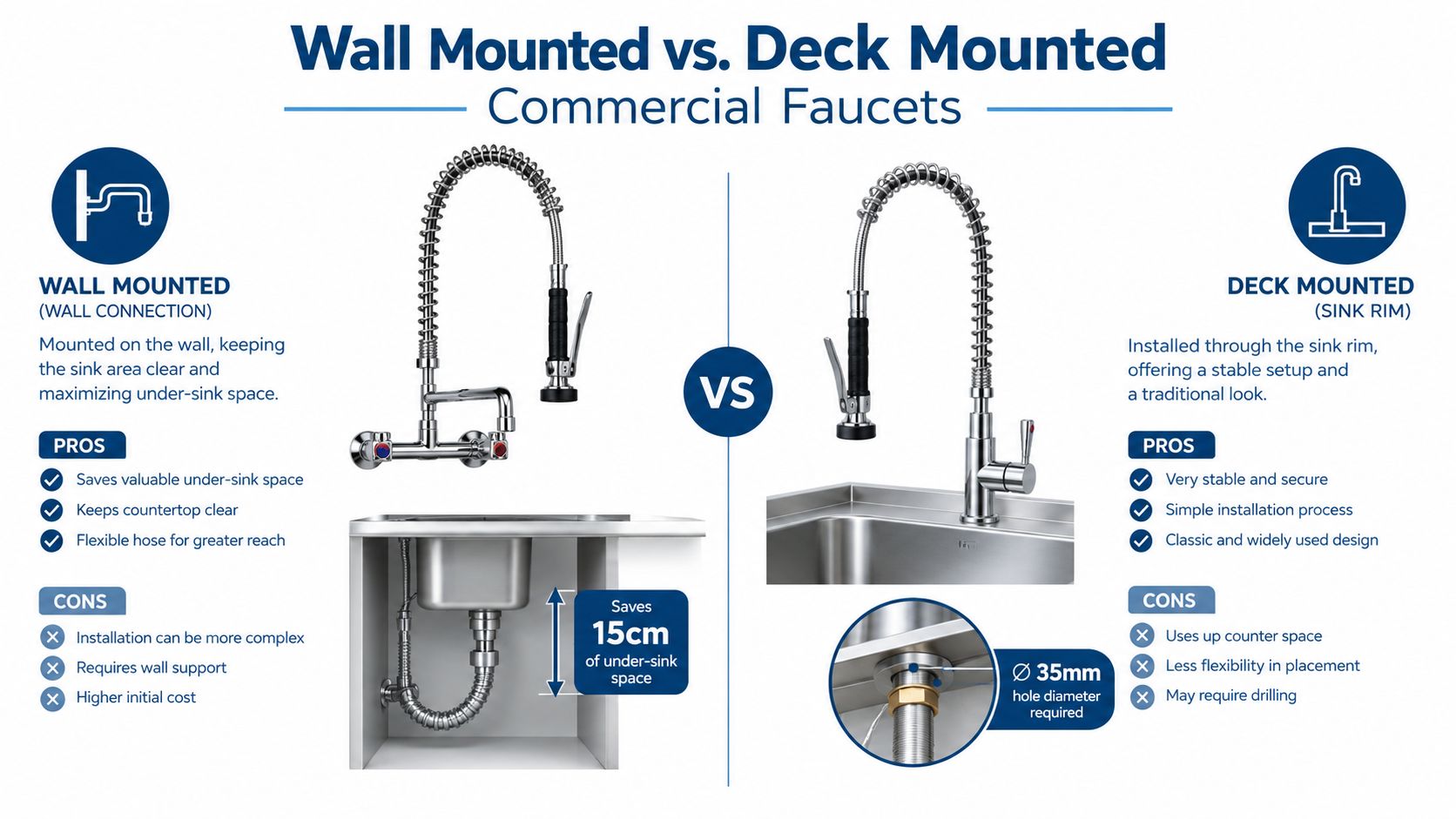
Mounting choice should follow the existing wash station rather than a preference for one visual style. Deck-mounted commercial faucets pass through the sink deck or bench where the sink, hole configuration and thickness are compatible. Wall-mounted units connect through the wall and can leave the sink deck clear, but they need suitable plumbing and a secure mounting surface.
Deck mounting suits compatible sink layouts
A deck-mounted commercial sink mixer can be practical when the sink already has the correct hole arrangement and the connections are accessible below. It keeps the tap aligned with the sink and may simplify replacement where the existing fitting uses the same mounting format.
The limitations appear when the sink deck is narrow, the tap body interferes with a drainboard or the bench cannot accommodate the mounting hole. The installation also needs enough space for the hose to move without striking nearby equipment.
Wall mounting changes the plumbing question
A wall-mounted pre-rinse tap can preserve usable sink-deck space and may work well where the wall is already set up for commercial tapware. It can also create a cleaner relationship between the spray head and a deep pot-wash bowl.
However, the wall must provide the right plumbing points and support. The backsplash, wall finish, pipe position and spray height all matter. A wall-mounted unit can be unsuitable if the outlet is too low, too high or too far behind the sink for comfortable hose movement.
The infographic supplied with this guide identifies a 15 cm under-sink space difference for its wall-mount comparison and a 35 mm hole diameter for its deck-mount example. Those figures belong to the illustrated comparison, not a universal specification for every commercial tap. Current product instructions should always take priority.
Before purchase, confirm:
- Mounting method: Wall, sink deck or bench.
- Existing holes: Diameter, centres and usable mounting surface.
- Plumbing location: Hot and cold connections and their access.
- Sink relationship: Whether the outlet sits over the correct bowl.
- Clearance: Backsplash, shelving, pass-throughs and other equipment.
Neither mounting method is automatically better. The suitable choice is the one that matches the sink construction, plumbing and working position.
Commercial Pre-Rinse Units versus Pull-Out Kitchen Mixers
A residential-style pull-out mixer and a commercial pre-rinse assembly can both have a flexible spray head, but they're designed around different patterns of use. The fact that a tap looks industrial doesn't prove that it can handle repeated trigger activation, hose movement or high-duty dish-station work.
| Consideration | Commercial pre-rinse unit | Pull-out kitchen mixer |
|---|---|---|
| Intended duty | Repetitive rinsing in commercial wash areas | General sink use |
| Hose arrangement | External flexible hose and spray valve are common | Hose usually retracts through the tap body |
| Reach | Designed around bowls, cookware and pre-rinse areas | Designed around a domestic or light-duty sink |
| Height | Often taller, subject to clearance limits | Usually lower profile |
| Construction | Components are selected for commercial use where specified | Construction varies widely by product |
| Flow | Must be checked against the product specification and station needs | Often designed for general household use |
| Mounting | Deck or wall options may be available | Commonly deck mounted |
| Replacement parts | Spray valves, hoses and seals may be separately serviceable | Replacement arrangements vary |
| Warranty and application | Must be checked for commercial use | Domestic warranty may not cover hospitality duty |
Duty matters more than appearance
A light fitting may feel perfectly adequate during occasional rinsing, then become awkward when staff use it continuously through a service. A commercial pre-rinse assembly generally gives a more direct working grip and a spray valve intended for targeted rinsing, but its taller structure can create clearance problems.
The reverse mistake also occurs. Some operators select an oversized-looking tap without checking whether the sink, shelving and water service can support it. The result is a fitting that looks capable but is uncomfortable to use or impossible to install correctly.
Compare the parts that staff actually handle
The spray valve should be comfortable to hold and easy to activate repeatedly. The hose should move through the required area without catching on the sink edge, while the support arrangement should keep the head safely positioned between uses.
A pull-out mixer may still suit a light-use food-preparation sink, particularly where the main tasks are filling and occasional rinsing. A high-volume dishwasher pre-rinse station usually needs a purpose-designed commercial pre-rinse tap, provided the product specifications match the duty and installation.
Measuring Height, Reach, Sink Fit and Spray Performance
The most expensive spray unit is still the wrong purchase if it cannot fit under the shelving above the sink. Height must be measured from the actual mounting point, not guessed from the general appearance of the fitting.
Measure the complete vertical space
Record the following before selecting a model:
- Bench or sink height from the floor.
- Mounting point on the sink deck, bench or wall.
- Overall faucet height from the product specification.
- Overhead clearance beneath shelving, extraction equipment, cupboards or other obstructions.
The full assembly may extend higher than expected because of its spring, support or spray head. Use the manufacturer's stated overall dimensions for the selected unit rather than applying a standard commercial height to every model.
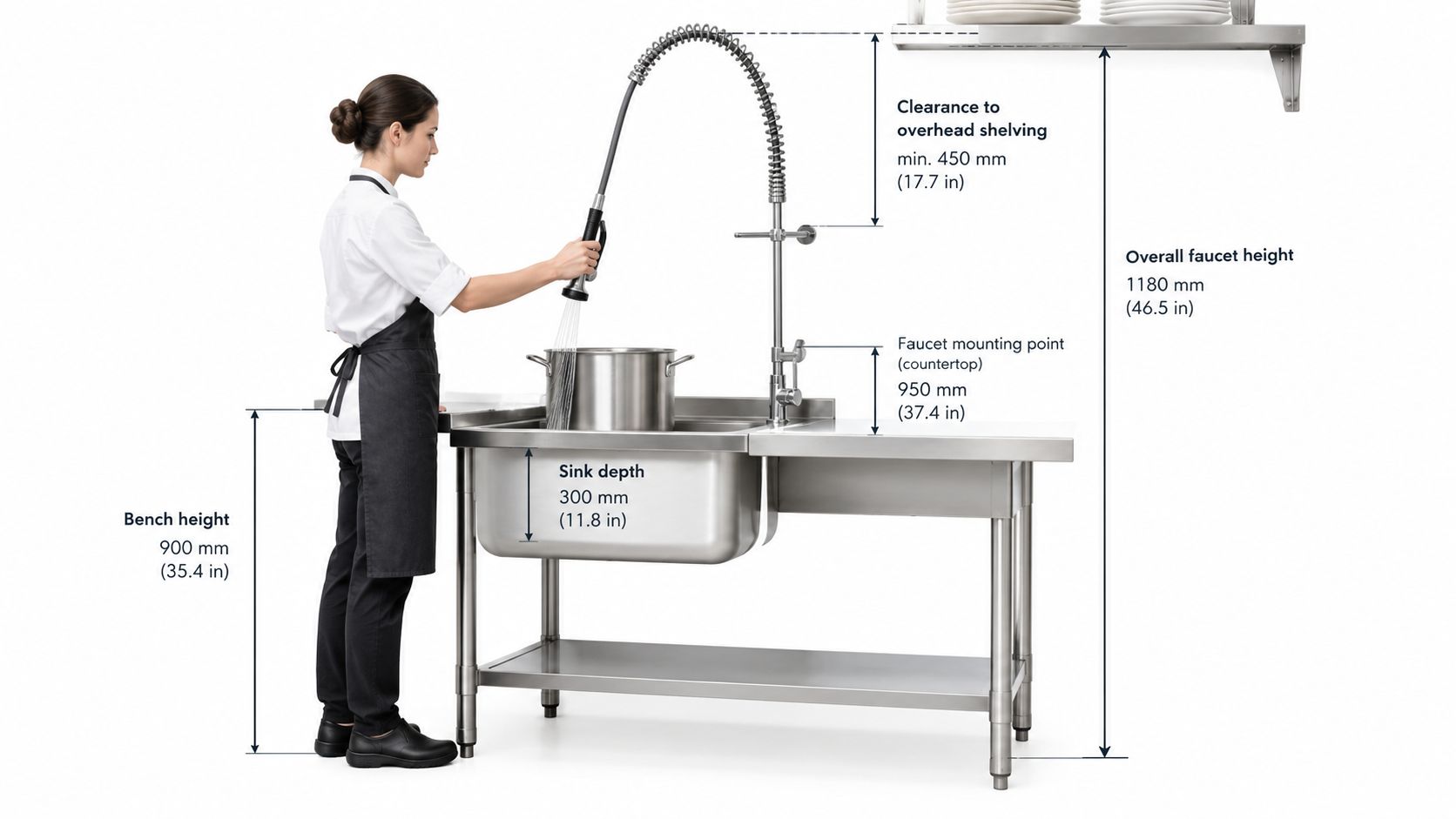
Reach should be tested against the largest item
A spray head needs to cover the practical pre-rinse area, not just reach the centre of the nearest bowl. Check whether staff can comfortably rinse:
- Each bowl in a double or triple sink.
- The corners of deep bowls.
- Large pots and trays.
- GN pans and cookware with wide rims.
- Items positioned beside the drainboard.
More hose length isn't always an advantage. A long or poorly supported hose can sag into the bowl, catch on equipment or require extra handling. The useful question is:
What is the largest item staff need to rinse, and can they manoeuvre it comfortably under the spray head?
The stainless steel sink range provides useful context because sink depth, bowl width, drainboard position and fabrication all influence the correct faucet reach.
Compare spray performance without chasing maximum force
Where published specifications are available, compare:
- Flow rate, using the stated unit and test conditions.
- Spray pattern, including how concentrated or broad the outlet is.
- Trigger design, including comfort and control.
- Water-pressure requirements, if provided.
- Temperature limits, where relevant.
A higher-flow spray isn't automatically more effective. Excessive force can increase splash and water use, while an overly restricted spray may make staff hold the valve open for longer. The suitable setting removes loose residue efficiently within the sink.
For New Zealand operators, tap equipment used over kitchen sinks falls within the WELS framework. The testing regime covers flow rate as well as hydraulic strength, endurance, watertightness and torque, so durability and sealing matter alongside efficiency. The Ministry for the Environment's WELS supplier information explains the testing context for tap equipment.
Calculate usage from actual operation
A practical estimate is:
Flow rate × actual minutes of use = approximate water consumption
For illustration, a valve using 2 L/min less than another and operating for 90 minutes per day would pass approximately 180 litres less water through the valve each day, calculated from the stated flow difference and operating time. This is an illustrative calculation, not a verified saving for a particular product.
Lower flow only creates value when the spray still removes debris effectively. If staff compensate by rinsing for much longer, the theoretical reduction can disappear.
Workflow, Ergonomics and Splash Control in the Wash Area
The best spray unit supports a clean sequence: dirty landing area, scrape, pre-rinse, rack, dishwasher. Staff should be able to move a dirty tray into the pre-rinse position, direct water at the food residue, place the item into a rack and move that rack towards the dishwasher without repeatedly crossing clean zones.
A faucet placed too far to one side can make staff rotate large pots across the sink. A spray head that rests too high may encourage stretching, while one that hangs too low can obstruct the bowl. The work area should allow quick movement between the sink and dishwasher without forcing staff to walk backwards or carry dirty racks through the clean storage area.
Repetition makes small design features important
Pre-rinsing involves repeated hand, wrist and shoulder movement. Selection should account for:
- Trigger comfort: The control should be easy to operate repeatedly.
- Hose movement: The hose should travel smoothly without catching.
- Spray-head weight: Staff shouldn't need to grip an unnecessarily awkward head.
- Working height: The unit should suit the bowl and the operator's working position.
- Reach: The spray should cover the required area without stretching.
- Dishwasher proximity: Staff should move between pre-rinse and racking naturally.
The relevant objective isn't maximum pressure or maximum hose length. It's minimum unnecessary movement per rack across the repeated work of the station.
Control splash at the source
Splash depends on the sink depth, spray position, water flow and how the operator holds the item. A strong spray aimed at a shallow bowl can send water onto the bench, floor or nearby clean equipment. A poor angle can also make the user compensate by moving the tray further away, which worsens control.
Building Performance guidance states that water pressure supplied through a tap should be adjustable so it doesn't spray or splash the user or adjacent surfaces. The sanitary fittings guidance supports a practical purchasing principle: the spray should remove debris effectively while keeping water within the wash area.
Water treatment can also affect warewashing outcomes, but it doesn't change the need to select a faucet that suits the station. The warewashing explanation of reverse osmosis covers a separate part of the equipment decision.
Compliance, Maintenance and Long-Term Ownership
A commercial kitchen faucet with sprayer sits within a potable water system, so compliance should be checked before appearance, finish or headline spray force. In New Zealand, water used for human consumption, food preparation and utensil washing must be potable and protected from contamination under the Building Code requirements for water supplies. Auckland Council also expects food-business plumbing and sanitary fixtures to align with the Building Act 2004 and requires water to be available at a volume, pressure and temperature suitable for the operation.
Food premises guidance identifies separate sink functions for food preparation, crockery and cutlery washing, and cleaner's sink duties where applicable. A sprayer attached to a food-preparation or wash-up station therefore needs to be considered as part of the complete plumbing arrangement.
Backflow protection is not optional
Backflow is the unintended reversal of water into the potable supply. Hose-connected spray fittings can create a cross-connection risk if the installation doesn't provide suitable protection.
Building Code guidance allows protection through an air gap or a backflow prevention device. Where an air gap is used, it must be the greater of 25 mm or twice the diameter of the supply pipe, as set out in New Zealand backflow prevention guidance.
The relevant mechanical-device standard is AS/NZS 2845.1:2022, which covers materials, design, performance and testing. Field testing and verification requirements also apply under the New Zealand backflow testing framework. The AS/NZS 2845.1:2022 resource should be considered alongside the requirements of the specific installation.
Check potable-water materials and serviceability
From 1 September 2025, copper-alloy products intended to contact potable water for human consumption must have a maximum lead content of 0.25% to comply with the Building Code. Taps, mixers and associated fittings are among the product types covered by the rule, as described in MBIE's G12 water-supplies guidance.
Ownership also depends on service access. Before ordering, confirm whether the manufacturer supplies or supports replacement:
- Spray valves and hoses.
- Springs and support components.
- Cartridges and handles.
- Seals and other serviceable parts.
There isn't a universal replacement interval for these components. Mineral deposits, debris, usage and cleaning practices all affect performance, so staff should follow the manufacturer's cleaning and maintenance instructions.
New Zealand commercial plumbing guidance also treats hot-water delivery differently in kitchens. Guidance recommends continuous piped hot water while food premises are in use and a minimum sink water temperature of 63°C for sink units, while MBIE's 50°C maximum tap temperature change for most buildings excludes kitchens and laundries. The plumbing and drainage transcript explains that distinction.
Choosing the Right Commercial Kitchen Faucet with Sprayer
A suitable unit should answer these questions before it reaches the installation stage:
- What will be rinsed? Trays, pots, GN pans, crockery and food-preparation items create different reach requirements.
- What is the largest item? Test whether it can be manoeuvred under the spray head without stretching.
- What sink is being used? Check single, double or triple bowls, depth, drainboard position and mounting holes.
- How much height is available? Measure from the mounting point to shelving, hoods and other obstructions.
- How much spray reach is required? Cover every working bowl and the practical pre-rinse area.
- Is a separate filling spout useful? A fixed pot filler can fill pots or containers without holding the spray trigger, but only if the selected model includes one.
- Wall or deck mounting? Match the fitting to the plumbing, sink deck, backsplash and supporting structure.
- What water pressure and flow are available? Check the product's published requirements and the site's water service.
- How does it sit beside the dishwasher? Staff should move from dirty items to pre-rinse, racks and the machine without crossing clean areas.
- Are replacement parts available? Confirm access to spray valves, hoses, cartridges, seals and other manufacturer-serviceable components.
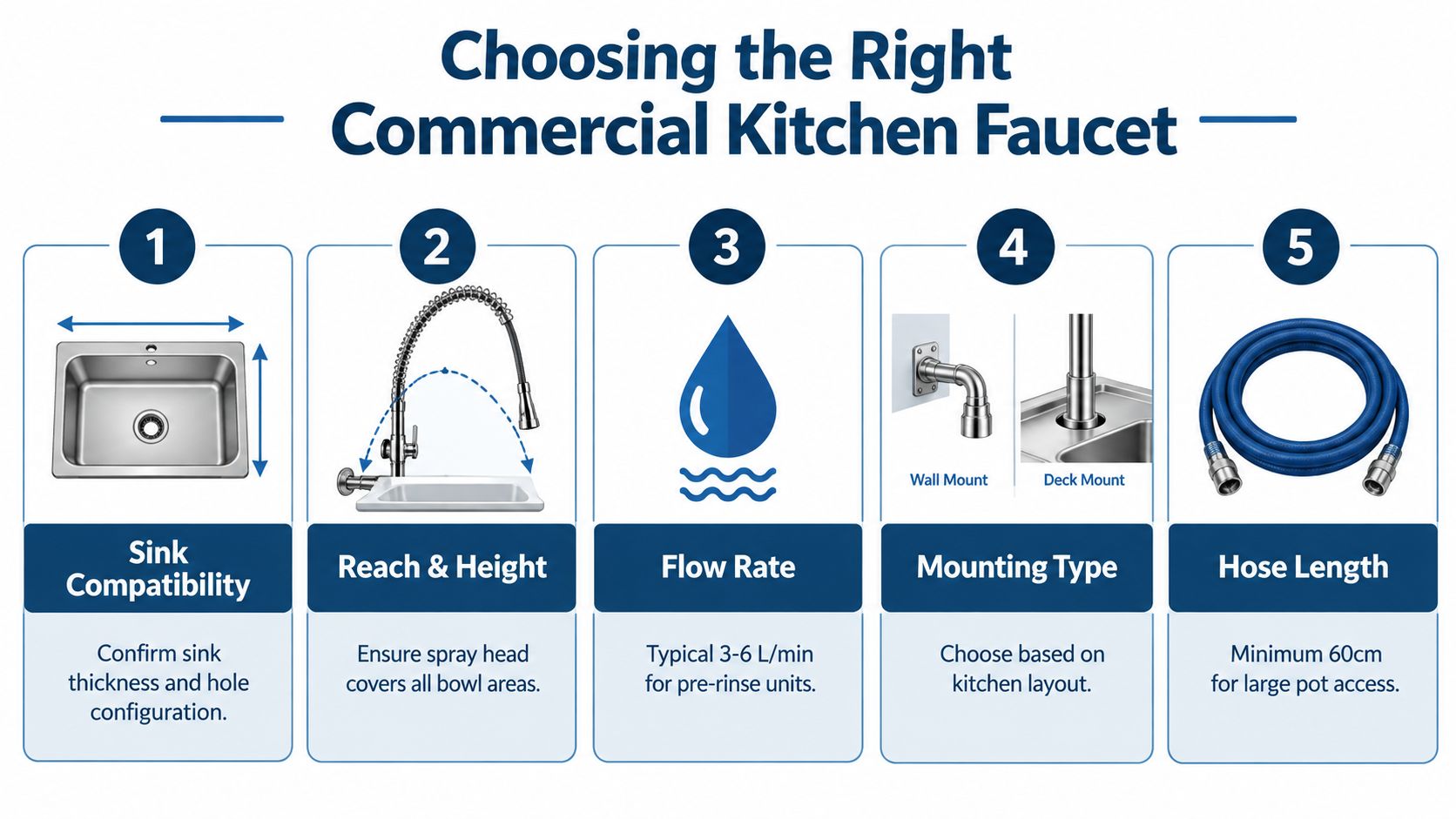
The commercial kitchen faucet buying guide provides a broader reference, while a dedicated commercial pre-rinse unit should be selected against the actual sink, wash volume and dishwasher workflow. Simply Hospitality offers commercial tapware, pre-rinse units, commercial sinks and dishwashing equipment for hospitality operations, with product specifications available for checking before purchase.
A commercial kitchen faucet with sprayer works best when it has enough height and reach for the sink, enough spray performance to remove loose debris, controlled water use and a position that supports clean rack movement. Visit Simply Hospitality to review commercial tapware and dishwashing equipment, or contact the team for help matching a pre-rinse unit to the wash station, plumbing arrangement and daily workflow.