

Choosing Dinnerware and Tableware for NZ Hospitality
Most advice on dinnerware and tableware starts with style boards and ends with regret. A plate that looks great in a catalogue can become awkward once it's stacked, carried, washed, replaced and put back into service every day. For hospitality operators, the better starting point is the menu, then portion size, then plating style, then plate or bowl shape, then the wider table setting, and finally the service workflow back of house.
That order matters because tableware is part of the operating system of a venue, not just décor. The range has to present food properly, move through the wash cycle cleanly, stack without wasting space, and hold up to normal hospitality handling. Even a visually strong setting can fail if the pieces are hard to store, awkward to clear, or unsuitable for the venue's service rhythm.
A practical mindset helps here. The right question isn't “what looks premium”, it's “what works through service without creating extra labour or replacement headaches”. A simple bar setting guide such as basic bar setup tips is useful for the same reason, because good front-of-house equipment is chosen around workflow, not just appearance.
Why Tableware Is Operating Equipment, Not Just Decoration
The common mistake is choosing dinnerware from the front, then finding out what it costs in service. Operators see a shape they like, picture it on the table, and only learn the practical limits after the range is in daily use. That is the wrong order.
Work from the menu to the shelf
Start with the menu, portion size, plating style, plate or bowl shape, table setting, then the service workflow. Each step affects the next, and changing one usually means adjusting several others. A deep bowl can suit a saucy main, but it may also take more shelf space, change cutlery placement, and make stacking less efficient.
Range choice should follow service, not photography. A good-looking plate still becomes a poor commercial fit if it slows clearing, creates awkward overlaps in the dishwasher, or forces the kitchen to over-portion just to fill the surface. Food has to read well on the table, and it has to move through service without creating extra work.
Practical rule: choose the vessel after the dish, not before it.
Treat the setting as one operating system. Plates, bowls, glassware and cutlery need to support the same service style, whether that is fast casual, hotel breakfast, shared dining, or a more formal evening room. For a reminder that setup choices are always tied to workflow, basic bar setup tips makes the same point from the beverage side of the operation.
That approach cuts friction in the kitchen and on the floor. It also reduces the chances of a range that looks right on day one but becomes awkward once staff start clearing, washing, stacking and replacing it through a real service cycle.
Dinnerware Versus Tableware and the Materials to Compare
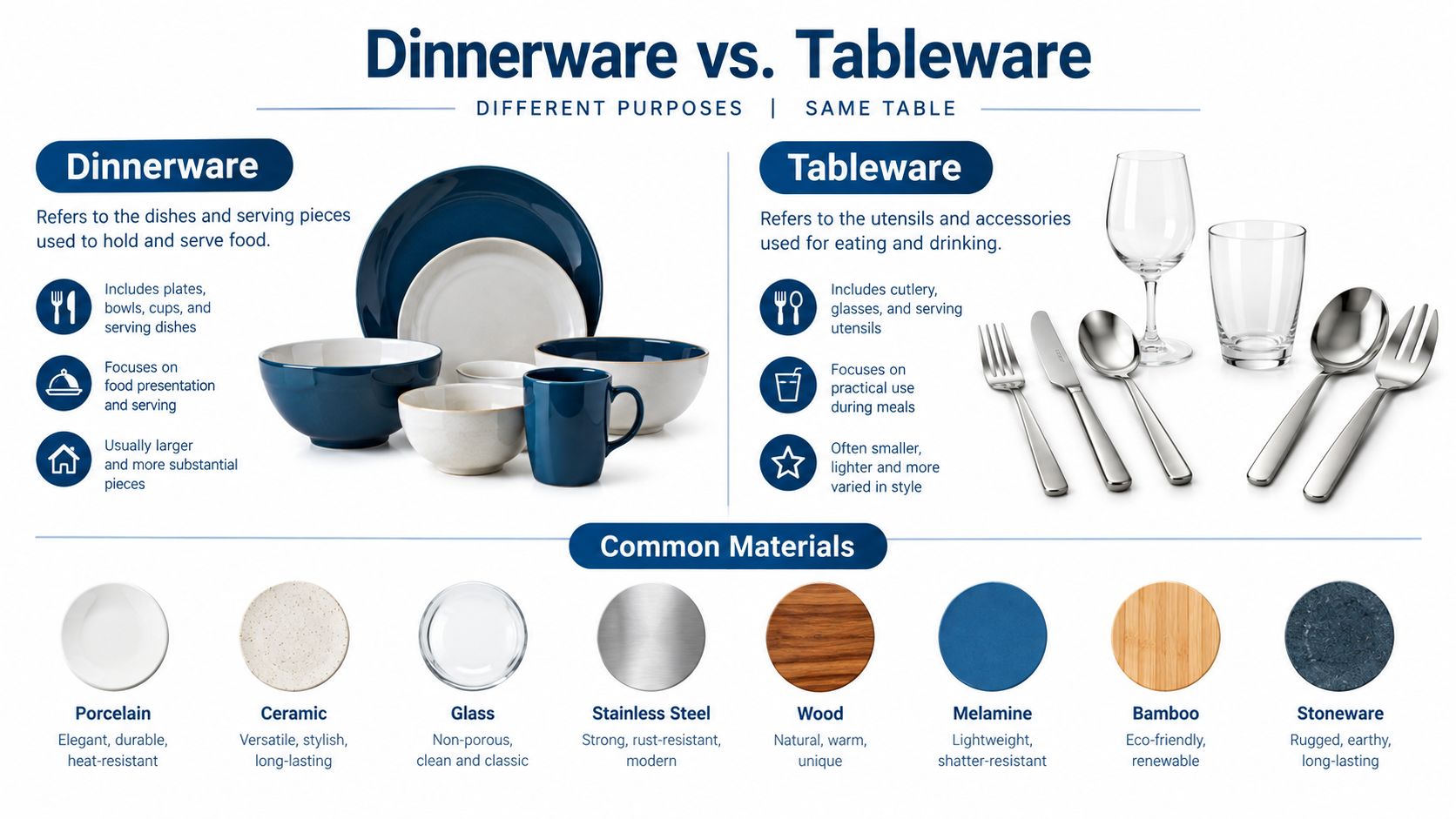
Dinnerware and tableware aren't quite the same thing, and it helps to separate them early. Dinnerware generally means plates, bowls and related serving pieces used with meals. Tableware is broader, covering dinnerware, cutlery, glassware, serving pieces and table accessories.
Match the material to the service, not the trend
For most hospitality settings, the main choices sit across porcelain, ceramic and stoneware. These materials are common because they suit everyday commercial service, but they don't all create the same feel. Porcelain usually gives a cleaner, more refined look, while ceramic and stoneware often read as warmer or more textured at the table. The right choice depends on the menu, the room and how the venue wants the food to read.
Bone china sits in a different lane. It can suit venues that want a lighter, more delicate presentation, particularly where the table setting is part of a formal dining experience. Melamine and other specialist materials can be sensible in outdoor, poolside or higher-breakage settings, provided the pieces are stocked for that purpose and the venue is happy with the feel and finish.
A few questions are worth asking before committing to any range:
- What does the food need visually? Some dishes need a quiet, neutral frame. Others benefit from texture or colour.
- How will staff carry and clear it? Weight and shape affect fatigue and handling.
- How will it sit in the wash? Some shapes are easier to stack and dry than others.
- Does the range suit the venue's tone? A polished hotel breakfast room and a casual café rarely want the same table language.
- What needs to coordinate with it? Cutlery, glassware and serving pieces should feel like part of one setting.
For a broader look at crockery selection in local hospitality settings, the crockery NZ discussion is a useful companion read. The core point stays the same, material is a venue-by-venue decision, not a ranking exercise.
Plate Shape, Finish and How the Food Reads on the Table
Plate shape affects perception faster than most operators realise. Diameter matters, but usable plating area matters more. A larger plate isn't automatically better, because a large surface can make a carefully portioned dish look sparse, while a smaller or better-shaped plate can make the same food feel intentional and complete.
Shape changes the way the menu lands
Bowls deserve the same attention. Depth and capacity affect soups, pasta, composed salads and shared dishes, and they also affect how easily food can be plated without spill or smearing. Rim shape matters too. A pronounced rim can frame the food and give staff a clearer handhold, while a coupe-style plate opens up more of the surface for modern, food-led plating.
Colour and finish change the reading of the dish as well. White dinnerware gives strong contrast and usually keeps the focus on the food. Coloured pieces can work well when they support the venue concept or the menu style, but they should earn their place rather than be chosen because they're fashionable. Matte finishes tend to feel softer and more restrained, while gloss finishes reflect light more strongly and can lift a cleaner, brighter presentation.
The right finish is the one that helps the food read clearly under the venue's lighting, not the one that looks most striking in isolation.
For venues refining a contemporary look, the Bonna table presentation article is worth reviewing because it shows how presentation-led ranges are discussed in practice. Linen also plays a role. The relationship between plate, cloth and cutlery is obvious in Lewis and Sheron on linens, especially where the room is meant to feel considered rather than busy.
The useful habit is to test plate language against actual dishes. Sauces, liquids, shared plates, side dishes, desserts and beverage service each need different space and different visual framing. A plate that flatters a main might not suit an entrée or a dessert course at all.
The Service Cycle and Where Tableware Quietly Fails
The easiest way to judge a range is to follow one plate through a full service. Not the catalogue image, the actual cycle. A plate starts in storage, gets plated, carried, cleared, scraped, washed, stacked, dried and stored again. Each stage exposes a different weakness.
What happens between the pass and the cupboard
Storage comes first, and it already narrows the options. If the range stacks poorly, it eats shelf space and creates handling risk before service even starts. During plating, the weight and rim design affect how confidently staff can work, especially when they're assembling multiple covers at speed.
At service, the shape needs to support the food and the hands carrying it. During clearing and scraping, awkward edges or recesses slow things down. After that, the wash cycle becomes the true test. MPI treats crockery and utensils as food-contact equipment, and its Food Control Plan guidance expects them to be cleaned and sanitised as part of normal food safety practice. That makes smooth, accessible surfaces and sensible stacking part of the buying brief, not an afterthought.
New Zealand's older Food Hygiene Regulations add a further reminder. They specify machine-wash settings with wash water of at least 60°C and a clean-water rinse of not less than 77°C for at least 10 seconds. Any venue relying on a warewasher needs dinnerware that fits that system, not dinnerware chosen in isolation from it.
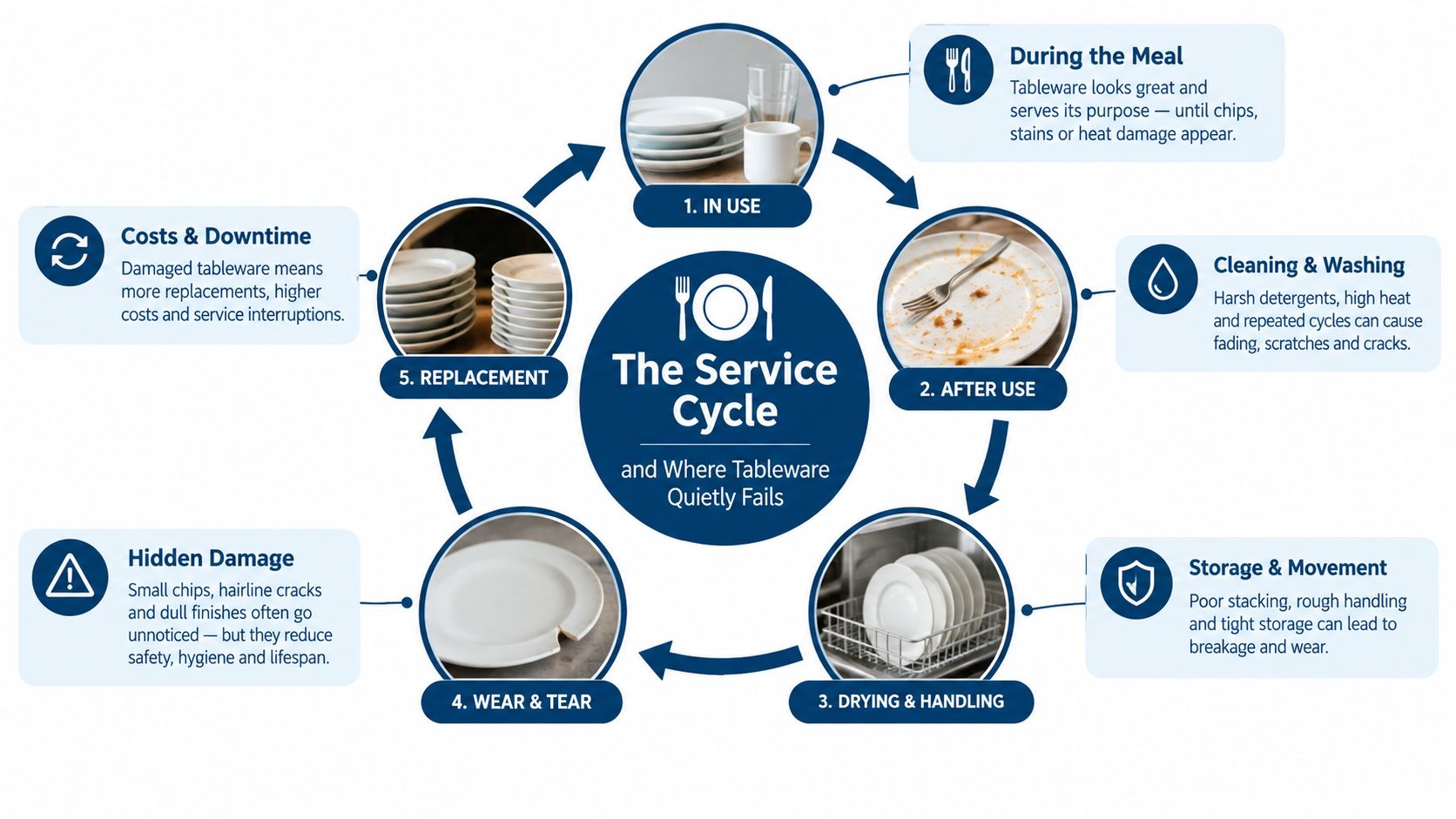
A venue looking at broken plates and turnover pressure will often find that the core issue is replacement and workflow, not just damage. The broken crockery cost discussion is useful because it keeps the focus on service continuity. If a range can't move cleanly through the whole cycle, it costs time even when nothing visibly breaks.
Working Out How Much Tableware You Actually Need
The old “three plates per seat” rule sounds tidy, but it's too blunt for real operations. A defensible stockhold starts with the venue's actual service pattern, not a generic rule of thumb. Seats, peak covers, table turns, warewashing turnaround, service style and a realistic loss buffer all need to be part of the calculation.
Model each piece separately
A main plate, an entrée plate, a sharing dish and a bowl do not need the same volume of stock. The pieces that move most often need more redundancy because they cycle faster through the wash and back into service. Specialist pieces can usually be held in smaller quantities, provided the menu really uses them that way.
A simple way to think about it is this:
| Stockhold variable | Main plate | Entrée plate | Sharing/serving piece | Bowl |
|---|---|---|---|---|
| Peak demand | Highest | Moderate | Variable | Moderate to high |
| Turnaround pressure | High | Moderate | Lower but uneven | High |
| Storage demand | High | Moderate | Often bulky | Moderate |
| Replacement risk | Frequent | Frequent | Irregular | Frequent |
| Buffer needed | Meaningful | Meaningful | Small but planned | Meaningful |
A small worked example helps in budget discussions. A 60-seat venue with brisk lunch turnover may need a much larger count of main plates than a breakfast room with slower table movement, even if both rooms have the same number of seats. The service model changes the stockhold before breakage or loss is even considered.
Useful check: if warewashing is the bottleneck, buy to the wash cycle, not just the floor plan.
Chipped or cracked pieces should be removed from service immediately. Food Standards Australia New Zealand states that eating and drinking utensils must be clean and sanitary immediately before each use and prohibits chipped, broken or cracked utensils for handling food. That makes a daily inspection routine part of stock planning, not just a maintenance habit.
Coordinating Cutlery and Glassware with the Dinnerware
A table feels coherent when the pieces belong together. If the cutlery is too light, too ornate or visually out of step, the setting looks unfinished even when the plates are right. The same is true for glassware. The table is a system, not a pile of separate purchases.
Cutlery and glassware should pull in the same direction
For cutlery, the details that matter are weight, balance, finish, size and range availability. A consistent family reads better across the menu than a mixture of styles gathered over time. That is where a range such as Stanley Rogers often comes into the discussion, because operators want a cutlery family that stays visually consistent while still working across mains, desserts and beverage service.
For glassware, the fit starts with the beverage programme. Water service, wine by the glass, cocktails and non-alcoholic drinks do not all want the same form. Presentation, storage and warewashing matter just as much as bowl shape or stem length. Ranges such as Zwiesel, Pasabahce, Ocean, Stölzle and Luigi Bormioli sit in different service lanes, so the right choice depends on the tone of the venue and how the glasses will move through service.
The same operational test applies here as with dinnerware. Does the range clear easily, stack safely, wash cleanly and replace consistently? Does it fit the space and the wash cycle? Those questions matter more than whether the range looks good alone on a shelf.
For a useful way to compare table elements together, the N-TASH tableware collections page shows how coordinated pieces can be thought about as part of one table setting rather than as isolated items. The practical lesson is simple. A table that works as a system creates fewer problems for staff and a more settled experience for guests.
Whole-of-Life Cost and Ranges Available Through Simply Hospitality
The cheapest plate per unit is not always the lowest-cost choice over time. Purchase price is only one part of the equation. Replacement availability, breakage and loss, storage, handling and warewashing practicality all shape the total cost of ownership.

What different ranges solve
Bonna suits briefs that call for a more contemporary presentation language and a range that can carry modern plating styles. Tablekraft is a practical fit for hospitality table settings where consistency and day-to-day usability matter, and the Tablekraft article gives useful context on why venues keep returning to that approach. For cutlery, Stanley Rogers helps operators build a coherent family around the table instead of matching unrelated pieces over time.
Glassware needs its own decision tree. Zwiesel, Pasabahce, Ocean, Stölzle and Luigi Bormioli each sit in different service lanes, from straightforward all-purpose use through to more polished beverage presentation. The question is not which brand is “better”, it is which one fits the drinking programme, the room and the replacement pattern.
The same operational test applies across the range. Does it clear easily, stack safely, wash cleanly and replace consistently? Does it fit the space and the wash cycle? Those questions matter more than whether a range looks good on a shelf.
For a useful way to compare table elements together, the N-TASH tableware collections page shows how coordinated pieces can be considered as one table setting rather than isolated items. A Tablekraft range can also be assessed against service demands in the same practical way, using its place in the full table mix rather than as a standalone purchase.
A sensible buying conversation always comes back to total fit. The range has to work with the menu, the service style, the storage available, the wash cycle and the likely replacement path. That is the point where a polished-looking range becomes working equipment rather than a decorative purchase.
If you are weighing up Bonna, Tablekraft, Stanley Rogers or coordinated glassware, visit Simply Hospitality and request a stockhold calculation for your venue.