


Grease Trap Requirements NZ Before You Install
New Zealand has no single grease trap rule: a food business discharging fats, oils and grease may need approved interception, but the duty depends on its wastewater and the local council or wastewater operator. The practical decision is which equipment, capacity and approval pathway applies to the particular premises, not which trap another café bought.
For an operator planning a fit-out, the safest purchasing sequence starts with the discharge requirements and drainage design. Equipment selection follows those decisions, alongside provision for cleaning, inspection and ongoing records.
Are Grease Traps Required for New Zealand Food Businesses
Commercial food businesses may need approved grease interception equipment when their wastewater contains fats, oils and grease, commonly shortened to FOG. A restaurant, café or production kitchen shouldn't treat a trap as either automatically unnecessary or automatically identical to the system at another premises.
The assessment needs to reflect what enters the drain. Cooking oil collected separately for disposal is different from fat washed off roasting trays, buttery baking tins or heavily soiled plates.
The discharge matters more than the business name
A useful assessment brings together:
- Business activities: The menu, cooking methods and food preparation work.
- Wash-up: Pot washing, sink emptying, dishwashing and equipment cleaning.
- Discharge characteristics: The grease, food solids and wastewater generated during service and cleaning.
- Local requirements: The applicable trade waste bylaw and wastewater network conditions.
- Drainage arrangement: Which fixtures discharge through the proposed treatment equipment.
A local trigger illustrates why a national yes-or-no answer isn't enough. Queenstown Lakes District Council states that premises discharging, or likely to discharge, more than 100 grams of fats, grease or oils per 1,000 litres per day must install a grease trap.
That threshold belongs to Queenstown Lakes. It shouldn't be used as an exemption test for premises in another district.
Practical rule: Describe the wastewater first. Ask the authority to assess that discharge, rather than asking whether a business with a particular trading name needs a trap.
Food safety approval isn't drainage approval
Food safety obligations under the Food Act 2014 and trade waste responsibilities address different risks. A food control plan deals with safe food handling, while grease interception deals with wastewater discharged from the premises.
A kitchen can have an orderly cleaning programme and still need changes to its drainage treatment. Equally, installing a trap doesn't settle food safety responsibilities.
For purchasing purposes, the important distinction is between equipment that looks suitable and equipment the relevant authority will accept for the proposed discharge. A supplier's description, an existing tenant's arrangement or a neighbouring venue's installation isn't a substitute for that confirmation.
Who Sets the Grease Trap Rule for Your Site
There is no single nationwide grease trap rule. The council or wastewater network operator sets discharge requirements for the site, while the building consent authority considers building work and applicable drainage provisions.
Palmerston North City Council's trade waste requirements require grease traps where non-residential wastewater is likely to contain grease. Food premises preparing food for sale need a suitable trap and grease-trap consent, renewed annually. Choosing a tank is only one part of meeting the local requirements.
Published grease trap triggers and approval routes by council
These council examples help identify what to ask about. They do not establish permission to proceed at a particular address. Confirm current requirements with the authority responsible for the site.
| Council | What triggers the duty | Approval route |
|---|---|---|
| Palmerston North | Non-residential wastewater likely to contain grease; food premises preparing food for sale | Trap suited to the volume and the council's grease-trap consent process |
| Christchurch | Cafés, restaurants and food businesses | Approved, appropriately sized trap installed by a registered plumber; relevant Building Code provisions considered |
| Wellington | Commercial, trade and industrial premises discharging trade waste | Installation permit for trade waste devices and trade waste consent before operating |
| Tauranga | Grease-bearing discharge assessed using a Building Code method | Local sizing assessment and written acceptance of any exception |
| Timaru | Non-domestic premises likely to discharge grease | Current consent, maintenance service contract and sizing agreed with the Trade Waste Unit before installation |
| Clutha | Premises cooking, preparing or selling food, including restaurants, takeaways, hospitals, hotels, bakeries, butcheries and supermarkets | Trade waste consent before discharge; building consent may apply to new or modified traps |
| Queenstown Lakes | Actual or likely discharge exceeding the council's published FOG threshold | Grease trap required under the local discharge requirements |
| Westland | Commercial food premises and food-preparation businesses | Appropriate trap and trade waste consent before operating |
For an Auckland premises, contact Watercare early to confirm whether it manages the connection and which requirements apply. A Wellington approval pathway or Christchurch equipment recommendation does not establish what an Auckland site needs.
Different approvals answer different questions
Trade waste approval sets the conditions for what a business may discharge. Building consent, where required, covers the proposed building and drainage work. Approval under one process does not automatically satisfy the other.
Christchurch's grease and oil trap guidance refers operators to G13/AS2 or G14. The applicable drainage provisions should be considered for the specific proposal, rather than assuming a universal tank specification.
Use appropriately licensed plumbing and drainage professionals to establish who can design, install and complete the work. Food compliance is a separate responsibility; Hospitality's guide to New Zealand food safety regulations explains that area of compliance.
Which Hospitality Kitchens May Need a Trap
A bakery washing buttery tins and a hotel washing breakfast cookware can both generate greasy wastewater. The menu and business name alone do not determine whether a trap is required.
Cooking methods, production volume and washing activities help define the wastewater proposal. Even a café doing light preparation should confirm the local requirements rather than assume an exemption.
Hospitality sites and what to confirm
| Business type | Potential grease sources | What to confirm |
|---|---|---|
| Restaurant | Fryers, chargrills, sauté pans and pot wash | Connected fixtures and peak covers |
| Café | Grill, preparation and dishwasher | Whether oily wastewater reaches the sewer |
| Commercial catering kitchen | Batch cooking and large pot wash | Discharge volume relative to a small interceptor |
| Takeaway | Fryers and short, intense operating peaks | Peak flow, not just floor area |
| Bakery | Butter, pastry and tin washing | Whether high-fat wash water is discharged |
| Hotel | Breakfast, room service and banquet dishwashing | Combined outlets, not an individual kitchen alone |
| Institutional kitchen | Schools, hospitals, aged care and marae production | The authority for the site and production hours |
| Food production premises | Processing and wash-down | Trade waste consent requirements before discharge |
These are assessment prompts, not automatic requirements or exemptions. Describe the full operation, including preparation and washing outside customer-facing trading hours.
A catering kitchen may finish cooking before a concentrated pot-washing session begins. In a hotel, breakfast, functions and room service may share drainage, so an equipment list for one outlet may not describe the combined discharge.
Dishwashing and tenancy details deserve attention
Dishwashers and pot sinks can carry fat from pans, utensils and plates, even when the menu appears straightforward. Hot wash water and detergents affect grease behaviour, so have a qualified professional assess whether the proposed dishwasher connection is suitable.
For leased premises, ask the landlord for available drainage drawings, shared-system details and maintenance arrangements. A trap serving another tenancy, or one installed for a previous business, should be checked before you rely on it.
A business category is a useful starting description. Connected fixtures and the wastewater they generate provide the design information.
Used cooking oil, scraped food waste and wastewater need separate handling arrangements. Plan them as part of the wider hospitality waste management system.
Before seeking equipment advice, list the preparation sinks, pot sinks, dishwashers and wash-down points. The wastewater operator and plumbing professional can then assess a defined proposal rather than a general description of the venue.
What Size Grease Trap a Kitchen Needs
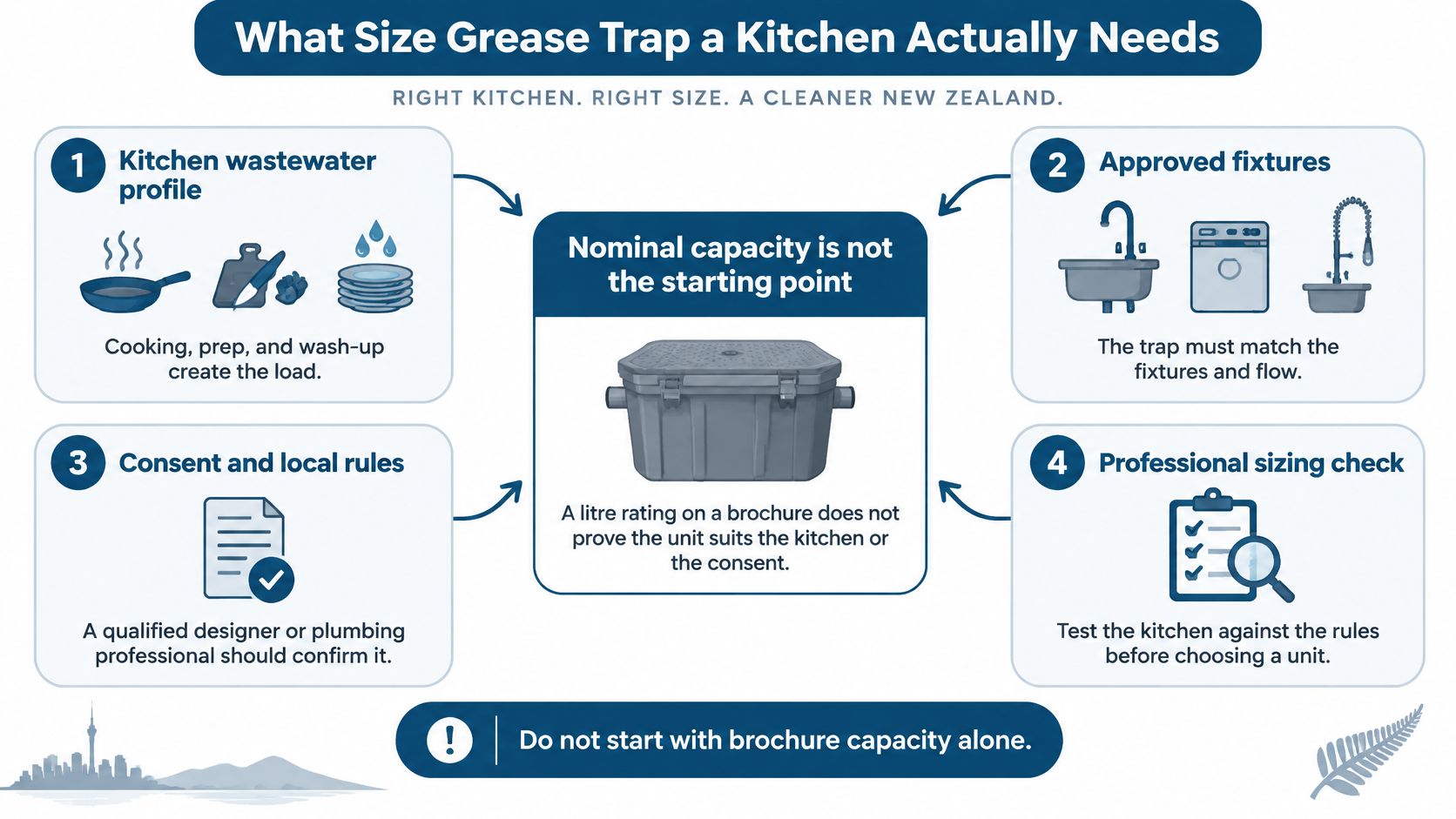
Grease trap capacity needs to match the connected fixtures, wastewater and local sizing method. A brochure's litre rating alone does not establish suitability or show that the unit meets the site's consent conditions.
A qualified designer or plumbing professional needs the fixture schedule, discharge characteristics and applicable local method to recommend equipment. The assessment should account for peak kitchen activity, not just an average trading day.
Local methods produce different answers
Tauranga's grease trap decision flowchart specifies capacity of at least twice the capacity of connected sanitary fixtures and appliances, with an absolute minimum of 100 litres, and a restaurant and café allowance of at least 5 litres per person based on seating, subject to the larger applicable calculation. The guidance also uses a minimum wastewater retention time of one hour as its sizing basis and sets 500 litres as the minimum for passive traps or equivalent systems, with exceptions requiring written council approval.
These figures belong to Tauranga's method, not a nationwide formula. Council positions also differ in their expectations for system type: Christchurch recommends a passive outdoor arrangement, Timaru requires agreement with its Trade Waste Unit, and Clutha has more demanding expectations for passive traps. Confirm the applicable specification with the relevant authority before settling capacity.
Grease trap sizing considerations
| Sizing consideration | Why it matters | Who should confirm it |
|---|---|---|
| Connected fixtures | Each sink and appliance contributes wastewater the system must accept | Licensed plumber or designer |
| Dishwasher discharge | Temperature, detergent and dispersed fat affect treatment suitability | Plumber and trade waste officer |
| Peak flow | Concentrated wash-up can be more demanding than average operation | Designer using the local method |
| Grease loading and hours | Heavy cooking and extended operation affect accumulation | Operator for activities; council for acceptance |
| Space and cleaning access | Servicing requires more room than the tank footprint alone | Designer, landlord and waste contractor |
| Local specification or written exemption | An alternative arrangement needs explicit acceptance | Wastewater network operator |
A small under-bench interceptor and a larger passive separation system collect grease in different ways and are not interchangeable. Mechanical separators and grease converters also need assessment against their operating characteristics and the local requirements.
For equipment described as Mactrap, check the exact model documentation and its acceptance for the site. A brand name alone does not establish approved capacity, connection suitability or exemption from a passive-trap requirement.
Limited tenancy space calls for an approved alternative, not just a unit that fits.
Sink choice is part of the design discussion. Settle bowl capacity and intended use alongside the drainage assessment, and review stainless steel sink considerations before fabrication or ordering.
Installation Decisions Before the Fit-Out
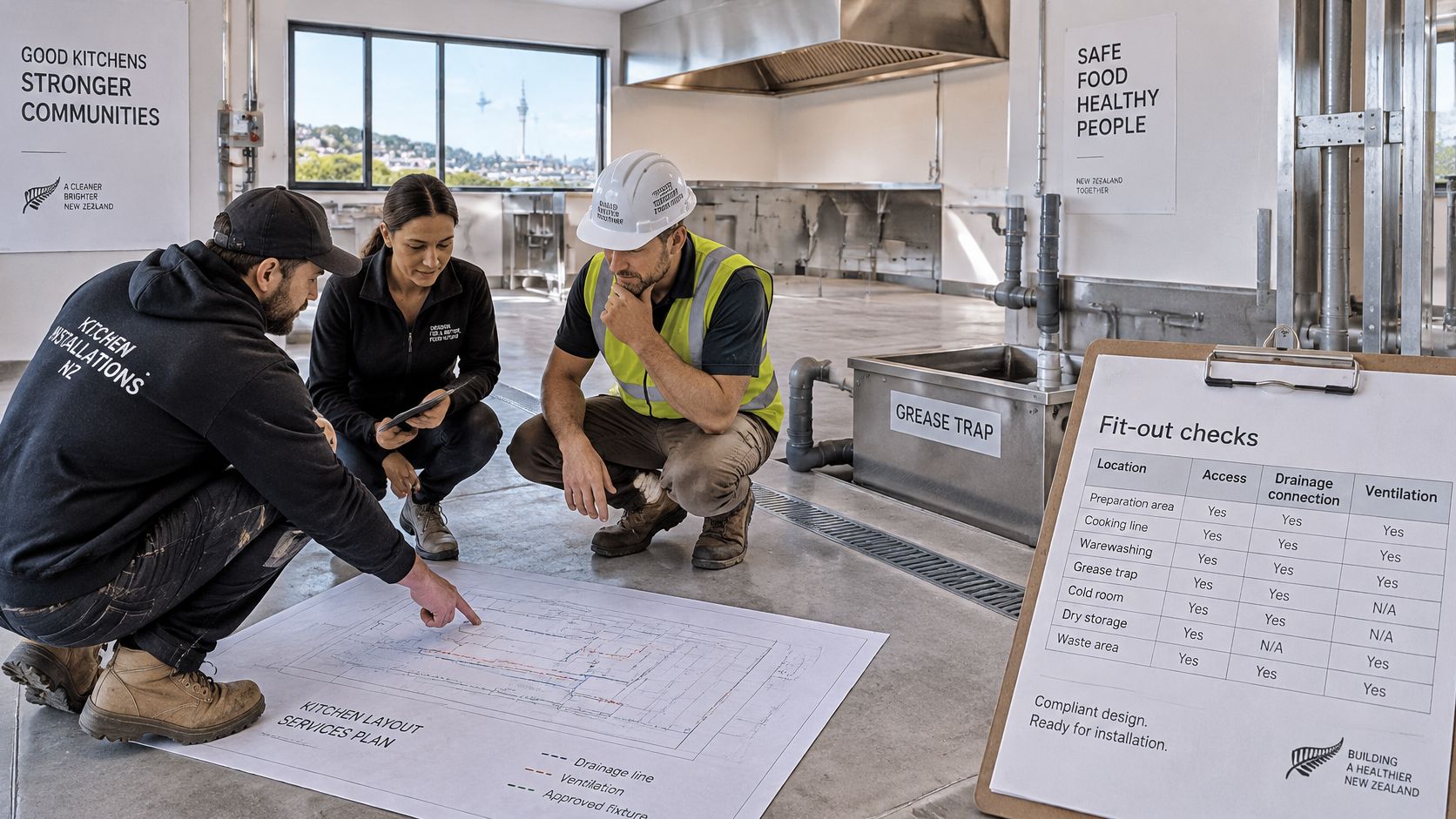
Plan the grease trap before benches, cabinetry and fixed appliances lock in the kitchen layout. A tank that fits the available space still needs to be opened, inspected and serviced safely.
The installation drawing should show approved connections, location, ventilation requirements, access clearances and the service route. Read manufacturer instructions together with council conditions.
Indoor and external locations involve different compromises
- Under-sink installations: Check lid removal, working room and pipe access. The system should be serviceable without dismantling the bench.
- Other indoor locations: Consider odour control, safe isolation during maintenance and separation from food handling work.
- External installations: Allow for pipe routes, ground conditions, landlord approval and a workable pump-out route.
- Underground installations: Set the access-cover position and surrounding surface design before construction begins.
The designer needs to assess the proposed system against the site and relevant requirements. Clutha District Council's grease trap information leaflet says building-consent drawings should show the trap's location, type, size and downstream sampling point. Its guidance generally calls for passive traps with at least two chambers and not less than 1,000 litres unless specific written approval is granted. Requirements and evidence may differ between districts.
Coordinate the services before fixing the layout
A practical drawing should identify the fixtures feeding the system, as well as the room contractors need to work safely. The approved connection design should also exclude unsuitable discharges. Staff behaviour cannot correct an unsuitable plumbing arrangement.
For a new commercial kitchen or major renovation, SACH Design can support early coordination of equipment layouts and plumbing needs through Hospitality's kitchen design service. Layout planning does not issue a consent or replace the responsible plumbing designer.
Fixed appliances should be installed and commissioned by qualified trades. Before ordering cabinetry, check final electrical or gas supply, cut-outs, ventilation and clearances against the model documentation.
Trace the maintenance route on the drawing before the layout is fixed: access to the premises, the trap lid and the route for removing waste. Hospitality does not provide plumbing installation, trade waste certification or regulatory approval.
Cleaning, Records and Costly Grease Trap Mistakes
Grease and solids build up in a trap, reducing the volume available for separation and increasing the risk of poor discharge performance. Maintenance frequency depends on the system, its use and the consent conditions.
Westland District Council's trade waste guidance says cleaning every one to three months is often acceptable. Larger or heavily used kitchens may need more frequent servicing. Treat that interval as local guidance, not a nationwide schedule.
Separate operator checks from professional servicing
Staff checks can flag problems early without asking kitchen workers to handle liquid waste. Set a clear process for reporting odours, slow drainage, leaks and alarms where fitted.
A practical routine covers:
- Access: Keep covers and service routes clear of stock, bins and movable equipment.
- Condition: Report damaged lids, seals, visible leaks and unusual discharge behaviour.
- Operations: Note menu, production or washing changes that could increase loading.
- Records: Confirm scheduled servicing took place and the supporting documents arrived.
Professional pump-out and servicing should follow the system requirements and consent conditions. Agree with the contractor what material will be removed, what service work will be completed and how waste disposal will be handled.
Where required by the council, the contractor should be certified under the WasteMINZ Liquid and Hazardous Wastes Code. Confirm this before arranging the service. Keep records of inspections, pump-outs, disposal, defects and corrective actions. A receipt confirms attendance; the service record should also show what work was done and any problem identified.
Cleaning products and grease removal
Collected grease and cleaning waste must not be tipped back into drains. Collect bulk cooking oil separately, scrape food residues before washing, and explain disposal arrangements to every shift. Cleaning products and additives may suit some systems, but they do not replace physical grease removal or establish that a trap has adequate working volume or meets its discharge requirements.
Bio-Zyme Industrial Deodoriser and Degreaser, 5 litre two-pack is a product option. Check its suitability against the system requirements and authority conditions before use.
A kitchen sanitation checklist from Facility Management Insights can help organise general cleaning tasks. For grease-system maintenance, use grease trap cleaning guidance alongside the contractor's system-specific instructions and local consent conditions.
Maintenance priority: Book service around production and safe contractor access, not only around the cheapest available appointment.
Mistakes that turn into rework
Costly problems often start when the approved arrangement no longer matches how the kitchen operates.
- Buying before checking: A compact unit may not meet the authority's requirements, leaving equipment that cannot be used as intended.
- Undersizing the system: Peak wash-up or the actual fixture load can exceed what the tank can handle.
- Connecting unsuitable fixtures: Extra equipment added during a refurbishment can change the accepted discharge arrangement.
- Missing approvals: Completing an installation does not settle building or trade waste requirements.
- Blocking service access: Benches, stock or structures over the working area can disrupt routine maintenance.
- Losing records: Missing inspection and disposal documents leave less evidence of the maintenance completed.
- Waiting for a blockage: Accumulated grease can cause odours, slow drainage and interruption during service.
- Copying another council's arrangement: Equipment or service routines accepted in one district are not approval for another site.
- Assuming converter equivalence: A grease converter is not automatically an approved replacement for a passive trap or mechanical separator.
The consequences can include blockages, service interruptions, replacement work and regulatory action if consent conditions are breached. Rectification can cost more when it involves reopening floors or moving fixed benches.
Keep appliance grease management distinct
A Roband extended grease channel for an 8 slice grill station manages grease at that appliance. It does not replace a trade waste interceptor or determine how wastewater from sinks and dishwashing is treated.
A SKOPE Open Deck Display Fridge - Black - OD460N presents chilled products. Include its cleaning in the venue's equipment hygiene programme, and have a plumbing professional determine the approved route for associated cleaning wastewater.
Keep appliance cleaning, grease collection and drainage servicing as distinct tasks. Otherwise, pump-outs and disposal records can be overlooked during routine clean-down.
How to Confirm the Rules Before You Buy
Before buying a trap, confirm the requirements for the site's actual wastewater discharge. An existing unit or consent may not cover a new menu, higher production or a relocated wash-up area.
Clutha District Council's trade waste guidance explains that food premises need consent before discharge. New or modified traps may also require building consent, and application fees can apply. The guidance distinguishes passive traps, grease converters and mechanical grease separators as different treatment approaches.
A practical approval sequence
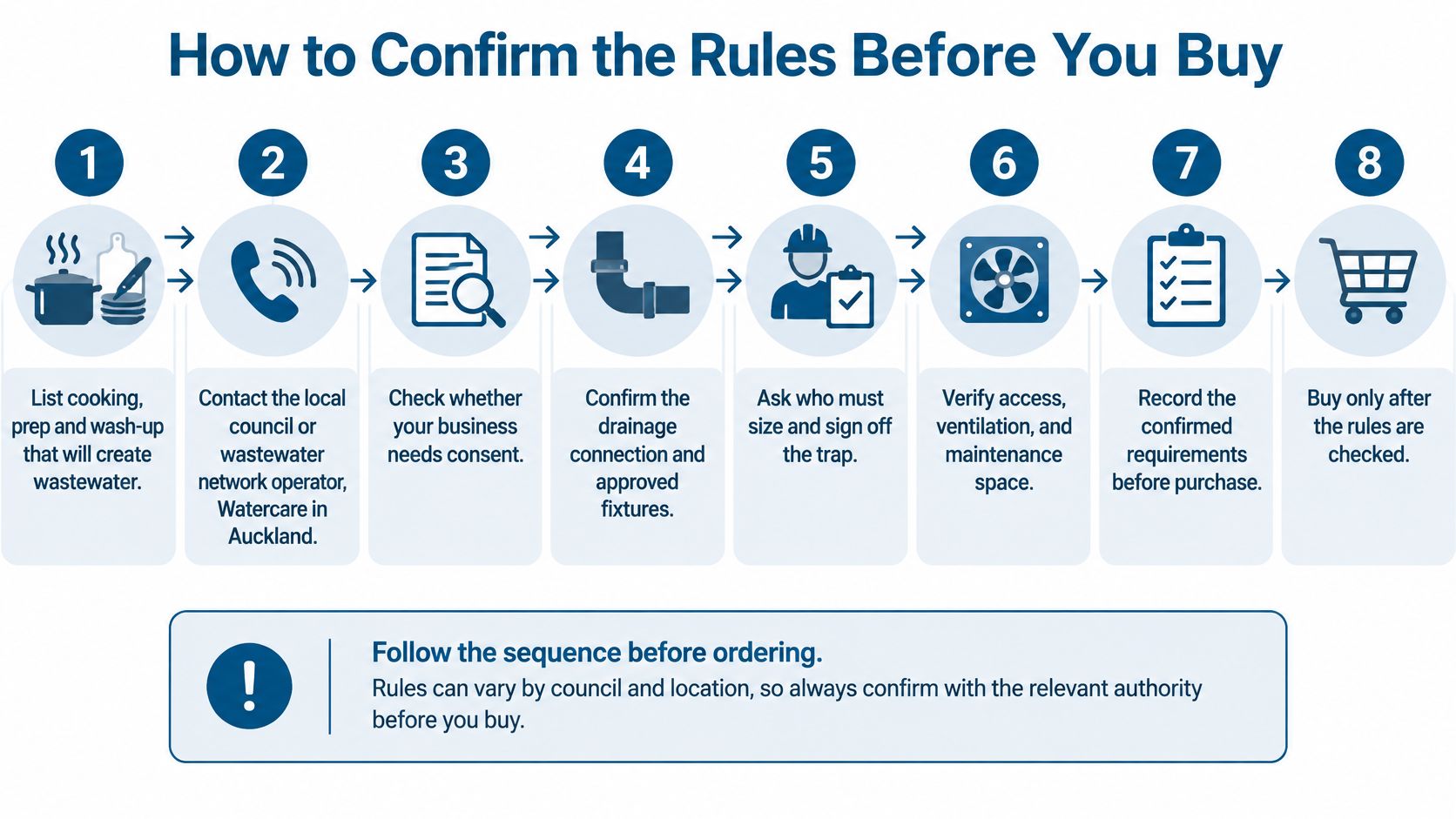
- List wastewater-producing activities. Include cooking, preparation, pot washing, dishwashing and wash-down, and describe how the kitchen will operate.
- Contact the responsible authority. Ask the local council or wastewater network operator who handles the address. For an Auckland connection, check whether Watercare is responsible.
- Confirm trade waste requirements. Ask the authority for its application process, discharge conditions and current fee schedule.
- Review existing drainage. Get available drawings and clarify shared systems, access rights and maintenance responsibilities with the landlord.
- Engage qualified professionals. Use an appropriately licensed plumber, drainlayer or suitably qualified designer for the work involved.
- Settle equipment type and capacity. Get a technical assessment and written acceptance if proposing an alternative treatment arrangement.
- Resolve approvals before installation. Confirm installation permissions and any building consent. Obtain operational trade waste approval before discharge begins.
- Set maintenance and record responsibilities. Agree who will arrange inspections and servicing, keep disposal documentation and organise corrective work.
Grease trap checks before you buy
| Question | Who to ask | Why it matters |
|---|---|---|
| Is a trap required for this discharge? | Council or wastewater operator | The venue category alone doesn't decide it |
| Is there a current trade waste consent? | Responsible authority and landlord | A change in operation may require reassessment |
| Does the work need building consent? | Building consent authority | Discharge permission doesn't approve building work |
| What size and type will be accepted? | Trade waste officer and qualified designer or licensed plumber | Brochure capacity doesn't establish suitability |
| Can it be installed and pumped out here? | Plumber, landlord and liquid-waste contractor | Servicing needs a workable physical route |
| What records must be kept? | Authority administering the consent | The team needs a clear documentation process |
Keep the accepted equipment proposal, approved fixture arrangement, installation requirements and servicing responsibilities together in the purchasing file. Written confirmation matters when space constraints or an alternative treatment method need special consideration.
Hospitality is New Zealand owned and operated and can help select equipment around the accepted kitchen plan. Its Services menu includes an online Trade Account Application and a Service Request form. Neither is an application for drainage approval.
Trap installation, pump-outs, system certification and trade waste approval remain the responsibility of the relevant trades, contractors and authorities.
Hospitality offers commercial kitchen equipment, sinks, benches and fit-out advice to support an approved drainage plan. Visit Simply Hospitality with the proposed equipment schedule, kitchen layout and confirmed wastewater requirements to get help selecting equipment that fits the business and its servicing needs.