

Choosing the Right Insulated Bag for Food Delivery
Buying the thickest bag isn't a reliable way to protect a delivery order. An insulated bag for food delivery is a passive thermal carrier that slows heat transfer between packaged food and its surroundings. The right choice fits the containers, supports safe temperature control and survives the loading, carrying and cleaning that commercial delivery demands. Operators should judge the complete transport process, not a promise that a bag keeps food warm.
What an Insulated Food Delivery Bag Actually Does
An insulated delivery bag provides a thermal barrier around packaged food. Its insulated walls, lining and closure reduce heat exchange with the surrounding environment, while its shape helps organise and protect the load.
It doesn't generate heat or refrigeration. Passive insulation slows temperature change; actively heated carriers and refrigerated transport equipment supply temperature control through powered equipment. Neither approach removes the need for correct loading and monitoring.
Match the design to the delivery work
Restaurant takeaway, pizza, catering trays and chilled groceries present different handling problems. An operator arranging Uber Eats or DoorDash collections needs a carrier compatible with the order packaging, while a caterer needs equipment that accommodates trays without forcing lids against the closure.
Meal delivery services may need separate hot and chilled loads. Bicycle, motorcycle and scooter couriers also need a carrying arrangement that remains stable during travel.
| Bag type | Best application | Main advantages | Limitations |
|---|---|---|---|
| Standard insulated delivery bag | Packaged restaurant and café takeaway | Straightforward loading and flexible order combinations | May lack the footprint or support needed for trays |
| Pizza delivery bag | Pizza boxes carried horizontally | Shape suits flat boxes and horizontal stacking | Poor fit for tall containers, drinks or mixed groceries |
| Insulated backpack | Bicycle, motorcycle and scooter deliveries | Hands-free carrying | Loaded weight, balance and container orientation need checking |
| Large catering delivery bag | Bulk orders and catering trays | Accommodates larger packaging formats | Can become awkward to lift when full |
| Insulated cooler bag | Appropriate chilled-food applications | Can accommodate cold packs alongside food | Cold-pack space reduces usable food capacity |
| Rigid insulated food carrier | Catering and organised meal transport | Structural protection and defined loading space | Requires more storage space and may be heavier |
A takeaway bag shouldn't be stretched into a catering carrier because a tray can squeeze through its opening. The lid must clear the opening, the tray must sit level and the closure must fasten without pressure on the food.
Likewise, pizza boxes need a suitable internal footprint. Tilting boxes to fit a narrow carrier defeats the purpose of selecting packaging intended for horizontal transport.
Treat the benefits as operating objectives
The intended benefits are temperature protection, container protection and controlled handling. They aren't automatic results of owning an insulated bag.
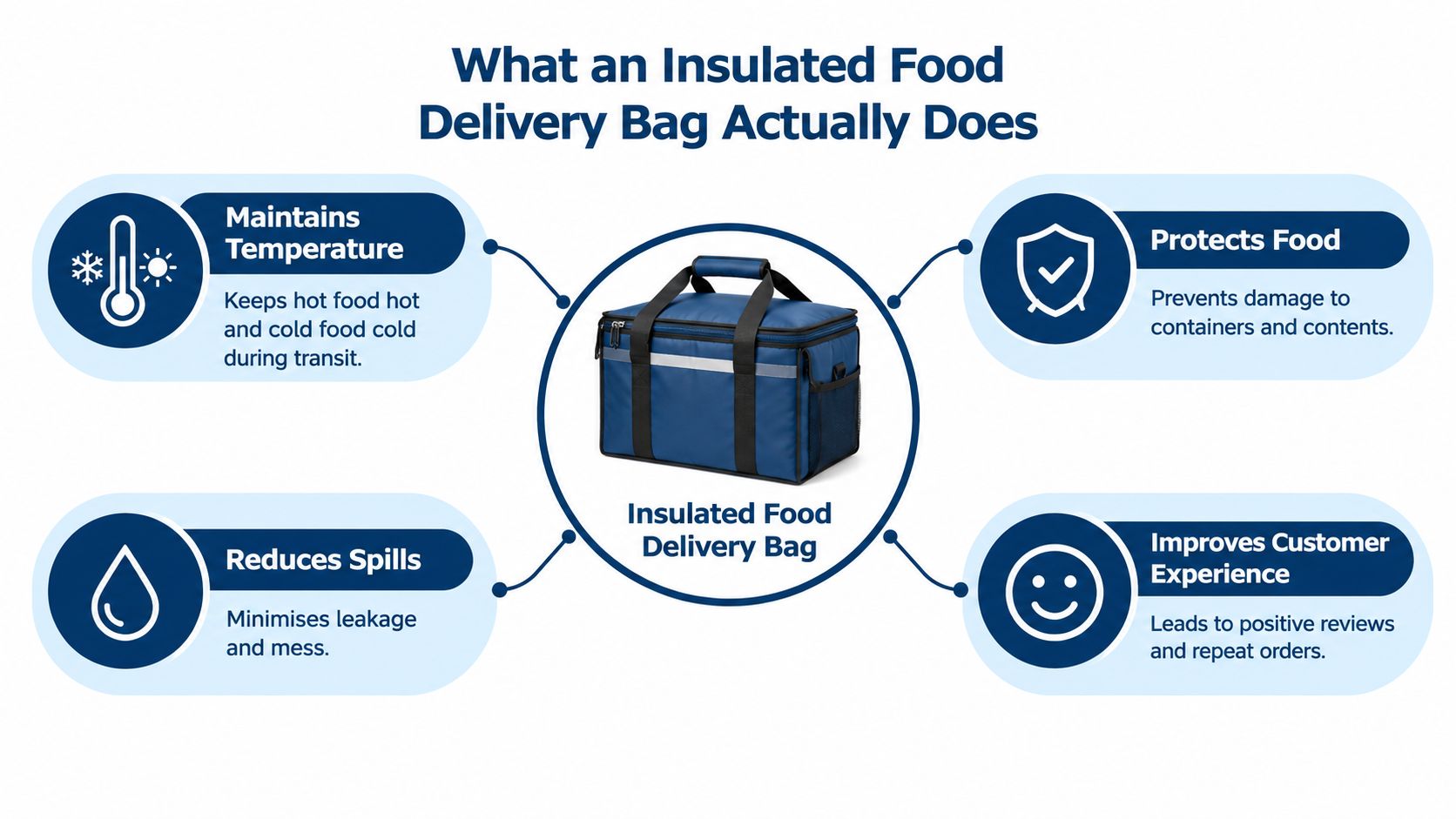
The graphic summarises intended outcomes, not guaranteed performance. A suitable bag still needs compatible packaging, secure loading and a delivery process that has been tested.
Purchasing rule: Choose the carrier around the food, packaging and journey. Don't choose the food arrangement around whichever bag happens to be available.
For mixed operations, separate carrier types may be more practical than an oversized general-purpose bag. A restaurant delivering pizzas and chilled desserts should assess those loads separately rather than expect a shared compartment to resolve incompatible requirements.
Choosing the Right Size and Capacity
Usable internal dimensions matter more than advertised litre capacity. A capacity figure doesn't establish whether a pizza box will lie flat, whether a catering tray will pass through the opening or whether the zip will close above stacked lids.
Operators should measure the actual packaging used during service, including projecting lid rims, folded bag tops and handles. External dimensions remain useful for checking vehicle storage, but they don't reveal the space available for food.
Turn packaging into a bag specification
A practical sizing check should cover the complete loaded arrangement:
- Container footprint: Measure the widest length and width, including the lid.
- Stack height: Measure containers with lids fitted and food loaded, rather than relying on empty nesting dimensions.
- Order grouping: Establish which items travel together and which need separate compartments or carriers.
- Handling clearance: Allow enough room for loading and removal without scraping lids against the lining.
- Transport fit: Check the vehicle opening, storage position and space needed to lift the bag out.
A simple stacked-container calculation
For a hypothetical stack of identical meal containers, the starting calculation is:
Required internal height = loaded container height × containers in the stack, plus handling clearance.
The internal length and width must accommodate the widest container footprint. If orders sit side by side, the required width becomes the combined width of those containers, with clearance for any divider.
This calculation should be checked with a physical stack. Lids may flex under weight, sauces may make containers unstable and cold packs may occupy space that appeared available on paper.
A bag that closes only when the operator pushes down on the food is too small.
An oversized carrier creates a different problem: containers can shift unless the load is properly supported. The right capacity holds the planned order arrangement without crushing it or leaving uncontrolled movement.
Finally, operators should lift the fully loaded trial arrangement. Caterers need to consider stairs and loading benches; couriers need to assess balance and carrying comfort. A bag that fits the vehicle but cannot be handled comfortably isn't a workable specification.
Insulation, Heat Retention and Food Quality
Thermal performance comes from the complete construction and loading arrangement, not insulation thickness alone. Materials, seams, closures and the way containers sit inside the bag all influence the result.
Starting food temperature, ambient conditions, journey duration and opening frequency also matter. A carrier assessed with a substantial load shouldn't automatically be assumed suitable for a lightly filled order.
Assess the complete thermal system
Manufacturer information should identify the intended application and explain any performance testing. A holding-time claim without its starting temperature, load arrangement and test conditions offers little purchasing guidance.
- Insulation construction: Assess the stated material and thickness alongside the rest of the design.
- Closure quality: Check whether corners, zips and flaps close properly around the intended load.
- Loading pattern: Consider container materials, food quantity and unused space.
- Route conditions: Include collection delays, weather exposure and repeated opening during deliveries.
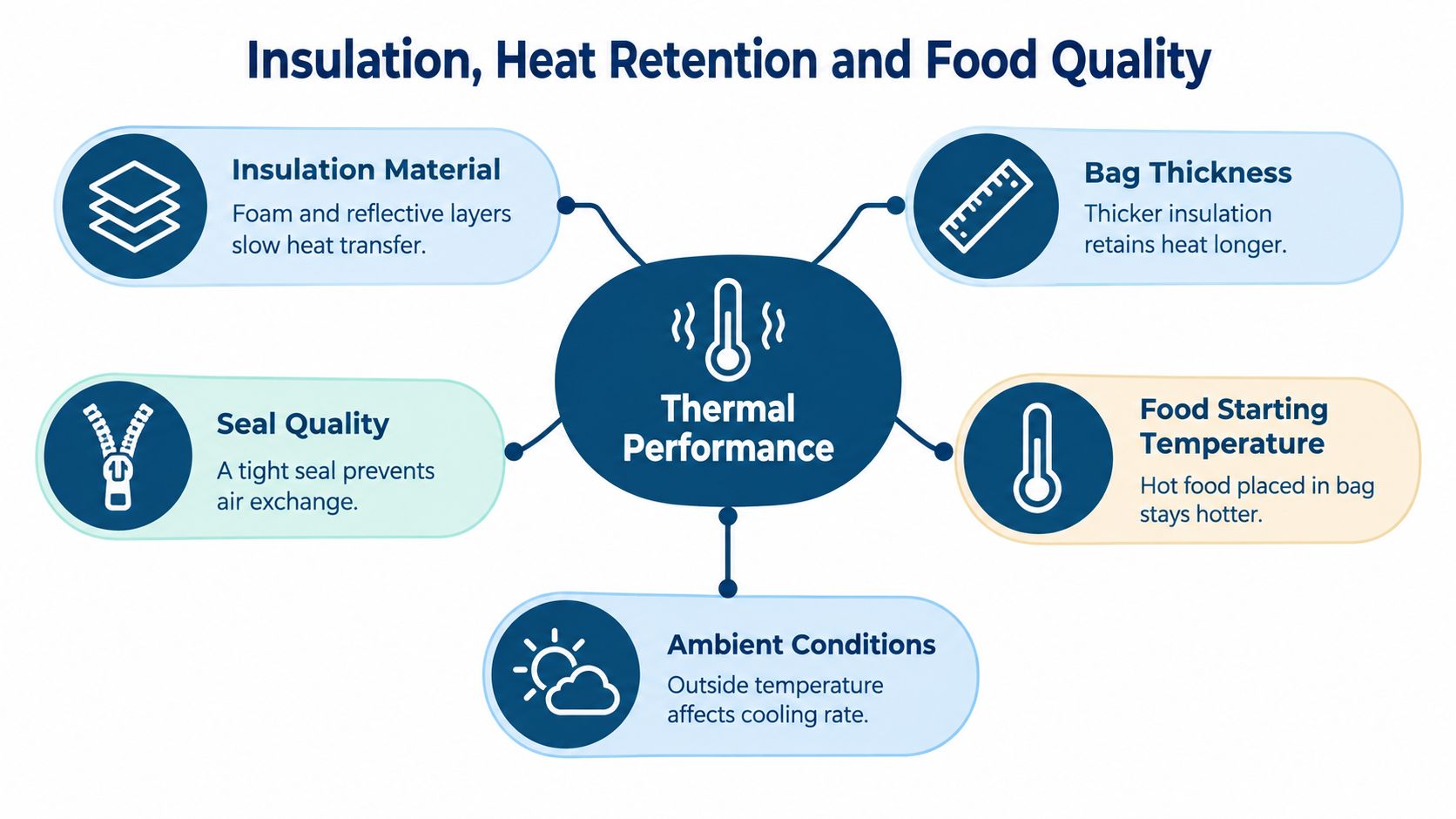
The diagram identifies relevant variables, but it shouldn't be read as a guarantee that thicker insulation always produces a particular result. Construction and actual operating conditions still need assessment.
MPI's transport research illustrates that limit: chilled meat warmed in summer at approximately 0.7°C per 10 minutes in an insulated cooler bag with an ice pack, compared with 1.1°C in a car boot and 2.4°C in an uninsulated car interior, according to MPI's food transport study. Those findings support route-specific validation, not a universal cold-holding promise.
Warm food isn't necessarily good food
Temperature and eating quality need separate checks. Fried food can arrive warm but lose its texture when steam condenses around it.
Operators should match packaging ventilation to the dish while maintaining the required food safety controls. Leaving the delivery bag open isn't a sound substitute for choosing suitable food containers.
The discussion of insulated food containers provides a related equipment perspective. For purchasing decisions, the useful question remains whether the complete container-and-carrier arrangement protects the actual menu during the actual journey.
Food Safety During Delivery
An insulated bag belongs inside a documented time-temperature control system. It isn't evidence that an extended delivery period is safe.
Under the New Zealand food safety framework established by the Food Act 2014, operators need transport procedures suited to their food and business. The Food Regulations 2015 transport requirements require necessary conditions for food safety and suitability to be maintained, with corrective action and relevant records when controls fail.
Set controls before dispatch
MPI guidance specifies chilled potentially hazardous food at or below 5°C, hot food above 60°C and frozen food frozen; food may travel between 5°C and 60°C only when it will be eaten within four hours of entering that range, as set out in MPI's food transport guidance. That window concerns consumption, not just the time spent driving.
The operating procedure should cover:
- Preparation: Pre-condition carriers and suitable cold packs or hot-holding inserts before loading.
- Separation: Keep hot and chilled loads apart, and separate raw food from ready-to-eat products.
- Monitoring: Record food temperatures at dispatch and delivery using a calibrated thermometer or suitable data logger.
- Corrective action: Define when staff must quarantine food and follow the approved reheating or disposal procedure.
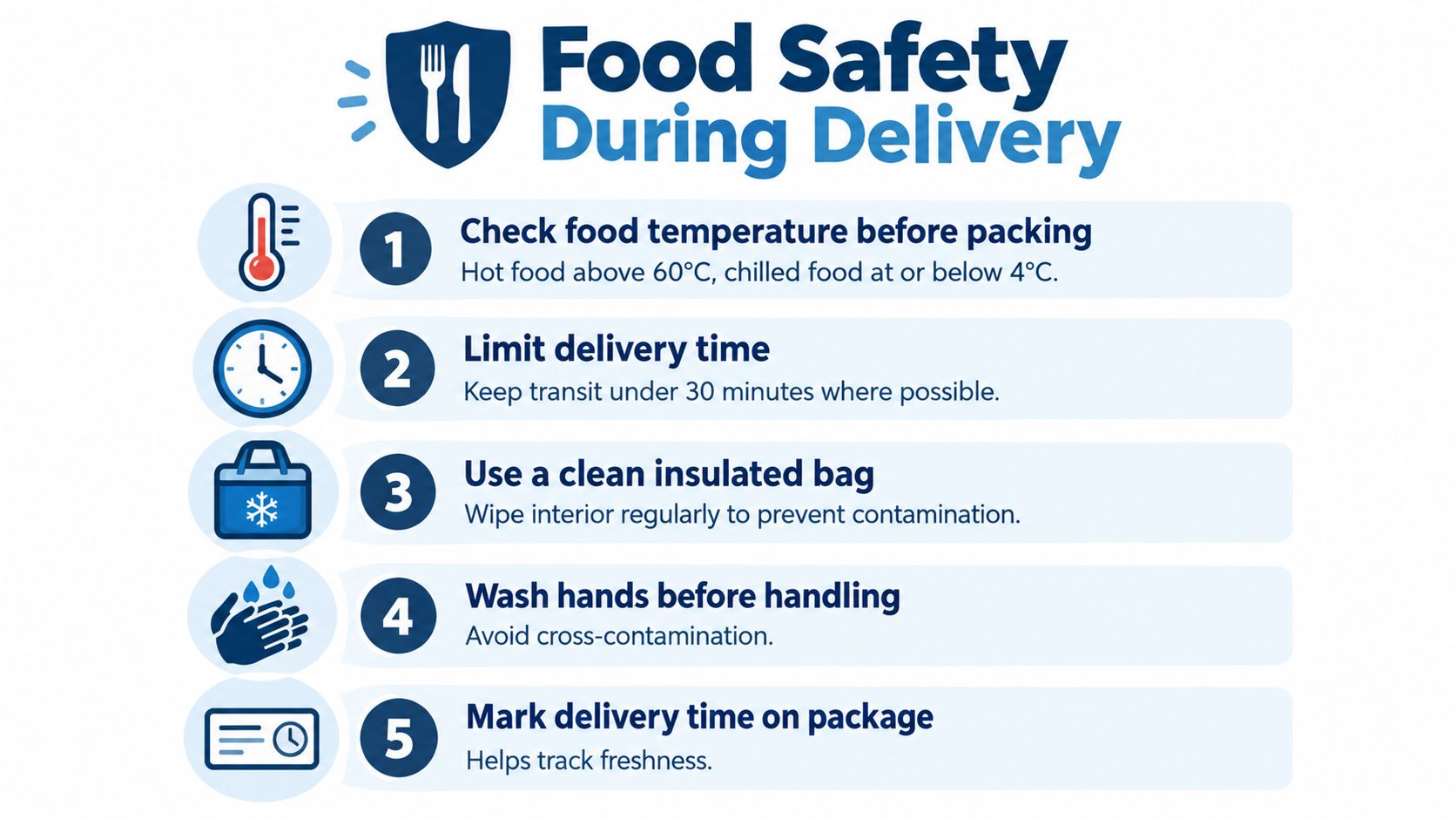
The operating limits stated above take precedence over simplified infographic suggestions. A short delivery target alone doesn't validate safety, and surface wiping alone doesn't establish an adequate cleaning procedure.
Validate the difficult journey
Testing should cover the longest planned route, challenging ambient conditions, realistic opening frequency and different load sizes. Staff should measure the food, not merely the air or exterior of the bag.
MPI also advises covered food in clean, closed containers, separation of raw and cooked food, and a clean carrying area free from chemicals and other contamination sources in its food transport hygiene guidance. Damaged or leaking containers should be rejected before loading.
A delivery limit should come from a documented test, not from the distance a driver believes is manageable.
Long journeys or temperature-sensitive loads may require active equipment. The principles of cold chain management are particularly relevant when chilled deliveries exceed what the validated passive system can support.
Features to Look for in a Commercial Delivery Bag
A delivery bag is a time-temperature control device, and it should be bought like one. Every feature on the checklist below either extends your validated holding window or shortens it. Product photography tells you nothing about whether a bag holds temperature over your longest route or survives a year of commercial loading.
Request manufacturer instructions and test data before comparing prices. Accept claims such as water resistance or heat retention only where the supplier specifies them for that product, then confirm them during your own validation runs against the four-hour MPI window.
A checklist for repeated use
- Insulation: Construction matched to your hot or chilled application, with documented testing where available. This is the feature that determines your validated delivery limit, so demand evidence rather than marketing language.
- Closures: Zips or hook-and-loop systems that seal completely. A closure that gaps or catches packaging leaks heat on every opening.
- Structure: Enough rigidity to protect stacked containers and maintain the sealed air space that passive insulation depends on.
- Cleanability: Accessible corners, manageable seams and manufacturer-approved cleaning methods, since residue buildup becomes a hygiene failure under MPI transport expectations.
- Moisture protection: Clearly stated spill and rain resistance.
- Durability: Stitching, handles and base reinforcement rated for your planned load weight.
- Portability: Handles, straps or backpack arrangements assessed at loaded weight, not empty.
- Accessibility: An opening that lets staff retrieve one order without disturbing the rest, because every unnecessary opening costs temperature.
- Storage: Foldable where space is tight, rigid where load protection takes priority.
Pizza operators should spec the carrier alongside the box. The practical considerations in choosing pizza boxes for NZ takeaway service set the dimensions and stacking behaviour the bag must accommodate, and a mismatch here ruins both.
Buy for the service pattern, not the shelf price
The cheapest bag is not automatically poor value, but price alone is an incomplete comparison. Weigh cleaning labour, repair options, closure lifespan and what a failed zip costs mid-shift. Ask whether your staff can clean and store the carrier properly during a normal service week. A bag that is awkward to maintain gets maintained poorly, and a poorly maintained bag fails validation faster than a cheap one that fits the operation.
Improving Delivery Efficiency and Reducing Packaging Failures
A suitable bag can still produce a poor delivery when the dispatch routine is disorganised. Staff need an agreed loading position, clear order identification and a consistent handover process.
Packing immediately before collection, where practical, avoids unnecessary waiting in the carrier. Drinks should be secured separately from containers they could crush or soak, and food should sit level rather than against a sloping vehicle seat.
Hypothetical example of an avoidable failure
Consider a hypothetical takeaway operation loading loose meal containers and drinks into an oversized bag. During transport, a drink tips, wets a paper package and contaminates the bag interior.
The operator may then need to remake the order, arrange another delivery or issue a refund. The profitability effect is qualitative but straightforward: replacement ingredients, packaging, staff time and another journey consume resources without creating another paid order.
A structured carrier or suitable internal restraint could address movement, but equipment alone wouldn't resolve the whole problem. Staff would also need a drink-securing method and a check that the load is stable before handover.
Build the bag into dispatch
- Identify orders: Keep labels visible without repeatedly opening unrelated packages.
- Plan access: Arrange stops so drivers can retrieve the intended order without disturbing the remaining load.
- Check condition: Inspect closures, linings and handles before service, and remove damaged equipment from use.
- Reset between uses: Clean and sanitise as required by the food safety procedure, then allow appropriate drying.
The broader process can be assessed alongside OrderOut's modern guide to delivery systems. Equipment selection should remain tied to the operator's own packing and handover requirements rather than assumptions about a standard delivery workflow.
For complementary packaging decisions, Packaging Considerations for Delivery Businesses addresses the customer-facing pack.
Before adopting a bag, operators should trial real menu items on representative journeys. Arrival checks should assess food condition, packaging integrity and food temperature separately, with results recorded so staff can distinguish a carrier problem from a container or loading problem.
Buying Insulated Food Delivery Bags in New Zealand
The strongest purchasing specification starts with the menu and ends with a documented operating procedure. Restaurants, cafés, caterers and institutional kitchens should compare equipment against their own delivery conditions rather than a general-purpose description.
A quotation should identify the exact model, usable dimensions, construction, cleaning instructions and intended application. Any manufacturer performance claim should be accompanied by its test conditions.
Buying Checklist for NZ Insulated Delivery Bags
| Consideration | What to check | Why it matters |
|---|---|---|
| Food type | Hot, chilled, frozen, fragile or mixed loads | Determines the required transport arrangement |
| Delivery method | Car, van, bicycle, scooter or hand carrying | Affects stability and handling |
| Internal dimensions | Packaging footprint, stack height and opening | Establishes usable fit |
| Capacity | Planned orders plus inserts and restraints | Prevents misleading volume comparisons |
| Insulation | Construction and documented test conditions | Supports application-specific assessment |
| Durability | Stitching, base, handles and closures | Identifies likely maintenance points |
| Cleaning requirements | Approved method and drying needs | Establishes the practical hygiene workload |
| Portability | Loaded weight and carrying arrangement | Supports manageable handling |
| Storage | Folded or rigid dimensions | Confirms back-of-house suitability |
| Purchase price | Included components and replacement options | Allows a fair equipment comparison |
| Expected frequency of use | Service pattern and turnaround requirements | Helps match construction to workload |
Request confirmed options, not assumed stock
For standard takeaway, the enquiry should cover insulated delivery bags and compatible takeaway containers. Pizza operations should request pizza delivery bags matched to their boxes; caterers should ask about larger food transport equipment and tray compatibility.
Current stock and specifications need direct confirmation. No particular bag design, material, capacity or holding performance should be assumed without product documentation.
Complementary takeaway packaging from Matthews Packaging & Hygiene should also be assessed by its actual product specification. A distributor name doesn't establish that an item is insulated, leak-resistant or suitable for a particular food.
Operators reviewing their wider obligations can consult the overview of New Zealand food safety regulations. The final buying decision should join equipment selection with the business's approved food safety controls, not treat them as separate purchases.
Hospitality equipment suppliers provide hospitality equipment, packaging and consumables, with advice to help operators assess suitable delivery arrangements. Restaurants, cafés and caterers can visit Simply Hospitality and contact the team with their container dimensions, menu, delivery method and route requirements to discuss appropriate options and confirm current availability.