

Is a Commercial Pot Washer Worth the Investment?
For most NZ hospitality venues generating more than around an hour of manual pot-washing time per day, a correctly sized commercial pot washer typically pays back through released labour alone. Smaller operations usually get better returns from fixing their existing warewashing process first.
That's the blunt answer, and it matters because the wrong purchase can tie up cash while the dish area stays just as busy. The right machine, sized for the actual bottleneck, can free kitchen staff, steady turnaround, and take pressure off a part of the operation that often gets ignored until it starts slowing service.
What a Commercial Pot Washer Actually Does
A commercial pot washer is built for the heavy, awkward, heavily soiled items that standard warewashing gear struggles with. Think stockpots, saucepans, frying pans, GN containers, baking trays, mixing bowls, large utensils, and in some kitchens selected production components, provided the chamber and rack layout suit the item.
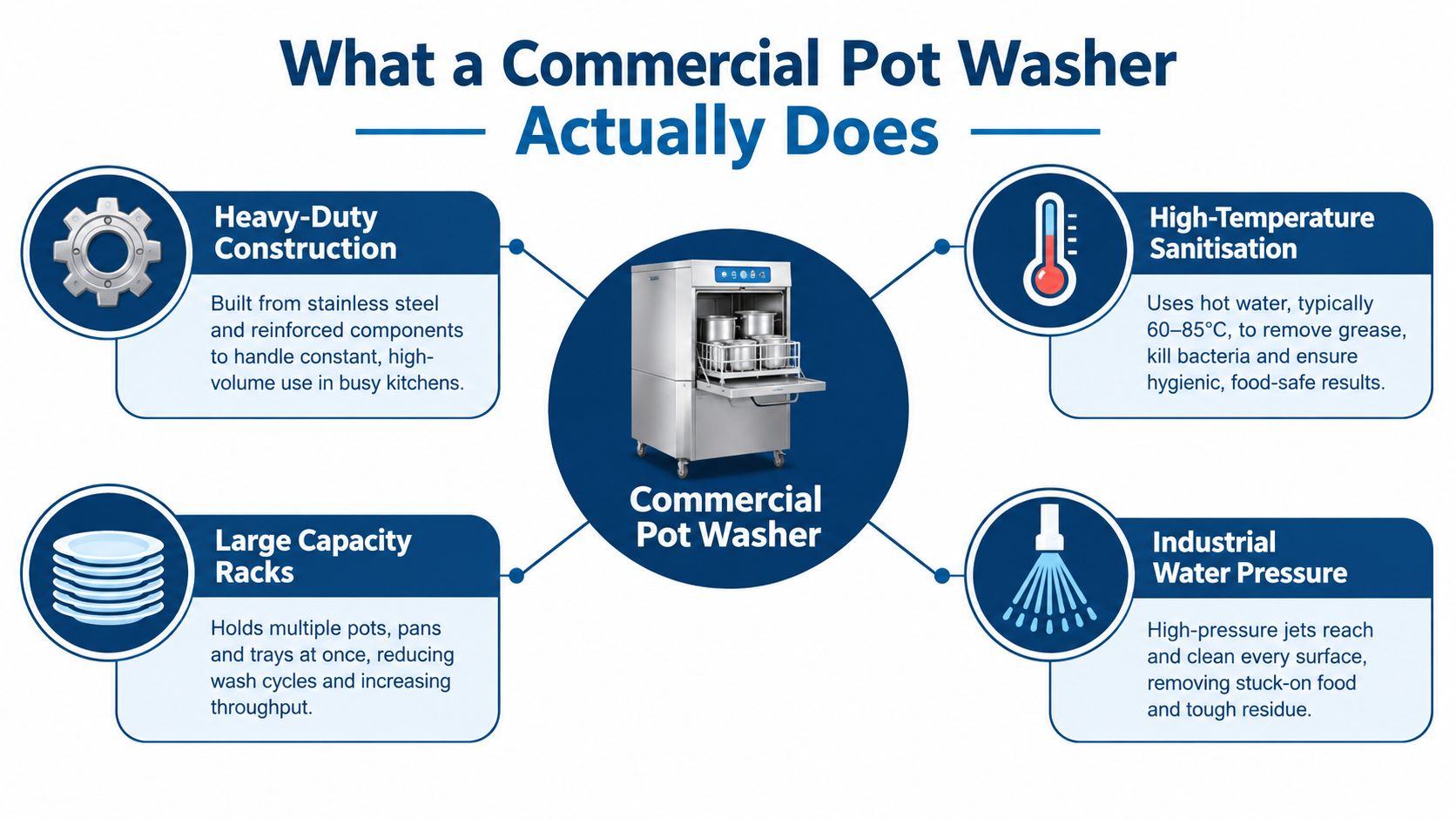
The important bit is that not every pot washer fits every item. Chamber dimensions, rack arrangements, spray coverage, and the manufacturer's approved applications determine whether a tray, pan, or bowl belongs in the machine. A unit that looks large enough on paper can still be the wrong fit once the widest tray or tallest stockpot goes in.
Pot washers are not just bigger dishwashers
A standard undercounter dishwasher is usually aimed at crockery, glassware, cutlery, and lighter kitchenware. A pass-through or hood dishwasher handles more volume and often suits busier kitchens, but it still isn't automatically the right tool for burnt-on cookware or oversized pans. A dedicated pot washer is the specialist option, the one chosen when the load is too heavy, too large, or too dirty for the general-purpose machine to handle efficiently.
That difference matters because capacity is not the same as suitability. A venue can own a commercial dishwasher and still be under-served on cookware if staff are forcing pots, trays, and pans through a machine that was never designed for that job.
Practical rule: if the item is awkward enough that staff avoid washing it until the end of shift, the machine needs to be chosen for that item, not for the dishes beside it.
For operators comparing equipment, it helps to start with the actual load list rather than the machine category. The right reference point is the largest and dirtiest item that regularly goes through the wash area during peak service, not the average plate count. For a broader view on how kitchens decide where the quickest operational gains sit, see this Simply Hospitality article on the kitchen upgrades that usually return value fastest, and if the machine choice needs to be matched to your warewashing setup, this Winterhalter UF-series utensil washer page is a useful place to start.
When a Commercial Pot Washer Earns Its Keep
The businesses that benefit most are the ones where cookware washing is a daily production task, not an occasional clean-up job. That includes high-volume restaurant kitchens, hotels and resorts, bakeries and patisseries, catering and central production kitchens, hospitals and aged-care foodservice, school kitchens, and food preparation or light manufacturing facilities. In those settings, dirty cookware doesn't just need washing, it needs turning around fast enough to keep the line moving.
A small restaurant washing a handful of pans each day usually doesn't need a dedicated machine. It may need a better layout, better scraping habits, a larger conventional dishwasher, or just tighter end-of-shift routines. A pot washer starts to make sense when large or heavily soiled equipment creates a real bottleneck.
The labour cost is the real question
New Zealand hospitality businesses are working in a labour-cost environment where the adult minimum wage rose from NZ$15.75 per hour in 2017 to NZ$22.70 in 2023, then to NZ$23.15 on 1 April 2024, NZ$23.50 on 1 April 2025, and NZ$23.95 on 1 April 2026 (NZ Politics Promise Tracker). That matters because dishwashing often sits with entry-level staff, and those hours are paid whether the pot wash area is efficient or not.
One hour of labour spent washing pots each day over a six-day trading week represents 312 labour hours annually. At NZ$23.50 per hour, that is about NZ$7,332 in direct wages, and at the 2026 rate of NZ$23.95, it becomes about NZ$7,472 before holiday pay, KiwiSaver, training, supervision, recruitment, or sick leave. That is why the business case gets stronger quickly once manual pot washing becomes part of the daily rhythm.
A pot washer is worth a hard look when the wash area is consuming paid time that should be going into prep, service, or turnover.
Operators who are actively filling kitchen roles can see how quickly that labour pressure shows up by watching browse hospitality openings, because the labour squeeze and the warewashing decision usually sit in the same conversation. If the machine is freeing staff from repetitive washing and letting the kitchen stay staffed more intelligently, it earns its place. If it only replaces one kind of washing with another, it probably doesn't.
The Hidden Cost of Manual Pot Washing
The biggest mistake is treating manual pot washing as a detergent-and-water cost. The true cost is staff time, plus the opportunity cost of the person standing at the sink instead of doing work that moves the kitchen forward.
Manual pot washing usually includes scraping and soaking, scrubbing baked-on residue, repeated rinsing, handling heavy cookware, drying and returning items, and cleaning the wash area itself. Each step takes time, and each one pulls an employee away from prep, service, or close-down tasks.
Use labour time, not detergent, as the benchmark
A simple way to think about it is:
Minutes spent pot washing per day × true hourly labour cost × operating days = approximate annual labour cost.
That formula is more honest than comparing purchase price to the cost of soap. It also fits the pressure New Zealand operators face every day. Hospitality labour averaged 40% of operating costs in 2025, the highest level recorded by the Restaurant Association, the sector employed 146,300 people in 2024, and skilled kitchen staff were still in short supply (Restaurant Association 2025 Hospitality Report). Labour pressure is not a theory, it is the background condition.
A pot washer will not remove every labour minute. Staff still need to scrape, load, unload, and put items away. What it does is cut out the repetitive hand-washing block that burns time and energy at the end of the shift. That is the part worth paying for.
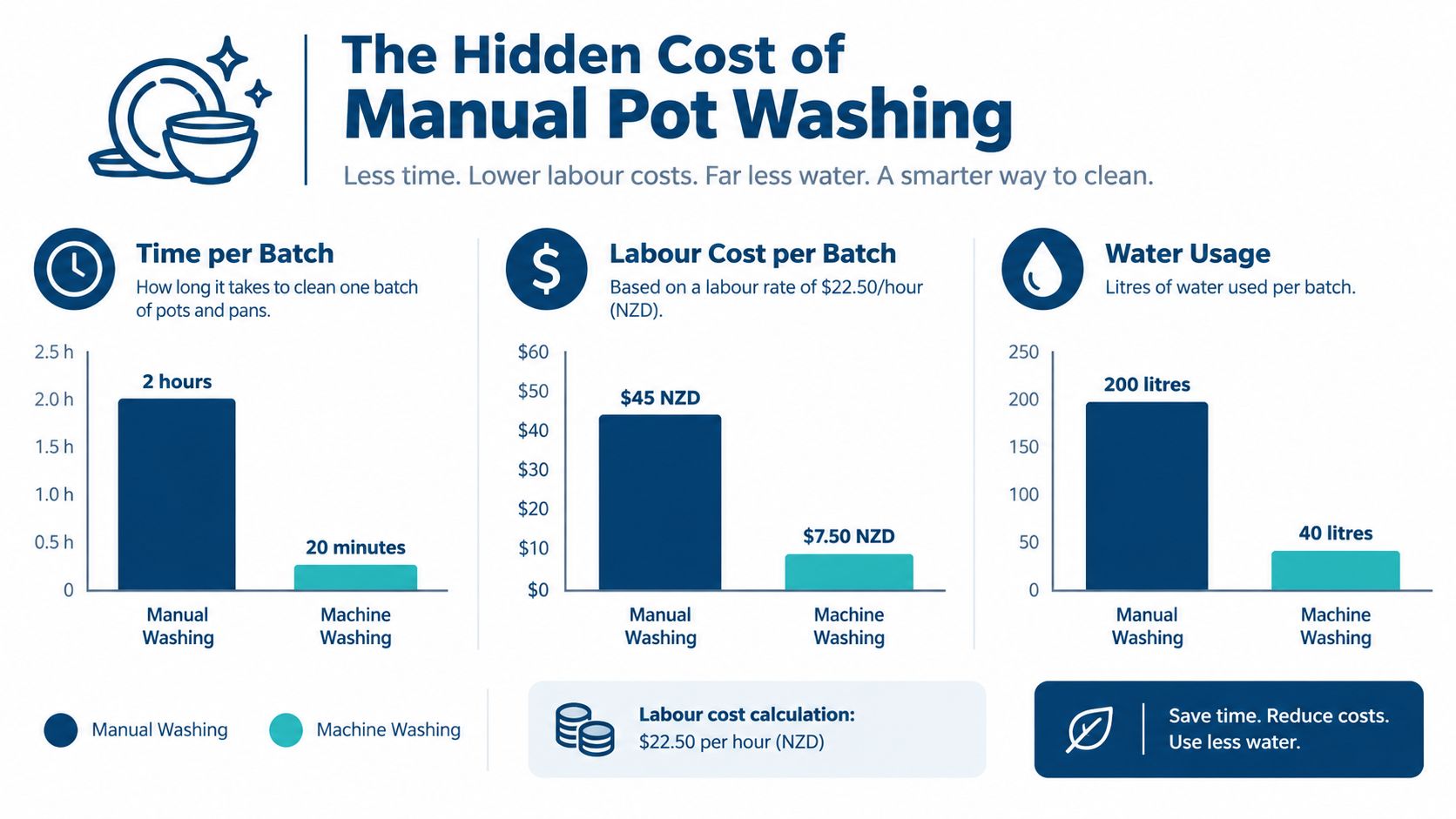
For a useful side-by-side look at manual washing and machine warewashing, read this Simply Hospitality comparison of manual dishwashing and commercial dishwashers. That is the right lens: paid minutes, not just rinsing.
Illustrative Business Example
A kitchen spends 2 hours daily on manual pot washing. After installing an appropriate machine, active staff involvement drops to 45 minutes.
At an illustrative labour cost of NZ$35 per hour:
- Time released: 75 minutes daily
- Labour capacity created: NZ$43.75 daily
- Across 300 operating days: NZ$13,125 annually
Those figures are hypothetical, not guaranteed customer results. They show the shape of the decision, not a promise.
That is the value test. If the machine releases time that would otherwise be paid labour, the saving is tangible. If staffing levels stay the same and the freed time is absorbed elsewhere, the benefit shows up as more capacity, less overtime, or smoother service rather than a direct cash saving.
An Illustrative Payback Calculation
The cleanest way to judge the purchase is to work backwards from the labour block the machine removes, then add the other measurable operating effects. That's a lot more disciplined than starting with the sticker price and hoping the rest works itself out.
A simple payback framework
Use this:
Total installed investment ÷ monthly net operating benefit = approximate payback period.
The net operating benefit should include only what can be defended in the accounts or in the roster:
- Labour capacity released
- Genuine overtime reduction
- Changes in chemical, water, and energy costs
- Maintenance and servicing
- Any other measurable operational effect
A useful comparison is between the machine types themselves. An undercounter dishwasher is usually fine for smaller cookware if the manufacturer approves it and the items physically fit. A pass-through dishwasher handles more volume and suits larger kitchens. A dedicated pot washer becomes the stronger option when the loads are too large, too dirty, or too frequent for the general-purpose setup.
The mistake that skews the maths is counting released time as guaranteed cash saving when the roster never changes.
That's why the payback period needs to be conservative. Labour time released only becomes direct cash back if staffing costs fall. Otherwise, the value might be less overtime, better staff deployment, or fewer production delays. Those are real benefits, but they're not the same as a wage line item disappearing.
A machine decision should also be compared with other kitchen investments, because not every pressure point needs a pot washer. For a practical comparison with adjacent equipment choices, this Simply Hospitality article on choosing between a glasswasher and a dishwasher is a useful reference point. The right call is the one that removes the bottleneck at the lowest whole-of-life cost, not the one with the biggest cabinet.
Pot Washer Versus Standard Commercial Dishwasher
This is the comparison buyers often skip, then regret later. What matters is the match between machine and workload, not status. If the kitchen is buying for appearance, it is usually buying the wrong machine.
| Machine type | Best suited for | Typical chamber size | Soil handling |
|---|---|---|---|
| Undercounter dishwasher | Crockery, glassware, cutlery, smaller cookware | Compact | Light to moderate soil |
| Pass-through dishwasher | Busier kitchens with mixed wares and higher throughput | Larger than undercounter | Moderate soil, better for volume |
| Dedicated pot washer | Large cookware, trays, utensils, heavy production loads | Tall and purpose-built | Heavy soil, awkward items, repeated batches |
A conventional dishwasher can handle smaller pots, GN pans, and utensils if the manufacturer approves the load and the items fit properly. A dedicated pot washer earns its place when the item size, soil level, or wash frequency is beyond what a general-purpose machine can clear without dragging out the cycle or forcing extra handling.
Whole-of-life ownership matters
Purchase price is only the starting point. The machine also needs correct installation, routine servicing, and a site that can support it day after day. Hard-water scale still matters in warewashing, and MPI's cleaning and sanitising guidance keeps the standard clear, cleaning removes dirt, grease, and most bugs, while sanitising kills harmful bugs left on a clean surface (MPI cleaning and sanitising guidance). That is why the machine has to fit the venue's cleaning routine, not sit outside it.
A pot washer still needs the right detergent, staff procedure, and a sensible end-of-shift clean-down. If the team will not clean it properly, the machine will not perform properly.
For buyers weighing whether a general-purpose machine will do the job, this comparison of a glasswasher and a dishwasher is useful context. For sanitation questions, the practical benchmark is sanitation guidance from BacteriaFAQ.com. The point is simple. The biggest machine is not automatically the right one.
Water, Energy and Whole-of-Life Ownership
The purchase only makes sense if the full operating picture works. In New Zealand kitchens, that means water, heating energy, scale control, chemicals, servicing, and a backup plan for faults all have to be part of the decision.
Start with the utility load, not the brochure
Dishwashing sits inside a kitchen that is already heavy on power use, so the central question is how much extra load the machine adds and whether it reduces work elsewhere. A pot washer that cuts rewash, shortens handling, and uses less hot water can pay its way quickly. One that sprays efficiently on day one but wastes heat, fouls up with scale, or needs constant intervention becomes expensive very fast.
EECA's hotel energy guidance makes the wider point clear. Refrigeration accounts for about 22% of sector energy use, and commercial ovens and cooking elements for a further 15%, so any warewashing load has to fit into a crowded energy bill. The same guidance also flags regular removal of lime deposits from dishwasher tanks, heater coils, and spray nozzles as part of keeping equipment efficient. EECA hospitality guidance
Water use matters for the same reason. A New Zealand commercial-dishwashing source reports a machine consumption of about 2.3 litres per cycle and cites annual savings of more than 20,500 US gallons, about 77,600 litres, compared with less efficient washing practices. The exact saving depends on the machine, cycle frequency, pre-rinsing, water temperature, tariffs, and whether you are comparing against hand washing or older equipment. The direction is still obvious. Less water usually means less hot water, and less hot water means lower energy cost. Restaurant NZ energy cost saving tips
Check the food-safety side as well
MPI's cleaning and sanitising distinction still applies. A machine has to leave food-contact items in a condition that fits the venue's food-control process, not just clear visible soil quickly. Where gas supply is interrupted, MPI says items should come out hot, described as too hot to touch, after the rinse cycle when the machine is operating correctly. If the machine cannot heat water enough to sanitise items, the fallback is to remove visible dirt, wash with hot water and detergent, rinse with clean hot water, sanitise with a food-safe sanitiser, complete any required final rinse, and then air-dry or use a single-use drying cloth. MPI gas interruption guidance
That is why whole-of-life ownership is the true test. The venue needs a machine that can handle scale, chemicals, servicing, and fault recovery without turning into a daily problem. For operators dealing with water quality issues, this Simply Hospitality article on reverse osmosis in warewashing is a useful companion read.
Day-one performance is the easy part. The ownership test is whether the machine keeps working cleanly and safely under kitchen pressure.
How to Decide Before You Spend
The right decision starts on the floor, not in the catalogue. A venue should measure the pots, trays, and utensils generated during the busiest 30 to 60 minutes, then compare that load with the machine's rated throughput, loading pattern, and pre-rinse requirements. Peak demand matters more than total daily volume because that is where production gets blocked.
Run the pre-purchase checks properly
The site also needs to be ready for the machine. The practical checklist is straightforward:
- Machine dimensions and loading clearance: Make sure the unit fits the room and can be loaded without awkward lifting.
- Electrical requirements: Confirm supply is adequate for the machine's load.
- Water supply and pressure: Verify potable water and hot-water recovery can keep up.
- Drainage: Check that waste can be handled cleanly.
- Chemical dosing: Confirm the machine's detergent and rinse system can be supported.
- Water treatment: Assess whether the site needs it.
- Ventilation and steam management: Don't trap heat in a tight wash area.
- Dirty and clean landing space: Leave room for flow in and out.
- Maintenance access: Make sure servicing won't disrupt production.
A commercial pot washer is worth the investment when the cost of manual washing, delayed equipment turnaround, and production bottlenecks exceeds the cost of owning and running the machine. For smaller venues, the smarter move is usually to fix the existing process first.
Try the alternatives before committing capital
Many operators get more out of a tighter washing process than they expect. Better scraping and pre-rinsing, correct dishwasher racks, improved wash-area layout, suitable detergents, and more disciplined scheduling can all remove friction before a machine purchase is even on the table. A larger conventional dishwasher can also be enough if the cookware is not too awkward and the soil load is manageable.
The other question is ownership structure. Some venues buy outright, some lease through finance, and some decide the process fix is enough for now. The right answer depends on utilisation, staffing pressure, and how often the wash area is the thing holding the kitchen back.
If the machine is going to remove a real bottleneck, it's worth serious consideration. If not, the current process probably needs a better layout, better discipline, or better training before it needs new steel.
If the numbers still look borderline, Simply Hospitality can help compare pot washers, pass-through dishwashers, and the supporting warewashing setup against your actual kitchen load. Visit Simply Hospitality to review the options and choose the right solution for your venue.