

Kitchen Cooking Utensils: How to Choose Tools That Last
Service is ten minutes away and the only spoon on the pass has to stir the stock, scrape the pan and portion the sauce. The handle is loose, the edge has already marked the coated frypan, and nobody is sure whether that same spoon touched raw chicken. Kitchen cooking utensils are the tools that decide whether a busy line stays consistent, or whether one flimsy item becomes the bottleneck.
The right handheld tool improves control, keeps portions steady, supports food safety and saves the seconds that add up across a service. A large drawer of mismatched gear rarely does that. What works is a small set matched to the menu, the cookware and how often the kitchen uses it.
What Counts as a Kitchen Cooking Utensil
Kitchen cooking utensils are handheld tools used to prepare, cook, handle, serve and portion food. They work the food. They don't hold the heat the way a pot or pan does.
That split is easy to blur on a buying list.
- Cookware is the vessel: frypans, saucepans, stockpots and baking trays.
- Kitchen appliances are powered equipment that sits on the bench or in the line, such as ovens, fryers, combi ovens and mixers.
- Preparation equipment sits between the two. Knives, boards, scales and probe thermometers matter here only where they change which utensil is safe to use beside them.
The everyday categories are short, and each one has a job:
- Spatulas and turners
- Tongs
- Ladles
- Spoons
- Whisks
- Skimmers
- Serving utensils
- Specialist cooking tools, such as pasta servers and glaze brushes
Hospitality businesses often find they don't lack tools. They struggle when one spoon is asked to do three jobs and does none of them well. Matching each tool to its task beats owning a large collection. The reference table below is the practical starting point.
Essential Utensils, Their Jobs and What to Check
The same name can hide very different designs. A flat turner and a curved one, a solid ladle and a slotted one, or a balloon whisk and a flat whisk, each suit different cooking methods. The table below pairs each utensil with its job and the detail worth checking before you buy.
| Utensil | Primary use | What to look for |
|---|---|---|
| Tongs | Turning, lifting and serving food | Locking mechanism, spring tension that stays firm, heat-resistant tips, length suited to the pan |
| Spatulas | Scraping, folding and mixing | Flexible or rigid blade matched to the bowl or pan, one-piece head-to-handle join |
| Turners | Flipping food on cooking surfaces | Thin, angled edge that slides under food, rigid enough for burgers and fish |
| Ladles | Portioning soups, sauces and liquids | Bowl size matched to the portion served, spout for drip-free pouring |
| Whisks | Mixing, emulsifying and aerating | Wire thickness and count, solid handle, balloon shape for aeration and flat shape for sauces |
| Slotted spoons | Lifting food while draining liquid | Slot size that suits the food, deep bowl for batches |
| Skimmers | Removing food or debris from liquids | Fine mesh for stock, long handle for deep pots |
| Serving spoons | Portioning prepared dishes | Bowl size for consistent portions, solid or perforated to suit the dish |
| Pasta servers | Handling cooked pasta | Wide, shallow head, slots or fine holes for draining |
| Kitchen brushes | Applying glazes, sauces and oils | Heat-tolerant silicone or natural bristle that does not shed |
Three checks apply to every row. The handle should stay comfortable through a full shift, not just a quick stir at the bench. The working head should match the vessel it will touch, so a wide turner isn't forced into a small saucepan. The join between head and handle should show no gaps where food can collect, because a trapped residue line is a cleaning failure waiting to happen.
A slotted spoon lifts blanched vegetables out of boiling water and lets the liquid fall away. A skimmer, with finer mesh and a longer handle, clears foam from a deep stockpot without taking half the liquid with it. For portioning, a purpose-shaped ladle such as the Wiltshire Fusion Stainless Steel Soup Ladle keeps the hand clear while the bowl governs the serve.
Knives sit next to these tools rather than inside the utensil drawer. A sound cutting set, covered in this guide to chef knives in New Zealand, reduces the urge to hack at food with a turner or the side of a spoon.
Practical rule: If the kitchen is short of tools, start with tongs, a turner and a ladle. Add specialist pieces only when the menu needs them.
Stainless Steel, Silicone, Wood and Nylon Compared
Material decides how a utensil behaves under heat, how it treats the pan surface and how well it survives the wash-up. Buyers weigh rigidity, surface care, heat behaviour and cleaning demands before they pick a set.
| Material | Advantages | Limitations | Suitable applications |
|---|---|---|---|
| Stainless steel | Durable and rigid for demanding tasks, non-porous surface that is straightforward to clean and sanitise | Conducts heat into the handle, can scratch coated pans, heavier to hold | Stirring, lifting, portioning, sauce work and stock skimming |
| Silicone | Scrapes and folds cleanly, flexible, useful with selected coated cookware | Heat rating varies by product, edges can tear or soften with age | Scraping bowls, folding mixtures, coated pans within the rated temperature |
| Wood | Comfortable grip, kind to many cookware surfaces, knife-friendly | Porous grain needs thorough drying, can crack or hold odours, care set by manufacturer | Stirring and mixing sauces and batters, low-volume tasks |
| Nylon and heat-resistant synthetics | Lightweight, widely available, often heat-tolerant | Ratings differ widely, can melt or warp under high heat, may stain | Light stirring and serving at lower temperatures |
Stainless steel stays rigid under a heavy sauce or a full ladle of soup. Its non-porous surface washes clean and sanitises easily, which matters where the same tool moves between tasks through a shift. The trade-offs are real: it carries heat back into the handle, and a hard edge can mark a coated pan. Grade and weight also vary between pieces, so feel the balance before buying a set for all-day use.
Silicone scrapes bowls and folds mixtures without a sharp metal edge. It is useful with selected coated cookware, but only inside that product's own temperature rating. Edges can tear or turn sticky with age, so a cheap blade that looks fine on day one may not last a season of service. Check the rating stamped on the tool, then treat a torn edge as a replacement trigger rather than something to work around.
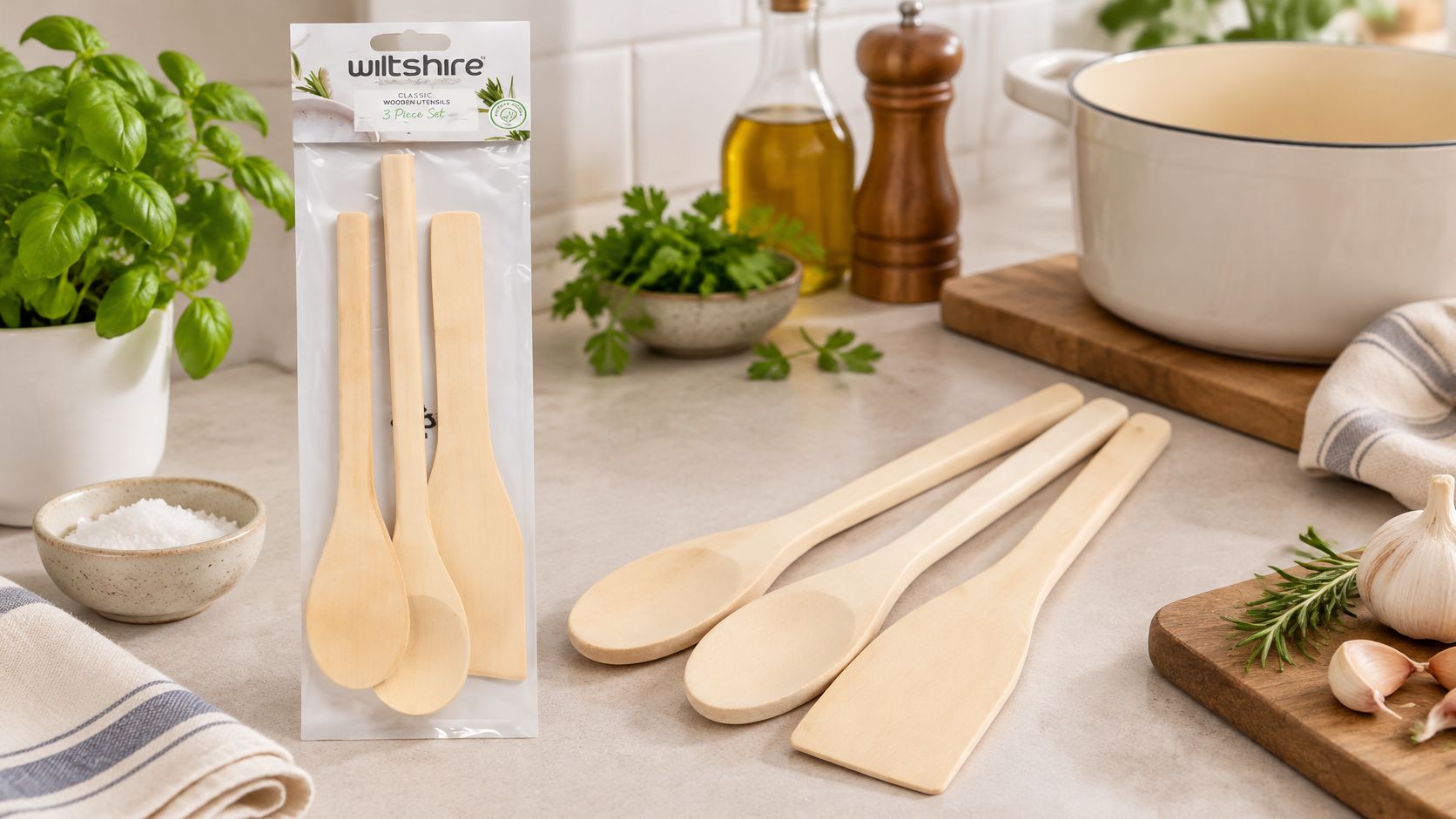
Wood is comfortable in the hand and kinder to many cookware surfaces. It suits sauces and batters, then needs thorough drying and whatever care the maker specifies, because a damp, scored grain can hold food residue and odours. Shape still matters. The Wiltshire Classic Utensils Wood Set 3 uses natural timber and defined heads so pan contact and portion stay controlled, rather than one round spoon doing every job. Care for timber tools is covered in more detail in this piece on wooden utensils.
Nylon and other heat-resistant synthetics are light and common. Ratings differ widely. Some warp or melt if they sit against a very hot pan, and stained nylon is hard to bring back, so keep these tools for lower-temperature stirring and serving.
Labels are not a buying decision
Judge a label by what it certifies and how the product performs. A non-stick or "PFAS-free" claim says little on its own about durability, task suitability or survival through a commercial wash-up. Cookware Industry New Zealand notes that PFAS can enter the country in imported products, including non-stick cookware, and that newer compounds may sit outside enforceable limits. Certification schemes for PFAS-free claims generally look for tested limits on fluorine content, disclosure that PFAS additives and post-consumer recycled material are absent, and controls against cross-contamination in manufacturing.
Ask what the utensil is made of, how its surface holds up under heat and abrasion, whether food-contact documentation covers that specific product, and how often it will need replacing. Then choose the material that fits the task.
Matching Utensils to Each Cooking Method
Utensil choice follows the equipment and the food. A generic "chef's set" answers neither, which is why so many of its pieces end up at the back of a drawer.
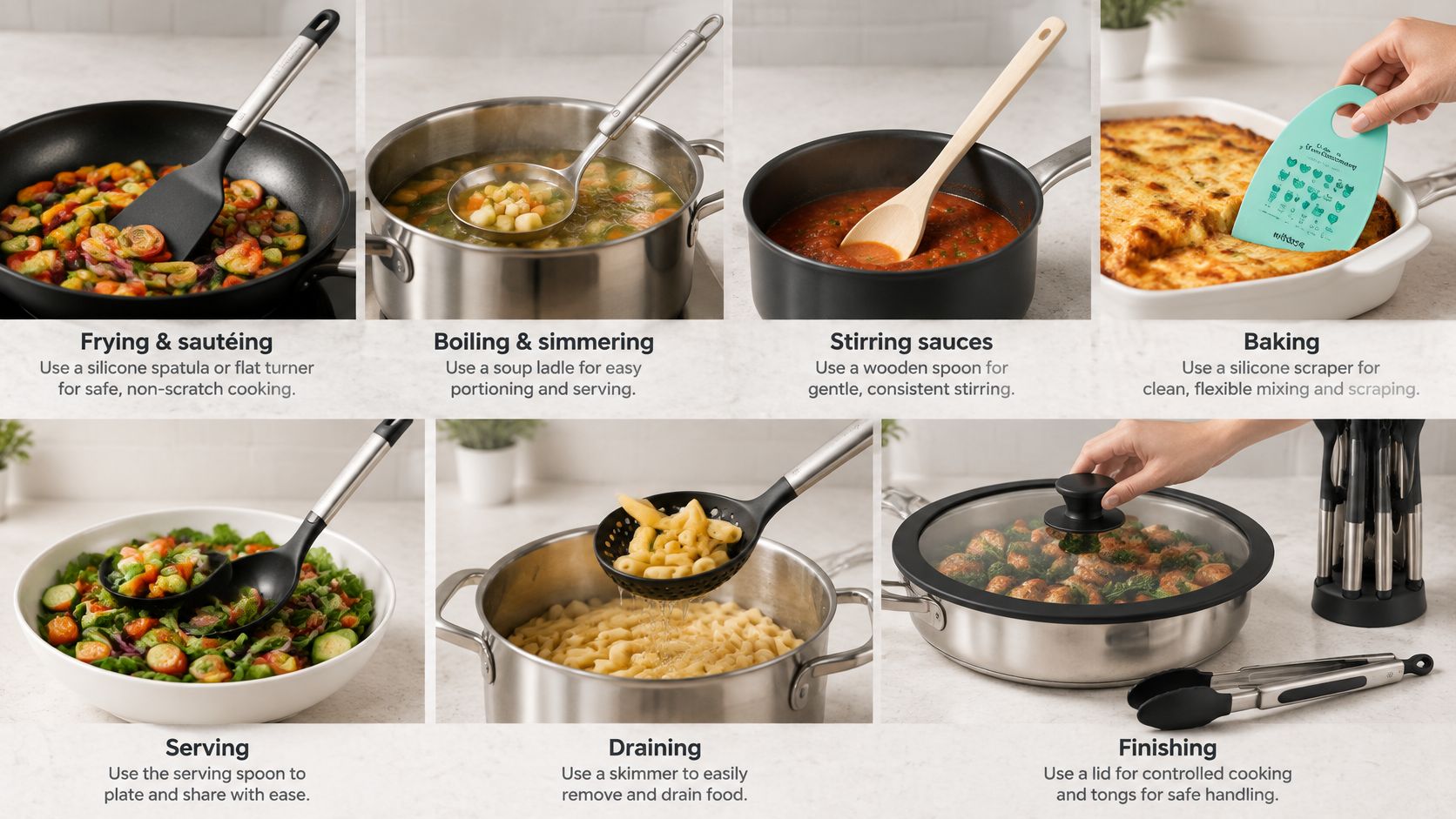
| Cooking method | Utensil combination | Why it suits the task |
|---|---|---|
| Frying and sautéing | Silicone or stainless spatula and flat turner | Moves food across the pan; silicone suits coated surfaces within rated limits |
| Grilling | Long locking tongs and oil brush | Keeps hands back from the heat |
| Boiling and blanching | Skimmer and slotted spoon | Removes food quickly and drains it |
| Baking | Silicone spatula and pastry brush | Scrapes bowls cleanly and applies glazes evenly |
| Sauce preparation | Whisk and ladle | Emulsifies sauces and portions them consistently |
| Stir-frying | Long-handled spatula or slotted spoon | Moves food in a deep, hot pan |
| Plating and serving | Tongs and serving spoons sized to the portion | Gives consistent portions and clean presentation |
Long handles keep hands clear of stockpots, deep fryers and a roaring grill. Shorter tools give better control for delicate fish or pastry. A rigid turner that flips a burger cleanly can tear a soft fillet, while a flexible scraper that empties a bowl can fold under a heavy stir-fry. Match the stiffness of the tool to the load it has to carry.
The same tool also behaves differently on different cookware. Silicone that glides on a coated pan can feel draggy on bare steel. Stainless that works well in a stockpot can score a non-stick surface, so the pan sets the utensil choice as much as the food does. For bowl and bake work, blade width and flexibility decide the fit. A flexible option such as the Wiltshire Silicone Scraper Blue - 2 Pack is shaped for turning, lifting, spreading and scraping, so it covers batter, sauces and spreads without changing tool mid-task.
Judge doneness by temperature
Colour alone is an unreliable guide for meat. Ministry for Primary Industries guidance sets three validated combinations: 75°C for 30 seconds, 70°C for 3 minutes, or 65°C for 15 minutes. The probe goes into the centre of the thickest part, where heating is slowest, and it needs cleaning and sanitising between uses so cooked food never meets a probe that just read raw meat. Tongs and turners should move that food without piercing it, since each puncture releases juices and makes the surface harder to read.
Where a food-control plan applies, the kitchen should confirm the chosen temperature and time combination holds up under real service conditions before relying on it daily.
Domestic and Commercial Utensils and How to Choose
A turner that flips eggs at a weekend brunch is doing a different job from one that works a flat-top for six hours. The domestic piece can be lighter, softer sprung and cheaper because it gets rested between uses. The commercial piece earns its price through construction that holds its shape and a handle that still feels secure at the end of the shift.
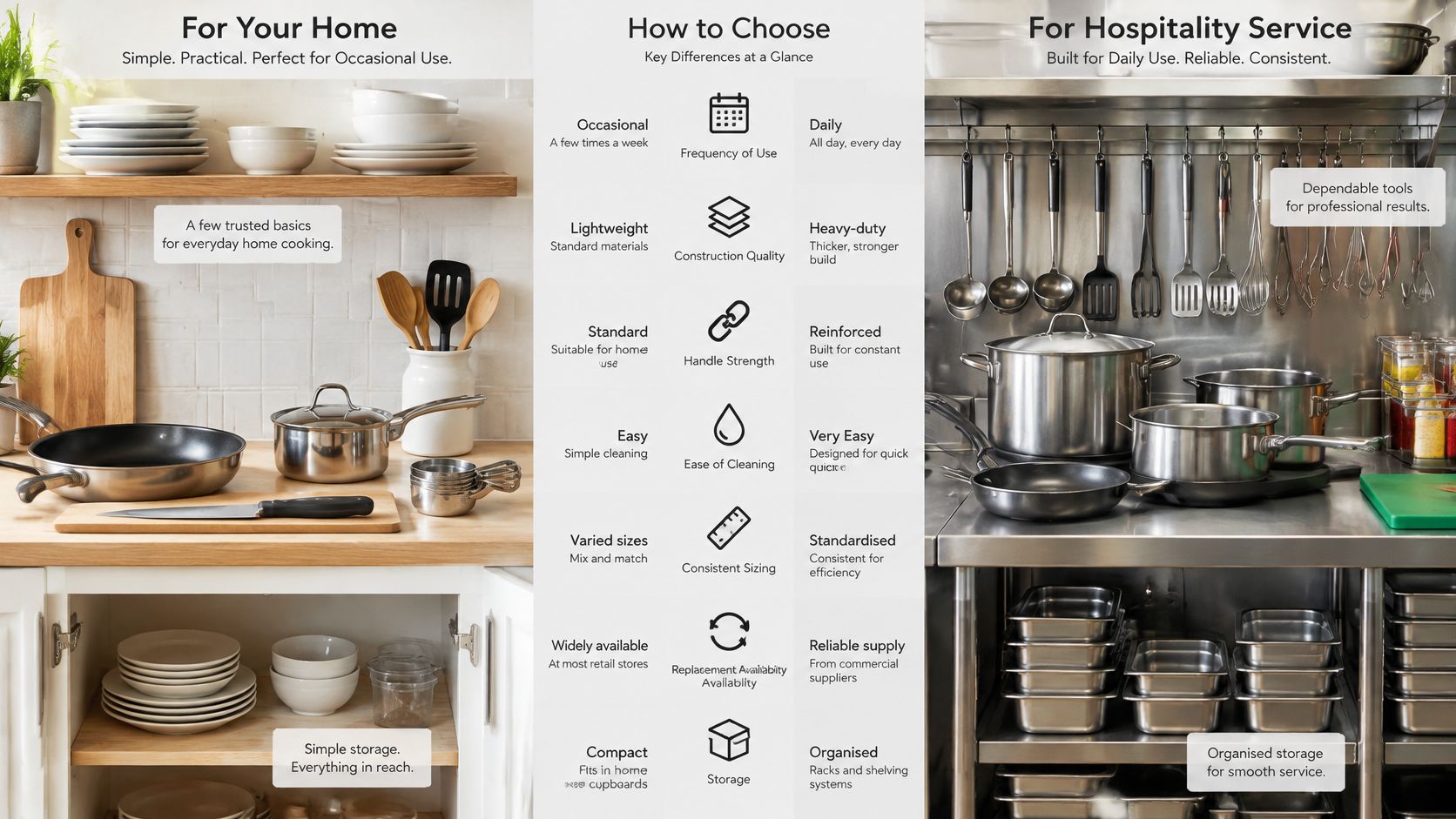
Where home use and service diverge
Frequency of use is the first split. A home ladle might see a few soups a week. On a café or restaurant line the same motion happens dozens of times a service, and a weak rivet or soft spring shows up quickly.
Construction and handles follow. Commercial work rewards a secure head-to-handle join and a grip that does not dig in after twenty minutes of stirring. A modest tool that portions and turns the same way every service usually outperforms a heavier piece that is awkward to hold, because fatigue shows up as sloppy work before it shows up as a broken handle.
Cleaning and sizing decide whether portions stay even between staff. A ladle bowl that is not a known size makes one cook's sauce serve larger than another's. Tools that trap food in a gap also slow the wash-up.
Replacement and purchase cost close the list. A slightly dearer tool is wasted if a matching spare is not available when one bends on a Saturday night. Crumbs and grease left in a shared drawer are a hygiene problem as well as a clutter problem, which is why utensil storage belongs in the same thinking as a restaurant integrated pest management guide.
The wider equipment question, from light domestic pieces through to gear built for daily trade, is set out in this comparison of domestic, semi-commercial and commercial equipment.
Cookware compatibility is part of the utensil decision
Electric cooking is the norm in many New Zealand homes, and it changes what sits in the utensil crock. In a nationally representative 2023 study of 1,442 New Zealanders, nearly two-thirds reported using an electric cooktop in working order during the previous 12 months, and nearly half saw the cost of induction equipment and the chance their existing cookware would not work with it as major disadvantages, according to EECA's consumer research. Pots and pans have to suit the heat source, and utensils have to suit those pots and pans. Metal edges that are fine on stainless or cast iron can mark a coated surface.
A buying checklist that survives a full prep
Run any shortlist through one working session before ordering a case.
- Material quality: chosen for the pan and the task rather than the finish.
- Handles: comfortable for the full task, with a length that keeps the hand off the heat.
- Construction: a tight join, no food trap, a spring or lock that still feels firm at the end of the shift.
- Head shape: sized to the vessel and the portion.
- Heat resistance: the rating on that product, not a generic claim for the material.
- Food-contact paperwork: for the specific item, especially coated or synthetic pieces.
- Cleaning instructions: what the maker allows, including whether a dishwasher is suitable.
- Spares and unit cost: a matching replacement you can order, at a price that holds up when you buy by the sleeve rather than singly.
A handle that feels comfortable in the shop can still tire the wrist when someone stirs a large batch, so test the grip on the intended task rather than on the shelf. A cheaper utensil that portions evenly and washes clean can outperform a costly one that does neither.
How to Clean, Replace and Store Utensils Safely
Correct care keeps a utensil both hygienic and usable. There isn't one wash method for every material, so follow the maker's instructions where they differ.
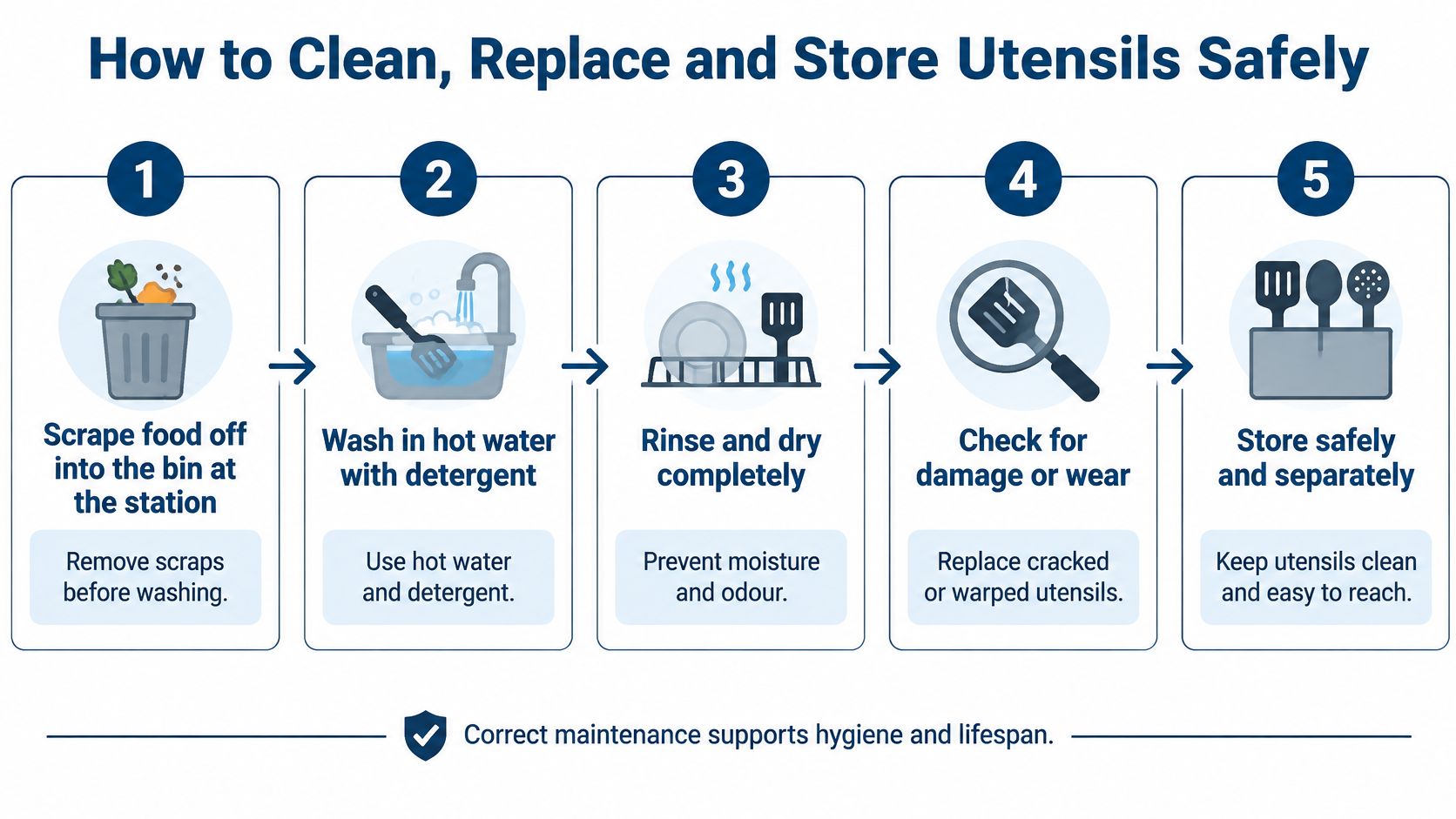
- Scrape food off into the bin at the station before it dries on.
- Wash in hot water with detergent, using the method the manufacturer allows.
- Sanitise where the task requires it, especially after raw food.
- Air-dry fully before stacking, so moisture doesn't sit in joins.
- Inspect handles, rivets and joints, then store in a clean, separated spot.
Check by material, not by habit. Silicone needs a look for tears, sticky patches or lingering odour. Wood needs a look for cracks, swelling and deep grooves, then thorough drying. Stainless steel needs a look for bent heads and loose handles. A crack can trap food, so cracked or warped tools come out of service rather than "making one more shift".
MPI food-control guidance identifies the temperature danger zone as 5°C to 60°C, where harmful microbes can grow. That is a reason to stop treating every tong as interchangeable. Dedicated utensils for raw food and for cooked or ready-to-eat food, separated by place or by time, with a full clean and sanitise between uses of the same area, keep contamination off the pass. One set of tongs for raw chicken at the prep bench, and another clean set for cooked portions at the pass, is the working pattern. Colour coding or clear labels make that split obvious when the board is full.
A kitchen utensil holder only helps if what goes into it is already clean and dry. Damp tools parked together undo the wash.
Build Your Utensil Collection Around Your Menu
A café running sandwiches and coffee doesn't need the same kit as a restaurant grilling to order or a bakery turning out trays all morning. Start with the menu, the cooking equipment and the volume, then buy the tools those three demand.
| Kitchen type | Priority utensils | Additional considerations |
|---|---|---|
| Home kitchens | Tongs, turner, ladle, whisk, silicone spatula | Choose comfortable handles and storage that suits the cupboard space |
| Cafés | Tongs, scraper spatula, whisk, serving spoons, pastry brush | Coffee and cold-prep tasks often need separate, clearly labelled tools |
| Restaurants | Tongs, turners, skimmer, slotted spoon, ladle, long-handled spatula | Match tools to grill, fryer and stockpot sizes, with spares for busy service |
| Commercial bakeries | Silicone spatulas, dough scrapers, pastry brushes, whisks | Heat ratings and cleaning routines matter for repeated oven and bench use |
| Catering businesses | Serving spoons, ladles, tongs, slotted spoons | Portion consistency and transport-friendly storage for off-site service |
| High-volume commercial kitchens | Multiple tongs, turners, ladles and skimmers, with spare stock | Labelled storage, replacement stock and sets sized to peak service |
Coordinated sets make matching and storage easier. Buying single tools for the pieces that wear fastest often gives better value, because the ladle may outlast the tongs. Keep enough of the frequently used items for busy service, plus a spare of the ones that disappear into the wash at peak. A shortfall at 7 pm costs more than extra clutter.
Home cupboards follow the same logic at a smaller scale. Clear zones for everyday tools, rather than one overloaded drawer, are the point of The White Kitchen Company's storage ideas.
Test tools against waste, not against the price tag
Utensils cut preparation waste when they standardise a portion or lift yield. A WasteMINZ study cited by Hospitality NZ, reported by Scoop Business, estimated that New Zealand cafes and restaurants discarded about 24,000 tonnes of food a year, with more than 60% considered avoidable: 60% of that waste was created during cooking, 33% from plate leftovers and 7% from spoilage.
Portioning ladles, scales and scraper spatulas tighten that cooking-side waste. Which one earns the spot depends on the kitchen. Weigh trim, overproduction and returned food by category for two weeks, then change one tool or one process and compare. A cheaper utensil that improves yield beats a premium tool staff ignore.
A collection earns its place when every piece has a job on tomorrow's menu, a spare for the busy hour, and a wash routine staff will follow.
Matching the utensil to the pan protects the cooking surface and makes each motion easier. Hospitality sells cookware from brands including ELO, Chef Inox, Flonal, Joseph Joseph and Force, so tongs, turners, ladles and whisks can be chosen against those pans rather than as a separate afterthought. How sets are built up is covered in this look at cookware sets.
Hospitality supplies kitchenware and commercial cooking equipment for cafés, restaurants, caterers and institutional kitchens across New Zealand, including the handheld tools that keep portions, surfaces and service consistent. If the menu, the pans and the volume don't line up with what's in the drawer, the team can help narrow the list, and you can talk through the utensils that fit your kitchen with them.