
Understanding Roband Heat Lamps and Food Displays
A café counter can lose valuable bench space to plates, food pans and finishing work long before the lunch rush begins. An overhead Roband heat lamp can keep food visible and warm during the final hand-off, but it isn't a universal replacement for a bain marie, heated display or holding cabinet. The right decision starts with the service job, the holding window and the space available beneath the lamp.
That distinction matters across restaurant passes, café displays, buffet lines, carvery stations, hot-food counters and plated-food pickup areas. Understanding Roband heat lamps and food displays means treating the lamp as one part of a temperature-control and service system, not as proof that food is being held safely.
What a Roband Heat Lamp Actually Does at the Service Counter
A barista may finish toasted bagels under an overhead lamp while the next order is being plated. A short-order cook may slide schnitzels onto a pass, where they wait briefly before a server collects them. At a buffet, an attendant may reload a Bain Marie while the display line remains open to customers. These jobs look similar, but they ask different things of the equipment.
A Roband heat lamp is a job-specific source of radiant heat and light positioned above a plated-food zone, shelf or service counter. It can help maintain warmth during a short hand-off, support the appearance of food on an open ledge and keep a finished plate from cooling too quickly before collection. It can also provide useful illumination where staff and customers need to see the food clearly.
Counter space is often the first constraint. An overhead unit keeps the working surface beneath available for plates, food pans or presentation, while a floor-standing or under-bench solution consumes space that a compact café may not have. Roband's role in New Zealand hospitality is discussed in more detail in this practical overview of why Roband equipment is widely used.
The useful service window
Heat lamps work well when the food is already cooked and the delay is short. Common uses include:
- Restaurant passes: Keeping plated meals warm while the final garnish, sauce or table coordination is completed.
- Café finishing zones: Supporting toasties, bagels and similar items during collection.
- Pickup areas: Giving plated orders a visible, warm place to wait briefly.
- Customer-facing displays: Adding light and warmth without enclosing the food behind a cabinet.
They don't bring cold food up to a safe temperature. They also can't guarantee controlled hot holding for an extended service, and they won't replace a bain marie or hot cupboard where prepared food must remain consistently hot.
Practical rule: A lamp can support the last stage between preparation and service. It shouldn't be used to disguise a production plan that leaves food sitting for too long.
Food quality sets another limit. A lamp may keep the surface warm, but prolonged exposure can dry bread, toughen proteins or change the appearance of sauces. The strongest setup keeps food moving promptly from preparation to the customer.
How Overhead Heat Lamps Work
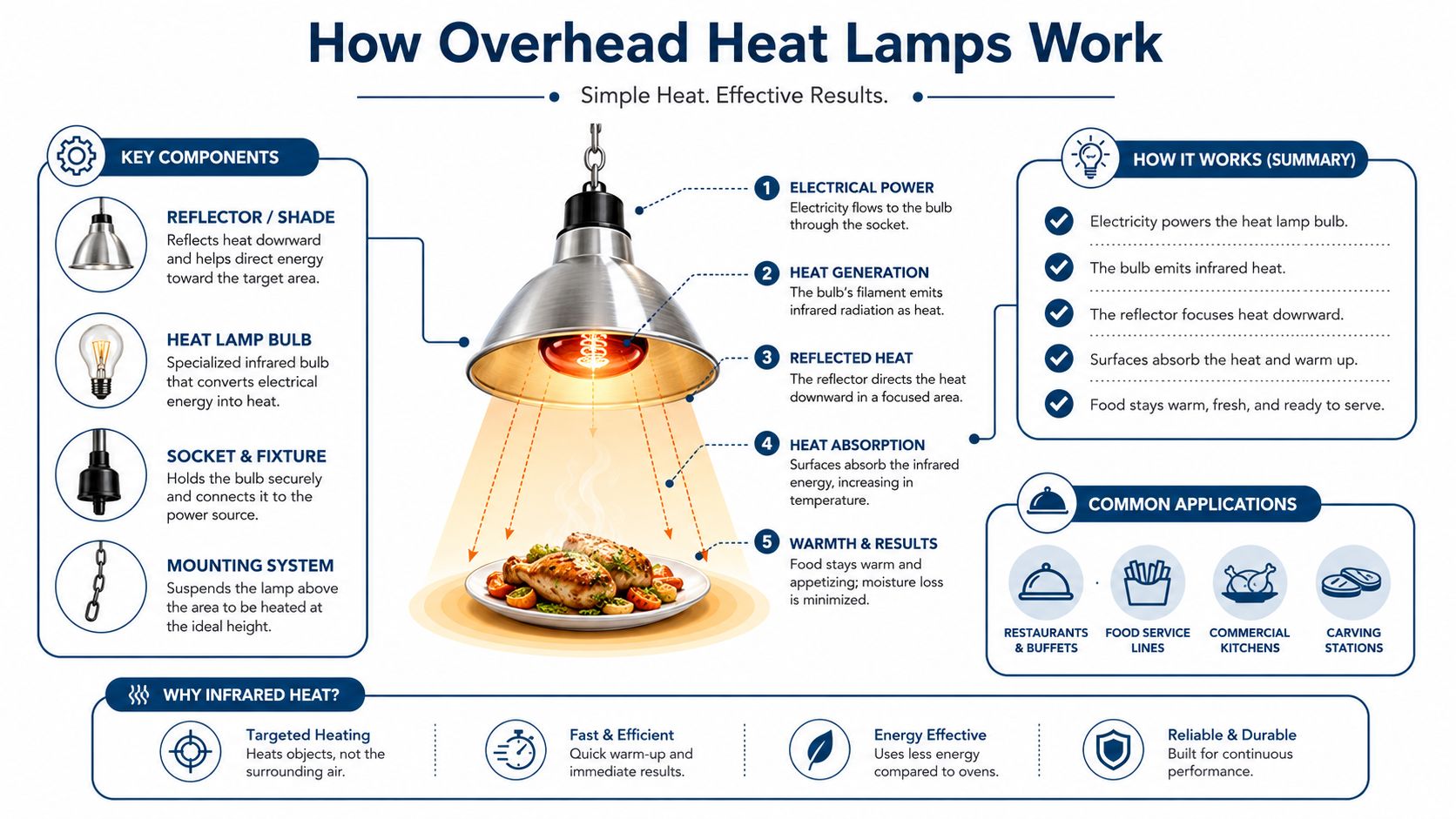
Overhead heat lamps primarily warm food through infrared radiation. The energy travels from the lamp towards the exposed upper surface of the plate or food, rather than relying only on heated air. The housing can also influence convection around the food, while the plate and surrounding counter affect how heat is conducted and retained.
Roband's New Zealand heat-lamp literature specifies 230V assemblies with outputs stepping from 900W at 900mm, 1200W at 1200mm, 1500W at 1500mm, and 1800W at 1800mm, with recommended mounting heights of 300mm to 400mm above the product surface. These specifications are set out in the Roband heat-lamp brochure. The mounting height is not a cosmetic detail. It determines how much radiant heat reaches the food and how evenly the service area is covered.
Distance changes the result
At a shorter distance, the top of a dish can become too hot while the centre remains cooler. Glazes may darken, cheese can over-finish and a plate's surface may lose visual appeal. At a greater distance, the radiant field spreads out and weakens, leaving the edges of the pass less effective.
A simple inverse-square intuition is useful. As the lamp moves away, the same output is distributed across a larger area, so the food receives less concentrated heat. Reflective hoods can direct more of the available energy downwards, but they can't correct a poor layout, blocked reflector or badly positioned plate.
Roband configurations may use incandescent infrared bulbs, halogen or quartz alternatives, and strip-heater formats. A bulb can create a more concentrated zone, while a strip heater generally spreads warmth across a longer, flatter area. The correct choice depends on whether the counter needs one defined finishing point or a consistent field across several plates.
The food container matters as well. For storage, reheating and serving meal prep in a shelf-efficient rectangular vessel, the Mepal Cirqula Rectangle 1000ml Nordic White uses a BPA-free polypropylene bowl with a flexible TPE-sealed window lid and a stated capacity of 1000ml.
The practical lesson is that lamp height, plate position and heat pattern form one system. Adjusting only one of those variables usually produces uneven results. Operators should mark the usable hot zone on the counter, place the lamp within the manufacturer's recommended height and test the actual food being served rather than judging performance from the glow alone. Further practical context is available in this guide to commercial food warmers.
Where Roband Heat Lamps Fit in a Service Layout
The same overhead lamp can behave very differently depending on the counter beneath it. A restaurant pass usually needs a clear, accessible zone where completed plates wait for the server. A café may need one compact finishing point over a toastie or bagel station. A buffet or carvery needs a broader presentation area, with access for staff and customers as well as controlled holding equipment.
A pass-through heat lamp adds no bench depth because the heat source sits above the work surface. An over-display strip heater mainly adds the width of its reflector, which can be easier to accommodate than a full heated cabinet. That space benefit is valuable, but it doesn't remove the need to check mounting points, clearances, service access and ventilation.
| Service Environment | Typical Configuration | Primary Job |
|---|---|---|
| Restaurant pass | Overhead lamp or heated gantry above plate-up space | Keep finished plates warm during collection |
| Café display | Compact lamp over a defined finishing or presentation zone | Support warmth and visibility for quick service |
| Buffet line | Strip heater above an open display ledge, often alongside other food-service equipment | Support presentation while staff replenish the line |
| Carvery station | Higher-output overhead heat over the carving and serving area | Keep displayed portions presentable during active service |
| Hot-food counter | Heated display, Bain Marie or combination layout | Provide more structured holding for prepared food |
| Plated-food pickup area | Short overhead warming zone | Reduce cooling during the final hand-off |
Match the layout to the hand-off
At a pass, staff need clear plate access and minimal obstruction. A lamp positioned too low can interfere with plating, while one positioned too far from the active zone may warm one side of the counter and leave another exposed.
A café display requires a different balance. The equipment should support the item being presented without creating glare, blocking customer sightlines or occupying the counter space needed for payment and collection. Buffet and carvery layouts need even more attention to replenishment paths, sneeze protection, serving utensils and the separation of raw preparation from ready-to-eat food.
Operators planning a broader fit-out can use this hospitality fit-out resource from Enky Editorial alongside restaurant kitchen layout ideas to think through movement, access and equipment placement.
The catalogue should come last. The layout decision flows from the actual service job, the food being displayed and the time between preparation and collection.
Short-Term Warmth Versus Controlled Hot Holding
A lamp is a strong choice for short-term temperature support when the food is already cooked and the service delay is brief. A plated meal waiting at a pass, a toastie finishing before collection or a garnish being added to a hot dish can benefit from overhead warmth without needing a full cabinet.
Controlled hot holding is different. Food displays, bain maries and heated cabinets are designed around maintaining a more stable holding environment over a longer service period. A lamp may warm the exposed surface while leaving the interior, underside or food at the edge of the display less consistent. Ambient air, food type, bulb output, mounting height and the shape of the display all affect the result.
The four-hour rule in New Zealand makes uncontrolled holding especially important. Food kept between 5°C and 60°C must be tracked, and if it remains in that range for longer than four hours, it must be discarded, according to the New Zealand public health fact sheet.pdf). Operators shouldn't wait for a lamp to fail before deciding that the application needs dedicated holding equipment.
| Service Window | Recommended Holding Method | Why It Works |
|---|---|---|
| Final hand-off at a pass | Overhead heat lamp | Adds warmth and light while staff complete service |
| Brief café collection period | Lamp or compact heated ledge | Keeps the product visible without using much bench depth |
| Active buffet service | Bain Marie or controlled heated display | Supports structured holding while staff replenish food |
| Extended hot-food counter | Heated display or holding cabinet | Provides a more controlled environment for ongoing service |
| High-volume plated service | Heated gantry with suitable supporting equipment | Combines access, workflow and short-term temperature support |
| Slow service with food remaining on display | Dedicated hot-holding equipment | Reduces reliance on radiant heat alone |
Long buffets, slow lunch periods, dairy-heavy dishes and any preparation that sits out beyond a short collection window deserve closer scrutiny. The exact choice depends on the food and the venue's food-control procedures, but the principle is consistent. A lamp supports service speed. Dedicated hot holding supports controlled storage during service.
The best equipment also protects food quality. Crisp coatings soften, fried foods lose texture and plated sauces change as time passes, even when the temperature remains acceptable. Good planning reduces the holding burden instead of asking equipment to compensate for slow collection.
Food Safety and Temperature Rules in New Zealand
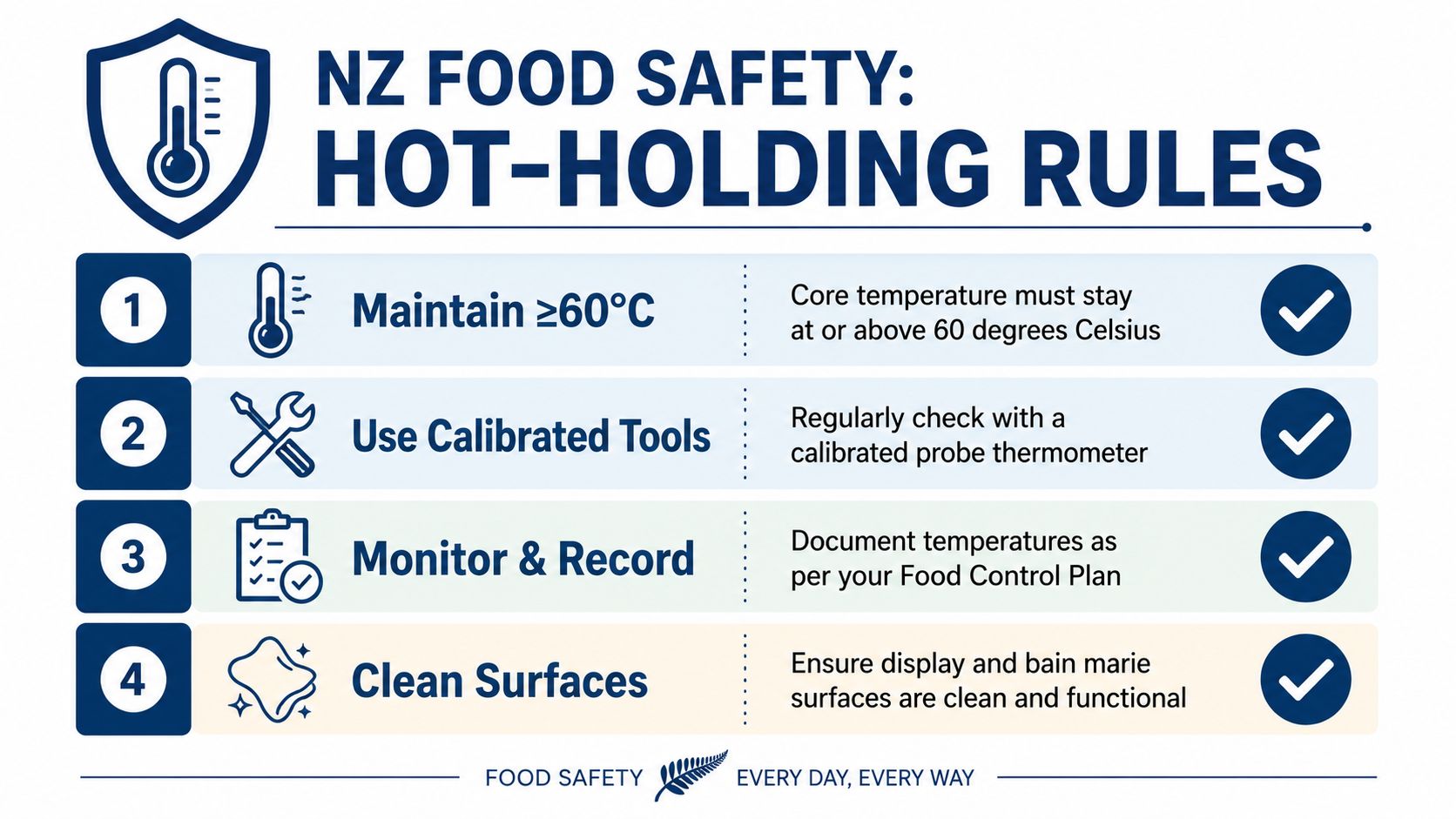
New Zealand food-display rules create a clear operating foundation for heated food displays. Ready-to-eat potentially hazardous food must be kept at 5°C or below, or 60°C or above, with the range between those points treated as the danger zone, according to the Wellington-region public health food-safety fact sheet.pdf).
The same guidance states that hot food on display should be heated to 80°C before being placed in a display case, and that the case should keep food above 65°C. Hot food mustn't be displayed for longer than one day. These requirements mean a Roband lamp is compliant only when the complete setup reliably keeps the food out of the danger zone for its intended use.
Measure the food, not the glow
MPI hot-holding guidance says food should be heated to 75°C before it is placed in a warmer, then held above 60°C, with temperatures checked every two hours when food is held hot for more than two hours. If the temperature falls below the safe limit, the guidance requires reheating to above 75°C and adjusting the equipment so the food stays above 60°C. Those instructions appear in the MPI hot-held food guidance.
Staff should use an appropriate probe thermometer as part of the venue's normal Food Control Plan or National Programme procedures. Records should show that the business has monitored the food, not just switched on the lamp. A probe should be cleaned between uses, and staff should know where to measure, especially with thick foods, stacked portions or mixed trays.
The display itself also needs attention. Food-contact surfaces must remain clean, utensils should prevent cross-contamination, and raw proteins shouldn't share a working area or gantry with ready-to-eat items without suitable controls. Historic New Zealand requirements also show why visibility and equipment design matter. The Food Hygiene Regulations 1974 included controls for displayed meat and fish, as well as lighting requirements for food premises, while later guidance placed stronger emphasis on measured hot and cold holding temperatures.
For operators, the practical conclusion is simple. Temperature monitoring is part of the equipment choice, not an extra task added afterwards. If the team can't check and document the food consistently during busy service, a more controlled display or holding cabinet may be the safer operational fit. The wider responsibilities around food handling are covered in this New Zealand food-safety regulations article.
Cleaning, Maintenance and Running Costs
Heat lamps sit directly above food, so grease, steam and splatter are normal operating conditions. Staff should switch equipment off, allow it to cool and wipe reflectors, shades and accessible surfaces as part of the daily close. Bulbs, guards, ceramic sockets, wiring and switches need periodic inspection for residue, discolouration, loose connections or heat damage.
A sensible cleaning routine separates food-safe wiping from technical inspection:
- After service: Remove grease and food residue from cool shades, reflectors and surrounding surfaces.
- During scheduled maintenance: Check guards, sockets, wiring and switches for damage or looseness.
- Before service: Confirm that the lamp illuminates the intended zone and that the mounting remains secure.
- After spills: Clean the affected area promptly once the unit is safe to handle, rather than allowing residue to bake onto the housing.
A dirty reflector can change the way light and heat reach the food. Splatter on a bulb can also create an uneven hot spot, while residue around a socket makes future inspection harder. Staff shouldn't spray chemicals directly onto bulbs, sockets or electrical components.
Electricity depends on the configuration
Running cost depends on the lamp's rated load, the duty cycle and how often staff leave it operating between rushes. The Electricity Authority reported a national average residential electricity price of about 31.3 cents per kWh in June 2025, a reference point for the wider electricity-cost environment rather than a commercial tariff for every venue.
Roband equipment varies materially by model. One Roband brochure lists a hot-foodbar at 3,200W and 13.9A, while the Roband pie-warmer manual lists models at 1100W, 1250W, 1550W and 1650W, as shown in the Roband pie-warmer manual. Those figures make clear why operators should check the nameplate load, circuit capacity and expected duty before ordering.
| Configuration | Typical Power Draw | Duty Profile | Energy Tip |
|---|---|---|---|
| Single overhead lamp | Model-dependent | Short, service-led use | Switch off outside active service |
| Strip heater | Model-dependent | Wider display coverage | Heat only the occupied display zone |
| Heated food display | Model-dependent | More sustained holding | Select capacity around actual turnover |
| Bain Marie | Model-dependent | Ongoing wet or dry holding | Avoid heating empty wells for long periods |
| Holding cabinet | Model-dependent | Extended structured holding | Use for the food and service window it was designed to support |
The table intentionally avoids treating one wattage as universal. Operators should use the exact model specification, then consider the venue's opening hours, preheat practice and downtime. A small extraction hood or suitable ventilation can help move grease and humidity away from lamp assemblies, but it mustn't compromise clearances or create a new cleaning hazard.
General kitchen-cleaning principles, including attention to grease and food-contact areas, are outlined in this commercial kitchen cleaning guide. Installation planning should also account for splash zones from neighbouring equipment, safe mounting, access for bulb replacement and enough clearance above the unit for cleaning and service.
Choosing the Right Roband Setup for Your Venue
The correct Roband setup follows the holding window, portion type and throughput, not the other way around. A compact café may need a single overhead strip above a defined pass-through section. A buffet venue may need a longer infrared bar paired with a carved-base display or Bain Marie. A pizza or finished-plate operation may combine overhead warmth with a hot plate below, while a bakery counter may need an enclosed display with different humidity and presentation characteristics.
Before comparing models, the operator should answer:
- How long will food wait before collection?
- Is the food plated, portioned in pans or displayed whole?
- Does the counter need light as well as heat?
- How much bench depth must remain available?
- Can staff monitor the food at the required frequency?
- Does the existing electrical supply suit the selected load?
| Venue Type | Recommended Setup | Key Spec to Check |
|---|---|---|
| Compact café | Focused overhead lamp or short strip heater | Mounting height, footprint and collection flow |
| Restaurant | Heated gantry over the pass | Coverage, plate access and cleaning clearance |
| Buffet venue | Longer heated display with Bain Marie support | Food-pan capacity, temperature control and replenishment access |
| Carvery | Overhead heat above the carving and serving zone | Heat distribution, visibility and safe mounting |
| Hotel or institutional kitchen | Holding cabinet, Bain Marie or combined display system | Capacity, electrical load and monitoring procedure |
| Bakery or customer-facing counter | Suitable enclosed or open display format | Presentation, food quality and service access |
Buying for the busiest shift helps prevent an under-specified setup that fails when the pass fills. A supplier conversation can also reveal constraints that a brochure won't show, such as a low ceiling, a nearby splash zone, awkward cable routing or insufficient room to remove a guard for cleaning.
Operators considering customer experience may also find broader ideas on how food presentation can help boost restaurant repeat visits, but display equipment still needs to serve the kitchen workflow first. Product-specific decisions should remain grounded in the food, the service window and the venue's procedures. For related Roband equipment considerations, this article on Roband sandwich presses provides useful context on matching equipment to a defined service task.
Hospitality operators can compare Roband Bain Maries, holding cabinets, heated displays and other hot-food equipment around the available counter space, electrical requirements and holding process. Visit Simply Hospitality to review suitable equipment categories or contact the team for practical advice on configuring a safe, accessible hot-food service area.