

What Does Running Out of Ice Really Cost a Hospitality Business?
The bar is full, the first round of cocktails is moving quickly, and the ice bin is already lower than expected. A bartender starts rationing cubes, a runner calls nearby suppliers, and customers begin hearing that familiar phrase, “That drink isn't available at the moment.” In a hospitality business, the cost of that shortage isn't limited to a few emergency bags. It can include lost beverage contribution, slower service, diverted labour, food-safety decisions, and a damaged customer experience.
New Zealand hospitality operates with limited room for avoidable disruption. The sector generates substantial revenue, yet operators also face significant cost pressure, including menu-price growth and overall inflation reported in the Hospitality New Zealand industry report for 2024 Hospitality New Zealand industry report. The practical question behind “What Does Running Out of Ice Really Cost a Hospitality Business?” is therefore not only what replacement ice costs. It's how much productive service a venue loses when a critical resource disappears at peak demand.
Why Ice Is a Critical Service Input in Hospitality
A quiet Tuesday afternoon can absorb an ice shortage. A busy Friday evening usually can't.
Ice supports far more than cocktail presentation. Bars use it for spirits, mixed drinks, soft drinks, cocktail shaking and serving. Cafés rely on it for iced coffee, cold beverages and some blended drinks. Hotels, caterers and event venues may also need ice buckets for bottle and table service, while restaurants can use it for chilled displays, seafood presentations and platter service where the application and handling method are appropriate.
That makes ice a service input. When it runs short, the venue may still have staff, glassware, ingredients and customers, but part of the menu becomes slower or impossible to deliver. The effect is particularly sharp when demand arrives in a concentrated window. An ice machine can appear adequate across an ordinary day while failing to replenish the bar quickly enough during a full-house service.
Practical rule: Size ice production and storage around the busiest realistic service period, not only the average day.
The exposure also extends beyond drinks. Refrigeration systems accounted for 22% of energy consumption in New Zealand's accommodation and food-services sector in 2022, compared with 15% for commercial ovens and cooking elements, according to the Energy Efficiency and Conservation Authority. That figure isn't a direct measure of ice-machine losses, but it shows why cold-chain infrastructure deserves operational attention. Ice can support chilled preparation, food displays, seafood and meat handling, and rapid cooling workflows, depending on the venue's procedures.
Reliable equipment protects the busiest trading days because it keeps service capacity available when fixed costs continue regardless of what the bar can sell. Operators reviewing the wider connection between equipment reliability and peak trading can also consider how reliable equipment protects your busiest trading days. For businesses monitoring profitability, consistent records also make accounting for bars and hotels more useful, because an outage can be recorded as a specific operational incident rather than an unexplained variance.
The Real Cost of Running Out of Ice
The immediate cost is usually visible at the point of service. A bartender can't prepare an iced drink without changing the recipe, finding an alternative, or declining the order. A customer may choose another beverage, but that substitution isn't guaranteed. Some customers will wait, while others will leave the order incomplete or decide not to return.
The shortage also consumes time. Staff may need to:
- Source replacement ice: Telephone suppliers, arrange collection, or organise urgent delivery.
- Move away from service: Leave the bar, pass, kitchen or front-of-house station to collect and transport stock.
- Modify production: Explain substitutions, change recipes, or prepare slower alternatives.
- Manage customer expectations: Tell guests which drinks are unavailable and why.
- Clean and reset: Check bins, scoops and temporary storage if emergency ice arrives in unfamiliar packaging.
Emergency purchasing adds a direct expense, but the purchase price isn't the whole line. Transport, courier charges, fuel, collection time, storage space and food-safe handling can all matter. A planned supply arrangement may be reasonable; an out-of-hours purchase during a busy service can be much less attractive.
The labour effect can be calculated more clearly than many operators expect. The Restaurant Association reports typical hospitality profit margins of 4–7%, while its 2024 remuneration survey recorded average hospitality pay of NZ$27.15 per hour across more than 1,000 businesses and 27,000 employees Restaurant Association 2024 annual hospitality report. Diverting two employees for 45 minutes would consume NZ$40.73 in direct wage time before payroll on-costs, delivery and lost sales are included. At a 5% net margin, recovering that wage time through additional sales would require approximately NZ$815 in revenue.
That calculation doesn't mean every shortage produces that exact result. It shows why the right question is operational throughput. A venue may preserve some sales with substitutions while still paying staff to manage the disruption and serving customers more slowly. The broader relationship between an equipment failure and service capacity is also relevant when assessing what one hour of kitchen downtime really costs.
Longer-term consequences are harder to price. A delayed drink, unavailable cocktail or poorly presented bottle-service order may affect trust and repeat visits. Those are possible consequences, not guaranteed financial losses, so they shouldn't be assigned a made-up dollar value. They should still appear in the operator's risk assessment because customer experience can deteriorate before the accounts show a clear line item.
Revenue Versus Profit in an Ice Shortage
A venue that can't sell NZ$1,000 of cocktails hasn't automatically lost NZ$1,000 of profit. The correct starting point is contribution, which reflects the revenue that remains after the variable costs avoided when the drink isn't sold.
The basic calculation is:
Lost beverage revenue × contribution margin = estimated lost contribution
The relevant margin should account for costs such as the spirit, mixer, garnish, packaging and other immediate variable inputs. Rent, salaried supervision and much of the scheduled labour usually continue whether the drink is sold or not, although the venue should use its own accounting treatment when calculating a realistic margin.
Customer behaviour also matters. If a cocktail isn't available, one guest may buy a beer, another may choose a soft drink, and another may abandon the order. That means the original sale isn't necessarily fully lost. A sound estimate separates:
- Unavailable sales: Drinks the venue could have sold but couldn't prepare.
- Substituted sales: Alternative beverages purchased instead.
- Deferred sales: Orders delayed or abandoned during the shortage.
- Protected contribution: Sales preserved by an emergency ice purchase.
- Direct incident costs: Ice, transport, collection and extra labour.
This distinction changes how an operator assesses an ice-machine upgrade. The business case shouldn't rely on raw turnover that may partly be recovered through substitutions. It should focus on the contribution margin protected during peak periods, plus direct costs avoided when the venue no longer needs emergency procurement.
Illustrative Business Example
A busy bar experiences an ice shortage during a three-hour evening service. The following assumptions are hypothetical and aren't a customer result:
- 20 potential drinks per hour can't be served.
- Average selling price is NZ$18.
- The affected period lasts three hours.
- Illustrative contribution margin is 70%.
The potential lost revenue is:
20 drinks × NZ$18 × 3 hours = NZ$1,080 potential lost revenue
The illustrative lost contribution is:
NZ$1,080 × 70% = NZ$756 potential lost contribution
If the bar also spends NZ$150 on emergency ice, transport and additional labour, the total financial impact could exceed NZ$900 for that service window. The calculation is deliberately simple. It doesn't assume that every unavailable drink would have been sold, and it doesn't add the same cost twice if transport or labour is already included in the emergency figure.
A venue can replace the assumptions with its own records. The useful inputs are peak drinks per 15 minutes, average selling price, contribution margin, outage duration, staff-hours diverted and emergency procurement costs. A beverage-led operation should also distinguish a short shortage from a prolonged one that removes entire menu categories or forces an early close.
How Operators Can Use the Model
The strongest records usually come from the point of service. Managers can compare the number of drinks sold during a normal comparable period, the drinks unavailable during the incident, substitutions made, and the time staff spent recovering. That produces a more defensible estimate than multiplying the venue's total sales by the length of the outage.
Emergency bagged ice can also be treated as a contribution-protection cost rather than an automatic waste expense. If the purchase preserves profitable service, it may be financially sensible. If the venue buys emergency ice repeatedly because production or storage is undersized, the pattern points to an equipment planning problem. The practical comparison between planned ownership and repeated emergency purchasing is covered in buying bagged ice versus owning an ice machine.
Why Ice Shortages Actually Happen
Most shortages are predictable in hindsight. They usually come from a mismatch between peak demand, machine capacity, storage and operating conditions, rather than from one isolated mistake.
Common causes include:
- An undersized machine: Average daily demand looks acceptable, but the machine can't replenish fast enough during service.
- A small storage bin: Production may be adequate over a full day, while the immediately available reserve is too limited.
- Unexpected beverage sales: A function, promotion or busy service consumes ice faster than the normal forecast.
- Seasonal conditions: Warm weather, outdoor dining, events and holiday trading increase demand.
- Menu changes: New cocktails, iced coffees or blended drinks use more ice than the original plan allowed.
- Equipment faults: Mechanical or water-supply problems interrupt production.
- Poor ventilation: Heat around the machine can affect operating performance.
- Inadequate cleaning: Scale, blocked components or neglected sanitation can reduce reliable output.
- Staff usage patterns: The bar may draw ice faster than the machine can replace it, particularly when scoops or bins aren't managed consistently.
A machine that meets average daily demand can still fail during a concentrated three-hour service. That distinction is why demand logs should record when ice is used, not just how much the venue buys or produces across a day.
Equipment monitoring can help identify temperature, performance or operating changes before a shortage reaches the bar. Operators considering that wider approach can review commercial refrigeration monitoring systems, while still following the ice-machine manufacturer's own operating and maintenance requirements.
Ice Production Versus Storage Capacity
Daily production capacity and storage-bin capacity are different specifications. Buyers often focus on the kilograms a machine can produce over a stated period, then overlook how much ice is available at the start of a peak service.
Ice production determines replenishment. Ice storage determines how much ice is immediately available when demand peaks.
A machine rated to produce a certain quantity over 24 hours doesn't produce that entire quantity during the busiest three hours. Production ratings also depend on manufacturer test conditions, including ambient temperature, water temperature, ventilation and installation. Actual output may therefore differ from the headline figure in a warm or poorly ventilated bar.
A machine can have sufficient daily production but insufficient storage. If the bin empties before replenishment catches up, the venue still runs out even though the machine may eventually produce enough ice across the whole day.
A practical peak-demand calculation
Operators can estimate the requirement from the service pattern rather than beginning with a machine catalogue:
Drinks per peak period × average ice per drink + other ice requirements = estimated peak ice demand
The calculation should consider:
- Drinks sold during the busiest service period.
- Different ice quantities for cocktails, spirits and soft drinks.
- Iced coffee, blended drinks and cold beverage stations.
- Ice buckets and bottle service.
- Food display or other legitimate operational uses.
- Seasonal demand, outdoor dining and functions.
- Ice consumed between replenishment opportunities.
Average ice per drink should come from the venue's actual recipes and serving practices. A cocktail programme may use a different mix from a café, hotel bar or seafood display. The result should then include an operational buffer suited to the venue's risk tolerance, service pattern and access to emergency supply. There isn't one sensible buffer for every business.
Check both sides of the specification
When assessing a machine, the operator should ask two separate questions. Can the unit replenish the quantity needed across the operating day? Can the bin hold enough ice to cover the period when demand rises faster than production?
The relationship matters in compact spaces, where a larger storage bin may affect bench height, access or workflow. A combined fridge, freezer and ice-making arrangement can also create different trade-offs from a dedicated unit, so the installation plan should account for fridge, freezer and ice-maker equipment rather than treating production as an isolated specification.
Different Ice Types and Where They Fit
Ice format affects the job the ice has to do. It changes presentation, displacement in the glass, melting behaviour and suitability for particular beverages or displays.
- Full cubes suit spirits, mixed drinks and table service where a substantial, slower-melting cube and familiar presentation are useful.
- Half cubes can provide a practical balance for general beverage service, particularly where glasses, recipes and speed require a smaller format.
- Gourmet ice is often selected for premium presentation, especially in drinks where the appearance and shape of the ice form part of the experience.
- Nugget ice can suit venues that want a softer, chewable format for selected cold drinks, although the right choice depends on the menu and customer expectation.
- Flake ice can be useful for food displays, seafood presentations, juice bars and some blended applications where close contact and flexible packing matter.
No format is universally best. Full cubes may suit a spirits-led bar but be less practical for a display that needs ice to fill uneven spaces. Flake ice may work well for a seafood presentation but not deliver the appearance expected in a premium whisky serve.
The buyer should treat ice shape as a working specification, not a marketing label. The relevant questions are which drinks need it, how quickly it melts in the intended service, how it fills the glass or display, and whether staff can handle it cleanly and consistently.
Choosing the Right Commercial Ice Machine
A commercial ice machine should be compared against the venue's peak demand, installation conditions and service requirements. Purchase price matters, but it shouldn't decide the selection on its own.
A practical comparison checklist
Check the following before choosing a unit:
- Rated daily production: Understand the stated test period and conditions.
- Actual expected output: Ask how ambient temperature and water conditions affect production.
- Storage capacity: Confirm how much ice is ready before replenishment catches up.
- Ice type: Match the format to the beverage and food programme.
- Dimensions: Measure access routes, bench height, clearance and service space.
- Ventilation: Check where hot air is discharged and whether the surrounding area is suitable.
- Water and drainage: Confirm connections, flow requirements and drain positioning.
- Electrical supply: Check the required connection before installation.
- Cleaning access: Make sure staff can reach the areas that need regular cleaning and sanitising.
- Warranty and support: Clarify what is covered and how technical issues are handled.
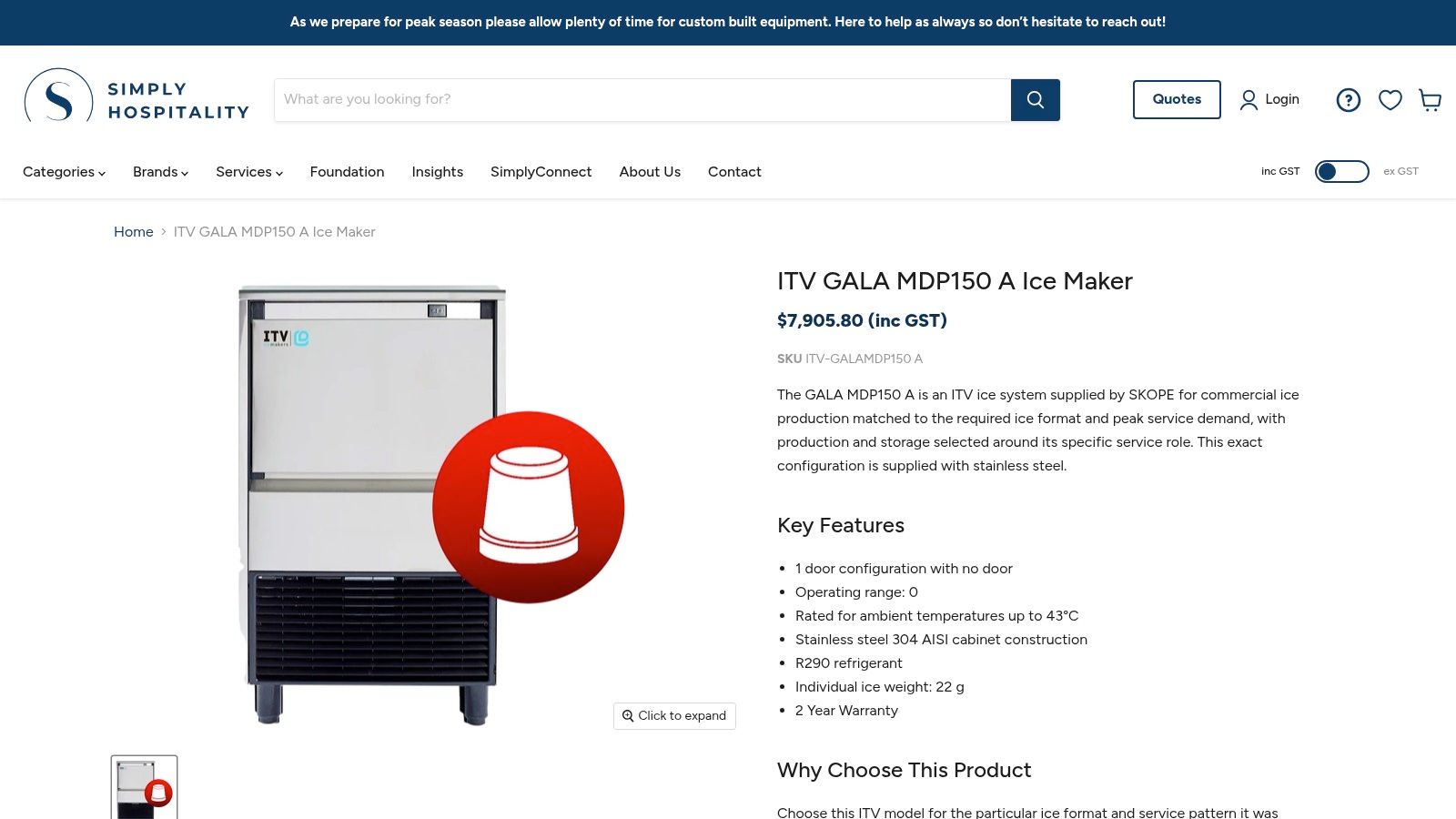
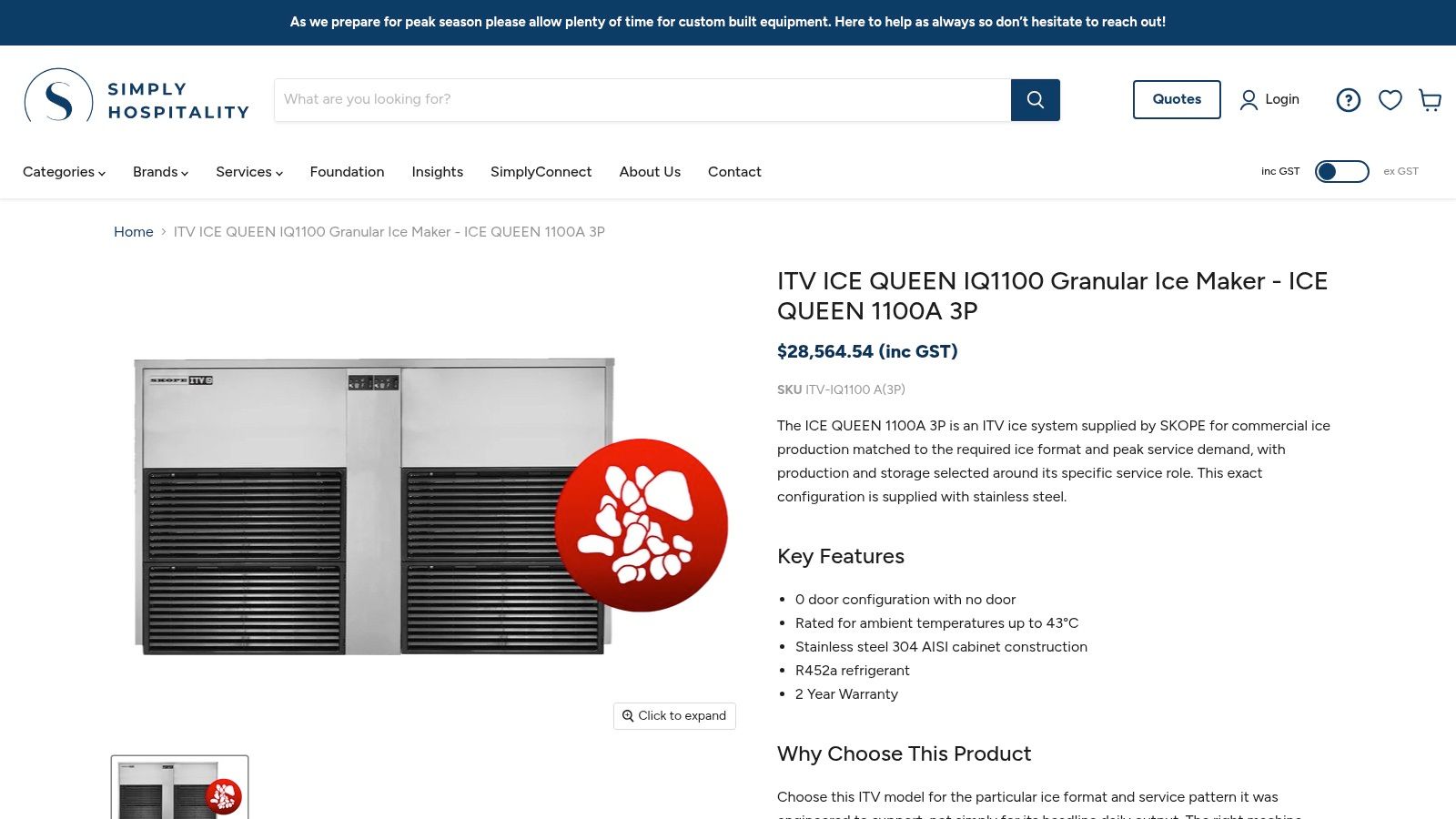
Current options available through Simply Hospitality include the ITV GALA MDP150 A Ice Maker and the ITV ICE QUEEN IQ1100 Granular Ice Maker. The GALA MDP150 A is an ITV ice system supplied through SKOPE with a stainless-steel cabinet, AISI 304 stainless-steel construction, R290 refrigerant and an operating range that includes ambient temperatures up to 43°C, according to the listed product information. The ICE QUEEN IQ1100 is a granular ice maker, so its application should be assessed against the venue's need for granular ice rather than compared only with cube production.
The relevant product pages should be checked for current manufacturer specifications covering production, storage-bin capacity, dimensions, water requirements, energy and water information, ambient limits and warranty. Those details can change by configuration, so a buyer shouldn't infer them from a similar model. The wider commercial ice machines, ITV ice machines, SKOPE ice machines, bar equipment and commercial refrigeration collections provide useful starting points for comparing configurations.
Key specifications to compare across commercial ice machines
| Specification | What to check | Why it matters |
|---|---|---|
| Production | Rated output and test conditions | Shows replenishment potential, not immediate reserve |
| Storage | Bin capacity and usable access | Determines ice available at peak demand |
| Ice type | Cube, gourmet, nugget or granular format | Connects the machine to the actual menu or display |
| Ambient limits | Expected operating environment | Helps assess suitability in warm or enclosed areas |
| Installation | Dimensions, ventilation, water, drainage and power | Prevents fit-out problems and poor operation |
| Cleaning | Access and manufacturer process | Supports hygiene and dependable output |
| Support | Warranty and service arrangements | Clarifies the response if production stops |
Comparing kilograms per day alone can hide the difference between a unit that replenishes steadily and one that offers the storage profile a busy service needs. The best choice may be a balanced production and storage system rather than the largest machine available.
Prevention, Payback and Practical Next Steps
Prevention starts with the basics. Staff should follow the manufacturer's instructions for cleaning, sanitising and servicing, keep ventilation clear, and watch for scale, restricted airflow or condenser issues. Cleaning isn't only a hygiene task. Neglected components can affect reliable production, while poor access can make the maintenance process inconsistent.
Emergency bagged ice has a legitimate role as contingency stock. Before relying on it, the venue should confirm supplier availability, delivery time, cost per kilogram, storage space, handling arrangements and food-safe transport. Ice intended for consumption must be treated as food. New Zealand guidance says staff shouldn't touch it with bare hands, and clean utensils and protected containers are required food-safety guidance for event and market food businesses.
Emergency ice becomes less sensible when the venue needs it every busy weekend. That pattern usually indicates that production, storage or demand planning needs review. Seasonal planning matters as well. Warmer weather, outdoor dining, functions and holiday periods can increase demand, so operators should review peak seasonal sales instead of relying only on annual averages.
If ice supports chilled food or beverages, staff also need to verify actual temperatures rather than assuming that visible ice means safe control. MPI identifies the food-temperature danger zone as 5°C to 60°C and says cold potentially hazardous food should be kept below 5°C, with the 2-hour/4-hour rule guiding use or disposal decisions MPI food-temperature guidance. Ice doesn't replace a thermometer, a documented process or sound food handling.
A simple financial starting point is:
Annual avoidable shortage costs ÷ incremental equipment investment
A more complete payback calculation is:
Incremental installed investment ÷ annual net financial benefit = approximate payback in years
The annual net benefit should account for contribution protected, emergency ice avoided, labour recovered and additional operating costs. The largest available machine won't automatically create the best return. A properly matched production and storage system may fit the venue's demand, space, services and budget more effectively.
Hospitality can help hospitality operators compare commercial ice machines, storage capacity, ice formats and installation requirements against real service demand. Visit Simply Hospitality to review suitable equipment and contact the team for practical guidance on choosing an ice solution for a bar, café, restaurant, hotel or events business.