


Is Staff Fatigue Costing Your Hospitality Business Money?
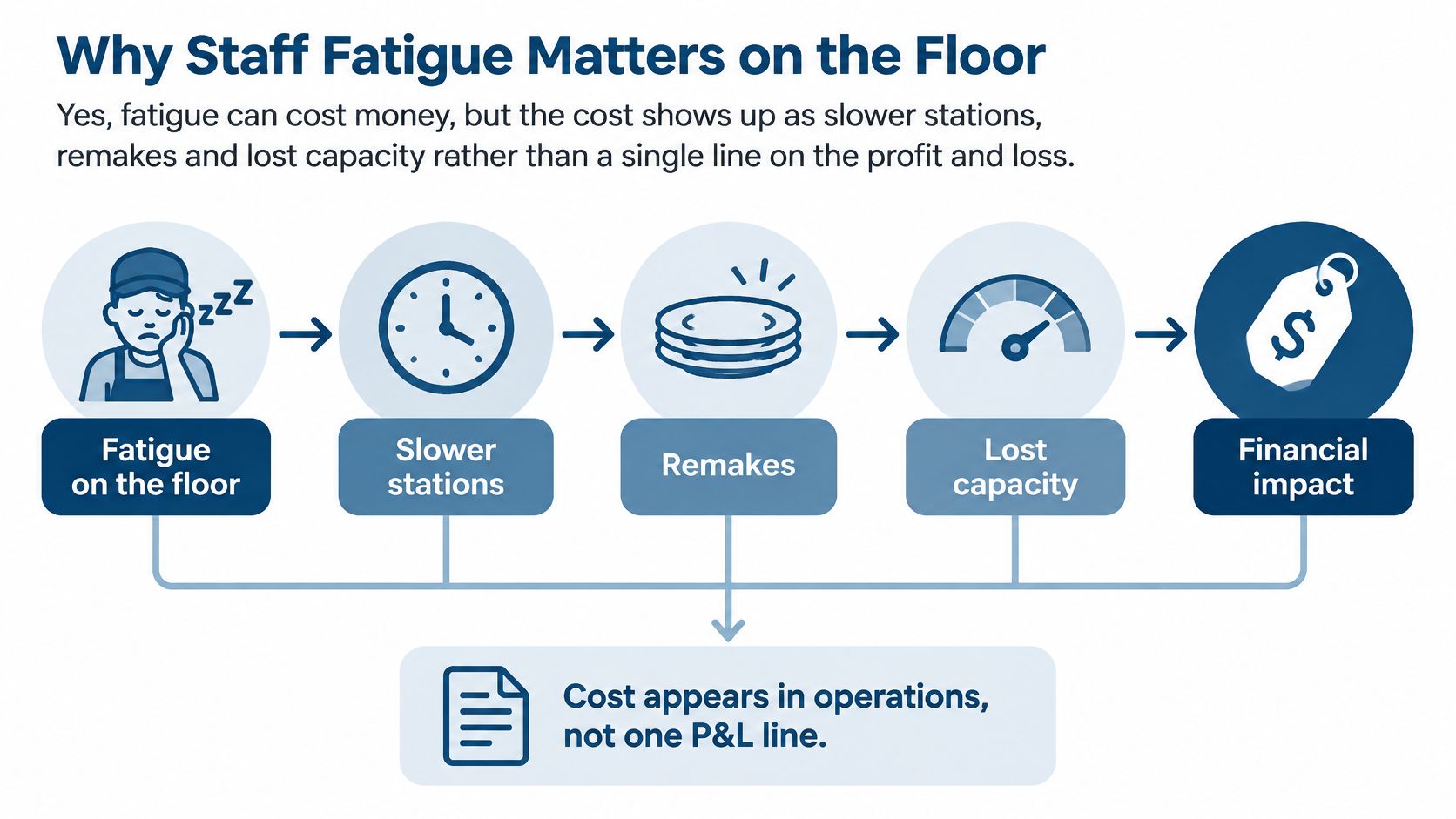
Does staff fatigue show up clearly on a profit and loss statement? Usually not. It can still cost money through slower stations, remakes, lost capacity and extra labour, so the useful question is where those effects are occurring and what the business can change without blaming tired employees.
A sound starting point is to review recovery, rostering and kitchen layout before buying equipment. Better tools can reduce particular repetitive tasks, but they can't fix a short team, missed breaks or a closing shift followed by an early start.
Why Staff Fatigue Matters on the Floor
How does fatigue affect a service before it reaches the profit and loss? It can show up as slower preparation, missed calls or a remake. A team may recover after a busy shift, but persistent fatigue can make concentration, coordination and safe work harder, particularly when there is little time between shifts.
Hospitality work combines physical effort and customer pressure. Staff may stand for long periods, repeat preparation tasks, lift heavy containers, work in hot kitchens and respond to a rush of orders while communicating across the pass. Irregular hours, inadequate breaks and a late close before an early open can all make recovery harder. Fatigue is a working-conditions problem, so the first checks belong with the roster, workload and environment.
In the 2025 MBIE hospitality workforce survey, 66% of hospitality employees reported feeling tired as a result of their service work, and 43% showed turnover intention. WorkSafe New Zealand reports that approximately 31% of workers often or mostly/always work while fatigued. These findings make fatigue relevant to both operations and health and safety. A tired worker may struggle to keep up, miss a step or find it harder to raise a concern during a difficult service.
Consider a kitchen that handles the early service well, then slows on preparation, misses calls and has to redo orders late in the shift. One difficult service does not establish the cause. A recurring pattern at the same time of day or on similar rosters is a reason to review the working conditions alongside service records.
Comfort and secure footing matter over a long shift. Operators reviewing footwear can read Simply Hospitality's advice on non-slip shoes. Workers seeking extra comfort can find supportive work boot inserts. These are practical considerations alongside a review of rostering, recovery and the work environment.
Hidden Costs of Tired Staff
Fatigue can show up as extra labour, lost product and inconsistent service, but none of these costs has a single cause. A practical review looks at the operating conditions behind a problem without blaming the people doing the work.
| Potential fatigue impact | Business consequence |
|---|---|
| Slower preparation or service | Stations fall behind and orders take longer |
| Reduced concentration | Steps may be missed during busy periods |
| Mistakes, remakes or food waste | Ingredients, time and product are lost |
| Uneven production | Portions and finish quality can vary |
| Overtime or absence | Labour costs rise or shifts run short |
| Turnover or workplace incidents | Experience is lost, or time is spent managing an incident |
A run of remakes, for example, might stem from unclear specifications, poor communication, an unfamiliar menu or equipment problems, as well as tiredness. One difficult Saturday does not establish fatigue as the cause.
Labour costs remain a significant pressure for accommodation and food services. In its New Zealand insolvency trends report, Deloitte reported that the sector's labour-cost index rose approximately 25% from 2020 Q1 to 2026 Q1, compared with 19% across all industries; the report also said accommodation and food services accounted for 13% of formal insolvency appointments in 2026 Q2. These figures do not show that fatigue caused a particular cost or business failure. They do underline the commercial value of addressing avoidable labour pressure.
Rostering, recovery and workload are the first places to test. Equipment comes later, when a specific task or layout is adding strain.
What Extra Time Can Cost Per Shift
Four employees, each taking 10 extra minutes, add 40 minutes of work. At an illustrative fully loaded employment cost of $32 per hour, that time is worth $21.33 per shift. Across 300 shifts, it amounts to approximately $6,400.
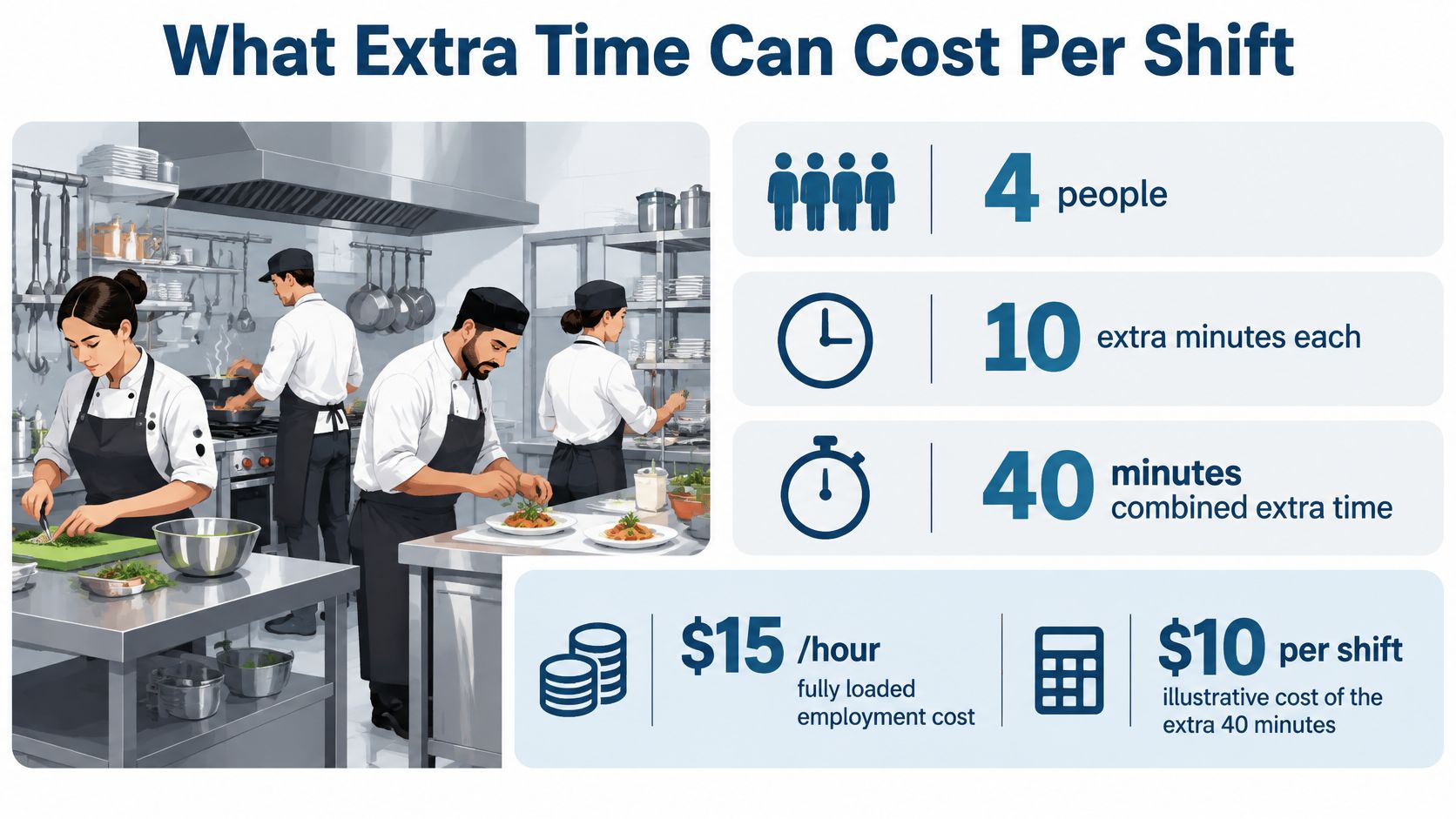
These are illustrative figures, not a measured fatigue cost, a sector benchmark or an automatic payroll saving. If the employees finish within hours the business already pays for, the wage bill may not fall. The effect could instead be lower output, a later close or less capacity to take another order.
Cash losses are more direct when extra time pushes staff into overtime, or when the same pressure contributes to remakes, spoiled product or a missed profitable order. Even then, fatigue shouldn't be treated as the automatic cause. Operators need to check what happened and identify whether the relevant process, staffing or equipment issue can be addressed.
To adapt the example, count the people affected, time a specific task rather than guessing, use the business's own fully loaded employment cost, then multiply only across shifts where the pattern occurs. A four-person kitchen example won't automatically fit a two-person café, a hotel kitchen or a front-of-house team. Each has different tasks, pay costs and service patterns.
For a related look at the cost of inefficient work, see Simply Hospitality's article on how much poor kitchen workflow costs each shift. The calculation here is deliberately limited to the value of added staff time. It doesn't assign a price to complaints, injury costs or a general productivity loss.
How Fatigue Shows Up in Food and Service
Fatigue can show up in small service errors before it becomes an obvious problem. A cook may portion inconsistently, miss a prep step or respond more slowly to the pass. Front-of-house staff may enter an order incorrectly, and presentation can slip as a busy period wears on.
Consider a remake traced to a prep step completed late in the shift. The ingredients are used twice, staff repeat the work, and another order may wait. The customer may also need to raise the issue. Those costs depend on the circumstances, so a universal dollar figure would be misleading.
Routine food-safety tasks also rely on attention. A missed temperature check, food left in the danger zone or a surface not cleaned between tasks can create risk. Record near misses and the conditions around them, then check whether a process change could help.
In the 2024 MBIE Hospitality and Tourism Employment survey, 50.5% of respondents said they could always take their contracted breaks, while 61.0% either intended to leave their job within 12 months or were unsure whether they would. The survey does not show that fatigue caused every mistake or departure. It does make recovery and retention relevant to consistent service.
Log mistakes and near misses without turning the record into a telling-off. Use simple categories such as portion, order, temperature, communication and presentation, then review them for patterns by time of day or task. For another view of the operational cost of delays, read how slow service can cost a restaurant.
Kitchen Layout Demands That Wear People Down
A cook who repeatedly crosses the kitchen for ingredients, or a café worker who steps away from the station for milk, spends energy on avoidable movement. Layout can make the same menu more physically demanding to produce.
| Physical demand | Possible contributing factor | Potential improvement |
|---|---|---|
| Repeated walking between stations | Ingredients and tools stored away from the task | Place high-use items at the station |
| Frequent bending | Low shelves and floor storage for daily product | Move daily stock to waist height |
| Awkward reaching | Equipment or shelves above a comfortable zone | Reposition tools within easy reach |
| Carrying heavy containers | No trolley or mobile storage on the route | Use a trolley for heavy moves |
| Congested work areas | Trolleys, bins and people sharing one gap | Clear a defined path and landing zone |
| Inadequate preparation space | One bench doing several jobs | Give each task a set-down area |
| Poor storage organisation | Like items split across the kitchen | Group stock with the station that uses it |
| Repetitive manual handling | Every transfer done by hand | Reduce lifts with mobile storage |
Ergonomics and workflow work together. A bench at a comfortable height offers limited help if staff cross the kitchen for every garnish. Moving ingredients closer can also create congestion if the route and landing space are unclear.
Place daily-use ingredients in underbench refrigeration beside the preparation area. Set stainless benches at a comfortable working height, use a trolley for heavy containers and group tools with the tasks that need them. Remove the unnecessary effort itself.
A pastry cook who repeatedly crouches for sheet trays may need a better storage position. A grill hand needs a clear route around trolleys and other obstacles. The right layout depends on the kitchen's workstations, menu and pinch points. Kitchen design ideas for saving time on every service can help operators assess workflow. If storage position is the problem, compare suitable commercial refrigeration options for the station before choosing equipment.
Rosters Breaks and Realistic Workloads
Could a roster be adding fatigue even when total hours look reasonable? Repeated late shifts, split shifts, consecutive service days, commuting time and difficult customer interactions can all make a working week harder to recover from.
The WorkSafe NZ review of hospitality-sector risk factors reports that 54% of hospitality workers worked evenings between 7pm and 11pm more than six times per week, compared with workers in other industries. It also identifies unsocial hours and emotional demands as factors associated with work-life imbalance, stress and emotional exhaustion.
A technically compliant roster can still leave recovery fragmented. Part-time status does not automatically mean low fatigue risk, particularly in hotels, bars and late-trading restaurants. Review closing-to-opening intervals and repeated late shifts alongside contracted hours.
Start with the roster pattern and the work it needs to cover:
- Plan for service demand: Staff peak periods realistically, rather than expecting a small team to absorb every rush.
- Protect breaks: Check Employment New Zealand's current guidance on rest and meal breaks, and organise work so staff can take them.
- Share demanding work: Rotate tasks where skills and service requirements allow, and train more than one person for physically demanding jobs.
- Track overtime and recovery: Review repeated overtime and shift sequences, then address patterns that limit recovery.
- Make reporting practical: Give employees a straightforward way to raise fatigue concerns without treating them as a motivation problem.
MBIE's 2022 survey found that 17.9% of 902 New Zealand tourism and hospitality workers considered their hours excessive, compared with 9.4% who said they didn't receive enough hours. That split points to roster distribution as an area to review before adding shifts across the board.
A separate MBIE Hospitality-Related Sector analysis estimated that 8,900 employees, or 10.08% of the sector's estimated 88,300 employees, regularly worked more than 40 hours per week in 2022. The analysis notes that official figures do not specify how many hours are worked at night, on split shifts or at weekends, so venues need to track those details themselves.
For a wider perspective on building healthier workplaces through systemic changes, consider fatigue a measurable operating cost. Test roster patterns, break access and workload distribution first, then assess whether other changes are needed.
Equipment That Eases Repetitive Work
Repeated chopping, mixing, pan handling and warewashing can drain energy across a shift. Match equipment to the task, production volume and available space. A poor fit can add cleaning, handling and congestion rather than ease the workload.
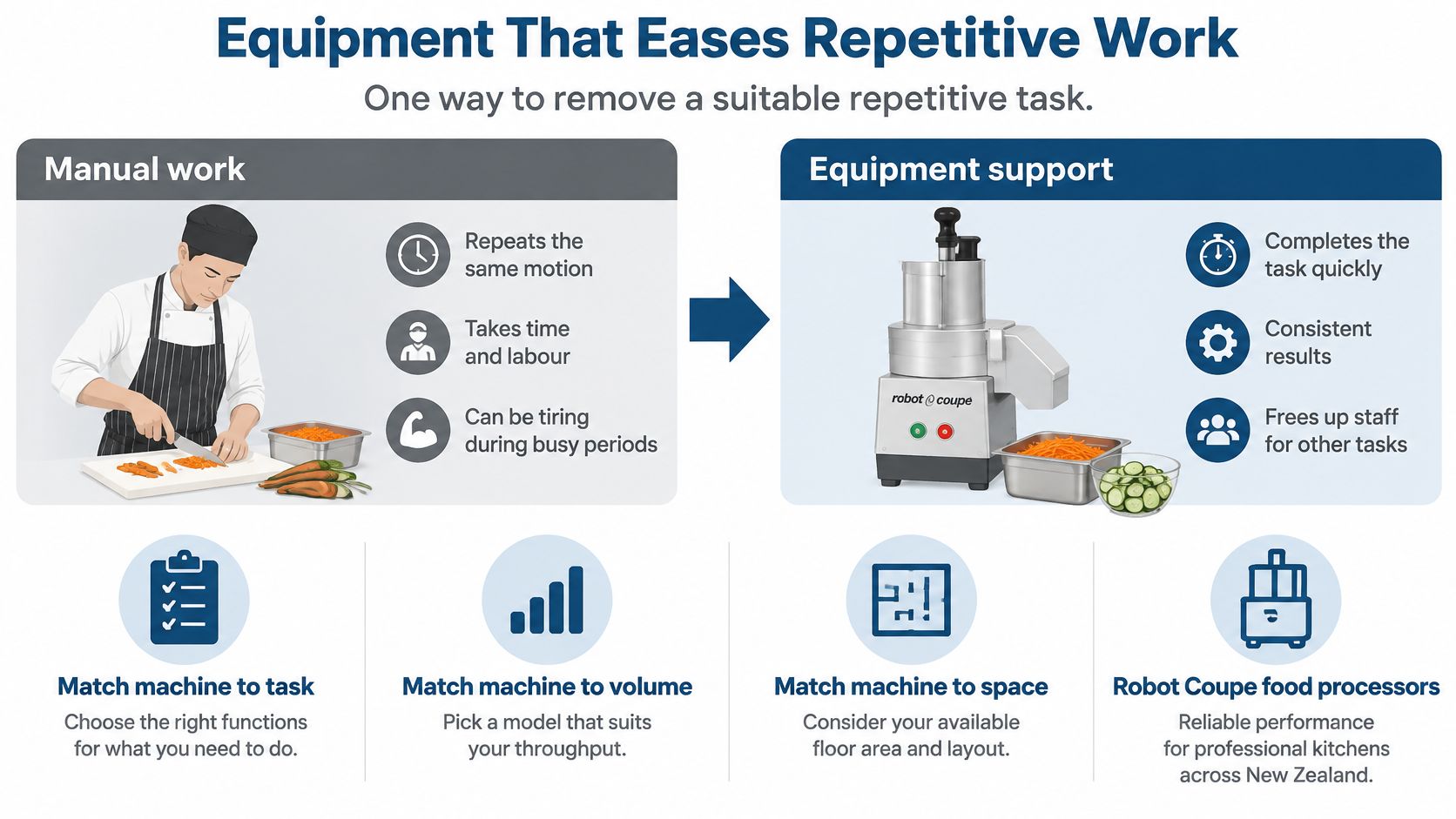
A Robot Coupe food processor can assist with repetitive chopping, slicing and preparation when its capacity suits the batch. Staff still need to scrape and clean it. Planetary or spiral mixers can reduce manual mixing and kneading for suitable doughs and batters, provided the machine suits the recipe and production volume.
Unox, Convotherm and Giorik combi ovens may combine suitable cooking processes and reduce repeated pan handling. They won't suit every dish or kitchen workflow. SKOPE and Atosa underbench refrigeration can keep ingredients close to preparation areas, though storage needs and staff movement both affect how much underbench space is practical.
Commercial dishwashers from Classeq and Winterhalter can reduce manual warewashing when the volume justifies the machine. They need suitable water, power and ventilation, along with clear space for dirty and clean wares. Stainless steel benches at a suitable working height and mobile trolleys can also ease handling if they fit the route without blocking a work area.
Compare commercial dishwashers and commercial refrigeration against the task and layout. For workstations where staff stand for long periods, consider anti-fatigue mats. In food-processing settings, the Inox Macel One-Point Fixed Meat Hook - 160 x 6mm is designed for controlled hanging and handling.
Measure the Pattern Then Choose the Fix
Which part of the shift is consistently costing time, energy or money? Review records over several weeks by role and daypart, then use the pattern to choose what to change first.
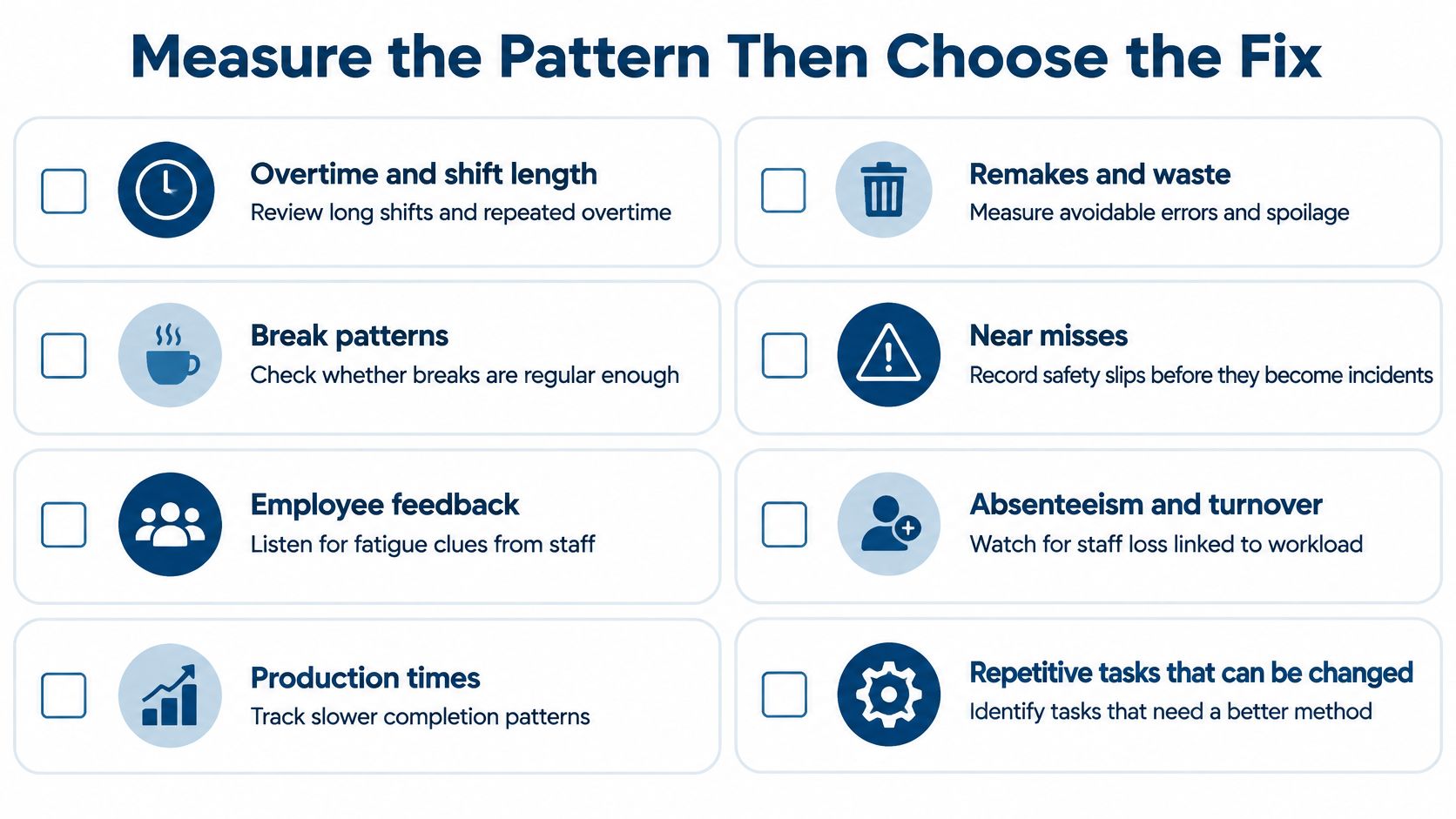
Include these eight checks in the review:
- Overtime and shift length: Compare planned and recorded hours.
- Break patterns: Note when breaks are missed or interrupted.
- Employee feedback: Ask where fatigue is most noticeable and which tasks contribute to it.
- Production times: Track completion times by station and daypart.
- Remakes and waste: Record errors and discarded product, with a reason.
- Near misses: Record safety slips alongside incidents.
- Absenteeism and turnover: Check for patterns by role and shift.
- Repetitive tasks that can be changed: Identify work involving repeated effort or handling.
Use the findings to test changes in a sensible order. Start with rostering and recovery, then review layout and workflow. Consider equipment when a specific task or capacity constraint remains.
| Identified problem | Potential response | How to measure improvement |
|---|---|---|
| Long closes and short recovery | Adjust rosters and protect breaks | Overtime hours and breaks recorded |
| Repeated walking and bending | Reposition stores, benches and paths | Time-to-plate and near misses in that zone |
| Manual chopping, mixing or washing at volume | Match a machine to that task and volume | Minutes on the task and station overtime |
| Remakes clustered late in service | Fix the cause first, then review capacity | Remake count by daypart |
| People leaving a heavy role | Share the task and review the workload | Turnover and absence in that role |
Staffing improvements address workload distribution, roster gaps and access to breaks. Track recorded breaks and overtime, then compare absence patterns. Workflow improvements target walking, congestion and double handling. Time a sample of orders and note whether near misses continue in the same area. Equipment improvements fit a specific repetitive task or capacity constraint. Measure task time, remakes and station overtime.
Separate direct savings from other gains. Reduced overtime or food waste shows up as a financial change. More output within existing paid hours is a capacity gain, but does not necessarily reduce payroll. Better recovery and less physical strain matter even when no dollar value can be calculated.
Hospitality supplies commercial kitchen equipment and can help operators compare options for an identified task. Fatigue risk deserves attention even when its cost cannot be measured reliably. Visit Simply Hospitality to explore food preparation, refrigeration, warewashing and stainless steel workspaces.