

Which Commercial Kitchen Investments Should You Make First?
The most common answer to which commercial kitchen investments should be made first is usually too simple to be useful. “Start with refrigeration” sounds practical, but it falls apart as soon as the business model changes. A pizza restaurant, a café, a bakery, a bar, and a production kitchen can all have completely different first priorities.
What works better is a decision process, not a product ranking. The sequence should run menu, production requirements, peak capacity, workflow, infrastructure, equipment specification, then purchasing priority. That's how limited capital gets directed into equipment the business needs to open properly, trade reliably, and avoid expensive mistakes later.
For New Zealand operators, that matters because the sector already carries heavy ongoing cost pressure. In financial year 2024, the accommodation and food services sector recorded NZ$9.813 billion in other purchases and operating expenses, NZ$6.657 billion in salaries and wages, and NZ$708 million in depreciation according to Figure.NZ industry expense data. The first wave of spending needs to support throughput, reliability, and labour efficiency, not just fill a kitchen with equipment.
Why There Is No Single Best First Purchase
A commercial kitchen shouldn't be budgeted by habit. It should be budgeted by what the venue must produce, how fast it must produce it, and what happens during peak service when every weak point shows up at once.
A lot of operators understandably look for a universal rule. That's usually because opening budgets are tight and the equipment list feels overwhelming. But “always buy refrigeration first” is no more reliable than “always buy the biggest oven you can afford”. Sometimes refrigeration is the first category to lock in. Sometimes it clearly isn't.
The menu decides more than the equipment category
A venue built around pizza may need to protect the oven specification above everything else. A high-turnover café may depend more heavily on coffee equipment, underbench refrigeration, and warewashing. A bakery may need ovens, mixers, benches, and prep flow before almost anything else. A bar may need comparatively little cookline equipment but still require serious refrigeration and glasswashing capacity.
Practical rule: The first equipment to fund is the equipment without which the menu cannot exist.
That sounds obvious, but many budgets drift away from it. Operators often spread money evenly across categories instead of protecting the equipment that generates the menu.
Purchasing priority and design priority are different
Many fit-outs go wrong. The first item purchased isn't necessarily the first item that should be designed around. The smarter approach is to design the whole kitchen first, then decide what gets purchased in stages.
That distinction matters even more when cash is limited. New Zealand tourism satellite account data show food and beverage serving services generated NZ$4.908 billion in output in the year ended March 2025, while accommodation services generated NZ$3.929 billion. The previous year those figures were NZ$4.027 billion and NZ$3.282 billion, which represented growth of about 21.9% and 19.7% respectively according to the Stats NZ tourism satellite account tables. Growing demand supports staged capital spending, but staged spending only works well when the full kitchen plan is already resolved.
A better way to decide
A more reliable framework is:
- Essential for opening: Core equipment the venue can't operate without
- Essential capacity: Enough equipment to handle realistic peak trade
- Labour and workflow: Equipment that removes bottlenecks and repetitive manual work
- Expansion and optimisation: Valuable additions that can wait if needed
That structure is far more useful than chasing a universal number one purchase.
Design the Whole Kitchen Before You Buy It in Pieces
Operators can stage construction and purchasing. They shouldn't stage the design.
That single distinction prevents a lot of expensive rework. Buying equipment one piece at a time without a complete kitchen plan often leads to poor bench spacing, awkward door swings, inadequate drainage, undersized extraction, the wrong power supply, or refrigeration that technically fits but doesn't support service flow.
The sequence that actually works
The practical order is straightforward:
- Menu
- Production requirements
- Peak capacity
- Workflow
- Infrastructure
- Equipment specification
- Purchasing priority
Each step affects the next. If the menu requires holding, proofing, chilling, or fast-turnaround plating, the layout and services need to support that before any equipment is ordered.
A common issue seen across refurbishments is that operators choose a key appliance early, then force the rest of the kitchen around it. That usually looks cheaper at the start. It often costs more later.
For kitchens that want a practical example of workflow-led specification, an underbench unit such as the SKOPE ProSpec 3 Door Underbench Fridge - PG11.UBR.3.SD.RH can make sense when refrigeration is part of the kitchen's working architecture rather than just bulk storage. This configuration has a 3 door layout with solid swing doors, stainless steel 304 AISI cabinet construction, an operating range of 1°C to 4°C, adjustable shelving, and Bluetooth-enabled SCS Connect monitoring, so it's the sort of product that needs to be considered in relation to line layout, prep access, and service rhythm rather than bought in isolation.
Infrastructure needs to be settled early
Some decisions are cheap to change on paper and expensive to change on site.
That includes:
- Electrical supply: Cooking, refrigeration, dishwashing, and small appliances all compete for available power
- Gas where applicable: Position, compliance, and future expansion need early coordination
- Drainage: Especially important for dishwashers, ice machines, and some prep areas
- Extraction and ventilation: This is not optional in a cooking kitchen
- Equipment positions: Clearances, access, and operator movement have to work under pressure
A kitchen can survive a delayed add-on purchase. It usually doesn't recover cheaply from the wrong services layout.
Ventilation deserves particular attention. New Zealand's Food Hygiene Regulations 1974 require premises to have ventilation sufficient to keep conditions comfortable, prevent excessive heat, reduce condensation and excess moisture, and remove odours, fumes, and impurities. If natural ventilation is inadequate, a mechanical system must be installed, as set out in the Food Hygiene Regulations 1974.
The practical design side matters too. Guidance under the Building Code for food premises sets out that ventilation may be natural or mechanical, and where natural airflow is used, vents to the exterior are needed near both the top and bottom of storage areas, with openings protected against flies and vermin under the G3 food preparation compliance document.
For operators planning a new kitchen layout, designing a kitchen that saves time on every service is usually a far better starting point than shopping category by category.
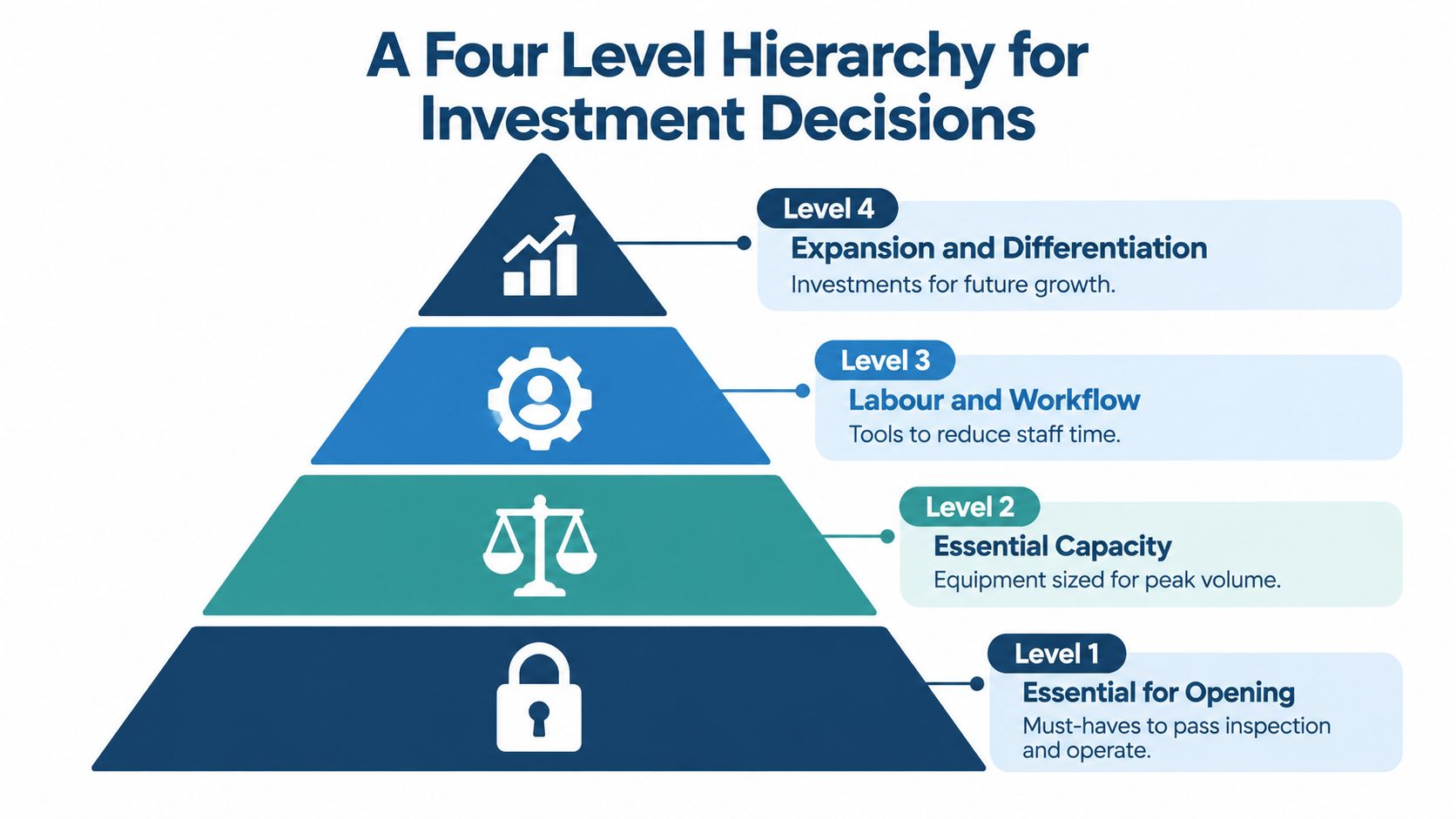
A Four Level Hierarchy for Investment Decisions
The easiest way to make good first-purchase decisions is to stop thinking in product categories and start thinking in investment levels. Refrigeration, cooking, prep, and warewashing can all appear at different levels depending on the venue.
Level 1 essential for opening
This is the foundational layer. If an item is missing, the kitchen can't legally or practically open in its intended form.
That usually includes core cooking equipment, essential refrigeration, primary prep equipment, and required warewashing. For one venue, that might be a Blue Seal range and a dishwasher. For another, it might be a UNOX combi oven, a mixer, and chilled ingredient storage.
Level 2 essential capacity
This level is where many budgets become unrealistic. A kitchen may technically operate with one upright fridge, one small sink area, or one light-duty oven. That doesn't mean it can survive peak trade, supplier delivery cycles, or a full prep day.
Essential capacity means enough equipment to handle real trading conditions, not just pass a startup checklist.
Examples include:
- More refrigeration volume: Enough chilled and frozen space for delivery patterns and peak inventory
- Cookline depth: Sufficient burners, oven capacity, or fry capacity for the service model
- Warewashing throughput: Enough dish or glasswashing speed to keep serviceware circulating
- Prep surface and storage: Adequate benches, shelving, and ingredient access around the line
Level 3 labour and workflow
A kitchen starts becoming easier to run.
Hospitality businesses often find this layer is more important than it first appears because staffing pressure changes the value of equipment. Industry material cited in the hospitality sector reports a shortage of up to 15,000 workers, with more than 80% of Restaurant Association members reporting recruitment difficulty, up to 62% of businesses temporarily closed because of staffing shortages, and 84% of employers finding senior roles hard to fill, according to the Serving Success hospitality report.
That's why labour-reducing equipment can move up the priority list quickly. Combi ovens, better prep aids, stronger warewashing, or extra underbench refrigeration may do more for opening resilience than a more impressive but less useful piece of equipment.
Decision filter: If two options both let the kitchen open, the better first investment is often the one that removes the most predictable bottleneck.
Level 4 expansion and optimisation
This is the layer for worthwhile additions that can wait. The exact items vary a lot.
A blast chiller might be optional in one operation and fundamental in another. Additional beverage refrigeration, specialist cooking stations, secondary prep equipment, or higher-end finishing tools often sit here if they don't affect opening or realistic early trade volumes.
For operators mapping equipment around service consistency, planning equipment for consistent meal service is often a useful next step because it tests the list against actual production flow rather than wish-list purchasing.
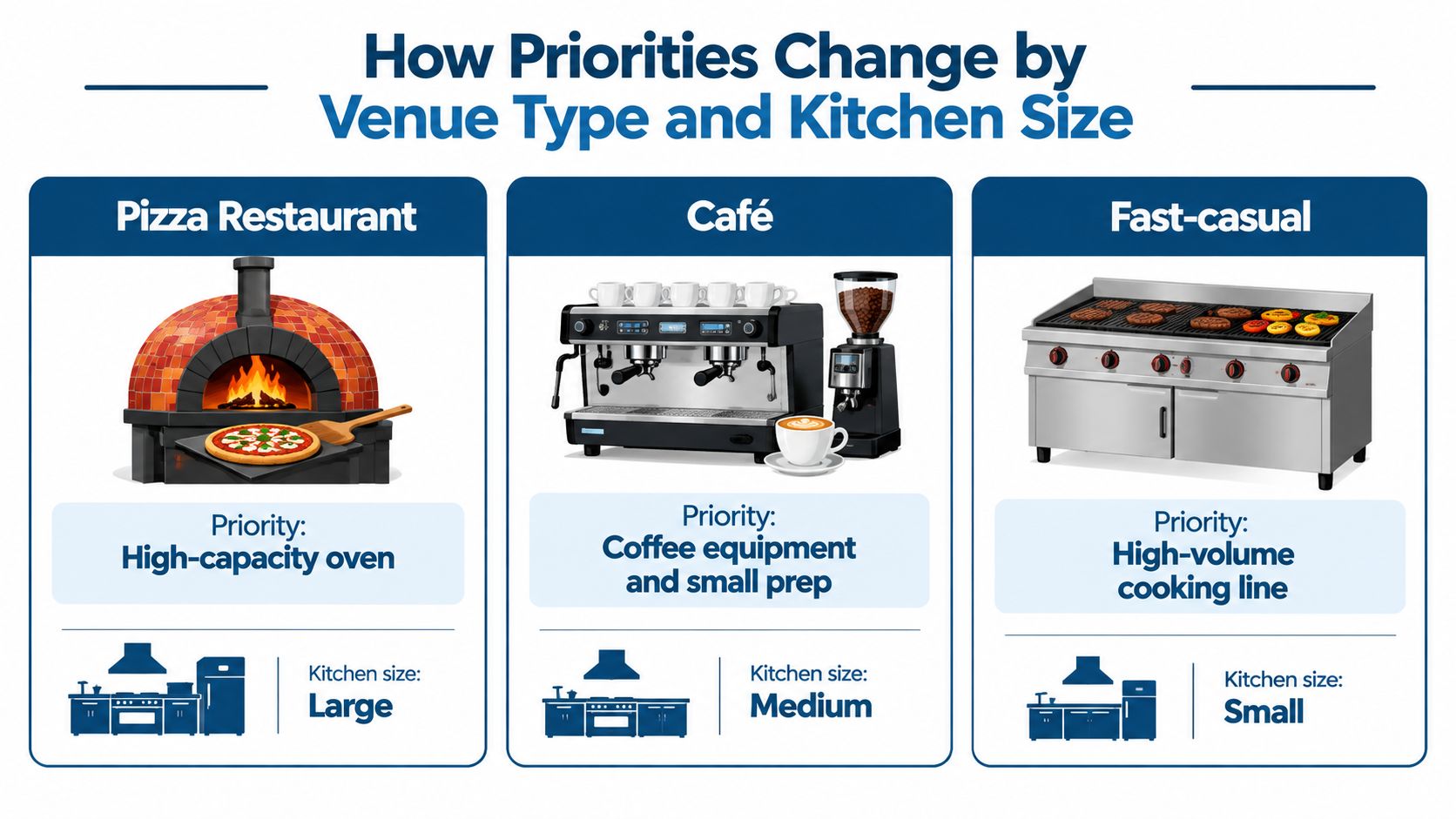
How Priorities Change by Venue Type and Kitchen Size
The same budget can produce very different equipment lists depending on the venue. That's why any answer to which commercial kitchen investments should be made first has to be tied to the operation, not just the appliance category.
First investment focus by venue type
| Venue Type | Typically Essential for Opening | Typically Essential Capacity | Often Staged to Later |
|---|---|---|---|
| Pizza restaurant | Primary pizza oven, dough prep, core refrigeration | More deck or chamber capacity, dough storage, extra prep refrigeration | Additional finishing equipment, expanded holding |
| Café | Coffee equipment, chilled storage, light cooking, warewashing | Extra underbench refrigeration, better prep flow, stronger dishwasher | Secondary display, specialty small appliances |
| Bakery | Ovens, mixers, benches, tray handling, ingredient storage | Additional oven capacity, proofing or chilling support, more prep space | Speciality finishing equipment |
| Bar | Back-bar refrigeration, glasswashing, ice handling, limited food prep if required | More beverage storage, faster glasswashing, service station support | Expanded food equipment if menu grows |
| Fast-casual kitchen | Core cookline, refrigeration, prep, warewashing | More line capacity, hot holding, pass support, backup cold storage | Additional menu stations |
Refrigeration should be specified properly
Refrigeration is a major spend in many kitchens, but it shouldn't automatically be treated as the first purchase in every fit-out. It needs to be sized around actual operation.
Questions that matter include:
- How often do deliveries arrive
- What does peak inventory look like
- How much product is chilled versus frozen
- How much prep refrigeration is needed at the line
- What beverage refrigeration sits outside the main kitchen
- How much of the cabinet is usable
Headline cabinet size can be misleading. Shelving layout, door type, pan access, and where the unit sits in the workflow all affect whether the space works in practice.
For larger commercial kitchens, Green Star's NZv1.0 operating profile assumes 16 hours of operation, seven days per week, and in New Zealand kitchen audits refrigeration averaged 56% of total energy use, with a reported range from 6% to 65% where it appears as a specific end use, according to the NZGBC Energy Use Calculation Guide. That's one reason refrigeration deserves careful specification even when it isn't the first item funded.
Operators uncertain about storage sizing often benefit from reviewing whether a commercial refrigerator is too small for the business, because insufficient cold storage usually shows up as a daily workflow problem long before it shows up as a simple buying mistake.
Cooking equipment should follow the menu
Cooking equipment shouldn't be budgeted as a generic percentage. The right question is simpler. Which pieces of equipment generate the menu?
A pizza venue may build around oven performance. A bistro may rely on a Blue Seal or Cobra cookline. A bakery may centre the fit-out on baking capacity and bench flow. A café may need lighter cooking but stronger support around prep and service speed. A hotel or larger site may lean toward Turbofan, UNOX, or Convotherm depending on menu complexity, production style, and batch requirements.
The most expensive item in the kitchen isn't automatically the first one to protect. The menu-driving item usually is.
Don't overlook warewashing
Warewashing gets pushed down the list because it doesn't produce food. That's a mistake.
The kitchen is a loop:
- Preparation
- Cooking
- Service
- Clearing
- Warewashing
- Equipment and serviceware available again
If the last stage can't keep up, the rest of the operation slows down. Operators often notice this only once the venue is busy and clean plates, pans, utensils, or glassware start running short.
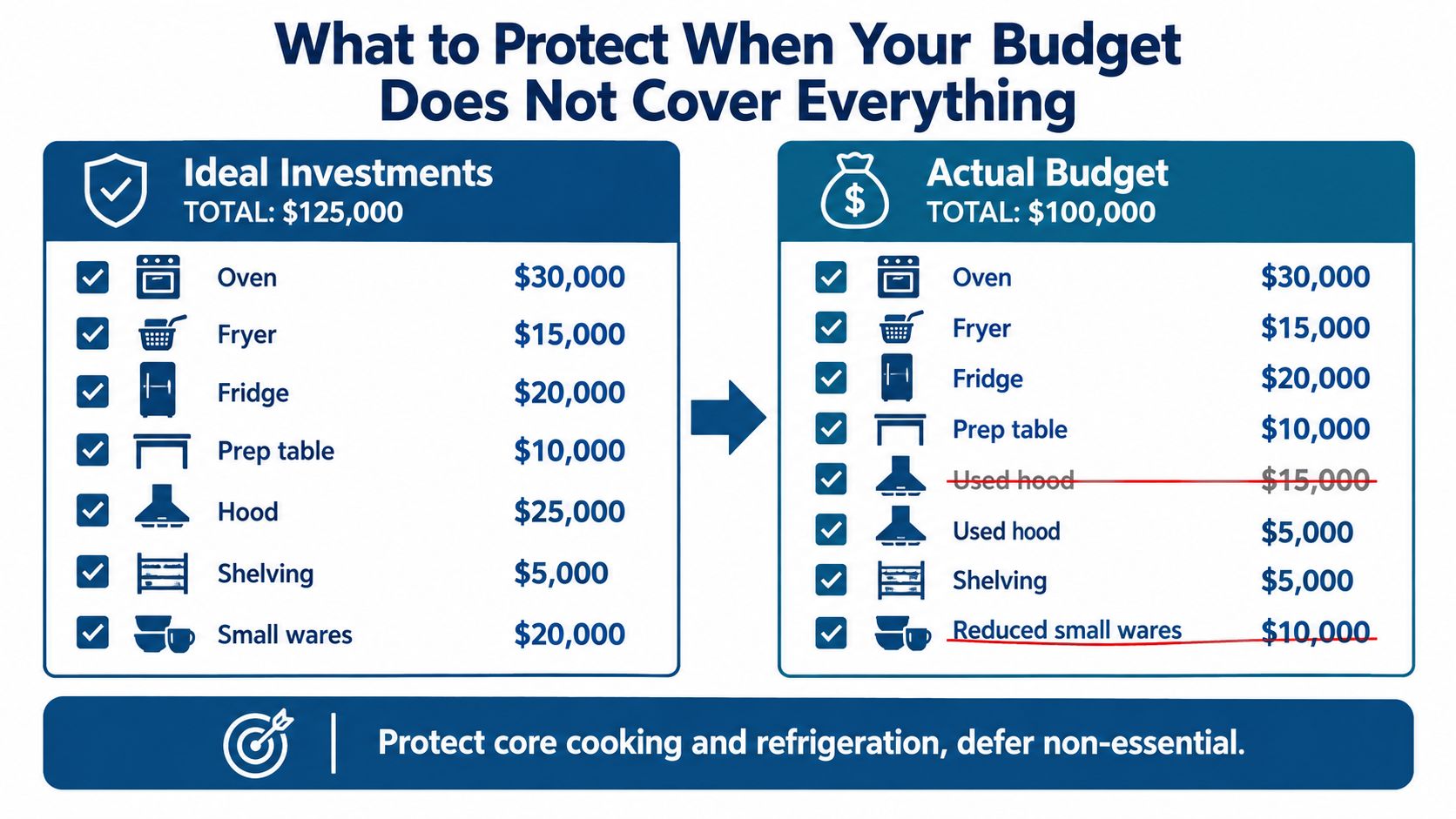
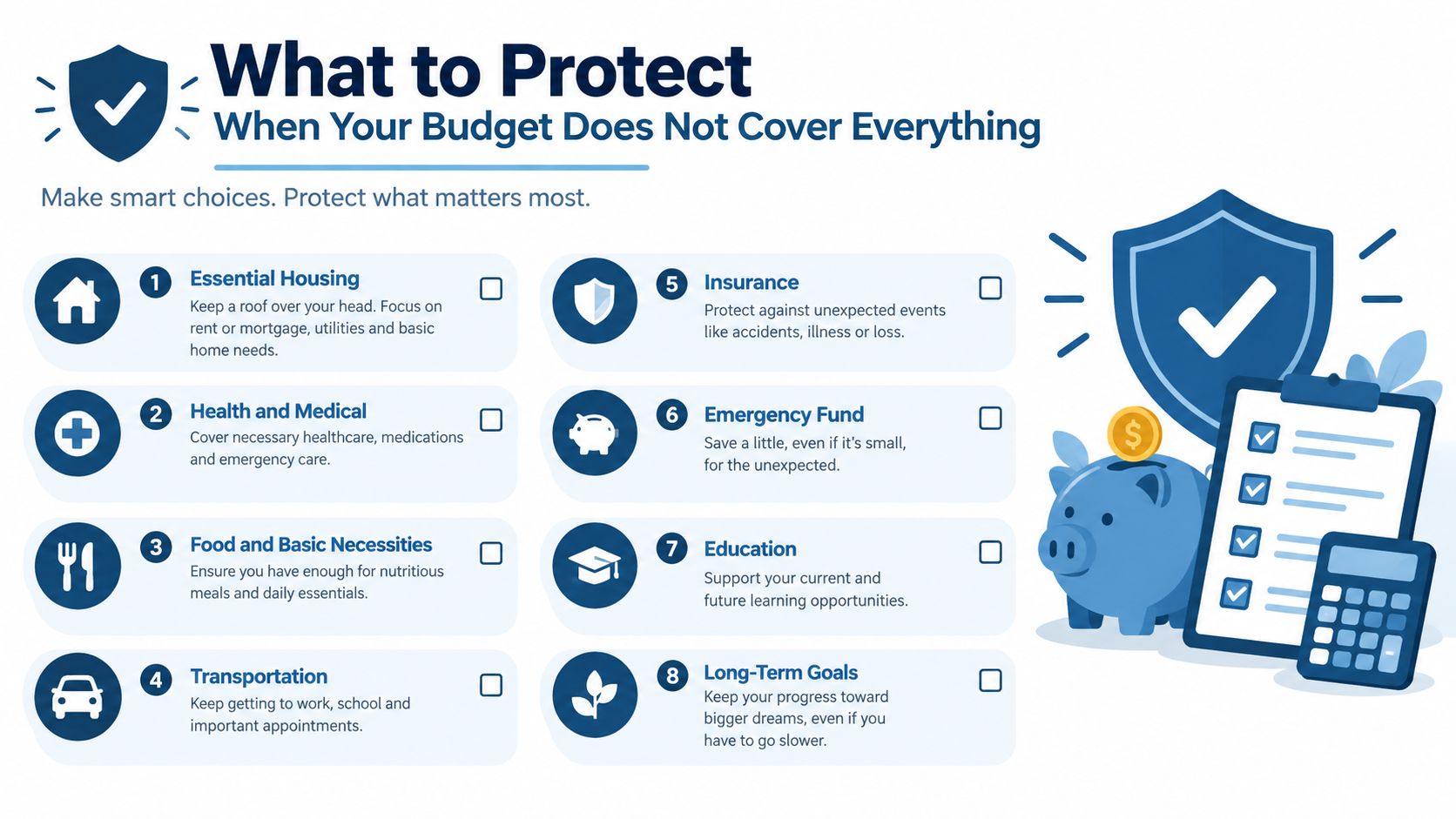
What to Protect When Your Budget Does Not Cover Everything
A tight budget shouldn't change equipment suitability first. It should change purchasing priority first.
That distinction matters because cutting every category evenly usually creates a kitchen that is underpowered everywhere. It's better to fully protect the parts that make the operation viable and stage the parts that don't.
An illustrative constrained-budget example
Assume an operator has an equipment budget of $100,000 but the properly specified schedule comes to $125,000. This is an illustrative example, not a customer case.
The wrong response is to trim every category until the list fits. That often leaves the venue with:
- underpowered cooking
- insufficient storage
- poor workflow
- fragile service capacity
The better approach is to test every item against the four-level hierarchy.
What should stay protected
A practical triage usually looks like this:
- Protect menu-critical equipment first: If the venue's core offer depends on a specific oven, grill, fryer, mixer, or coffee setup, that stays intact.
- Protect sufficient refrigeration and storage: Not just one cabinet for compliance, but enough chilled or frozen capacity for normal deliveries and peak stockholding.
- Protect realistic throughput: A dishwasher, cookline, or prep station that can't keep pace on a busy day isn't really “saving money”.
- Protect infrastructure decisions: Extraction, drainage, power supply, and equipment positions are expensive to redo later.
Then look for items that can be added in a second stage. That might include extra display refrigeration, a second prep appliance, secondary holding equipment, or some non-critical smallwares, depending on the concept.
Buying a smaller or less suitable item just to tick a box can cost more than delaying a non-essential purchase.
How ROI works in a new kitchen
Return on investment is harder to express neatly in a new business because there's no existing baseline. The decision has to be judged differently.
Useful criteria include:
- Required capacity. Can the kitchen produce the intended menu at expected peak volume?
- Avoided labour pressure. Does the equipment remove repetitive work or reduce the number of manual steps?
- Avoided bottlenecks. Will this item stop queues forming at prep, pass, cold storage, or wash-up?
- Reliability. Is the equipment appropriate for commercial use and service continuity?
- Cost of replacement later. How disruptive and expensive would it be to correct this decision after opening?
That's also where financing may deserve consideration for some essential items. If a piece of equipment is fundamental to opening properly, it can be better to preserve the correct specification and change the purchase method rather than compromise the kitchen.
For operators weighing reliability against upfront savings, how reliable equipment protects busiest trading days is a useful reality check.
Choosing Between Design Support and Finance Options
SACH Design, SilverChef, and equipment supply don't solve the same problem. They're not competing answers.
What each option actually does
SACH Design sits at the planning end. It helps resolve layout, workflow, services, compliance considerations, and specification logic before money is committed to the wrong equipment or the wrong positions.
SilverChef can, where appropriate, reduce the upfront cash required for eligible commercial equipment. That can be useful when the opening budget is tight but the kitchen still needs the correct core specification.
Hospitality sits in the specification and supply layer, with access across commercial kitchen categories and brands such as Blue Seal, Cobra, Turbofan, UNOX, and Convotherm where those suit the operation.
A business may use all three. Design the full kitchen first. Decide what's essential at opening. Stage what can wait. Then choose the most suitable purchase or finance method for each item.
Compliance, energy, and operating cost still matter
Buying on sticker price alone can be short-sighted, especially in replacement cycles and long-hour kitchens. MBIE's amendment to energy-using product regulations came into force on 1 May 2026, updating minimum energy performance standards and labels for several equipment classes including dishwashers and chillers, while EECA's food and beverage service pathway recommends measuring emissions first and then optimising equipment and processes before adopting new technology, as outlined by MBIE's energy efficiency regulation amendments.
EECA also recommends that operators keep monthly records of electricity, gas, petrol, and water, compare them with the same month last year and on a rolling 12-month basis, and use that data to set reduction targets and plan replacement, according to the EECA food and beverage energy checklist.
For operators preparing finance applications alongside a fit-out, stronger planning documentation can also help improve SBA loan approval odds because lenders generally respond better when the purchase list and use of funds are clearly justified.
For a closer look at staged funding options, financing through SilverChef for Simply Hospitality equipment gives helpful context.
Your Phased Purchase Plan and Opening Checklist
A practical purchase plan usually works best in phases, even when the kitchen is designed as a complete system from the start.
A workable phased sequence
Phase one should cover the essentials. Core cooking, essential refrigeration, required prep, warewashing, and the infrastructure that supports them.
Phase two should protect realistic capacity. That may mean extra cold storage, additional line support, stronger wash-up throughput, or more prep space and shelving.
Phase three should target labour and service friction. Extra underbench refrigeration, prep aids, faster small appliance support, or additional holding can make day-to-day trading smoother.
Phase four is where optimisation belongs. Specialist menu expansion equipment, secondary stations, and nice-to-have upgrades can sit here until demand justifies them.
Opening checklist before any order is placed
- Menu fit: Does each major item directly support the intended menu?
- Peak test: Can the kitchen handle realistic busy periods, not just quiet trading?
- Workflow check: Do staff movements, prep flow, and wash-up loops make sense?
- Services review: Are power, drainage, extraction, and clearances resolved?
- Stageability test: Can any deferred item be added later without major rework?
- Future growth: Will the kitchen support expansion without immediate replacement?
One simple tip is to review likely lead times early. Delays in kitchen equipment can affect opening schedules, and resources such as Trail Star Development on restaurant delays are useful reminders that equipment timing needs to be part of launch planning, not an afterthought.
Operators who are still comparing a new fit-out plan with later upgrade decisions may also want to read Which Commercial Kitchen Upgrade Delivers the Fastest Return on Investment?, Should You Renovate Your Commercial Kitchen in Stages?, Is Underestimating Future Growth Costing Your Business?, How Much Revenue Can Better Kitchen Workflow Generate?, and What Does Waiting Cost During Peak Service?.
Hospitality helps New Zealand operators turn menus and budgets into practical equipment schedules, with support across refrigeration, cooking, warewashing, fit-out planning, and staged purchasing decisions. For a new kitchen, refurbishment, or complete re-specification, visit Simply Hospitality to discuss what needs to be funded first, what can wait, and how to avoid costly equipment mistakes before opening.